Widget Image
Follow PPD Social Media
Saturday, January 17, 2026
HomeStandard Blog Whole Post (Page 999)

Americans’ dissatisfaction with U.S. gun laws and has shot up to 55 percent, almost hitting the all-time high of 57 percent measured in 2001. On the other hand, 40 percent say they are satisfied, which is down from the historical average of 47 percent since Gallup began measuring gun law satisfaction in 2001.

But the increase in dissatisfaction is fueled by those who say gun laws are “too strict,” not those who want more gun control. Further, the gap between those who say the U.S. needs stricter gun laws and those wanting less strict laws only narrowed because of a steep increase in the percentage of Americans who want less strict laws.

Those who say the U.S. should loosen gun law restrictions increased by 11 points to 16 percent, up from only 5 percent a year ago. Perhaps some of this has to do with timing.

Gallup released their January 2013 poll that was conducted almost immediately after the December 2012 Sandy Hook school shooting, which no doubt led to reactionary views driven by the president’s exploit children-as-a-backdrop campaign.

As far as issue satisfaction as a whole, Americans’ satisfaction with gun laws ranks near the middle of a list of 19 issues measured in Gallup’s 2014 update of its annual Mood of the Nation survey. The highest levels of satisfaction came from the nation’s military strength, despite it’s weaker condition in reality, and the nation’s ability to deal with terrorism, despite Benghazi and failed Middle East policy.

On the other end of the spectrum, the lowest levels of satisfaction were found with poverty and homelessness, along with the state of the nation’s economy.

The stark change marks a reversal in Americans’ views on gun laws this year. Typically, those who are dissatisfied have historically leaned heavily in favor of wanting stricter gun laws, not less strict laws. But this year is different, and may reflect an overall shift toward the right in Americans’ views on the issues per state.

Gallup recently released a party ID by state measurement, which found a continuing erosion in the once-heavy advantage enjoyed by the Democratic Party over the Republican Party.

Americans' dissatisfaction with U.S. gun laws and

U.S. contracts for pending home sales fell sharply in December to a more than two-year low, pointing to signs of a slowdown in the housing market.

The National Association of Realtors reports signed contracts to buy previously-owned homes dropped 8.7 percent in December from the month of November, widely missing economists’ expectations they would remain unchanged.

The National Association of Realtors said on Thursday its Pending Home Sales Index, based on contracts signed last month, dropped 8.7 percent to 92.4, the lowest level since October 2011. Contracts were 8.8 percent below the December 2012 levels.

Economists polled by Reuters had expected signed contracts, which become sales after a month or two, to remain virtually unchanged.

The National Association of Realtors, scapegoated bad cold weather across the United States last month, which they claim deterred potential buyers.

“Unusually disruptive weather across large stretches of the country in December forced people indoors and prevented some buyers from looking at homes or making offers,” said NAR chief economist Lawrence Yun in a statement.

In truth, housing sales have been hurt by a small rise in mortgage rates that have pushed up borrowing costs. A report from the Realtors group last week showed home resales rose modestly in December after three monthly falls in a row.

The National Association of Realtors had their fingerprints all over the 2007 – 2008 financial crisis, which was driven in large part by an abundance of risky, delinquent loans.

But again, the National Association of Realtors called for a loosening of what they term “tight credit” conditions. However, in the month of December, nearly one-half of all home purchase loans had down payments of 5 percent or less, and nearly one-quarter had debt-to-income ratios exceeding 43 percent.ase loans had down payments of 5 percent or less, and nearly one-quarter had debt-to-income ratios exceeding 43 percent.

According to Ed Pinto of AEI, “The homeownership rate, as reported by the US Census Bureau, stands today at 65.3 percent. When adjusted for the millions of homeowners who are seriously delinquent, the rate drops to 62.7 percent. This is virtually unchanged from the rate of 61.9 percent in 1960, notwithstanding a dramatic loosening of lending standards over the last 50-plus years.”

U.S. contracts for pending home sales fell

us-economic-growth

The Commerce Department reported US economic growth slowed at an annualized rate of 3.2 percent in the fourth quarter, down from 4.1 percent from the previous quarter.

Though the reading matched economists’ expectations, the Commerce Department blamed the government shutdown in October for the reduced fourth-quarter GDP growth, which they say was about 0.3 percentage point.

Meanwhile, the number of Americans filing for first-time unemployment benefits rose last week to 348,000 from an upwardly revised 329,000, the week prior. Wall Street expected the number of claims to rise to 330,000 from an initially-reported 326,000.

Even though emerging markets are in trouble and job growth in the US stifled last month the Federal Reserve said it is bullish on America. The Federal Open Market Committee ignored the negative economic indicators and voted unanimously to press forward with its plan to gradually wean the economy from easy-money stimulus policies.

The Fed has forecast that the economy will continue to expand at around that 3% rate throughout 2014 and at an even stronger rate in 2015 without stoking inflation.

Wall Street was buzzing at the end of the day when Internet giant Google (GOOG) posted a lighter-than-expected 17 percent increase in fourth-quarter profits on Thursday, but the company’s revenue growth exceeded forecasts due to increased revenue from paid clicks.

Shares of the tech titan bounced between gains and losses in after-hours action following the mixed results and a dividend announcement.

Google said it earned $3.38 billion, or $9.90 a share, last quarter, compared with a profit of $2.89 billion, or $8.62 a share, a year earlier.

Excluding one-time items, it earned $12.01 a share, trailing forecasts from analysts for $12.20.

Revenue increased 17% to $16.86 billion, narrowly topping the Street’s view of $16.75 billion. International revenue totaled $8.77 billion, representing 56% of total revenue, up from 54% the year before.

The Commerce Department reported US economic growth

The Chamber of Commerce is spending their money wisely, because Republican leaders announced their support for a House immigration reform plan, which grants limited path to legal status for some illegal immigrants. The Chamber of Commerce, who will benefit immensely from an influx of cheap labor in an economy that millions of Americans are suffering to survive in.

Democrats praised the House immigration reform plan not so much on substance, but they said it could open the door to a deal on a more comprehensive immigration legislation, or full blown amnesty.

The position was included in a document released by party leaders during their annual retreat in Maryland, during which the establishment discussed how to best deal with the insurgent activists who are threatening their power structure and evolving doors on K Street. The “standards for immigration reform” document supposedly rules out a special path to citizenship for illegal immigrants.

The document said immigrants living here illegally could remain and live legally if they pass background checks, pay fines and back taxes, learn to speak English and understand U.S. civics, and can support themselves without access to welfare.

Republican leaders attempted to make clear that border security must be improved first.

“None of this can happen before specific enforcement triggers have been implemented,” the document said.

New York Democratic Senator Chuck Schumer, the second largest revolving door for K Street and Wall Street big business, second only to Mitch McConnell, also a big advocate for full-blown amnesty on the Senate side, said the announcement could smooth the way for a deal on legislation. The Senate passed an immigration reform bill last year.

“While these standards are certainly not everything we would agree with, they leave a real possibility that Democrats and Republicans, in both the House and Senate, can in some way come together and pass immigration reform that both sides can accept. It is a long, hard road but the door is open,” he said.

The Republican Party leadership is now playing with fire, which threatens to snatch defeat from the hands of victory in the upcoming 2014 midterm elections. The party is within reach of retaking the Senate, but supporting amnesty while the economy is struggling in order to please the Chamber of Commerce, will demoralize their base.

A new Quinnipiac University poll found both independent and Republican voters have swung strongly against an immigration reform amnesty since last May, despite falsely posing to respondents a choice that referenced “a path to citizenship.”

Although most voters —  64 percent — still view legal immigration as good for America, a new survey conducted by Rasmussen Reports found 51 percent of Americans oppose the Senate immigration reform plan that would triple immigration over the next 10 years. In fact, when actually told the particulars of the plan, one-in-three favor cutting the number of legal immigrants to this country, even if the border is totally secured to prevent illegal immigration.

But that doesn’t seem to matter to Republican leadership in the House, who have been the recipients of over $50 million spent by the Chamber of Commerce, who are looking to increase profits by gaining access to even more cheap labor. Meanwhile, during the Obama recession, nearly 92 million Americans have quit on the American dream, quit the workforce, altogether out of frustration.

The Chamber of Commerce is spending their

WASHINGTON — Someone you probably are not familiar with has filed a suit you probably have not heard about concerning a four-word phrase you should know about.

The suit could blow to smithereens something everyone has heard altogether too much about, the Patient Protection and Affordable Care Act (hereafter, ACA).

Scott Pruitt and some kindred spirits might accelerate the ACA’s collapse by blocking another of the Obama administration’s lawless uses of the Internal Revenue Service.

Pruitt was elected Oklahoma’s attorney general by promising to defend states’ prerogatives against federal encroachments and today he and some properly litigious people elsewhere are defending a state prerogative that the ACA explicitly created.

If they succeed, the ACA’s disintegration will accelerate. Because under the ACA, insurance companies cannot refuse coverage because of an individual’s pre-existing condition.

Because many people might therefore wait to purchase insurance after they become sick, the ACA requires a mandate to compel people to buy insurance. And because many people cannot afford the insurance that satisfies the ACA’s criteria, the ACA mandate makes it necessary to provide subsidies for those people.

The four words that threaten disaster for the ACA say the subsidies shall be available to persons who purchase health insurance in an exchange “established by the state.” But 34 states have chosen not to establish exchanges.

So the IRS, which is charged with enforcing the ACA, has ridden to the rescue of Barack Obama’s pride and joy.

Taking time off from writing regulations to restrict the political speech of Obama’s critics, the IRS has said, with its breezy indifference to legality, that subsidies shall also be dispensed to those who purchase insurance through federal exchanges the government has established in those 34 states.

Pruitt is challenging the IRS in the U.S. District Court for the Eastern District of Oklahoma, and there are similar challenges in Indiana, Virginia, and Washington, D.C.

The IRS says its “interpretation” — it actually is a revision — of the law is “consistent with,” and justified by, the “structure of” the ACA. The IRS means that without its rule, the ACA would be unworkable and that Congress could not have meant to allow this. The ACA’s legislative history, however, demonstrates that Congress clearly — and, one might say, with malice aforethought — wanted subsidies available only through state exchanges.
Some have suggested that the language limiting subsidies to state-run exchanges is a drafting error.

Well, some of the ACA’s myriad defects do reflect its slapdash enactment, which presaged its chaotic implementation. But the four potentially lethal words were carefully considered and express Congress’ intent.

Congress made subsidies available only through state exchanges as a means of coercing states into setting up exchanges.

In Senate Finance Committee deliberations on the ACA, Chairman Sen. Max Baucus, D-Mont., one of the bill’s primary authors, suggested the possibility of conditioning tax credits on state compliance because only by doing so could the federal government induce state cooperation with the ACA.

Then the law’s insurance requirements could be imposed on states without running afoul of constitutional law precedents that prevent the federal government from commandeering state governments.

The pertinent language originated in the committee and was clarified in the Senate. (See “Taxation Without Representation: The Illegal IRS Rule To Expand Tax Credits Under The PPACA,” by Jonathan H. Adler and Michael F. Cannon in Health Matrix: Journal of Law-Medicine.)

Also, passage of the ACA required the vote of every Democratic senator. One, Nebraska’s Ben Nelson, admirably opposed a federal exchange lest this become a steppingstone toward a single-payer system.

If courts, perhaps ultimately including the Supreme Court, disallow the IRS’ “interpretation” of the law, the ACA will not function as intended in 34 states with 65 percent of the nation’s population. If courts allow the IRS’ demarcate, they will validate this: By dispensing subsidies through federal exchanges, the IRS will spend tax revenues without congressional authorization. And by enforcing the employer mandate in states that have only federal exchanges, it will collect taxes — remember, Chief Justice John Roberts saved the ACA by declaring that the penalty enforcing the mandate is really just a tax on the act of not purchasing insurance — without congressional authorization.

If the IRS can do neither, it cannot impose penalties on employers who fail to offer ACA-approved insurance to employees.

If the IRS can do both, Congress can disband because it has become peripheral to American governance.

George Will’s email address is [email protected].

(c) 2014, Washington Post Writers Group

Opinion: Someone you probably are not familiar

This week many Americans are recognizing national School Choice Week, which hopes to highlight the positive reforms available to address our broken education system. There has even been some action on the part of Republican lawmakers.

As PeoplespunditDaily.com previously reported, Sens. Tim Scott (S-SC) and Lamar Alexander (R-TN) have proposed dual plans to address some of these reforms. Unfortunately, rather than having an informed and reasonable debate, they have been attacked by the proponents of the government monopoly on education. And they aren’t the first.

Ben Chavis, Lumbee Tribe member and former head of the American Indian Model Charter Schools, was targeted in 2010 by California proponents of the government monopoly on education. Unfortunately, the Oakland school board voted 4 – 3 against Mr. Chavis and he was run out along with AIM.

While they never did substantiate the preposterous and unfounded claims of impropriety they waged against him, they did irrefutable harm to the minority students who benefited the most from school choice opportunity. I wrote about this and other school choice programs extensively in Our Virtuous Republic, but one quote from the book is noteworthy to address here. Andrew Coulson, an education policy expert who studied the performance of AIM chatter schools and school choice, wrote in his 2011 study:

I found that AIM is the highest-performing charter school network in the state, by a wide margin. Low-income black and Hispanic AIM students actually out-perform Lowell, one of San Francisco’s most respected and academically selective high schools.

What a shame.

Proponents of the government monopoly on education have cited:

  • Impact on student performance
  • Impact on public schools
  • Impact on the taxpayer
  • Impact on segregation
  • Impact on ethics

A study released by the Friedman Foundation took a look at the 19 studies conducted on school choice programs in recent times, concluding that school choice negatively impacted each of the above arguments nearly never. Again, I wrote about this before, but it is well worth citing it again, particularly since it is national School Choice Week and it matters so much.

This week many Americans are recognizing national

school choice

Sens. Tim Scott (R-SC) and Lamar Alexander (R-TN) proposed dual school choice plans during school choice week to truly address income inequality.

President Obama delivered on expectations to address “income inequality” in the State of the Union address, but two GOP senators are doing more than talking.

During national School Choice Week, Senators Lamar Alexander (R-TN) and Tim Scott (R-SC), are offering duel plans to give parents more choice when it comes to how their federal tax dollars are spend on K-12 education for their children.

Senator Alexander proposed his Scholarships for Kids Act, which would appropriate billions in federal education dollars to states that would empower parents to use the money.

“If you had to ask Americans one single thing that was likely to make the most opportunity in helping you move from the back of the line to the front, it would be a good education,” Sen. Alexander said.

Under the proposal outlined by Alexander, parents could use education money to either remove their children from failing public schools to successful charter or private schools, or even move them to high-performing public schools.

Senator Tim Scott proposed the CHOICE Act, which would grant more flexibility to military families, those with children facing physical challenges and all other students stuck in failing schools and impoverished neighborhoods. Sen Scott has a story to tell that uniquely qualifies him to articulate the realities of education.

Scott was raised in a single-parent home, nearly flunking out of high school until being blessed with a mentor who helped him his change his attitude and turned him in another direction.

“Too many of our kids are sold a bill of goods that there is no chance to escape poverty when, in fact, school choice provides a bridge for that student who has potential to realize it,” Sen. Scott said.

The fundamental difference between Democrats and Republicans, such as Scott and Alexander, is that Republicans believe the money for education to follow the children and empower the parents. Democrats, on the other hand, believe that the taxpayer, including parents in failed school systems, should continue to fund teachers’  unions who have been failing to educate our children with the knowledge and tools necessary for them to get ahead in life.

They believe we simply do not spend enough money, despite spending the largest amount of money per student out of any other developed country.

For instance, Thomas Gentzel, the Executive Director of the National School Boards Association, claims there is no proof to the claim that tax dollars moving with students leads to a better education.

“We certainly haven’t seen any consistent evidence anywhere in the country that these kinds of programs are effective or producing better results,” Gentzel said following the lawmakers’ announcement.

Gentzel also worries about the negative impact of taking funding away from already-struggling public schools.

“That kind of compounds the problem for those schools, makes the hill even steeper for them to climb in terms of providing great education for their students,” he said.

What Gentzel is referring to is sometimes referred to by the left as “creaming” students or “dredging.”

But as you will read below, neither of those claims are true. As a study conducted by the Friedman Foundation — viewable below — found none of the left’s arguments opposing school choice to be valid.

As far as deteriorating public schools further, because of the need to compete with private and charter schools, out of the 19 studies conducted on school choice since 2011, 18 found a positive impact on public schools, while just 1 found no observable effect.

Unions, such the National Education Association (NEA), furiously and vehemently oppose the idea of empowering parents with school choice by allowing taxpayer money to follow students.

The NEA has attacked the concept of school choice or, — vouchers, as they like to deem it — an “elitist strategy,” claiming that it often winds up “circumventing the constitutional prohibitions against subsidizing religious practice and instruction,” and allows public money to flow into religious schools.

Alexander and Scott have rebutted with what most in DC know to be true: Unions are more concerned with maintaining their stranglehold on education, rather than making student performance their prime concern. Alexander noted the left’s hypocrisy when those on the left favor the GI bill for veterans, Pell Grants and student loans. They are all commonly acknowledged to be “vouchers.”

“But they’re against trying the same idea for the poorest children to give them the chance to go to the best elementary school or high school,” he said.

Alexander and Scott said they were “hopeful” some Senate Democrats will decide to join their school choice reform efforts. The Republican-controlled House of Representatives has already passed an education measure that includes several similar components.

Eric Holder, on the other hand, is suing the state of Louisiana for their school choice program, which is widely accepted as a very successful program, particularly among the minority parents who benefited the most from school choice.

During national School Choice Week, Senators Lamar

Party-Id-By-State

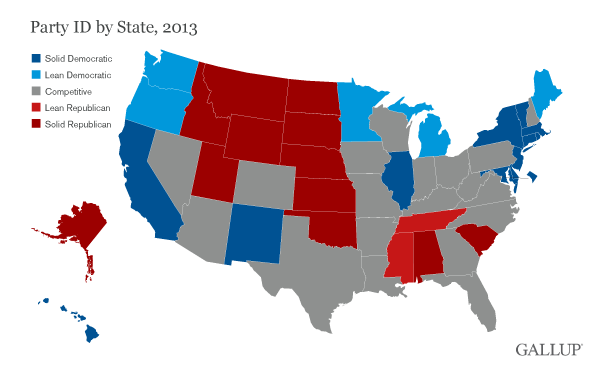
The Democratic Party is continuing to lose ground in the Gallup party ID by state survey, a trend that has continued since Gallup began measuring in 2008.

In 2013, Democratic states outnumbered Republican states by 3, but that represents a slide from a 7-state advantage in 2012, and an evaporation of their once-30-state advantage in 2008.

The single-most significant change in the party ID by state measurement in 2013 was the 3-state gain made by the Republican Party in solidly Republican states. According to Gallup, solidly Republican states are those states where Republicans outnumbered Democrats by at least 10 percentage points.

The three solidly Republican states were South Carolina, a state Democrats thought they had a real shot at making gains in, South Dakota and Oklahoma. The 3-state gain was slightly offset by a net loss of one Republican-leaning state. On the other hand, Democrats had net losses of one solid and one Democratic-leaning state, while the number of competitive states was unchanged.

The implication with respect to the 2014 midterm elections is a bit of an obfuscation, as it relates to Gallup reporting. Because Democrats lost ground in states where there are now highly competitive Senate races, which Democrats did not think they would have to defend, states like Michigan now give the Republicans a far better chance at taking the Senate.

As we have shown in the 2014 Senate Map Predictions on PeoplesPunditDaily.com, the Republican Party has greatly expanded the map over the last few months beyond what commentators and pundits have yet acknowledged.

Michigan, for instance, moved from solidly Democratic in 2012 to leaning Democratic in 2013, which makes the state of the 2014 Senate race in Michigan exactly how we called it, a “Toss-Up.”

Further, Alaska is now a full 20 points more Republican than in the previous year, and even far more Republican than when Mark Begich barely won his seat by just under 4,000 votes. The 2014 Alaska Senate race is rated “Leans Republican” on the PeoplesPunditDaily.com Senate Map Predictions, because the uncertainty of the GOP primary has kept it from moving to “Likely Republican” on our map.

The overall political orientation of the country stayed roughly the same in 2013 than it was in 2012, with the Democrats enjoying a 6-point advantage — 47 percent to 41 percent. In 2012, Democrats enjoyed a 5-point advantage — 47 percent to 42 percent. The Democratic increase — which is why the Generic Congressional Ballot is always more Democratic than actual Election Day results — came from highly populated, already-Democratic leaning states.

That will not help them to keep the Senate or win House seats.

The Democrats gained 3 points each in California, New Jersey, and New York, and gained 1 point in Illinois.

“The resulting four-state lead for Democrats in 2013 is far less than their 12-state lead in 2010 — a year with a wave election that swept out 63 House Democrats and established the current Republican majority,” Lydia Saad of Gallup correctly observed.

The Democratic Party is continuing to lose

thomas-purcell-liberty never-sleepsPresident Obama’s State of the Union address last night came across as a monumental bore to anyone that follows politics and was just more of the same rhetoric that has consistently been a hallmark of this administration.

Thankfully.

Many experts had agreed that had Obama pushed for executive instead of legislative action to change the course of the economy and enact political agenda changes to the nation, it could have lead to a constitutional crisis and a potential break in the government. Speaker of the House Boehner threatened to sue in the Supreme Court if the President enacted change with “a pen” instead of congressional authorization. It was no doubt, a seminal moment in American history.

Fortunately, the President blinked.

It was due, in no small part, to his abysmally low personal approval rating and the increasing tensions in the American people. We have been divided as a nation like never before, rivaling the differences we had in 1861 which led to Civil War. The President recognized this and spent a great deal of his speech addressing it, while pushing forth his unpopular agenda. Obama announced he would take his case to the American people and left it at that.

Yet, it should have been expected. Time after time, the President has taken this course with other nations and other projects. Obama brought us toe to toe with the Russians over Syria, drawing a ‘red line’ over the use of chemical weapons, and then backing down when faced with a serious escalation.

Examine the Iranian situation: he agreed to a deal that really is no deal and the Mullahs of Iran are now laughing at us publicly. On Obamacare he failed to enact the legislation he wanted; was forced to compromise on major components, and ultimately produced a plan that is unworkable and doomed to failure.

For all the tough talk Obama gives his political enemies, he is all bluster — a fact that should have been recognized by the GOP elite who threw conservatives under the bus in order to avoid a fight during the budget negotiations last year.

This president has failed to produce one viable solution to the problems facing this nation in his 5 years in office. Politically a success, but as a President, he is a consummate failure.

His speech pounded home the usual political talking points under the guise of mistruths of economic success, but will do little to solve the problem of the vast majority of people who simply stopped producing. His argument that we should see a diplomatic solution to the specter of war in the Gulf will not protect the Israelis from another holocaust. His pleas of amnesty for illegal aliens will not improve job availability for millions of citizens who can’t find work. The theory that we need guaranteed returns on new reformulated investment accounts will not make the people invest more, or make our retirements any easier. His talking points about all his leftist ideas will not fool the American people.

We are on to you now Mr. President and he is aware of it.

Perhaps it is the best message we can take away from that speech last night.

Thomas Purcell is the host of the popular radio show Liberty Never Sleeps, and author of “Shotgun Republic.”

Opinion: Speaker of the House Boehner threatened

fact checking state of the union

We heard some real whoppers tonight, so I thought it was pretty important to release the “5 Biggest Bombs: Fact Checking State Of The Union Address” as soon as possible. From climate change to ObamaCare, little from the president’s speech was substantive, or even true.

1. “The debate over climate change is settled. Climate change is a fact.”

President Obama was referring to a September UN climate change report that concluded humans are responsible for most of the rise in global temperatures, which immediately came under fire from observers who questioned the report’s scientific credibility.

It is “extremely likely” that humans are the primary cause of global warming, the report states. That wording is stronger than the “very likely” assessment from the IPCC’s last comprehensive climate change report, released in 2007. The U.N., however, also acknowledges another possibility; maybe it was wrong. ”There may also be … an overestimate of the response to increasing greenhouse gas and other anthropogenic forcing,” the new report admits.

The report’s contradictory statements show an “embarrassing lack of internal inconsistency,” according to an analysis by Patrick Michaels and Chip Knappenberger of the Cato Institute.

Michaels and Knappenberger argue that the IPCC declined to account for deviations between climate impacts predicted by IPCC models and actual temperature increases. They said the IPCC report fails to consider “the discrepancy between the observed effectiveness of greenhouse gases in warming the earth and this effectiveness calculated by the climate models that the IPCC uses to project future climate change.”

IPCC models have also come under fire for their failure to explain an ongoing pause in the rise of global temperatures, which in reality, have remained flat for approximately 15 years.

The fact is that money directed at the study of climate change is unequivocally steered toward those who will conclude what the progressive bureaucracy at the UN wants them to conclude.

On public opinion, the issue is far from settled. When given a choice, 67 percent of likely U.S. voters say creating jobs is more important than taking steps to stop global warming, while just 24 percent say taking action on global warming is more important.

2. Iran is dismantling their nuclear program.

Inspectors from the UN nuclear watchdog the International Atomic Energy Agency (IAEA), confirmed that the program to enrich uranium to 20 percent had been halted by disconnecting the centrifuges at Natanz. But they can easily be connected and reengaged, because the dilution of all fissile material — which is used to convert its stockpile of 20 percent enriched uranium to nuclear fuel — has not been verified.

Further, according to Olli Heinonen, former deputy director of the International Atomic Energy Agency, Iran is only 2 to 3 weeks away from producing enough highly enriched uranium to assemble a nuclear weapon if they reattached the centrifuges. The capability has not been dismantled, at all.

3. Raising the minimum wage will help the economy.

A clear consensus among economic experts holds all data show raising the minimum wage costs the economy more jobs, a fact even echoed by the Department of Labor.

study conducted by the Department of Labor concluded that the first minimum wage, 25 cents per hour in 1938, cost the jobs of 30,000 to 50,000 of the 300,000 workers who were covered and had previously earned below the minimum. And a 2007 review of 102 studies that were conducted beginning in the 1990s by David Neumark and William Wascher found, “Indeed, the preponderance of the evidence points to disemployment effects.”

Even Bill Gates, on MSNBC no less, told commentators that the minimum wage increase would “destroy jobs.”

4. Income inequality has deepened. Upward mobility has stalled. And workforce inequality for women is severe.

Under the Obama administration, poverty and dependence have both skyrocketed, even as the top wealthy 1 percent have accumulated 95 percent of the wealth. But as a whole, a team of economists led by Harvard’s Raj Chetty released a study last week that found the United States isn’t any less socially mobile than it was in the 1970s.

When examining children born between 1971 and 1993, the economists found that the odds of a child born in the poorest 20 percent of families making it into the top 20 percent hasn’t changed, at all.

“We find that children entering the labor market today have the same chances of moving up in the income distribution (relative to their parents) as children born in the 1970s,” the economists concluded.

As far as women, the studies concluding income inequality are misleading, at best. When comparing doctors, for instance, male doctors on average work 600 hours more per year than women, which is how they compute that data. Women have specific needs that keep them out of the workforce for a longer period annually, but do not earn less on an hour for hour basis.

5. Americans do not want to revisit old debates, or return to a pre-health care reform system without ObamaCare. So, stop voting to repeal it in the House.

Never mind Obama again lied about the number of people who have signed up for health coverage that could be attributed to ObamaCare. We at PPD, far before Glenn Kessler at the Washington Post and Sean Trende at RCP, have exploded this fraud time and time again. For now, let’s just stick to the claim that ObamaCare should be kept because the American people are unwilling to go back.

ObamaCare has never received majority support among the American people, but it is only getting worse. Democrats used to have the fallback argument that claimed some aspects to the bill were popular, such as pre-existing conditions and keeping dependents on a plan until they are in their latter 20s.

But more and more polling is showing that Americans want choice, and only 8 percent said they had a good experience with the marketplace. As of today, only about a third of Americans want to keep ObamaCare and approve of the law, while the vast majority of Americans want the bill gone.

If you had any degree of common sense and followed politics even slightly, then you would know the Republican Party owes their majority to those who oppose ObamaCare. It would be wise to keep taking those votes fellas, despite what Obama claims.

Richard D. Baris is the creator/editor of People’s Pundit Daily and author of “Our Virtuous Republic: The Forgotten Clause in the American Social Contract”

We heard some real whoppers tonight, so

People's Pundit Daily
You have %%pigeonMeterAvailable%% free %%pigeonCopyPage%% remaining this month. Get unlimited access and support reader-funded, independent data journalism.

Start a 14-day free trial now. Pay later!

Start Trial