Widget Image
Follow PPD Social Media
Saturday, January 17, 2026
HomeStandard Blog Whole Post (Page 1023)

Hillary Clinton has fallen behind in a CO poll, with all GOP contenders — save for Ted Cruz who is tied — beating out the so-called presumptive nominee.

An early snapshot Colorado poll conducted by Quinnipiac University is bad news for the presumptive Democratic nominee, Hillary Clinton. In a matchup against potential GOP contenders, Clinton trails every candidate save for Texas Senator Ted Cruz, who ties Clinton.

The voters of Colorado just don’t feel the former First Lady and Secretary of State Hillary Clinton, has what it takes to be president. Colorado voters say by a 46 – 49 percent margin for Clinton and a 24 – 66 percent margin for Vice President Joseph Biden, neither Democratic candidate would make a good president. For New Jersey Gov. Chris Christie, those numbers are far better, with 48 – 29 percent of Colorado voters saying that Christie would make a good president.

In an early look at the 2016 race for the White House, Gov. Chris Christie beats former Secretary of State Hillary Clinton 46 – 38 percent in Colorado, with some improvement for Clinton versus other potential GOP candidates, though not enough. Clinton is at 44 percent against U.S. Sen. Rand Paul of Kentucky, who garners 47 percent, 43 percent to 45 percent for for VP candidate U.S. Rep. Paul Ryan of Wisconsin, and against Sen. Ted Cruz of Texas they are tied at 44 – 44 percent.

While other GOP contenders fair well against Hillary Clinton in Colorado, voters say Chris Christie is their guy. “The race might be hypothetical, but the lead is very real. Coloradans showing the love for Garden State Gov. Christopher Christie, who for the first time in running well ahead of Hillary Clinton,” said Tim Malloy, assistant director of the Quinnipiac University Polling Institute.

“Right now, Colorado voters say Gov. Christie is the only contender who would make a good president.”

Clinton’s fall from grace off of the Rockies is no doubt due to some degree from President Obama becoming a leper. Colorado voters disapprove 59 – 36 percent of Barack Obama, which is his worst approval rating in any state measured or national Quinnipiac University poll for that matter, since he was elected. Now, even women disapprove by 52 – 41 percent, while men disapprove 66 – 31 percent.

“President Barack Obama hits the rocks in the Rockies,” Malloy said. “Republicans are singing, ‘Rocky Mountain low, Obama’s in the snow.'”‘ Yet ObamaCare still seems to be the dominant factor in the Democrats recent misfortunes. Colorado voters oppose ObamaCare 56 – 40 percent, with opposition at 96 – 3 percent among Republicans and 59 – 35 percent among independent voters.

Democrats still support ObamaCare 83 – 14 percent, but 45 percent of Colorado voters think ObamaCare will make the quality of healthcare they receive worse in the next year, while only 18 percent say healthcare will get better, and 34 percent expect no difference.

An early snapshot Colorado poll conducted by
Secretary of State John Kerry announced Wednesday that he and Afghan President Hamid Karzai have reached an agreement on a vital Afghanistan security deal.

The negotiations surrounded the presence and status of U.S. troop forces in Afghanistan beyond the 2014 withdrawal deadline set by President Obama.

The two national leaders are still pursuing the approval of tribal elders for the document, which is not yet signed by them.The document will be presented and framework highlighted at a meeting with tribal elders in order to obtain their approval on Thursday.

“I’m pleased to say that in a series of conversations with President Karzai over the course of this morning … that we reached an agreement as to the final language of the bilateral security agreement,” Kerry announced.

Kerry, however, did deny that there was any “apology” in the works, referring to reports on Tuesday that as part of the deal, President Obama would have to send a letter to the people of Afghanistan acknowledging certain “mistakes” that were made.

Some experts and officials have suggested that there may have to be a letter at least, but Secretary Kerry rejected the idea that any part of the deal would constitute an apology.

“Let me be clear: President Karzai didn’t ask for an apology. There was no discussion of an apology. There will — there is no — I mean, it’s not even on the table. He didn’t ask for it, we’re not discussing it,” Kerry said.

Again, the deal is still not finalized by either tribal leaders. Approval by the traditional council of 3,000 prominent Afghans, known as the Loya Jirga, is far from guaranteed. According to the laws, the tribe leaders can revise or flat-out reject any clause of the draft agreement, and a flat-out rejection would most likely prevent the Afghanistan government from even signing the then worthless agreement.

“We have agreed on the language that would be submitted to the Loya Jirga, but they have to pass it,” Kerry said.

The point of contention has been proposal of Afghan jurisdiction over U.S. troops, something that has never been in contest in prior wars with prior administrations. The Afghans wanted to try U.S. troops in Afghanistan if they commit a crime, something the U.S. has ruled out in the past, and continues to do so.

Night raids were also a sticking point for Afghani officials, which the details of what U.S. forces will be allowed to do if they remain after 2014 is still very much controversial.

U.S. officials have yet to even disclose the number of U.S. troops they want to keep in Afghanistan post-2014, but Kerry said the role of the U.S. military would be “limited.”

“It is entirely train, equip and assist. There is no combat role for United States forces, and the bilateral security agreement is a way to try to clarify for Afghans and for United States military forces exactly what the rules are with respect to that ongoing relationship,” Secretary Kerry said.

Secretary of State John Kerry announced Wednesday

President Obama’s job approval rating has plummeted to the lowest level of his presidency, according to a new CBS News poll released Wednesday. The findings are in line with Pew Research, AP and others who have also found the president at his most unpopular state yet.

Americans’ approval of ObamaCare has also dropped to its lowest since CBS News started polling on the law, which is telling, because CBS News polling has been on the higher end of approval for the law, while others have found much wider gaps (View All PPD Averages For Obama And ObamaCare).

In the new CBS poll, just 37 percent now approve of the job President Obama is doing as president, which is down from 46 percent in the October CBS poll, a devastating 9 point drop in just one month. Meanwhile, Obama’s disapproval rating is now 57 percent, the highest level for this president in any CBS poll.

Fueled by a failed rollout and broken promises, approval of ObamaCare has free-falled to 31 percent, also the lowest number measured in any CBS poll. The number represents a drop of 12 points since last month, with 61 percent disapproving (also a new high for the CBS poll), which includes 46 percent who say they “strongly disapprove.”

While Republicans are almost unanimous in their disapproval of ObamaCare, with more than two-thirds of independents agreeing, it is with Democrats that the law is now almost at levels seen among other Americans. Nearly 6 in 10 Democrats still support ObamaCare, but support has dropped a whopping 16 points from the October CBS poll – down from 74 percent approval in October to 58 percent. Among independents, support has fallen 11 percent and another 5 percent among Republicans.

More than a month after the health care exchanges opened, just one in 10 Americans think the sign-up for the exchanges has been going well. Instead, more than two-thirds think it’s not going well – including seven in 10 of those who have looked up information on the exchanges themselves.

People’s Pundit Daily reported yesterday that experts said it was “impossible” for the website to be fixed by November, and just a third of Americans disagree, stating they believe HealthCare.gov will be fixed by the December 1st deadline set by the Obama administration.

While 34 percent say they are at “least somewhat” confident the ObamaCare website will be fixed, almost two-thirds are either “not very” or “not at all” confident, with most of the numbers propped up by the 55 percent of Democrats who say they are at “least somewhat” confident.

Astonishingly, just 7 percent of Americans think ObamaCare is working and should be kept in place as it is, with 48 percent saying they think there are some good things in the law, but changes are needed to make it work better. Another 43 percent think the law needs to be repealed, entirely. Though the CBS poll clearly finds similar trends, a new majority in most polls say that they want ObamaCare repealed, altogether.

The president’s overall job approval rating has declined among all demographic groups for which data has been provided since last month, with independents falling 12 percent, men by 9 percent, and women by 10percent. Most telling, more women now disapprove than approve of the job Obama is doing as president, disapproving by a margin of 39 – 54 percent.

Nov13c Morning

President Obama's job approval rating has plummeted

Henry Chao, Deputy Chief Information Officer and Deputy Director of the Office of Information Services testifies before the Energy & Commerce Committee’s Oversight and Investigations Subcommittee November 19, 2013 in Washington. (M. Scott Mahaskey/POLITICO)

Testimony from Henry Chao, deputy chief information technology officer at CMS, underscored the laundry list of ObamaCare website problems, including the security of HealthCare.gov.

But Chao dropped a bombshell when he testified that up to 40 – 60 percent of IT systems supporting the exchange on the site still needed to be built. “It’s not that it’s not working,” Chao told lawmakers at an Energy and Commerce Oversight and Investigations subcommittee hearing. “It’s still being developed and tested.”

Chao wasn’t the only HealthCare.gov official in the hot seat today. During the testimony heard in front of the House Science, Space and Technology Committee, all of the witnesses were forced to admit that Americans’ personal, private information is not safe on the federal “exchange,” HealthCare.gov.

“Given the testimony we have heard today, there is only one reasonable course of action. Mr. President, take down this website,” Congressman Lamar Smith, Texas Republican and chairman of the committee said during a separate hearing that added security to the list of ObamaCare website problems.

But for some Americans, these revelations weren’t a surprise, at all.

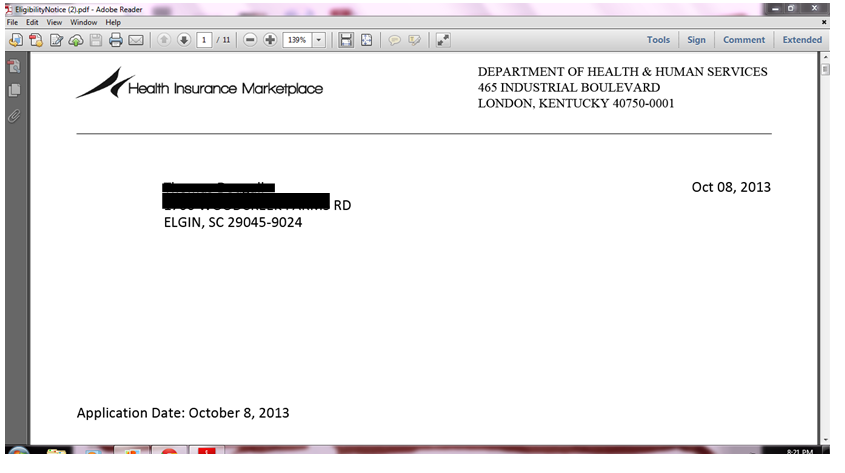
Friday evening, Tom Dougall of South Carolina had a voicemail from a total stranger. Justin, a man in North Carolina, said he received a document on HealthCare.gov with Dougall’s personal information. “Initially, I was concerned because I didn’t know if this was some guy who was scamming me or if in fact this was a guy who really had my personal information,” Dougall said in an interview with the Heritage Foundation.

Dougall immediately contacted WMBF News in Myrtle Beach, South Carolina, and then Senators Lindsey Graham (R-SC) and Tim Scott (R-SC), along with Representative Joe Wilson (R-SC). After getting in touch with Justin Hadley, whose story first broke on Heritage’s “The Foundry” over the weekend, Dougall found out that Hadley had received a notice about his marketplace eligibility with downloadable letters addressed to Dougall.

healthcare.gov

“I want my personal information off of that website,” Dougall said.

But there is no way for Dougall and other users of HealthCare.gov to turn back the clock, and Rep. Tim Murphy R-PA, was worried about Americans who cannot secure already compromised private information, and there is no telling how many other Americans may have been compromised as Dougall was.

“Right now, healthcare.gov screams to those who are trying to break into the system, ‘If you like my health care info, maybe you can steal it,’” he said at the end of the hearing on the security of HealthCare.gov.

Henry Chao told Rep. Murphy and the committee that the federal portal has not been “successfully” hacked, and that the system is safe to use. Clearly Mr. Dougall would disagree with that assessment, but he wouldn’t be alone.

David Kennedy, a “white hat hacker” who also testified at the House Science, Space, and Technology Committee hearing Tuesday, said to Greta Van Susteren during “On the Record” that the agency’s estimate the website had been hacked 16 different times seems very low to him.

“I think that that shows that there’s little to no monitoring so they probably don’t even know if they’re getting hacked right now,” Kennedy said.

Kennedy said that it is common for most websites to receive upwards of 30,000 to 40,000 various types of hacker attacks in one month, alone.

“Something as popular as HealthCare.gov is going to exhibit a lot more than that,” he said, “so if they’re only seeing 16 of these it means that a lot of those are going undetected, and they’ve probably already gotten access to the site or are working on getting access to the site.”

The administration was downplaying November expectations for fixes to the many ObamaCare website problems, and now we know why. Kennedy also said that it would be “impossible” for the many ObamaCare website problems to be ironed out in a few weeks, let alone ensure the safety of users’ information.

Testimony from Henry Chao, deputy chief information

The U.S. Supreme Court has refused to block controversial the Texas abortion ban that require doctors who perform abortions be affiliated with a nearby hospital, and bans abortion after 5 months.

The court by a 5-4 vote denied a request by Planned Parenthood to block a ruling by the Fifth Circuit Court of Appeals, which allows key parts of the Texas abortion law to stay in effect while the case plays out.

The ruling means that the provision — which Planned Parenthood is erroneously arguing would make it virtually impossible for Texas women to get an abortion — simply requires abortion doctors to have admitting privileges to a hospital within a certain geographic location, and will remain in effect.

After suffering a series of setbacks, the pro-life movement has scored a temporary victory with the ruling, keeping the restrictions in place for the remainder of the duration the case plays out.

Bans on late-term abortions enjoy widespread support among the American people, but liberal activist judges have struck down prior attempts to implement reforms on the state level.

The Texas abortion ban represents one of several recent pushes following the horrific case of Dr. Kermit Gosnell to restrict abortion after 20 – 24 weeks, or 5 -6 months. Recent scientific studies have found that developing babies around that stage of development feel pain, setting  a renewed pro-life movement on course.

Unsurprisingly, the four liberal justices who voted in favor of the hearing the request telegraphed that they would have overturned the appeals court’s October 31 ruling that allowed the law to take effect.

In its 20-page ruling, the panel of appeals court judges acknowledged that the law’s provision  requiring doctors to have admitting privileges at a nearby hospital “may increase the cost of accessing an abortion provider and decrease the number of physicians available to perform abortions.”

However, the panel said that the U.S. Supreme Court has held that having “the incidental effect of making it more difficult or more expensive to procure an abortion cannot be enough to invalidate” a valid law that serves a legitimate purpose, “one not designed to strike at the right itself.”  The provision has led at least 12 clinics in the state to stop performing abortions since the ruling, because they cannot meet the basic threshold for safety.

A spokeswoman for the Texas Attorney General’s Office said Tuesday said they are “pleased” with the Supreme Court’s ruling.

“These are commonsense – and perfectly constitutional – regulations that further the state’s interest in protecting the health and safety of Texas women,” Lauren Bean said. In fact, the Supreme Court has already set precedent protecting a woman’s right to abort a pregnancy in the first trimester, but also protects the ability of lawmakers to ban late-term abortions.

Republican Texas Gov. Rick Perry also said, of course, that he was happy with the court’s decision.

“This is good news both for the unborn and for the women of Texas, who are now better protected from shoddy abortion providers operating in dangerous conditions,” Perry said.

The appeals court panel left in place a portion of a previous judge’s order that prevents the state from enforcing the U.S. Food and Drug Administration protocol for abortion-inducing drugs in cases where the woman is between 50 and 63 days into her pregnancy. Doctors testifying before the court had said such women would be harmed if the protocol were enforced.

The appeals court’s order is temporary until it can hold a complete hearing, likely in January.

During the trial proceedings, so-called officials for the abortion industry testified that they’ve tried to obtain admitting privileges for their doctors at 32 hospitals, but so far only 15 accepted applications and none have announced a decision.

Certain hospitals with religious beliefs will not be allowing abortion doctors to work at their facilities.

The U.S. Supreme Court has refused to

Virginia state lawmaker and former candidate for governor Creigh Deeds, who was stabbed several times at his home Tuesday, was just upgraded to fair condition. His son, who was found dead earlier this morning after the attack, had just undergone a mental health evaluation and was cleared 24 hours earlier.

Virginia State Police Public Relations Manager Corinne Geller said at a press conference after Deeds was stabbed in both the head and upper torso several times, he actually walked out of his Millboro home, and was then picked up by a cousin along Virginia Route 42. Deeds had been transported earlier to a nearby farm and subsequently airlifted to UVA Hospital in Charlottesville.

Corinne Geller told the media that when authorities arrived at Deeds’ home they found  his son Gus Deeds, 24, suffering from injuries sustained from a life-threatening gunshot wound. He later died at the scene, however, despite valiant efforts by police and first responders. Gus Deeds’ body was transferred to a medical examiner in Roanoke, Virginia, where an autopsy will take place.

An official told the Richmond Times-Dispatch that Gus Deeds underwent a mental health evaluation Monday at Bath Community Hospital, which was actually conducted under an emergency custody order.

Dennis Cropper, who is the executive director of the Rockbridge County Community Services Board, told the Times-Dispatch that Gus Deeds was in fact released later that very day because, unbelievably there were no available psychiatric beds to be found in the entire Western Virginia area.

Virginia and national Democratic Party sources cited Virginia law enforcement authorities who told them that Gus Deeds stabbed his father before shooting himself.

Creigh Deeds was initially hospitalized and classified to be in critical condition, but his status has been upgraded to fair.

As far as a motive, Police are still investigating, but they are not looking for any suspects at this stage. Geller said authorities are treating the incident and investigation into the events as an attempted murder and suicide.

“It’s a very complex investigation,” Geller said. She added that police have been able to talk with the senator, but she wouldn’t make public the content of that conversation, or what he said to her if anything, at all.

Creigh Deeds, who is a former Bath County prosecutor, was first elected to the House of Delegates in 1991 and then to the state Senate in 2001 during a special election following the death of Emily Couric.

In 2005, he lost a Virginia attorney general race to current Republican Gov. Bob McDonnell, with the margin of victory was fewer than 400 votes out of nearly 2 million cast.

In 2009, he lost again to McDonnell in the governor’s race.

“In this tough and sad time, our thoughts and prayers are with the Deeds family. The news from this morning is utterly heartbreaking,” McDonnell said in a statement. “At this moment, our state unites in prayer for Creigh Deeds and his family.”

Deeds, a rural Democrat who drafted a constitutional amendment guaranteeing Virginians’ right to hunt, was one of the few remaining Democrats who enjoy the backing of the National Rifle Association and other gun-rights advocacy groups.

Deeds and his wife, Pam, divorced shortly after the 2009 campaign, but we have no information to suggest that played any role in the tragic event.

Virginian State Senator Creigh Deeds has been


Live streaming video by UstreamThe Energy and Commerce Committee’s investigation into the botched rollout of the health care law has uncovered a document that indicates senior administration officials at the White House and Department of Health and Human Services were aware of the concerns about meeting the October 1 launch date and the inability to complete end to end testing as early as March 2013.

Tuesday, November 19, 2013 – 10:15am

Witnesses:
Panel I

Mr. Henry Chao: Deputy Chief Information Officer and Deputy Director of the Office of Information Services Centers for Medicare and Medicaid Services (CMS)

Panel II

Mr. David Amsler: President and Chief Information Officer Foreground Security, Inc.

Ms. Maggie Bauer: Senior Vice President, Health Services Creative Computing Solutions, Inc. (CCSi)

Mr. Jason Providakes: Senior Vice President and General Manager Center for Connected Government MITRE Corporation (MITRE)

deputy henry Chao testifies to the house

Adding to a laundry list of corrupt, despotic actions taken by the federal government to ensure the reelection of Barack Obama, a new report shows the final unemployment rate calculated before the 2012 presidential election, was fake.

From August to September, the unemployment rate unexpectedly fell and it fell dramatically, from 8.1 percent in August to 7.8 percent in September. The impossible drop baffled experts, leading former CEO of GE Jack Welch to tweet, “amazing what these Chicago guys will do to win election. Can’t debate, so fudge numbers.”

Welch refused to back down from his accusation that the Obama administration faked the numbers, numbers which according to a reliable source for the New York Post, were in fact manipulated.

As if the likelihood of a rogue employee taking it upon themselves wasn’t nil enough, the Census Bureau, which is the bureaucracy that conducts the survey used to measure the unemployment rate, was well-aware of it.

Apparently, two years before the 2012 presidential election, the Census Bureau actually caught one employee making up pertinent data used in the report to calculate the unemployment rate.

And a knowledgeable source says the deception went beyond that one employee — that it escalated at the time President Obama was seeking reelection in 2012 and continues today.

“He’s not the only one,” said the source, who asked to remain anonymous for now but is willing to talk with the Labor Department and Congress if asked.

The Census employee that was caught faking the results is Julius Buckmon, according to confidential Census documents obtained by The Post. Buckmon told me in an interview this past weekend that he was told to make up information by higher-ups at Census.

Ironically, it was Labor’s demanding standards that left the door open to manipulation.

Labor requires Census to achieve a 90 percent success rate on its interviews — meaning it needed to reach 9 out of 10 households targeted and report back on their jobs status.

Census currently has six regions from which surveys are conducted. The New York and Philadelphia regions, I’m told, had been coming up short of the 90 percent standard.

Philadelphia filled the gap with fake interviews. “It was a phone conversation — I forget the exact words — but it was, ‘Go ahead and fabricate it’ to make it what it was,” Buckmon stated.

Census, under contract from the Labor Department, conducts the household survey used to calculate the unemployment rate.

Interviews with sixty thousand households are entered into each month’s jobless number, currently standing at 7.3 percent. This is a scientific poll, thus each household interviewed represents five thousand homes in the United States.

Buckmon, conducted three times as many household interviews as his peers and took it upon himself to fill out survey for the people that did not answer their doors or who he could not reach by phone.

Furthermore, he was never instructed how to answer the questions regarding these nonexistent people, if they were employed, unemployed, looking for work, or had forgone the search altogether.

The unemployment rate is the most closely watched economic number. By making up survey results — and, essentially, creating people out of thin air and giving them jobs — Buckmon’s actions could have lowered the jobless rate.

The people that are aware of the schematics of the survey understand that by simply creating individuals and filling out the surveys in their name would increase the number of people reported as employed.

Even though there were more than a dozen falsifications reported according to internal documents, Census only investigated a handful of these instances such as the one by Buckmon.

The Labor Department did not inform anyone that the data was “fudged” and Census never publicly disclosed the falsification. Labor spokesman stated, “yes, absolutely they should have told us, it would be normal procedure to notify us if there is a problem with data collection.”

Program Coordinator Joal Crosby was asked why there was not an investigation in each region that was suspected of false data. It was reported that Crosby was unable to determine why an investigation was not done for CPS. The Consumer Expenditure Survey investigated four out of the fourteen instances reported.

Manipulating said data is dangerous because important regulations and monitory policy laws decisions are based upon reports such as these. It is supposed to give the administrators, lawmakers, business owners insight on how to proceed economically.

Not to mention it manipulates Americans as well, giving the people the wrong impression of the president’s effectiveness, especially since he repeatedly campaigned that he would create more jobs.


A new report suggests Jack Welch was

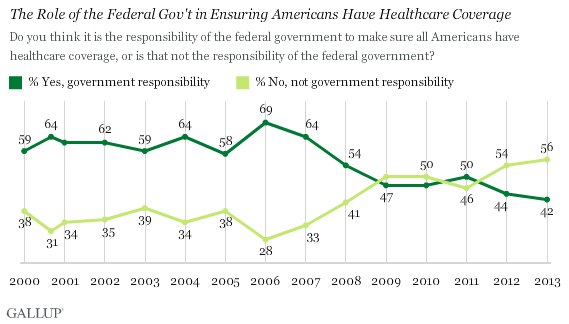
Today People’s Pundit Daily reported that an even higher record number oppose ObamaCare, but a survey from Gallup shows the left is in real trouble. A new survey by Gallup found that 56 percent of adults now say that it is not the job of the federal government to ensure that all Americans have healthcare coverage.

The 56 percent of U.S. adults who now say it is not the federal government’s responsibility to make sure all Americans have healthcare coverage is now a new record high. But the left has really taken a beating on this issue, despite Nancy Pelosi telling “Meet the Press” that healthcare is a right, not a privilege.

Prior to 2009, a clear majority of Americans consistently had said the government should take responsibility for ensuring that all Americans have healthcare.

government healthcare

Charles Krauthammer, an award winning columnist for People’s Pundit Daily, remarked on Fox News that we may be witnessing the end of liberalism for generations. The findings by Gallup at least somewhat show the potential for Charles to be correct, with a stark reversal in public opinion and sentiment supporting such a trend.

While for many Americans healthcare seemed to be a fundamental right, one protected and ensured by the federal government, now that has changed with reality.

As reported by Gallup, amid the failed ObamaCare rollout and realization that the government is a scary entity to control healthcare, attitudes across all three partisan groups have moved away from the view that ensuring healthcare coverage is a proper role of government. It is true, however, the shift is most significantly among Republicans and independents.

In September 2000, only 53 percent of Republicans believed the government should not be responsible for ensuring all Americans had health coverage. Today, a whopping 86 percent feel that way, representing an increase of 33 percentage points in 13 years. Not surprisingly, throughout the same period, the number of Republicans believing the government should ensure healthcare coverage for all has fallen from 42 percent to 12 percent.

Historically, independents have polled along with Republicans on the issue of health care, and now that trend continues with 55 percent of independents now saying the government should not be involved with healthcare, representing an increase of 28 points since 2000.

The real story, however, is the percentage of Democrats who hold this view. That number has risen to a statistically significant 30 percent, which is its highest level since Gallup first asked the question and an 11-point increase since 2000 — with the largest change in opinion occurring between 2006 and 2008.

People's Pundit Daily reported that a new

U.S. homebuilder confidence leveled off in November after a consecutive 2-month drop, but according the National Association of Home Builders consistent home demand was stifled by potential future budget battles in Washington.

The NAHB/Wells Fargo Housing Market Index released Monday measured in at 54 in the month of November. The October figure was downwardly revised to 54 from the originally reported 55.

Economists polled by Reuters were not far off in their expectations, predicting a reading of 55 for the month of November.

“Given the current interest rate and pricing environment, consumers continue to show interest in purchasing new homes, but are holding back because Congress keeps pushing critical decisions on budget, tax and government spending issues down the road,” read the statement released by the Washington-based industry group’s chairman, Rick Judson.

Judson also claimed that homebuilder confidence was also stifled by rising construction costs and low appraisals. Yet, the index has held above 50 for 6 straight months. In reading the index, measurements below 50 mean more homebuilders view market conditions as poor than favorable.

“The fact that builder confidence remains above 50 is an encouraging sign, considering the unresolved debt and federal budget issues cause builders and consumers to remain on the sideline,” NAHB Chief Economist David Crowe said in the same statement from the group.

Even though many will solely scapegoat the potential for future impasse in Washington, the increase in mortgage rates this summer due to the Fed potentially scaling back on their easy money policy has been largely responsible for the brakes being put on the housing recovery.

In truth, if mere rumors have the power to rock the sector in such as manner, then the housing market is weak, propped up only by monetary policy pressured by the Obama administration.

Mortgage rates climbed to 2-year highs in August on mere rumor-induced fears that the Federal Reserve may have been considering reducing its $85 billion monthly purchases of Treasuries and mortgage-backed securities in September. Though the Fed cited improvement in the labor earlier this year, they are largely afraid of inflation. But the labor market proved to fragile, with labor force participation now remaining at a 35-year low.

Obviously, central bank officials decided against tapering its bond-purchase stimulus 2 months ago, and have since done everything in their power to downplay rumors they will consider such a move before sometime in 2014.

“In short, the report still implies net improvement in sales relative to before mortgage rates started to rise in May, but activity has stalled in the last few months,” Jim O’Sullivan, chief U.S. economist at High Frequency Economics wrote in a research note.

The survey’s index on homebuilders’ views on current sales conditions held steady for a second month at 58, the industry group said.

The gauge of expectations for single-family home sales for the next six months fell for a third straight month to 60 from a downwardly revised 61 in October, which was again, initially reported incorrectly at 62.

The component on prospective buyer traffic dropped to 42, which is now the lowest since we have seen since June. It was downwardly revised to 43 last month. The October reading was also initially reported incorrectly at 44.

Midwest homebuilders reported the most significant drop in confidence. The Midwest region’s sentiment fell all the way to 54 points in November from a 62 reading in October. The index’s three-month average fell to 60 from 63.

The Northeast region, however, showed the biggest improvement in homebuilder sentiment. The NAHB index for the Northeast region rose to 44 from what was an 11-month low of 30, increasing its three-month average to 39 from 38.

U.S. homebuilder confidence leveled off in November

People's Pundit Daily
You have %%pigeonMeterAvailable%% free %%pigeonCopyPage%% remaining this month. Get unlimited access and support reader-funded, independent data journalism.

Start a 14-day free trial now. Pay later!

Start Trial