Federal Reserve monetary policy known as quantitative easing, or printing money and buying bonds.
The Federal Reserve will reduce its monthly bond purchases to $45 billion despite anemic first-quarter growth, suggesting the risks are beginning to weigh on their minds.
In continuing its so-called tapering policy, the Federal Open Market Committee announcement Wednesday was the fourth time in as many meetings the committee cut $10 billion from its asset purchase program, also known as quantitative easing.
Despite a headline and misleading 6.7 percent unemployment rate, first-quarter growth of just .1 percent and inadequate job growth, the Fed’s decision-making committee claimed the economy and labor market were strong enough to handle another round of tapering.
“The Committee currently judges that there is sufficient underlying strength in the broader economy to support ongoing improvement in labor market conditions,” said the committee’s policy statement.
The statement also scapegoats the economic harm from the unusually brutal winter weather, claiming that “growth in economic activity has picked up recently, after having slowed sharply during the winter because of adverse weather conditions.”
But the Fed’s policy-making committee is beginning to fear obvious risks from their policy, which have always been inflation and hurting the American saver. Prices for food and other goods have increased last quarter, while spending on necessity products is down. In another report released by the Commerce Department Wednesday spending on health care hurt economic growth, as American consumers were forced to adjust their spending habits, cutting into overall GDP growth.
Yet the FOMC also reaffirmed its aforementioned timeline for increasing the federal funds rate, stating “it likely will be appropriate to maintain the current target range for the federal funds rate for a considerable time after the asset purchase program ends.”
In its March meeting, the Fed’s policy-setting committee altered its conditions for an increase in the short-term federal funds interest rate, junking its 6.5 percent unemployment rate target for a vague, undisclosed economic environment including “labor market conditions, indicators of inflation pressures and inflation expectations, and readings on financial developments.”
As for its asset purchases, beginning in May, the Fed will buy $20 billion of agency mortgage-backed securities and $25 billion of longer-term Treasury securities, which represent reductions of roughly $5 billion for each asset.
The decision was unanimous, with not a single voting members disagreeing with the committee’s policy action.
US economic growth all but stopped in the first quarter, with gross domestic product expanding at an anemic annual rate of 0.1 percent, the slowest since the fourth quarter of 2012.
A new report from the Commerce Department said on Wednesday that the pullback was severe, down from the fourth quarter’s 2.6 percent pace.
Economists polled by Reuters had forecast growth to slow, but only to a 1.2 percent rate. Right on cue, many began to blame the slowdown on an “unusually cold and disruptive winter,” yet declines in sectors ranging from business spending to home building shows data unrelated to weather, which were largely unaffected by weather. A pattern is beginning to emerge during the Obama years, which show a sharper final quarter growth rate only to disappoint at the start of the first.
The Commerce Department report was released just hours before the Federal Reserve ends its two-day policy meeting, and the private payroll processor, ADP, released a jobs report topping expectations.
The slowdown in US economic growth could have thrown a wrench in the Fed’s plan to push a message that the economy is getting stronger, as it is set to announce a they will reduce the amount of money it is pumping into the economy by printing money and monthly bond purchases known as quantitative easing.
While economists and the Fed will say they estimate weather could have taken off as much as 1.4 percentage points from US economic growth, no one can or will give details or specific data on the impact of the weather.
Bottom line, businesses were aggressively restocking in the second half of 2013 and accumulated $87.4 billion worth of inventory in the first quarter, which was the smallest amount since the second quarter of 2013.
That was down significantly from the $111.7 billion gathered up in the fourth quarter and resulted in manufacturers receiving fewer orders. Inventories shaved off 0.57 percentage point from GDP growth in the first quarter.
Trade was responsible for a lost 0.83 percentage point, as exports fell at a 7.6 percent rate in the first quarter after growing at a far better 9.5 percent pace in the final three months of 2013.
In total, inventories and trade were responsible for shaving off 1.4 percentage point from total GDP growth.
Consumer spending, which accounts for more than two-thirds of U.S. economic activity, actually increased at a 3.0 percent rate on services and expenses related to ObamaCare, or the Affordable Care Act. While a Morgan Stanley study found the cost of health care skyrocketing under the ACA, Americans are forced to spend more money on health care under ObamaCare, and the proof is in the data.
Still, consumer confidence is showing a shakiness in the first quarter.
Spending on goods fell sharply, which again is being blamed on cold weather, when likely health care costs are adjusting Americans’ spending habits. Consumer spending had increased at a brisk 3.3 percent pace in the fourth-quarter, prior to the premium increases hitting consumers in force.
Investment in home building contracted for a second straight quarter, as a rise in mortgage rates over the past year side-lined buyers and demonstrated a fundamental weakness in the housing markets.
A second quarter of contraction in spending on home building suggests a housing recession, which the U.S. central bank will be unable to ignore or spin.
U.S. private sector jobs growth was 220,000 in April, which was the highest amount since November and more than expectations, a report by a payrolls processor showed on Wednesday.
Last month was also revised higher to 209,000, up from a previously reported 191,000. Economists polled by Reuters had forecast that the ADP National Employment Report would show a gain of 210,000 jobs in April.
However, another report by the Commerce Department showed the U.S. economy grew at an annual pace of 0.1 percent in the first quarter, which was the slowest pace since the fourth quarter of 2012. Wall Street was looking for annualized growth of 1.2 percent.
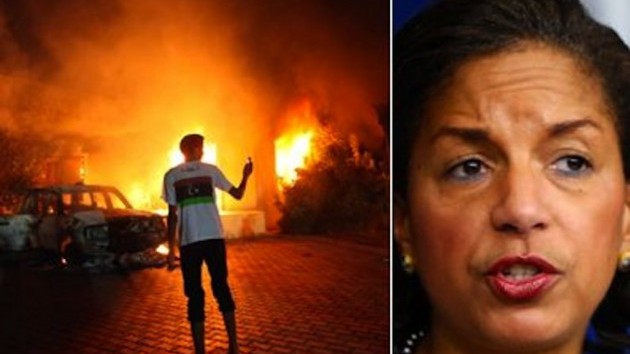
Newly released Benghazi emails link the White House through Ben Rhodes to talking points Susan Rice used on no less than five Sunday talk shows, which turned out to be lies. (Photo: AP)
Newly released emails on the Benghazi terror attack show a senior White House advisor played a direct and pivotal role in prepping former U.N. ambassador Susan Rice for her despicable Sunday show appearances on ABC, CBS, NBC, Fox News and CNN. Rice either knowingly lied or was used by the White House as a patsy when she blamed the Benghazi attack on an Internet video.
The conservative watchdog group, Judicial Watch, obtained more than 100 pages of documents as result of a June 21, 2013, Freedom of Information Act (FOIA) lawsuit filed against the Department of State (Judicial Watch v. U.S. Department of State (No. 1:13-cv-00951)).
On September 14, 2012, an email from Ben Rhodes, who was the deputy national security adviser for strategic communications and assistant to President Obama, had a subject line: “RE: PREP Call with Susan: Saturday at 4:00 pm ET.” It was sent to a dozen members of the Obama administration’s inner circle, including Press Secretary Jay Carney. Deputy Press Secretary Joshua Earnest, then-White House Communications Director Dan Pfeiffer, then-White House Deputy Communications Director Jennifer Palmieri, then-National Security Council Director of Communications Erin Pelton, Special Assistant to the Press Secretary Howli Ledbetter and then-White House Senior Advisor and political strategist David Plouffe, all received the email.
In the email, Rhodes says the game plan was to stress the anti-Islam Internet video, but insinuates the strategy will be to obfuscate differences between the Benghazi attack and what were widespread protests across the Middle East directly related to foreign policy failures following negative developments on the botched Arab Spring.
The email specifically lists the following two goals, as well as several others:
“To underscore that these protests are rooted in an Internet video, and not a broader failure of policy.”
“To reinforce the President and Administration’s strength and steadiness in dealing with difficult challenges.”
What follows in the email is the line repeatedly returned to by administration officials when they knew that the attack had nothing to do with the video. “We find it disgusting and reprehensible. But there is absolutely no justification at all for responding to this movie with violence,” the email stated.
“The goal of the White House was to do one thing primarily, which was to make the president look good. Blame it on the video and not [the] president’s policies,” Judicial Watch President Tom Fitton said.
The Rhodes email was conveniently omitted from the 100 pages of emails released by the Obama administration last May, which they offered only after Republicans held up the confirmation of John Brennan for CIA director.
The former head of AFRICOM, General Carter Ham, told the House Armed Services Committee in January that the White House situation room was alerted immediately after the attack.
“The attack started at 9:42. I don It see any mention here about a demonstration, just simply an attack. Do you know if there was some kind of demonstration before this attack?” asked Chairman Martha Roby (R-AL).
“I am not aware of one, sir. It became pretty apparent to me, and I think to most at Africa Command pretty shortly after this attack began, that this was an attack,” General Ham responded.
In congressional testimony in early April, former deputy CIA director Michael Morell threw Susan Rice under the bus, claiming it was her during her Sunday show appearances who linked the video to the Benghazi attack. Morell said the video was not part of the CIA analysis.
“My reaction was two-fold,” Morell told members of the House Intelligence Committee, regarding her appearances. “One was that what she said about the attacks evolving spontaneously from a protest was exactly what the talking points said, and it was exactly what the intelligence community analysts believed. When she talked about the video, my reaction was, that’s not something that the analysts have attributed this attack to.”
Yet, documents obtained by Judicial Watch confirmed that CIA talking points, which were prepared for Congress and likely used by Rice on “Face the Nation” and four additional Sunday talk shows on September 16, had in fact been heavily edited by then-CIA deputy director Mike Morell, who did so with a “heavy hand.” According to one email:
The first draft apparently seemed unsuitable….because they seemed to encourage the reader to infer incorrectly that the CIA had warned about a specific attack on our embassy. On the SVTS, Morell noted that these points were not good and he had taken a heavy hand to editing them. He noted that he would be happy to work with [then deputy chief of staff to Hillary Clinton]] Jake Sullivan and Rhodes to develop appropriate talking points.
Monday, three top Senate Republicans sent letters to the House and Senate foreign affairs committees requesting they demand the administration to explain who briefed Rice in advance of the Sunday talk shows and whether State Department or White House personnel were involved.
“How could former Ambassador to the United Nations Susan Rice, during the five Sunday talk shows on September 16, 2012, claim that the attacks on our compounds were caused by a hateful video when Mr. Morell testified that the CIA never mentioned the video as a causal factor,” the letter from Sens. Lindsey Graham (SC), Kelly Ayotte (NH) and John McCain (AZ) stated.
People’s Pundit Daily has requested a response from the White House over whether or not Rhodes personally prepped Rice for the Sunday shows. We have also requested more information regarding two key recipients of the emails, Jay Carney and David Plouffe. Both were intimately involved with perpetrating this false story, as well as openly hostile to us and other nationwide news organizations when pressed on details that didn’t fit their narrative.
Meanwhile, the newly released emails also reveal that on Sept. 27, 2012, a Fox News report that was titled “US officials knew Libya attack was terrorism within 24 hours, sources confirm,” was passed around to all senior players of the administration. The comments, however, were redacted, claiming “personal privacy information.”
“Now we know the Obama White House’s chief concern about the Benghazi attack was making sure that President Obama looked good,” said Judicial Watch President Tom Fitton. “And these documents undermine the Obama administration’s narrative that it thought the Benghazi attack had something to do with protests or an Internet video. Given the explosive material in these documents, it is no surprise that we had to go to federal court to pry them loose from the Obama State Department.”
NBA Commissioner Adam Silver banned Donald Sterling for life from the NBA and will pressure other NBA Board of Governors to sell.
DEVELOPING: Los Angeles Clippers owner, Donald Sterling, has been banned for life from dealings with the NBA and fined the maximum allowable amount of $2.5 million for discrimination, NBA commissioner Adam Silver announced Tuesday.
In a press conference, Silver also said they will force Sterling to sell the team, and claimed he had the other owners’ and members’ of the team’s full support. He will have to go to the Board of Governors for 75 percent approval to force out Sterling, who did say earlier this morning that he would not sell the Clippers.
Sterling reportedly did not know the decision before Silver announced it, and did pick up the phone for comment. He confirmed he didn’t know the decision beforehand, but would not offer a comment.
Sterling was engulfed in controversy after recordings emerged of him making discriminatory comments about black Americans.
U.S. consumer confidence staggered in the month of April in a privately conducted survey released Tuesday, which fell in line with previous tracking data.
Last week, we cautioned investors to take the Thomson Reuters/University of Michigan reading on the overall index of consumer sentiment, which measured in above expectations at 84.1, with a grain of salt. While the closely-watched headline number was the highest reading since July of 2013, the Rasmussen Consumer Index, which measures consumer confidence on a daily basis, fell three points on Friday to 101.4. Consumer confidence was down a point from both one week ago and a month ago, and is unchanged from three months ago.
Similarly, the Gallup measurement that tracks consumer spending on a 3-day rolling average tanked from from $82 to $72, while the 14-day rolling average is down 5 to from $90 to $85. For both Gallup and Rasmussen, the trends so little sign of improvement over the last quarter
Now, on Tuesday, the Conference Board said consumers are discouraged by business and labor market conditions, reporting its index of consumer attitudes dropped to 82.3 in April from an upwardly revised 83.9 in the month of March. Economists had expected a reading of 83.0, according to a Reuters poll, and March was initially reported as 82.3.
The expectations index rose to its highest since August, hitting 84.9 in April from an upwardly revised 84.8 in March, while the present situation index fell to 78.3 after an upwardly revised 82.5 last month.
The “jobs hard to get” index increased to 32.5 percent from 31.4, revised downward from 33.0.
Single-family home prices in the U.S. rose in the month of February, but just barely beat Wall Street’s expectations, according to a survey released Tuesday.
The S&P/Case-Shiller composite index of 20 metropolitan areas increased by 0.8 percent in February on a seasonally adjusted basis. Economists polled by Reuters had forecast a 0.7 percent increase.
“Despite continued price gains, most other housing statistics are weak,” said David Blitzer, chairman of the index committee at S&P Dow Jones Indices, who cited new and existing home sales data.
Blitzer’s analysis stands in stark contrast to analysis from the National Association of Realtors, who stand to personally gain from positive sentiment in the housing markets.
The National Association of Realtors said on Monday its Pending Home Sales Index, which factors contracts signed only last month, ticked up 3.4 percent to 97.4. The March increase not only beat economists’ expectations for a 1.0 percent gain, but it was the first time in nine months the index didn’t fall.
But David Blitzer disagrees.
“The recovery in housing starts, now less than one million units at annual rates, is faltering. Moreover, home prices nationally have not made it back to 2005,” he said in an email.
On a non-seasonally adjusted basis, prices were essentially flat in the month of February compared with the month of January.
Prices in the 20 cities rose 12.9 percent year over year, which just missed expectations of 13 percent.
Secretary of State John Kerry gestures as he speaks at the American Jewish Committee Global Forum in Washington, Monday, June 3, 2013. (AP Photo/Manuel Balce Ceneta)
Secretary of State John Kerry again fell under heavy fire Monday for making controversial comments about Israel and the prospects of a one-state solution. But Kerry’s latest blunder resurrected what most in the Beltway know, which is that an anti-Israel position is becoming the dominant view within the Democratic Party.
While straddling the fence by trying to show his support for Israel and the prevailing pro-Palestine position emerging on the American left, he said Israel would end up an “apartheid” regime without a two-state solution.
After a firestorm erupted Monday, Kerry attempted to back off his “apartheid” comments. “I have been around long enough to also know the power of words to create a misimpression, even when unintentional, and if I could rewind the tape, I would have chosen a different word to describe my firm belief that the only way in the long term to have a Jewish state and two nations and two peoples living side by side in peace and security is through a two state solution,” Kerry said.
But, the truth, is that this is far from the first time the word “apartheid” has been used by prominent Democrats to characterize the state of Israel.
Evelyn Garcia, a Democratic National Committee (DNC) member and 2012 candidate for the Florida House of Representatives, accused Israel of “crimes against humanity” and of running “mass concentration camps” in a series of revealing emails released in July, 2012., She apologized and resigned from the DNC.
Garcia actually sent the emails in 2011, but they were first released by BizPacReview.com in 2013. In an email dated May 24, 2011, Garcia wrote: “Slavery was ended, apartheid was ended and so this occupation must end.” And, again, two months later on July 26, Garcia wrote that “by supporting Israeli occupation with US foreign aid, we are all complicit and guilty of their crimes against humanity.”
“I deeply resent U.S. taxpayer funds being used to continue Israeli aggression, (yes, confiscating other peoples’ land and building illegal settlements is aggression), not to mention ‘incursions’ that kill PEOPLE, destroy civilian homes and infrastructure all over, mass concentration prison camps, etc, etc, etc.”
In fact, Kerry isn’t even the first cabinet member to make outrageous comments regarding Israel. Secretary of Defense Chuck Hagel got the go ahead from senators only after facing a slew of cutting questions from Sens. Cruz (R-TX), Graham (R-SC) and McCain (R-AZ). Cruz played audio of an interview Al Jazeera conducted with Hagel in 2009, during which he refused to rebut the pro-Palestinian press on their claim Israel is committing war crimes when they defend themselves against Islamic terrorist attacks.
President Obama, himself, has no love for either Israel or Prime Minister Benjamin Netanyahu, and while it may be a secret in America, Israelis are well-aware of it. America, under Obama, has lost the faith of Israelis, with recent polls showing they no longer trust in America’s ability to negotiate with Iran. Further, they correctly believe Obama doesn’t have their best interests in mind.
The poll asked if Israel can rely on the United States to ensure Israel’s security regarding negotiations with Iran. The survey found 55 percent of Israelis said that it could not, while only 31 percent said it could. And while 70 percent of respondents who identified with the right-wing said that Israel could not trust us, on the left, as well, just 40 percent said that they could.
Further, just 24 percent believed that the Obama administration was giving Israel an “accurate picture” of the negotiations, while 42 percent believe that Israel is not being told all of the details. And the Israeli people aren’t the only ones on to the Obama administration.
Recently, Israeli Defense Minister Moshe Ya’alon was forced to apologize for saying Secretary Kerry was “obsessive and messianic,” and that he hoped Kerry “gets a Nobel Prize and leaves us alone.” Yet, there are some in the Democratic Party who remain hopeful they can reconcile the divide. It isn’t at all clear whether the few remaining pro-Israeli Democrats are simply aware of large Jewish constituencies in their districts, or are being genuine. Out of all the Democrats on Capitol Hill, Sen. Barbara Boxer (D-CA) was the first one to push back on Kerry’s recent comments, though vulnerable Alaska Senator Mark Begich played follow the leader shortly after.
Israel is the only democracy in the Middle East and any linkage between Israel and apartheid is nonsensical and ridiculous.
“Reports that Secretary Kerry has suggested Israel is becoming an apartheid state are extremely disappointing,” House Majority Leader Eric Cantor (R-VA), who is Jewish, said in a statement. “The use of the word apartheid has routinely been dismissed as both offensive and inaccurate, and Secretary Kerry’s use of it makes peace even harder to achieve.”
Both Kerry’s comments and Cantor’s response come as recent reports claimed that the Palestinian Authority made a deal with Hamas, which was a deal-breaker for Netanyahu. In an interview with Fox News’ Bret Baier, Netanyahu said that peace talks are “essentially buried” if Palestinian Authority President Mahmoud Abbas goes ahead with the agreement.
“It’s a blow to Israel; it’s a blow to peace,” he said. “It’s a terrible blow to the Palestinian people, because they must choose, too, whether they want to go forward or go backward. Yesterday, with the pact with Hamas, the Palestinian people went, took a huge step backward, away from peace, away from a good future for themselves.”
While Cantor called for an apology for Kerry’s comments, which further threaten to undermine any hope for Israel’s willingness to negotiate, Texas GOP Sen. Ted Cruz called for Kerry’s resignation on the Senate floor.
“Mr. President, it is my belief that Secretary Kerry has thus proven himself unsuitable for his position and that before any further harm is done to our alliance with Israel, he should offer President Obama his resignation,” Cruz said. “And the president should accept it.”
Considering the administration’s propensity to ignore calls for cabinet resignations, Cruz shouldn’t hold his breathe. However, is doesn’t even matter if the current secretary of state resigns or not. His comments, once again, have highlighted the anti-Israeli view that has become the dominate view in the increasingly farther left-moving Democratic Party.
The National Association of Realtors said on Monday its Pending Home Sales Index, which factors contracts signed only last month, ticked up 3.4 percent to 97.4. The March increase not only beat economists’ expectations for a 1.0 percent gain, but it was the first time in nine months the index didn’t fall.
Still, many economists are cautiously optimistic after a recent shakiness in the housing market. Contracts become sales after a month or two, so the March increase suggests home resales could continue to rebound in the months ahead. But there is little dispute housing markets disappointed last summer, exposing suspected volatility and weakness after small increases in mortgage interest rates.
“After a dismal winter, more buyers got an opportunity to look at homes last month and are beginning to make contract offers,” said Lawrence Yun, the chief economist for the NAR.
“Sales activity is expected to steadily pick up as more inventory reaches the market, and from ongoing job creation in the economy.”
But some are already taking exception with his statements, since the number of properties to build on was down, but vacate properties remain in over-supply.
Existing home sales in March fell to their lowest level in more than 1-1/2 years, but it is the fact that more first-time buyers are coming into the market that gives reason for optimism.
Despite last month’s surge, pending home sales were still down 7.9 percent compared to March of last year because buyers remained sidelined. The Federal Reserve will no doubt continue to print money and keep interest rates as low as possible despite risks to inflation.
Contracts increased in the Northeast, in the South and in the West. They, however, fell in the Midwest.
US President Barack Obama talks during a joint news conference with President Benigno Aquino of the Philippines. (Photo: Strait Times)
President Obama spoke about a new 10-year US-Philippine security pact Monday that would grant the U.S. limited access to military bases in the Philippines. The Enhanced Defense Cooperation Agreement is part of a larger plan dubbed the Asian pivot, which aims to balance an increasingly militarized China in the Pacific region.
“We want to be a partner with you in upholding international law,” Obama said of China at a joint press conference with President Benigno Aquino of the Philippines.
“Our goal is not to counter China. Our goal is not to contain China. Our goal is to make sure international rules and norms are respected and that includes in the area of international disputes,” Obama said.
U.S. Ambassador Philip Goldberg and the Philippine Defense Secretary, Voltaire Gazmin, signed the agreement at the main Manila-based military camp just before Obama arrived in the Philippines.
Obama’s overnight stay in the Philippines is his last stop on what has been a week-long trip to Asia to shore-up U.S. commitments to its allies, and to discuss recent aggressive posturing by China over territorial disputes. Obama visited Japan, South Korea and Malaysia, all of which have had disputed claims in the South China Sea, an area rich with fuel deposits. In the dispute, the United States has always been reluctant to choose a position favoring one nation over another, a sentiment Obama continues.
“We don’t even take a specific position on the disputes between nations, but as a matter of international law and international norms, we don’t think that coercion and intimidation is the way to manage these disputes,” Obama said. He said when the U.S. has similar disputes with its neighbors, it relies upon dialogue diplomacy, not threats. “We don’t go around sending ships and threatening folks.”
But actions speak louder than words, and from a security studies position China is concerned. Obama signed a similar agreement with Australia previously as part of the pivot to Asia. It is becoming clear he is responding to China’s apparent desire for regional hegemony. Last year, the Chinese coast guard surrounded another offshore South China Sea territory, the Second Thomas Shoal. The South China Sea, which Obama flew over to view by air, by all estimates is vastly rick in oil and gas resources. And China wants to control production of them.
Back in November, 2013, China scrambled two fighter jets to investigate — rather intimidate — U.S. and Japanese aircraft that flew into a newly created air defense zone China says is off limits unless permission is granted. China had announced a week earlier that all aircraft entering the airspace over the disputed area located between China, Taiwan, South Korea and Japan, must first notify Chinese authorities. China said they would take unspecified measures against those who do not comply.
President Aquino said the new agreement “takes our security cooperation to a higher level of engagement, reaffirms our countries’ commitment to mutual defense and security, and promotes regional peace and stability.”
The country’s military, which has struggled to develop to an adequate force, are pleased with the deal that certainly means more U.S. assistance to accomplish their goals. But not everyone was pleased.
A group of roughly 800 Filipino activists burned U.S. flags while chanting “no-bama, no bases, no war” on the road to the gates of the palace where Obama met with Aquino. Some burned an effigy of Obama riding a chariot pulled by Aquino, who was depicted as a dog. In fact, the Philippine Constitution prohibits the establishment of permanent U.S. military bases.
However, U.S. military personnel have been present and active in the southern Philippines since 2002, tasked with providing Filipino forces training in counterterrorism who have also struggled to fight Muslim extremists in the region.
You have %%pigeonMeterAvailable%% free %%pigeonCopyPage%% remaining this month. Get unlimited access and support reader-funded, independent data journalism.