Widget Image
Follow PPD Social Media
Friday, January 16, 2026
HomeStandard Blog Whole Post (Page 977)

The second quarter was off to a bullish start Tuesday as the broad S&P 500 hit a new high fueled by stronger than expected manufacturing data and auto sales.

The Dow Jones Industrial Average increased 75 points, or 0.46 percent to 16533, while the S&P 500 jumped 13.2 points, or 0.7 percent to 1885. The Nasdaq Composite was up 69 points, or 1.6 percent to 4268.

Though the markets as a whole have not performed strongly throughout the same duration, especially considering the amount of money the Fed keeps printing, the S&P 500 increased for its fifth-straight quarter Monday. Overall, stock market gains this year have not been substantial, with the broad-market index only increasing by 1.3 percent.

A wave of global manufacturing data fueled the bull market today.

The Institute for Supply Management’s PMI gauge says U.S. manufacturing activity picked up slightly in March, with measurements to 53.7 from 53.2 the month prior. However, the data missed expectations on Wall Street, which was looking for the gauge to jump to 54.

Readings above 50 suggest expansion, but those below 50 suggest contraction.

Economists are still blaming winter weather for the slow growth, or worse-than-usual weather that was felt across the country despite the UN-Democrat push on global warming.

News of China’s official factory gauge ticking up slightly in March from the month before was received with cautious optimism. But, a private survey still showed contraction in the China’s factory sector. And yet another report showed the eurozone’s factory sector grew in March from the month prior, as the 18-member currency bloc’s economy appears to continue in its recovery. Activity in Germany and France — the two biggest economies — both beat market expectations.

Analysts at Barclays characterized the global data “robust.”

In corporate news, a Senate panel claimed that Caterpillar (CAT) evaded paying $2.4 billion in taxes between 2000 and 2012, while the world’s biggest heavy machinery giant denied charges of dubious accounting practices. Apple (AAPL) is reportedly working on building new screens for the soon-to-be announced iPhone 6, Reuters reported.

Monthly sales figures from the Big Three U.S. automakers are due out on the day. Ford (F) claimed its U.S. March sales increased 3 percent, the largest measure in eight years. Also, Fiat’s (FIATY) Chrysler revealed a 13 percent increase in sales. General Motors (GM) also posted a better-than-expected 4.1 percent increase in sales.

CEO of General Motors, Mary Barra, is expected to testify before Congress over the ignition-switch scandal that hit the No. 1 U.S. automaker late last week and early this week. Since February the company has issued recall notices for roughly 5.5 million vehicles worldwide, including 1.5 million added late Monday.

GM has recalled 2.6 million vehicles over a defect in the ignition switch that may cause the engine to shut off, which has been linked to 13 deaths. Last Friday, the company recalled another 172,000 of the Chevy Cruze model. In a completely different recall notice, 490,200 pickup trucks and SUVs were also recalled. In mid-February, the company recalled 780,000 cars to fix a problem with airbag deployment.

Meanwhile, in commodities, U.S. crude oil futures fell 28 cents, or 0.28 percent to $101.30 a barrel, while Wholesale New York Harbor gasoline fell 0.9 percent to $2.911 a gallon.

Gold, the anti-crisis safe-haven, rose $1.50, or 0.12 percent to $1,285 a troy ounce.

The second quarter was off to a
latest obamacare approval pollsExamine the latest ObamaCare approval polls, and two observations will immediately jump out at you. First, disapproval spreads are increasing enough to show just how deeply unpopular the law has become, and just how much of an outlier the ABC News/Washington Post poll has become. Sadly, one of these organizations isn’t a first-time offender, and due to their consistent propensity to be the outlier, releasing wildly inaccurate survey findings, we are downgrading their rating from a 2.5 to a 3.5, nearly the lowest rating a pollster can be assigned by PeoplesPunditDaily.com.

For those who may not be avid readers, we rate pollsters based on past accuracy as part of our election forecast model, with 1 representing a stellar rating, or performing within an average 1 or 2 point margin of error, and 4 being the least accurate. For example, SurveyUSA, YouGov, Quinnipiac University and Gravis Polls, all have performed well in the past. On the other hand, Rasmussen Reports and the Democratic pollster Public Policy Polling (PPP), are low-performance and wildly inaccurate polling firms who consistently miss the mark by wide margins.

Let’s begin with a bit of recent history to explain our decision, then we will look at the latest ObamaCare polls that served as the proverbial straw that broke the pundit’s back, leaving us no choice but to downgrade the joint public survey.

The Virginia governor race in 2013, for instance, is a perfect example and was, perhaps, the worst call made by the Washington Post pollster, until now. Abt-SRBI conducted a survey for the Washington Post from 10/24 to 10/27 that found McAuliffe leading Cuccinelli 51 percent to 39 percent. Despite all of the signs clearly showing the race tightening as ObamaCare moved front and center, the Washington Post commissioned a survey that stayed true to a narrative they had pushed that entire campaign. A month prior, PeoplesPunditDaily.com took a look at the relationship between the bias media coverage — much of it from the Washington Post — and the nearly-twenty point swing toward McAuliffe beginning in the month of May.

It was disgraceful, and blatant.

We have hesitated to pull the trigger on this rating because, though polls commissioned exclusively for the Washington Post have made far too many bad calls in recent years, independent ABC News polling has been relatively accurate until 2010, and pollsters deserve some time to either correct their methodology (due to the fluid nature of the electorate) or change the company they keep. However, it has become painfully obvious that — when surveys are jointly commissioned — their methodologies are either blissfully and intentionally flawed, or outright manipulated.

Let’s now look at the latest ObamaCare approval polls, which as of now, currently averages 39.5 percent approve and 54 disapprove, according to the PPD average.

At a time when pollsters from the right and left are finding all-time high disapproval spreads upwards of 18 percent, the ABC News/WaPo poll found only a 2 percent spread. And when we look at the broader sample of adults, we actually find a positive 2 percent approval spread, something no pollster has ever, ever found. Two other surveys of adults conducted just a few days earlier — from CBS News and the Associated Press/GfK — both found an unprecedented amount of negative sentiment toward the law, oppose + 13 (CBS News) and oppose +17 (Associated Press/GfK), respectively. In fact, regarding the Associated Press/GfK, among a nearly-identical sample of 1012 adults, a record low of just 26 percent approved of ObamaCare.

Among polls conducted among registered voters, including from the bipartisan CNN/Opinion Research and Fox News, which are conducted jointly by Democrat and Republican polling firms, pollsters recorded all-time high levels of opposition to the president’s signature health care law. Even Rasmussen Reports, who I recently demonstrated swung demonstrably toward the left after favoring Republicans for two cycles, has found a new high — oppose +18 — for the law itself, and, a new low — 36 percent — level of support for single-payer.

Every pollster releases an outlier from time to time. But a laundry list of outliers is evidence of a dubious attempt to push a politically motivated narrative, or in this case specifically, a suspicious attempt to influence and misrepresent public opinion over ObamaCare right before the deadline arrived.

At People’s Pundit Daily, we cannot and will not allow such findings to influence our model or the political process, thus we are downgrading the ABC News/WaPo poll to allow PPD and other pundits to adjust election analysis accordingly.

The latest round of ObamaCare approval polls

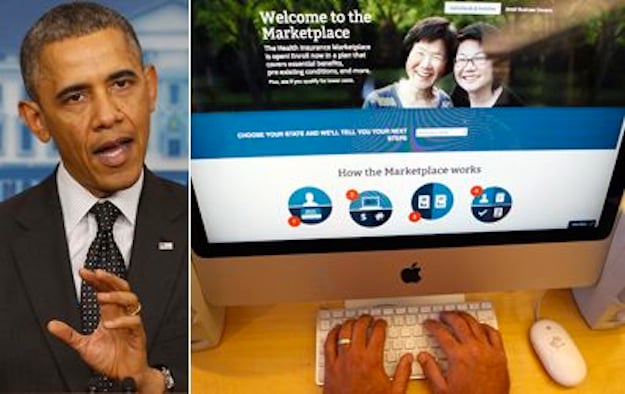
The ObamaCare website problems reared their ugly head once more, as people trying to apply and enroll for coverage before Monday’s midnight deadline found the site was “currently unavailable.”

Healthcare.gov was down for several hours Monday morning, a statement from the Department of Health and Human Services said. However, NBC News, or a propaganda institution masquerading as a news organization rushed to the aid of the administration, offering a puff piece complete with instructions for users.

“Consumers may also complete their application by calling the call center at 1-800-318-2596. The federal data services hub is working normally,” the article quoted HHS.

The website was offline for maintenance overnight, because it is still a security hazard with faulty code, and crashed for four hours due to technical problems. The site was not down due to a rush of last-minute enrollees.

Monday at midnight ET is the deadline to sign up for insurance in the online markets created by President Barack Obama’s signature health care law.

As of last week, the administration claims 6 million people had applied for insurance, but the numbers that matter are nonexist in both administration statements and NBC News’ coverage.

The administration again unilaterally extended the enrollment deadline for those who supposedly had started an application by Monday but didn’t finish. A literal radio button was added just last week for those who could not sign up, due to errors, missing information or website glitches. However, it was all operating on the honor system, and was never validated by the site or HHS. NBC echoed HHS and the administration who is playing up the narrative that says “as long as people have gotten in line by Monday, they will be allowed to finish their applications.”

It’s not voting, it’s health insurance. But, rather than reporting that the law is not achieving its stated goal — which was to insure the uninsured — or, the fact the administration isn’t being honest about including people who haven’t paid their premiums in the enrollment numbers, NBC instead opted to throw the Obama administration a bone.

“The government says it will accept paper applications until April 7 and take as much time as necessary to handle unfinished cases on HealthCare.gov,” they so helpfully contributed. Except, what they won’t tell Americans is that their information isn’t safe on the website — where hackers are easily able to redicrect information — or, handing a paper application to so-called ObamaCare navigators who weren’t even screened for criminal backgrounds.

“They are cooking the books on this,” Sen. John Barrasso (R-WY) told “Fox News Sunday” referring to the dishonest enrollment numbers NBC News won’t report.

According to McKinsey & Co., who conducted a study on enrollment through both the federal and state insurance exchanges using data as of Feb. 1, the law is still not working. McKinsey found that only 14 percent, which translates to about 500,000 individuals, were “actual uninsured who have actually gained health coverage.” However, an additional 13 percent of uninsured individuals had signed up for Obamacare but still had not paid their first month’s premium. An addition 2 to 5 percent paid their first month’s, but not their second.

Of those who had signed up by that time, 73 percent either had insurance and preferred to choose a plan on the exchange or enrolled because their individual plans were cancelled. Because around 6 million Americans had their health insurance cancelled as a result of the law’s standards, a net 5 plus million Americans are now uninsured who were previously insured.

The ObamaCare website problems reared their ugly

The Institute for Supply Management-Chicago says their measurement of Midwest manufacturing activity fell to 55.9 in the month of March, significantly below the reading of 59 Wall Street had expected. The index was also far below the measurement of 59.8 the month prior.

Still, as of 9:32 AM ET, the Dow Jones Industrial Average was up 108 points, or 0.66 percent to 16430, while the S&P 500 jumped 12.6 points, or 0.68 percent to 1870. The Nasdaq Composite rose 37.6 points, or 0.91 percent to 4193.

The Institute for Supply Management-Chicago says their

North Korea shells South Korea

March 31, 2014: South Korean and U.S. Marines aim their machine guns during the U.S.-South Korea joint landing exercises called Sangyong, part of the Foal Eagle military exercises, in Pohang, South Korea. (AP Photo/Ahn Young-joon)

South Korean Marines returned artillery fire across a disputed sea border Monday after North Korean shells from a live fire drill fell into the water South of the frontier.

Fortunately, there have been no reports of any injuries, but island South Korean residents spent several hours in shelters during the shelling. Ferry service, which serves as a go-between from the islands to the mainland, were temporally out-of-service. Kang Myeong-sung, speaking from a shelter on Yeonpyeong island, which is in literal sight-distance from North Korean territory, said that he didn’t hear any fighter jets but did hear the artillery fire.

North Korea fired 500 rounds of artillery shells over more than a 3-hour period. While most of the ordinance fell North of the boundary, nearly a fifth — or, about 100 of — fell south of the sea boundary, according to South Korean Defense Ministry spokesman Kim Min-seok.

In response, South Korea fired 300 shells into North Korean waters.

As is usually the case when North Korea shells South Korea, no shells fell on land, but Kim said the North’s artillery bombardment was another provocation meant to gauge Seoul’s security status.

The developments follow an announcement from Pyongyang that it would conduct these military drills, which was widely seen as a sign of frustration by the rogue regime, because they have been unsuccessful at extorting outside aid.

This isn’t the first time in recent history the western sea boundary has been the scene of shelling, even ending in several deadly naval exchanges. Back in March 2010, a South Korean warship was sunk by a torpedo attack that killed 46 sailors. Of course, North Korea denies responsibility for the sinking, but experts . And in November 2010, a similar North Korean artillery bombardment killed four South Koreans on Yeonpyeong.

The Korean Peninsula remains in a technical state of war because the 1950-53 Korean War ended with an armistice, not a peace treaty. About 28,500 American troops are deployed in South Korea to deter potential aggression from North Korea.

South Korean Marines returned artillery fire across

2016 Democratic Presidential Nomination

2,242 Delegates Needed to Clinch Nomination | Delegate Count

(Please Note: Estimated total “soft” [pledged and unpledged] & “hard” delegates = 4,483)

Election-2016-Democratic-Presidential-Candidates


[election_2016_polls]


Polling Data

[wpdatatable id=9]


Election 2016: Latest Republican Presidential nomination polls aggregated, averaged, and updated daily when new surveys are released.

[ssbp]

2016 Democratic Presidential Nomination 2,242 Delegates Needed to

jeb bush 2016 really?

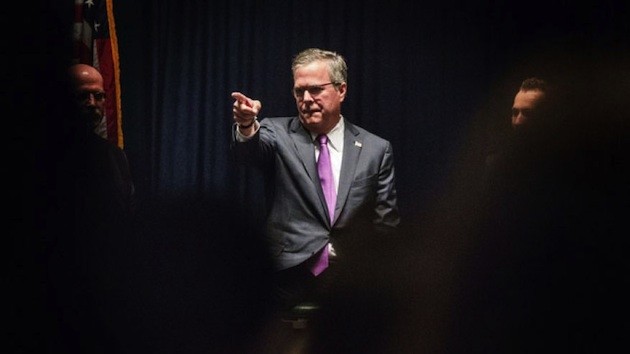
March 27, 2014: Former Florida Gov. Jeb Bush, a potential GOP presidential candidate in 2016, during a education panel discussion at Advanced Technologies Academy, in Las Vegas. Bush is the chairman of the Foundation for Excellence in Education, which promotes expanding charter schools and vouchers to allow students to attend private schools. (AP Photo/Las Vegas Review-Journal, Jeff Scheid)

A behind-the-scenes big donor push for a Jeb Bush 2016 presidential bid is now well underway, underscoring just how disconnected the party establishment is with their actual voter base. Driven by fears that New Jersey Governor Chris Christie is too damaged by the media-obsessed Bridgegate affair, the “vast majority” of the top 100 donors to 2012 nominee Mitt Romney’s campaign have taken up the task to draft the former Florida governor.

“He’s the most desired candidate out there,” said another bundler, Brian Ballard, a member of both national finance committees for two past losers, Romney in 2012 and John McCain in 2008. “Everybody that I know is excited about it.”

Despite Kentucky Senator Rand Paul walking away with the straw poll at the Conservative Political Action Conference and, his even more electorally significant win in the Northeast Republican Leadership Conference earlier this month, the know-it-all party donors believe his libertarian views on the National Security Agency and supposed weakness on foreign policy has made him an electoral liability. For Republican elites, the brother of two former presidents — one of which, had the most unpopular foreign policy platform in decades, while the other couldn’t win reelection based on his foreign policy successes — would be a much better choice.

Former Secretary of State Henry Kissinger, who served under an impeached Republican president, told The Post he would be “delighted” to see Jeb Bush 2016 signs. “He would be outstanding,” Kissinger said, even though he hasn’t thrown Christie under the bus as others seem to have done. “He is someone who is experienced, moderate and thoughtful.”

Though the party’s big donors seem to think another Bush is just what the Republican Party needs, Jeb Bush has never led in either individual polling or in the PPD average of 2016 Republican presidential nomination polls. whereas both Paul and Christie have. Currently, former Arkansas governor turned-Fox New host Mike Huckabee is still holding on to a slight lead. However, Paul is not only leading the GOP field in recent New Hampshire primary polling, but also slightly behind Huckabee in Iowa.

Yet, it is this big donor push that led Crystal Ball to recently and shockingly adjust their forecast. Now, Sabato and the guys at the University of Virginia Center for Politics placed Jeb Bush at the top of their list, pushing down both Wisconsin Gov. Scott Walker and Senator Paul, two candidates that could actually excite the voter base.

But it isn’t just conservative Republican base voters who are having a hard time warming up to the idea of another Bush. A recent Washington Post-ABC News poll found that almost half of all Americans say they “definitely would not” vote for Jeb Bush in the 2016 presidential election.

Apparently, Karl Rove is gearing up to waste billions of big donor dollars — again — pushing the idea that his former boss’s brother is more electable than Sen. Rand Paul or others. Unfortunately for the donors’ wallets and the direction of the country, the data just doesn’t bare that narrative out. But that isn’t even the worst aspect to this story, or the character of Karl Rove & Co.

Rove and the general Republican Establishment need base voters to win. After bitter primary elections they expect and take for granted these voters. But when their guys loses, they want to take their ball and go home.

Mark DeMoss, another former adviser to the failed Romney campaign, someone seen as influential with the evangelical voting bloc, said that he would only help Bush. If Bush doesn’t run, he says, then he will sit out the 2016 campaign.

“I think he is a talented, credible, thinking leader,” DeMoss said. “The question is, how much appetite is there in the Republican Party and in the general electorate for that?”

DeMoss, like so many Establishment Republicans, would apparently prefer Hillary Clinton to someone who is actually conservative.

Behind-the-scenes big donors push for a Jeb

2016 Republican Presidential Nomination

1,236 Delegates Needed to Clinch Nomination | Delegate Count

(Estimated total “soft” & “hard” delegates = 2,470)

Election-2016-Republican-Presidential-Candidates


[election_2016_polls]


Polling Data

[wpdatatable id=19]


Election 2016: Latest Republican Presidential nomination polls aggregated, averaged, and updated daily when new surveys are released.

[ssbp]

2016 Republican Presidential Nomination 1,236 Delegates Needed to

nebraska senate race

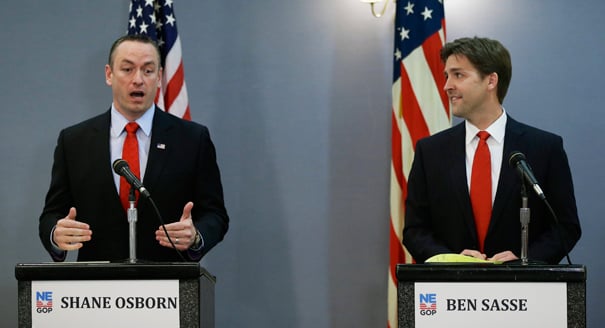
Nebraska Senate race hopefuls, former Republican State Treasurer Shane Osborn and Midland University President Ben Sasse participate in a debate in Omaha, Neb., Tuesday, March 11, 2014. (AP Photo/Nati Harnik)

The Nebraska Senate race is the seventeenth article in what has been a series offering expanded analysis of our 2014 Senate Map Predictions. The surprise retirement of Republican Senator Mike Johanns and the delayed decision by Republican Gov. Dave Heineman to opt out of the race, had put this race on hold. But now the GOP field is beginning to take shape enough to opine further.

On the Democrat side, Larry Marvin formally announced he will run, and was the first Democrat to declare his candidacy in the Nebraska Senate race. Marvin is a pain in the Nebraska Democratic Party Establishment’s you know what, through and through. He is an Air Force veteran and was a long-shot candidate for U.S. Senate both in 2008 and 2012. He, of course, lost to Bob Kerrey who went on to get blown out by Deb Fischer 57.8 to 42.2 percent in a not-so good cycle for Republicans. David Domina, trial attorney and candidate for governor in 1986, is also declared.

The Republican primary is where all the action has been and will continue to be in this contest. The crowded Republican primary field is as follows:

Declared

  • Sid Dinsdale, President of Pinnacle Bank
  • Clifton Johnson, businessman
  • Bart McLeay, attorney
  • Shane Osborn, former Treasurer of Nebraska
  • Ben Sasse, President of Midland University

Not that we ever favor discounting underdogs, but it has become pretty clear that this will be a K-Street versus Main Street contest between two top contenders. Shane Osborn, 39, is a former Navy pilot and state treasurer, and was the Establishment’s pick largely due to high name recognition. But his cozying up to K Street and the Establishment GOP has been a bit too much for the party activists to handle.

The Club for Growth, the Senate Conservatives Fund, Sen. Mike Lee (R-UT) and Sarah Palin, all had endorsed his top primary opponent, Ben Sasse. Sasse, 42, has been the president of Midland University, a small Lutheran school in Fremont since Dec. of 2010. He was also an assistant secretary in the Department of Health and Human Services under George W. Bush.

Senate Minority Leader Mitch McConnell reportedly went ballistic after Senate Conservatives Fund endorsed Sasse over Osborne, and undertook a fundraising effort through the National Republican Senatorial Committee to organize attacks on the insurgent.

The Establishment versus insurgent narrative was further set in stone when FreedomWorks announced they have rescinded their endorsement of Osborn, opting instead to get in line with other conservatives and back Sasse. “Both Osborn and Sasse are great people, and this was not a decision taken lightly,” FreedomWorks president Matt Kibbe said in an email.

“The question at the heart of this decision is, who would caucus with the Freedom Caucus, and who would fall in line with the establishment? At this point, it is clear that Shane Osborn formed allegiances with Mitch McConnell and the K Street lobbying class.”

Of course, this wasn’t the best of news for Osborne to hear. He didn’t respond to us immediately, but his campaign did release the following statement: “FreedomWorks has decided to endorse a candidate who they have attacked for months over his lack of conservatism and record of championing big government policies. Sasse is selling himself as the ObamaCare nemesis, but nothing could be further from the truth.”

So, that’s the back and forth. Now, let’s look at some data.

Currently, Osborn is leading Sasse 35 percent to 24 percent in the latest survey conducted by Republican pollster Kellyanne Conway. In The Polling Company survey commissioned for Breitbart.com, Conway found name recognition to be the reason for Osborn’s lead. How do we know this? Because when told specific biographies, Sasse edges out Osborne 54 percent to 49 percent, likely due to the fact that ObamaCare is the top issue on primary voters’ minds and Sasse is seen as uniquely qualified to handle the issue.

An earlier survey seems to bare this out, as well. Harper Polling found a much tighter race in early March, with Osborne leading the lesser-known Sasse by just 30.4 percent to 29 percent. Both The Polling Company and Harper Polling found two variables that work to Sasse’s advantage. First, there is a large amount of undecideds in the Nebraska Senate race primary, 30 percent and 23.2 percent, respectively. Second, Sasse polls better among voters who have an opinion on the candidates, leaving far more room for Sasse to grow his support as voters get more familiar with his name than Osborne, who is already well-known.

Still, the NRSC is a formidable presence in Republican primaries. Even though they boast unimpressive victories, such as Sen. Cornyn defeating Steve Stockman in Texas with under 60 percent of the vote, a win is still a win. Until we see some more data, preferably from pollsters who have an accurate track record as determined by our PPD model, we will more comfortable making a call for one candidate in the primary. For now, we are still going to move this race from “Leans Osborne” to a “Toss-Up” because the data clearly suggest that is where this race truly is.

As far as the general election, we are moving the Nebraska Senate race to “Likely Republican” from “Safe Republican.” In the national political environment we are in, which has went from bad to worse for the Democratic Party, I would be hard-pressed to describe a scenario in which any of the Democratic candidates could win.

President Obama currently has the approval of only 37.5 percent of the residents in the Cornhusker State. The Partisan Voting Index (PVI) is in the double-digit Republican neighborhood, specifically R+12. According to the annual state-by-state Gallup party ID measurement, Nebraska has become even more Republican since 2012, and now the Cornhusker State is the eight-most conservative state.

A daunting, or nearly insurmountable challenge for the Democratic Party.

View Polling Below Or View 2014 Senate Map Predictions

Poll Date(s) Sample MoE Dinsdale Johnson McLeay Osborn Sasse Undecided
The Polling Company 02/25 – 02/28/14 400 ± 4.9 9 1 2 35 24% 30%
Harper Polling 02/03 – 02/04/14 565 ± 4 13.1 4.3 30.4 29% 23.2%
Public Opinion Strategies^ 10/27 – 10/28/13 400 ± 4.9 7 1 39 7% 46
Gravis Marketing 09/06 – 09/07/13 1,842 ± 2.2 7 2 41 5% 45

The Nebraska Senate race is the seventeenth

Watch full Chris Christie interview from “The Kelly File” with Fox News host, Megyn Kelly. In the interview, the NJ governor reacts to an investigative report clearing him of wrongdoing in the Bridgegate scandal.

Gov. Chris Christie told Megyn Kelly he “also always knew that this is where it would end because I knew from the beginning I didn’t have anything to do with this and didn’t know anything about it”

But Christie, like many voters, is not ready to give himself a pass. He again took ultimate responsibility for the lane closures in the Ft. Lee area, which broke when Democrats began panicking over poll numbers showing the New Jersey governor — just off his big reelection victory — edging top contender Hillary Rodham Clinton in a head-to-head matchup for president in 2016.

“And that’s, you know, consolation I think for me and for others who support me but it doesn’t mean that I’m not responsible and ultimately you know I’m responsible for what people do on my watch.”

Christie also addressed whether or not he has “too much baggage now to run for president,” as Megyn Kelly asked.

“That will be for other people to judge. There’s no baggage here because I didn’t do anything. And that eventually will wash out as it’s starting to already. Because what the American people and the people of New Jersey really care about is ‘did you do it?’ And when they find out you didn’t, I think what you’re going to find is that they’ll just say ‘okay.'”

VIDEO: Watch full Chris Christie interview from

People's Pundit Daily
You have %%pigeonMeterAvailable%% free %%pigeonCopyPage%% remaining this month. Get unlimited access and support reader-funded, independent data journalism.

Start a 14-day free trial now. Pay later!

Start Trial