Widget Image
Follow PPD Social Media
Saturday, January 17, 2026
HomeStandard Blog Whole Post (Page 995)

virginia gay marriage ban

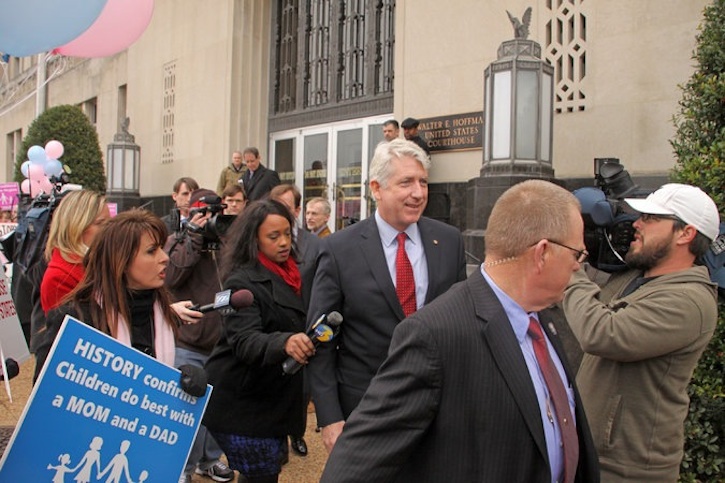
Mark R. Herring, the Virginia attorney general, center, outside the federal courthouse in Norfolk last week. (Photo: Jay Paul/Getty Images)

The voter approved Virginia gay marriage ban has been struck down by a federal activist judge, making it the first state in the South to see its popularly supported ban overturned.

U.S. District Judge Arenda Wright Allen issued a stay of her order while it is appealed, meaning that gay couples in Virginia will still not be able to marry until the case is ultimately resolved. Both sides believe the case won’t be settled until the Supreme Court decides to hear it or one like it.

Virginia is now the second state in the South to have their values overturned, with a judge in Kentucky ruling Wednesday that the state must recognize same-sex marriages performed in other states. However, the ruling did not address the constitutionality of same-sex marriages performed inside the state.

The two rulings in Kentucky and Virginia are the latest in a strand of similar decisions in Utah and Oklahoma federal courts. The people in the state, who approved by ballot the Virginia gay marriage ban, are just now realizing the ramifications of voting Democrat down the ticket during the 2013 elections.

Virginia Attorney General Mark R. Herring, decided to not even bother upholding the law or his Oath of Office to do so, as he believes the Virginia gay marriage ban violates the equal protection clause of the 14th Amendment. Whether or not a particular AG agrees with the law is beside the point, because they are tasked with enforcing the law of the land. It is particularly disturbing that the popularly supported law, or one passed directly by a ballot reflecting the will of the people, was ignored.

Herring’s office, however, did ask for the judge to stay her order to avoid what occurred in Utah, following a federal judge declaring that state’s ban on gay marriages was unconstitutional.

In the aftermath of the ruling, more than 1,000 gay and lesbian couples were married before the U.S. Supreme Court granted the state an emergency stay. the Supreme Court ruling stopped the weddings and now the fate of those married couples is uncertain. A federal judge also declared Oklahoma’s ban unconstitutional, a ruling that is also on hold while it is appealed.

The Virginia gay marriage case surrounded on a Norfolk couple that were denied a marriage license by the Norfolk Circuit Court in July, after the Supreme Court struck down the federal Defense of Marriage Act. A Chesterfield County couple that married in California and is raising a teenage daughter also later joined the lawsuit.

The attorneys representing the plaintiffs are the activist attorneys who successfully challenged California’s voter-approved ban on gay marriages in court, with another instance of Democrat officials deciding to not defend the law popularly supported on a ballot initiative, twice.

The Virginia gay marriage ban was struck
insurance premiums

Last month, before the various deadlines, People’s Pundit Daily reported that insurers claimed only 5 to 15 percent of those who selected a plan through the insurance Marketplace had paid for their plan. New reports, however, suggest that up to 30 percent have still not paid their first month’s insurance premiums by the deadlines.

The Health and Human Services Department released new numbers last week touting an increase in ObamaCare signups among younger people. Yet for a program that needs roughly 40 percent between the ages of 18 – 34, a cumulative 24 percent participation rate is far too low, and when factoring the numbers of those who actually paid their insurance premium yet, the program is actually in even worse shape then being reported.

The White House forced insurers to give people more time to pay, but insurers said many people missed the extended deadlines, as well.

Matthew N. Wiggin, a spokesman for Aetna, told the Times that about 70 percent who signed up for ObamaCare paid their insurance premiums. The deadlines to pay the insurance premium for Aetna policies taking effect on Jan. 1, was Jan. 14. For policies sold by Coventry Health Care, which is now part of Aetna, the deadline was Jan. 17.

While the numbers may vary from isurer to insurer, the trend is clear: The latest ObamaCare enrollment numbers cannot be trusted, which is exactly what one source at the Health and Human Services Department told Fox News.

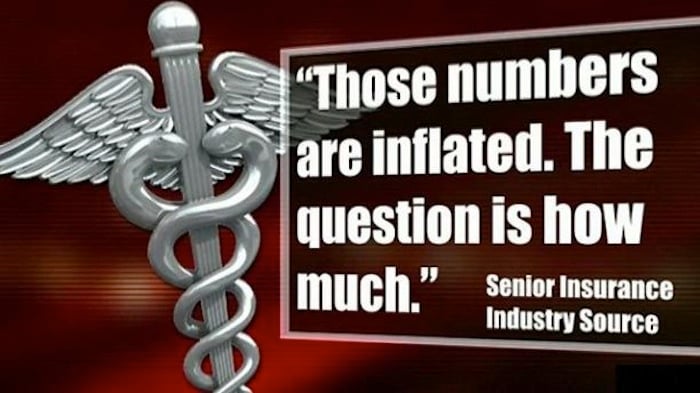
“The numbers are not as high as 3.3 million — it’s lower,” one senior insurance industry source told Fox News. “Those numbers are inflated. The question is how much.”

The administration has evaded this issue numerous times with numerous excuses, first claiming that they did not know how many people signing up for coverage had paid their premiums because the government had not finished building the “back end” of the computer systems needed to pay insurers.

When pressed by Fox just this week, White House press secretary Jay Carney, said the numbers are known only by the industry. “It is a contract between an individual or – well an individual even representing his or her family – and a private insurance provider,” Carney said. “So insurance companies obviously have data about when those payments were made, but this would be no different from any other insurance contract that you would – you would purchase.”

But a senior insurance industry source said the administration does, in fact, have at least a rough idea of how many people have paid their insurance premiums. Because this determines who actually gets government subsidies, the administration has to eventually know who’s paying into the system in order to ensure subsidies are being directed to the right people. From Fox News:

As a rough example, an industry source said if a consumer has to pay a $100 monthly premium for coverage and the government subsidy is worth $80, the consumer only pays the $20 difference to the insurance company. The $80 subsidy is later paid by the government directly to the insurance company, so the insurance companies have to show the administration who is paying into the system in order to get that reimbursement.

It would appear that the administration is yet again not being truthful about the ObamaCare enrollment numbers, which will ultimately decide whether or not congressional action in the form of a built-in bailout will have to be considered.

Because various insurers are having different experiences it is difficult to tell exactly what is the rate for people who are paying, overall.

Greg Thompson, a spokesman for the Health Care Service Corporation, which offers Blue Cross and Blue Shield plans in Illinois, Texas and three other states, told media that “around 80 percent” of people choosing those plans had paid their first month’s premium by the Jan. 30 due date.

While some are claiming up to 30 percent haven’t yet paid, others like Thompson are likely bring the overall average down around 25 percent. Unfortunately, younger people who are key to the survival of the program, are more likely than other consumers not to pay their premium, which suggests that the number of participation is even lower than the already-inadequate 27 percent.

New reports suggest that up to 30

The Health and Human Services Department boasted the release of new ObamaCare Marketplace enrollment numbers, but youth participation was still far too low in the month of January to argue the program’s viability and sustainability.

In a blog post previewing the new Marketplace enrollment report, Health and Human Services wrote:

Enrollment in the Health Insurance Marketplace continued to rise in January, with a 53 percent increase in overall enrollment over the prior three month reporting period, with young adult enrollment outpacing all other age groups combined, HHS Secretary Kathleen Sebelius announced today.

However, the proportion of young adults ages 18 to 34 who have actually selected a Marketplace plan through the State-based Marketplaces (SBMs) and Federally-facilitated Marketplace (FFMs) grew far too modestly in the fourth month of the open enrollment period compared to the prior three months, or just 3 percentage points. In the fourth month just 27 percent were ages 18 – 34, compared to the prior three months that saw a cumulative 24 percent participation proportion.

Though the administration has tried to downplay their own stated goals, experts agree that the program can only remain financially stable with youth participation totaling a proportional average of 40 percent. In total, 3.3 million people enrolled in the Health Insurance Marketplace plans by Feb. 1, 2014, which is the end of the fourth reporting period for open enrollment, and though January saw 1.1 million of that figure, the administration is far below the rate needed to exceed 7 million by the end of open enrollment in March.

Plan selections also suggest that sicker, older people are selecting plans, with more generous plans insinuating the need for higher coverage. As of February 1, 62 percent selected a Silver plan, while just 19 percent selected a Bronze plan, which experts say will be the majority choice for healthier Americans.

The administration recently announced yet another unilateral delay of the law’s implementation, in this case for mid-size businesses who are otherwise required to comply with the mandate. The move came shortly after the CBO released a report finding that ObamaCare will kill over 2.3 million jobs by providing workers with incentives not to work full-time, and job creators incentivized not to hire.

Despite the spin by HHS and administration officials, the bottom line is that both the numbers and Obama’s actions show the law is in trouble. Unfortunately, due to the built-in bailout for insurance companies, it is the American people who are truly in trouble.

The Health and Human Services Department boasted

grassroots-tea-party

Believe it or not, sometimes the President is right.

A while ago, during the budget lockdown and subsequent government shutdown, President Obama made a good point. If you want things to change, better start winning some elections.

It’s not often that he makes a salient point, but when he does it’s often about politics.

The Republicans want to stop the expansion of government and get the bureaucracy off the back of the American people.

Unfortunately, a large percentage of the American people seem to think the way to accomplish that is through accusations of Obama’s birthplace, chemtrails in the sky and complaining about the GMO’s in their box of Cheerios.

This fringe segment of GOP is doing more damage than good.

While I would never suggest that the GOP cave on principles or on core issues — such as illegal immigration, gun control or government spending — it also has to control the more fringe elements of the party that continually push the issue of impeachment and criminality on the part of this administration.

We cannot hope to gather votes and win elections while tilting at windmills and chasing our tail in distraction after distraction. Whether or not their argument is valid is not the issue- winning elections is.

The grassroots Tea Party groups are the organizations that are most responsible for keeping these people in line.

As a collective grassroots effort, the Tea Party tends to attract a wide variety of these “fringe” arguments and has a tendency to promote a more libertarian ideology.

It needs to restrain itself from putting the cart before the donkey. The Tea Party should be now focusing on getting out the vote, encouraging people to register as Republicans and giving the GOP a consolidated ground game in what may be the most pivotal election to turn the tide against this government in years.

There is opportunity with the failures of ObamaCare, taxation and stalemate in Congress — let’s not blow it on specious arguments.

The Tea Party was formed in the aftermath of the Affordable Care Act legislation and has forgotten its roots – the “Taxed Enough Already” crowd.

As such, they have fallen into the trap of not focusing on core Republican arguments and have driven people out of the party to vote Libertarian instead of Republican.

What are those principles?

Lower taxes, a smaller more efficient government, strong national defense and free markets should be our national argument. That’s it.

That is a platform that people will vote for, whether they are liberal or conservative. Focusing on what normally are states’ rights issues such as abortion, gay rights and Common Core are sidetracking our national and congressional elections.

Once we start winning some elections, regain Congress and the White House, then we can get back to more reasonable government and repeal and restrain what has been done to this country in the last 5 years.

Until then, we are just tilting at windmills.

Thomas Purcell is a nationally syndicated columnist and host of the Liberty Never Sleeps podcast hour and author of “Shotgun Republic.”

Commentary : The grassroots Tea Party groups

iranian-revolution-protest-American-flag

Iranians are marking the anniversary of the Islamic-led 1979 Iranian revolution with the familiar chants of “Down with the U.S.” and “Death to Israel.”

Hundreds of thousands of Iranians have gathered in Tehran for the 35th anniversary of the Islamic revolution that toppled the pro-U.S. Shah Mohammad Reza Pahlavi and brought the Islamo-facist regime to power.

State media reported similar rallies elsewhere in Iran on Tuesday.

The traditional anti-American rhetoric came despite what many in the West would like to believe was a significant political shift in Tehran, with the election last year of the so-called moderate President Hassan Rouhani, who is supposedly pursuing an open-handed policy of engagement with the West.

Iran and the six world powers came to a landmark nuclear deal in November, in which Iran vowed to cap its controversial uranium enrichment program in return for the easing of billions of dollars in sanctions by the West.

Even the president’s own party doesn’t believe the deal was smart, nor that Iran was sincere in their promise.

Meanwhile, Iran’s official news agency says the country has successfully test-fired two missiles, including a long-range ballistic missile launch, while U.S. officials mock the show of aggression by the Iranian Navy. The Navy sent what the U.S. referred to as “rust buckets” into U.S. waters to show a projection of power.

To be sure, the display of naval power is nothing significant, as the ships are truly an “afterthought” technologically speaking. But the missile launches, however, are not.

The Monday report by IRNA described the missiles as a “new generation,” but did not make clear if they were new designs or upgrades of existing ones.

It said the ballistic missile had radar-evading capabilities, but did not give a name. It said the second missile was called Bina, or “Insightful,” and was a laser-guided missile system, which could be fired from the ground or from aircraft.

Iran already has surface-to-surface missiles with a range about 2,000 kilometers (1,250 miles) capable of reaching Israel and the U.S. military bases in the region.

The anniversary of the 1979 Iranian revolution

debt limit increase

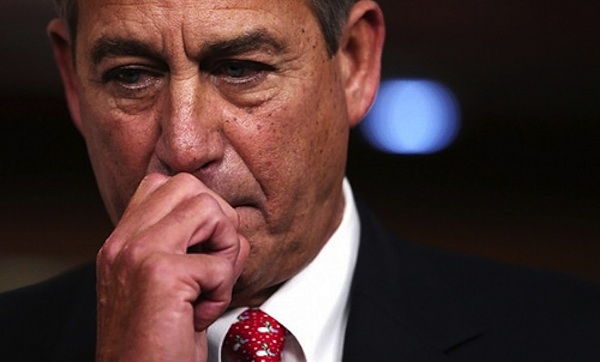
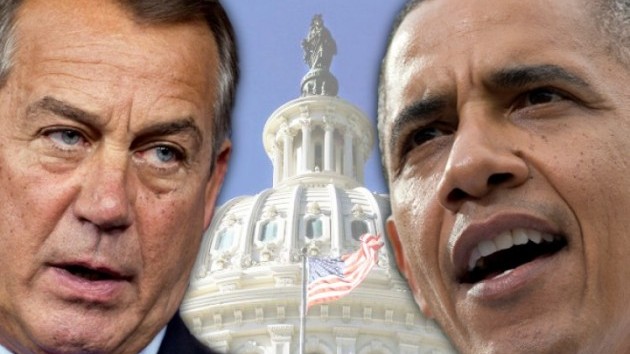
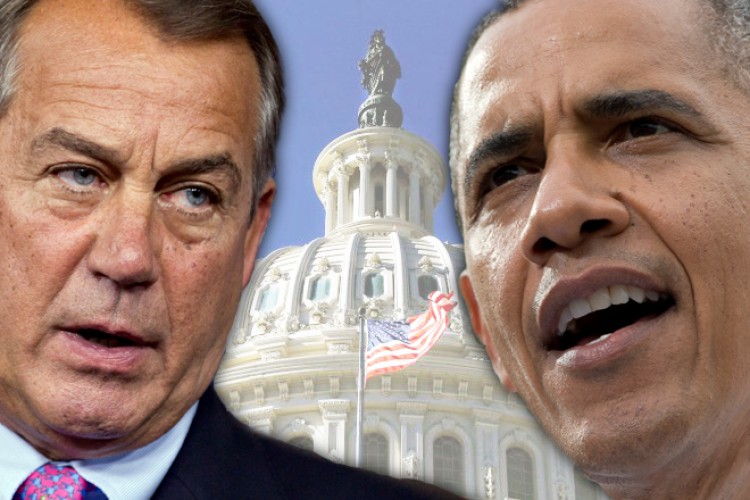
The Republican-controlled House has approved a debt limit increase, in a 221 to 201 vote, to allow Treasury to borrow freely through March 15, 2015. House Speaker John Boehner, in an abrupt shift, announced Tuesday that the House would vote on an increase in the nation’s borrowing cap without any strings attached.

Boehner caving on a “clean” debt limit increase, which was supported by just 28 Republicans, was tantamount to a complete capitulation by so-called fiscally conservative Republicans to President Obama and congressional Democrats, who argued that the Republicans should not attempt to use the bill as leverage to extract concessions from the administration.

But there is nothing “clean” about the debt limit increase, another credit extension to pay for the pet projects of big government lawmakers who are seemingly unconcerned about the disastrous trajectory the U.S. fiscal house is heading in.

Conservative groups quickly condemned the decision, voicing concern that Congress would let the cap continue to rise above its current $17.3 trillion level without anything in return.

“A clean debt ceiling is a complete capitulation on the Speaker’s part and demonstrates that he has lost the ability to lead the House of Representatives, let alone his own party,” Jenny Beth Martin, co-founder of Tea Party Patriots, said in a statement.

Yet, Speaker Boehner somehow believes he can take that road without bearing responsibility.

“We’ll let the Democrats put the votes up. We’ll put a minimum number of (GOP) votes up to get it passed,” Boehner said. “We’ll let his party give him the debt ceiling increase that he wants.”

If Republicans aren’t buying that explanation, there is little reason for conservatives or anyone to believe that the American people will as a whole, either.

The House also voted Tuesday to restore full cost of living increases to pension benefits for younger military retirees, whom they abandoned during the Ryan-Murray budget deal. The final vote was 326-90.

The Republican-controlled House has approved a debt

obamacare employer mandate delay

Following the latest unilateral move to delay ObamaCare, Republicans ramped up their calls to delay or repeal ObamaCare. The Obama administration announced Monday the ObamaCare employer mandate delay will only apply to some businesses, giving some employers a reprieve next year, while arbitrarily phasing in the mandate for others.

The administration had already delayed the implementation of the so-called employer mandate by a year, initially pushing the requirements off until 2015, suspiciously past the midterm elections. Now, the Treasury Department  announced Monday that the administration would not enforce the rules across the board next year.

“Once again, the president is giving a break to corporations while individuals and families are still stuck under the mandates of his health care law. And, once again, the president is rewriting law on a whim,” House Speaker John Boehner said in a statement. “If the administration doesn’t believe employers can manage the burden of the law, how can struggling families be expected to?”

Senator and physician John Barrasso (R-WY), said the announcement Monday provides “further evidence that the health care law is hurting the economy.”

Because of the delay the administration has decided to — once again — unilaterally change the law to allow employers with 50 to 99 employees avoid the ObamaCare employer mandate requirement in 2015. They will still be required to report on how many workers are covered, but will have until 2016 — after the midterm elections — before being required to cover full-time staff or pay a penalty. Americans, however, would still be required to obtain health insurance through the individual mandate, or the rule that forces each citizen to purchase health insurance.

Under the new changes to the law, employers with 100 or more workers will be required to provide health insurance to full-time staff next year. But the new rules will only require them to immediately cover 70 percent of workers, and then 95 percent the following year and all those thereafter.

Per the prior delay, companies with fewer than 50 employees will not be required to provide health coverage.

The administration claims they are suddenly reversing their stance on businesses who have been voicing their concerns over the damage ObamaCare rules will have on the economy. However, the change is another example of the flawed implementation and, in fact, the design of the law. Fewer workers getting insurance through their employers could mean more individuals on the ObamaCare exchanges seeking subsidized coverage, increasing the cost to taxpayers.

Further, as shown by the latest Congressional Budget Office, will destroy over 2.3 million jobs by incentivizing  millions not to work, a grim economic policy reality, which has forced Democrats to create a new word “job-lock” to explain.

But what the administration cannot seem to grasp, however, which is what lawmakers have been saying all along, the mere threat of the employer mandate is causing many companies to cut full-time workers in the hope of keeping their staff size below 50 to avoid being subject to the requirement.

Administration officials can claim that this is not happening on a large-scale, but the jobs reports over the last three years suggest otherwise, with the latest claiming it will take 6 years to return to pre-recession job market levels.

Treasury officials said Monday that businesses will be told to “certify” that they are not cutting full-time workers simply to avoid the mandate. Employers will be told to sign a “self-attestation” on their tax forms affirming this, under penalty of perjury.

Officials stressed that the latest ObamaCare employer mandate delay only applies to a relatively small percentage of employers, an echo of a tactic that includes minimizing the lives’ of Americans, though these companies employ millions of workers. It’s all relative to the administration.

Barrasso joined Sen. Tom Coburn (R-OK), and other Republican lawmakers in writing a letter to IRS Commissioner John Koskinen on Monday asking about the enforcement of the individual mandate, addressing all the other changes to the law’s implementation.

“Given a number of last-minute administrative ‘adjustments’ made by the Administration, there is some understandable confusion and concern about the enforcement of the individual mandate tax,” they wrote. “With the Administration’s decision to waive, delay, or unilaterally alter some provisions of the law-including the employer mandate tax on businesses-taxpayers deserve clarification on how the agency intends to enforce the individual mandate tax.”

The Obama administration announced Monday the ObamaCare

shirley-temple-dead

Shirley Temple, the child actress who saved 20th Century Fox from bankruptcy and became one of the most popular movie stars of the 1930s, has died at the age of 85.

Publicist Cheryl Kagan told the Associated Press than Temple, known in her private life as Shirley Temple Black, died surrounded by family at her home in Woodside, CA, near San Francisco.

Born in 1928 in Santa Monica, Calif., Temple jumped into show business by performing in a series of one-reel feature film spoofs called “Baby Burlesks” for $10 per day.

In 1934, 20th Century Fox signed Temple to a 7-year contract that paid her $150 per week. Shirley Temple would go on to famously star in films like “Stand Up and Cheer,” “Baby Take A Bow,” and “Bright Eyes.” By the end of the year, Temple’s pay had been upped to more than $1,250 per week.

Between 1935 and 1938, Temple was America’s top box-office draw.

Shirley Temple, the child actress who saved

[ooyala code=”QzYzNtazrNx-P2J-qQO4iBAwlTkMDm-V” player_id=”undefined”]

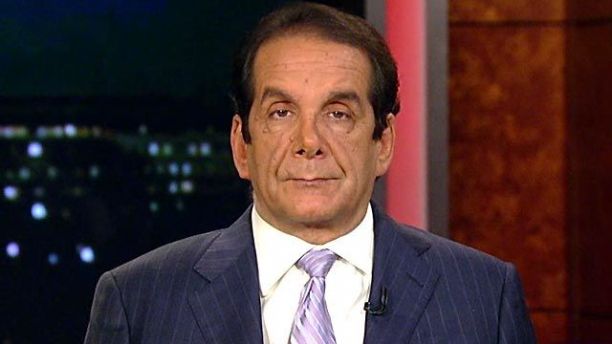
Fox News contributor and syndicated columnist Charles Krauthammer, called the latest ObamaCare delay what it is: the “stuff you do in a banana republic.” The Obama administration has unilaterally changed the law at will since it’s failed rollout, delaying and omitting requirements as it sees political expedient to the president and his party.

“I mean this is stuff that you do in a banana republic,” Krauthammer said on “Special Report” with Bret Baier. “It’s as if the law is simply a blackboard on which Obama writes any number he wants, any delay he wants, any provision. It’s changing a law in the way that you are not allowed to do.”

Krauthammer went on to add that the announcement was a “political decisions to minimize the impact leading up to an election.”

The Obama administration announced Monday the ObamaCare employer mandate delay will only apply to some businesses, giving some employers a reprieve next year, while arbitrarily phasing in the mandate for others.

Charles Krauthammer, called the latest ObamaCare delay

The Democratic Party is drooling over the prospect of turning the largest conservative state blue, drawing on the potential that Texas has the second-largest Hispanic population of any state. But ironically, a new Gallup poll found Hispanics in Texas may prevent that transformation, as they are more likely to identify with the Republican Party than they are nationwide. Gallup also found white voters in the state are decidedly more Republican than they are nationwide.

Hispanics in Texas still largely tilt Democratic by 46 to 27 percent, but the 19-percentage-point Democratic advantage is far smaller than the nationwide average of 30 points. With 61 percent of white voters in Texas identifying with the Republican Party, as opposed to 48 percent nationwide, the state is not likely to turn blue easy. Adding to the Democrats’ problems in the state, their white base is shrinking down to 26 percent as opposed to 38 percent nationwide, with political participation among Hispanics in Texas far lower than needed.

Hispanics in Texas are more likely to say they are not registered to vote than are registered, with just 43 percent saying they are. This compares to a whopping 82 percent of whites who vote in large majorities for Republican candidates and 77 percent of blacks who say they are registered, which vote in a near monolithic pattern for Democrats, though black voters in Texas are also slightly more Republican than they are nationwide. When we add up the support, Republicans already have a majority coalition even if just 8 percent of Hispanics in Texas vote Republican.

Of course, this is not to say that the future may be different, as we at PeoplesPunditDaily.com have investigated and documented the lengths the Democratic Party is willing to go to in order to turn Texas blue. However, Republican inroads have been made among Hispanics in Texas since the first election of Barack Obama in 2008, when just 23 percent identified as Republican. Meanwhile, from 2008 until now, Democrats have shed 7 percent who identify with their party in the state, while they lost just 4 percent nationwide. During the same period, Republicans added 4 points to their already-large majority support among white voters.

The data show that Hispanics, alone, simply may not be enough to turn Texas blue. In fact, if this trend continues as it has since 2008, then the Democratic Party may find that Hispanics in Texas are a hinderance rather than an advantage, as more move toward the right and continue to break Democratic ties, which we see is occurring. Whether or not that pattern persists, remains to be seen.

It would appear, for now, Battleground Texas will need to register massive amounts of Hispanics in Texas that currently do not participate in the political process, though who knows if they will even want to.

A new Gallup poll found Hispanics in

People's Pundit Daily
You have %%pigeonMeterAvailable%% free %%pigeonCopyPage%% remaining this month. Get unlimited access and support reader-funded, independent data journalism.

Start a 14-day free trial now. Pay later!

Start Trial