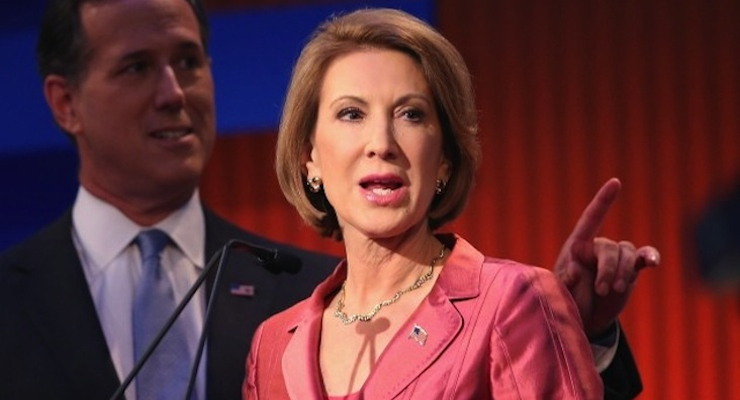
Former Hewlett-Packard CEO and Republican presidential candidate Carly Fiorina, front, stands on the debate stage to the left of former Pennsylvania Sen. Rick Santorum, left. (Photo: Scott Olson / Getty)
Carly Fiorina has surged to third place in a new post debate poll from Rasmussen Report, while support for frontrunner Donald Trump has fallen by a third. The former Hewlett-Packard CEO and Republican presidential hopeful was the clear winner of the first Republican debate that took place Thursday in Cincinnati, Ohio.
“You’re lucky you weren’t here earlier,” Fox News host and debate moderator Megyn Kelly said in the open to the prime-time debate. “She opened a can of you-know-what before.”
Kelly, who otherwise had a highly-criticized night, was obviously correct and the voters are beginning to respond. Carly Fiorina brought her A Game on issues of foreign policy, domestic policy, and effectively articulated the philosophical differences between party ideology and, of course, frontrunner Donald Trump.
“He is the party’s frontrunner right now and good for him,” the only female GOP candidate said. “He’s tapped into an anger that people feel. They’re sick of politics as usual. I’ll tell you this. Since he has changed his mind on amnesty, on health care and on abortion, I would just ask what are the principles by which he will govern?”
For Fiorina, it was the first opportunity to introduce herself to American voters, including Republicans, Republican-leaning independents and even Democrats. And she took advantage of what turned out to be an even bigger opportunity than several second-tier campaigns anticipated. The second-tier candidate debate at 5 PM ET drew a whopping 6.1 million viewers, according to Nielsen TV ratings, making it the third-highest rated primary debate of all time. The previous champ was ABC News, which hosted a debate that drew 7.6 million on December 10, 2011.
In the new post debate poll, Florida Sen. Marco Rubio and former Florida Gov. Jeb Bush are tied for second place with 10 percent support, with Fiorina and Wisconsin Gov. Scott Walker tied for third at 9 percent. Neurosurgeon Ben Carson, who edged out Donald Trump in the Gravis Marketing “Who Won?” Post Debate Poll, came in fourth with 8 percent of the vote, up from 5 percent in the Rasmussen Reports poll conducted late July.
While Fiorina saw the biggest jump, up from just 1 percent in the previous survey, Trump saw the biggest decline, falling 9 points from 26 to 17 percent. The Donald still leads the pack in the PPD average of national polls at 22.8 percent, while Fiorina trails with an average 2.8 percent. However, with Rasmussen conducting the first large sample national primary poll since the debate, Fiorina’s support will likely continue to be underestimated in the national average. Whether her newfound support turns out to be a simple post-debate bump or prove to have staying power, remains to be seen.
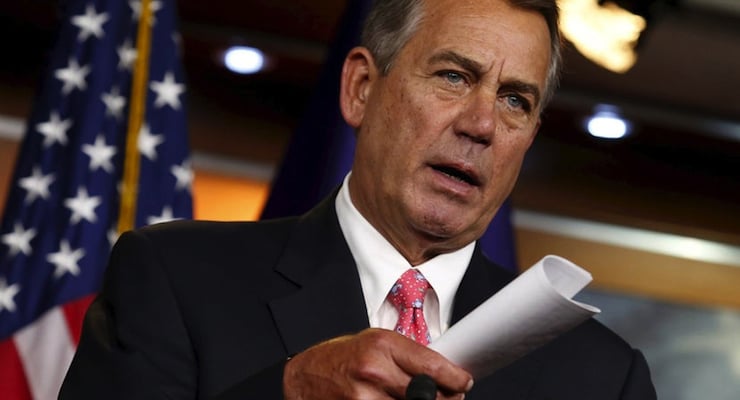
U.S. House Speaker John Boehner, R-Ohio, speaks at a news conference on Capitol Hill in Washington on March 19, 2015. (Photo: Yuri Gripas/Reuters)
Let’s celebrate some good news. When politicians can be convinced (or pressured) to exercise even a modest bit of spending restraint, it’s remarkably simple to get positive results.
…one of the few recent victories for fiscal responsibility was the 2011 Budget Control Act (BCA), which only was implemented because ofa fight that year over the debt limit. At the time, the establishment wasscreaming and yelling about risky brinksmanship. But the net result is that the BCA ultimately resulted in the sequester, whichwas a huge victorythat contributed tomuch better fiscal numbersbetween 2009-2014.
And “much better fiscal numbers” really are much better.
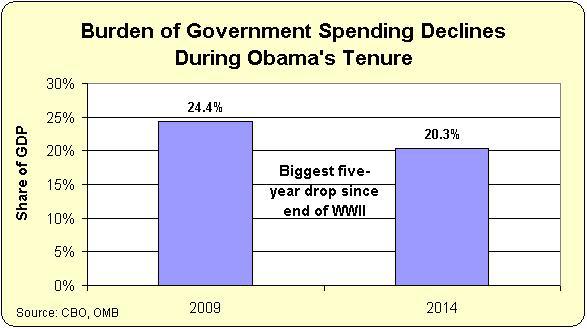
Here’s a chart I put together showing how the burden of federal spending declined between 2009 and 2014. And this happened for the simple reason that spending was flat and the economy had a bit of growth.
Federal Spending from start of Obama administration to the present. (Source: Dan Mitchell)oehner
But now let’s look at some bad news. It won’t surprise anyone to learn that the big spenders in Washington don’t like fiscal discipline. They don’t like the modest restraint required by the Budget Control Act and they want to repeal or eviscerate the law. And they’ve already enjoyed some success, replacing spending restraint with tax hikes and budget gimmicks back in 2013.
And now there’s pressure for a similar capitulation this year, led by the Committee (gee, what a shocker) that’s in charge of spending money. An article in Politico captures some of the internal dynamics.
…what should have been a dream job for House Appropriations Chairman Hal Rogers (R-Ky.) has instead become an exercise in frustration. Despite his plum position, Rogers finds himself at odds with GOP leadership… He’s calling for his party to raise strict spending caps he says are choking off necessary funding… But Rogers’ calls for a budget deal have fallen flat.
By the way, it’s not the main point of today’s column, but the article also shows why it was so important to eliminate “earmarks.”
It’s a reminder of the sway lost by the once powerful appropriations panel, in an age when earmarks are outlawed… The committee, once an aspiration for every lawmaker, is struggling to make its voice heard… appropriator Steve Womack (R-Ark.)…cheered Rogers for “pushing our leaders to the extent that he can” toward a budget accord. “Appropriators are in a tough spot … We just don’t have the grease that we formerly possessed.”
Good. I don’t want big spenders to have “grease” that facilitates a bigger burden of government.
They want to bust the spending caps so they can line their pockets at the expense of the American people. Which is why maintaining the BCA caps are a critical test of whether Republicans are sincere about controlling Leviathan.
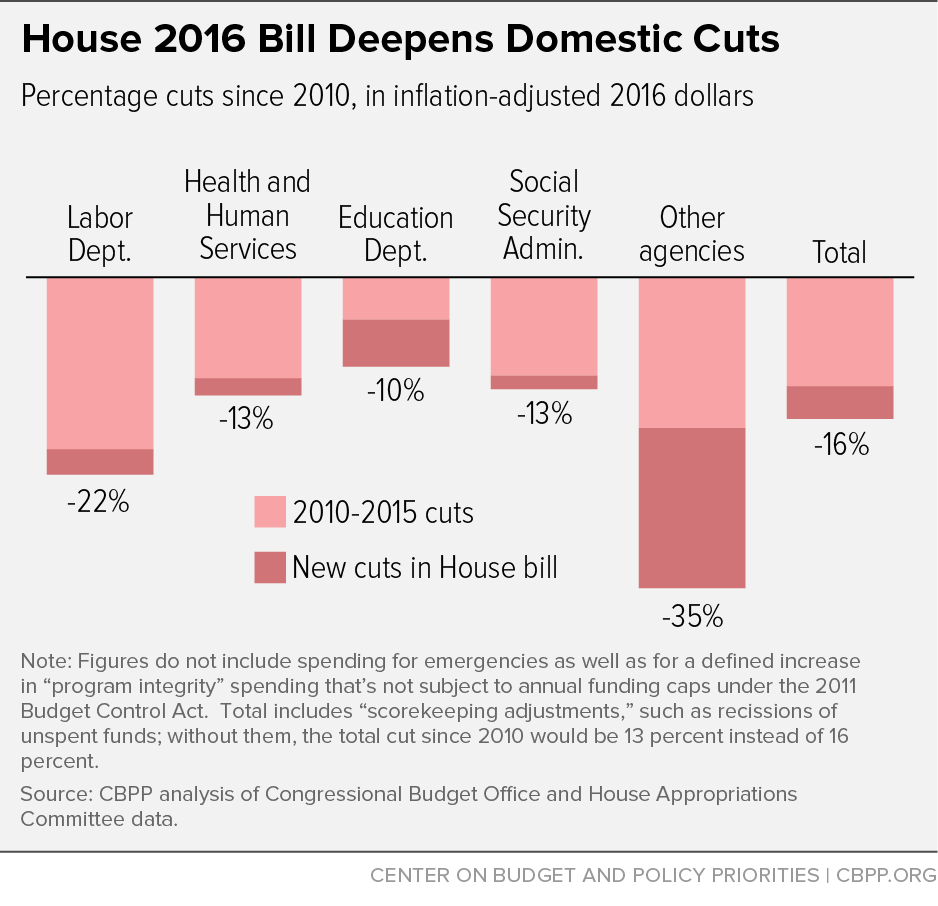
To understand the importance of the spending caps, here’s a chart from the Center on Budget and Policy Priorities, a left-wing group that supports bigger government. I won’t vouch for their specific numbers since they have an incentive to exaggerate and overstate the amount of fiscal discipline that’s been imposed, but there’s no question that the big spenders have been handcuffed in recent years.
Now that we’ve reviewed why it’s important to have spending caps, let’s talk about the elephant in the room. There are two reasons why Republicans may sell out. First, as already discussed,some of them are spendaholics. They like bribing voters with other people’s money. The second reason the GOP may capitulate is that the President and congressional Democrats may force a “government shutdown” fight. To be more specific, the annual spending (or “appropriations”) bills are supposed to be completed by October 1, which is the start of the new fiscal year.
If President Obama uses his veto pen, which is what most observers expect, there will be a shutdown. And even though previous shutdowns have yielded positive policy changes, Republicans are afraid that they will suffer political blowback.
Given that they won a landslide election in 2014 after the 2013 shutdown (and also prevailed after the 1995 shutdown fight), this skittishness is a bit of a mystery, but the conventional wisdom is that GOPers will capitulate to Obama and agree to a deal that busts the spending caps.
Which would be very unfortunate for the cause of good fiscal policy.
On the issue of big government and spending discipline, I recently appeared on John Stossel’s show, along with my colleague Chris Edwards, while participating in FreedomFest. Here’s what we said about the importance of shrinking Washington to promote freedom and prosperity.
P.S. In this video, Chris and I pontificate at greater length on fiscal policy issues.
[brid video=”13252″ player=”1929″ title=”Dan Mitchell and Chris Edwards on Big Government vs Growth”]
P.P.S. While I’m critical of the politicians on the Appropriations Committee, I don’t think they’re necessarily any worse than other lawmakers. As I explained last month when analyzing the bad behavior of politicians who are on the committees that deal with transportation, the system creates a perverse incentive structure to expand government.
This undated photo shows a bust of ancient Egyptian Queen Nefertiti in the Neues Museum in Berlin. (Photo: AP)
Dr. Nicholas Reeve, an English archaeologist, believes he has discovered a secret doorway leading from the tomb of King Tut to that of Queen Nefertiti. Reeve, of the University of Arizona, has suggested that the tomb of the “boy king” Tutankhamun, the most famous of Egypt’s pharaohs, has been hiding the secret since Howard Carter and George Herbert discovered the resting place filled with gold in 1922.
Queen Nefertiti, who bore the titles “Lady of All Women” and “Mistress of Upper and Lower Egpyt” during her lifetime, was the mother of Tutankhamun and wife of Akhenaton, the man who temporarily turned Egyptian religion and culture upside-down. Reeves told the Times that he discovered the bricked-up “ghosts” of the doorways after examining digital scans of the walls in Tutankhamun’s tomb, which is location in the Valley of the Kings across the Nile River from Luxor in southern Egypt. While he believes that one of the doorways leads to a little-used storeroom, the other on the north side of the boy-king’s tomb is believed to lead to “the undisturbed burial of the tomb’s rightful owner.”
If Reeves turns out to be correct, the room containing Tut’s tomb was built to be an antechamber to that of the more illustrious and glamorous Nefertiti. It would also explain some facts about Tutankhamun’s resting place that have puzzled researchers. Tutankhamun’s tomb is smaller than those of other Egyptian kings and, as Reeves points out, a large number of the artifacts that have enraptured millions of museum visitors around the world are largely second-hand, having been recycled from earlier burials.
Finally, the opening in question appears to have been decorated with religious scenes at an earlier date than the other three walls of Tutankhamen’s tomb. The scenes would have been meant to confer protection on the room beyond.
“Only one female royal of the late 18th Dynasty is known to have received such honours [sic], and that is Nefertiti,” Reeves wrote in a report published by the Armana Royal Tombs Project.
Nefertiti, who was said to be one of the most beautiful and powerful women of the ancient world, ruled as the chief consort of the pharaoh in the late 14th century B.C.. She is believed to have died in around 1330 B.C., approximately seven years before the estimated date of Tutankhamun’s death. Despite her fame and power during her lifetime, no one is quite sure where she has been buried. Some believe she was buried at Armana, the relocated capital city established by her husband approximately 250 miles north of the Valley of The Kings. Others say one of two mummies discovered in the Valley of the Kings may be the former Queen of Egypt.
[brid video=”13211″ player=”1929″ title=”Why Is Higher Education So Expensive”]
It’s no secret that U.S. college tuition costs are rising dramatically, and the increasing cost of higher education burdens young people and their families. How can we make college more affordable? Many suggest that the best way to keep tuition affordable is by increasing government assistance through student loans, grants, and tax credits for education.
In this video, produced by Learn Liberty, Professor Daniel Lin shows that doing so will actually lead to higher college costs, because loans/grants/tax credits are directly related to the increasing cost of education.
It is important to understand the root cause of the rising prices. In the video, Professor Lin explains that increased demand—fueled by improved job prospects for graduates and increased government assistance—is to blame for soaring tuition prices. Knowing the cause should inform our search for a solution.
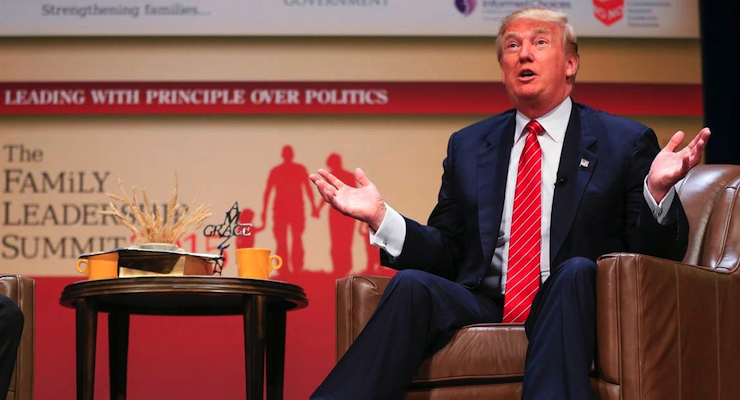
Republican presidential candidate, real estate mogul Donald Trump, speaks at the Family Leadership Summit in Ames, Iowa, Saturday, July 18, 2015. (AP Photo/Nati Harnik)
It’s time that the sophisticated analysts who pride themselves in their ability to discern nuance realized that Donald Trump’s popularity and his defenders are more nuanced than most people imagine.
Because Trump is outrageous compared with the usual presidential candidate, Beltway pundits assume his followers and sometime defenders are classless rubes willing to overlook any objectionable remark he makes and his mixed record on conservative causes.
These commentators seem more disgusted with Trump defenders than with President Obama’s destructive agenda and the threat it represents to America.
Their angst, I would argue, is not primarily about Trump. Their real beef is with Reagan conservatives and others who refuse to be calm about Obama’s assaults and are sick of lectures on bipartisanship and “civility.”
They are the superior ones who regard Sen. Ted Cruz as a grandstanding extremist because he refuses to be calm about this nation’s predicament and vigorously fights back. They are the ones who always want to throw in the towel in battles with Obama before those battles have even begun.
They see themselves as the only adults in the GOP room, and though they pretend to tolerate — if not admire — the tea party and Christian conservative activists, they must race to the bathroom and wash out their mouths with soap every time they publicly demonstrate anything but contempt for these lunatics. Some of them may even be among those silently grinning as the Obama administration dubs the tea party and returning veterans “domestic terrorists.”
They weren’t at all bothered by Sen. John McCain’s slander of Trump supporters as “crazies.” But they couldn’t wait to pounce on Trump when he fired back with a barb impugning McCain’s heroism. Of course, I won’t defend that remark, but even if Trump meant it literally, which I doubt, it doesn’t excuse McCain’s initial insult and its significance.
These three overlapping groups — tea partyers, Reagan conservatives and Christian conservatives — are fair game not just for liberal Democrats but also for establishment Republicans, and the groups are fed up.
After all, if it weren’t for them, establishment honchos would be powerless; they depend on these millions for their political lifeblood. Still, they give them nothing but disrespect in return.
I think I understand the inclination of establishment types to be cautious and not rock the boat too much with Obama for fear of losing that “next election.” But there is always going to be a next election. At what point does our side really stand up? At what point do we quit pandering to the mushy middle with pale pastels instead of pressing forward with policies marked by bold colors? Their fear has reached the point of paranoia, and they have neutered themselves.
I am glad Trump has shaken up the political world this campaign season, even if I don’t approve of everything he says and don’t prefer his candidacy. As an occasional defender, I think I take his candidacy less seriously than some of his attackers.
It seems that those attacking Trump most vociferously are the ones who generally attack Cruz. They mainly condemn Trump, I believe, because they see him sucking the oxygen from their beloved establishment candidates. His brashness and perceived crudeness are mostly an excuse, and it is quite convenient for their purposes.
The irony is that Trump will only be a viable candidate if establishment types keep obsessing over him and offending his supporters or drive him to pursue a third-party run. If they would quit trying to marginalize genuinely conservative candidates, perhaps the void that Trump has filled would eventually fill itself and squeeze Trump out.
The main difference between the establishment position and that of Reagan conservatives is more than a matter of disposition. It is that the former is impervious to the objective urgency of America’s predicament. Establishment types seem content to sit around the table, legs crossed, and dispassionately consider current events and the political climate as if they were little more than a game. “We’ve seen this all before,” some of them say, “and the situation will correct itself, so not to worry.”
They are yawningly unpanicked about the threats facing America and confuse their own apathy with adulthood. They are not, despite their apparent calm, the adults in the room, nor are the conservatives the unruly children. Adults realize true dangers facing their children (and their nation) and take action. They don’t congratulate themselves on appearing mature while letting their children or their nation be destroyed.
Some Trump supporters may be blind followers who would trail him over a cliff, but most are people who see their country disintegrating and having no effective means of turning it around.
There are a number of GOP candidates who would strive to dismantle the Obama nightmare, and we should all be grateful for the depth of the GOP bench. It is remarkable and a further testament to the public’s awareness of our nation’s dire predicament that so many capable people have stepped forward.
So please, my establishment friends, quit worrying about Trump; don’t be so quick to judge the Trump phenomenon and his supporters. The sooner you quit misjudging, underestimating and insulting them the sooner this race can return to what you would consider more normal. Have a little faith in the American people and in those conservatives with whom you claim to have common cause. They will be heard from this election season one way or the other.
US Democratic presidential hopeful Hillary Clinton speaks outlining economic vision at the New School in New York on July 13, 2015. (Photo: JEWEL SAMAD/AFP/Getty Images)
The problem is that Hillary may actually wind up in a position of power. So there’s a danger that the entire nation could be victimized because of her disregard of the laws of supply and demand. Let’s look at a fresh example. The New York Times has a story about Ms. Clinton’s latest effort to bribe people with their own money.
Hillary Rodham Clintonon Monday will propose major new spending by the federal government that would help undergraduates pay tuition at public colleges without needing loans. …her proposals…would cost $350 billion over 10 years…about $175 billion in grants would go to states that guarantee that students would not have to take out loans to cover tuition at four-year public colleges and universities.
To make matters worse, some of this money would be used to bribe states into additional spending (sort of the higher-education version of Obamacare’s Medicaid scam).
In return for the money, states would have to end budget cuts to increase spending over time on higher education, while also working to slow the growth of tuition, though the plan does not require states to cap it.
And to make matters even worsier (yes, that’s a made-up word, but it seems appropriate), there’s a big tax increase to finance Ms. Clinton’s new scheme.
Mrs. Clinton would pay for the plan by capping the value of itemized deductions that wealthy families can take on their tax returns.
But let’s set aside the concerns about fiscal policy and focus on what Clinton’s plan would mean for higher education.
And we’ll start with a thought experiment. Imagine you sold cars and the government decided to give people lots of money to buy your products. In the world of economics, this causes the “demand curve” to shift to the right.
Now answer a simple question: Would car prices under this policy (a) increase, or (b) decrease?
Moreover, there’s lots of evidence that the same thing already has happened with higher education. And now there’s new research that reaches the same conclusion.
As pointed out by the Wall Street Journal, recent scholarly data confirms that colleges and universities jack up prices to capture the additional subsidies.
Politicians…their solutions—cheap loans and taxpayer cash—end up increasing the cost of a degree. The latest evidence that schools jack up tuition to absorb federal money comes in a new report from the Federal Reserve Bank of New York. …The Fed researchers looked at how colleges responded when Congress bumped up per pupil aid limits between 2006 and 2008. Sure enough, students took out more loans, but universities gobbled up most of the money. Ohio University economistRichard Vedderconnected these dots a decade ago, estimating in 2006 that every dollar of grant aid raised tuition 35 cents. He now looks prescient. The New York Fed study found that for every new dollar a college receives in Direct Subsidized Loans, a school raises its price by 65 cents. For every dollar inPell Grants,a college raises tuition by 55 cents. This is one reason tuition has outpaced inflation every year for decades, while the average borrower now finishes college owing more than $28,000.
So what’s the bottom line? What will happen if Hillary Clinton expands subsidies to higher education?
Administrative bloat, reduced faculty loads and Shangri La dorms… College will continue to be expensive as long as government aid amounts to a wealth transfer to universities.
In other words, Ms. Clinton’s plan will double down on the policies — described in this video — which already have made college needlessly expensive.
All she’s doing is shifting more of the cost onto the backs of taxpayers.
Fortunately, there is a solution to this mess. Simply get the federal government out of the education business. This would reverse the bad policies that have caused colleges and universities to become more expensive and less efficient.
Sadly, this ideal approach probably won’t be adopted anytime soon.
But that doesn’t mean progress is impossible. Washington may actually move policy a bit in the right direction. And Elizabeth Warren (yes, that Elizabeth Warren) may even play a constructive role.
As reported by the Wonkblog section of the Washington Post, there’s growing interest in a plan to make colleges and universities partly responsible when students default on loans.
A coalition of liberal and conservative lawmakers is promoting a plan on Capitol Hill that would force colleges to pay up when their students default. If schools share the risk of borrowing or have some “skin in the game,” policymakers figure they would work harder to keep costs down….Senate Democrats, led by Elizabeth Warren (D-Mass.) and Jack Reed (D-R.I.), introduced legislation in 2013 requiring schools with default rates above 15 percent to reimburse the government 5 percent of the total defaulted debt. The higher the default rate, the higher the penalty. …Congressional Republicans are renewing the call for schools to share the risk of borrowing, as are presidential hopefuls Wisconsin Gov. Scott Walker and Ben Carson. The policy is being considered as a part of the re-authorization of the Higher Education Act.
The story even has some very sensible economic analysis about how third-party payer should be blamed for rising prices.
As it stands, there is little incentive for colleges to keep costs under control. As long as there is a supply of students and federal financial aid, both for-profit and nonprofit schoolscan charge high prices and encourage people to take out loans to cover the cost. If schools had a financial stake in every student’s ability to repay loans, they might be less inclined to saddle students with debt in the first place—or they might lower costs altogether.
Gee, what a shocking thought. If people have to play with their own money rather than taxpayer money, they suddenly behave more responsibly!
P.S. We should also remember that there is such a thing as too much “investment” in higher education.
P.P.P.S. Now for the most important news. The Beltway Bandits are now Eastern National Champions of 55+ AAA softball, winning five straight games in Raleigh, North Carolina this past weekend.
We’ll play in Las Vegas for a national title in late September.
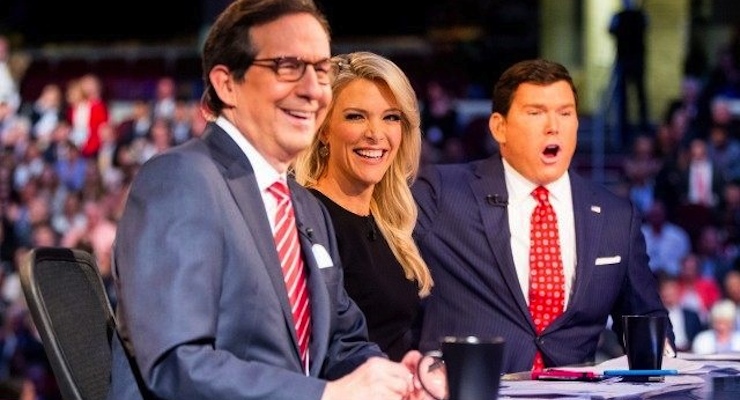
From left to right: Fox News debate moderators Chris Wallace, Megyn Kelly, and Bret Baier. (Photo: AP)
The so-called “debates,” among too many Republicans to have a debate, are yet another painful sign of how much words and ideas have degenerated in our times.
No one expects these televised sound bites and “gotcha” questions to be anything like the historic Lincoln-Douglas debates on the momentous national issue of slavery.
But the mob scene of candidates on stage that began with the 2012 campaign, and is now being repeated, is a big step down from the modern one-on-one debates between presidential candidates that began with John F. Kennedy versus Richard Nixon in 1960.
We still have momentous national issues. In fact, the threat of a nuclear Iran with intercontinental missiles is a threat to the survival of America and of Western civilization. The issue could not be bigger.
But this issue did not get even half the attention as was lavished on Donald Trump. Even in the earlier “debate” among the second-tier candidates, where Trump was not present, the first question asked was about Donald Trump.
Nothing could more plainly, or more painfully, show what is wrong with the priorities of the media.
A poll taken after the “debates” showed that, of the 17 participants, the top 5 were all people who had never run a state government or a federal agency. In other words, those who came out on top in this battle of sound bites were people whose great strength was in rhetoric.
After more than six years of Barack Obama in the White House, have we learned nothing about the dangers of choosing a President of the United States on the basis of sound bites, with no track record to check against his rhetoric?
Remember his promise of creating “the most transparent administration” in history? Remember his talk about “investing in the industries of the future” — and how that led to the bankruptcy of Solyndra? Remember “If you like your doctor, you can keep your doctor”?
These were all great exercises in rhetoric. But before there was a track record to check against that rhetoric, voting to put Obama in the White House was like flying a plane through mountains at night. If we manage to get through the next year and a half without crashing, should we try that gamble again?
It so happens that there are some governors with outstanding track records among the 17 Republican candidates. But not one of them made the top 5 in the first poll after the “debates.”
This is not to say that no one who has never been a governor should be considered. But to pick the top 5 exclusively from people with no governing experience shows how little we have learned about such gambles with the destiny of this nation.
Part of this is due to the format of these media “debates” among numerous candidates, which reduces their statements to little sound bites — and sound bites are seldom very sound.
Part of this is due to the kinds of questions asked by the media moderators. These first two “debates” were run by people from the Fox News Channel and, by media criteria, they were even praised by their competitors at CNN. But that just shows what is wrong with media criteria.
In the 2012 “debates,” moderator John King asked Newt Gingrich about his marital problems — and Gingrich drew a standing ovation from the audience when he pointed out that the millions of people who were watching on television had not tuned in to find out about his personal life. But then as well, others in the media sprang to John King’s defense, saying that any other media journalist would have asked that same question.
They might well be right. But that just shows what is wrong with the media. This year’s Fox News Channel moderators included people who are fine in their own programs. But cast in this new role as moderators, their reliance on the usual media practices was a great disservice to the country at a time when there are very serious — and potentially catastrophic — issues in the balance.
Is this country’s fate not as important as Donald Trump’s antics? Then why would the first of these “debates” open with a question about Donald Trump, who was not even present?
There is plenty of blame to go around, and neither the media, the candidates, nor the public should be exempted from their share.
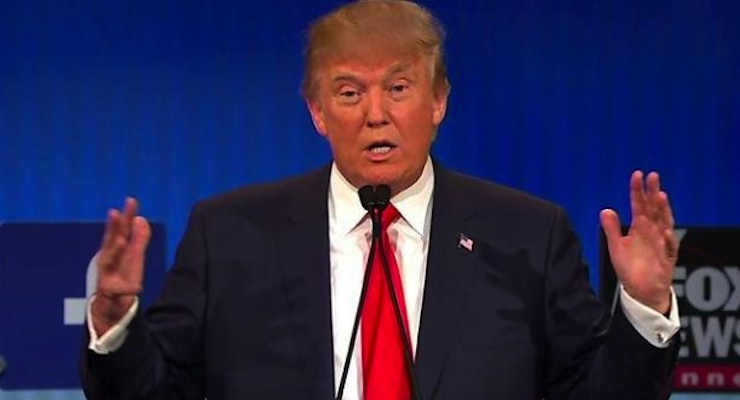
Billionaire real estate mogul Donald Trump on the Republican debate in Cincinnati, Ohio, when he said Fox News host Chris Wallace lived in a fairy tale.
There’s this great scene from “Law & Order” where Detective Briscoe shows a victim’s picture to a prostitute. He asks whether she knew of anyone who had “dated” him.
“I didn’t, but he’s cute,” she says.
“You’ve been at this too long, honey.” Briscoe replies. “He’s dead.”
The political punditry seems unable to agree on whether Donald Trump’s candidacy will survive the billionaire’s latest barrage of rhetorical barbarities. We refer to his attacks on Fox News questioner Megyn Kelly and the infamous “blood” remark.
But all this presupposes that Trump is conducting a real, living candidacy rather than a mega-prank. By all appearances, he is using the Republican fringe’s high tolerance of — nay, appreciation for — off-the-wall comments to expand the Trump brand at no cost to Trump. The billionaire also seems to be whipping up the right wing’s hatred of establishments, including the Republican one, for fun and profit.
Face it. Some 24 million viewers didn’t tune in to the Fox News debate just to hear Trump say outrageous things. They wanted to see him make the other candidates suffer.
Trump’s performance led to his banishment from the subsequent RedState debate. Its organizer, Erick Erickson, explained, “I don’t want my daughter in the same room” as Trump.
Sounds chivalrous, but Erickson’s coat of armor is not without chinks. It was Erickson who attributed feminists’ anger to their “being too ugly to get a date.” And he called Michelle Obama a “Marxist harpy wife.”
That armor evidently needs repair, for Erickson now seems hurt by the pro-Trump blowback. “I have emails from people referring to Megyn Kelly as a ‘whore,'” he complained. “I have emails from people referring to me as ‘gay.’ I have emails referring to the president by the N-word and (saying) that Donald Trump is standing up to all of us.”
Imagine such sensitivity coming from the man who writes such blog posts as “Is Obama Shagging Hookers Behind the Media’s Back?” That’s when he’s not writing deep religious tracts.
This is the ballpark Republicans have been playing in. Trump may say things that are dumb and crude, but they’re no dumber or cruder than the musings of the right-wing spokesmen whom party leaders routinely court.
Erickson can portray himself as a bulwark against indecency, but he’s really been Trump’s warmup act. Without his and others’ normalization of lunatic statements, Trump would never have gotten as far as he has.
One feels for the respectable Republicans dragged into these environs. It was sad to see Ohio Gov. John Kasich pummeled at the Fox News debate for having humanely expanded Medicaid in his state. It was unfortunate but inevitable that someone (this time Rand Paul) would slam New Jersey Gov. Chris Christie for having publicly hugged President Obama. The context, some may remember, was the president’s visit and offer of federal help after the devastation of Superstorm Sandy.
On the other hand, Christie and other Republicans had no problem sharing the stage with the likes of Erickson.
The Huffington Post last month moved its Trump coverage to the entertainment section from politics. Jay Rosen, a well-known media analyst, praised the decision as “the work of fed-up and free-thinking adults.”
But the move has irked political writers at The Washington Post. Are they merely defending their turf? Or have they been at this too long?
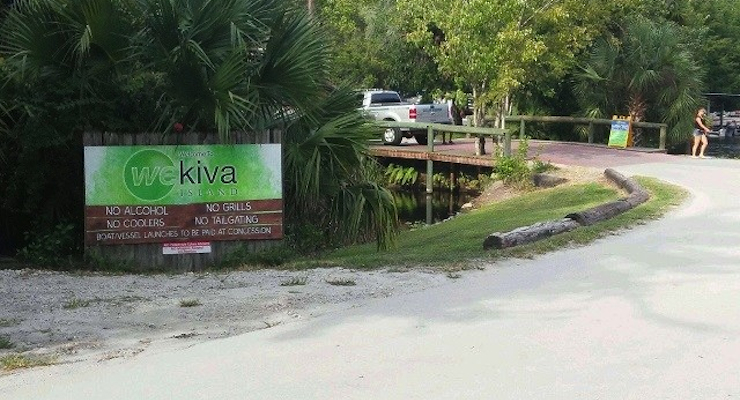
Entrance to Wekiva River in Seminole COunty, Florida.
SEMINOLE COUNTY, Fla. – Florida Fish and Wildlife officials say the alligator that seriously attacked Rachael Lilienthal, 37, on the Wekiva River Saturday afternoon, was killed.
Fire Rescue officials say that Lilienthal — who was bitten in the torso and suffered a lower arm amputation below the elbow — was swimming by herself in a busy area when she decided she wanted to go to a more remote area of the river. Not long after, officials say, she felt something grab her arm and pull her under the water.
Lilienthal was reportedly pulled under the water repeatedly — so much so, she lost track — and felt her arm break from the bite. Wildlife officials said kayakers came to Lilienthal’s rescue and were able to fight off the alligator using their paddles. Lilienthal was taken to Orlando Regional Medical Center. Florida Fish and Wildlife officials confirmed they located, identified and trapped the alligator around 12:30 a.m. Sunday. The alligator has been euthanized.
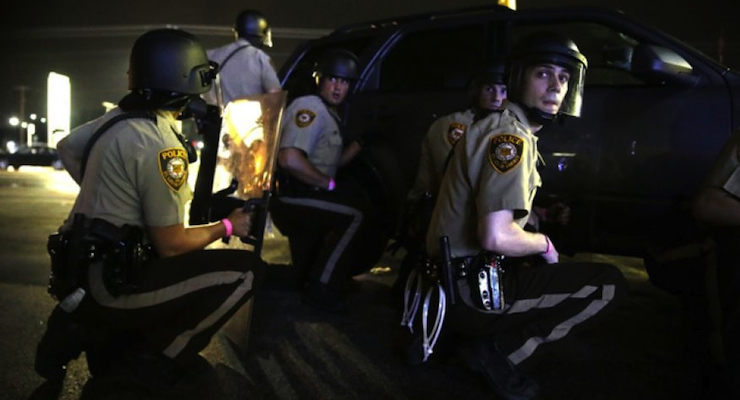
Aug. 9, 2015: Police take cover behind a vehicle during a protest in Ferguson, Mo. The one-year anniversary of Michael Brown’s death in Ferguson began with a march in his honor and ended with a protest that was interrupted by gunfire. (Photo: AP Photo/Jeff Roberson)
St. Louis County Police Chief Jon Belmar said a man opened fire on plainclothes police detectives in Ferguson late Sunday before being pursued and shot by the officers. The shoot out Sunday took place on the day marking the one year anniversary of 18-year old Michael Brown, who was shot by then-Officer Darren Wilson justifiably. The shooting, however, was highly politicized and when a grand jury refused to indict Officer Wilson and it was revealed the “hands up, don’t shoot” version of events was false, it led to widespread protests and rioting.
Chief Jon Belmar said that suspect — whom he refused to identify — was in “critical, unstable” condition at a local hospital. However, the St. Louis Post-Dispatch identified the man as 18-year-old Tyrone Harris Jr., whose father, also named Tyrone, told the paper that his son had just come out of surgery early Monday, and noted that his son and Michael Brown “were real close.”
Belmar said that officers had been tracking the man, whom they believed to be armed, during the protest. He said the man approached the detectives, who were sitting in a van, and opened fire. The officers returned fire from inside the vehicle before pursuing the man on foot. Belmar said the man shot again at the officers, all four of whom returned fire. The man who fired on officers had a semi-automatic 9MM gun that was stolen last year from Cape Girardeau, Missouri, according to the chief.
The officers have been placed on administrative leave, in keeping with standard practice after police-involved shootings. Belmar said none of the officers, who have between 6 and 12 years of experience, was seriously injured.
The shooting took place at approximately 11:15 p.m. local time as several hundred people gathered on West Florissant Street.
Belmar told reporters at a news conference early Monday that a second shooting involving two groups of people happened on the west side of West Florissant Avenue just before the police-involved shooting. Belmar said that between 40 and 50 shots were fired in an exchange that lasted approximately 45 seconds, an amount he described as “remarkable.” There was no immediate word of any casualties from that shooting.
“They were criminals. They weren’t protesters,” Belmar said of those involved in the shootings. There is a small group of people out there that are intent on making sure that peace doesn’t prevail. There are a lot of emotions. I get it. But we can’t sustain this as we move forward.”
You have %%pigeonMeterAvailable%% free %%pigeonCopyPage%% remaining this month. Get unlimited access and support reader-funded, independent data journalism.