Widget Image
Follow PPD Social Media
Thursday, January 1, 2026
HomeStandard Blog Whole Post (Page 610)

2016 California Democratic Primary

548 Delegates: Proportional Allocation (June 7, 2016)

Total delegates include 317 district, 105 at large, 53 Pledged PLEOs and 73 Unpledged PLEOs. Rules explained below polling table.

[election_2016_polls]


EGolden State Polling Data

[wpdatatable id=55]


The latest 2016 California Democratic Primary polls taken for the contest on Tuesday June 7. There are 548 delegates awarded on a proportional basis. A whole 475 of 548 delegates to the Democratic National Convention are pledged to candidates based on the results of the vote in the 2016 California Democratic Primary.

A mandatory 15% threshold is required in order for a candidate to be pledged National Convention delegates at either the congressional district or statewide level.

  • 317 district delegates are to be pledged proportionally to presidential contenders based on the primary results in each of the State’s 53 congressional districts.
  • 158 delegates are to be pledged to presidential contenders based on the primary vote statewide.
    • 105 at-large National Convention delegates
    • 53 Pledged PLEOs

[ssbp]

2016 California Democratic Primary 548 Delegates: Proportional Allocation (June 7, 2016) Total

2016 California Republican Primary

172 Delegates: Winner-Take-All (June 7, 2016)

Total delegates include 10 base at-large, 159 in the 53 congressional districts and 3 party delegates. Rules explained below polling table.

[election_2016_polls]


EGolden State Polling Data

[wpdatatable id=54]


The latest 2016 California Republican Primary polls taken for the contest on Tuesday June 7. There are 172 delegates awarded on a winner-take-all basis. All 172 of The Golden State’s delegates to the Republican National Convention are pledged to candidates on the day of the 2016 California Republican Primary.

159 district delegates are to be bound to candidates based on the primary results in each of the 53 congressional districts: each congressional district is assigned 3 National Convention delegates and the presidential contender receiving the greatest number of votes in that district will receive all 3 of that district’s National Convention delegates.

13 at-large delegates–including 10 base at-large delegates plus 3 RNC delegates–are to be bound to the candidate receiving the greatest number of votes in the primary statewide.

The selection of Presidential Nominating Convention Delegates to the Republican National Convention … shall be chosen by the Presidential candidate who obtained the plurality of Republican votes within each Congressional district, and, for … at large … by the Presidential candidate who obtained the plurality of Republican votes statewide. [Standing Rules and Bylaws of the California Republican Party As Amended 20 September 2015 Article VI Section 6.01 (A)]

Further, 3 party leaders–the National Committeeman, the National Committeewoman, and the chairman of the California’s Republican Party–will attend the convention as pledged delegates by virtue of their position. Individual Congressional District and “At-Large” delegates are chosen by the candidates.

Each delegate to the Republican National Convention shall use his or her best efforts at the convention for the party’s presidential nominee candidate from California to whom the delegate has pledged support until the person is nominated for the office of President of the United States by the convention, receives less than 10 percent of the votes for nomination by the convention, releases the delegate from his or her obligation, or until two convention nominating ballots have been taken. Thereafter, each delegate shall be free to vote as he or she chooses…. [California Elections Code Section 6461.(c)]

2016 California Republican Primary 172 Delegates: Winner-Take-All (June 7, 2016) Total

2016 Pennsylvania Democratic Primary

210 Delegates: Proportional (April 26, 2016)

Total delegates include 127 district, 42 at large, 20 Pledged PLEOs and 21 Unpledged PLEOs. Rules explained below polling table.

[election_2016_polls]


Keystone State Polling Data

[wpdatatable id=53]


The latest 2016 Pennsylvania Democratic Primary polls taken for the contest on Tuesday, April 26. There are 210 delegates awarded on a proportional basis. In the Keystone State, 189 of 210 delegates to the Democratic National Convention are pledged to candidates based on the results of the vote in the 2016 Pennsylvania Democratic Primary.

A mandatory 15% threshold is required in order for a candidate to be allocated National Convention delegates at either the congressional district or statewide level.

127 district delegates are to be pledged proportionally to presidential contenders based on the primary results in each of the State’s 18 congressional districts.
In addition, 62 delegates are to be pledged to presidential contenders based on the primary vote statewide.

  • 127 district delegates are to be pledged proportionally to presidential contenders based on the primary results in each of the State’s 18 congressional districts.
  • In addition, 62 delegates are to be pledged to presidential contenders based on the primary vote statewide.
    • 42 at-large National Convention delegates
    • 20 Pledged PLEOs

District Level delegates appear on the primary ballot and selections are made from the highest vote getters. In the event a presidential candidate qualifies to receive District delegates but failed to slate a sufficient number on the primary ballot, the necessary delegates will be elected at the State Convention.

[ssbp]

2016 Pennsylvania Democratic Primary 210 Delegates: Proportional (April

2016 Pennsylvania Republican Primary

71 Delegates: Winner-Take-All “Loophole” (April 26, 2016)

Total delegates include 10 base at-large, 54 in the 18 congressional districts, 3 party and 4 bonus delegates. Rules explained below polling table.

[election_2016_polls]


lKeystone State Polling Data

[wpdatatable id=52]


The latest 2016 Pennsylvania Republican Primary polls taken for the contest on Tuesday, April 26. There are 71 delegates awarded on a winner-take-all basis. In the Keystone State, 54 of the 71 delegates to the Republican National Convention will be directly elected (their names appear on the ballot) in what is called a “loophole” primary.

Each of the 18 Congressional Districts are allocated 3 delegates. Rule 8.4 of the Republican State Committee of Pennsylvania’s Rules states that all delegates elected by Congressional District “…shall run at large within the Districts and shall not be officially committed to any particular candidate on the ballot.”

17 delegates–including 10 base at-large delegates plus 4 bonus delegates and 3 RNC delegates–of the Commonwealth’s 71 delegates to the Republican National Convention are bound on the first ballot to the candidate who receives the most votes in the 2016 Pennsylvania Republican Primary. The delegates are released if the candidate withdraws, suspends, or terminates his/her campaign or publicly releases his/her delegates, according to Rule 8.3.

[ssbp]

[AdsWithin]

2016 Pennsylvania Republican Primary 71 Delegates: Winner-Take-All "Loophole"

jobs-employment-line-reuters

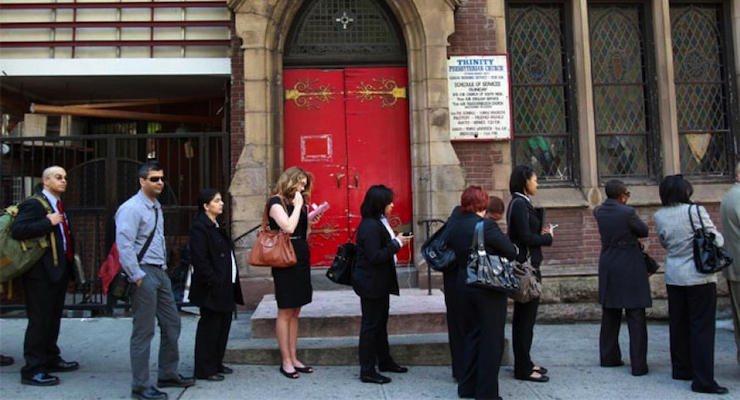
Unemployed Americans wait in line for to fill out applications for jobless benefits. (Photo: Reuters)

The Labor Department said Thursday weekly jobless claims rose by 6,000 to 265,000 last week. That came in lower than the estimate for 268,000. The prior week was revised lower by 6,000 to 259,000.

No state was triggered “on” the Extended Benefits program during the week ending March 5, according to the Labor Department, and an analyst said no special factors impacted the data. Though the jobs market has been plagued by low wages, low participation and part-time opportunities, the report marks 55 consecutive weeks of initial claims below 300,000, the longest streak since 1973.

The highest insured unemployment rates in the week ending March 5 were in Alaska (4.4), New Jersey (3.2), West Virginia (3.2), Wyoming (3.1), Pennsylvania (3.0), Connecticut (2.9), Montana (2.9), Rhode Island (2.9), Illinois (2.8), and Massachusetts (2.8).

The largest increases in initial claims for the week ending March 12 were in California (+1,359), Nebraska (+662), Washington (+503), Oklahoma (+318), and Vermont (+285), while the largest decreases were in New York (-1,549), Illinois (-1,234), New Jersey (-1,079), Ohio (-909), and Florida (-852).

The Labor Department said Thursday weekly jobless

durable-goods-reuters

American workers at a manufacturing plant for long-lasting durable goods. (PHOTO: REUTERS)

The Commerce Department reported on Thursday durable goods orders fell 2.8% in February from the prior month, missing the median forecast for a 2.8% decrease. Non-defense capital goods orders excluding aircraft, a closely watched proxy for business spending plans, fell 1.8% after gaining by a downwardly revised 3.1% in January.

The drop in durable goods orders in February was fueled by a whopping 27.1% decrease in civilian aircraft orders, which sparked a 6.2% decline in bookings for transportation equipment.

These so-called core capital goods orders were previously reported to have increased 3.4% in January. Excluding the volatile transportation component and durable goods orders fell by a shallower 1%, missing estimates for a decline by 0.2%.

Durable goods are defined as manufactured products ranging from washing machines to dryers to toasters to aircraft, which are meant to last three years or more. The manufacturing sector, which accounts for 12% of the U.S. economy, has been floundering even as other sectors, largely the service sector, carry the economy.

The decline in shipments last month could prompt economists to slice off first-quarter GDP growth estimates, which are currently around a 2% annualized rate. The economy grew at a 1.0% rate in the fourth quarter.

The Commerce Department reported durable goods orders

San-Bernardino-shooters

Syed Farook, 28, and Tashfeen Malik, 27, the suspects responsible for the San Bernardino Islamic terror attack. (Photos: AP/EPA)

One inevitable sequel to a terrorist attack is seeing the ugly mugs of creeps-turned-monsters thrust before us over a multitude of news cycles. Another is a debate over cellphone encryption.

Encryption is a means of turning information into secret code. Terrorists communicate through encrypted devices to hide their plans and protect the identities of their co-conspirators. For obvious reasons, law enforcement wants to know what’s being said and to whom.

The FBI had been demanding that Apple turn over an encryption key to crack the iPhone used by San Bernardino gunman Syed Rizwan Farook. Apple has refused, arguing that helping the FBI hack Farook’s iPhone would put the privacy of other iPhone users in jeopardy. That would be bad for business.

Apple’s case has always been morally and legally flawed, but now it may be moot. That’s because on the very day of the terrorist outrage in Brussels, the Justice Department announced it may now be able to get at the information in Farook’s iPhone without Apple’s input.

An unidentified third party has reportedly found a way to hack the phone. That method is being tested to ensure that it doesn’t destroy the valuable data in the process.

If it succeeds, Apple will have lost in three ways. No. 1: Consumers are no longer assured that iPhone data is invulnerable. No. 2: By forcing others to find a means of cracking an iPhone, Apple loses control over the process. And No. 3: Apple is left with having fought the bad fight.

All that goodwill Apple has amassed for its wonderful products could start draining away as Americans wonder what side it’s on. The rampage in San Bernardino took 14 lives and grievously injured 22 others. Survivors and relatives of the dead have protested Apple’s defense of a mass murderer’s cellphone data. That’s definitely bad for business.

Suppose Belgian investigators cleaning up the body parts came across an encrypted iPhone of a terrorist impressed by Apple’s promise of privacy. Would Apple refuse to help uncover accomplices in that bloodbath, as well?

Some argue that Farook’s iPhone 5c is easier to crack than the newer iPhones. Does Apple now want to bet that hacking the iPhone 6 or a later model can’t be done by a highly talented geek?

The Justice Department’s legal basis for requiring Apple to unlock an encrypted device is the 1789 All Writs Act. The law applies only if compliance is not an unreasonable burden. Apple claims invading Farook’s iPhone would be “unreasonably burdensome.”

With a search warrant based on probable cause, law enforcement may barge into your home, break into your metal file cabinets and look in your underwear drawer. (For further information, consult some “Law & Order” reruns.)

One’s cellphone is not a sacred space. Mobile phone users worried that police doing a warranted search might come across their third-grader’s math scores or a prescription for Viagra should not put such data onto their gadget in the first place.

The concern in Apple’s boardroom and elsewhere in the Silicon Valley is that governments less constrained by civil liberties than ours would demand the key to breaking the encryption. They already do, but that’s between the companies and the other countries. It’s really not the American public’s problem — unless you want to argue that tech company profits trump national security.

Apple’s position was insupportable. Now it may be irrelevant. A wise move for those in the tech industry would be to quietly work out some accommodation with law enforcement in the halls of Congress. Rest assured, they won’t want to hold such discussions in the heat of another, even more devastating terrorist attack.

One inevitable sequel to a terrorist attack

easter

On Easter, we examine public opinion on Jesus and the God of the Christian Bible.

What is the connection between personal freedom and rising from the dead?

When America was in its infancy and struggling to find a culture and frustrated at governance from Great Britain, the word most frequently uttered in speeches and pamphlets and editorials was not “safety” or “taxes” or “peace”; it was “freedom.” Two acts of Parliament broke the bonds with the mother country irreparably.

The first was the Stamp Act, which was enforced by British soldiers who used general search warrants issued by a secret court in London to rummage through the personal possessions of any colonists they chose, ostensibly looking to see whether they had purchased the government’s stamps.

A general search warrant, as the Foreign Intelligence Surveillance Act court issues in America today, did not specifically describe the person or place to be searched — which our Constitution now requires. Rather, these warrants were authority for the bearer to search wherever he pleased and seize whatever he wanted — and it remains so today despite what the Constitution says.

The second intolerable act in the Colonial era was the imposition of a tax to pay for the Church of England, which all adult male property-owning colonists were forced to pay, no matter their religious beliefs.

The Stamp Act assaulted the right to be left alone in the home, and the Church of England tax assaulted the freedom to retain one’s earnings and to choose to support one’s own means of worship. These two laws caused many colonists to realize they needed to secede from Britain and form their own country, in which freedom would be protected by the government, not assaulted by it.

Today the loss of freedom comes in many forms.

Sometimes it is direct and profound, as when Congress acts like a general legislature that can right any wrong, regulate any activity and tax any event; and the courts permit it to do so. Sometimes it is subtler — for example, when the government prints money to pay its bills and, as a result, all the money and assets we already have lose much of their value.

Sometimes the government steals freedom without our knowing it, such as when the National Security Agency reads our email and text messages and listens to our phone calls without a proper search warrant.

Freedom is the ability of every person to exercise personal free will without a government permission slip. Free will is a characteristic we share in common with God. He created us in His image and likeness. As He is perfectly free, so are we.

When the government takes away our free will, the government steals a gift from God; it violates the natural law; it prevents us from having and utilizing the means to seek the truth. The exercise of free will to seek the truth is a natural right that all humans possess, and the government may only morally interfere with that exercise when one has been convicted of using fraud or force to interfere with the exercise of someone else’s natural rights.

We know from events 2,000 years ago, which Christians commemorate and celebrate this week, that freedom is the essential means to discover and unite with the truth. To Christians, the personification, the incarnation and the perfect manifestation of truth is Jesus — who is the Christ, the Son of God and the Son of the Blessed Virgin Mary.

On the first Holy Thursday, Jesus attended a traditional Jewish Passover Seder. Catholics believe that at His last supper, Jesus performed two miracles so that we could stay united to Him. He transformed ordinary bread and wine into His own body, blood, soul and divinity, and He empowered His disciples and their successors to do the same.

On the first Good Friday, the government executed Jesus because it was convinced that by claiming to be the Son of God, He might foment a revolution against it. He did foment a revolution, but it was in the hearts of men and women. The Roman government had not heard of a revolution of the heart, so it condemned Him to death by crucifixion.

Jesus had the freedom to reject this horrific event, but He exercised His free will so that we might know the truth. The truth is that He would rise from the dead.
On Easter, three days after He died, that manifestation was completed when He did rise from the dead. By doing that, He demonstrated to us that while living, we can liberate our souls from the slavery of sin and our free will from the oppression of the government; and after death, we can rise to be with Him.

Easter — which manifests our own immortality — is the linchpin of human existence. With it, life is worth living, no matter its costs or pains. Without it, life is meaningless, no matter its fleeting joys or triumphs. Easter has a meaning that is both incomprehensible and simple. It is incomprehensible that a human being had the freedom to rise from the dead. It is simple because that human being was and is God.

Jesus is the hypostatic union — not half God and half man and not just a godly good man but truly and fully God and, at the same time, truly and fully man. When the Roman government killed the man Jesus, it killed God. When the man Jesus rose from His tomb, God rose from the dead.

What does Easter mean? Easter means that there’s hope for the dead. If there’s hope for the dead, there’s hope for the living. But like the colonists who fought the oppression of the king, we the living can only achieve our hopes if we have freedom. And that requires a government that protects freedom, not one that assaults it.

Happy Easter.

Judge Andrew Napolitano: What is the connection

March of Marriage in DC

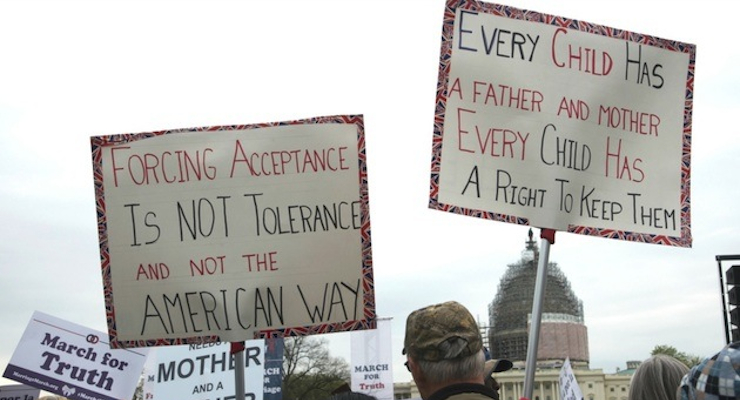
April 25, 2015 – Washington, DC USA: Protestors holds up a sign supporting heterosexual marriage at the March for Marriage (Photo:Patsy Lynch/Polaris/Newscom)

Alabama’s senators have thrown an interesting twist in what’s become gay activists’ favorite political game of late – killing the traditional family unit – and passed a bill that would, in essence, remove the state from the business of issuing marriage licenses.

What an in-your-face response to Obergefell v. Hodges, the Supreme Court case granting gays the same rights as heterosexual couples when it comes to marriage. When the highest court in the land told states “you must grant gay marriage licenses,” Alabama’s leading Republicans dared to say: Oh no we don’t. How?

The final page of SB 143, which passed the GOP-dominated senate in Alabama and moved to the House for debate and discussion, states this: “All requirements to obtain a marriage license by the State of Alabama are hereby abolished and repealed. The requirement of a ceremony of marriage to solemnize the marriage is abolished.”

The proposal, if it passes into law, would put an end to state-issued marriage licenses by county probate judges and instead require couples who’ve married to file forms to record their unions. The state probate judges would then simply record receipt of their contracts. Basically, it turns the state into record-keepers, not record-granters.

As Republican Sen. Greg Albritton, who sponsored the measure, said to one local newspaper, his bill “eliminates the requirement for a license so that neither the probate court nor the state will be the governor body of telling who can marry whom.”

Know what else it does?

It legally defies the Supreme Court’s redefinition of marriage by underscoring a long-forgotten fact – that marriage isn’t a concept of man, but rather God – and by putting in place the tools for couples to give wings to those words. Take the government out of marriage, and what’s left?

Marriage, in its purest and simplest form.

“This is a fascinating unintended consequence of the Supreme Court ruling on gay marriage,” said Robert Scott Bell, a Florida homeopath and host of the Robert Scott Bell Show whose own wedding went forth via covenant and faith, outside government’s matrix. “It moves the institution of marriage a little closer to where it once was, with our religious institutions, not government. Perhaps this was the wake-up call that was needed for people with deeply held religious convictions about holy matrimony. Why did we ever think we needed government to sanctify such relationship?”

Good question. Why indeed?

The fact that Alabama’s senators and SB 143 might be seen as reactionary or radical by some for daring to remove the state government from the arena of marriage only shows how dependent we’ve become on the public service sector for even the most basic – the most God-given – of human rights and activities.

But Bell bucked this system long ago.

“That’s why I married my wife by covenant and recorded it in the family Bible,” he said. “I found it rather counter-intuitive to openly invite government into our marriage via a license, so we didn’t.”

And, as he discovered in his own walk with freedom, neither man nor woman need government to marry. Well, Alabama senators are saying similarly – while at the same time letting the Supreme Court justices know: You may be the highest law in the land, but you’re hardly the highest law in the universe.

[mybooktable book=”police-state-usa-how-orwells-nightmare-is-becoming-our-reality” display=”summary” buybutton_shadowbox=”true”]

Alabama’s senators have thrown an interesting twist

US-Capitol-Building-iStockPhoto

U.S. Capitol Building on Capitol Hill. (Photo: iStockPhoto)

I realize it’s presumptuous, but I periodically make grandiose claims that a single column will tell readers “everything” they need to know about a topic. I’ve used that tactic when writing about tax loopholes, entitlements, fiscal policy,bureaucracy (twice), tax evasion, France, Greece, corporate inversions, and economic policy.

Sometimes I even claim a single image, chart, or cartoon provides a reader with “everything” needed to understand an issue.Examples include the minimum wage, economic policy, the welfare state, supply-side economics, the tax code, Europe’s fiscal crisis, Social Security reform, demographics, overpaid bureaucrats,healthcare economics, inequality, fiscal policy, and the Ryan budget (twice).

Needless to say, I don’t actually think these columns give readers “everything” on a topic. But I do hope the information makes a compelling and informative point about an issue.

So it’s time to expand this tactic and present one sentence that tells readers “everything” they need to know about the failure of big government. And it’s not even the full sentence, just the bolded portion in this excerpt from a BuzzFeedstory about how Belgium is trying to deal with terrorism.

One Belgian counterterrorism official told BuzzFeed News last week that due to the small size of the Belgian government and the huge numbers of open investigations…virtually every police detective and military intelligence officer in the country was focused on international jihadi investigations. …the official, who spoke on condition of anonymity because he was not authorized to speak to the media, said. “It’s literally an impossible situation.”

When I read that sentence, my jaw dropped to the floor. Belgium has one of the biggest and most bloated governments in the world.

You don’t have to take my word for it. Go to the OECD’s collection of data and click on Table 25 and you’ll see that the public sector in Belgium consumes almost 54 percent of the nation’s economy. That’s bigger even than the size of government in Sweden and Italy.

So the notion that fighting terrorism is hampered by the “small size of the Belgian government” is utterly absurd.

The real problem is that politicians and bureaucrats have become so focused on redistributing money to various interest groups that there’s not enough attention given to fulfilling the few legitimate functions of government. Not just in Belgium, but all over the world. Here’s what I wrote on this issue back in 2012.

…today’s bloated welfare state interferes with and undermines the government’s ability to competently fulfill its legitimate responsibilities. Imagine, for instance, if we had the kind of limited federal government envisioned by the Founding Fathers and the “best and brightest” people in government – instead of being dispersed across a vast bureaucracy – were concentrated on protecting the national security of the American people. In that hypothetical world, I’m guessing something like the 9-11 attacks would be far less likely.

What I said about America back then is even more true about Belgium today. Big governments are clumsy and ineffective, and bigger governments are even more incompetent. There’s even scholarly research confirming that larger public sectors are associated with higher levels of inefficiency.

And the same point has been made by folks such as Mark Steyn and Robert Samuelson (though David Brooks inexplicably reaches the opposite conclusion).

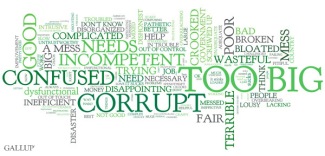
The good news is that the American people have an instinctive understanding of the problem. Whenasked to describe the federal government, you’ll notice that “effective” and “efficient” are not the words people choose.

P.S. On a related note, I argued in a column from 2014 that the federal government should be much smaller so it could more effectively focus on genuine threats such as the Ebola virus.

P.S. It’s worth pointing out that Israel, which faces far greater security challenges than Belgium, manages to do a better job with a government that is not nearly as large.

Daniel Mitchell, CATO economist and senior fellow,

People's Pundit Daily
You have %%pigeonMeterAvailable%% free %%pigeonCopyPage%% remaining this month. Get unlimited access and support reader-funded, independent data journalism.

Start a 14-day free trial now. Pay later!

Start Trial