Widget Image
Follow PPD Social Media
Friday, January 16, 2026
HomeStandard Blog Whole Post (Page 944)

Israel invades Gaza Strip

July 17, 2014: Smoke from flares rises in the sky as Israel invades Gaza City, explosions ring out in the northern area of the Gaza Strip. (Photo: AP)

The Israeli military confirmed they sent thousands of troops to invade portions of the Gaza Strip Thursday in an effort to destroy “terror infrastructure” used by Hamas to target the Jewish State.

The army said in a statement late Thursday that after 10 days of Hamas attacks, it had “initiated a ground operation within the Gaza Strip.” The army said the objective was to strike a “significant blow to Hamas’ terror infrastructure,” particularly the underground tunnels used by the terror group to move money, weapons and other supplies.

The Israeli ground invasion followed a failed attempt by 13 militants to infiltrate Israel earlier Thursday through a tunnel under the Gaza-Israel border. They were stopped in their tracks by an Israeli strike at the mouth of the tunnel.

“The decision of the Israeli army to start a ground invasion in Gaza is dangerous and they will pay back heavily for it,” Hamas spokesman Fouzi Barhom told reporters in Gaza. “Hamas is ready for the confrontation.”

Israeli Prime Minister Benjamin Netanyahu released a statement shortly after the ground invasion began, citing the terror group’s refusal to accept the terms of the Egyptian-brokered cease-fire, as well as their continuous rocket barrage despite a short 5-hour cease-fire that was agreed upon for humanitarian purposes.

“In light of the despicable and relentless aggression by Hamas and the dangerous infiltration into Israel, Israel is obliged to protect its citizens,” Netanyahu said.

Operation “Defensive Edge” will reportedly continue “until its goal is reached: to restore sustainable quiet and calm to the Israeli citizens while severely hurting and dismantling Hamas infrastructure as well as other terrorist organizations in Gaza.”

Israeli military spokesman Lt. Col. Peter Lerner also said that the operation will continue until the mission is completed.

“We will be striking the infrastructure,” he said. “We will be striking the operatives in order to safeguard the civilians of the state of Israel especially issues to do with tunneling, that was exemplified earlier today.”

Israel had called up 48,000 reserve soldiers over the course of the last eleven days, and later Thursday the Israeli Cabinet authorized the military to call up 18,000 more.

Egypt’s efforts to broker a longer-term truce after its initial plan was rejected by Hamas earlier in the week, have failed. Hamas, which assumed control of the Gaza Strip seven years ago, wants several international guarantees. First, Hamas demands the joint Israeli-Egyptian blockade will be eased so they can have access to the Al-Aksa Mosque on the Temple Mount in Jerusalem. But the areas surrendered nearby in 2012 by Israel was quickly turned into a terror safe-haven, resulting in the tunnel system the IDF seeks to destroy now.

It has been grossly under-reported that Hamas was in dire financial straits prior to the outbreak of fighting, because a tight crack down of the blockade by Egypt had stopped cash and weapons from coming into the strip through hundreds of smuggling tunnels under the Gaza-Egypt border. The conditions led many to believe the three kidnapped teenagers were to be ransomed by Hamas, but later killed when it became clear Israeli military raids would be the strategic response by the Israeli government. While both Israeli and U.S. officials have said there was a substantial amount of evidence to show Hamas was responsible, PPD has yet to see evidence of a ransom, though the financial incentive was real and strong.

Second, Hamas demands that Israel will release the Palestinian Schalit prisoners.

The six prisoners were initially freed by Israel as part of an exchange for a captured IDF soldier, but later re-arrested in the West Bank after the group recommenced terrorist activities. Israeli officials said the issue of re-releasing the prisoners was “not up for discussion,” because they are simply too much of a danger to their national security.

The latest violence began following the kidnappings and killings of three Israeli teenagers last month. Their bodies had been discovered in a shallow grave in the West Bank. Then, there was a subsequent kidnapping and killing of a Palestinian teenager in an apparent revenge attack. Israel launched an offensive on July 8, saying it was going to put an end to Hamas rocket fire “once and for all” out of Hamas-controlled Gaza Strip.

The Israeli military confirmed they sent thousands

new housing starts

(Photo: REUTERS)

U.S. housing starts and building permits unexpectedly fell for the month of June, suggesting the housing market recovery was struggling to get back on track after stalling in late 2013. Many attempted to blame the weak housing market on unusually cold weather since February’s weak report was released, but that excuse simple will not do in the middle of the summer.

Then, housing starts and building permits tanked far more than economist’s expected in May even as the weather began to warm in what was another sign the housing recovery was artificial.

Now, groundbreaking tanked by 9.3 percent to a seasonally adjusted annual 893,000 million unit-pace, which is the lowest since September, before the cold weather even. The Commerce Department also said on Thursday April’s starts were revised downward to show a steeper 7.3 percent drop, up from the previously reported 6.5 percent drop.

Economists polled by Reuters had forecast starts rising to a 1.02 million-unit rate last month.

Housing has been constrained by higher mortgage rates and a shortage of properties for sale has pushed up prices, reducing affordability for many everyday Americans.

Groundbreaking for single-family homes, the largest part of the market, plummeted 9.0 percent in June to a 575,000-unit pace, also the lowest since November of 2012. Meanwhile, single-family starts in the South dropped to their lowest level in two years.

Starts for the more volatile multi-family homes market fell by 9.9 percent to a 318,000-unit rate.

Permits, in total, fell 4.2 percent to a 963,000-unit pace in June, though Wall Street economists had expected them to rise to a 1.04-million unit pace. Permits for single-family homes alone did increase 2.6 percent to a 631,000 unit-pace, which is the highest level since November. However, permits for multi-family housing absolutely tumbled 14.9 percent to a 332,000-unit pace.

The housing market is still hanging by a threat, relying upon artificial and dangerous government regulations and rules to regain a small measure of momentum. Earlier in June, two policy statements made by Mel Watt, director of the Federal Housing Finance Agency (FHFA), and Shaun Donovan, secretary of HUD, backed-off tight restrictions that required sound lending practices, repeating the mistakes of the subprime mortgage crisis.

The FHFA is the regulator of Fannie Mae and Freddie Mac, which along with the Federal Housing Administration (FHA) are responsible for guaranteeing about 75 percent of all mortgage credit in the United States. In an effort to boost a failing housing market, they’ve abandoned the rules against underwriting risky mortgages.

U.S. housing starts and building permits unexpectedly

Microsoft Redmond Campus

Microsoft Redmond Campus. (Photo: REUTERS)

In a letter to employees early Thursday, Microsoft CEO Sataya Nadella said the tech giant will slash up to 18,000 jobs over the course of the next year. The first round including 13,000 cuts as soon as within the next six months.

The move comes after Nadella hinted at changes coming to the blue-chip software company in remarks made earlier in the week. The workforce cuts is the first step in a plan Nadella characterized the as one aimed at “building the right organization for our ambitions.”

The first round of cuts will wack the Nokia Devices and Services unit the hardest, by far. The unit will assume a loss of 12,500 jobs, including both professional and factory worker positions. Nadella said that even though the company is reducing the size of its workforce, it has plans to add specialized roles in certain strategic areas, however, those will be highly skilled positions obviously tailored outside of a typical factory worker’s skill set.

“My promise to you is that we will go through this process in the most thoughtful and transparent way possible,” Nadella said in a statement Thursday.

Nadella did promise that employees whose jobs are eliminated will be offered severance and other help with the transition out of the labor force.

In a letter to employees early Thursday,

Hamas rockets fire during cease-fire

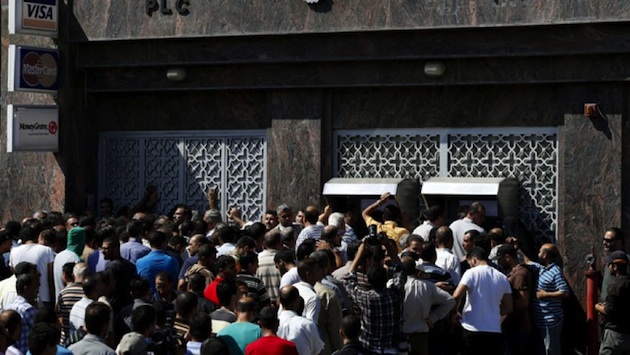
July 17, 2014: Palestinians gather to withdraw money from ATM machines in Gaza City. The Bank of Palestine opened one of its branches in Gaza City’s Rimal neighborhood as the cease-fire began, drawing hundreds of people trying to withdraw money. (AP Photo/Lefteris Pitarakis)

Israel’s military confirmed at least three Hamas rockets were fired into southern Israel from the Gaza Strip during a five-hour humanitarian cease-fire window Thursday. Israeli police spokesman Mickey Rosenfield also told the Associated Press that two rockets hit southern Israel, but fell in open areas causing no damage or injuries. Rosenfield said the rockets landed at 12 p.m. local time (5 a.m. ET), two hours after the cease-fire began.

Israel had agreed to the cease-fire requested by the United Nations for the purposes of getting emergency supplies, including food and water into Gaza. Leading up to Thursday’s temporary cease-fire, Israel conducted nearly 2,000 air strikes on Gaza over 10 days, while Hamas fired more than 1,300 rockets into Israel, reaching the country’s economic and cultural heartland. If not for the Iron Done defense system and a recent thwarting of an attempted attack by 13 Islamic militants., Israeli military spokesman Lt. Col. Peter say the attacks “could have had devastating consequences” on the civilian population.

The cross-border fighting has so far killed more than 230 Palestinians and an Israeli, according to officials. However, Israeli officials say Hamas rockets are so indiscriminate, their own rockets touch down in their own territory.

Egypt has resumed efforts to broker a longer-term truce after its initial plan was rejected by Hamas earlier in the week. Hamas, which assumed control of the Gaza Strip seven years ago, wants several international guarantees. First, Hamas demands the joint Israeli-Egyptian blockade will be eased so they can have access to the Al-Aksa Mosque on the Temple Mount in Jerusalem. Second, Hamas demands that Israel will release the Palestinian Schalit prisoners.

The six prisoners were initially freed by Israel as part of an exchange for a captured IDF soldier, but later re-arrested in the West Bank after the group recommenced terrorist activities. Israeli officials said the issue of re-releasing the prisoners was “not up for discussion,” because they are simply too much of a danger to their national security.

Reuters had quoted an anonymous Israeli official claiming that Israeli senior representatives at talks in Cairo had accepted an Egyptian proposal for a comprehensive Gaza cease-fire starting on Friday. The source said Israel’s leaders still had to approve the deal. But Foreign Minister Avigdor Liberman on Thursday denied these reports, though it is unclear whether a deal was sabotaged by the continued rocket fire from Hamas during the temporary humanitarian cease-fire.

Prime Minister Binyamin Netanyahu on Tuesday attempted to respond to his critics both on his own the Right by firing Deputy Defense Minister Danny Danon, a member of his own Likud Party, and Palestinian sympathizers who hold Israel to a higher standard for civilian casualties resulting from the military campaign.

The decision came after Netanyahu was attacked Tuesday by Danon for his decision to accept the Egyptian-proposed cease-fire with Hamas. In addition to Danon, he faced sharp criticism from Yisrael Beytenu leader Avigdor Liberman, Bayit Yehudi head Naftali Bennett, and other politicians inside the Likud. Many of these members of Netanyahu’s government, including Foreign Minister Avigdor Lieberman, support a ground invasion. Lieberman said a press conference that “the Israel Defense Forces must finish this operation in control of the entire Gaza Strip.”

But Netanyahu’s close associates, including those who disagree with the acceptance of the cease-fire, said Danon crossed a line. A source close to Netanyahu told the Jerusalem Post that such a statement coming from Israel’s deputy defense minister “had emboldened Hamas and harmed Israel’s deterrence.”

“While Israel is in the midst of a military operation against terrorist organizations and working determinedly to maintain the security of Israeli citizens, the deputy defense minister cannot sharply attack the leaders of the state,” Netanyahu said. “His harsh statements, which Hamas used against Israel, prove his irresponsibility.”

Netanyahu said that if Danon lacked confidence in his own government, he should have resigned. But when it became clear that he wasn’t going to resign, Netanyahu fired him.

Israel's military confirmed at least three Hamas

The former executive editor of the New York Times Jill Abramson sat for an interview with Greta Van Susteren “On the Record” Wednesday July 16, giving the inside the story on her time and the Times. Abramson said criminal leak investigation on reporter sources is one reason she believes President Obama’s administration is most secretive she has ever dealt with.

Abramson was fired back in May after criticizing the Obama administration for secrecy. But Arthur Sulzberger, Jr., the publisher at the liberal-dominated newspaper, said “she had lost the support of her masthead colleagues and could not win it back.”

He also what he characterized as “incorrect reports that Jill’s compensation package was not comparable with her predecessor’s,” and said her pursuit of a pay raise has no role in the decision to terminate her.

Former executive editor of the New York

protests over illegal immigrants

Border patrol officers during a immigration demonstration outside the Border Patrol facility Friday, July 4, 2014 in Murrieta, California. (Photo: AP)

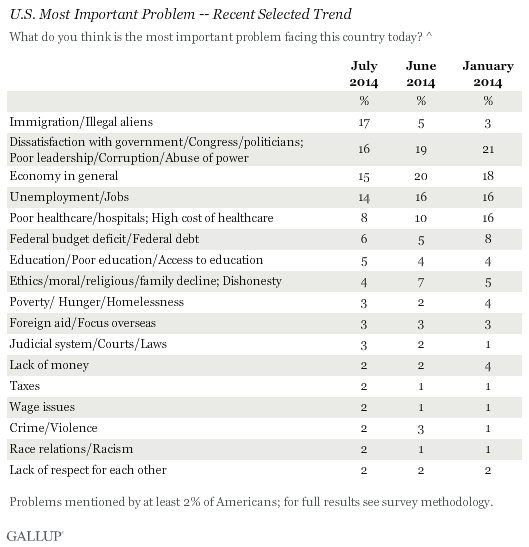
With a massive number of illegal aliens pouring across the border, the issue of illegal immigration has surpassed dissatisfaction with government and the economy as the top problem facing the U.S. today, American say. A new Gallup survey found the percentage of Americans citing immigration as the top problem has skyrocketed to 17 percent, which is up from 5 percent in June and the highest seen since 2006.

“As a result, immigration now virtually ties ‘dissatisfaction with government,’ at 16 percent, as the primary issue Americans think of when asked to name the country’s top problem,” said Lydia Saad at Gallup.

top issues Gallup

Whatever way you try to read it, the data is not good for President Obama and the Democratic Party. When respondents were asked to say which party can better handle the issue, Republicans were again at parity with Democrats, with each party enjoying 35 percent support among Americans. While this may not seem terrible for Democrats, historically, it’s a disaster.

Republicans enjoyed similar levels of support relative to Democrats on this question in September, 2010 — 40 – 38 percent — just before voters gave the president’s party a historic “shellacking” in the midterm House and Senate elections. Also, Republicans were practically tied with Democrats in 1994 (41 – 37 percent) and 2002 (38 – 36 percent), two cycles Gallup noted Republicans made big gains in the midterms.

“The only recent midterm election year in which Republican parity with the Democrats on this measure did not foretell Republican gains in the midterms was in 1990,” Saad noted, “but that year an unusually high proportion chose neither party as the best for handling the top issue.”

And the same can be observed for Democrats on the question. In 2006, the Democrats enjoyed a record 15-point advantage right before they won control of both houses of Congress. However, with Democratic Minority Leader Nancy Pelosi calling the border crisis “an opportunity,” it isn’t at all surprising Americans view the party with less trust.

“This crisis that some call a crisis, we have to view as an opportunity,” Pelosi said.

However, the American people couldn’t disagree more with the minority leader’s assumption. “In fact, more Americans think immigration should be decreased than increased, and by a nearly two-to-one margin, 41 percent vs. 22 percent,” Saad said commenting on another recent Gallup survey.

Similarly, a new survey from Pew Research found Americans say by a 42 – 40 percent margin that they trust Republicans more on issues of immigration, while just 28 percent say President Obama is doing a good job dealing with the issue.

Interestingly, Americans who express the most dissatisfaction and concern over the border crisis are disproportionately older, a recently reliable Republican voting bloc needed to turn out in November if Republicans hope to retake the Senate.

Outrage over the border crisis has been growing since busloads of illegal immigrants were turned back by flag-waving protestors in Murrieta, California, back in early July and rerouted to San Diego by Homeland Security. Prior, Arizona Governor Jan Brewer raised awareness to the practice when she slammed President Obama in a letter, citing the administration’s “dangerous and unconscionable” policy of dumping illegal aliens in cities around the state without her knowledge.

The San Diego border patrol union confirmed shortly after that illegal immigrants were spreading scabies and other diseases, and at least 4 cases of TB were confirmed by nurses by July 7.

“While the 17 percent of Americans naming immigration as the top problem is not large in absolute terms, the fact that the issue is of particular concern to Republicans and older Americans — both groups that Republicans need to turn out in force in the midterms — could be critical to the outcome,” Saad said.

With a massive number of illegal aliens

border crisis illegal immigrants

A new intelligence report obtained by Catherine Herridge at Fox News concluded that the border crisis is being caused by illegals seeking amnesty misunderstanding U.S. immigration policy, not violence in Central America.

The 10-page report conducted on July 7 was by the El Paso Intelligence Center (EPIC), which is headed up by the DEA and includes the Department of Homeland Security. “Its focus is on the collection and distribution of tactical intelligence, information which can immediately be acted on by law enforcement,” according to Herridge.

“Of the 230 migrants interviewed, 219 cited the primary reason for migrating to the United States was the perception of U.S. immigration laws granting free passes or permisos to UAC (unaccompanied children) and adult females OTMs (other than Mexicans) traveling with minors,” the report said.

PPD spoke to Guatemalan officials when the story first broke in early June, who told us that the Catholic Church and state-run media outlets had been advertising Obama’s policies as a “free pass” for them. Officials contacted the Obama administration last year to warn them of the imminent influx of illegal immigration, but the White House didn’t respond.

President Obama and other Democrats who have openly admitted their support for open borders have attempted to sell a false bill of goods to the American people, again. Since reports first began to surface, the left has claimed the border crisis was the result of violence in Central American countries that have been violent for decades, and that we should classify those who have crossed the border illegally as refugees.

“The violence isn’t new. The situation in those countries is not new,” Rep. Mario Diaz-Balart (R-FL) told reporters Tuesday. “These cartels have seen a weakness in the system. They’ve seen statements coming from the administration that they have used in order to just frankly increase the number of people coming over.

Democratic Rep. Henry Cuellar and Republican Sen. John Cornyn, both lawmakers from Texas, introduced bipartisan legislation on Monday that would make the process of determining whether illegals should be deported quicker by reforming an antiquated immigration law.

The Helping Unaccompanied Minors and Alleviating National Emergency (HUMANE) Act would rewrite the 2008 bill signed into law by President George W. Bush. Under existing law, the William Wilberforce Trafficking Victims Protection and Reauthorization Act, or TVPRA, illegal immigrants from countries other than Canada and Mexico are turned over to the Department of Health and Human Services, which then release them to the custody of relatives or other caregivers as they wait for their cases to come up in immigration court.

However, over 90 percent of “unaccompanied minors” never show up and simply disappear, according to San Diego Border Patrol union representative Gabe Pacheco. Arizona Sens. John McCain and Jeff Flake were recently criticized by the mainstream media for using the 90 percent figure loosely, but the reality is the government’s record-keeping practices are suspect to lawmakers. In 2012, alone, ICE was looking for more than 469,000 people who failed to appear.

Nationwide, according to immigration court officials in San Diego, roughly 33 percent of immigrants released by U.S. Customs and Border Enforcement (ICE) did not show up for their immigration hearings.

“It would provide a deterrence and stop the vast majority of these children and their families from initiating this journey in the first place only to find out it would not be successful by and large, and this would be the fix to solve that problem.” Cornyn said during a conference call Tuesday morning with reporters.

The intelligence assessment was not intended to be seen by anyone outside of relevant law enforcement officials, but suspiciously, the report cited data from the United Nations office on Drugs and Crime Statistics that found violent crime for Central America actually decreased. The United Nations earlier this week publicly pushed U.S. lawmakers to classify the illegal immigrants as refugees, despite knowing full-well the recent surge in border crossings had nothing to do with violence, which would make them eligible for such a status.

“There’s no doubt the message went out- go across border now the United States won’t do anything about it,” Rep. Kay Granger (R-TX) told Fox News.

The report was released as lawmakers who just visited Central America returned, and their statements also suggest that the prior criticisms of President Obama’s policies were valid.

Rep. Mario Diaz-Balart (R-FL) and others told reporters Tuesday that human smugglers — also known as coyotes – are exploiting Obama’s changes and refusal to enforce U.S. immigration law. The Obama administration decided in 2012 to practice prosecutorial discretion in cases where individuals were brought into the U.S. illegally as minors.

“It’s a critical situation and if we don’t deal with it urgently but well- done right- then we’re facing a crisis of just huge proportions,” Diaz-Balart warned.

The report represents the latest crumbling of a manufactured, D.C.-based narrative on the issue of immigration.

In June, the National Association of Former Border Patrol Officers called the border crisis an “orchestrated and contrived assault” by a government with an agenda. But new polling shows the government’s agenda doesn’t mirror the interests of the American people.

“In fact, more Americans think immigration should be decreased than increased, and by a nearly two-to-one margin, 41 percent vs. 22 percent,” said Lydia Saad of Gallup.

Similarly, a new Rasmussen Reports poll found just 31 percent of Americans favor legal immigration, and that’s only if the border is secured first and the government effectively stops the flow of illegal immigrants. Further, 52 percent of Americans say the U.S. is not strict enough on illegal immigrants and companies who hire them, while a small 14 percent minority disagree.

A new intelligence report obtained by Catherine

On Wednesday, the death toll in Gaza reached 201, while on Tuesday Israel suffered its first fatality in this latest round of fighting when a mortar shell struck and killed an Israeli man delivering food to soldiers near a Gaza border crossing. Prime Minister Benjamin Netanyahu vowed to hit Hamas with “great force” for the attacks, which will certainly result in more Palestinian civilians being hurt or killed.

Though Israel is always held to a higher standard than Hamas for causing civilian casualties, a new video released by the IDF shows just how far the Israeli military will go to reduce such instances, even aborting attacks on Hamas to avoid hitting Palestinian civilians.

The first video depicting aerial shots of the Gaza Strip seen by f Israeli air force pilots shows that on at least three occasions they aborted attacks after seeing Palestinian civilians in the area.

“We have identified a civilian on the roof. Less than 20 meters [from the target],” one pilot says, then is promptly ordered to “move on to the next target” from the chain of command.

In the second excerpt provided by the IDF, a pilot says he sees “people loading a vehicle within 100 meters [of his target]. There are people within 100 meters. Yes, there is a civilian walking in a yard.”

Copy that. We will not strike this target now,” ground forces respond.

In the third, a female IDF soldier reports that she sees what appears to be four or five adults.

“This is a very sensitive target. There are lots of people and children in the area,” the pilot says.

“Stop. For now we will not target this location,” the chain of command also tells him.

Critics will no doubt claim the video is made to show, but the fact is Hamas lost political credibility when it rejected the cease fire this week. Despite multiple warnings from Israel, the Gaza Interior Minister had repeatedly told the Palestinian people to ignore Israel’s warnings, claiming it was nothing more than a psychological warfare tactic meant to intimidate.

“I cannot condemn strongly enough the actions of Hamas in so brazenly firing rockets in multiple numbers in the face of a goodwill effort to operate a cease-fire,” U.S. Secretary of State John Kerry said Tuesday. Even U.S. allies across the pond, who recognize Palestine as a state, have condemned the decision.

“I hope the Hamas leadership now understand the best thing to do is to call a halt, have the negotiation, discussion, and sit down with everybody to work out a long-term, viable plan for Gaza,” former British Prime Minister and Middle East peace envoy Tony Blair told Sky News.

Israel has accused Hamas of hiding behind civilians and using them as cover for their rocket launching sites and weapons depots. The claim was bolstered when images surfaced from a video posted by Fatah’s military wing that showed a militant launching a rocket within yards of a house using a food cart to camouflage his launcher.

https://www.youtube.com/watch?v=5DFroK_1KYg

Though Israel is always blamed for civilian

Colorado Governor race - Hickenlooper vs Beauprez

Incumbent Democratic Gov. John Hickenlooper squares off against Republican Bob Beauprez in the Colorado governor race. (Photo: AP)

Incumbent Democratic Gov. John Hickenlooper and Republican Bob Beauprez are now neck-and-neck in the Colorado governor race, according to a series of recent polls. PPD is moving our rating from “Leans Democrat” to “Toss-Up” on our 2014 Governor’s Map Predictions model.

Though Hickenlooper leads Beauprez by 1 point on the PPD average, the latest poll conducted by Quinnipiac University finds the governor trailing his Republican opponent 44 – 43 percent, within the margin of error. When assessing both the PPD average and the race rating, PPD’s model weighs pollster results based on past performance, assigning a pollster a rating from 1 to 5 for accuracy. Quinnipiac University has a stellar 1.25 rating, coming within 2 points of the final result more than 70 percent of the time assessed.

Worth noting, the NBC News poll was conducted by Marist, who lost their stellar rating after badly calling the 2012 presidential election on numerous accounts. They are the only poll to find Hickenlooper leading by such a margin, and when you look at other races released along with the Colorado governor poll, you will find they are also an outlier in those other states.

Interestingly, Rasmussen Reports, a pollster on the other end of the spectrum with the likes of PPP, or Public Policy Polling, found similar results in a survey conducted in late June, just after Beauprez secured the Republican nomination.

“Is former U.S. Rep. Bob Beauprez enjoying a bounce after his Republican primary win or is he a real challenge to the Democratic incumbent?”, asked Tim Malloy, assistant director of the Quinnipiac University poll.

While we are certain to find out for sure in future polls, others have questioned whether the competitive of the race can be attributed to a bump, as well. It would be hard to argue that a bump has nothing to do with Hickenlooper’s drop, but a closer look inside the data from Quinnipiac’s past polls offers a more convincing assessment.

In past polls, even those that found the governor leading his potential challengers, Colorado voters said — by varying margins — that he did not deserve reelection. While the numbers have gone back and forth, there is a very real dissatisfaction with the governor from a not-so insignificant number of Colorado voters.

TREND: Do you feel that John Hickenlooper deserves to be reelected, or do you feel that he does not deserve to be reelected?
                     Jul 16  Apr 23  Feb 05  Nov 19  Aug 23  Jun 13
                     2014    2014    2014    2013    2013    2013
 
Yes/Deserves         42      47      45      42      45      45
No/Does not          48      43      45      49      48      44
DK/NA                10      10       9       9       7      11

Quinnipiac pointed out that voters are happy with the economy and the direction of the state, yet they curiously do not think the governor should be reelected.

“Coloradans seem generally optimistic about the future and confidant in the state’s economy. But that is certainly not enough to open the way for a smooth ride to reelection for Gov. John Hickenlooper,” Malloy noted.

The governor’s term hasn’t been without controversy, including the historic recall of the Colorado Senate President and another Democrat, who backed stricter guns laws in this year’s legislative session. One more Democrat still resigned to save themselves from embarrassment. Also, there was the little matter of staying an execution that the vast majority of voters supported, and the governor’s continued refusal to state whether he is truly pro-death penalty or not. That’s understandable because, he’s not and the voters are.

Couple state-specific controversy with the fact the election cycle is looking increasingly cherry for Republicans, and the race is a “Toss-Up,” just as the Colorado Senate race has become since Cory Gardner entered the race.

Poll Date Sample MoE Hickenlooper (D) Beauprez (R) Spread
PPD Average 6/25 – 7/14 45.3 43.7 Hickenlooper +1.0
Quinnipiac 7/10 – 7/14 1147 RV 2.9 43 44 Beauprez +1
NBC News/Marist 7/7 – 7/10 914 RV 3.2 49 43 Hickenlooper +6
Rasmussen Reports 6/25 – 6/26 750 LV 4.0 44 44 Tie

Incumbent Democratic Gov. John Hickenlooper and Republican

People's Pundit Daily
You have %%pigeonMeterAvailable%% free %%pigeonCopyPage%% remaining this month. Get unlimited access and support reader-funded, independent data journalism.

Start a 14-day free trial now. Pay later!

Start Trial