Widget Image
Follow PPD Social Media
Friday, January 16, 2026
HomeStandard Blog Whole Post (Page 958)

mcconnell vs grimes kentucky senate race

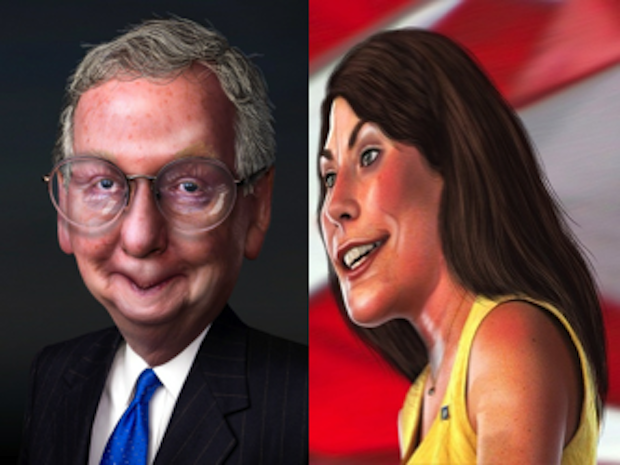
Minority Leader Mitch McConnell faces Alison Lundergan Grimes in the 2014 Kentucky Senate race.

Minority Leader Mitch McConnell is beginning to pull away from Democratic challenger Alison Lundergan Grimes in the 2014 Kentucky Senate race, according to recent polling. Since we first visited and rated the race it has always been rated “Likely Republican” on the PPD 2014 Senate Map, though characterized as one of two races Democrats see as an opportunity to win in conservative territory in November. Now, we are beginning to see the fundamentals we mentioned fall into place.

Following McConnell’s overwhelming victory over challenger Matt Bevin in the Republican Senate primary on May 20, two independent expenditure groups that support Senator McConnell have bought a total of $5.2 million in ad time to hammer Grimes and tie her to a deeply unpopular president and his signature health care law. Obviously, and predictably, it is beginning to have an affect.

When looking at the race’s polling over the past month, a trend immediately pops out showing McConnell opening up a lead. A poll conducted by SurveyUSA for the Courier-Journal found Grimes leading by just 1 point with 43 percent. Aside from the fact that 43 percent is close to the ceiling of support for Democratic candidates in state, the polling firm has certain polling methods, which places strict limitations on their ability to draw from a reliable sample. It’s not that SurveyUSA isn’t an honest pollster, but our pollster rating model finds serious flaws with their methodologies, and it shows in our accuracy test, which factors in how many times a pollster missed the mark by 3-points or more (among other variables).

A poll conducted by Republican polling firm Wenzel Strategies during the week following the primary found McConnell leading Grimes by 3 points, 47 to 44 percent. Again, we see Grimes around the low 40s in support, and she has never polled higher than 46 percent. Now, the latest survey from Rasmussen Reports founds McConnell pulling away with a 7-point lead — 48 to 41 percent — with Grimes falling back down in the low 40s where she has averaged in all polls conducted since 2013.

On primary day we cautioned over-confident Democrats that Grimes would not be effective at combating the truth, which is that she would be fully supportive of the Obama and liberal, big government agenda. The We Are Kentucky PAC, the main PAC supporting Grimes, recently reported raising just $32,500 in the first quarter of 2014. Since its inception last July, it has raised only $293,000. We Are Kentucky has yet to even run or reserve media advertising on behalf of Grimes. However, it has already burned through most of the money it has raised.

As of April 1, the PAC reports having just $108,336 cash on hand. Meanwhile, just one super PAC supporting McConnell — Kentuckians for Strong Leadership — has reported raising more than $3.3 million already. Worth noting, none of this money takes into account McConnell’s own massive — massive — campaign war chest. Since 2009, he has raised $21,686,624, with $10,145,566 cash on hand. So,  it is safe to conclude that much of McConnell’s lead has to do with the barrage of attack ads and McConnell’s money advantage.

But not all of it.

While we call Kentucky the Blue Grass State, the grass is just about the only thing blue about the state. President Obama’s approval in Kentucky is in the low 30s, and the Democratic brand is so unpopular that McConnell can survive his low approval numbers in November. In 2010, when Sen. Rand Paul easily won his seat riding a wave of Tea Party support, the Partisan Voting Index (PVI) for Kentucky was R+10. In 2014, the Partisan Voting Index is estimated at R+14, far too Republican to consider the 46 percent Grimes earned in just one poll anything but her ceiling of support.

Even the horribly flawed New York Times/Kaiser poll found McConnell ahead by 1-point back in April, but the sample was only +3 Romney. Mitt Romney carried the state of Kentucky by 23 points against Barack Obama in 2012, a year when the PVI fell between 2010 and 2014. Even though I have been hard on Rasmussen Reports in the past, they have likely hit the nail on the regarding where this race stands right now. McConnell, suffering from a lack of approval on his right flank, is hovering just below the 50 percent threshold, while Grimes is struggling to break 45 percent.

Grimes has a proven ability to win in a statewide race, but not against Mitch McConnell, and a U.S. Senate race is a much different atmosphere than a contest for secretary of state. Further, if there is one thing conservative Republicans who are unhappy with McConnell’s leadership wants to see more than Establishment candidates defeated, it’s a U.S. Senate soon-to-be controlled by the Republican Party after November. When we examine the Kentucky Senate race using the PPD model, which you can read about on the 2014 Senate Map Predictions page, Mitch McConnell has a 75 percent chance of defeating Alison Lundergan Grimes.

Poll Date Sample McConnell (R) Grimes (D) Spread
PPD Average 4/8 – 5/29 45.75 43.25 McConnell +2.5
Rasmussen Reports 5/28 – 5/29 750 LV 48 41 McConnell +7
Wenzel Strategies (R) 5/23 – 5/24 608 LV 47 44 McConnell +3
Courier-Journal/SurveyUSA* 5/14 – 5/16 1475 LV 42 43 Grimes +1
NBC News/Marist 4/30 – 5/6 2353 RV 46 45 McConnell +1
CEA/Hickman Analytics (D) 4/24 – 4/30 500 LV 46 45 McConnell +1
NY Times/Kaiser 4/8 – 4/15 891 RV 44 43 McConnell +1
Wenzel Strategies (R) 2/8 – 2/11 1002 LV 43 42 McConnell +1
Courier-Journal/SurveyUSA 1/30 – 2/3 1082 RV 42 46 Grimes +4
Rasmussen Reports 1/29 – 1/30 500 LV 42 42 Tie
PPP (D) 12/12 – 12/15 1509 RV 43 42 McConnell +1
Wenzel Strategies (R) 7/23 – 7/24 624 LV 48 40 McConnell +8
Wenzel Strategies (R) 6/1 – 6/2 623 LV 47 40 McConnell +7
PPP (D) 4/5 – 4/7 1052 RV 45 41 McConnell +4
PPP (D) 12/7 – 12/9 1266 RV 47 40 McConnell +7

The latest polls conducted on the Kentucky
Dan Sullivan

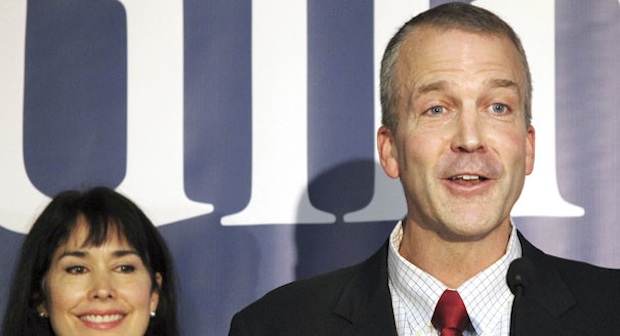
FILE – In this Oct. 15, 2013, file photo, Dan Sullivan, right, smiles while announcing a U.S. Senate bid in Anchorage, Alaska. On the left is his wife, Julie Fate Sullivan. Republican U.S. Senate candidate Dan Sullivan says no one he’s met on the campaign trail has questioned his residency or credentials as an Alaskan. The campaign of rival Lt. Gov. Mead Treadwell has questioned Sulliivan’s roots in Alaska, as has the state Democratic party. Sullivan moved to Alaska in 1997 and said he’s maintained ties here, even while serving out of state with the Marines and in Washington in the administration of George W. Bush. (AP Photo/Mark Thiessen, File)

Alaska Republican Senate candidates, Joe Miller and Mead Treadwell, met this week for a debate hosted by the United for Liberty – Alaska/Conservative Patriots Group. Libertarian Mark Fish also met at the Wilda Marston Theater in Anchorage, Alaska, where roughly 200 people were in attendance. However, Natural Resources Commissioner Dan Sullivan was a no-show, leaving unanswered the recent questions raised over his position on climate change.

Following the debate, Joe Miller won the straw poll conducted by the debate sponsors, which was the second straw poll win for Miller in less than a week. In Wasilla last Saturday, during the inaugural convention of the Alaska Republican Assembly, Miller easily won the convention’s U.S. Senate straw poll with a whopping 76 percent of the vote.

The candidates traded blows on issues such as immigration, same-sex marriage and climate change. Miller has been hammering his opponents on their positions regarding climate change. The Alaska Dispatch recently ran a puff-piece story that accused Miller of “trying once again to carve out the far-right territory as a climate change denier, though without directly saying so.”

During the debate, Treadwell affirmed his belief in man-made climate change, otherwise known as global warming or whatever name they have decided to call it this week. Sullivan, who didn’t show up to clarify his position, is trying to straddle the middle ground, claiming there is no consensus on the issue. Sullivan enjoys the endorsement of The Club for Growth, a group that would no doubt oppose climate change legislation. Still, Sullivan has made repeated statements in the past that suggest a flip-flop on the issue.

At a December 2007 conference in Washington, D.C., Sullivan said “our shared concern over the global environment and climate change” was a significant aspect to the Bush administration’s energy policy. At the Scandinavian Renewable Energy Forum in October, 2008, Sullivan said “our energy challenges and climate change challenges stem primarily from a common source — an overreliance on hydrocarbons as the world’s primary form of energy.”

Sullivan is the perceived front-runner in the race and is out-raising his Republican primary opponents. But according to both incumbent Senator Mark Begich, as well as senior political analyst of PPD, Richard D. Baris, pundits are almost certainly underestimating Miller.

“Aside from the fact pundits are referencing polling data far too much in a state that is notoriously difficult to poll, I took a look at this back in January,” Baris said. “And despite what the talking heads say, when you actually look at the data you can observe a very real, very clear path to victory for Mr. Miller.” In the January article he referenced, Baris wrote of the possibility that a “reverse vote-splitting phenomena” could sink the two Establishment candidates, leaving an energized grassroots support base strong enough to earn Miller the win.

“The straw poll results, now, provide more evidence that Miller has the grassroots momentum,” Baris added. The Alaska Republican primary is rated a “Toss-Up” on PPD’s 2014 Senate Map.

“Joe’s second straw poll win in less than a week reflects the growing momentum the campaign has been seeing on the ground,” said spokesman Randy DeSoto. “Joe turned in a strong performance in the debate, proving he is the true conservative/reform candidate and is the right choice to represent the Republican Party against Senator Begich in the fall.”

Joe Miller took his second straw poll

obamacare

Despite increased yet inflated enrollment, ObamaCare is not getting any less unpopular among the American people.

The Obama administration continuously touts higher-than-expected, but utterly phony ObamaCare enrollment numbers. Yet, in most polls, Americans’ attitudes toward the healthcare law have either remained deeply negative since the 2014 open enrollment period ended or changed only marginally in a few polls, at best. On the PPD average of polls, only 39 percent approve of ObamaCare, or the Affordable Care Act, while 51 percent still disapprove.

According to the most recent survey by Gallup, a fairly consistent 43 percent of Americans approve of the law, while a majority continues to disapprove of it, “roughly where sentiment was before the enrollment window officially closed on March 31.”

Gallup has been slightly more favorable to the law than the median average among pollsters, and far more favorable than other recent surveys, including a poll conducted by the Associated Press, which found just 28 percent of Americans fully support the law. The latest NBC/Wall Street Journal poll found just 36 percent support compared to 46 percent opposition.

If we were to simply ignore the specific variations in the numbers, then we can see that the spread, itself  — which consistently favors the opposition — has averaged roughly 12 points over the past month. Worth noting, the spread would be worse if two polls — one from Rasmussen Reports and the other from ABC News/WaPo — didn’t find more than marginal improvements (however, later in the month both of their follow-up polls found drops in support and rising opposition returning, and we were actually forced to downgrade the ABC/WaPo poll for their poor methodologies).

So, why is it that the law remains deeply unpopular, even with the all-out assault on those cruel and cold Republicans trying to take Medicaid away from the poor?

As is typically the case with public opinion, the answer isn’t as simple as some Republican explanations have claimed, and the current gauge of public sentiment is flatly nowhere near where the Democrats’ claims suggest. The real answer is complicated, but can be broken up into a two-fold explanation, which consists of a decision-making process that is one part ideological and one part rational policy preference, or also properly referred to as practical policy preference.

Practical policy concerns and preferences influence ideology more so than the other way around, though they clearly have an impact on each other when measuring current public opinion. Simply put, the American people may like the “idea” of every American gaining health insurance, but the law itself hurts their personal situation or is perceived to inevitably hurt them in the future. And the majority would be correct in drawing that conclusion.

A study conducted by healthcare analysts at Morgan Stanley found health insurance premiums increased at the highest rate ever measured by the firm. The survey of 148 brokers concluded health insurance premiums increase under ObamaCare because of ObamaCare, blatantly stating “increases are largely due to changes under the ACA.” Further, a CBO ObamaCare report released in February projected at least 2.3 million jobs will be destroyed due to the law’s incentivizing people not to work. The latest Commerce Department report, which showed the economy contracted, also showed consumer spending increased for health care costs, but decreased in other sectors that drive economic growth.

Polling conducted by Rasmussen, who regularly tracks these concerns, and snap-shot polling from the Associated Press/Gfk and others, all have corroborated the fact that the majority of Americans have concluded that ObamaCare will hurt them.

To be sure, there is a deep and systemic anti-government-centered solution base among the American public, which whether big government liberals like it or not, is still very much a part of the American national political identity. But that presence is simply not big enough to explain the conclusive swing in the public opinion data.

A survey from Gallup found that 56 percent of adults now say that it is not the job of the federal government to ensure that all Americans have healthcare coverage. But that wasn’t always the case. The number of Americans who say a government-centered solution to health care is out of the question has fluctuated quite a bit, while those in favor hit the 60s in the mid 2000s during the Medicaid Part D debate. Americans have largely hated the idea of a single-payer for all outside of Medicare, but they have been open to other suggestions in the past, that is prior to ObamaCare.

The 56 percent of U.S. adults who now say it is not the federal government’s responsibility to make sure all Americans have healthcare coverage is now a new record high. The left has really taken a beating on this issue, despite Nancy Pelosi telling “Meet the Press” that healthcare is a right, not a privilege.

We can safely conclude that the consistent negative perception of ObamaCare will not only continue for the foreseeable future, but that it is likely to get much, much worse. In the latest AP poll, 59 percent of Americans say they have insurance through “job-based private insurance” coverage, while just 8 percent said they were included in the individual private market that has been directly affected by the law. The president has issued waiver after waiver to postpone the inevitable  political damage  from cancellations, but up until now it has just been a tiny slice of Americans who have actually been impacted.

When the employer mandate kicks in, all hell will break lose, which will severely damage ObamaCare in the court of public opinion. A study conducted in November by People’s Pundit Daily, prior to the numerous unilateral delays, found that 145 million Americans are currently in policies that are not eligible to be grandfathered when measured against the “Essential Health Benefit Standards” required by the law. All of the facts point to the law’s failure to accomplish what its stated purpose was, which was to cover the uninsured.

The bottom line is that Americans will be forced to pay even higher costs than they previously paid for a product that they do not necessary want, and most assuredly do not need. The vast majority of Americans believe that the nation’s heath care system will get worse under the law, they believe it will hinder economic growth.

Couple all of this with a now-infamous broken promise, along with a likely bailout of the insurance companies due to an unsustainable high risk pool, and the health care law’s worst days are yet to come.

Why is it that, despite the Obama

The U.S. economy contracted in the first quarter for the first time in three years, at least technically. The government changed how it calculated GDP in 2012, which makes widely circulated GDP comparisons an apple and oranges comparison. Economists immediately blamed the severe winter weather, while continuing to point to signs economic activity has since rebounded.

The Commerce Department on Thursday made a downward revision to its growth estimate to show gross domestic product, or GDP contracting at a 1.0 annual rate. This is the worst economic performance since the first quarter of 2011, and showed a much weaker pace of inventory accumulation, as well as a wider than previously estimated trade deficit.

The government had previously estimated GDP growth expanding at a 0.1 percent rate, but that measurement included trade gap figures that were later revised. People’s Pundit Daily calculated the contracted to be roughly 0.7 percent, but the report topped that number. It is not unusual for the government to make sharp revisions to GDP numbers as it does not have complete data when it makes its initial estimates.

Wall Street’s and economists’ expectations forecast revisions to show GDP contracting at a 0.5 percent rate.

The economy was estimated to have grown at a 2.6 percent pace in the fourth quarter. There has been some signs of turnaround this month, but that seems to be the pattern for the last five years.

From employment to manufacturing data, reports this month suggest growth will increase in the second quarter, though disappointment in a lack of staying power is becoming the sad seasonal norm.

While economists wildly estimate that the cold weather could have cut as much as 1.5 percentage points from GDP growth, the government made no reference and gave no details involving the impact of the weather. This suggests the theory is simply not viable at this point in the season.

Businesses accumulated $49.0 billion worth of inventories, which was far less than the $87.4 billion estimated last month. Even though “experts” and economists were taken by surprise by the report, recent surveys showed the American were not, at all.

Prior to the report, the Rasmussen Consumer Index, which measures consumer confidence on a daily basis, dipped less than one point last Thursday to 102.8. Consumer confidence was down four points from a week ago, up two points from both one month ago and three months ago. But the disconnect between Main Street and Wall Street is astonishing. the Rasmussen Investor Index was down two points on Thursday at 120.5. Confidence was also down two points from a week ago, up one point from a month ago, and up five points from three months ago.

Overall, 49 percent of Americans said the U.S. economy was in a recession.

Similarly, Gallup’s U.S. Economic Confidence Index was -15 for the week ending May 25, its ninth consecutive week at or near this level. The index slumped a bit in early March, ranging from -18 to -20, but has fluctuated narrowly between -14 and -17 since.

Consumer spending, which accounts for more than two-thirds of U.S. economic activity, increased at a 3.1 percent rate, while it was previously reported to have increased at a 3.0 percent pace. However, it is what Americans are spending money on that is hurting economic growth.

The Affordable Healthcare Act, or ObamaCare, expanded healthcare coverage to many Americans. Yet, consumer spending on health insurance has skyrocketed along with the cost increases forced by the law, leaving little for other sectors in the fourth and now first quarters.

Business spending on nonresidential structures, including gas drilling, contracted at a 7.5 percent rate. The previous estimates were way off, as it had previously been reported to have increased at a 0.2 percent pace. The report showed corporate profits after tax plunged at a 13.7 percent rate, which was the biggest drop since the fourth quarter of 2008.

The U.S. economy contracted in the first

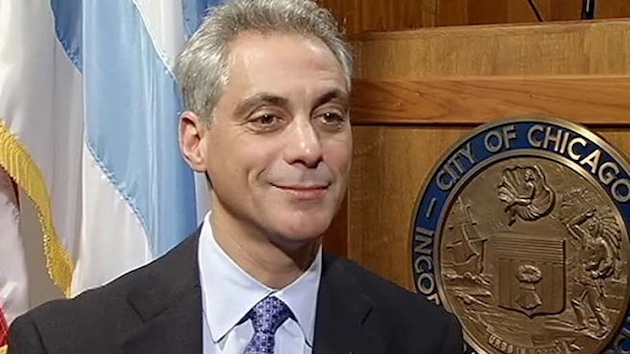
Chicago Mayor Rahm Emanuel

Back in January, Federal Judge Edmond E. Chang ruled against Chicago Mayor Rahm Emanuel and opponents of gun rights, handing down a decision that deemed the city’s longtime ban on gun stores unconstitutional. The federal court granted city officials a six-month grace period to approve a plan to lift the ban, setting a deadline of July 14.

Now, Mr. “never let a good crisis go to waste” is planning to propose a draconian plan that would require all gun sales in the city to be videotaped, while refusing to open up zoning in 99.5 percent of the city to new gun stores. Emanuel is expected to announce the plan at a city council meeting Wednesday, and sell the zoning restrictions as a simple attempt to ban gun stores near schools and parks.

Tuesday served as a sneak peek into the strategy Emanuel has chose, when speaking at the Chicago police department’s annual awards ceremony he called the new rules “a smart, tough and enforceable way to prevent illegal guns in the city of Chicago,” the Chicago Tribune reported.

Janey Rountree, the mayor’s deputy chief of staff for public safety, regurgitated the same general sentiment.

“There is no question it will be the smartest, toughest regulation on gun stores in the country,” she said. “It’s designed to prevent gun trafficking and illegal sales in these stores.”

But the reality of the plan suggests Emanuel and other opponents of Second Amendment gun rights have intentionally designed a plan with an aim to make conducting business for gun stores impossible. In addition to the zoning restrictions, dealers will only be able to sell one handgun per month, per buyer. Store records would also be subject to quarterly audits by other opponents of gun rights, and all of these rules are only implemented after gun stores receive a police-approved security plan prior to opening.

In order to receive such approval, gun stores would have to include approved exterior lighting, the proper amount of surveillance cameras, approved alarm systems, as well as certain gun and ammunition storage. Store employees would also be forced to “undergo fingerprinting, background checks and training on identifying potential gun traffickers.”

Emanuel’s proposal would also require a 72-hour waiting period for purchasing handguns and a 24-hour period waiting period for rifles and shotguns. Gun stores will not be able to reopen at the same location — which will translate into nowhere — for three years if the city has revoked its license for ordinance violations.

Despite longtime bans, Chicago has been and remains to this day one of the most dangerous cities in the United States. In 2013, alone, the Chicago police department confiscated nearly 7,000 illegal weapons, a rising trend that directly coincides with gun right restrictions.

After losing in federal court, Chicago Mayor

john kerry

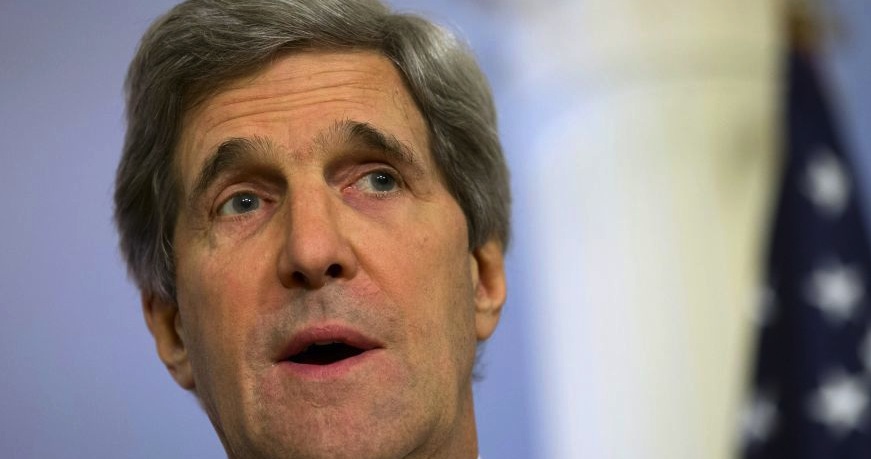
Secretary of State John Kerry suggested Wednesday that Edward Snowden, the fugitive whistleblower who leaked details of NSA spying programs, should “man up and come back to the United States.”

Kerry’s comments came after a recent interview with Snowden, during which he said he didn’t plan to take refuge in Russia. According to his version of the story, he was forced to go there because the United States decided to “revoke my passport.”

When asked in an interview about Snowden’s comments on NBC’s “Today” show, Kerry left nothing to the imagination regarding his feelings toward the leaker. “Well, for a supposedly smart guy, that’s a pretty dumb answer, after all.”

Edward Snowden was a former analyst at the NSA security contract company, Booze Allen. He leaked NSA documents to the media, sparking a debate over the Fourth Amendment. Federal prosecutors filed a sealed criminal complaint back in June, 2013, charging him with espionage, theft and conversion of government property.

The Obama administration demanded Russia hand over the fugitive after charges were brought up by the Justice Department, but Vladimir Putin flatly refused. If U.S. officials want to try him for treason, they will have to coax him home.

“If Mr. Snowden wants to come back to the United States,” Kerry said, “we’ll have him on a flight today.” Kerry said Snowden should “stand up in the United States and make his case to the American people.”

Since Snowden leaked NSA secrets, there has been no consensus over the role he really played, or rather how much information he was truly privy to during his time at Booze Allen. While some say Snowden was a low-level analyst, who didn’t have access to the secrets he has claimed to know, others disagree. Snowden took a step further in his last interview, claiming he was actually a trained spy.

In his interview with NBC anchor Brian Williams, a portion of which was broadcast Tuesday, Snowden said he was “trained as a spy” and argued that he had a much larger role in U.S. intelligence than the government has acknowledged. “I was trained as a spy in sort of the traditional sense of the word, in that I lived and worked undercover overseas,” he said.

Kerry said, “A patriot would not run away. … He can come home but he’s a fugitive from justice.”

“Let him come back and make his case,” Kerry added. “If he cares so much about America and he believes in America, he should trust the American system of justice.”

“I think he’s confused,” Kerry said. “I think it’s very sad. But this is a man who has done great damage to his country.”

Secretary of State John Kerry suggested Wednesday

michelle nunn

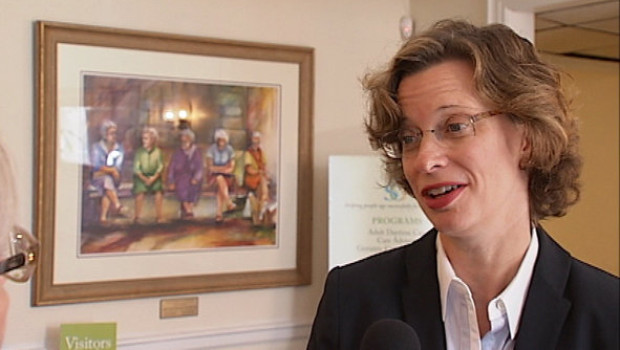
Georgia Democratic candidate for U.S. Senate, Michelle Nunn.

Michelle Nunn, the Georgia Democrat candidate for U.S. Senate, made a ton of cash when her nonprofit organization, Hands On Atlanta, merged with the Points of Light Foundation in 2007. There is certainly nothing wrong with being rewarded for hard work, particularly when communities are better off from that work. However, from 2007 to 2010, under the direction of Michelle Nunn, the organization also laid off a ton of people from their jobs, cutting 175 jobs down to 80.

Yet, at the same time the organization was cutting roughly 60 percent of its regular workforce, Michelle Nunn’s salary doubled.

The news was first reported in the Tuesday edition of Morning Jolt, highlighted by Jim Geraghty at National Review. As he noted, Nunn’s campaign paints a rosy picture of her time and experience at the Points of Light Foundation, an experience they have repeatedly heralded as a reason to vote for the daughter of long-time Georgia Democrat Senator Sam Nunn:

Seeing a need in Atlanta for a vehicle by which young people could engage in service to solve problems in their own communities, Michelle and a group of friends got together to create Hands On Atlanta, with Michelle as its first Executive Director. Over the next decade, Michelle grew volunteerism across Georgia, and eventually throughout the country, through Hands On Network, a national outreach of volunteer-service organizations. Michelle was selected for a three year Kellogg Foundation Fellowship that gave her an opportunity to travel the globe and work with civic and religious leaders to help them translate the common ground of their faith and ideals into building better, more productive communities and services.

In 2007, Hands On Network merged with the Points of Light Foundation, President George H.W. Bush’s organization and legacy. After leading a successful merger, Michelle became the CEO and President of Points of Light, now the largest organization in the country devoted to volunteer service.

According to the organization’s Form 990, in 2008 Nunn earned $250,000 in her role as CEO of the Points of Light Foundation. Then, in 2009, Nunn had a drop off to $197,506, according to data from the organization’s Form 990, and again recieved  $197,506 in 2010,

However, in 2011, Nunn received $322,056 in total compensation, with a base salary of $285,533 as CEO of Points Of Light Foundation. While her personal financial disclosure lists her 2012 salary as CEO Of Points Of Light Foundation as $270,770 and her 2013 salary as $214,231, it is unclear whether she also received large sums of other income related to the organization, as she had in 2011.

Democrats have held up Nunn’s candidacy as an example of their fragile potential to play offense on an increasingly reddening map in 2014. But was we previously noted, despite recent polling showing the Peach State more competitive than Republicans would like, it will very difficult for either Democratic candidate in one of the two high-profile races to be victorious in November. Democrats had hoped Republicans would nominate an unelectable candidate, but David Perdue and Jack Kingston will head to a runoff after they finished in the two top spots in the Georgia Senate Primary back on May 20.

The recent revelations are the latest in a string of campaign developments suggesting Nunn may not be quite as strong of a candidate as Democrats promised. Just prior to the Republican primary, Nunn was incapable of answering a reporter’s question during an interview with the liberal network, MSNBC. She could not answer whether or not she would have voted for ObamaCare if she was in the U.S. Senate. In fact, she ironically began an uncomfortable ramble about her time at the Points of Light Foundation, which even the liberal editor found difficult to smooth over.

The Nunn campaign did not respond to PPD’s request for a comment.

Georgia Democratic candidate for U.S. Senate Michelle

Long-lasting manufacturing goods, or durable goods are being made at Boeing plant. (Photo: Boeing/REUTERS)

Orders for durable goods rose unexpectedly in the month of April, but the news wasn’t all optimistic in the Commerce Department report Tuesday. A larger-than-expected fall in a measure of business capital spending plans will likely squash hopes of a rebound in economic growth this quarter.

The Commerce Department said Tuesday durable goods orders increased by 0.8 percent, fueled by demand for defense capital goods and other fabricated metal products, transportation equipment and electrical equipment. Appliances and components also rose.

Durable goods are classified as products meant to last three years or more, and they increased by a revised 3.6 percent in March. Economists had expected orders to fall by 0.5 percent after a previously reported 2.5 percent rise in March.

“We are the same track as we were before, which is still a slow track. There is not a dramatic case for companies to expand capacity because they don’t think the economy will improve dramatically,” said Mark Vitner, a senior economist at Wells Fargo Securities in Charlotte, North Caroline.

The closely scrutinized non-defense capital goods orders excluding aircraft fell by 1.2 percent after rising by a revised 4.7 percent in March. Even though March was the largest gain since November, the news bodes bad for business spending plans,

The revision was an increase from the previously reported increase of 2.9 percent in March.

Following the report, prices for U.S. Treasury debt fell, thought the dollar gained against the euro.

Meanwhile, home prices continued to increase in the month of March, which in other economic condition would be celebrated. But affordability is a concern is this weak economy, as rising home prices and even slight increases in mortgage rates are detrimental to home sales.

The Standard & Poor’s/Case Shiller gauge of house prices in 20 metropolitan areas increased 12.4 percent in March, compared to just one year ago.

As a result of Tuesday’s durable goods report, Wall Street will likely cut expectations for a rise in economic growth in the second quarter. The economy fell flat on its face in the first three months of the year, with the initially-reported and anemic 0.1 percent growth being cut after further data showed a likely contraction.

Core capital goods shipments fell 0.4 percent last month. Shipments of core capital goods are used to calculate equipment spending in the government’s GDP measurement. They increased 2.1 percent in March.

While the durable goods report is volatile month-to-month, the overall trend shows businesses are placing smaller and fewer orders, while holding an inventory of goods amassed in the second half of 2013. Last month, durable goods inventories rose 0.1 percent after increasing 0.2 percent in March.

Orders for defense capital goods jumped 39.3 percent, which was the largest rise since December 2012. Civilian aircraft orders and automobiles both fell. Orders excluding transportation barely rose by just 0.1 percent, following an increase of 2.9 percent in March.

There were declines in orders for machinery, primary metals and computers and electronic products.

Orders for durable goods rose unexpectedly in

general motors gm

Canada’s transportation department is investigating two crashes involving General Motors vehicles vehicles included in the recent ignition-switch recall.

Canada’s transportation department is investigating two crashes involving General Motors vehicles vehicles included in the recent ignition-switch recall.

Transport Minister Lisa Raitt’s press secretary confirmed Tuesday that the Canadian government is looking into two separate instances where GM air bags did not deploy in cars recalled by the auto bailout recipient. The investigation began after Transport Canada reportedly received complaints of fatal accidents in June 2013 and April of this year.

As for the first case, Canadian officials have decided the key moved out of the “run” position after the vehicle left the road. “Therefore, there may be various contributing causes for the collision and fatality,” a statement said.

However, Transport Canada said they are continuing to investigate how the key’s position may have influenced air-bag operation in that accident. But on the second complaint, they are in the middle of an investigation to discover why air bags did not deploy, at all.

While it is true that Transport Canada has not found any evidence that GM Canada failed to comply with the country’s Motor Vehicle Safety Act, the recent news is the latest in a train of bad press for the American motor giant. It was learned that the faulty ignition switches were known by some in GM much earlier than previously thought. According to a timeline provided by the company, themselves, some GM engineers were aware of a possible defect as early as 2001.

The agency also would not rule out the possibility of taking enforcement actions if GM Canada is found to be in violation of the law.

A GM spokesman responded by noting that the two crashes in Canada were already included in GM’s accident totals for the ignition-switch recall. The company has admitted that the recall, which was first brought up in February, was tied to 13 deaths and includes roughly 2.6 million vehicles worldwide.

In the U.S., alone, the recall involves nearly 2.2 million cars, including the 2005 to 2010 Chevrolet Cobalt and Pontiac G5 compact cars.

GM agreed to pay a maximum $35 million fine to the National Highway Traffic Safety Administration earlier this month, and the company also admitted it failed to provide a recall plan for the affected vehicles within five business days of learning about the safety issue. The time period is required by law.

GM has said an internal investigation led by former U.S. Attorney Anton Valukas may be completed by June.

Still, GM just announced four new recalls last week, and announced plans to take a $400 million charge in the second quarter to cover costs associated with repairs. Initially, GM expected to take a $200 million hit.

Shares rose 17 cents, or 0.5%, to $33.80 in recent trading. GM is down about 17.3% so far this year.

Canada's transportation department is investigating two crashes

Memorial Day

The cover of The Meaning of Memorial Day by Ellen White, Planting 20,000 Flags on Memorial Day.

Last year we shared this e-book for free. I ask you to share it with all of your friends this year, as well. With all of the BBQ celebrations I doubt anyone will have the chance to read it all today, but who said we need to only remember the true meaning of the American holiday – Memorial Day – one day a year.

But how should we the living best honor the lives of all those who have died in service to our country? In what manner and spirit should we remember? Why Memorial Day today? The ebook, “The Meaning of Memorial Day,” explores these questions with selections from American authors and statesmen, including Herman Melville, Ernie Pyle, Louisa May Alcott, Frederick Douglass, and Dwight D. Eisenhower. Each selection includes a brief introduction by the editors with guiding questions for discussion.

You can download the .pdf for review now or at a later time. It is a great read.

Visit the PPD bookstore to get your free e-Book.

More recommended reading in the PPD bookstore you may like:

The must-read book on American political philosophy by the People’s Pundit, himself, Richard D. Baris. Our Virtuous Republic is the book the establishment doesn’t want Americans to read! Baris identifies the true danger posed to Americans from big government, which is its strong, innate ability to destroy the human connection.

The ebook, The Meaning of Memorial

People's Pundit Daily
You have %%pigeonMeterAvailable%% free %%pigeonCopyPage%% remaining this month. Get unlimited access and support reader-funded, independent data journalism.

Start a 14-day free trial now. Pay later!

Start Trial