Widget Image
Follow PPD Social Media
Saturday, January 17, 2026
HomeStandard Blog Whole Post (Page 990)

wall street

Stronger than expected factory data and consumer sentiment helped reduce fears after negative GDP estimates and housing reports, pushing the broad S&P 500 to a new record high.

A reading on consumer sentiment from Thomson Reuters and the University of Michigan rose slightly in late February to 81.6 from 81.2 earlier in the month, topping estimates of 81.3.

The Institute for Supply Management-Chicago reported its gauge of manufacturing in the U.S. Midwest rose to 59.8 in February, compared to 59.6 the month prior. The measurement was higher than the 57 Wall Street was expecting. Readings above 50 point to expansion, while below 50 readings point to contraction.

Also, the National Association of Realtors reported contracts to buy previously-owned homes rose 0.1 percent in January, lower than the 2 percent increase Wall Street anticipated. Sales were down 9 percent from the same period the year prior.

Meanwhile, a report from the Commerce Department showed estimates that the U.S. economy grew at an annual pace of 2.4 percent in the fourth quarter, down sharply from a previous reading of 3.2 percent.

Stronger than expected factory data and consumer

The U.S. government cut back its estimate for fourth-quarter GDP growth after consumer spending and exports were less than originally anticipated, suggesting whatever momentum the economy had heading into 2014 is evaporating.

The Commerce Department said on Friday that gross domestic product expanded at a 2.4 percent annual rate, which is down sharply from the 3.2 percent pace reported last month and the 4.1 percent measured in the third quarter.

Economists polled by Reuters had expected growth would be cut to a 2.5 percent pace.

Consumer spending accounted for a large chunk of the government’s revision after retail sales in November and December came in weaker than assumed. Consumer spending was cut to a 2.6 percent rate, which was still the fastest pace seen since the first quarter of 2012. It had previously been reported to have grown at a 3.3 percent pace.

Consumer spending, which accounts for more than two-thirds of U.S. economic activity, contributed 1.73 percentage points to GDP growth, down from the previously reported 2.26 percentage points. In total, final domestic demand was lowered two-tenths of a percentage point to a 1.2 percent rate.

The loss of momentum appears to have spilled over into in the first quarter of 2014, with liberals blaming an unusually cold winter that supposedly weighed down retail sales, home building and him sales, hiring and industrial production. Meanwhile, administration officials are claiming there is “no time for debating the flat earth society” over global warming, which they now call climate change due to the data not stacking up.

The Federal Reserve, which has unanimously decided to begin cutting back on the amount of money it injects into the economy through monthly bond purchases, or QE 3, claims the recent slowdown is temporary.

Fed Chair Janet Yellen told lawmakers on Thursday that the cold weather was to blame for the weakening data. However, she said that it would take a “significant change” to the economy’s prospects for the Fed to suspend its plans to wind down its bond buying.

The U.S. government cut back its estimate

Colorado Senate race prediction

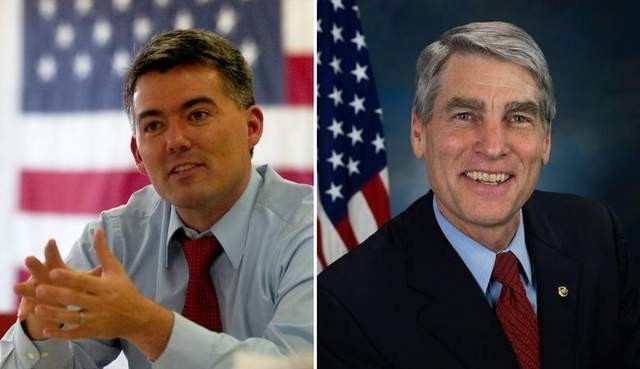
The PPD Colorado Senate race prediction moves to “Leans Democrat” with news of Rep. Cory Gardner (left) challenging vulnerable incumbent Democratic Senator Mark Udall (right).

The dynamic of this race has changed dramatically since the National Journal released a May article entitled, “Colorado’s Forgotten Senate Race.” Now, with the entrance of Rep. Cory Gardner, our Colorado Senate race prediction must be changed from the original rating in our twelfth article offering expanded analysis on our 2014 Senate Map Predictions.

Senator Mark Udall has been extremely vulnerable, but up until now, we couldn’t justify a rating more favorable to the Republicans’ hopes of retaken the Senate simply due to candidate recruitment. In my first article I wrote, “Because Rep. Cory Gardner, who is widely seen as a Republican rising star, decided he was not going to make a run we assume that the political landscape in the Centennial State was just not that GOP-friendly.”

But shortly after The Denver Post first reported Gardner was entering the race, the GOP front-runner and 2010 nominee, Weld County District Attorney Ken Buck, decided he was going to run for Gardner’s seat in the 4th Congressional District. The move by Buck, who had to contend with several second-tier candidates, has propelled Gardner to the front of the pack, paving the way for what I believe will be a relatively easy nomination process.

Former State House Leader and declared primary candidate, Amy Stephens, who spent 7 years in the state legislature, plans to drop out and endorse Cory Gardner. Stephens has ties to the influential Colorado Springs-based social conservative organization, Focus on the Family, and may very well rally whomever in the grassroots wasn’t already inclined to get behind the rising star.

I have long believed Senator Mark Udall could be defeated this cycle under the right conditions, and this is the news we at PeoplesPunditDaily.com needed to view this race as competitive. But before we get in to the actual rating, let’s recap some of the dynamics in the Colorado Senate race.

While Senator Mark Udall has an approval rating that has averaged from a low of 40 percent to a high of 44 percent, Colorado voters say by an average 47.5 – 40 percent margin that the Democratic incumbent does not deserve to be reelected. Adding to the conclusion Senator Udall is soft on support, he earned well under the 50 percent threshold in every major survey even when pitted against lesser-known Republican candidates.

It is too early to tell whether or not the news that Udall’s office intimidated the state’s insurance agency by pressuring them to change the ObamaCare-induced health plan cancellation numbers, will have a lasting effect. Still, it is clear that his support of ObamaCare has hurt the incumbent. As of mid-January, 335,000 Coloradans have lost their health insurance as a result of the law, and Gardner has been an outspoken critic of Udall’s support of the law and his attempt to hide the numbers.

Colorado voters oppose the Affordable Care Act 60 – 37 percent in the latest Quinnipiac University poll, and disapprove 59 – 37 percent of the job President Barack Obama is doing. Similarly, Gallup has measured Obama’s job approval at no more than 42 percent beginning in the fall of 2013, and he is currently at 42 percent now. However, because we only have polling from Quinnipiac University (rated 2 out of 4 for accuracy) and PPP (rated 4 out of 4), both of which use registered voter models and make presuppositions about the electorate far more favorable to Democratic candidates, our Colorado Senate race prediction cannot be largely based upon polling while ignoring Partisan Voting Index trends and the relationship between presidential approval rating and Senate election outcomes.

Both Partisan Voting Index and presidential approval rating models underscore the importance of candidate recruitment. In 2010, Republican candidates won roughly 83 percent of the races in states where the PVI (Partisan Voting Index) was more Republican than D+2. Ken Buck, consequentially, was among the 17 percent of Republican candidates who lost races within those statistical boundaries. Since the PVI was dead even in 2010, and will only tick up to D+1 in 2014, it is statistically likely a formidable candidate such as Cory Gardner could defeat Senator Udall.

Of course, they need a campaign organization and money to fund it to do so.

Gardner has roughly $875,000 cash on hand in his congressional re-election account, which means he will enter the race with far more funding than any other GOP candidate. However, that is far less than Udall’s $4.7 million war chest, and he will need to close that disparity — with inside and outside group money — to remain a contender. There is good news for the Republicans, however, because money that was held back prior will likely begin to start flowing in the race.

We are changing our Colorado Senate race prediction from “Likely Democrat” to “Leans Democrat” until we see more data to gauge the voters’ reactions to their new choice. In closing, I would just add that our new Colorado Senate race prediction reflects the totality of the political environment in the 2014 Senate battle, which is what we foresaw happening all along. As we get closer to the campaigns kicking into high gear, we will see the map expand in favor of the Republican Party. As of now, their greatest challenge is not demographics or other oft-repeated liberal pundit mantras, it is the talent gap.

Rep. Cory Gardner just closed that gap in the Colorado Senate race, substantially.

Poll Date Sample Udall (D) Gardner (R) Spread
PPD Average 3/5 – 3/16 42.0 40.5 Udall +1.5
PPP (D) 3/13 – 3/16 568 RV 42 40 Udall +2
Rasmussen Reports 3/5 – 3/6 500 LV 42 41 Udall +1


PPD is altering our Colorado Senate race

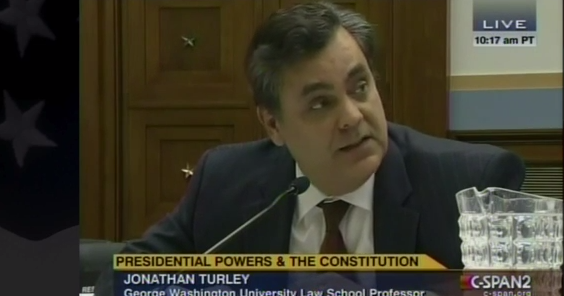
The well-known and renowned liberal law professor Jonathan Turley said at a hearing Wednesday that we are at a “constitutional tipping point” under President Obama. Turley again repeated his argument in an interview with “Fox and Friends” on Friday, warning that the system of checks and balances was designed to protect individual rights, not the institutions of government.

Turley did say that the imperial presidency did begin under President George W. Bush, but that it has “accelerated under President Obama.” However, what may account for the speedy power grab under Obama, is the utter lack of refusal by the members of the Democratic Party to challenge the blatant tyrannical overreach. Under Bush, many on the right were grossly uncomfortable with the amount of executive power obtained under the banner of national security. Yet, just one now-former congressman, Dennis Kucinich, was openly opposed to the power grab, and he was primaries out of his seat by a lock-and-step Democrat.

“What they don’t seem to appreciate, is that this will not be the last president,” Turley said. “And those who are silent today will have a hard time speaking up when the next president says I just don’t feel like enforcing environmental laws, or discrimination laws. Then they are going to find it very hard to voice opposition,” he added.

During the state of the union address President Obama told members of Congress that he was prepared to implement policy by executive fiat and circumvent Congress. Turley said it was “particularly bizarre” and disturbing that it was met with “rapturous applause,” because he was applauded for diminishing their power.

“The framers did not want anyone to have enough power to be able to go it alone, because they could also commit great abuses,” which we are now seeing under President Obama with his multiple instances of refusing to uphold his oath to faithfully execute the laws of the United States. Obama, from immigration to ObamaCare, has during too many occasions simply decided which laws he would enforce and which laws he would nullify.

He addressed the oft-repeated claim that Obama must use executive power to go-around Congress, because Congress isn’t getting enough done. “It’s an excuse,” he said. The system was designed for this purpose, and it’s working. When too much extreme policy is being implemented without the consent of the governed the Congress has the power to reign it in and stop the steamrolling by the executive branch.

As far as impeachment, he said that you “cannot use impeachment as a check and balance,” because it is “like running a nuclear power plant with an on and off switch,” suggesting that the problem is far deeper than realized and impeachment cannot stop long-term abuses. “We need to get back to the system of checks and balances,” he said.

Liberal law professor Jonathan Turley said at

ukraine-armed-men-airport

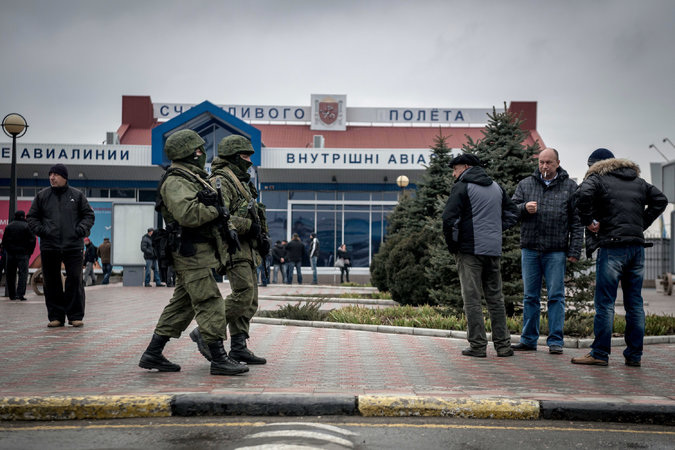
Armed men patrolled the street outside Simferopol’s airport in the Crimea region of Ukraine on Friday. Credit Sergey Ponomarev for The New York Times

Armed men were blocking the two main airports in the strategically imperative peninsula of Crimea on Friday in what the Ukraine Interior Minister called an “armed invasion” by Russia. The country asked the U.N. Security Council to intervene in the escalating conflict.

In Simferopol, which is the regional capital of Crimea, a number of masked armed men were taking up station at the international airport. They were dressed in camouflage and carrying assault rifles, but their military uniforms displayed no identifying insignia. It was not clear who they were and the soldiers declined to answer questions.

One of the soldiers, who identified himself only as Vladimir to an Associated Press photographer, said they were part of a “self-defense unit” that was making sure that no “fascists” would arrive from Kiev or elsewhere.

Ukraine’s National Security Council chief, Andriy Paruby, said that the soldiers’ activity in Crimea were not Crimeans themselves.

“This is either small extremist-separatist groups or military personnel from the Russian Black Sea Fleet,” he said.

Also, at a second airport called Belbek, which is used for military and some civilian flights, armed men took up additional positions. In a post on his Facebook page, the interior minister said that units believed to be affiliated with the Russian military had blocked access to the airport overnight, with some Ukrainian military personnel and border guards inside.

Avakov wrote that the men blocking the airport were also wearing camouflage uniforms with no identifying insignia, but he added, “They do not hide their affiliation.”

Meanwhile, Russia’s Black Sea fleet issued a staunch denial of involvement in the activity, saying, “No Black Sea Fleet units have moved toward (the airport), let alone taking any part in blockading it,” Interfax quoted a spokesman for the fleet as saying.

In Kiev, the speaker of Parliament, Oleksandr V. Turchynov, who is now the acting president of Ukraine, convened a meeting of the National Security and Defense Council to discuss the situation in Crimea.

Announcing the meeting in Parliament, Mr. Turchynov said, “Terrorists with automatic weapons, judged by our special services to be professional soldiers, tried to take control of the airport in Crimea.”

The Ukraine Parliament adopted a resolution demanding that Russia halt steps it says are aimed against Ukraine’s sovereignty and territorial integrity, and called for a U.N. Security Council meeting on the crisis.

The recent developments follow an order by Russian President Vladimir Putin to start large-scale military exercises in what many observers view to be a blatant show of force or even possible prelude to a Russian intervention in Ukraine. Armed men seized control of government buildings in the Crimea region of Ukraine, raising a Russian flag over a barricade. U.S. Secretary of State John Kerry warned Russia it would be a “grave mistake” to intervene militarily in Ukraine.

Police officers, who are supposed to be under the control of the Ministry of Interior in Kiev, made no effort to control the crowds and in some cases reportedly applauded the pro-Russia sentiment. The police stood motionless as armed militants seized government buildings overnight and erected a barricade outside the regional legislature.

Russia also has granted shelter to Ukraine’s fugitive president, Viktor Yanukovych, who broke his silence Thursday. In a statement he said he remains the country’s legitimate leader and that the actions of the Ukraine Parliament to strip his powers were illegal. He is scheduled to hold a news conference on Friday in the Russian city of Rostov-on-Don.

Ukraine’s Prosecutor General said in a statement Friday it is seeking extradition of fugitive former president Yanukovych, who is wanted on suspicion of mass murder in last week’s violent clashes between protesters and police, in which more than 80 people were killed.

The region and the conflict may be a bit difficult for followers to understand considering how fast events have occurred, so here is a bit of background.

Russian President Vladimir Putin has long dreamed of pulling Ukraine, a country of 46 million people considered the cradle of Russian civilization, closer into Moscow’s orbit to resemble what was a confederation of former satellite states.

As far as loyalties, Ukraine’s population is divided between those with loyalty to Russia and the West. The region of Crimea, which was seized by Russian forces in the 18th century under former praised ruler, Catherine the Great, was once the crown jewel in both Russian and the former Soviet empires.

The Crimea region in discussion became part of Ukraine in 1954 when Soviet leader Nikita Khrushchev transferred jurisdiction from Russia, a move that was a mere symbolic formality until the Soviet Union collapsed in 1991. Following those events, which were as rapid as the events today, Crimea found itself truly under the control of an independent Ukraine.

Now, in an effort to prop up the new government, who is attempting to run a country in financial distress, the International Monetary Fund has said it is “ready to respond” to Ukraine’s bid for financial assistance. The European Union is also discussing emergency loans for a country that is the chief conduit of Russian natural gas to western Europe.

Ukraine’s finance ministry has said it needs $35 billion over the next two years to avoid default. Sec. Kerry also announced that the Obama administration was planning $1 billion in loan guarantees for Ukraine and would consider additional direct assistance for the former Soviet republic satellite state.

Kerry’s comments followed others made by White House Press Secretary Jay Carney, who said Monday that the U.S. government will provide Ukraine foreign aid, with certain conditions, though Carney curiously said it is to “strengthen its social safety net.”

Armed men were blocking the two main

The number of Americans filing for first-time joblessness benefits rose last week to 348,000 from a downwardly revised 334,000 the week prior.

Wall Street was looking for claims to fall to 335,000 from an initially reported 336,000. Initial claims for state unemployment benefits increased 14,000 to a seasonally adjusted 348,000, the Labor Department said on Thursday. Claims for the prior week were revised to show 2,000 fewer applications received than previously reported.

Economists polled by Reuters had forecast first-time jobless benefits dipping to 335,000 in the week ended February 22, which included the Presidents Day holiday.

While last week’s increase pushed them to the upper end of their range so far this year, suggesting labor market weakness as claims tend to be volatile around federal holidays.

Economists and the mainstream media ave outrageously blamed unusually cold winter has clouded the labor market , with job growth halting sharply in December and barely recovering in January.

A third month of weak hiring is expected during the survey week for February nonfarm payrolls.

The claims report showed the number of people still receiving benefits after an initial week of aid rose 8,000 to 2.96 million in the week ended February 15.

The so-called continuing claims have been elevated in recent weeks and some economists say the cold weather could be preventing many recipients from going out to search for work and companies to delay hiring.

The number of Americans filing for first-time

John Kerry Warns Russia

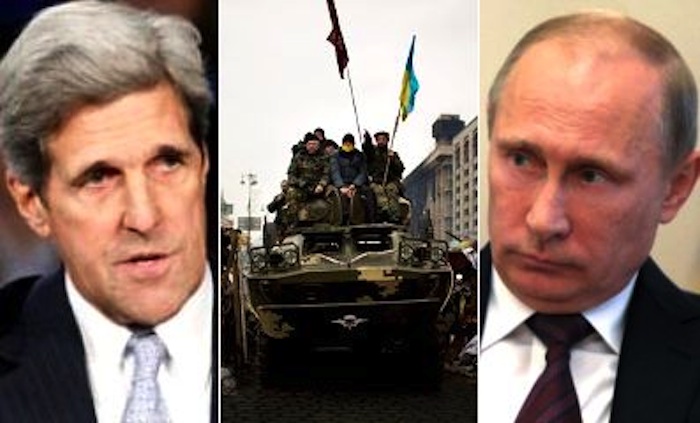
Secretary of State John Kerry warns Russia Wednesday after President Vladimir Putin ordered the large-scale military exercises in what many observers view to be a blatant show of force or even possible prelude to a Russian intervention in Ukraine.

The U.S. Secretary of State John Kerry warned Russia it would be a “grave mistake” to intervene militarily in Ukraine following an order by the Kremlin for 150,000 troops to test their combat readiness by having armed men seize control of government buildings in the Crimea region of Ukraine, raising a Russian flag over a barricade.

Secretary of State John Kerry issued the warning on Wednesday after Russian President Vladimir Putin ordered the large-scale military exercises in what many observers view to be a blatant show of force or even possible prelude to a Russian intervention in Ukraine.

“Any kind of military intervention that would violate the sovereign territorial integrity of Ukraine would be a huge, a grave mistake,” Kerry said in Washington. “The territorial integrity of Ukraine needs to be respected.”

Kerry also announced that the Obama administration was planning $1 billion in loan guarantees for Ukraine and would consider additional direct assistance for the former Soviet republic satellite state. The comments followed others made by White House Press Secretary Jay Carney, who said Monday that the U.S. government will provide Ukraine foreign aid, with certain conditions, though Carney curiously said it is to “strengthen its social safety net.”

Kerry also renewed U.S. demands that Moscow withdraw troops from another former Soviet republic satellite state, Georgia, and called for Georgia to continue to integrate with Europe and NATO.

Tensions between Russia and the West over Ukraine have been growing, as Russia views any Western intentions in its backyard are attempts to subvert Russian regional dominance. Some Russian officials have openly accused the West of orchestrating the protests that overthrew the former president.

Kerry tried to assure Russia that U.S. policy toward Ukraine, Georgia and the other states that once made up the former Soviet Union was not intended to reduce Russia’s influence in its region. He claims U.S. intention for former Soviet satellite states is to integrate with the West merely for freedom, democracies and stronger economies.

“This is not `Rocky IV’,” Kerry said, referring to the iconic 1985 Sylvester Stallone film in which boxer Rocky Balboa takes on and defeats a massive Soviet on steroids. “It is not a zero-sum game. We do not view it through the lens of East-West, Russia-U.S. or anything else. We view it as an example of people within a sovereign nation who are expressing their desire to choose their future. And that’s a very powerful force.”

The new, less Russian-friendly government was expected to be approved by the Ukraine Parliament Thursday. The new government will have the difficult task of addressing pressing issues amid a politically divided country already on the verge of financial collapse.

Meanwhile, Russian news agency RBK, citing a “prominent Russian businessman” and a “high-ranking official,” reported that Yanukovych had flown to Moscow Tuesday evening and had been seen at the Hotel Ukraine in the Russian capital. The report went on to claim that Yanukovych had later moved to the Barvikha Clinical Sanitorium, a luxury health resort west of Moscow.

While the U.S. and the rest of the West have already recognized the new Ukrainian government, whose drove Yanukovych from the capital, Russia considers him the legitimate president. Dmitry Medvedev said Monday that the new authorities have come to power as a result of “armed mutiny,” so their legitimacy is causing “big doubts.”

Russian officials staunchly denied that they are holding the former Ukraine president. Mikhail Margelov, the head of the Federation Council International Affairs’ Committee stating, “I know definitely that Yanukovych is not in Russia and, in my modest opinion, Russia would not have granted him asylum.” Further, the general director of the Hotel Ukraine, Dmitry Yelizarov, told the Interfax news agency that Yanukovych had not stayed at the hotel recently. The spokesman for this department, Viktor Khrekov, told The Associated Press on Thursday that he had no information about the report.

RBK said the information was confirmed by a government official, but neither the government official or the wealthy businessman were identified. The article was under the byline of respected journalists, including RBK’s editor in chief.

Meanwhile on Thursday, several dozen armed men stormed and seized the buildings of the legislature and the local government in Ukraine’s Crimea region, where the majority of the population are Russian speakers.

The men occupying the parliament building in the regional capital, Simferopol, did not come out to voice any demands. They wore black and orange ribbons, a Russian symbol of the victory in World War II. The men also put up a sign saying “Crimea is Russia.”

They threw a flash grenade in response to a journalist’s questions.

Igor Korotchenko, a former colonel of the Russian military’s General Staff, wrote a commentary in a Russian online newspaper, slon.ru, saying “if illegal armed formations attempt to overthrow the local government in Crimea by force, a civil war will start and Russia couldn’t ignore it.”

In addition to Putin ordering the military exercises, Russia’s defense ministry said it would take steps to strengthen security at facilities of the Russian Black Sea Fleet in Ukraine’s Crimean Peninsula, where recently there have been clashes between pro and anti-Russian demonstrators. Pro-Russian protesters have spoken of secession, and a Russian lawmaker has stoked their passions by promising that Russia will protect them.

The Kremlin’s orders raised additional fears regarding a possible Russian intervention in Ukraine akin to its 2008 intervention in Georgia, which led to the occupations of Abkhazia and South Ossetia. The move, which was seen as aggression, was condemned by the United States and the Western European powers.

Secretary of State John Kerry issued the

jan brewer vetoed sb 1062

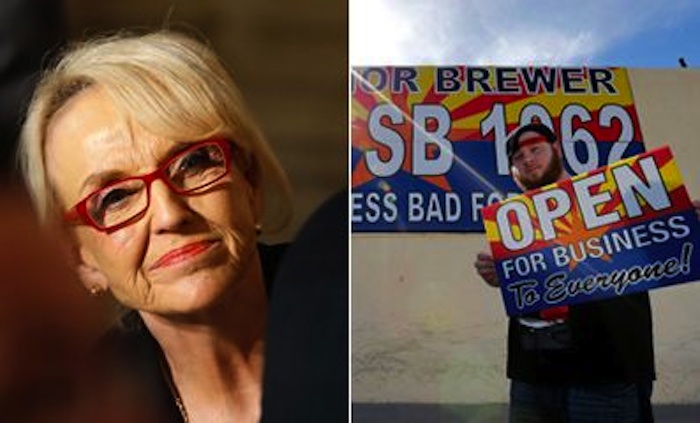
Wednesday, Arizona Gov. Jan Brewer vetoed SB 1062, a controversial bill that would have allowed religious beliefs as a defense for denying service to gays and others.  The bill aimed to preempt a situation where Arizona business owners are forced to provide services that violate their conscious, or religious freedom.

Brewer, who took several days to consider whether or not to sign the bill, said it had “the potential to create more problems than it purports to solve.It could divide Arizona in ways we cannot even imagine and no one would ever want.”

Democrats and civil rights groups opposed the measure backed by social conservatives, citing discrimination and its potential to hurt the state’s economy by driving away business.

But it was conservatives who were the most effective at garnering attention and opposing this bill, with our own Thomas Purcell articulating the conservative legal perspective. In his column, as well as radio show, Liberty Never Sleeps, Purcell slammed the GOP for what he called a lowering of the bar of the political process.

Arizona Republican Senator John McCain, who had urged her to veto the measure, commented after a short press conference by the governor.

“I appreciate the decision made by Governor Brewer to veto this legislation. I hope that we can now move on from this controversy and assure the American people that everyone is welcome to live, work and enjoy our beautiful State of Arizona,” McCain said in a statement.

The Arizona legislature passed the bill last week allowing businesses whose owners cite sincerely held religious beliefs to deny service to gays and others. It allows any business, church or person to cite the law as a defense in any action brought by the government or individual claiming discrimination.

The legislation caused a national uproar, with the business community, the state’s Super Bowl Committee and both Republican U.S. senators calling for a veto. Former GOP presidential nominee Mitt Romney also offered his unwarranted and unsolicited opinion, urging Brewer to veto the bill.

In her remarks to reporters, Brewer said the bill “does not address a specific and present concern related to religious liberty in Arizona. I have not heard of one example in Arizona where a business owner’s religious liberty has been violated.”

She also said it was “broadly worded and could result in unintended and negative consequences.”

Arizona Gov. Jan Brewer vetoed SB 1062

The ObamaCare website cost the federal government more than five times the originally contracted amount for computing cloud software, according to government contracts released by the Centers for Medicare and Medicaid Services (CMS).

On Tuesday, CMS released documents for its IT contract with the company Verizon Terremark, which is running the cloud component of the flawef Healthcare.gov site. The documents state that the original contract has ballooned in cost from $10.8 million to $59.9 million, since 2011.

CMS claimed it “could not have contemplated” the need for additional IT framework, which required millions in extra costs.

The contract has been changed 12 times between its initial award and Nov. 30, 2013, or the administration’s self-imposed deadline to supposedly “fix” Healthcare.gov following the website’s disastrous rollout last October.

The documents released Thursday also lay out the final two changes needed to “improve performance of the Marketplace” before Nov. 30, which will add to the final ObamaCare website cost an additional $13.9 million.

The ObamaCare website cost computing cloud software

Author of Shotgun Republic and host of the conservative talk radio show Liberty Never Sleeps, Thomas Purcell, hammered Republicans in the state legislature for the passage of Arizona SB 1062. In his weekly column for PeoplesPunditDaily.com, Purcell wrote a scathing rebuke of the Arizona GOP, who “set a low water mark for the political process last week when they passed Arizona SB 1062 and sent it to Governor Brewer’s desk for signature.”

The controversial bill aims to preempt a situation where Arizona businesses are forced to provide services that violate their conscious, or religious freedom. It may sound all well and good on the surface, but as Purcell points out, the bill 1) picks a fight that is politically stupid, and 2) “By passing this law, you are effectively making the case that laws do exist which discriminate against LGBT people and will allow lawsuits to be filed that could result in legal grounds for protected status. Once that is established you will force business owners into the very situation you are trying to legislate against.”

Many conservatives, putting aside the bill as a matter of law, believe that the SB 1062 fight was trivial at this point considering so many other dire challenges currently face our nation. Because of the severity of these challenges conservatives must convince the American people they are leaps and bounds more qualified than Democrats to handle them, and quickly. The last thing the Republican Party needs is to get in to a self-made, divisive fight that depicts them as exclusive, a foolish strategy when you are trying to build a winning electoral coalition, which is by definition, a task that is particularly inclusive by nature.

While we watch and wait as the pressure builds on Gov. Jan Brewer to reject this anti conservative bill, view the show above, and I will leave you with the following excerpt from Purcell’s column:

Right now conservatives are in a battle nationally for the soul, the heart and the minds of the American people. We are not discussing what we’re really all about, namely small government, low taxes, free markets and a strong national defense. We have to win the Senate and hopefully the White House before we can worry about the little details. Conservatives have to understand that fights like this divide the Republican Party and does nothing to further our cause.

Host of conservative talk radio show Liberty

People's Pundit Daily
You have %%pigeonMeterAvailable%% free %%pigeonCopyPage%% remaining this month. Get unlimited access and support reader-funded, independent data journalism.

Start a 14-day free trial now. Pay later!

Start Trial