Widget Image
Follow PPD Social Media
Saturday, January 17, 2026
HomeStandard Blog Whole Post (Page 993)

ukraine-protest

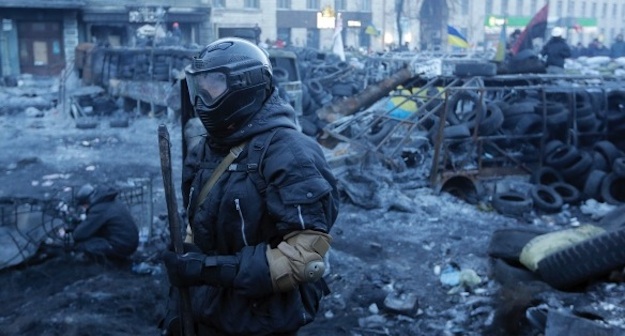
The ongoing Ukraine protests have taken a turn for the worse, with the EU reportedly agreeing in an emergency meeting Thursday to impose sanctions against the government. The Ukraine protests started at the end of November in response to President Yanukovych’s rejection of a landmark trade deal with the EU in favor of closer ties with Russia.

The tension had decreased last Monday when protesters ceased occupying government facilities in return for amnesty against prosecution.

Just one day later, however, outside of the parliament violence erupted when pro-government supporters known as the “titushki” barricaded the opposition’s attempt to scale back the president’s constitutional powers.

With the breakdown of the truce agreed upon on Wednesday, it is unclear which party provoked the fight, each party blaming the other for using live rounds.

Nevertheless, there is real combat that is taking place on the streets of Kiev. The violence ensued into the surrounding area and the Ukrainian riot police employed their first attack on Kiev’s Independence Square.

A trade union building that sheltered several protesters was set on fire and people could be seen evacuating by climbing down the walls to escape the flames.

The death toll has risen on both sides — leaving at least 33 people dead — and it is feared that the death rate will rise further. Among the deceased were 10 police officers, a minimum of 21 protesters who reportedly were killed by security forces in Kiev, and a journalist working for the Russian-language newspaper,  Vesti. The journalist, Vyacheslav Veremyi, was pulled from a taxi by masked men and shot.

Hundreds of people have been treated for injuries.

Witnesses have stated that some died as a result of single gunshot wounds, common and indicative of sniper fire. Now, video footage has emerged showing snipers firing on demonstrators who had been trying to retake their protest camp in Independence Square.

Officials stated that there are 67 police officers that had been captured by protesters.

Russia places fault upon the protesters making accusations that the anti-government demonstrators were engineering a violent take over of power.

President Viktor Yanukovych accuses the opposition leaders for the horrendous display of blood shed.

After failed talks President Yanukovych with opposition leaders Vitaly Klitschko, the leader of the Udar (Punch) party and Arseniy Yatsenyuk, who heads the Fatherland party, appealed to Yanukovych to “stop the bloodshed and minimize the victims.”

On Wednesday President Yanukovych stated: “The opposition leaders have disregarded the principle of democracy according to which one obtains power not on the streets or maidens but through elections.”

Before agreeing to impose sanctions, three European Union foreign ministers — France’s foreign minister Laurent Fabius, Poland’s foreign minister Radoslaw Sikorski, and Germany’s foreign minister Frank-Walter Steinmeier — had a five-hour meeting with President Viktor Yanukovych.

The foreign ministers agreed on the scope of the sanctions will be adjusted according to the developments in Ukraine. The restrictions are to be drafted into law in the coming days, Reuters reports.

Foreign Minister Radoslaw Sikorski met with opposition leaders — Vitaly Klitschko, who is the leader of the Udar (Punch) Party, and Arseniy Yatsenyuk, who heads the Fatherland Party — to test a “proposed agreement.” The details of the agreement are still unclear.

The EU, up until now, had refrained from imposing sanctions on Ukraine, stressing dialogue and compromise as a solution.

The US state department announced visa bans on 20 members of the Ukrainian government, however they did not provide any names. U.S. officials at the State Department reiterated Thursday that it would work with its European allies to resolve the crisis, and is now considering whether or not to join the EU sanctions. A freeze on assets and travel bans will hurt the oligarchs who back Ukrainian President Viktor Yanukovych.

Vitaly Klitschko, stated the next round of negotiations with President Yanukovych would resume later on Thursday.

The ongoing Ukraine protests have taken a

fed qe3

The Labor Department reports prices for finished goods rose 0.2 percent in January, while excluding the food and energy components, prices also rose 0.2 percent. The Department of Labor, for the first time since 1978, is now using a revamped method for calculating prices, one in which economists say offers a broader and more accurate look at prices across the economy.

The old method was unduly influenced by commodity prices, because it measured only the cost of producer received goods. The new method unveiled on Wednesday, will also measure services, which represent a significant amount of the U.S. economy. The Producer Prices Index will also now factor in construction, government purchases and exports.

Because services are included in the index, there is likely going to be few large swings in the reading from month to month. However, while the PPI did not traditionally move the markets dramatically, the changes could elevate the report to the level of the consumer price index, which measures prices that consumers pay for their products.

The fact that the PPI is released ahead of the consumer price index, which traditionally has been used solely to gauge inflation, the decision to ween off the Fed QE3 program today might indicate a concern for inflation.

The Federal Reserve’s policy-setting board agreed unanimously that the central bank should continue cutting the pace of asset purchases in the Fed QE3 program in what was referred to as “measured steps.” The Federal Reserve is setting the narrative that the decision was based upon the notion the economy will continue to grow as expected. However, it isn’t growing. So, what may be the other reasoning?

According to minutes from the January FOMC meeting, “a few” participants said they could see hiking the Fed’s benchmark interest rate “relatively soon,” while others on the board disagreed. The Fed members minimized a weaker-than-expected December jobs report, as well as recent economic data showing the economic slowdown. They also said they weren’t yet concerned about turmoil in emerging markets, although they agreed to “monitor” the situation in those markets.

Perhaps, with the more accurate measurement of inflation being offered up to the markets on Main and Wall Street, less-than positive inflation projections are headed down the pipe.

The Fed QE3 bond-buying program will be

housing starts

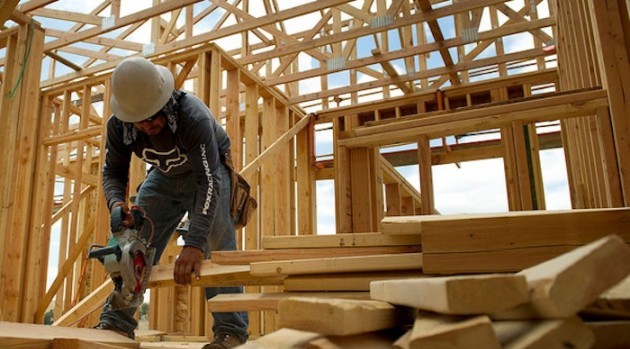
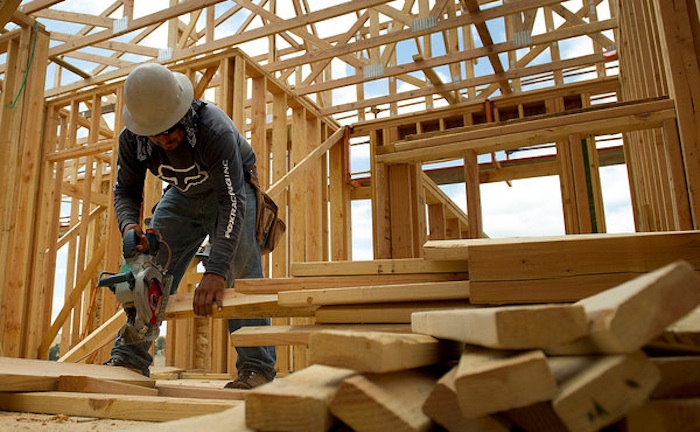
U.S. housing starts recorded their biggest drop in almost 3 years in January, as the third consecutive month of declines in permits confirmed weakness in the housing market. The Commerce Department said Wednesday new permits plummeted 16 percent to a seasonally adjusted annual rate of 880,000 units, which is the lowest level since September.

The percentage drop, alone, was the largest since February 2011.

Economists claim permits were likely weighed down by harsh weather this winter, as if winter has never been cold to the point people will pass on new construction when given the opportunity. Meanwhile, December housing starts were revised up to a 1.05 million-unit pace from the previously reported 999,000-unit rate.

The Commerce Department reports missed expectations, as economists polled by Reuters had expected starts to fall to a 950,000-unit rate in January. Despite the claims, not all of the weakness can be laid at the feet of the cold weather, considering evidence the economy was already losing momentum towards the end of the fourth quarter has been vast.

U.S. homebuilder confidence suffered its largest one-month drop ever in the month of February, falling below the key 50 mark for the first time since May. The markets were shaken on homebuilder confidence data that followed the Empire State’s manufacturing index showing that sector took a beating in the month, as well.

Further, while the Midwest gauge took a beating, the Northeast gauge shot up to the highest level since August 2008, debunking the cold weather explanation.

Single-family homes, the largest segment of the market, fell 15.9 percent to a 573,000-unit pace in January. That was the lowest level since August 2012. Starts for the volatile multi-family homes segment dropped 16.3 percent to a 307,000-unit rate.

Permits to build homes fell 5.4 percent in January, the largest drop in since June, to a 937,000-unit pace. Permits for single-family homes slipped 1.3 percent. Multifamily sector permits declined 12.1 percent.

U.S. housing starts recorded their biggest drop

Ohio Governor Race

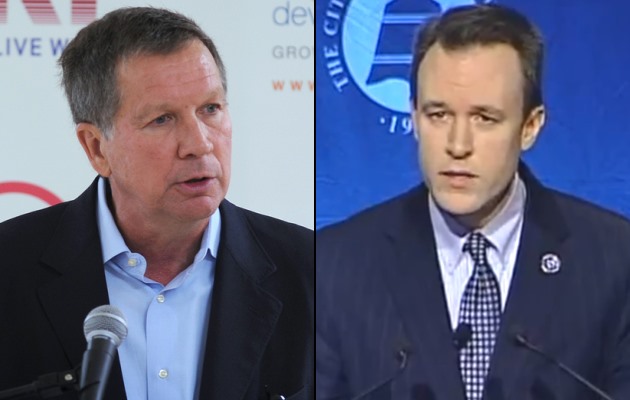
Incumbent Gov. John Kasich (left) and his likely Democratic opponent, Cuyahoga County (Cleveland) Executive Ed FitzGerald (right).

UPDATE: Rating change for the Ohio Governor race can be viewed here.

The Ohio Governor race is the fourth article in what will be a succession of articles offering expanded analysis on the 2014 Governor Map Predictions on PeoplesPunditDaily.com. Incumbent Republican Gov. John Kasich will likely face Cuyahoga County (Cleveland) Executive Ed FitzGerald.

The model utilized at PeoplesPunditDaily.com to assign ratings for our 2014 Governor Map Predictions, examines several variables, i.e. polling, demographics and Partisan Voting Index, candidate recruitment and strength, campaign organization and fundraising, presidential approval ratings among other proven predictive measurements. Let’s begin with polling conducted on the Ohio Governor race. Kasich, early on, led the lesser-known FitzGerald by a comfortable margin.

FitzGerald should be well placed demographically to give the governor a real race, particularly because of the area he has proven strong in. However, after months of polling, Kasich was trailing in only one poll conducted by the Democratic pollster PPP, and it was by 3 percent. As we have previously explained, Public Policy Polling has a terrible pollster rating of 4 out of a possible 1 through 4 rating based upon past accuracy. In other polling, he was leading early by upwards of 14 percent, which has waned down to a still comfortable margin, currently averaging around 6 points.

The latest Quinnipiac University poll of 1,370 Ohio registered voters was conducted from Feb. 12 to Feb. 17, and has a margin of error (MoE) of plus or minus 2.7 percent. Among the data highlights, Gov. John Kasich still enjoys a strong approval rating (51 percent) and leads FitzGerald by a moderately comfortable 5-point margin, though his level of support was only 43 percent compared to 38 percent for his challenger. There is one caveat that should be of concern to the governor, however.

Though Ohio voters say by a 61 – 31 percent margin Kasich is a strong leader and also by a 52 – 35 percent margin he is honest and trustworthy, they are closely divided on whether he cares about their needs and problems. In the survey, 43 percent said he does care and 47 percent said he doesn’t care. Yet, even though the race tightened a bit, observing the polling trend reveals a considerably higher floor of support for the incumbent.

TREND: If the election for Governor were being held today, and the candidates were Ed FitzGerald the Democrat and John Kasich the Republican, for whom would you vote?
                     Feb 19  Nov 26  Jun 25  Apr 18  Feb 28
                     2014    2013    2013    2013    2013

FitzGerald           38      37      33      37      35
Kasich               43      44      47      46      45
SMONE ELSE(VOL)       1       2       1       1       1
WLDN'T VOTE(VOL)      2       4       4       2       2
DK/NA                16      15      15      15      17

But, in the end, polls don’t vote, people do. So, what matters is how many from either camp will be showing up to the polls to vote in the Ohio Governor race. The demographic composition of the 2014 midterm election year will benefit Kasich over Fitzgerald, that is, if past composition averages are any indication of future elections. Furthermore, if we were being honest, Ohio Secretary of State Jon Husted has been ensuring that the typical Democrat failsafe in Cuyahoga County — i.e. voter fraud — will likely not be strong this cycle.

Under the direction of Husted, election officials discovered and purged more than 257,000 dead people who were still listed as active voters, which is significant considering in 2012 the 2 percent Obama victory represented just 166,214 votes out of a total of approximately 5.5 million ballots cast. I am certain that many pundits will have a problem with me including that figure, but reality is reality.

That said, Ohio is moving to the right in the political spectrum, according to the annual Gallup party ID-by-state metric, as Republicans have erased nearly all of the Democrats’ advantage in Ohio. The state was an already competitive battleground, as evident by the 2010 and 2012 outcomes. Similarly, the Partisan Voting Index (PVI) was R+1 in 2010, and is now again R+1 in 2014. In 2010, Republican candidates running in states with a PVI of D+2 or more Republican, had a success rate of roughly 83 percent. While Partisan Voting Index provides us with a comparable electorate to estimate probabilities in overall election outcomes, presidential approval rating weighs heavily upon our model.

It is important to note, however, presidential approval rating is far more predictive in Senate races than gubernatorial contests. Nevertheless, it is still worthwhile to examine the relationship. President Barack Obama’s job approval rating among Ohio voters measured a negative 34 – 61 percent in a November Quinnipiac poll, which at the time was his lowest score in any Quinnipiac University poll nationally or in any individual state. Currently, Gallup has Obama’s approval around 42 percent, with the two polling firms averaging Ohio out at trailing the national average by roughly 4 points.

Even in a wave election year it is difficult to unseat an incumbent governor, which moves us on to the two questions of candidate recruitment and campaign organization. Kasich is a proven strong candidate, who has accomplished the aforementioned task, while FitzGerald is not and has not. Adding to the Democrats’ Buckeye State challenges, Kasich heads into the race with more than $7.9 million in his war chest, and has consistently out-raised his likely opponent. In July of 2013, Kasich had an advantage of a $2.6 million war chest to just $600,000 for FitzGerald, which has grown substantially. 

Campaign finance reports show Kasich again raised nearly $3.9 million, receiving in-kind donations totaling more than $629,000. Democrat Ed FitzGerald raised a little more than $1.6 million, but much of it from his party. Overall, the status of this race is comfortably characterized as “Likely Republican,” despite some of the warning signs Democrats hope to exploit.

The overall dynamic of the race, as well as weighing each specific variable, far and away suggest a Kasich victory. However, whether or not Kasich will eke out a reelection win or hand FitzGerald a Buckeye blowout, no pundit can say for sure. That is, at this moment. View Polling Below Or Return To The PPD 2014 Governor Map

Poll Date Sample Kasich (R) FitzGerald (D) Spread
Quinnipiac 2/12 – 2/17 1370 RV 43 38 Kasich +5
Quinnipiac 11/19 – 11/24 1361 RV 44 37 Kasich +7
PPP (D) 8/16 – 8/19 551 RV 35 38 FitzGerald +3
Quinnipiac 6/18 – 6/23 941 RV 47 33 Kasich +14
Quinnipiac 4/10 – 4/15 1138 RV 46 37 Kasich +9
Quinnipiac 2/21 – 2/26 1011 RV 45 35 Kasich +10

The Ohio Governor race is the fourth

minimum-wage-increase-cbo-report

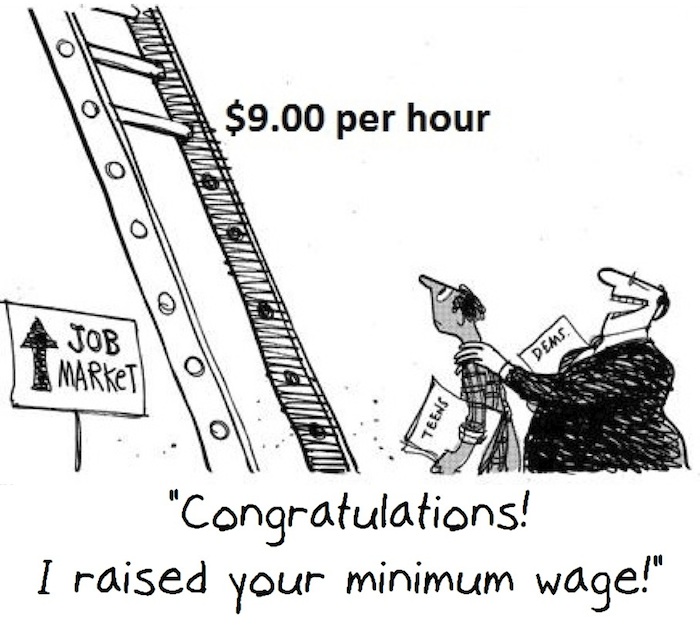
Democratic House members gathered at their annual retreat to talk midterm strategy, which included a minimum wage increase and income inequality. But a new CBO report says the plan by President Obama and fellow Democrats to increase the minimum wage to $10.10 an hour would cost at least 500,000 jobs.

Ironically, the other “top” issue at the retreat was unemployment. However, this is the second Congressional Budget Office report this month that found a Democratic policy will cost the American economy more jobs it does not have to lose. On Feb. 4, a CBO report projected that at least 2.3 million jobs will be destroyed due to the president’s and Democrats’ health care law, because ObamaCare provides incentives for people not to work.

Democrats immediately turned to the report’s findings that a minimum wage increase will increase wages for roughly 16.5 million Americans. Yet the report and the Democrats were immediately met with harsh Republican criticism.

“While helping some, mandating higher wages has real costs, including fewer people working,” said a spokesman for House Speaker John Boehner (R-OH). “With unemployment Americans’ top concern, our focus should be creating — not destroying — jobs for those who need them most.”

The CBO report said, however, their estimate of jobs destroyed was approximate, and that the actual economic impact could be a disastrous net loss of one million jobs.

The president reiterated his plan to increase the minimum wage, which he has already done for federal employees through executive fiat, only hours before the release of the new CBO report.

The White House was quick to respond to the report, albeit with inaccurate statements from Jason Furman, the chairman of the White House Council of Economic Advisers and one tasked with spinning the ObamaCare report earlier this month. Furman unbelievably told reporters on a conference call that the,“CBO’s estimate doesn’t reflect the overall consensus view of economists who say [the increase] would have minimum or no impact on employment.”

But the economic reality is far different, with the data conclusively proving that past minimum wage increase efforts have destroyed jobs, and will again if implemented in the future. A study conducted by the government’s own Department of Labor concluded that the first minimum wage, which was 25 cents per hour in 1938, cost the jobs of 30,000 to 50,000 of the 300,000 workers who were covered and had previously earned below the minimum.

Yet, Furman said the report is “essentially confirming the consensus” that such a minimum wage increase would reduce poverty and overall increase wages for moderate-to low-income families.

The CBO report is “essentially confirming the consensus,” just not in the manner that Furman suggests. In fact, a 2007 review of 102 studies that were conducted beginning in the 1990s by David Neumark and William Wascher found, “Indeed, the preponderance of the evidence points to disemployment effects.”

Still, despite the polling showing Americans favor an increase, Republicans argued the report puts conclusive weight behind their argument, which is the harder but correct argument to make. An increase would cut jobs, just as Bill Gates painfully told MSNBC earlier in the month,  because companies would have to spend more on wages.

“This report confirms what we’ve long known,” Boehner’s office said.

The CBO report couldn’t have been released at a less opportune time for the president, as the Democrat-controlled Senate is gearing to debate an Obama proposal to increase the $7.25 hourly minimum wage to $10.10 by the year 2016.

However, the proposal faces long odds of passing in the GOP-controlled House.

Sen. Tom Harkin, D-IA, who is the author of the Senate legislation, outrageously cited other liberal think-tank research claiming that a higher minimum wage would create jobs, not reduce them.

“And as the CBO report affirms, an increase in the minimum wage will help lift families out of poverty,” he said.

The report also states 900,000 fewer people would be living below the federal poverty line, however, the report presupposes the effects take place in an economic vacuum. Of course, no market mechanism takes place in such an environment, which is why we have the law of unintended consequences in any form of economy.

It is also the reason the CBO report amending their findings of ObamaCare was necessary, because they estimated the effect of the law in a vacuum, not reality, the first time in 2010. The congressional analysts also examined a proposal similar to Harkin’s and focused on the plan’s impact in late 2016, when it would take full effect.

After 2016, Harkin’s bill would require the minimum wage to be increased annually to reflect rising inflation.

The report said that besides increasing wages for people earning less than $10.10 hourly, some people making more than that amount would also see higher earnings as bosses adjust their pay scales upward, which is where the vacuum comes in. As employers adjust those earnings to compete with other companies for needed employees, they shed jobs to cover the costs.

Democrats really are running in 2014 on the party platform filled with policy proposals that kill American jobs.

Democratic House members gathered at their annual

U.S. homebuilder confidence suffered its largest one-month drop ever in the month of February, falling below the key 50 mark for the first time since May.

The National Association of Home Builders blamed winter’s severe weather and concerns about the costs of labor and building lots, perhaps ironic considering the president’s push for both global warming regulations and a hike in the minimum wage.

The NAHB/Wells Fargo Housing Market Index plummeted by 10 points to 46 in February, down from 56 in the month of January.

“Significant weather conditions across most of the country led to a decline in buyer traffic last month,” the Washington-based industry group’s chairman, Kevin Kelly, said in a statement. “Builders also have additional concerns about meeting ongoing and future demand due to a shortage of lots and labor.”

Readings below 50 show more builders have a negative opinion of housing market conditions, viewing them as poor rather than favorable.

“Clearly, constraints on the supply chain for building materials, developed lots and skilled workers are making builders worry,” NAHB Chief Economist David Crowe said in the same statement from the group. “The weather also hurt retail and auto sales and this had a contributing effect on demand for new homes.”

All three of the index’s major components fell in the month of February.

The survey’s index on homebuilders’ views on current sales conditions fell 11 points to 51, which is the lowest level since May, down from 62 in January.

The gauge of expectations for single-family home sales for the next six months dropped 6 points to 54, what is a nine-month low down from 60 the month prior.

The component on prospective buyer traffic took a 9-point hit down to 31 from 40 in January. February’s level was the lowest since April, when it came in at 30.

The markets were shaken on homebuilder confidence data that followed the Empire State’s manufacturing index showing that sector took a beating in the month, as well.

U.S. homebuilder confidence suffered its largest one-month

The New York Fed manufacturing index fell to 4.48 in February, from 12.51 the month prior, widely missing Wall Street’s expectation of a reading of 9.

Readings in the New York Fed manufacturing index that are above 0 indicate expansion, while those below point to contraction. Though the reading is still above zero, is represents more slowing in the sector that traditionally provides American working families with good paying jobs.

The New York Fed manufacturing index, sometimes referred to as the New York Empire index, is an early index and one of the earliest assessments of the U.S. manufacturing sector, with midwestern indexes shortly following.

The news is part of a string of disappointing economic data released Tuesday. The National Association of Home Builders’ gauge of homebuilder sentiment fell to 46 in February from 56 the month prior. It was the lowest reading since May.

The New York Fed manufacturing index fell

[wzslider info=”true”]

Conservatives have become accustomed to dealing with a lot nonsense resulting from the progressive monopoly on education, popular culture and the liberal media. However, we can no longer sit back while our country is destroyed from within at an ever-accelerating rate.

James Madison once wrote, “Those who mean to Govern themselves, must arm themselves with the power which knowledge brings.” As citizens of a free society, we must become masters of our own historical record, a task that includes assuring future generations receive a true and proper education. Truth, itself, has become a commodity on modern campuses of our once-admirable American universities.

So, I propose conservatives finally begin to fulfill our civic obligation to our youth by calling out those who seek to pollute their minds with outright lies, beginning with the liberal propaganda textbook written by Karen Kay Kirst-Ashman.

I am calling out this P-for-propaganda-hD professor for writing what she either knows to be flat-out lies regarding conservatives and conservatism, or is displaying a dangerous ignorance to American political history and the ideological origins of the American republic. Either way, Karen Kay Kirst-Ashman and her garbage textbooks have no place on a campus university anywhere in America.

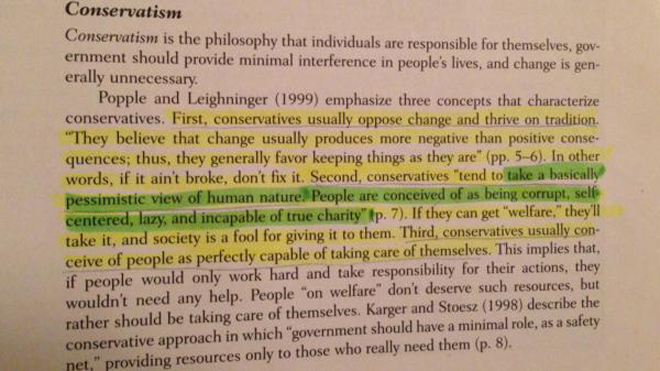
For those who have not yet read the story on FoxNews.com, “Introduction to Social Work & Social Welfare: Critical Thinking Perspectives,” makes various erroneous claims about conservatives and conservatism that 1) cannot even stand up to the basic scrutiny of logic, and 2) are simply historically inaccurate.

I would be enlightened to hear Professor Karen Kay Kirst-Ashman reconcile how conservatives “conceive of people as perfectly capable of taking care of themselves,” yet somehow still “take a pessimistic view of human nature.” To clear up her confusion, the ideology of American conservatism is predicated upon the principles of small “r” republicanism, which makes “self-evident” assumptions regarding the nature of human beings and government.

It is pretty simple. The closer our elected government officials are to the people, then the more responsive the representation is to the will of those who elect them. Because we care about those who are more intimately familiar with us, we want those who actually care about our welfare to have such authority, and in return be subject to responsibility when they dishonor their sacred responsibility in the social contract.

We take an optimistic view of human nature, particularly our natural obligation and desire to love our families and communities. It is in these traditional settings that our beautiful and uniquely human characteristics are most evident, such as love, duty, obligation and charity. We feel the greatest obligation toward our fellow-citizens and show the greatest degree of kindness toward one another when we are in intimate settings.

We do, however, take a pessimistic view of a centralized big government, which is disconnected and unresponsive to constituencies (i.e., the passage of ObamaCare), caring not for the damage they have done to human relationships and individual liberty. It destroys families units, which we conservatives call homes, not households. And it smothers civil society where human beings achieve their most-admirable accomplishments in personal and collective growth.

Nevertheless, these “self-evident” truths are all in opposition to progressivism, which is the ideology that truly takes a pessimistic view of human nature. Progressivism, or parentalism, is burdened by the dark belief that some are better than others, constantly in need of rulers to make decisions for them because they supposedly know what is best for those they have never met and will never know.

Second, on the matter of historical inaccuracy, Kirst-Ashman falsely claims President Ronald Reagan “failed to appoint many women to significant positions of power during his presidency.”

My God.

Instead of writing college textbooks, the “professor” should be reading high school textbooks. President Ronald Reagan not only appointed the first woman, Sandra Day O’Connor, to the United States Supreme Court, but also appointed the first woman ambassador to the United Nations, Jeane Kirkpatrick.

Remember professor, “ABC,” or “Anything But Communism.” Perhaps it was a conscious decision to leave out Jeane Kirkpatrick because she represents a wing of the now, non-existent Democratic Party that used to embrace capitalism, at least somewhat, and admonish communism. That may be hard for some to grasp, but there was a time when some Democrats thought Americans were “perfectly capable of taking care of themselves” without the hindrance disguised as help from the social welfare nanny state. “Ask not what your country can do for you,” was President Kennedy, not Reagan.

Of course she would oppose conservatism and support progressivism. If not for corrupt big government, which according to the Government Accountability Office wastes $250 billion annually on cronyism disguised as social welfare, no one else would force hardworking American taxpayers to fund the cost of her overpriced $200.00 garbage textbooks.

It should come as no surprise that Karen Kay Kirst-Ashman writes factually inaccurate propaganda to pollute our children’s minds. She’s got a ton of them helping to sink young Americans further in debt while they attend a university that is ill-equipped to prepare them for a job in this half-ruined American economy that her beloved progressivism destroyed.

So, I call out Karen Kay Kirst-Ashman and any head of any university who allows this junk in their libraries or criteria in their so-called higher learning institutions. I would like to think that they are just ignorant to what they are doing, and perhaps it is just my “pessimistic view on human nature” talking, but I am skeptical.

Therefore, I will put my thesis on human nature and the nature of government in my $8.00 book up against her or any of her bosses subscribing to the garbage in her $200.00 book, anytime they have the courage. Kirst-Ashman or anyone willing to defend her garbage can even pick the liberal channel and liberal moderator, and I will still intellectually destroy them for the good of the republic.

If Karen Kay Kirst-Ashman has been reading the same garbage she has been stupefying our youth with, then I will most-assuredly expose her as the fraud, “useful idiot” that she is.

I call on conservatives to join me in fighting back against these lies. Those of you who know my work know that I wholeheartedly believe we are doomed if we do not take back our history and, consequentially, our education apparatus. For if we continue to do nothing, it will be at our own peril and the peril of our future generations.

Watch the “OVR” mini movie for a real comparison of conservatism vs. progressivism below:

Conservatives must start calling out the liberal

Most Americans no longer even understand that President’s Day was once just the birthday of our first president and Founding Father, George Washington. Even less understand the significance of his refusal to serve more than two terms, or even that he started that tradition.

president's dayToday, we call the holiday President’s Day and often see Washington depicted with our 16th President of the United States, Abraham Lincoln. Unfortunately, much of those depictions are attempting to sell us something from a department store somewhere.
However, we should not ignore that a recent survey of eight-graders found just a fifth understood that Washington was the heart of the holiday, or even that the first 10 amendments to the Constitution are referred to as the Bill of Rights.

President James Madison, known to those who know as the father of our Constitution, once said that “those who mean to Govern themselves must arm themselves with the power which knowledge brings.”

We can begin to honor that tradition and self-evident truth by celebrating President’s Day with a video “Great Moments In Presidential History.” From there, there is so much more to do.

We can begin, policy-wise, by retaking the public school system, who — even if they wanted to teach our children correct history — likely do not even know it themselves. None of our Founding Fathers ever expected the experiment that was America to last without educating the whole of society on Natural Law, or the nature of men and government. The eighteenth century mind was wholly convince that a popularly based government could not exist without 1) education among the masses; and, 2) virtue among the citizenry.

As of now, we have a majority of neither. How long do we expect it to last when this is the case? That is, so long as we have not diluted and fooled ourselves into thinking we are smarter than our Founding Fathers.

VIDEO: Celebrate President's Day with this video

Hawaii governor race

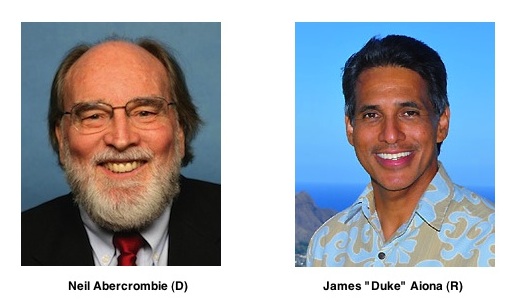
The Hawaii Governor race is the third article in what will be a succession of articles offering expanded analysis on the 2014 Governor Map Predictions on PeoplesPunditDaily.com. Incumbent Democratic Gov. Neil Abercrombie must first fend off a primary challenge from State Senator David Ige, before moving on to face from Republican Lt. Gov. Duke Aiona.

Gov. Neil Abercrombie has been viewed as vulnerable by other pundits, including myself, because of an approval rating around 40 percent. Hawaii is a perfect example of how much impact a poor state party can have on elections that can and should be won. Our first rating for this race, which was “Likely Democrat,” was based upon nonexistent candidate recruitment, lack of polling and the state’s blue tradition.

James R. “Duke” Aiona, Jr., previously won the Republican nomination for the Hawaii Governor race in 2010. While he was widely considered the front-runner for the party’s nomination, he went on to be defeated by then-congressman Neil Abercrombie. It was a wide margin of 57.8 to 40.8 percent. Because of the state’s Democratic domination, I was inclined to consider this race a tough, yet winnable race for Abercrombie.

But he is not a very popular governor, at all. We will look at his primary challenge first, then move on to the general election. We have our first survey coming out of the Hawaii News Now/Star Advertiser, which was conducted by Ward Research.

Hundreds of registered voters were asked if the Hawaii Governor race were held today, who would you vote for in the Democratic primary? In the Democratic primary, which isn’t quite as nasty as the Hawaii Senate race, 47 percent chose Neil Abercrombie, while a sizable 38 percent chose State Senator David Ige. A considerable 14 percent said they were still undecided, and the survey has a 4 percent MoE, or margin of error.

I am a big proponent of observing candidate action and comments when you want to know the inside story on a race. Numbers can only tell you so much, particularly numbers standing all alone at the moment.

Senator Ige told Hawaii News Now, “I’m very encouraged by the early results. You know there are many still undecided, and most importantly, it’s a really close race.” Though he is down by a healthy margin, the silver lining for David Ige is in his favorability rating’s ability to improve as more people get to know him throughout the campaign. While 30 percent have a favorable view of Ige, a whole 38 percent said they have never heard of him. It leaves room for improvement, to be sure.

University of Hawaii Assistant Political Science Professor Colin Moore said of the results, “He’s still beating David Ige in the primary. He shouldn’t be overly concerned. There’s still a lot of time left.”

That may be true, but what if he does defeat Ige to move on to the general election. In the poll, Gov. Neil Abercrombie trails his former Republican rival Duke Aiona in a head-to-head matchup by a wide 48 to 40 percent margin. Any incumbent, despite the state’s political leanings, should be very concerned they are polling at 40 percent.

“I’m a little shocked, but very encouraged by these numbers” Aiona told the paper.

Truthfully, I am very surprised by these results, as well.

“I think what this is, is confirmation that the people of Hawaii are just not happy with the way things are right now,” he added. Perhaps, he could be correct. Let’s look at and inside the numbers to test that assessment.

In total, 48 percent of Hawaiian registered voters have an unfavorable opinion of Neil Abercrombie, while 45 percent have a favorable view, including a larger 49/43 unfavorable rating among voters 35 to 54 (the largest voting age demographic in the state). Duke Aiona, surprisingly, had the highest favorability rating at 58/26 percent favorable in the survey, with an even larger 63/35 favorability margin among voters 35 to 54.

The results definitely give Abercrombie’s challenger, David Ige, a solid argument to make to Democratic primary voters. Of course, whether or not they swallow it is a whole other story.

“My opponent (Neil Abercrombie) is well-known and he can’t beat Aiona as a candidate. I still have much room to grow,” he said.

That is certainly true, even though Aiona has an even larger lead — 51 to 34 percent — over David Ige.

Mufi Hannemann, if he decides to run, may very well save Abercrombie from defeat. The Hawaii Governor poll gauged whether or not voters would be open to an independent run from Hannemann. Of those who responded, 39 percent said yes, while 57 percent said no. Hannemann views the poll as validation he could win a three-way race, not as him being a spoiler, which I see it to be more likely.

Hannemann gave an overly simplified analysis, saying “the fact that 4 out of 10 would pull a ballot for me in a 3 way race, we get 40 percent of the vote.” In reality, it is more likely that it is a reflection of the generally unhappy sentiment swirling over the governor’s job performance.

The PVI, or Partisan Voting Index according to Cook, is an almost-insurmountable partisan trend for any Republican opponent (D+12 in 2010 and D+20 in 2012). Similarly, Gallup recently released their new party ID by state survey, which showed a 24-point Democrat advantage in the state of Hawaii, though that is a stagnant number after years of increases.

However, Duke Aiona won in the statewide election when the Democrat advantage was still very significant, and since its adoption as a state, Democrats have run the statehouse for 44 out of the 55-year duration. Except, however, during a brief period when Aiona was Lt. Gov. Aiona. He is also widely credited for implementing moderate programs to crackdown and decrease the production and use of methamphetamine. Drug use was and still is a huge issue in Hawaii.

Nevertheless, basing a risky rating on one survey is not smart punditry, though I will not ignore the results, altogether. Thus, I am moving this race from “Likely Democrat” to “Leans Democrat” while we wait for survey confirmation. If we get one more indication that the Hawaii Governor race looks more like Illinois and less like Rhode Island, we will move this race as far as “Leans Republican” if not an even call.

The Hawaii Governor race is a winnable race for the Republican Party, almost akin to how Democrats feel about their chances of defeating Republicans in Georgia and Kentucky. Under the right conditions, with all of the political stars in alignment, it is certainly possible.

View Polling Below Or Return To The PPD 2014 Governor Map

Poll Date Sample Aiona (R) Abercrombie (D) Spread
Honolulu Star-Advertiser 2/1 – 2/11 642 RV 48 40 Aiona +8

RATING CHANGE: The Hawaii Governor race is

People's Pundit Daily
You have %%pigeonMeterAvailable%% free %%pigeonCopyPage%% remaining this month. Get unlimited access and support reader-funded, independent data journalism.

Start a 14-day free trial now. Pay later!

Start Trial