Widget Image
Follow PPD Social Media
Friday, January 2, 2026
HomeStandard Blog Whole Post (Page 651)

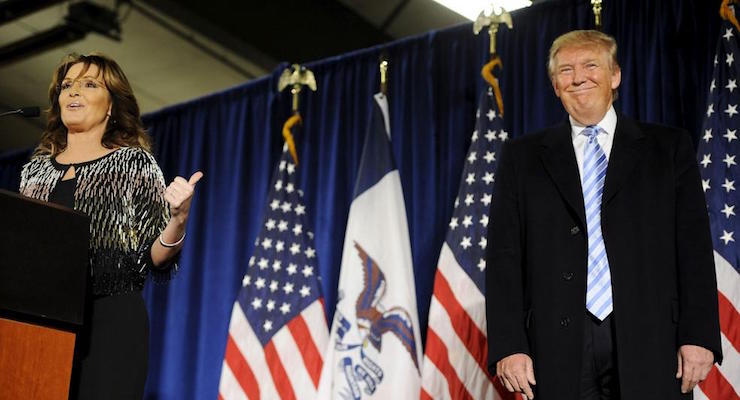
Palin-Trump-Iowa

Former vice presidential nominee and Alaska Gov. Sarah Palin, left, endorses Donald Trump, right, in Iowa on January 20, 2015. (Photo: Reuters/Mark Kauzlarich)

Former governor Sarah Palin is an intelligent person, contrary to how liberals have tried to portray her. So it seemed to me that, if anybody could explain why they were promoting the candidacy of Donald Trump, it would be Governor Palin.

But I listened in vain for any evidence or logic that would provide a reason to vote for Donald Trump for the office of President of the United States. There were lots of ringing assertions, just as in Trump’s own speeches, but no convincing facts or demonstrable reasons.

After all these months, no coherent plans have emerged from the rhetoric of “The Donald”– just sweeping boasts about all the things he says he will achieve. But boasts about the unknown future are hardly reassuring.

However puzzling the fervent support for Donald Trump may be today, given how little basis there is for it, such blind faith is not unique in history. Other dire or desperate times have produced other charismatic leaders to whom desperate people have turned, with hopes of deliverance.

Trump is certainly different from establishment Republicans, but it that enough?

Things were appalling in 1917 Russia, when people turned to Lenin to try to get them out of a disastrous war abroad and a bitter economic situation at home.

The fact that Lenin was quite different from the czar who had led the country into catastrophe might have seemed promising to some people. He was also different from the ineffective Kerensky government that failed in its brief months in office. But the totalitarian government that Lenin established proved to be even worse than its predecessors.

The idea that someone quite different from those who led a nation into disaster can be expected to produce an improvement is a non sequitur that has seduced many people in many places and times.

Germany’s Weimar Republic was nobody’s idea of an ideal government but Hitler’s reign that followed was far worse in every way. Many Americans denounced the rule of the Shah of Iran, but he was never a worldwide sponsor of terrorism, like those who replaced him.

A pattern that would appear in many other places and times was one in which people’s hopes became focused on someone new, charismatic and with ringing rhetoric– but utterly untested for the job of governing a nation.

That is where we are today.

The Republican field of candidates has had a number of people with experience governing at the state level, so that they have a track record that we could scrutinize. But the media obsession with Trump has left little time for weighing the pros and cons of those governors.

Some of them have already had to withdraw before we learned whether their qualifications were good, bad or indifferent. This may be a misfortune for their political careers but it can turn out to be a disaster for the country, if it leaves the field open only to people whom we must judge solely on the basis of their rhetoric.

There are still some governors left in the running, but they are not among the candidates who have the highest support in the polls, where most have received the support of fewer than 10 percent of the voters polled.

Former governor Jeb Bush looked like the front runner at the outset, especially with his impressive amount of money in his campaign chest. But it is not nearly as easy to buy an election as some commentators seemed to think, so perhaps we can take some solace from the discrediting of that notion.

We might also take some solace from the support received by Dr. Ben Carson, despite the media-fed notion that conservatives are racists. Even after his brief time leading the candidates in the polls has passed, Dr. Carson remains the candidate with the highest favorability rating among Republican voters who were polled.

But there are few other things to feel positive about as the primaries approach. Common sense by the voters may be the best we can hope for. And that can save the day, after all. In fact, they may be all that can save the day.

[mybooktable book=”wealth-poverty-and-politics-an-international-perspective” display=”summary” buybutton_shadowbox=”true”]

If anybody could explain why they were
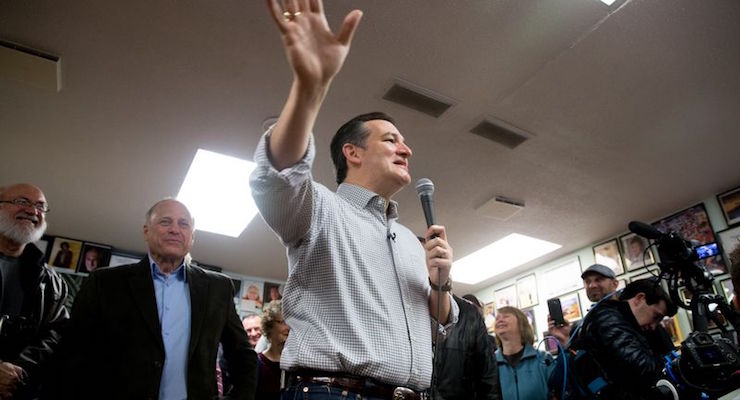
Ted-Cruz-Boone-Iowa

Texas Sen. Ted Cruz speaks in Boone, Iowa, on Jan. 4, 2016. (Photo: Andrew Harnik, AP)

Some time ago I said that many establishment Republicans dislike Ted Cruz so much that they would even back their nemesis, Donald Trump, if necessary to keep Cruz from winning. This is one time I wish I had been wrong.

The establishment has long held Cruz in contempt but didn’t believe he had any realistic chance of securing the GOP nomination. Now, with his campaign success, he’s scaring their pants off. Former Republican presidential candidate Bob Dole has issued apocalyptic warnings against nominating Cruz, and I’ve just received an email that Sen. Orrin Hatch prefers Trump over Cruz as well.

Earlier this week, it was New York Times pretend-conservative columnist David Brooks who suggested a Republican conspiracy against Cruz and Trump in favor of any other GOP candidate. “Very few presidents are so terrible,” he wrote, “that they genuinely endanger their own nation, but Trump and Cruz would go there and beyond.” Setting aside this mindless conflation of Cruz and Trump, do you believe we should be taking advice about potentially bad presidents from a guy who drooled over candidate Barack Obama because of his trousers?

More and more insiders fear Cruz far more than Trump. Trump drives the establishment batty by ginning up his supporters against them and for his current hardline stance on immigration, but they have to know it hasn’t been that long since Trump espoused a number of liberal positions and financially supported establishment figureheads in each party. As hard-nosed and independent as he seems, his track record reveals he is much more malleable and they’d have a better chance to influence him than Cruz.

Ted Cruz, on the other hand, has been a thorn in the establishment’s side since he came on the scene. Insiders are astounded that he has actually refused to abandon his campaign promises and his commitment to Reagan conservatism, despite overwhelming pressure and derision from the party and its power brokers.

They have concluded that Cruz must be driven by egomania and not principle. Who but a stubborn, opportunistic loner could resist the temptation to rub elbows with the power brokers once elected? Only oddballs honor their constituents and grassroots conservative causes above those of the ruling class. Only charlatans continue to articulate conservative ideas with passionate optimism and idealism once in office. Only zealots evince an abiding dedication to Reagan conservative principles beyond what’s necessary to get them elected. Only grandstanders would truly stand up to President Obama’s reckless budget demands instead of throwing in the towel of surrender before the fight has even begun.

Why is it automatically presumed that Obama will win every game of chicken he insists on playing with Republicans? Why can’t our side ever be confident enough in its own ideas and of the American people — as Ted Cruz is — to believe the people will back us if we call Obama’s bluff and articulate our case to them? The establishment’s rationale for caving has always been that Republicans, being the party of less government, can never win over the public in a shutdown showdown. They think that Cruz knows this too, but puts on a grandiose but futile show to play to the base and advance his political ambitions. Oh ye of little faith — little faith, that is, in the conservative ideas you maintain you embrace. If only the establishment would join Cruz in promoting the principles they say they share, just as Democrats always support an uncompromising and extremist Obama, there’s no telling what progress we could have made in thwarting some of Obama’s agenda.

As I see it, there are two major differences between Republican supporters and opponents of Cruz. One is that his supporters are more consistently conservative on every category of issues. The fight, in other words, is not just about strategy, as the establishment insists, but also involves policy.

The second is that Cruz’s supporters believe he is a man of integrity. Many of his detractors contend he is a phony, but I think their real fear is that he is not. He will not change his positions for expedience — though many are working overtime to convince us otherwise.

The establishment, then, either believes or wants to fool us into believing that it opposes Cruz because he is a poseur, a saboteur of good government — a man who impedes the cause of conservatism by his unwavering commitment to it. Only by compromise and pragmatism, they argue, can we really advance conservative principles.

The truth, however, is that they are not as committed to conservative principles as they say they are and don’t regard the current problems confronting our nation with the same degree of urgency as mainstream conservatives. They also place a high value on process — on bipartisanship and collegiality for their own sake — even over advancing a conservative agenda. Not long ago I read that one establishment icon said he didn’t think a Hillary presidency would be that bad. Seriously?

We finally have a candidate who is committed to conservative principles across the board, a man who reveres the Constitution and America, as founded, who acutely understands the destruction President Obama has wrought, and who we can rely on to fulfill his promise to do everything in his power, if elected, to reverse this disastrous course and restore us on a path to recovery.

If the establishment would quit hyperventilating over Ted Cruz and get behind him they could do more than anything else to advance the cause they profess to believe in.
[mybooktable book=”the-emmaus-code-finding-jesus-in-the-old-testament” display=”summary” buybutton_shadowbox=”true”]

If the establishment would quit hyperventilating over

Mortgage Risk Indices Update for December

home-foreclosures

National and State Mortgage Risk Indices are tracked and released by AEI’s International Center on Housing Risk.

The National Mortgage Risk Index, a gauge of housing market risk for Agency purchase loans, gained .55 year-over-year to 12.29% in December. The NMRI gained year-over-year in every month since January 2014, reflecting the impact of Agency purchase loan originations migrating from large banks to nonbanks.

This month’s NMRI has been expanded to include 9.7 million Fannie, Freddie, FHA, and Rural Housing refinance loans dating back to November 2012. AEI’s International Center on Housing Risk introduced two new risk metrics this month, including the NMRI for Agency purchase and refinance loans and the NMRI for Agency refinance loans.

“The addition of nearly 10 million Agency refinance loans to the NMRI is an important milestone, as it brings the risk rated loan total to nearly 18 million loans,” said Edward Pinto, codirector of the International Center on Housing Risk. “In future months we expect to add VA refinances and private (non-Agency) purchase and refinance loans, which are expected to bring the NMRI total to 22 million loans, thereby creating a marketwide National Mortgage Risk Index.”

However, the riskiness of Agency refinance mortgages declined slightly over the past year to 11.18% in December, down 0.19 percentage point. Worth noting, the results exclude VA refinance loans, which are not yet risk rated by the Center. Meanwhile, the NMRI for the composite of Agency purchase and refinance loans (new) came in at 11.81% in December, up 0.22 percentage point from a year earlier. This composite index is trending up more slowly juxtaposed to the index for purchase loans overall, fueled largely by a smaller decline for refinance loans.

The NMRI, which was established post-subprime mortgage crisis to gauge housing market risk, is based on nearly the universe of home purchase and refinance loans with a government guarantee. In December, according to the report, the NMRI data covered roughly 239,000 purchase loans and 182,000 refinance loans. With the addition of these loans, the total number of loans that have been risk rated in the NMRI since December 2012 rose to 17.8 million.

“The data clearly show that first-time buyers have plentiful access to credit,” said Stephen Oliner, codirector of AEI’s International Center on Housing Risk. “Those who assert that credit is tight are ignoring the facts.”

Other notable takeaways from the December NMRI include the following (H/T AEI):

• The pace of homebuying remained strong, with purchase loan volume in December up 7% from a year earlier. The overall volume was buoyed by continued robust demand from first-time buyers, driven by looser lending and an improving job market.

• The NMRI for first-time buyers hit 15.76%, just off the series high set in November 2015; the December level is up 0.92 percentage point from a year earlier and is well above the Repeat Primary Homebuyer NMRI of 9.84%.

• Credit standards for first-time home buyers are not tight and getting looser. In December, 70% had down payments less than or equal to 5%, 27% had DTIs greater than the QM limit of 43%, and the median FICO score was 706, a bit below the median for all individuals in the U.S.

• The cut in FHA’s annual insurance premium early this year boosted its purchase loan market share to 29% in December from 23% in March. This increase has come largely at the expense of Fannie Mae and the Rural Housing Service.

• Fueled by historically low mortgage rates and high and growing leverage, a seller’s market has now prevailed for 38 straight months. As a result, the rise in real home prices from the 2012:Q2 trough has far outstripped income growth, crimping affordability.

• The seismic shift in purchase market share from large banks to nonbanks continued in December, boosting overall risk as nonbanks have a much higher MRI. In December, the large bank share was 25%, down from about 60% in November 2012. For FHA loans, the large-bank share in December was even lower – about 15%.

The National Mortgage Risk Index, a gauge

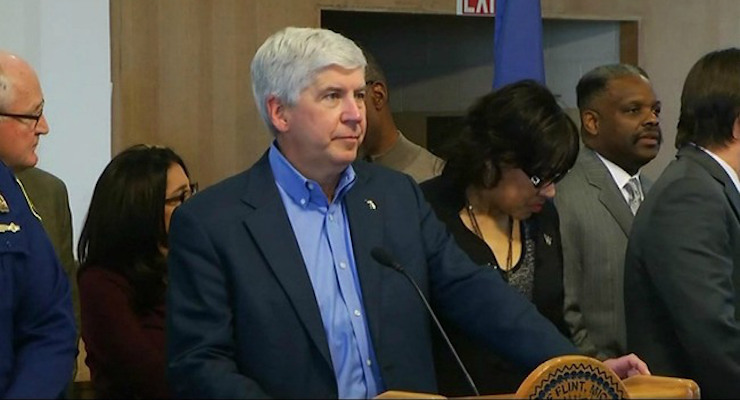
Rick-Snyder-Flint-MI-Presser

Gov. Rick Snyder holds a press conference to outline his plan to address Flint, Michigan, water crisis on Jan. 11, 2016.

Remember the cluster-you-know-what in New Orleans following Hurricane Katrina? Corrupt and incompetent politicians in both the city and at the state level acted passively, assuming that Uncle Sam somehow should be responsible for dealing with the storm.

And we’ve seen similar behavior from other state and local politicians before, during, and after other natural disasters.

The obvious lesson to be learned is that the federal government shouldn’t have any responsibility for dealing with natural disasters. All that does it create a wasteful layer of bureaucracy, while also inculcating a sense of learned helplessness on the part of state and local officials who should be responsible for dealing with storms and other local crises.

In other words, the answer is federalism. State and local governments should be solely responsible for state and local issues.

But not just because of some abstract principle. There’s a very strong practical argument that you get more sensible decisions when the public sector is limited (as Mark Steyn humorously explained) and there is clear responsibility and accountability at various levels of government.

And this is why the biggest lesson from the scandal of tainted water in Flint, Michigan, is that local politicians and bureaucrats should not be able to shift the blame either to the state or federal government. Which was my main point in this interview.

[brid video=”25658″ player=”2077″ title=”Dan Mitchell on the Federalism Solution to Flint’ Water Crisis”]

To be sure, it is outrageous that state and federal bureaucrats knew about the problem and didn’t make it public, so I surely don’t object to officials in Lansing and Washington getting fired.

But I do object to the political finger pointing, with Democrats trying to blame the Republican Governor and Republicans trying to blame the Democratic President. Nope, the problem is an incompetent local government that failed to fulfill a core responsibility.

The Wall Street Journal has the same perspective, opining that the mess in Flint is a failure of government.

…the real Flint story is a cascade of government failure, including the Environmental Protection Agency.

More specifically (and as I noted in the interview), we have a local government that became a fiefdom for a self-serving bureaucracy that was more concerned with its privileged status than in providing core government services.

…after decades of misrule: More than 40% of residents live in poverty; the population has fallen by half since the 1960s to about 100,000. Bloated pensions and retiree health care gobble up about 33 cents of every dollar in the general fund.

And the WSJ editorial also castigated the state and federal bureaucrats that wrote memos rather than warning citizens.

MDEQ and the EPA were chatting about Flint’s system as early as February. MDEQ said it wanted to test the water more before deciding on corrosion controls, though it isn’t clear that federal law allows this.…the region’s top EPA official, political appointee Susan Hedman, responded… “When the report has been revised and fully vetted by EPA management, the findings and recommendations will be shared with the City and MDEQ and MDEQ will be responsible for following up with the City.” She also noted over email that it’s “a preliminary draft” and it’d be “premature to draw any conclusions.” The EPA did not notify the public.

The lesson is that adding state and federal bureaucracy impedes effective and competent local government.

The broader lesson is that ladling on layers of bureaucracy doesn’t result in better oversight and safety. It sometimes lets agencies shirk responsibility for the basic public services like clean water that government is responsible for providing.

Here’s the bottom line.

Federalism is about getting better government by creating clear lines of responsibility and accountability in an environment that allows state and local governments to learn from each other on best practices.

The current system blurs responsibility and accountability, by contrast, while also imposing needless expense and bureaucracy. And we get Katrina and Flint with this dysfunctional approach.

So whether it’s Medicaid, education, transportation, welfare, or disasters, involvement from Washington makes things worse rather than better.

[mybooktable book=”global-tax-revolution-the-rise-of-tax-competition-and-the-battle-to-defend-it” display=”summary” buybutton_shadowbox=”true”]

The biggest lesson from Flint, Michigan, is

Scholastic-Bookstore-HQ

The entrance at Scholastic headquarters in New York City.

Scholastic (NASDAQ:SCHL), producers of children’s reading materials–and one of the leading companies of student publications for schools around the world–just pulled a picture book about George Washington and his slaves.

Why? The reasons are ridiculous.

A Birthday Cake for George Washington,” released earlier this month, was painted as “sentimentaliz[ing] a brutal part of American history,” the Associated Press reported. In other words, the problem was the pages showed happy slaves–a smiling Hercules and his daughter, Delia–cooking up a celebratory cake for their master and owner, Gen. Washington. And the publisher said in a statement: That image just doesn’t cut it.

“The book may give a false impression of the reality of the lives of slaves and therefore should be withdrawn,” Scholastic said.

Because slaves never smiled–never, never, not under any circumstances, ever? Okay. That’s a viewpoint. But this is a book for first-through-third graders. For that age, everybody smiles–including animals and inanimate objects. Some of them even dance. Can you say Disney’s Beauty and the Beast? (Imagine the outrage if the smiling slaves in “A Birthday Cake for George Washington” did that. Or, look at it the other way and imagine the outrage if the father-daughter enslaved duo were instead presented as bare-backed and downtrodden, with bloody red whip marks stretched wide across their skeletal torsos.)

Regardless, censorship in this instance is not only unfounded–they’re third-graders, for crying out loud. Plenty of time to instill their minds with the true horrors of slavery in grades four-through-12 and beyond. But, and this is true with all forms of censorship, it also presents a slippery slope.

Censor one book, what about another? That sort of thing. And in this case, the finger-pointing can indeed do a 180 and turn right back at the source, Scholastic.

What does a book about an 8-year-old boy named George who desperately wants others to see him as a girl, have in common with a cartoon-esque account of a Captain Underpants character who time travels to discover he’s gay? That’s right – they’re both published by Scholastic.

“The world’s largest publisher and distributor of children’s books is heavily promoting a pro-transgender book designed for students as young as third grade,” Life Site News wrote in September 2015, of “George,” by Alex Gino, an author who paints himself as a 20-year activist for “queer and trans” issues.

So, transgender and homosexuality for third-graders is okay; smiling slaves, not. Because ostensibly books on transgender and homosexuality promote tolerance while books on smiling slaves tap at a history most want to forget, skewed as it may be.

Got it. Except, of course, there’s this one little troublesome point with that rationalization. Censorship of such blatant and agenda-driven selectiveness reeks of Nazi Germany days.

Remember Joseph Goebbels, Adolf Hitler’s propaganda man?

In 1933, Goebbels drew a crowd of about 40,000 – most of whom hailed from the college and intellectual camps, those who thought they knew best how Germans ought to be raised and taught – for a massive book burning by bonfire, in order to, as he termed it, “clean up the debris of the past.”

How is that different from America’s current infatuation with cleaning up the debris of our slavery past, tearing down monuments of Robert E. Lee, pressing to remove statues of Thomas Jefferson, demanding to obliterate evidence of Lee, Jefferson Davis and Stonewall Jackson from Stone Mountain in Georgia? Now come the books – beginning with the elementary-level “A Birthday Cake for George Washington.”

Beware the slippery slope; America is not Germany, but for the grace of God and the sanity of her people, could very well one day be.

[mybooktable book=”police-state-usa-how-orwells-nightmare-is-becoming-our-reality” display=”summary” buybutton_shadowbox=”true”]

Scholastic (NASDAQ:SCHL) just pulled a picture book

mid-atlantic-manufacturing-aluminium-raw-materials-reuters

A worker in the mid-Atlantic manufacturing sector works with raw aluminum materials. (PHOTO: REUTERS)

The Philadelphia Federal Reserve’s Manufacturing Business Outlook Survey showed mid-Atlantic activity contracted in the month of January, though rose slightly.

(UPDATE: A previous version initially reported the region as the Midwest, which is covered in the ISM’s Chicago Business Barometer.)

Economists expected the index to edge down to -6.0. Even though industry conditions improved modestly in the survey, which also includes New Jersey and Delaware, manufacturers turned even more pessimistic about their future prospects. The six-month outlook gauge fell to 19.1 from 24.1 in December, the lowest degree of confidence since November 2012. Manufactures predicted drop-offs in new orders and shipments.

philadelphia fed manufacturing business outlook survey data graph

Source: Philadelphia Federal Reserve

The report out of the Philadelphia Fed follows another regional survey–the Empire State Manufacturing Survey–which was released last week by the New York Fed. The survey found manufacturing activity across New York contracted at the quickest pace since the recession in 2009. Traders and economists use the Fed’s regional surveys, five in all, as clues ahead of a carefully-watched gauge of national production conducted by the Institute for Supply Management. While the ISM sruvey will release that report on Feb. 1, the prior month also showed national contraction.

Special Questions (January)

Philadelphia Federal Reserve Manufacturing Business Outlook Survey

The Philadelphia Federal Reserve's Manufacturing Business Outlook

Weekly-Jobless-Claims-Graphic

Weekly Jobless Claims Graphic. Number of Americans applying for first-time jobless benefits.

The weekly jobless claims report released by the Labor Department showed applications rose to 293,000 week ending January 16, up from a downwardly revised 283,000 the week prior. The number represents a six-month high (July) and indicates the labor market may be impacted by the sharp economic slowdown.

Wall Street expected the number of Americans filing for first-time unemployment benefits to fall to 278,000 from an initially reported 284,000. There were no special factors impacting this week’s initial claims, according to a Labor Department analyst, and no state was triggered “on” the Extended Benefits program during the week ending January 2.

The 4-week moving average–which is widely considered to be a better gauge, as it irons-out volatility–was 285,000, an increase of 6,500 from the previous week’s downwardly revised average. Still, unemployment claims have now been below the 300,000 threshold, which is typically associated with a strong labor market, for 46 straight weeks. While that is the longest streak since the early 1970s, long-term unemployment has shrunk the pool of benefit-eligible workers.

The highest insured unemployment rates in the week ending January 2 were in Alaska (4.6), New Jersey (3.5), Pennsylvania (3.4), Connecticut (3.2), Montana (3.2), West Virginia (3.2), Illinois (2.8), Massachusetts (2.8), Minnesota (2.8), and Rhode Island (2.8).

The largest increases in initial claims for the week ending January 9 were in California (+17,371), Texas (+13,399), New York (+6,819), Georgia (+5,901), and Missouri (+5,892), while the largest decreases were in Iowa (-2,737), Kentucky (- 1,790), Minnesota (-1,031), New Jersey (-698), and Michigan (-591).

The weekly jobless claims report released by

Alexander-Litvinenko

Alexander Litvinenko, former KGB spy is photographed at his home in London in this May 10, 2002 file photo. (Photo: AP/Alistair Fuller)

A British judge ruled Thursday that Russian President Vladimir Putin “probably ordered” the murder of former KGB and FSB agent Vladimir Litvinenko, a Kremlin critic who died three weeks after drinking tea laced with poison at a London hotel in 2006. The Russian government has denied any involvement in Litvinenko’s murder and has refused to extradite the two man suspects in the case.

Judge Robert Owen said Thursday that he is certain Alexander Litvinenko was given tea laced with a fatal dose of polonium-210 at a London hotel in November 2006. In his 326-page report, Judge Owen said that based on the evidence he had seen, there was a “strong probability” that Russia’s FSB security service conducted the operation to kill Litvinenko. The murder-hit was “probably” approved by then-FSB head Nikolai Petrushov and by Putin.

“We regret that a purely criminal matter has been politicized and has darkened the general atmosphere of bilateral relations,” a spokesperson for Putin said.

The judge also noted that Litvinenko “was regarded as having betrayed the FSB” with his actions, and that “there were powerful motives for organizations and individuals within the Russian state to take action against Mr. Litvinenko, including killing him.” Litvinenko fled to Britain in 2000 after a falling out with Putin and his oligarch inner circle. However, in the years leading up to his death, the former spy became a whistleblower and a vocal critic of Putin, whom he accused of corruption and having involvement with organized crime.

“I am very pleased that the words my husband spoke on his deathbed when he accused Mr. Putin have been proved by an English court,” Litvinenko’s widow Marina said outside the High Court.

Though both deny involvement, British police have accused Dmitry Kovtun and Andrei Lugovoi of actually carrying out the Kremlin-sponsored killing. Moscow refuses to extradite either of them and, not surprisingly, the Russian government has always denied involvement in Litvinenko’s death.

But that didn’t stop the British government from appointing Judge Owen to head a public inquiry into the murder, which put a strain on U.K.-Russian relations. He heard from dozens of witnesses during months of public hearings last year, and also saw secret British intelligence evidence.

A British judge ruled Thursday that Russian

Countries-Drinking-Age

Young women enjoying a drink at an OpenCatwalk event at the Belvedere by Q! hotel on July 9, 2014 in Berlin, Germany.

In America, alleged land of freedom, a 19-year-old soldier just back from Afghanistan can’t sidle up to a bar and legally order a beer.

In supposedly regulation-crazed Europe, meanwhile, an 18-year-old can order a martini. In the beer-drinking cultures of Belgium and Germany, a 16-year-old can ask for beer or wine.

Do you detect a flaw in this story?

Prohibition has been gone for over 80 years. Most agree that it was worse than the disease it was meant to eradicate — the scourge of drunkenness. Nowadays, backers of drug legalization rightly hold up Prohibition as their model for failed policy.

Yet we see few arguments for lowering the national drinking age from the current 21 to 18, where it was until 1984. On the contrary, the public is still being pummeled by “expert” studies linking virtually any alcohol consumption to a variety of maladies, from cancer to road fatalities.

Britain has just issued the U.K. chief medical officer’s new guidelines for alcohol consumption. They’re just short of nuts. They make no distinction between the ability of men and women to process alcohol. Wiser guidelines note that female bodies can’t take as much.

The doctors set a weekly limit for drinking at a strangely low six pints of beer or four large glasses of wine. A 30-year-old male weightlifter or a 74-year old female “wisp of a thing,” same guideline.

The report goes on. Any amount of alcohol consumed on a regular basis raises the risk of mouth, throat and breast cancers. An Associated Press story on the guidelines authoritatively announces, “Alcohol is a known carcinogen.” How is that?

The Harvard School of Public Health has noted a link between alcohol consumption and breast cancer, but with an asterisk. “Getting extra folate (a B vitamin) may cancel out this alcohol-related increase,” according to its report titled “Alcohol: Balancing Risks and Benefits.”

As for the benefits, Harvard cites numerous studies showing moderate drinking seems to lower the risk of cardiovascular death. The British report made the most grudging nod in that direction. It said that red wine might be good for heart only if you are a woman over age 55 and drink no more than two glass a week.

Would the good doctors please explain why moderate drinkers live longer than those who don’t drink at all?

There’s this urge to simply lay blame for all kinds of societal ills possibly related to alcohol on alcohol only. True, alcoholism is a curse for those afflicted and their loved-ones. What makes it a curse is the addiction part. Some people simply shouldn’t drink.

Drunken driving is a menace, but the problem is drinking (START ITAL) and (END ITAL) driving, not the drinking itself. The bar fly who pours himself into a taxi at the end of the evening is no danger on the road — far less so than the teetotaler fiddling with the car’s infotainment system.

Binge drinking is both unhealthy and unsightly. It reflects mostly immaturity and a lack of education on civilized drinking. Some of it, ironically, stems from drinking bans on college campuses. Former Kenyon College President S. Georgia Nugent has made this argument. She’s written that students heading off to a party knowing no alcohol will be served engage in “pre-gaming,” that is, consuming huge quantities in advance.

Britain has never taken this nanny talk seriously enough to raise its legal drinking age from the current 18. By the way, the drinking age in Canada is 19 and in almost all of Latin America, 18.

America stands pretty much alone in treating people old enough to marry, vote and fight in wars like children. Time to let 18-year-olds drink and manage themselves.

America stands pretty much alone in treating

Donald-Trump-vs-Barack-Obama

Billionaire real estate mogul Donald Trump, left, and President Barack Obama, right.

Those of us who like to believe that human beings are rational can sometimes have a hard time trying to explain what is going on in politics. It is still a puzzle to me how millions of patriotic Americans could have voted in 2008 for a man who for 20 years — TWENTY YEARS — was a follower of a preacher who poured out his hatred for America in the most gross gutter terms.

Today’s big puzzle is how so many otherwise rational people have become enamored of Donald Trump, projecting onto him virtues and principles that he clearly does not have, and ignoring gross defects that are all too blatant.

There was a time when someone who publicly mocked a handicapped man would have told us all we needed to know about his character, and his political fling would have been over. But that was before we became a society where common decency is optional.

Yet there are even a few people with strong conservative principles who have lined up with this man, whose history has demonstrated no principles at all, other than an ability to make self-serving deals, and who has shown what Thorstein Veblen once called “a versatility of convictions.”

With the Iowa caucuses coming up, it is easy to understand why Iowa governor Terry Branstad is slamming Trump’s chief rival, Senator Ted Cruz, who has opposed massive government subsidies to ethanol, which have dumped tons of taxpayer money on Iowa for growing corn. Iowa’s Senator Charles Grassley has come right out and said that is why he opposes Senator Cruz.

Former Senator Bob Dole, an establishment Republican if ever there was one, has joined the attacks on Ted Cruz, on grounds that Senator Cruz is disliked by other politicians.

When Senator Dole was active, he was liked by both Democrats and Republicans. He joined the long list of likable Republican candidates for president that the Republican establishment chose– and that the voters roundly rejected.

With both establishment Republicans and anti-establishment Republicans now taking sides with Donald Trump, it is hard to see what principle– if any– is behind his support.

Some may see Trump’s success in business as a sign that he can manage the economy. But the great economist David Ricardo, two centuries ago, pointed out that business success did not mean that someone understands economic issues facing a nation.

Trump boasts that he can make deals, among his many other boasts. But is a deal-maker what this country needs at this crucial time? Is not one of the biggest criticisms of today’s Congressional Republicans that they have made all too many deals with Democrats, betraying the principles on which they ran for office?

Bipartisan deals — so beloved by media pundits — have produced some of the great disasters in American history.

Contrary to the widespread view that the Great Depression of the 1930s was caused by the stock market crash of 1929, unemployment never reached double digits in any of the 12 months that followed the stock market crash in October, 1929.

Unemployment was 6.3 percent in June 1930 when a Democratic Congress and a Republican president made a bipartisan deal that produced the Smoot-Hawley tariffs. Within 6 months, unemployment hit double digits — and stayed in double digits throughout the entire decade of the 1930s.

You want deals? There was never a more politically successful deal than that which Neville Chamberlain made in Munich in 1938. He was hailed as a hero, not only by his own party but even by opposition parties, when he returned with a deal that Chamberlain said meant “peace for our time.” But, just one year later, the biggest, bloodiest and most ghastly war in history began.

If deal-making is your standard, didn’t Barack Obama just make a deal with Iran — one that may have bigger and worse consequences than Chamberlain’s deal?

What kind of deals would Donald Trump make? He has already praised the Supreme Court’s decision in “Kelo v. City of New London” which said that the government can seize private property to turn it over to another private party.

That kind of decision is good for an operator like Donald Trump. Doubtless other decisions that he would make as president would also be good for Donald Trump, even if for nobody else.

[mybooktable book=”wealth-poverty-and-politics-an-international-perspective” display=”summary” buybutton_shadowbox=”true”]

Those of us who like to believe

People's Pundit Daily
You have %%pigeonMeterAvailable%% free %%pigeonCopyPage%% remaining this month. Get unlimited access and support reader-funded, independent data journalism.

Start a 14-day free trial now. Pay later!

Start Trial