Widget Image
Follow PPD Social Media
Tuesday, January 13, 2026
HomeStandard Blog Whole Post (Page 770)

Greek-Prime-Minister-Alexis-Tspiras

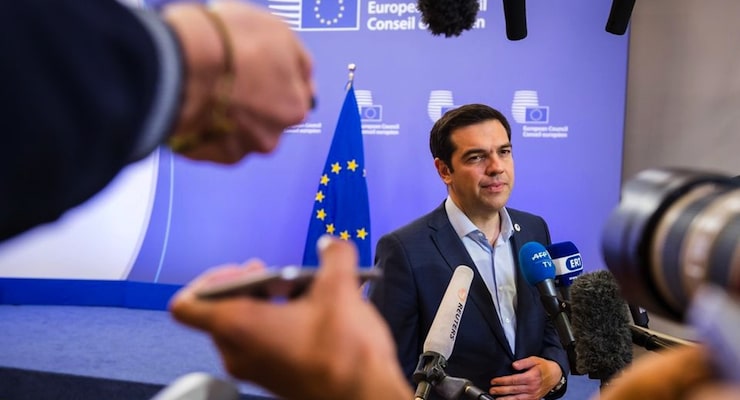
Greek Prime Minister Alexis Tsipras speaks with the media after a meeting of eurozone heads of state at the EU Council building in Brussels on Monday, July 13, 2015. A summit of eurozone leaders reached a tentative agreement with Greece on Monday for a bailout program that includes “serious reforms” and aid, removing an immediate threat that Greece could collapse financially and leave the euro. (AP Photo/Geert Vanden Wijngaert)

I’ve shared lots of analysis (both serious and satirical) about the mess in Greece and I feel obliged to comment on the latest agreement for another bailout. But how many times can I write that the Greek government spends too much money and has a punitive tax system (and a crazy regulatory regime, a bloated bureaucracy, etc)?

So let’s try a different approach and tell a story about the new bailout by using some images.

Here’s an amusing perspective on what actually happened this weekend.

I explained a few days ago that the bailouts have simultaneously enabled the delay of much-needed spending reforms while also burdening Greece with an impossible pile of debt.

But the Greek bailouts, like the TARP bailout in the United States, were beneficial to powerful insiders.

Here’s a look at how banks in various European nations have been able to reduce their exposure to Greek debt.
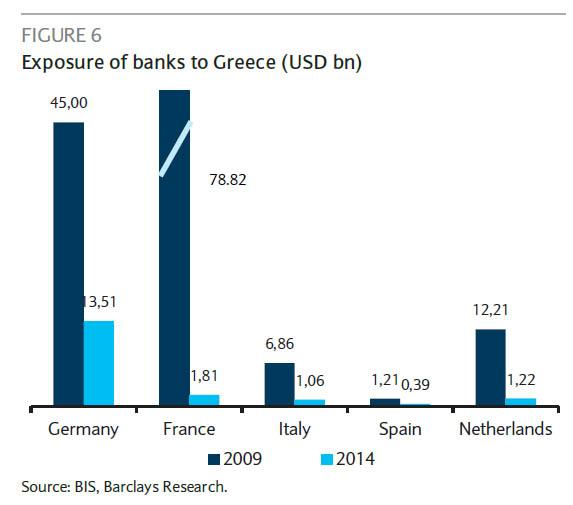
Sure, the banks almost surely still lost money, but they also transferred a lot of the losses to taxpayers.

To get a sense of the magnitude of handouts, here’s a chart from a Washington Post story.

And now, assuming the deal gets finalized, that pile of foolish and unsustainable debt will be even bigger.

One of the main components of the new agreement is that Greece supposedly will raise revenue by selling $50 billion of state-owned assets.

Don’t believe that number. But not because there aren’t plenty of assets to sell, but rather because the track record on privatization proceeds suggests that there is a giant gap between what Greece promises and what Greece delivers.
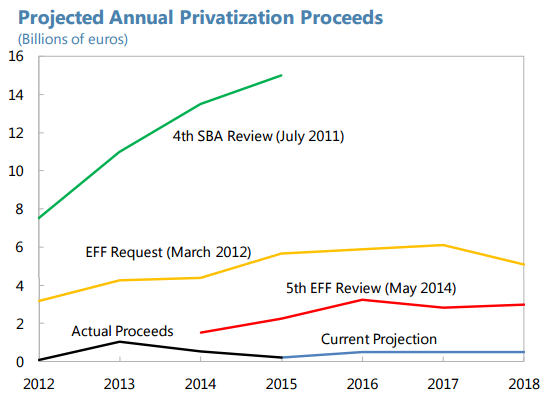
To understand why assets aren’t being sold, just keep in mind that most of the assets are under the control of the government in order to provide unearned benefits to different interest groups.

If you’re an overpaid unionized worker at a government-owned port, for instance, the last thing you want is to have that port sold to a private investor who presumably would want to link pay to productivity.

Here’s the best bit of humor I’ve seen about the negotiations this past weekend. It purports to show a list of demands from Germany to Greece.

While this image is funny, it’s also wrong.

Germany isn’t imposing anything on Greece. The Germans are simply stating that Greek politicians need to make some changes if they want more handouts.

Moreover, it’s quite likely that Germany will wind up being a big loser when the dust settles. Here’s some of what Gideon Rachman wrote for the U.K.-based Financial Times.

If anybody has capitulated, it is Germany. The German government has just agreed, in principle, to another multibillion-euro bailout of Greece — the third so far. In return, it has received promises of economic reform from a Greek government that makes it clear that it profoundly disagrees with everything that it has just agreed to. The Syriza government will clearly do all it can to thwart the deal it has just signed. If that is a German victory, I would hate to see a defeat.

So true.

I fear this deal will simply saddle Greece with a bigger pile of debt and set the stage for a more costly default in the future.

The title of this column is about pictures. But let’s close with some good and bad analysis about the Greek mess.

Writing for Real Clear Markets, Louis Woodhill has some of the best insight, starting with the fact that the bailout does two things.

First, this new bailout is largely just a mechanism to prevent default on past bailouts. Sort of like making a new loan to your deadbeat brother-in-law to cover what he owes you on previous loans.

…the €53.5 billion in new loans…would just be recycled to Greece’s creditors (the IMF, the EU, and the ECB) to pay the interest and principal on existing debts.

Second, it prevents the full meltdown of Greek banks.

The key point is that a bailout agreement would restore European Central Bank (ECB) “Emergency Liquidity Assistance” (ELA) to the Greek banking system. This would allow Greeks that still have deposits in Greek banks (€136.5 billion as of the end of May) to get their money out of those banks.

That’s good news if you’re a Greek depositor, but that’s about it.

In other words, those two “achievements” don’t solve the real problem of Greece trying to consume more than it produces.

Indeed, Woodhill correctly identifies a big reason to be very pessimist about the outcome of this latest agreement. Simply stated, Greek politicians (aided and abetted by the Troika) are pursuing the wrong kind of austerity.

…what is killing Greece is a lack of economic growth, and the meat of Tsipras’ bailout proposal consists of growth-killing tax hikes. The media and the economics profession have been framing the alternatives for Greece in terms of a choice between “austerity” and “stimulus.” Unfortunately for Greece, austerity has come to mean tax increases, and stimulus has come to mean using “other people’s money” (mainly that of German taxpayers) to support Greek welfare state outlays. So, if “other people” aren’t willing to fund more Greek government spending, then the only option the “experts” can imagine is to raise taxes on an economy that is already being crushed by excessive taxation.

Let’s close with the most ridiculous bit of analysis about the Greek situation. It’s from Joe Stiglitz,

Joseph Stiglitz accused Germany on Sunday of displaying a “lack of solidarity” with debt-laden Greece that has badly undermined the vision of Europe. …”Asking even more from Greece would be unconscionable. If the ECB allows Greek banks to open up and they renegotiate whatever agreement, then wounds can heal. But if they succeed in using this as a trick to get Greece out, I think the damage is going to be very very deep.”

Needless to say, I’m not sure why it’s “solidarity” for one nation to mooch in perpetuity from another nation. I suspect Stiglitz is mostly motivated by an ideological desire to redistribute from the richer Germans to the poorer Greeks,

But I’m more interested in why he isn’t showing “solidarity” to me. I’m sure both his income and his wealth are greater than mine. So if equality of outcomes is desirable, why doesn’t he put his money where his mouth is by sending me a big check?

Needless to say, I won’t be holding my breath waiting for the money. Like most leftists, Stiglitz likes to atone for his feelings of guilt by redistributing other people’s money.

And I also won’t be holding my breath waiting for a good outcome in Greece. As I wrote five-plus years ago, Greece needs the tough-love approach of no bailouts, which would mean a default but also an immediate requirement for a balanced budget.

Last but not least, I’m going to confess a possible mistake. I always thought that Margaret Thatcher was right when she warned that the problem with socialism is that you eventually run out of other people’s money. But this latest bailout of Greece shows that maybe politicians from other nations are foolish enough to provide an endless supply of other people’s money.

CATO economist and PPD contributor Dan Mitchell
gov-scott-walker-getty

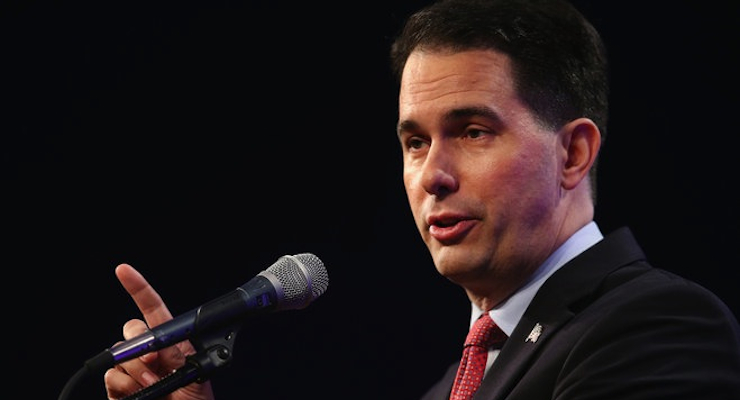
Wisconsin Gov. Scott Walker, a potential Republican presidential hopeful, speaks in Iowa in May, 2015. (Photo: Getty)

Wisconsin Gov. Scott Walker has officially announced his 2016 bid for president, making him the 15th Republican presidential candidate to declare. Walker announced his plans on social media and in a fundraising email.

Gov. Walker, who gained national attention and notoriety during his battle with the labor unions in the home state of union progressivism, is currently the frontrunner in Iowa, according to early polling of the caucuses. Following a well-received and widely reviewed performance at the Iowa Freedom Summit, the Wisconsin governor surged to lead and hasn’t relinquished it since.

“If we are going to do this, we are going to do it right,” Gov Walker said. “We will need to hit the ground running and build a campaign fund big enough to take on Hillary Clinton or whomever the Democrats nominate.”

Walker won three elections in four years after the budget battle prompted unions to launch and lead a failed recall effort. Each time, Walker won reelection with a greater percentage of the vote. According to PPD’s senior political analyst, Richard D. Baris, Walker perhaps has the most potential out of all the GOP candidates to unite the party’s factions.

“Though they clearly want Jeb Bush, Gov. Walker is a candidate both the establishment can deal with and the base loves,” Baris said. “That said, he is also a serious threat to Hillary Clinton, which is why she wants to suck the air out of the room today.”

Clinton will release an economic plan Monday that will call for targeting the wealthy and more regulation, an approach Walker vehemently disagrees with.

“Our bold, conservative reforms helped bring Wisconsin’s unemployment rate down to 4.6% in 2015 from a peak of 9.2% in 2010 and our hard-working families have more money in their wallets,” Walker said in an email. “We took power away from the Big Government Labor Bosses and gave it to the workers — where it belongs. We got Wisconsin’s fiscal house in order by turning a $3.6 billion budget deficit to a nearly $1 billion surplus and providing $2 billion in tax relief.”

“Our reforms were big, bold, and courageous. We faced detractors and vicious attacks at every turn.”

Walker is set to officially kick off his campaign later Monday at a rally in Waukesha, Wis., and tweeted “Meet Scott Walker” to introduce himself to voters.

Wisconsin Gov. Scott Walker has officially announced

el-chapo-guzman

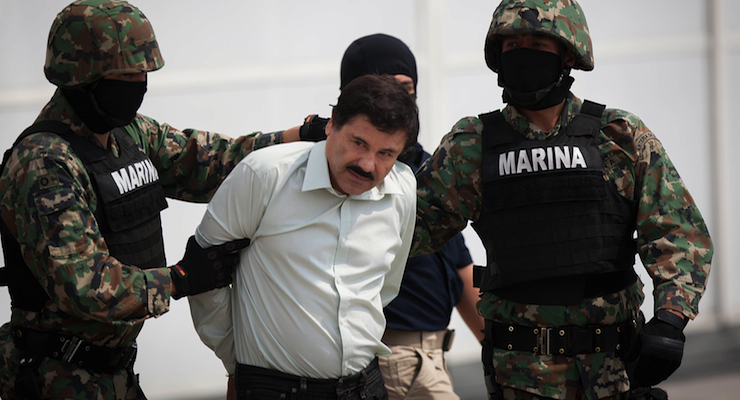
Mexican Drug Lord El Chapo Guzman seen escorted by law enforcement officials after his first prison break. (Photo: AP)

Drug lord Joaquin “El Chapo” Guzman escaped from a maximum security prison via a 1 mile tunnel found in a small opening in the shower area of his cell. This is the second time the Mexican government allowed Guzman, the head of the Sinaloa Cartel worth nearly $1 billion, to escape despite assurances to the U.S. government.

“This represents without a doubt an affront to the Mexican state,” said President Enrique Pena Nieto, speaking during a previously scheduled trip to France. “But I also have confidence in the institutions of the Mexican state — that they have the strength and determination to recapture this criminal.”

But not everyone — including 2016 Republican presidential hopeful Donald Trump — is as confident as Mr. Nieto.

“Without a doubt,” Terry Kirkpatrick, a former retired U.S. Customs and Border Protection special agent said when asked if Trump was right. “This is corruption at the highest level.”

Guzman was last seen around 9 p.m. in the shower area of his cell — yes, he had his own personal shower in what is otherwise described by prisoners as hell on earth — according to a statement from the National Security Commission. When the prison’s security camera surveillance network failed to pick him up, guards checked his cell and found it empty, along with a 20-by-20-inch (50-by-50 centimeter) hole near the shower.

“Corrupt Mexican officials obviously let him go a second time,” Trump said in a statement. “He is possibly in the U.S. and his drugs and drug dealers freely cross into the United States through our pathetic border.”

Guzman used a latter to descend into a hole 10 meters (30 feet) deep that ran into a tunnel roughly 1.7 meters (5 feet-6 inches) high, which was outfitted with ventilation and lighting. Authorities said they found tools, oxygen tanks and a motorcycle — yes, a motorcycle — adapted to run on rails that they believe was used to carry dirt out and tools during the tunnel’s construction.

“I’m sure they had guards from the local and federal police standing on the outside ready to escort him to wherever he wanted to go in Mexico City,” Kirkpatrick said.

Thirty employees from the Altiplano prison, located roughly 55 miles (90 kilometers) west of Mexico City, have been taken in for questioning, according to the federal Attorney General’s Office. A manhunt is also currently underway patrolling the Mexican side of the U.S.-Mexico border, which officials say is largely controlled by Guzman’s cartel.

Guzman’s cartel is known for building elaborate tunnels beneath the Mexico-U.S. border to transport cocaine, methamphetamines and marijuana, with ventilation, lighting and even railcars to easily move products. Authorities say that Guzman’s cartel proliferates the greatest and most-diverse amount of drugs to the U.S. and Europe.

Officials also say Guzman, who is named public enemy number one in Chicago, is responsible for some 30,000 deaths.

He was first caught by authorities in Guatemala in 1993, extradited and sentenced to 20 years in prison on drug-trafficking-related charges before he escaped in 2001. Guzman had help from 13 prison guards, who were in fact prosecuted and convicted. Guzman was finally re-captured in February 2014 after eluding authorities for days across his home state of Sinaloa.

After Guzman was arrested, the U.S. wanted to extradite him, but the Mexican government denied the need to extradite. Officials worried he would escape just as he did in 2001 while he was serving a 20-year sentence in the country’s other top-security prison, Puente Grande, located in the western state of Jalisco.

Former Mexican Attorney General Jesus Murillo Karam told the AP earlier this year that the U.S. would get Guzman in “about 300 or 400 years” after he served time for all his crimes in Mexico. He dismissed concerns that Guzman could escape a second time. That risk “does not exist,” Murillo Karam said.

“It wasn’t overconfidence; it was Mexican judicial nationalism,” said Raul Benitez, a security expert at Mexico’s National Autonomous University. “First he had to pay his debt in Mexico and then in the U.S. Now it’s very evident that it was a mistake.”

Donald Trump reacted to drug lord Joaquin

Europe-Greece-Bailout

July 12, 2015: Greek Finance Minister Euclid Tsakalotos, right, speaks with Managing Director of the International Monetary Fund Christine Lagarde during a round table meeting of eurogroup finance ministers at the EU Lex building in Brussels. (Photo: AP/Michel Euler)

Greece and its European creditors hatched out a new bailout agreement early Monday that European Council President Donald Tusk said imposes “serious reforms.” The deal temporarily averts the prospect of a Grexit, or the government of Athens exiting from the euro zone and breaking from the single currency.

European Council President Donald Tusk tweeted shortly before 9 a.m. local time Monday that the so-called EuroSummit had “unanimously reached agreement” on a financial aid program that included what Tusk called “serious reforms” and “financial support” for the leftwing Athens government. At a news conference later Monday, Tusk jokingly referred to the deal as an “a-Greek-ment.”

Yet, despite Greece’s socialist leaders bringing the nation to the financial brink in the hope to secure a deal that lessens pain from debt and entitlement cutbacks, they agreed to cut back even further in exchange for more loans. Without the EU funding, the country’s financial system will collapse, but the deal still requires approval from Greece’s parliament by the end of Wednesday.

“We managed to avoid the most extreme measures,” Greek Prime Minister Alexis Tsipras said. “Greece will fight to return to growth and to reclaim its lost sovereignty.”

Greek debt is currently at around 320 billion euros ($357 billion), which represents roughly 180 percent of the country’s annual gross domestic product. Few economists think that debt will ever be fully repaid. Last week, the International Monetary Fund said Greece’s debt will need to be restructured.

Greece and its EU creditors hatched out

[brid video=”11174″ player=”1929″ title=”Sanders Obama Failed to Negotiate with Republicans”]

Democratic presidential candidate Sen. Bernie Sanders, the socialist from Vermont, said President Obama failed to negotiate with Republicans. In an interview with CBS’ Face the Nation Sunday, Sanders said the Republicans never wanted to negotiate and Obama abandoned those who supported him.

“I will be able to deliver in Washington and I will be able to win the election in November, because we are going to be bringing more people into the process,” Sanders said, vowing to take his message even to conservative states. “We are not only going to blue states John but to red states. We are going to from Alabama to Mississippi. We are going to go to conservative states, and we are going to talk about poverty in this country.”

Sanders said that the reason Republicans did so well last election is because “63 percent of the American people didn’t vote,” a claim disputed in detail by PPD’s senior political analyst Richard D. Baris.

“We have been hearing that claim since the Democrats got trounced in 2014, and it simply isn’t accurate,” Baris said. “Turnout was down across the nation from 2012 but up from 2010 in states with competitive races where the money and effort to increase engagement was allocated. Even if Democrats had their 2012 electorate, they still would have lost Colorado, Iowa and every other competitive Senate seat. Demographics are demographics, and Republicans increased their margin with each bloc across the board.”

Still, when pressed why the message sounded just like then-Sen. Barack Obama’s message, who has failed to push much of the 2016 candidates’ agenda items, Sanders had some harsh words for the president.

“Here is the mistake that Barack Obama made, though I am friends with Barack Obama and we disagree on a lot of issues,” Sanders said. “Barack Obama said to the millions ‘hey, thank you for electing me, I’ll take it from here.”

Democratic presidential candidate Sen. Bernie Sanders, the

[brid video=”11170″ player=”1929″ title=”Greece Crisis Iran Nuclear Deadline debated on Fox News Sunday Panel”]

This week on FOX News Sunday, Brit Hume, Julie Pace, Karl Rove, and Juan Williams, discuss the surge in popularity from Donald Trump, and latest world news. Also, the FNS panel discusses diplomats are scurrying all over Europe to decide the fate of Greece’s economy and Iran’s nuclear program. What does it mean for the U.S.?

[brid video=”11171″ player=”1929″ title=”Candidate Donald Trump debated on Fox News Sunday”]

This week on FOX News Sunday, Brit

Washington_State_Capitol

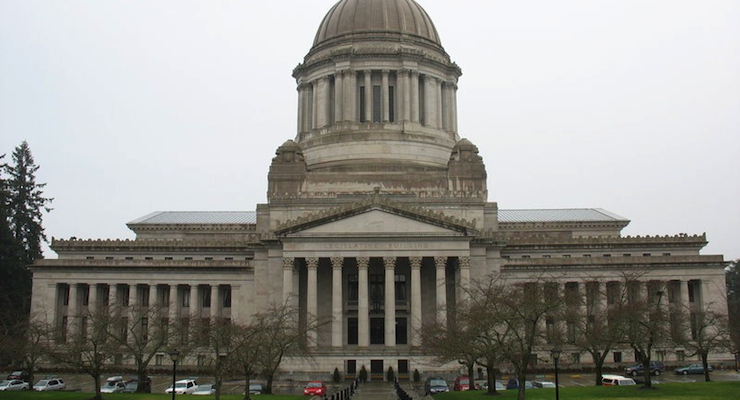
The Washington State Legislature meets in the Legislative Building on the Washington State Capitol campus in Olympia.

I’ve argued that we’ll get better government if we make it smaller. This is important because government is responsible for some things – such as national defense and protection of property rights – that are genuinely important.

Yet a bloated public sector distracts officials from effectively focusing on those things that matter.

There are some legitimate functions of government and I want those to be handled efficiently. But I worry that effective government is increasingly unlikely because politicians are so busy intervening in areas that should be left to the families, civil society, and the private sector.

This is not a novel observation. Mark Steyn humorously observed, “our government is more expensive than any government in history – and we have nothing to show for it.”

And Robert Samuelson made the same point in a more serious fashion, writing, “American government has assumed more responsibilities than can reasonably be met.”

Perhaps most important, there’s even scholarly research – including from bureaucracies such as the International Monetary Fund and European Central Bank – that confirms small government is more efficient and competent.

Now keep all this in mind as we look at an amazing example of what happens when a government is so big and bloated that it spectacularly fails in one of its core responsibilities.

Here are some excerpts from a jaw-dropping story in the U.K.-based Telegraph.

For almost two years Abdullah al Andalusi, led a double life… By night, he taught that the terror group Islamic State of Iraq and the Levant (Isil) was “no different to Western armies,” said that “kaffirs,” non-Muslims, would be “punished in hell” and claimed that the British government wanted to destroy Islam. By day, using a different name, he went to work for the same British government at the London offices of Her Majesty’s Inspectorate of Constabulary (HMIC), the official regulator of all 44 forces in England, Wales and Northern Ireland.

Yes, you read correctly. A jihadist was employed by law enforcement.

But he wasn’t a low-level cop walking a beat. He was in a high-level position with access to information about the battle against Islamic extremism!

HMIC’s staff, who number less than 150, are given privileged access to highly sensitive and classified police and intelligence information to carry out their inspections. The inspectorate’s work includes scrutinising police forces’ counter-terrorism capabilities and top-secret plans for dealing with terror attacks. It has also recently published reports on undercover policing and the use of informants. HMIC admitted that Mr al Andalusi, whose real name is Mouloud Farid, had passed a security vetting check to work as a civil servant at the inspectorate. He was subsequently promoted to executive grade, a management rank, placing him at the heart of the security establishment.

The good news is that this extremist thug was discovered and then lost his job.

Was this the result of a clever and effective counter-terrorism investigation?

Hardly. It was only dumb luck that his superiors discovered his radical activities.

He was only sacked after bosses spotted him on television defending extremist Islamic positions.

You’ll also be glad to know that British taxpayers were giving him a very generous compensation package. So much money, in fact, that it didn’t make sense for him to take up opportunities to become a full-time hater of western civilization.

…said one former colleague at the Muslim Debate Initiative, who asked to remain anonymous. …“Opportunities came along to do dawah [preaching] as a full-time job, but he was never tempted to do that because he had a stable income and pension with the civil service.”

And taxpayers also helped pay for his expensive housing.

Mr al Andalusi…lives in a subsidised £750,000 housing association flat in Westminster.

Gee, how nice that he gets to live in a nice place at the expense of others. I wonder if his subsidized housing is as nice as the taxpayer-financed housingprovided to Jihadi John?

Though let’s give Mr. al Andalusi credit. At least he was employed, even if only as an over-compensated bureaucrat.

Other radical jihadists simply go on welfare so they can devote all their time to hate.

So al Andalusi doesn’t qualify to be a member of the Moocher Hall of Fame. Yes, he got subsidized housing, but we want to reserve this honor for more deserving bums.

Speaking of which, the United States also has a self-destructive habit of giving handouts to radicals who oppose civilization. The Tsarnaev family was on the public teat and there have been lots of Somali terrorists sponging off America’s bizarre welfare-encouraging refugee program.

So maybe I need to update the U.S. vs. U.K. government stupidity contest to reflect the fact that both nations are so masochistic that they give handouts to their enemies.

Mitchell: I’ve argued that we’ll get better

Greek-Finance-Minister-Yanis-Varoufakis

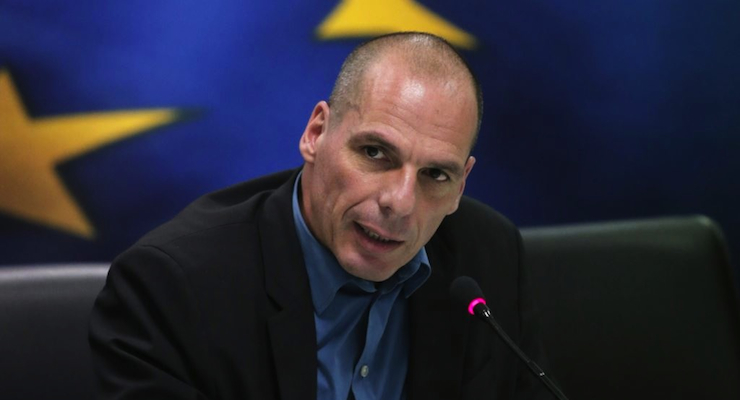
Former Greek Finance Minister Yanis Varoufakis (Photo: AP)

I very rarely feel sympathy for the people of Greece. Indeed, events over the past five years have even led me to write that “I hate the Greeks.”

I also disparaged the people of Greece by stating on TV that they’ve been trying to loot and mooch their way through life. So you can see that I generally believe in the tough-love approach.

But there comes a point when even a curmudgeon like me is going to say enough is enough and that the Greek people have suffered enough already.

And I had that experience yesterday. Check out this headline from a story in yesterday’s EU Observer.

Economic advice from the French government?!? Isn’t that a bit like asking the Chicago Cubs for suggestions on how to win the World Series?

What are the French advisers going to do, propose ways to make the government even bigger? Suggest ways of driving even more entrepreneurs out of the country?

For Heaven’s sake, this is the last thing the people of Greece need.

Sort of reminds me of a headline I saw attached to a report by Reuters a few years ago.

Geesh, the Greeks already suffered because of an invasion by people working for the German government back in the 1940s. Seems like another deployment of German bureaucrats would be adding insult to injury.

Particularly since it would create the worst of all worlds, marrying Teutonic tax efficiency (for example, taxing prostitutes with parking meters) with Greek profligacy (for example, subsidies for pedophiles).

I’m not sure where that would end, but it surely wouldn’t be a good place.

Now let’s make a more serious point about tough love and Greek suffering.

Back in early 2010, about the time the Greek fiscal crisis was becoming a big issue, I warned that a bailout would actually make things worse. I suggested it would be better to let Greece default, both because it would penalize foolish investors who lent too much money to the Greek government and because it would force Greece to live within its means.

That would have meant short-run pain, to be sure, but I think that approach would have involved the least amount of aggregate suffering.

But the political class ignored my helpful advice and instead decided that bailouts would be a better idea. But how has that worked out? The Greek economy has been moribund and the Greek people are now saddled with far more debt. Yes, some short-run pain was mitigated, but only at the cost of much more pain over the past few years (with more pain in the future).

Interestingly, the International Monetary Fund’s top economist unintentionally has confirmed my analysis. Here’s some of what Olivier Blanchard recently posted as part of an effort to defend the IMF’s choices back in 2010.

Had Greece been left on its own, it would have been simply unable to borrow. …Even if it had fully defaulted on its debt, given a primary deficit of over 10% of GDP, it would have had to cut its budget deficit by 10% of GDP from one day to the next.  These would have led to much larger adjustments and a much higher social cost.

Blanchard obviously thinks reducing government spending by 10 percent of GDP would have imposed too much “social cost,” but imagine if Greece had bitten the bullet back in 2010. Sort of like what Estonia did in 2009.

Yes, there would have been a challenging adjustment. Interest groups would have received fewer handouts. Greek bureaucrats would have lost jobs and/or had their pay reduced. Payments to vendors would have been delayed. State-run TV may have been shut down. The regulatory apparatus probably would have been cut back. And I’m sure the Greek government probably would have raised taxes as well.

Now imagine how much better off Greece would be today if it went with that approach.

We don’t have a parallel universe where we can see the results of that different approach, but consider the fact that Estonia had a deeper downturn than Greece, presumably in part because it undertook strong measures, but since that time has been Europe’s fastest-growing economy.

Greece, by contrast, has been Europe’s slowest-growing economy. Hmmm…seems like this should be part of any discussions about “social cost.”

So what lessons can we learn?

I realize there are lots of factors that determine economic performance and that it’s impossible to isolate the impact of either Estonia’s spending-cut policy or Greece’s bailout policy. But it would take a very bizarre and untenable set of assumptions to conclude that Estonia didn’t make smarter policy choices.

The only silver lining to Greece’s dark cloud is that it’s not too late to do the right thing.

P.S. Since we ended by speculating about the good results of my tough-love approach, let’s also enjoy some Greek-related humor.

This cartoon is quite  good, but this this one is my favorite. And the final cartoon in this post also has a Greek theme.

We also have a couple of videos. The first one features a video about…well, I’m not sure, but we’ll call it a European romantic comedy and the second one features a Greek comic pontificating about Germany.

Last but not least, here are some very un-PC maps of how various peoples – including the Greeks – view different European nations.

Dan Mitchell: There comes a point

OPM-Director-Katherine Archuleta

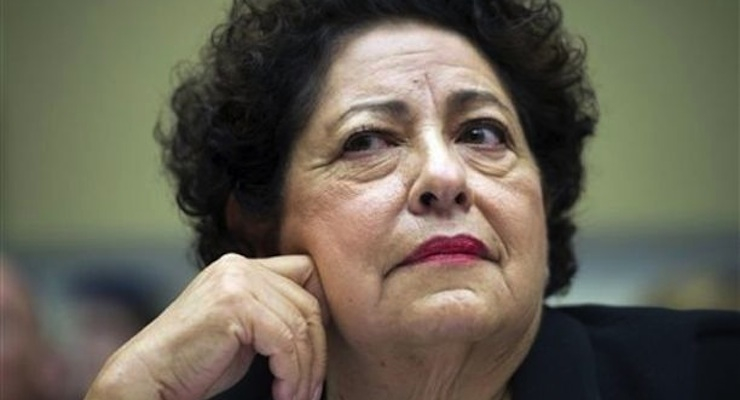
OPM Director Katherine Archuleta answers lawmakers’ questions during testimony on Capitol Hill.

OPM Director Katherine Archuleta resigned Friday following confirmation of a massive data breach that allowed hackers to steal the records of more than 21 million people. PPD confirms. Archuleta submitted her resignation after the Office of Personnel Management (OPM) released findings in a statement Thursday on the investigation into a pair of major hacks believed to have been carried out by China.

“The team has now concluded with high confidence that sensitive information, including the Social Security Numbers (SSNs) of 21.5 million individuals, was stolen from the background investigation databases,” the statement said. “This includes 19.7 million individuals that applied for a background investigation, and 1.8 million non-applicants, predominantly spouses or co-habitants of applicants. As noted above, some records also include findings from interviews conducted by background investigators and approximately 1.1 million include fingerprints.”

White House spokesman Josh Earnest claimed Friday that Archuleta submitted her resignation without nudging from the president, stating it was “quite clear” to Obama new leadership at OPM is desperately needed, regardless. However, House Republican leadership say that she is just the tip of the incompetent iceberg, and while they welcome the resignation, much more needs to be done.

“This is the absolute right call,” House Oversight and Government Reform Chairman Jason Chaffetz said in a written statement following the announcement. “OPM needs a competent, technically savvy leader to manage the biggest cybersecurity crisis in this nation’s history. The IG has been warning about security lapses at OPM for almost a decade. This should have been addressed much, much sooner but I appreciate the President doing what’s best now.”

Archuleta will be replaced by Beth Cobert, according to administration source that spoke to PPD on the condition of anonymity. They said that the president did push the former OPM head to resign so that Cobert, who currently serves in the White House budget office, could take over.

In a statement, Archuleta said the move was the right thing to do in order to allow the agency to “move beyond the current challenges.” She praised the agency’s employees as “some of the most dedicated, capable and hardworking individuals in the federal government.”

“I have complete confidence in their ability to continue fulfill OPM’s important mission of recruiting, retaining and honoring a world-class workforce to serve the American people,” Archuleta said.

The now former OPM head was no stranger to controversy, though her name has only recently been in headlines. During the 2012 election, Archuleta served as a key political strategist in the Obama campaign. In hindsight, she came under fire for a tweet that seems rather ironic for two reasons.

Mitt Romney was lambasted and somehow characterized as backward-thinking when he criticized the president’s handling of the growing cyber threat from China. Further, he was openly mocked by President Obama during the 2012 foreign policy debate for calling Russia the greatest geopolitical enemy facing the United States.

Marine General Joseph Dunford, who was nominated to become chairman of the Joint Chiefs of Staff, told lawmakers on Thursday he agreed, adding the old Col War foe’s behavior is “nothing short of alarming.” Now, on the heels of Archuleta losing her job over an attack the former Massachusetts governor repeatedly warned of, it would appear it is she who was ill-prepared for 21st century threats.

And she has paid for it with her job and reputation.

IF YOU FEEL YOU MAY HAVE BEEN IMPACTED

OPM said it is “highly likely” anyone who underwent a background investigation through the agency since 2000 has been affected. The 21.5 million number mostly includes those who applied for one, but also 1.8 million others, “predominantly spouses or co-habitants of applicants.”

In the coming weeks, OPM will begin to send notification packages to these individuals, which will provide details on the incident and information on how to access these services. OPM will also provide educational materials and guidance to help them prevent identity theft, better secure their personal and work-related data, and become more generally informed about cyber threats and other risks presented by malicious actors.

OPM head Katherine Archuleta resigned following revelations

People's Pundit Daily
You have %%pigeonMeterAvailable%% free %%pigeonCopyPage%% remaining this month. Get unlimited access and support reader-funded, independent data journalism.

Start a 14-day free trial now. Pay later!

Start Trial