Widget Image
Follow PPD Social Media
Wednesday, January 14, 2026
HomeStandard Blog Whole Post (Page 847)

import export

(Photo: REUTERS)

The Labor Department said Friday that U.S. import prices hit a 6-year low at 2.8 percent in January, with across-the-board decreases not seen since 2008. The report is the latest sign that domestic inflation pressures are not strong enough to hit the Federal Reserve’s target, which they repeatedly cite as a prerequisite for raising interest rates in mid-2015.

The Labor Department also revised December’s number down to 1.9 percent from a previously reported 2.5 percent drop, which marks the seventh straight month of declines in import prices. Economists polled by Reuters had forecast import prices would fall by 3.2 percent last month.

In the 12 months through January, import prices have declined 8.0 percent, also the largest drop since September 2009.

Crude oil prices have tanked nearly 60 percent since June, fueled by increased shale production in the U.S. and weak global demand. However, with rigs closing at a rate of 60-70 per week, the trend is expected to reverse and gas prices are already beginning to climb.

The dollar has strengthened significantly relative to the currencies of the country’s main trading partners, which is another factor keeping the Federal Reserve from hitting its 2 percent target. But it also undercuts U.S. competitiveness in the current global environment.

Last month, imported petroleum prices plummeted 17.7 percent, also the biggest fall since December 2008 after falling 12.4 percent in December. Imported food prices fell 2.2 percent in January, or the largest fall since February 2012.

The declines were broad, as the prices of imported capital goods, automobiles and consumer goods (excluding automobiles) all fell.

Import prices excluding petroleum fell 0.7 percent last month after staying flat in December, the biggest drop since March 2009. Export prices also fell by 2.0 percent in January, the largest decline since October 2011, after falling 1.0 percent in December.

The Labor Department said Friday that U.S.

Developing:  The closely watched gauge of consumer sentiment from Thomson Reuters and the University of Michigan fell to 93.6 in February from a prior reading of to 98.1 in January. The reading came in well below Wall Street expectations for 98.3.

The survey tops off a week of rather terrible economic data, including a related report out of the Commerce Department Thursday showing retail sales fell more than expected in January, with weak U.S. consumer spending indicating slower first quarter growth. American households are not spending whatever increased disposable income they have resulting from the 39.5 percent decline in gasoline prices since June.

Consumer spending, which accounts for roughly two-thirds of all U.S. economic activity, grew at its quickest pace since 2006 in the fourth quarter, but is now the latest indicator of slowdown in U.S. economic growth.

In a survey published Thursday, a whopping 65 percent of Americans say the U.S. is still in a recession. With more disappointing data rolling in, more and more economists are beginning to raise concerns the public may be on to something, as they typically are ahead of the economic cycle.

The closely watched gauge of consumer sentiment

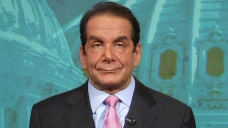
In an interview on The Kelly File Thursday, syndicated columnist Charles Krauthammer said the U.S. closing the embassy in Yemen was “humiliating.”

“When your reduced to saying that the Germans had to close their embassy, then you know exactly how far we’ve fallen,” Krauthammer said. “Germany isn’t exactly a power in the Middle East anymore.”

The State Department announced late Tuesday that the U.S. Embassy in Yemen was closed and evacuated after the country was taken over by Shiite rebels last month. The U.S. embassy had already been operating with severely reduced staff for several weeks.

Only hours later, the United Kingdom followed suit and France took the same steps toward the same end.

“On a tactical level, just sort of explaining the evacuation it’s humiliating,” Krauthammer said. “And this is after Benghazi. It isn’t as if we didn’t know what was going to happen.”

Earlier on the program, State Department spokesperson Jen Psaki admitted the policy of the Obama administration involving “the Arab Spring from December 2010 forward has failed, and at a minimum is in the midst of failing,” as host Megyn Kelly put it.

“As it relates to Libya, you’re right,” Psaki admitted. “The president and others in the administration have spoken about what more we could have and should have done and as have other countries.”

In an interview on The Kelly File

ashton_carter

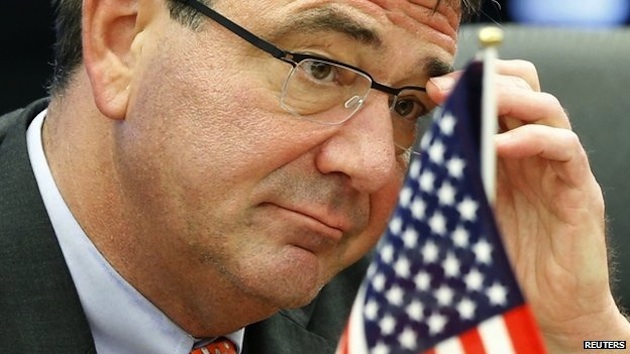
File photo: Ashton Carter seen on July 20, 2012. (Photo: REUTERS)

The Republican-controlled Senate Thursday confirmed Ashton Carter, making him President Obama’s fourth defense secretary since taking office. Carter takes the job as the U.S. confronts Islamic State militants, amid the ongoing conflict in Ukraine and other grave worldwide threats.

Defense Department officials say the 93-5 vote to replace Chuck Hagel, the former Republican senator who resigned in November as a scapegoat, is “the best we can get.”

Carter, 60, is now President Obama’s fourth defense secretary in just six years, joining Robert Gates, Leon Panetta and Hagel, two of which have offered damning criticism of the Obama doctrine.

Sen. John McCain, R-Ariz., chairman of the Armed Services Committee, alluded to the divide between the White House and Pentagon, saying he had “sincere hope and, sadly, little confidence that the president who nominated Dr. Carter will empower him to lead and contribute to the fullest extent of his abilities.”

At his confirmation hearing last week, McCain told Carter he hoped he would push back on any attempt by the White House to micromanage the Defense Department, or over-centralize U.S. foreign and defense policies.

“I’ll be entirely straight and upfront with the president and make my advice as cogent and useful to him in making his decisions as I can,” Carter promised. Carter said 2,106 American service members have lost their lives in Afghanistan. “Finishing the job there is very important,” he said.

Senate Majority Leader Mitch McConnell, R-Ky., who also voted for Carter, said he “needs to have the courage to speak truth to power — to Congress, yes, but also to his commander in chief.”

The Republican-controlled Senate Thursday confirmed Ashton Carter,

The Labor Department said on Thursday weekly jobless claims, or the number of applications for first-time unemployment benefits rose more than expected last week.

First-time claims for unemployment benefits increased by a sizable 25,000 to a seasonally adjusted 304,000 for the week ended Feb. 7. Further, the prior week’s data was again revised up to show 1,000 more applications received than previously reported. Economists polled by Reuters had forecast claims rising to 285,000 last week.

A Labor Department analyst said the department had estimated claims for Massachusetts because of a snowstorm that had closed offices in the state. While Massachusetts later submitted claims data, the figures allegedly did not vary from the initial estimate.

The four-week moving average of claims, which is considered a better measure of labor market trends as it irons out week-to-week volatility, fell 3,250 to 289,750 last week. However, in this case, the average still includes a one-week outlier showing large declines that resulted from difficulties adjusted for seasonal factors.

The number is concerning considering the low eligibility and low participation in the U.S. workforce. The claims report showed the number of people still receiving benefits after an initial week of aid fell 51,000 to 2.35 million in the week ended Jan. 31.

The Labor Department said on Thursday weekly

retail sales

(Photo: REUTERS)

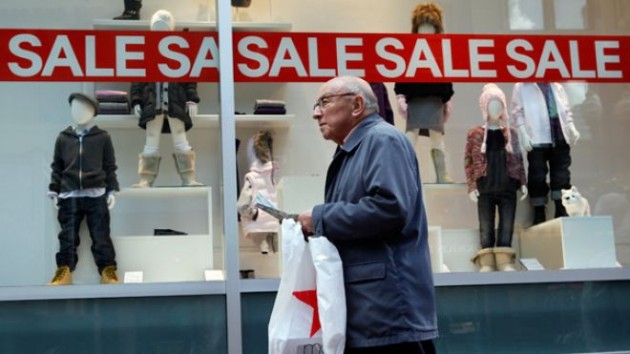
The Commerce Department said Thursday retails fell more than expect in January, with weak U.S. consumer spending indicating slower first quarter growth. American households are not spending whatever increased disposable income they have resulting from the 39.5 percent decline in gasoline prices since June,

Excluding automobiles, gasoline, building materials and food services, spending ticked up by just 0.1 percent last month following a revised 0.3 percent drop in December.

The so-called core retail sales correspond most closely with the consumer spending, which accounts for more than two-thirds of U.S. economic growth (GDP). The increase in core retail sales was less than median economists’ expectations for a 0.4 percent increase.

Economists say American households are using the extra income from gasoline to pay down debt and increase their savings. Declining gasoline prices naturally hurt sales receipts at service stations, which saw a 9.3 percent decline, the biggest fall since December 2008.

Falling gasoline receipts combined with a 0.5 percent drop in automobile sales sent overall retail sales down 0.8 percent in January, marking the second straight monthly decline.

Consumer spending grew at its quickest pace since 2006 in the fourth quarter, but is now the latest indicator of slowdown in U.S. economic growth. But the lack of growth in wages may have more to do with the lack of spending than previously anticipated. While the economy has added more than a million jobs over the past three months, or numbers not seen since 1997, job creation quality is stunningly poor.

In a survey published Thursday, a whopping 65 percent of Americans say the U.S. is still in a recession. With more disappointing data rolling in, more and more economists are beginning to raise concerns the public may be on to something, as they typically are ahead of the economic cycle.

In January, core retail sales were sliced by a 0.7 percent drop in furniture and home furnishings sales, the biggest decline in this category since December 2013.

Receipts at clothing stores fell 0.8 percent, while sales at sporting goods stores were down 2.6 percent, their biggest drop in a year. Receipts at online stores rose 0.5 percent, while sales at electronic and appliance stores gained 0.3 percent.

The Commerce Department said Thursday retails fell

economic news

Gallup CEO Jim Clifton made headlines last week for calling the government’s unemployment number “The Big Lie.” While he walked those comments back soon after for fear he might “suddenly disappear” on his way home, the American people overwhelmingly agree.

According to a new FOX Poll released Wednesday night, a whopping 65 percent of Americans say the economy is still in a recession. In 2010, when unemployment averaged 9.65 percent and average monthly job creation stood at just over 100,000, a whole 88 percent said so.

“There’s no other way to say this,” said Clifton. “The official unemployment rate, which cruelly overlooks the suffering of the long-term and often permanently unemployed as well as the depressingly underemployed, amounts to a Big Lie.”

Out of the total 1.1 million jobs created in 2010, nearly half (495,000) were temporary help services and, even larger when considering overlap, are the number of jobs created that were part-time.

Now, in 2014 and 2015, politicians bragging about a falling unemployment number fueled by a weak labor participation rate are finding out Americans aren’t fooled so easily.

Even among the 33 percent who say the recession is over, 18 percent of them feel another could be coming. Only 15 percent of Americans say both the recession is completely over and the economy is recovering.

As Clifton explained, Gallup’s Job Creation Index, which just released data showing the labor market in the same condition as it was in 2014, defines a good job as 30+ hours per week for an organization that provides a regular paycheck. However, the government considers an individual who clocks in a minimum of one hour of work in a week and was paid at least $20, as employed.

While Americans may not understand the methodologies used by government agencies, which paint a rosier picture than reality, the economy is life for everyday Americans.

When asked about their family’s finances, only 31 percent of Americans say they are getting ahead. While that’s up from 24 percent in 2013, it is barely above the 27 percent measured in September 2009, the first year of President Obama’s first term. That number actually fell after he entered office during the Great Recession, which ended in the spring of 2009, months before the Democratic Congress even passed his stimulus bill.

The latest poll shows that roughly half — still 49 percent — say they are “just able to pay most bills,” while 18 percent say they’re “falling behind.” It was 17 percent in 2009.

Voters living in households with annual income over $50,000 are twice as likely as those with lower incomes to say they are getting ahead (42 percent vs. 20 percent), but their proportionate representation of American households, is falling.

With such a high misery index there is little wonder voters 61-38 percent oppose raising taxes.

Meanwhile, a 56-percent majority thinks the government should be cutting taxes, cutting spending, and reducing regulations, while 40 percent prioritize expanding domestic programs and increasing spending on infrastructure.

The Fox News poll is conducted by telephone with live interviewers under the joint direction of Anderson Robbins Research (D) and Shaw & Company Research (R). The 1,044 registered voters were reached via landline and cell phone numbers randomly selected for inclusion in this nationwide survey from February 8-10, 2015. The full poll has a margin of sampling error of plus or minus three percentage points.

According to a new FOX Poll released

freedom-of-thought-benjamin-franklin

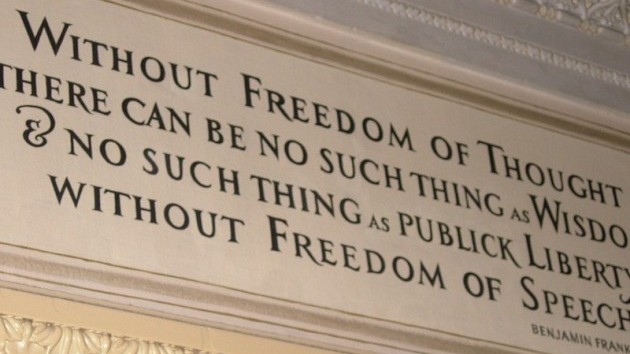
“Without Freedom of thought there can be no such thing as wisdom;and no such thing as public liberty, without freedom of speech.”

Thought police, in George Orwell’s dystopian 1949 work, “1984,” were government authorities tasked with rooting out thought crimes – or, the basic mental patterns that were believed to be the genesis for criminal actions – using omnipresent surveillance technologies and intelligence gathering techniques.

Supposedly, that was fiction.

Yet, PredPol is making quite a wave among law enforcement. So is crime mapping. So is AlSight. What are these? In short, technology that fits right in with Orwell’s narrative.

PredPol, short for Predictive Policing, is cloud-based software that takes police incident reports, sifts them through an algorithm and then spits out an analysis of where crimes are most likely to occur on a given shift – and which types of criminal activities are probably going to take place in a given hour. The logic is that officers reporting for their shifts can then use that data and conduct more common sense patrols.

As Los Angeles Police Chief Charlie Beck said: “I’m not going to get more money. I’m not going to get more cops. I have to be better at using what I have, and that’s what predictive policing is about.”

Crime mapping, meanwhile, pinpoints the geographical locations of various types of past criminal activities as a way of directing the path of police patrols for the present and future – a sort of intelligence-gathering system. A heavy drug crime area? Send in the drug task force members to conduct undercover buy operations. A rash of home burglaries in the neighborhood? Add extra patrol cars to that part of town.

AlSight, created by the Texas-based BRS Labs, is a bit different – and more Orwellian. This software works in conjunction with data captured on surveillance cameras to first, track and determine what constitutes normal behavior for the area of spy coverage – and second, alert and report those behaviors that step outside the parameters of what’s been determined as normal. The touted beauty of AlSight is that it can take on a human-type consciousness to compare and contrast what’s normal – travelers boarding a train, for example – versus what isn’t – a passenger dropping a bag by a trash barrel and walking away, for instance – and alert the authorities accordingly.

And all three programs are supposed to keep the nation safer – the communities freer of crime. Santa Cruz, Calif, reported a double-digit drop in its crime rate since implementing PredPol. Shreveport just became the second city in Louisiana to adopt crime mapping and call on citizens to help locate the suspect who stole a gun out of a police officer’s patrol car. San Fernando Valley reported substantial drops in burglaries since launching its predictive policing program in 2011. And AlSight has been a monitoring tool of choice for some time for San Francisco’s Municipal Transit Authority, for select spots in Houston, Texas, and for water treatment plants in El Paso.

But the technology brings some queasiness – and constitutional concerns.

Since when is the default operating mode for law enforcement to assume Americans are guilty? Isn’t that, in essence, what these programs, with their catch-all surveillance, and their computerized analytics, are doing – collecting data on citizens who’ve yet to be charged or even suspected of crimes, and then placing at least some of them under targeted police watch?

Innocent until proven guilty used to be the guiding law enforcement light in our republic. Thoughts are not actions – thoughts are never crimes.

Cherly Chumley, a full-time news writer with The Washington Times, is also the author of Police State USA: How Orwell’s Nightmare is Becoming Our Reality, available at Amazon and Barnes & Noble. To learn more about Cheryl, visit her website.

[mybooktable book=”police-state-usa-how-orwells-nightmare-is-becoming-our-reality” display=”summary”]

New technological programs such as PredPol and

patriot-act

President George W. Bush was fond of saying that “9/11 changed everything.” He used that one-liner often as a purported moral basis to justify the radical restructuring of federal law and the federal assault on personal liberties over which he presided. He cast aside his oath to preserve, protect and defend the Constitution; he rejected his oath to enforce all federal laws faithfully; and he moved the government decidedly in the direction of secret laws, secret procedures and secret courts.

During his presidency, Congress enacted the Patriot Act. This legislation permits federal agents to write their own search warrants when those warrants are served on custodians of records — like doctors, lawyers, telecoms, computer servers, banks and even the Post Office.

Such purported statutory authority directly violates the Fourth Amendment to the U.S. Constitution, which guarantees the right to privacy in our “persons, houses, papers and effects.” That includes just about everything held by the custodians of our records. Privacy is not only a constitutional right protected by the document; it is also a natural right. We possess the right to privacy by virtue of our humanity. Our rights come from within us — whether you believe we are the highest progression of biological forces or the intended creations of an Almighty God — they do not come from the government.

This is not an academic argument. If our rights come from within us, the government cannot take them away, whether by executive fiat, popular legislation or judicial ruling, unless we individually have waived them. If our rights come from the government, then they are not rights, but permission slips.

The terms of the Patriot Act were made public, and those of us who follow the government’s misdeeds could report on them. After all, this is America. We are a democracy. The government is supposed to work for us. We have the right to know what it is doing in our names as it is doing it, and we have the right to reveal what the government does. Yet, under this law, the feds punished many efforts at revelation. That’s because the Patriot Act prohibits those who receive these agent-written search warrants from telling anyone about them. This violates our constitutionally protected and natural right to free speech. All of this has been publicly known since 2001.

Then, in June 2013, Edward Snowden, the uber-courageous former CIA and NSA official, dropped a still smoldering bombshell of truth upon us when he revealed that the Bush administration had dispatched the NSA to spy on all Americans all the time and the Obama administration had attempted to make the spying appear legal by asking judges to authorize it.

Snowden went on to reveal that the NSA, pursuant to President Obama’s orders and the authorization of these judges meeting in secret (so secret that the judges themselves are not permitted to keep records of their own rulings), was actually capturing and storing the content of all emails, text messages, telephone calls, utility and credit card bills, and bank statements of everyone in America. They did this without a search warrant based on probable cause — a very high level of individualized suspicion — as required by the Constitution.

Snowden revealed that Obama’s lawyers had persuaded these secret judges, without any opposition from lawyers representing the victims of this surveillance, that somehow Congress had authorized this and somehow it was constitutional and somehow it was not un-American to spy on all of us all the time. These judges actually did the unthinkable: They issued what are known as general warrants. General warrants were used against the colonists by the British and are expressly prohibited by the Fourth Amendment. They permit the bearer to search wherever he wishes and seize whatever he finds. That’s what the NSA does to all of us today.

Last week, we learned how deep the disrespect for the Constitution runs in the government and how tortured is the logic that underlies it. In a little-noted speech at Washington and Lee Law School, Gen. Michael Hayden, the former director of both the CIA and the NSA, told us. In a remarkable public confession, he revealed that somehow he received from some source he did not name the authority to reinterpret the Fourth Amendment’s protection of privacy so as to obliterate it. He argued that the line between privacy and unbridled government surveillance is a flexible and movable one, and that he — as the head of the NSA — could move it.

This is an astounding audacity by a former high-ranking government official who swore numerous times to uphold the Constitution. He has claimed powers for himself that are nowhere in the Constitution or federal statutes, powers that no president or Congress has claimed, powers that no Supreme Court decision has articulated, powers that are antithetical to the plain meaning and supremacy of the Constitution, powers that any non-secret judge anywhere would deny him.

If the terms and meaning of the Constitution could be changed by the secret whims of those in the executive branch into whose hands they have been reposed for safekeeping, of what value are they? No value. In such a world, our Constitution has become a worthless piece of paper.

Judge Andrew Napolitano has written nine books on the U.S. Constitution. The most recent is Suicide Pact: The Radical Expansion of Presidential Powers and the Lethal Threat to American Liberty.

Judge Napolitano: In such a world with

[wzslider info=”true” lightbox=”true”]

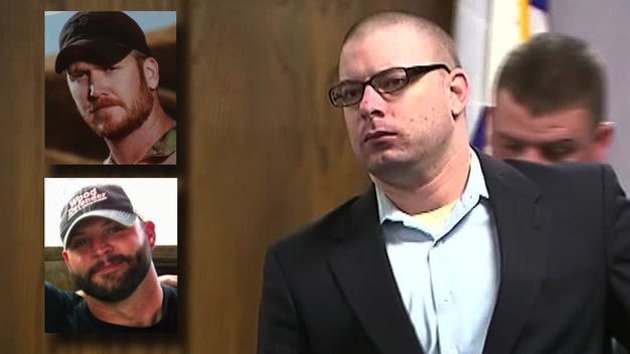
The opening arguments in the trial of Eddie Ray Routh, who is charged with the murders of famed Navy SEAL Chris Kyle and his friend, Chad Littlefield began today. Chris Kyle, the real “American Sniper” known for his service in Iraq and compassionate post-service work with veterans, was shot alongside Littlefield by Routh at the Rough Creek Lodge gun range in Texas.

The Kyle family described Littlefield as their “rock” and characterized him as a valuable and indispensable friend.

Kyle’s tragic end came after Eddie Ray Routh’s mother, who worked at the school where the Kyle children attended, asked the hero to help her son readjust to civilian life. Routh’s mother claimed he had been suffering from mental illness, which the defense argued was the cause of his actions and the result of PTSD. Kyle accepted the request, inviting Eddie Ray Routh and Littlefield to the gun range at Rough Creek Lodge.

Taya Kyle testified that when she called her husband “he sounded like he was irritated,” and answered only a brief “Yep” when she inquired if he was alright.  She added that some time had passed before Chad Littlefield’s wife, Leanne, called asking if she had heard from the men. Taya Kyle sent at least one text message to her husband and expressed to him that she was getting worried.

She received no response.

Mrs. Kyle and Mrs. Littlefield had every reason to be concerned. They both received news that no wife ever wants to hear. A police officer known to the Kyle family soon confirmed the two men were dead.

During testimony, the court learned that Chris Kyle sent a text message to Littlefield regarding Routh while driving to the range, stating “this dude is straight up nuts.” Littlefield, who was in the front passenger seat directly in front of Routh replied expressing concern, as well, texting backing, “he’s right behind me. Watch my six.”

Eddie Ray Routh was diagnosed with several conditions, including psychosis, paranoia, schizophrenia and PTSD. Tim Moore, Routh’s defense attorney, is arguing an insanity defense, which legal experts say is more difficult to pull off in the state of Texas. In The Lone Star State, the law assumes a defendant is sane, and the burden of proof lays with the defense to prove the defendant is, in fact, insane.

While the defense claims he was high on marijuana, Moore will no doubt have a hard time proving that Routh was in the midst of psychosis.

Erath County District Attorney Alan Nash described the manner in which Routh committed the crime, underscoring that Chad Littlefield was shot four times in the back, once in the hand, and once in the face. He noted that Chris Kyle was shot five times in the back and side, as well as once in the side of the head. Prosecutors hammered home that Routh used two different guns to commit the murders.

But there are more questions being raised not about the manner in which the act was committed, but rather over the alleged PTSD claim and Routh’s background.

The Warfighter Foundation, a nonprofit veterans group, confirmed the Marine veteran never saw combat nor experienced traumatic situations while serving overseas. Routh served one tour in Iraq in 2007, at Balad Air Base, which was the 2nd largest U.S. installation in Iraq that saw no major violent events.

The Warfighter Foundation filed a Freedom of Information Act request, which revealed the Joint Base Balad was a full-amenity military installation. The base gave U.S. troops access to swimming pools, dancing lessons, a movie theater, American restaurants and snack bars. It frequently housed celebrities and U.S. officials during their visits.

In 2007, Routh was a prison guard at a facility at Balad Airbase located 40 miles north of Baghdad, which held radical Islamic terrorists. On multiple occasions, he lamented to his father over prisoners’ living conditions, including the three-square toilet-paper rations they received daily. During at least one phone call with his father, Routh expressed sympathy for the detainees and expressed anti-U.S. policy sentiments.

But while Kyle’s fans and admirers will continue to pursue these questions, Mr. Nash is certain to focus only on the law, which Day 1 has already shown, is on the side of justice for Chris Kyle and Chad Littlefield.

The opening arguments in the trial of

People's Pundit Daily
You have %%pigeonMeterAvailable%% free %%pigeonCopyPage%% remaining this month. Get unlimited access and support reader-funded, independent data journalism.

Start a 14-day free trial now. Pay later!

Start Trial