Widget Image
Follow PPD Social Media
Friday, January 16, 2026
HomeStandard Blog Whole Post (Page 938)

Israeli Prime Minister Benjamin Netanyahu

Israeli Prime Minister Benjamin Netanyahu speaks at a press conference at the Defense Ministry in Tel Aviv on July 28, 2014. (Photo credit: Haim Zach / GPO/Flash90)

He may not be Mr. popular with U.N. Secretary-General Ban Ki-moon & Co., but as far as the people of Israel are concerned Prime Minister Benjamin Netanyahu is a rock star. Israel launched a more aggressive campaign against Hamas and its rockets and tunnels after the terror group violated several cease-fires, but the discovery of a vast network of “terror tunnels” has been a game-changer for Israeli public opinion.

Now,whether from the left or right, support for the Gaza offensive and Netanyahu’s leadership is almost unprecedented.

According to a slew of recent polling, support for the Israeli leader and his handling of the war with Hamas in the Gaza Strip, has grown exponentially over the past three weeks. The nearly unheard-of unity is being fueled by support from both the Israeli people as a whole and the more Palestinian-sympathetic political class, who are all rallying behind Netanyahu’s leadership during a time of near-worldwide abandonment.

United Nations Security Council drafted a statement earlier this week that called for an immediate cease-fire in Gaza, and for both Israel and Hamas “to accept and fully implement the humanitarian cease-fire into the Eid period and beyond.” During a phone conversation Monday with U.N. Secretary-General, Netanyahu told Ban Ki-moon that the U.N. statement prioritized the interests of a “murderous terrorist organization” over Israeli security, a sentiment the Israeli people strongly share.

A poll this week for Israel’s Channel 10 news, conducted by the Sarid Institute, found that 87 percent of Jewish Israelis support continuing the Gaza operation. A survey by the Israel Democracy Institute found that 95 percent of Israeli Jews think the operation in Gaza is just, and 4 of 5 oppose a unilateral withdrawal. Just 4 percent said the Israeli military has used excessive force.

The U.N., which has always been majority pro-Palestine, has become increasingly hostile to Israel over the course of the conflict. The increasing civilian death toll, many of which could’ve been avoided if Hamas didn’t use U.N. shelters and schools for weapons caches, has become a stick with which the U.N. has used to beat up on Israel.

Even with the existence and proliferation of videos showing Gaza youth confirming Hamas does not allow Palestinian civilians to leave their homes when Israel warns them to evacuate, as well as confirmation that the Gaza Interior Minister repeatedly told civilians to ignore evacuation warnings, Israel has been shouldering the majority of the blame for the casualties. The Israeli people, however, are clearly filtering out facts from fiction.

In another survey released this week out of the University of Haifa, 85 percent of Jewish Israelis said they are “very satisfied” or “satisfied” with Netanyahu’s leadership, while 91 percent of Israelis support the self-defense campaign against Hamas terrorists in Gaza, otherwise known as Operation Protective Edge. As observed in the Channel 10 news poll, Haifa also found just 4.2 percent believe the operation is a “mistake.”

Despite the fact that 34 percent of respondents said that Israeli Arabs “cannot be trusted” and are “a security risk,” compared to just 12 percent who say that they “can be trusted” and 15 percent who believe they “are not a security risk,” a plurailty of Israelis still believe in a “Two-State Solution” for peace — 42 percent. Further, just 20 percent of respondents preferred the crowning of Jordan as a Palestinian state and only 10 percent said that any form of annexation for Judea-Samaria and Gaza was the answer.

He may not be Mr. popular with

labor market jobs

Job seekers navigate through a weak labor market and teetering economy. (Photo: REUTERS)

The number of Americans filing first-time jobless claims for unemployment benefits rose last week, but debate over underlying trends in the labor market continues.

Initial claims for state unemployment benefits increased 23,000 to a seasonally adjusted 302,000 for the week ended July 26, the Labor Department said on Thursday. However, optimists point to the four-week rolling average of claims, which is widely considered to be a more accuarte gauge of labor market trends. The four-week average irons out week-to-week volatility, and it fell 3,500 to 297,250, the lowest level since April 2006.

The prior week’s claims were revised to show 5,000 fewer applications received than previously reported. Claims for the week ended July 19 were the lowest since May 2000.

Economists polled by Reuters had forecast claims rising to 301,000. Summer automobile plant shutdowns for retooling caused greater-than-expected volatility than typically observed this time of the year. This throws off a model the government uses to adjust the data for seasonal variations.

However, pessimists point to the very credible claim that the number of Americans eligible for first-time jobless benefits has shrunk over the course of the past years. As the labor force participation rate remains low, as well as the employment-to-population ration — both of which, have been abysmal — the number of American filing for first-time jobless benefits shrinks simply due to the lack of eligible Americans.

The Labor Department said there were no special factors influencing the state level data.The

The latest economic data on GDP and job growth contradict each other, with the labor market cooling and gross domestic product showing signs of improvement. Even though the data don’t have any influence on July’s nonfarm payrolls, because it falls outside the survey window, another recent report may shed some light on the state of job creation in the U.S. economy.

According to a report released Wednesday by the payroll processor ADP, private-sector employment increased by 218,000 jobs in July from the month prior, missing the 230,000 estimate. While the economy has experienced six straight months of job creation above 200,000, the U.S. economy must at least 250,000 jobs monthly to keep pace with population growth.

The government is expected to report on Friday that payrolls increased by 233,000 in July, according to a Reuters survey of economists. But many economists remain cautious because, according to the jobs data, the labor market could continue its 5-year long trend of fizzling out after experiencing modest gains.

The month of June’s saw 288,000 jobs created, Federal Reserve officials said Wednesday that the labor market conditions are such that a “significant underutilization of labor resources” remains.

The claims report showed the number of people still receiving benefits after an initial week of aid increased 31,000 to 2.54 million in the week ended July 19.

The unemployment rate for people receiving jobless benefits held at 1.9 percent.

The number of Americans filing first-time jobless

Argentina defaults on debt

Argentina economy minister, Axel Kicillof. (Photo: REUTERS)

Argentina defaults on its debt after officials failed to reach a deal with holdout creditors after two days of talks, ending the night without a settlement on Wednesday. This is Argentina’s second default in just over than 12 years.

Argentina’s economy minister, Axel Kicillof, repeatedly referred to the holdout hedge funds as “vultures” during a news conference at the Argentine consulate in New York.

“Unfortunately, no agreement was reached and the Republic of Argentina will imminently be in default,” Daniel Pollack, the court-appointed mediator said in a statement Wednesday evening.

Kicillof said Argentina proposed the holdout creditors roughly the same terms as other creditors who recently negotiated with the country, but those terms were rejected.

Argentina restructured its debt in 2005 and 2010 after defaulting back in 2002, and more than 90 percent of the bondholders had agreed to accept new bonds with reduced payments. The holdouts, however, refused the same terms fearing the same repeated failure to meet Argentina’s obligations, and were awarded $1.33 billion, plus interest, by a U.S. judge.

A fresh default is not expected to damage Argentina’s already weak economy anymore than it did more than a decade ago. In 2002, dozens of people were killed in street protests and the authorities froze savers’ accounts to prevent a continuous run on the liquidity-light banks.

The default will worsen an economy that was already in recession, as well as weaken the currency as more Argentines hoard U.S. dollars. The hoarding of U.S. dollars will put significant pressure on foreign reserves, pushing up prices further. With Argentina being the world’s third-largest soybean exporter, the commodity is expected to increase in price as demand increases.

“The full consequences of default are not predictable, but they certainly are not positive,” Pollack said, calling the situation unfair and painting Argentina as a victim.

He said he planned to return to Argentina after the news conference.

One of the country’s biggest challenge was that it could not pay the holdout creditors what was required without automatically triggering a clause that would have force the country to renegotiate with bondholders who accepted previously restructured debt agreements after the 2002 default.

The holdout creditors require full repayment on junk bonds they bought cheap when the country Latin America’s No. 3 economy first defaulted.

The Buenos Aires government had requested a stay of the U.S. court ruling that set Wednesday’s deadline, but the country had until midnight Wednesday (0400 GMT on Thursday) to reach a deal. U.S. District Judge Thomas Griesa in New York was set to prevent Argentina from making the July 30 deadline – representing the end of a 30-day grace period – for a coupon payment on exchanged bonds.

Argentina argues that a so-called rights upon future offers, or RUFO, clause prohibits it from settling with the holdouts. However, RUFO expires at the end of 2014.

Kicillof contends that Argentina made good on that payment, citing a $539 million deposit in a Buenos Aires account of trustee agent Bank of New York Mellon. And, according to a source at the bank, as of Tuesday that money was still there.

U.S. ratings agency Standard & Poor’s adjusted the country’s long- and short-term foreign currency credit rating to “selective default,” down from triple-C-minus and C. S&P noted that Argentina had not yet made a June 30 coupon payment on its discount bonds due in 2033. The default rating will remain until Argentina makes a payment, the S&P said.

Roberto Sifon-Arevalo, managing director at S&P, said that the “making of the payment is not an automatic process – it takes time for that to happen,” .

Argentina defaults on its debt after officials

lois lerner

Former IRS official Lois Lerner resigned after emails surfaced shoing damning evidence the IRS targeting scandal was, in fact, worse than previously reported.

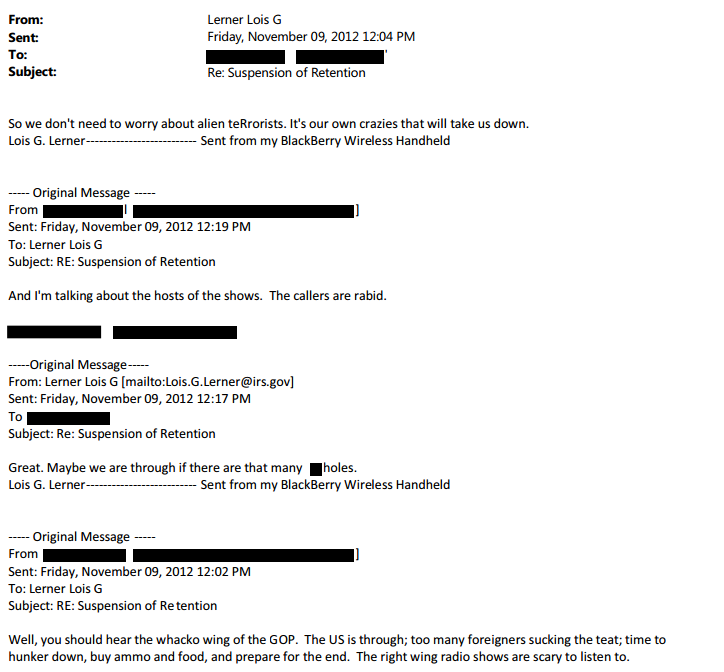
Newly discovered Lois Lerner emails released by the House Ways and Means Committee show just how much contempt the former IRS official had for conservatives, who she refers to as “crazies” and “assholes.”

Following what appears to be an effort to monitor or eavesdrop on conservative talk radio hosts and their callers, Lerner mocks conservatives for being concerned about the direction of the country, a concern right-track wrong-track polling suggests is shared by an overwhelming majority of Americans.

“So, we don’t need to worry about alien teRrorists [sic],” Lerner wrote on November 9, 2012. “It’s own our crazies that will take us down.”

Lois Lerner emails IRS

Lerner emails released by the House Ways and Means Committee.

Rep. Dave Camp (R-MI), chairman of the House Ways and Means Committee, wrote a letter to Attorney General Eric Holder that accompanied the newly discovered Lerner emails submitted to Justice Wednesday.

“Today, I write with supplementary evidence in support of the Committee’s referral relating to Ms. Lerner’s willful targeting of conservatives and mishandling of taxpayer information,” Camp wrote.

“This new evidence clearly demonstrates why Ms. Lerner not only targeted conservatives, but denied such groups their rights to due process and eqaul protection under the law,” Camp adds.

The Republican-controlled House of Representatives voted to hold Lerner in contempt back in May, and further referred her activity to the Justice Department, who just recently agreed to open another investigation following new damning Lerner emails showing inappropriate and illegal targeting practices.

A recent poll conducted jointly by Democratic pollster Anderson Robbins Research and Republican pollster Shaw & Company Research found the vast majority of the American people aren’t buying the government’s story about the lost IRS emails, as just 12 percent of voters believe the emails were destroyed accidentally. Now, 76 percent believe the emails missing from the account of Lois Lerner, the ex-IRS official at the center of the scandal over targeting of conservative groups, were deliberately destroyed.

Republicans said the previous investigation by the Justice Department was “compromised” when it was learned that the Obama administration outrageously appointed an Obama donor to head up the probe.

In a previous letter to Attorney General Eric Holder, Republican lawmakers said they learned that Barbara Kay Bosserman, the trial attorney appointed to investigate the IRS scandal, was a long-term donor of both the Democratic National Committee and President Obama, a revelation confirmed by the White House.

Campaign finance records show Bosserman contributed at least $6,750.00 going back to 2004 and donated sometimes twice a month, rotating between Obama’s campaign and the Democratic national committee, at one point giving $1,000.00 in one shot to the “Obama for America” super PAC.

“While the Committee has not seen any evidence of a serious investigation by your Department, it is my sincere hope that in light of this new, strong evidence that you immediately begin aggressively investigating this matter or appoint a special counsel,” Camp wrote to Holder.

Holder and the Obama administration have resisted calls for a special counsel thus far, but Lerner’s illegal activity apparently extends beyond targeting citizens with whom she ideologically disagree with. Committee investigators also found that Lerner used her personal email for official IRS business, including confidential return information.

“A newly discovered email from February 22, 2012 shows an exchange between Ms. Lerner and an IRS IT professional regarding a ‘Virus on Home PC,'” the letter states. “In exchange, Ms. Lerner indicates that she kept work information on her home computer, some of which may have been lost.”

The chairman said this new development “further raises concerns that taxpayer information may have been leaked.”

Newly discovered Lois Lerner emails show just

Small Business Job Growth Trend ADP

Small Business Job Growth Trend (Credit: ADP)

The latest economic data on GDP and job growth contradict each other, with the labor market cooling and gross domestic product showing signs of improvement. According to payroll processor ADP, private-sector employment increased by 218,000 jobs in July from the month prior, missing the 230,000 estimate. Meanwhile, the Commerce Department reported Wednesday that the U.S. economy grew at an annualized pace of 4 percent in the second quarter after contracting by a revised 2.1 percent pace in the first quarter, beating Wall Street expectations for a 3 percent increase.

If the initial reading holds, which is often not the case, then the U.S. economy is on track to grow at an abysmal 1.9 percent pace in 2014, further decreasing the time China will surpass the U.S. as the world’s largest economy. The government has published revisions to GDP data since 1999, which shows the economy historically performs far stronger in the second than previously reported, but also greater than the year as a whole, suggesting the jobs data could spell slowdown going forward.

According to the jobs data, the labor market is continuing its 5-year long trend of fizzling out after experiencing modest gains.

Private sector small business employment increased by 84,000 jobs from June to July, down from 1126,000 the month prior. Small business job creation this month accounted for 39 percent of all the employment gains across all payroll size groups, though historically they represented a far higher percentage. Within small businesses, 41 percent of all the employment growth came from companies that have between 1-19 employees, under the ObamaCare mandate requirement.

But other sectors cooled even further.

“Franchise job growth slowed significantly in July,” said Ahu Yildirmaz, vice president and head of the ADP Research Institute. “Since many franchise businesses fall into the less than 50 employees category, this is consistent with a sharp drop in small business hiring during the month.”

“Although down from June, the July jobs number marks the fourth straight month of employment gains above 200,000,” said Carlos Rodriguez, president and chief executive officer of ADP. Unfortunately, the U.S. economy needs to add at least 250,000 jobs monthly just to keep pace with population growth. And although the labor market has recovered the number of jobs lost during the financial crisis, 70 percent were replaced with part-time, low-paying positions.

Job creation in the goods-producing sector was weighed down by a stall in hiring in the higher-paying manufacturing arena, which was shockingly low at 3,000. Construction, however, added 12,000 private-sector jobs, despite the poor housing market data released this week.

The GDP data was released hours before the Federal Reserve concluded a two-day policy meeting, but it is unlikely they will alter their easy money monetary policy. The U.S. central bank already dismissed the economic contraction in the first quarter as a weather-related anomaly, despite the decrease in consumer spending during the first quarter.

That news doesn’t bode well for Americans who saved more in the second quarter. The saving rate increased to 5.3 percent from 4.9 percent in the first quarter. Yet, as long as the Fed keeps the rates at near zero, then Americans will see little to no return on their savings, while the investor class continues to get rich in inflated stock markets. Of course, the Fed would rather boost future spending rather than see Americans save for the future.

Despite increases in inventories, trade was a drag on GDP for a second consecutive quarter, as some of the increase in domestic demand was countered by an explosion in imports. Domestic demand rose at a 2.8 percent pace, which was the fastest since the third quarter of 2011, while it increased at a 0.7 percent pace in the first quarter.

Americans, however, may start to cut back on saving regardless, as the price index in rose at a 2.3 percent rate in the second quarter, which was the fastest pace in three years. The so-called core measure that excludes food and energy costs still increased at a 2.0 percent pace, or the fastest pace since the first quarter of 2012.

The latest economic data on GDP and

ObamaCare remains deeply unpopular among the American people, with some polls measuring their lowest level of support for the law ever. So, when Sen. Ted Cruz says the Republican Party’s message should be about repealing every bloody word of ObamaCare,” then it would appear the junior senator from Texas is just stating the obvious.

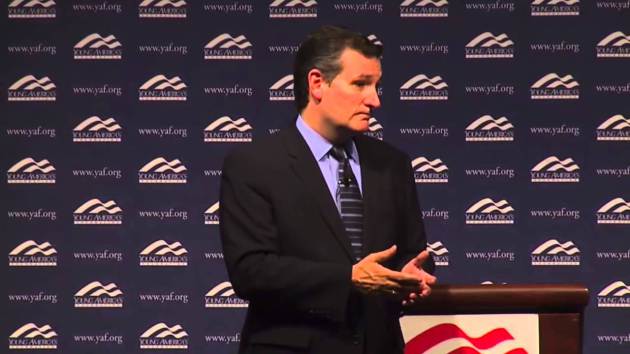
However, speaking at the National Conservative Student Conference hosted by Young America’s Foundation, Cruz said the GOP needs to convey a far more comprehensive message, which emphasizes repealing ObamaCare.

Sen. Ted Cruz at the National Conservative Student Conference hosted by Young America’s Foundation, July 29, 2014:

If we’re going to repeal ObamaCare, and I’m convinced we’re going to, it’s going to come from y’all. It’s going to come from the people saying this thing isn’t working, let’s start over. And I intend — let me just say, that ’14 and ’16, I think those elections should be about many, many things, they should be about freedom, they should be about jobs, they should be about growth, but they should be about repealing every bloody word of ObamaCare.

Speaking at the National Conservative Student Conference


A California labor union wants a California school board to include former Black Panther and convicted cop-killer Mumua Abu-Jamal in their curriculum. The union backs a plan to not only use Abu-Jamal to paint the justice system as racist to school children, but also to compare him to Dr. Martin Luther King Jr.

Abu-Jamal was convicted in the 1981 killing of 24-year old Philadelphia police officer Daniel Faulkner, and the case has long-been a crusade of the radical left. Dr. Johanna Fernandez, a history professor at Baruch College CUNY and coordinator for Campaign to Bring Mumia Home, appeared on “The Kelly File” with Megyn Kelly Tuesday night to defend the radical social justice agenda. After several attempts to shout over the Fox News host to avoid answering her questions, Fernandez was shut down when Kelly cut the interview.

Jason Riley, author of the new book Please Stop Helping Us: How Liberals Make It Harder for Blacks to Succeed, said it would be sad to introduce Abu-Jamal into a curriculum as a role model for black children alongside Dr. King. He said that now, “black parents will also have to guard children against the school curriculum that is going to be celebrating black criminality.” Riley said that would be teaching another generation of black children to see themselves as victims, calling it beyond shameful.


The last time Abu-Jamal was in the news was earlier this year, when President Obama nominated former NAACP lawyer Debo Adegbile to head up the Civil Rights Division. As acting director of the NAACP Legal Defense and Educational Fund, Adegbile succeeded in getting the cop-killer’s death sentence overturned, but conviction has been upheld numerous times.

Though Adegbile was ultimately blocked by a 47-52 vote in the Senate, the story was once-again resurrected.

Maureen Faulkner, the widow of the Philadelphia officer killed by Abu-Jamal, was outraged when the president nominated Adegbile, saying he was “the wrong person for the job.” When Senate Democrats experienced political blowback, they were forced to drop their support for Adegdile and she gracefully thanked Democratic senators who “broke ranks and had the courage to do the right thing.”

Fernandez, who came across as an angry, aggressive woman on “The Kelly File,” also appeared on Hannity during the nomination controversy. When she put forward the same talking points, Katie Pavlich, a Fox News Contributor who had been covering the story, refuted each of them line-by-line.

(Below: In a heated debated hosted by FNC’s Sean Hannity, Katie Pavlich (Fox News Contributor) and Dr. Johanna Fernandez (History Prof. Baruch College CUNY) debate the facts about Abu-Jamal.)

http://youtu.be/09FGS7MqSPM

A California labor union wants a school

Hamas Al Aqsa TV and radio Gaza

In this image taken from video, an Israeli strike blasted the media complex that houses the propaganda offices of Hamas-run Al Aqsa television and radio in central Gaza City, July 29, 2014. (AP)

Israel’s military continued to hammered target in the Gaza Strip on Tuesday, following a national address by a more resolute Israeli Prime Minister Benjamin Netanyahu.

Speaking to his nation Monday night, Netanyahu said that Israeli forces will act “aggressively” and must be prepared for a “prolonged campaign.”

“Bravery and determination are needed to fight a terror group which seeks our destruction,” Netanyahu said, making clear to Palestinian sympathizers in the U.N. that the Operation “Defensive Edge” will continue until the “terror tunnels” are destroyed.

“We need to be ready for a prolonged campaign,” Netanyahu said. “We will continue to act aggressively and responsibly until the mission is completed to protect our citizens, soldiers and children.”

“There is no war more just than this,” he added.

“His threats do not scare Hamas or the Palestinian people and the occupation will pay the price for the massacres against civilians and children,” Hamas spokesman Sami Abu Zuhri said in response to Netanyahu’s statements.

Meanwhile, Israeli tank fire hit the fuel depot of the Gaza Strip’s only power plant on Tuesday, and an Israeli military spokeswoman said 70 targets were targeted in Gaza throughout the night.

“The power plant is finished,” said its director, Mohammed al-Sharif.

A Hamas spokesman confirmed that the image above is indeed one of its broadcast outlets, Al-Aqsa TV and Al-Aqsa Radio, which were also targeted early Tuesday. At least two major explosions hit the media building, which was one of the tallest in Gaza.

During a phone conversation Monday with U.N. Secretary-General Ban Ki-moon, Netanyahu blasted the most recent United Nations Security Council statement, which calls for an immediate cease-fire in Gaza. The statement calls for both Israel and Hamas “to accept and fully implement the humanitarian cease-fire into the Eid period and beyond.”

Netanyahu told Ban Ki-moon that the U.N. statement prioritizes the interests of a “murderous terrorist organization” over Israeli security.

“The statement did not deal with the harm done to Israeli civilians, nor to the fact that Hamas turned Gaza civilians into human shields,” Netanyahu said. He also said that neither U.N. statement or its actions have addressed the fact that Hamas is using U.N. facilities to attack Israeli civilians. Corrupt U.N. officials either ignored or helped the storage of Hamas rockets in two U.N. schools late last week, which aids Hamas in their hope to trick Israel into attacking civilians.

Netanyahu told Ban that that the international community should “work to demilitarize Gaza,” rather than allow U.N. money to find its way to Hamas, which is then used to build terror tunnels to attack Israel.

“They are continuing to fire even now at Israel citizens,” he said. “Israel will continue to deal with the terror tunnels, which is only the first step in demilitarization.”

Palestinian U.N. Ambassador Riyad Mansour said Monday that he hope that Israel will “honor and respect” a new humanitarian cease-fire, despite Hamas repeatedly violating or rejecting such cease-fire proposals over the duration of the conflict.

“You cannot keep 1.8 million Palestinian civilians in the Gaza Strip in this huge prison,” he complained to reporters. “That is a recipe for disaster. It is inhumane, and it has to be stopped and it has to be lifted.”

Ironically, PPD confirmed the Gaza Interior Minister had told Palestinian civilians during the onset of the conflict to ignore Israeli warnings to evacuate areas in Gaza. Further, a video posted by PPD shows Palestinian youth confirming that most people are only trapped in the Gaza Strip because Hamas will not let them flee to safety.

Israel’s U.N. Ambassador Ron Prosor struck a more assertive tone in response to the comments and question over whether Israel would accept a new humanitarian cease-fire. He noted that the Israeli Security Cabinet had already agree to five cease-fires since the conflict began, while Hamas had honored none.

“Every single time the international community called for a cease-fire, we ceased and Hamas fired,” he said.

The Gaza health ministry claims the 20-day war has killed more than 1,050 Palestinians, though it is unclear how many are civilians. Israel has lost 52 soldiers, as well as two Israeli civilians and a Thai worker killed by rocket and mortar attacks from Gaza, according to the Israeli military.

Israeli military spokesman Lt. Colonel Peter Lerner denied Israeli involvement in a strike on a Gaza park that killed 10 people Monday. “This incident was carried out by Gaza terrorists whose rockets fell short and hit the Shifa Hospital and the Beach (Shati) camp,” he said.

Israel's military continued to hammered target in

home sales and home prices

(Photo: REUTERS)

U.S. single-family home prices unexpectedly dropped in the month of May on a seasonally adjusted basis, missing expectations of a small gain.

The S&P/Case Shiller composite index of 20 metropolitan areas reported a decline of 0.3 percent in May Tuesday on a seasonally adjusted basis, while economist polled by Reuters had forecast a gain of 0.2 percent. The latest housing market data added to an already-grim picture of a weak sector.

Monday the National Association of Realtors reported contracts to buy previously-owned U.S. homes fell in June at double the pace expected by economists, adding to months of data showing a weak housing market. New home sales also fell dramatically in June and the prior month’s data was revised to show less growth.

Getting back to the S&P/Case Shiller index, non-seasonally adjusted prices rose 1.1 percent in the 20 cities, also missing expectations of a 1.5 percent rise.

“Housing has been turning in mixed economic numbers in the last few months,” David Blitzer, chairman of the index committee at S&P Dow Jones Indices said in a statement.

“Prices and sales of existing homes have shown improvement while construction and sales of new homes continue to lag.”

Prices in the 20 cities have increased by just 9.3 percent year over year, which is the weakest year-over-year gain since February 2013 and off of expectations for a 10 percent gain.

The seasonally adjusted 10-city gauge dropped by 0.3 percent in the month of May compared to the flat measurement in April. The non-adjusted 10-city index rose 1.1 percent in May versus to a 1 percent gain in April, while year-over-year, the 10 city gauge rose 9.4 percent.

U.S. single-family home prices unexpectedly dropped in

Putin and Russian separatists

A day after President Obama accused Russia of violating the 1987 I.N.F. Treaty, the Russian-backed separatists in Ukraine suffered a severe loss on the battlefield near the area where Malaysia Airlines Flight 17 crashed July 17. The self-proclaimed prime minister of the separatists republic in Donetsk, Alexander Borodai, left territory once held by the rebels on Monday for Moscow, leading Ukrainian officials to question whether the rebels were gearing up to flee the city.

Vladimir Antufeyev, a top official in the so-called People’s Republic of Donetsk, said that Borodai had gone to Russia to discuss “humanitarian aid” and would soon return to the region. But, Igor Girkin, a defense official, said Monday that over 100 wounded separatists soldiers had been evacuated to Russia because he couldn’t “rule out the total siege of Donetsk from all sides.”

U.S. officials say Russia is taking a more direct role in the fighting, and the setbacks could explain why Russia had been lobbing artillery from the motherland across the border into eastern Ukraine for several weeks.

Deputy National Security Adviser Tony Blinken said the Russians were using the situation with Malaysian Airlines Flight 17 as “cover and distraction,” and all the while have been moving heavy weaponry over its border and into Ukraine.

“We’ve seen a significant re-buildup of Russian forces along the border, potentially positioning Russia for a so-called humanitarian or peace-keeping intervention in Ukraine,” Blinken said. “So there’s urgency to arresting this.”

Meanwhile, in what has been the most serious allegation the Obama administration has leveled against Russia, a letter from Obama to Putin says the U.S. has determined that Russia has violated the ban on American and Russian ground-launched ballistic or cruise missiles capable of flying 300 to 3,400 miles.

A soon-to-be public State Department report will claim administration officials have unanimously concluded that Russia is no longer in compliance with the Intermediate-range Nuclear Forces Treaty, or I.N.F. Treaty.

“The United States has determined that the Russian Federation is in violation of its obligations under the I.N.F. treaty not to possess, produce or flight test a ground-launched cruise missile (GLCM) with a range capability of 500 kilometers to 5,500 kilometers or to possess or produce launchers of such missiles,” that report says.

The Obama administration has known about Russia’s activity in this area since 2008, and actually made the decision in 2011 that there was a compliance issue with the treaty. Republican lawmakers have been sounding the alarm on the violation for years, but it is only now that the Obama administration found it beneficial to bring these developments to light in the public and international arena.

Still, Obama says in his letter to Putin that he is interested in more diplomatic dialogue with Moscow that will preserve the 1987 treaty, and underscores developing steps that Russia can take to re-establish compliance. Secretary of State John Kerry voiced the same interest in a Sunday phone call to Sergey V. Lavrov, the Russian foreign minister, who recently mocked the idea of further sanctions imposed by the U.S. and European countries on Russia. Lavrov said they would not work or deter Russia.

“We will overcome any difficulties that may arise in certain areas of the economy, and maybe we will become more independent and more confident in our own strength,” he said to Reuters.

With the exception of British Prime Minister David Cameron, U.S. allies in Europe have placed their trade relationship with Russia above punishing violations of their own international norms.

The EU has been dragging their feet behind Washington with its earlier sanctions package, as dependence on Russian energy exports could damage their economies. Barring a complete embrace by the Obama administration to increase production and exports of U.S. energy resources, Obama and Cameron have few options.

A spokesman for Prime Minister Cameron did call on Europe Monday to move a “strong package of sectoral sanctions as swiftly as possible.”

A day after President Obama accused Russia

People's Pundit Daily
You have %%pigeonMeterAvailable%% free %%pigeonCopyPage%% remaining this month. Get unlimited access and support reader-funded, independent data journalism.

Start a 14-day free trial now. Pay later!

Start Trial