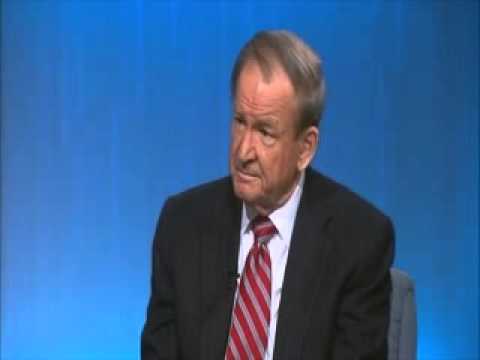
This week on The McLaughlin Group, Pat Buchanan, Eleanor Clift, Mort Zuckerman, and David Rennie discuss the conflict between Israel and Hamas, MH17, tension between Moscow and the EU, and US-German relations.
[brid video=”9570″ player=”1929″ title=”Gruber v. Gruber Conflicting Statements Exposes Lies of ObamaCare Architect”]
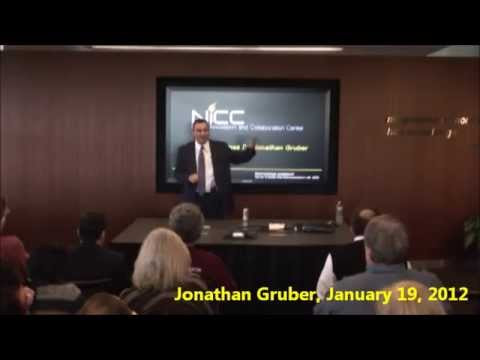
ObamaCare architect Jonathan Gruber said back in 2012 that subsidies were only permitted per the law in SBMs, or state-based exchanges. Above is not only Gruber in 2012, but first begins with a recent interview he did on MSNBC, during which does a complete reversal.
We prosecuted the damning case against Gruber further in this recent article, including new, recently released audio. But below is the full speech he gave in 2012.
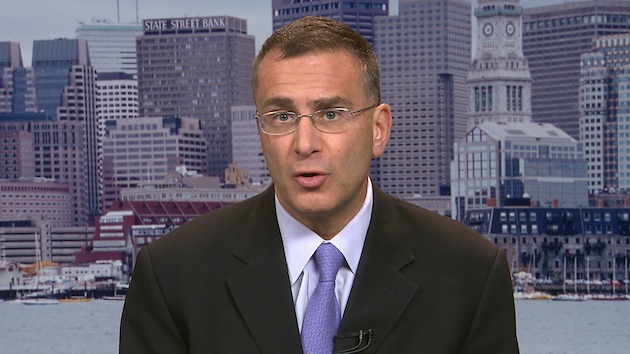
ObamaCare architect Jonathan Gruber does MSNBC interview after federal court ruling on ObamaCare subsidies.
On July 22, the powerful D.C. Circuit Court of Appeals invalidated ObamaCare subsidies for health insurance obtained through the federally run exchange, HealthCare.gov.
Immediately after the ruling, the administration once again dispatched Jonathan Gruber, an MIT economist and chief architect of ObamaCare, to make the case for why the ruling was misguided.
In a series of interviews and appearances since, Gruber has made a number of comments and accusations, including calling those who say the law should be interpreted as it was written “screwy,” “nutty,” “stupid” and “desperate.” The man who recently said that he knew “more about this law than any other economist,” insisted that those who crafted the law “had no intention of excluding the federal exchanges,” and even outrageously proclaimed that anyone who disagreed with that statement was a “criminal.”
Gruber assumed the title of “chief architect of ObamaCare” when the Obama administration deemed The Washington Post-given title appropriate in 2012, because they needed Gruber — the chief architect of RomneyCare — to refute the claims Gov. Romney made on the campaign trail. In fact, Gruber was so successful at achieving his goal, the Romney campaign decided it wasn’t a politically smart war to wage, largely leaving the issue off the table.
“Literally every single person involved in the crafting of this law has said that it`s a typo,” Gruber said in an interview with MSNBC.
The D.C. appeals court declined to view the issue as a clerical error, as the administration is attempting to portray it. The court ruled 2 – 1 that the Obama administration and the IRS overreached when they reinterpreted the language of the Affordable Care Act, better known as ObamaCare, unilaterally deciding to extend subsidies to those who buy insurance through the federally run exchanges.
But the justices on the court weren’t the only ones to view the law as explicitly barring the practice of doling out subsidies through the federal exchange, Gruber himself said so. Below is a clip from Gruber’s interview on MSNBC making the aforementioned comments, which runs into a speech Gruber made in 2012 (the full version of the 2012 speech is available below).
New audio has emerged that can be heard via YouTube in this next clip, where Gruber again repeats concerns over the law’s barring of federally distributed subsidies, which he clearly didn’t view as a clerical error, or “typo.” Remember, the agency behind the regulation that may sink ObamaCare is the same IRS that was targeting conservative groups, and they did so at the same moment Gruber was making these statements. As Chris Stirewalt put it, the IRS’s “actions provided aid and comfort to elected Democrats, even as it disenfranchised millions of Americans who voted in their states to reject state-run exchanges.”
[brid video=”9573″ player=”1929″ title=”Jonathan Gruber Once Again Says Subsidies Are Tied to StateBased Exchanges”]
So, when Gruber and the administration now pretend they were taken by surprise by this “typo,” they are lying, “period.” Gruber further made a fool of himself when he told Jonathan Cohn at The New Republic that his comment made in 2012 was “a speak-o — you know, like a typo.” For Gruber, President’s Obama’s promise that “if you like your health care plan, then you can keep your health care plan, period,” was also “a speak-o.”
The court’s ruling and the administration’s repeated attempts to undermine their own law will no doubt negatively impact millions of Americans. The justices did not make this decision lightly.
“We reach this conclusion, frankly, with reluctance. At least until states that wish to can set up Exchanges, our ruling will likely have significant consequences both for the millions of individuals receiving tax credits through federal Exchanges and for health insurance markets more broadly,” the ruling stated.
The court knows their ruling threatens to unravel the entire law, which most Americans would likely argue is the best thing that could happen to them. However, it isn’t their job to determine the impact their rulings with have on public policy, but rather their job is to ensure the political branches of government are operating within their constitutional authority. If millions of Americans who enrolled in ObamaCare end up losing their subsidies, thus are unable to afford their otherwise impossibly expensive insurance premiums, the fault will solely lay with the president and his administration.
To better understand how this could have happened, let’s first review the situation in its proper historical context.
The House, at that time, was still in Democratic control under the direction of former Speaker now-Minority Leader Nancy Pelosi, and they passed a version of the bill that included language once could argue did, indeed, extend ObamaCare subsidies beyond state-based exchanges. The Senate, however, was another story.
In a shocking rebuke of the law, which Americans never wanted and still do not want, Scott Brown was elected in deep Blue Massachusetts to replace the late liberal Sen. Ted Kennedy, a long-time advocate of government-run healthcare.
Democrats simply didn’t have the votes to take up another piece of legislation similar to the even more centralized House bill. They had no choice but to settle on the version that had already been passed in the Senate, which specifically barred ObamaCare subsidies for consumers in states that did not set up SBMs, or state-based marketplaces. The House went on to pass the Senate version, and here we are.[brid video=”9573″ player=”1929″ title=”Jonathan Gruber Once Again Says Subsidies Are Tied to StateBased Exchanges”]
The U.S. embassy in Libya Saturday was evacuated for the second time since the effort to topple Muammar Qaddafi and institute a new government began, and the diplomats ordered to neighboring Tunisia under U.S. military escort. The State Department said the “ongoing” conflict between rival militias has undermined security in Tripoli.
“Due to the ongoing violence resulting from clashes between Libyan militias in the immediate vicinity of the U.S. Embassy in Tripoli, we have temporarily relocated all of our personnel out of Libya,” spokeswoman Marie Harf said.
Libya was the location of the deadly 2012 Benghazi terror attack that resulted in the murder of Ambassador Chris Stevens, Glen Doherty, Tyrone Woods and Sean Smith. A select committee was established in the House of Representatives, which is headed-up by Rep. Trey Gowdy (R-SC), to investigate the lack of security prior to the attack and the subsequent cover up.
“Securing our facilities and ensuring the safety of our personnel are top department priorities, and we did not make this decision lightly,” Harf said. “Security has to come first. Regrettably, we had to take this step because the location of our embassy is in very close proximity to intense fighting and ongoing violence between armed Libyan factions.”
American personnel at the Tripoli embassy, which had already been operating with limited staffing, left the capital around dawn and traveled by road to neighboring Tunisia, according to Harf.
“At the request of the Department of State, the U.S. military assisted in the relocation of personnel from the U.S. Embassy in Tripoli,” a spokesman from the U.S. Department of Defense said.
“During movement, F-16’s, ISR assets and an Airborne Response Force with MV-22 Ospreys provided security,” the statement said.
As the evacuation was under way, residents of the city reported in real time on social media that American military aircraft flew overhead while U.S. soldiers escorted a convoy of vehicles out of town. The Department of Defense said the mission was conducted without incident and lasted approximately five hours.
The State Department said embassy operations will remain closed until the security situation improves. The Benghazi mission was abandoned after that Benghazi terror attack and was never reopened. Whether the embassy In Tripoli will suffer the same fate remains to be seen, and was already operating with reduced staff due to the violence that began weeks ago.
The fighting has been centering around the city’s airport, as dueling militias fight for control of the country’s entry point.
The U.S. evacuation comes after Turkey announced Friday that it was closing down its embassy. The United Nations and other international NGO aid groups also left the country.
“We are committed to supporting the Libyan people during this challenging time, and are currently exploring options for a permanent return to Tripoli as soon as the security situation on the ground improves. In the interim, staff will operate from Washington and other posts in the region,” Harf said.
The evacuated staffers will continue to work on Libya issues in Tunis, elsewhere in North Africa and Washington.
The State Department also released a travel warning for Libya urging Americans not to travel to Libya, and if U.S. citizens are in Libya they should seriously consider leaving immediately.
“The Libyan government has not been able to adequately build its military and police forces and improve security,” it said. “Many military-grade weapons remain in the hands of private individuals, including antiaircraft weapons that may be used against civilian aviation.”
Washington also closed the U.S. embassy in Libya on Feb. 2011. The embassy suspended operations when the western-led revolt that eventually toppled longtime leader Muammar Qaddafi was underway. After the formation of a transitional government in July, 2011, the embassy reopened in September, and Qaddafi was killed in October of 2011.
On Friday, U.S. Ambassador to Libya Deborah Jones appealed for fighting near the embassy to stop.
“We have not been attacked but our neighborhood a bit 2 close to the action,” she tweeted. “Diplomatic missions 2 B avoided pls.” Then, on Sunday, Jones tweeted about “heavy shelling and other exchanges” of fire in the area the U.S. embassy was located.
The fighting in Tripoli started up earlier this month when Islamist-led militias — mostly from the western city of Misrata — launched an assault from the western mountain town of Zintan. On Monday, a $113 million Airbus A330 passenger jet for Libya’s state-owned Afriqiyah Airways was destroyed.
The Islamist group, the Operation Room of Libya’s Revolutionaries, posted on its Facebook page Friday that “troops arrested Abdel-Moaz over allegations that he served under Qaddafi” and “instigated rallies against” the Islamists.
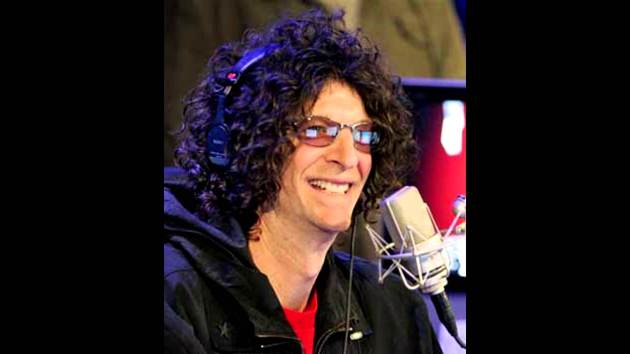
WARNING – ADULT LANGUAGE: Celebrity radio superstar and comedian Howard Stern defends Israel, boldly and proudly stating that “if you’re anti-Israel, you’re anti-American.”
Stern took a caller who wondered if Stern might change his tune on Israel given the current fighting in the Middle East.
“I don’t change my f%$#ing tune [about Israel]; Israel’s at no fault,” Stern said. “Israel’s at no fault.”
In his own way, Stern went on to address what many say is a clear double-standard.
“Jews get enough shit all over the world … Jews are the indigenous people of that area,” he says. “The Arabs don’t even want those Palestinians .. nobody wants them.”
Few, if any, celebrities have been standing up for Israel since this conflict began. The star of Private Parts told it how he thought it was, as usual.
“If you’re anti-Israel you’re anti-America. [It’s] the only democracy over there, the only friend we have .. who’s willing to fight and stand up for what’s right.”
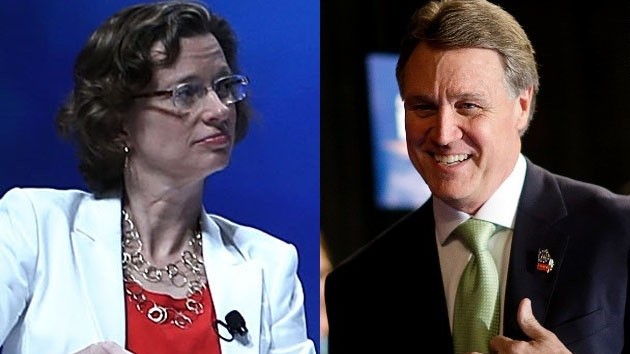
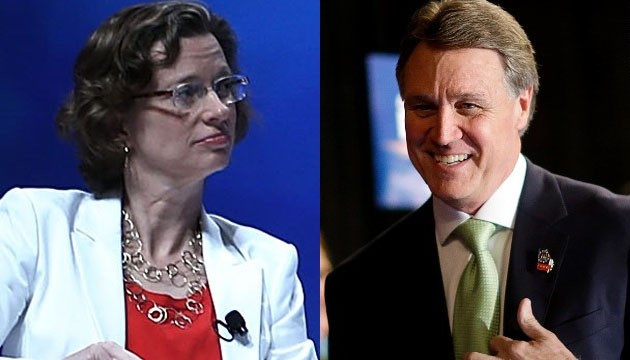
Businessman and Republican nominee David Perdue is favored over Democrat Michelle Nunn (left) in the Georgia Senate race this November. (Photo: Getty/AP)
The first poll conducted on the Georgia Senate race since Businessman David Perdue won the runoff on Tuesday shows him holding a six-point lead over Democrat Michelle Nunn.
In Georgia’s closely-watched U.S. Senate race, it’s no secret Democrats are hoping Nunn would be a strong candidate that she will help to offset Republican gains nationwide. However, polling is likely to begin to move in Perdue’s direction when considering where in the state Perdue is leading, with whom he is leading among, and the overall fundamentals of the race.
A new Rasmussen Reports poll of likely Georgia voters found Perdue with 46 percent to Nunn’s 40 percent. Considering she has run uncontested while the crowded GOP took turns bombarding each other with negative ads, her level of support is underwhelming to say the least.
While there still is a sizable 10 percent that are undecided, Georgia’s politically leaned 6 points more Republican than the nation in 2012, which was a presidential election cycle when Democrat constituencies were actually excited. PPD’s 2014 Senate Map Predictions model has been predicting how high the deck was stacked against Nunn for months. There is no doubt that Georgia has moved slightly in the Democrat’s direction over the last decade, as we’ve previously examined. Roughly 44 percent of Georgia residents are now minorities — which is up by 7 points over the past decade — and nonwhites could outnumber whites in Georgia by 2020.
But it’s just not there yet, assuming it will even get there at some point in the future. With all of the talk about Georgia slowly moving to the left, Mitt Romney actually carried the Peach State by a larger margin in 2012 than McCain in 2008. Romney actually increased a Republican candidate’s share of the vote in an election that saw black voters vote at higher rates than whites.
Further, the fundamentals suggest Perdue has a far greater advantage than other pundits have let on. Save for the guys at The Washington Post’s Monkey Cage, the typically reliable — or, this cycle somewhat reliable — election forecasters have made some pretty outrageous forecasts.
Republican Senate candidates have out-raised Nunn by about 3 to 1 and, in the case of David Perdue, he self-funded his primary campaign to the tune of $3 million. Nunn might have a consider war chest to start out with, but the fundraising variable in our model suggests the excitement is on Perdue’s side.
The runoff results were very alarming to Georgia Democrats we spoke to the following day, and rightfully so. They had hoped for a bitter primary battle that left each of the candidate’s supporters so resentful that they wouldn’t support the winner in droves. Not only did that not happen, but Kingston’s southern Georgia and coastal county stronghold supported Perdue in higher-than-expected numbers. Further, Karen Handel threw her support behind Rep. Jack Kingston, yet her supporters still went for Perdue.
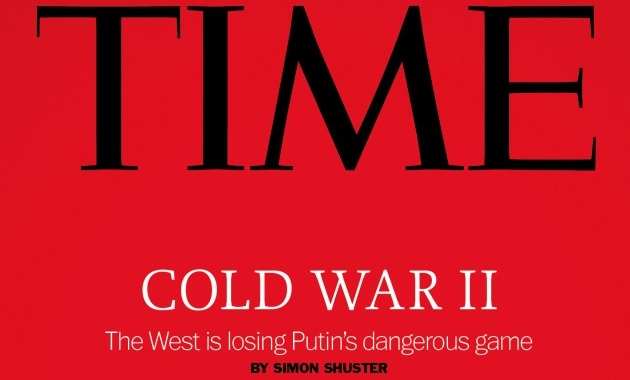
The August 4, 2014 issue of TIME Magazine entitled Cold War II, lead story by Simon Schuster. (TIME photo-illustration; Putin: Alexey Nikolsky–Ria Novosti/EPA)
The August 4, 2014, issue of TIME Magazine shouts the headline title, “Cold War II – The West is losing Putin’s dangerous game,” a lead story by Simon Schuster. The article explores whether we are in fact heading for another Cold War and, if so, what has occurred to bring it about.
Yet, despite the scathing critique of the Obama foreign policy doctrine, which simply recognizes the growing instability in eastern Europe since the “Russian reset,” former Sec. of State Hillary Clinton is running around telling everyone in interviews that “the reset worked.”
Voters, however, strongly disagree with the top 2016 Democratic presidential hopeful.
A new survey conducted by Rasmussen Reports found that 63 percent of likely voters believe it is at least “somewhat likely” that the United States and Russia will return to a 1950s-like Cold War relationship over the next few years. That’s a startling number, even for those who aren’t particularly fond of Rasmussen polls, because it is up 18 points from 45 percent they measured in March and up an astonishing 27 points from 36 percent in August 2013.
Mitt Romney, the 2012 Republican presidential nominee, was admonished a mocked by President Obama and an adoring liberal media when he argued that Russia was the most dangerous geopolitical the U.S. had to contend with today. Yet, now, just 29 percent see a Cold War II scenario as unlikely. In fact, nearly as many Americans — 21 percent — say it’s “very likely” the United States and Russia will return to a Cold War relationship, while just 4 percent think it’s “not at all likely.”
Most voters don’t want the United States to provide military assistance to Ukraine to help fight pro-Russian rebels there, but as Rasmussen noted, “perhaps in part because they feel more strongly than ever that the U.S.-Soviet Cold War is beginning to repeat itself.”
It would seem the American people would now take Mr. Romney’s warnings a little more seriously if it was a 2014 campaign rather than a 2012 contest. Mr. Obama’s average approval on foreign policy has tanked since the 2012 presidential election. PPD’s average of polls finds only 36.2 percent approve and 55.2 disapprove.
The survey of 1,000 Likely Voters was conducted on July 23-24, 2014 by Rasmussen Reports. The margin of sampling error is +/- 3 percentage points with a 95% level of confidence.
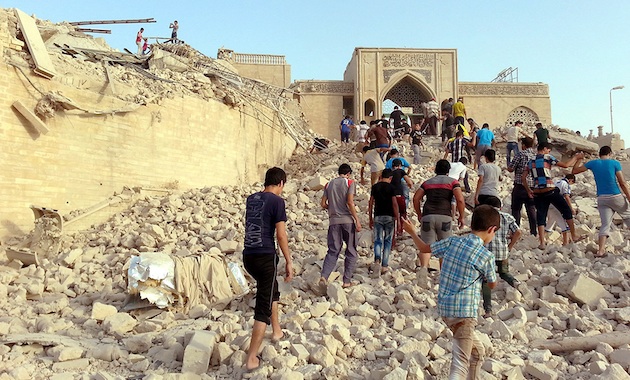
Iraqis inspect the wreckage of the grave of the Nebi Yunus, or the prophet Jonah, in Mosul, Iraq, on July 24, 2014. (EPA)
The Sunni Islamic extremists who make up the Islamic State of Iraq and Syria destroyed the tomb of Jonah the prophet Thursday. Contrary to other reports, the site is holy to both Christians and Muslims. One man, who took a video — viewable below — of the explosion from afar, can be heard saying “No, no, no. Prophet Jonas is gone. God, these scoundrels.”
Watch video taken by local Iraqi man below:
However, there is little doubt that Jonah, who is also called Dhul-Nun in Arabic (ذو النون) meaning “The One of the Whale,” is more emphasized in Judeo-Christian faiths. And the attack was certainly meant to send a message to the world that other faiths aren’t welcome.
Sam Hardy, a professor at the American University of Rome who writes the blog Conflict Antiquities, told The Washington Post exactly why he believes ISIS did this.
“It indicates they are going for total eradication not just of their enemies but even of the possibility of people living together under their rule,” he told the paper.
ISIS has been persecuting Christians and others outside the Sunni Muslim faith since assuming control of more than one-third of Iraq. In addition to issuing proclamations that Christians should leave Iraq while they still can, the destruction of any and all holy sites by ISIS remains a real possibility.
“Basically pretty much anything in the Bible,” Hardy said.
And why would they be worried about destroying valued treasures of intrinsic and sentimental value to both the West and East?
“If we didn’t intervene when they were killing people, it would be kind of grotesque to intervene over a building,” Hardy said.
The AFP recounts the events via an official at the Sunni endowment:
“‘Islamic State completely destroyed the shrine of Nabi Yunus after telling local families to stay away and closing the roads to a distance of 500 metres from the shrine,’ said the official at the Sunni endowment, which manages Sunni religious affairs in Iraq.
“The endowment official, who spoke on condition of anonymity, and Mosul residents told AFP it took the Sunni extremists an hour to rig the shrine with explosives.
“‘They first stopped people from praying in it, they fixed explosive charges around and inside it and then blew it up in front of a large gathering of people,’ said a witness who did not wish to give his name.”
The story of Jonah
Jonah, or Younis in Hebrew (יוֹנָה), was a prophet of the northern kingdom of Israel in about the 8th century BC. Though he is famous for being swallowed by a fish or a whale, depending on translation, Jonah was commanded by God to go to the city of Nineveh to prophesy against it “for their great wickedness is come up before me” (Jonah 1:2).
Jonah, at first, disobeyed God and attempted to flee from “the presence of the Lord” by going to Jaffa and sailing to Tarshish, which is in the opposite direction. When a supernatural storm arises the crew of the ship decided to throw Jonah over in an attempt to calm God’s anger via the storm. He was saved by a huge whale, or fish, and was held in its mouth for 3 days and nights.
God again commanded Jonah to go to Nineveh and prophesy to its inhabitants, and this time, he went. Upon entering the city, Jonah cries “In forty days Nineveh shall be overthrown.” The people of Nineveh begin to believe God’s message and decide to fast. The king of Nineveh puts on sackcloth and sits in ashes, making a royal proclamation that decrees fasting, sackcloth, prayer and repentance.
God sees their repentant hearts and spares the city at that time (Jonah 3:5 – 10). The entire city is humbled and broken with the people (and even the animals) in sackcloth and ashes. Even the king comes off his throne to repent.
There is more to the story, but perhaps more people should pick up a Bible and read it.
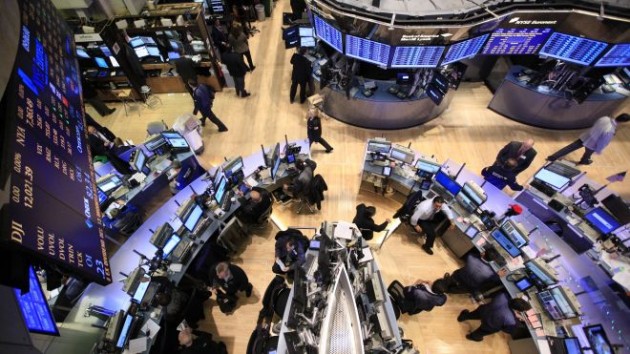
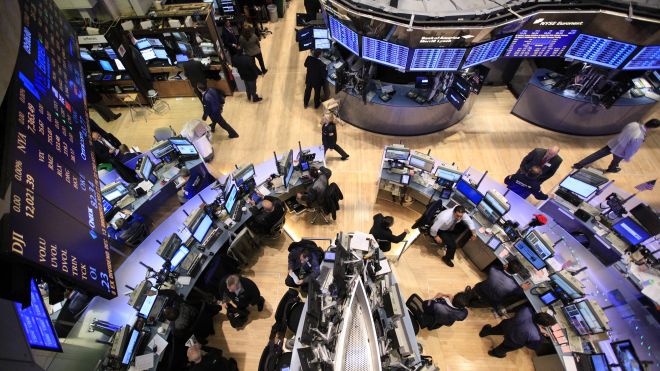
Traders on NYSE navigate the markets. (Photo: REUTERS)
U.S. markets opened in the red on Friday after disappointing earnings from companies such as Amazon.com, and weak housing market from the day before weighed down traders.
Investors didn’t respond positively to stronger-than-expected orders for durable goods, which were released before the opening bell. The Commerce Department reported orders for long-lasting goods climbed 0.7 percent in June from March, beating estimates of a 0.5 percent increase
The S&P 500 opened 9 points, or 0.4 percent lower at 1,980.96, falling off from the record close reached on Thursday, while the Dow Jones Industrial Average shed 117 points, or 0.7 percent to 16,965.02 at the opening bell.
The Nasdaq Composite opened 30 points lower, or 0.7 percent at 4,441.20, hurt by Amazon.com and Pandora, both tumbling 12%.
Follow MarketWatch’s live blog of today’s stock-market action.
Investors were disappointed with Amazon.com(NASDAQ:AMZN) and a wider-than-expected second-quarter loss late Thursday. Shares plunged 11%. Also read: Is Amazon spending like a drunken sailor?
Pandora Media (NYSE:P) fell a whole 9 percent on larger-than-expected losses reported late Thursday.
Starbucks Corp.(NASDAQ:SBUX) hit the bricks as another top loser, down 3 percent at the open. The company posted a 22 percent profit increase and lifted its outlook, but many view the company’s 2015 outlook as cautious.
Shares of Xerox (NYSE:XRX) also fell 2.7 percent, as second-quarter earnings fell in large part due to revenue from its document-technology business coming up short.
The day’s trading debuts include fast-food chain El Pollo Loco(LOCO), which priced shares at $15, the top of the range.
Investors will also closely watching Cynk Technology (OTCMKTS:CYNK), which will begin trading again after the Securities and Exchange Commission suspended trading in the stock earlier this month.
Eighteen days into the Israeli ground offensive to end the endless Hamas rocket fire from the Gaza Strip, and brokering a cease-fire is proving just as complex as the vast network of terror tunnels discovered by the Israeli Defense Forces.
U.S. Secretary of State John Kerry was dispatched to craft an agreeable cease-fire this week, and Israel’s security Cabinet will meet Friday to consider the plan. However, on the day that marks the final Friday of Ramadan, the Muslim month of fasting and prayer, which ends with a feast beginning Sunday or Monday, the Palestinian Fatah movement called for a “day of rage.”
Kerry’s plan, which will include a call for a humanitarian truce for the duration of at least five days, has little chance at success with the terror group Hamas. The militant terror group has already broken two separate cease-fires, one of which was also for humanitarian purposes. But the terms Hamas demands are undeniably impossible for Israel to live with.
Hamas rejected the first Egyptian-brokered cease-fire proposal, demanding the joint Israeli-Egyptian blockade be eased so they can have access to the Al-Aksa Mosque on the Temple Mount in Jerusalem. Israel imposed the blockade in 2006 after Hamas and other militants abducted an Israeli soldier. Egypt tightened its own restrictions last year after the overthrow of the oppressive Muslim Brotherhood government in Cairo, which was aided by Hamas, and has destroyed many of the cross-border smuggling tunnels were used by Hamas to bring in weapons.
Any further easing of the blockade would ensure Hamas could again begin to tunnel more elaborate networks of terror tunnels from which they could launch attacks on Israel, smuggle weapons and stage kidnappings. Defense Minister Moshe Ya’alon said shutting down the tunnels is critical to security in Israel.
“We’ve been busy with the tunnels for a long time — in the last year we have discovered four in our territory,” Ya’alon said. “This can be dealt with diplomatically or militarily — now it’s being done militarily with a lot of success.”
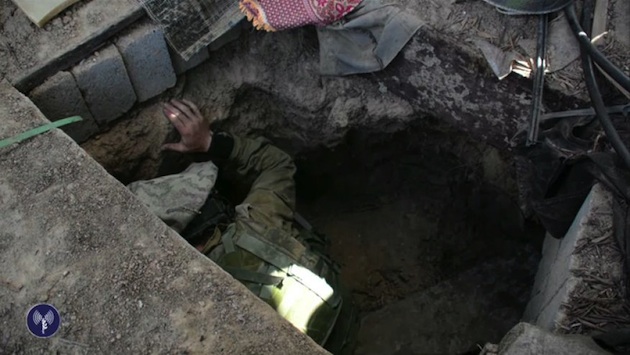
More than 60 access shafts leading to 28 tunnels have been uncovered since Operation Protective Edge began on July 8. Pictures released by the IDF show a sophisticated network of tunnels complete with stone walls and metal ladders.
“An IDF force uncovered a terror access shaft in Gaza in which were weapons, maps and IDF uniforms, all intended for the execution of terror attacks against Israel,” said an IDF statement. “In addition, an IDF force attacked several militants emerging from a tunnel opening in the southern Gaza Strip. Since the beginning of the ground operation more than 60 access shafts leading to some 28 tunnels have been uncovered.”
Also, Hamas demands that Israel will release the Palestinian Schalit prisoners. The six prisoners were initially freed by Israel as part of an exchange for a captured IDF soldier, but later re-arrested in the West Bank after the group recommenced terrorist activities. Israeli officials said earlier in the conflict the issue of re-releasing the prisoners was “not up for discussion,” because they are simply too much of a danger to their national security.
Still, Kerry’s new proposal stands a far better chance of being accepted by Israel, who has already agreed to the terms of two cease-fires, than Hamas. However, because the terror tunnel network was far more extensive than previously thought, it is difficult to imagine what benefit Israel would see from the cease-fire if they were to be allowed to remain. A U.S. intelligence source said that American satellite imagery suggests that as many as 60 tunnels have been built underneath Gaza.
“We’ve been busy with the tunnels for a long time — in the last year we have discovered four in our territory,” Ya’alon said. “This can be dealt with diplomatically or militarily — now it’s being done militarily with a lot of success.”
Kerry’s proposal does in fact include a provision that states Israeli Defense Forces would be allowed to stay in Gaza to continue to locate and destroy Hamas tunnels. Several members of the U.N. Security Council have objections to that provision, but in light of recent events, have remained relatively quiet.
Missile caches have been found in UNRWA schools that Israeli officials say arrived through one of the terror tunnels. “The rockets were passed on to the government authorities in Gaza, which is Hamas,” a senior Israeli official told the Times of Israel. “In other words, UNRWA handed to Hamas rockets that could well be shot at Israel.”
Kerry, who will leave Cairo Friday afternoon and return to Washington, is awaiting an answer from the Qatari and Turkish foreign ministers as to how Khaled Meshal, the head of Hamas’ political wing, has responded to his proposal.
You have %%pigeonMeterAvailable%% free %%pigeonCopyPage%% remaining this month. Get unlimited access and support reader-funded, independent data journalism.