Widget Image
Follow PPD Social Media
Friday, January 16, 2026
HomeStandard Blog Whole Post (Page 951)

supreme court obama

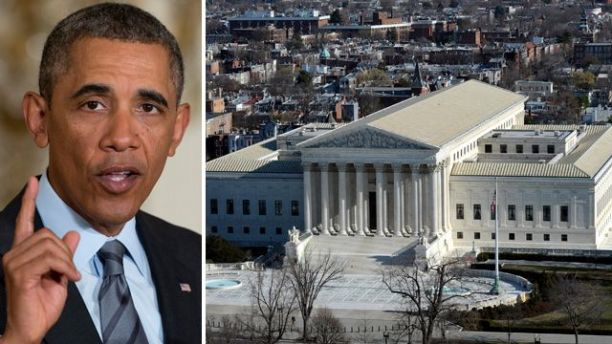
In a rare instance, the Supreme Court handed down a unanimous decision Thursday, striking down President Obama’s NLRB recess appointments. The decisions made by the board during the period of time Obama’s appointments served are all null and valid.

The court said Thursday that President Obama exceeded his recess appointment authority when he filled slots on the National Labor Relations Board back in 2012. The high court acknowledged the president’s recess appointment power, but said that the Senate’s three-day window of operation was too short.

“Under the standards set forth here, the Senate was in session during these pro-formal sessions at issue,” the court said. The ruling held the Senate “was in session and the Senate maintained power to conduct rules and business.”

Justice Stephen Breyer said in the majority opinion that a break has to last at least 10 days to be considered a recess under the Constitution.

“Three days is too short a time to bring a recess within the scope of the Clause. Thus we conclude that the President lacked the power to make the recess appointments here at issue,” Breyer wrote.

In other words, the president should have asked the Senate for a unanimous consent measure, which could have easily been granted. The justices said in their first-ever consideration of the Constitution’s recess appointments clause that only Congress gets to decide when it is in recess, not a king-like president, and that there was no recess when Obama acted despite his argument that they were.

The president, as usual, said he made the appointments because Republicans refused to allow the NLRB to function. But that’s irrelevant to the separation of powers, even if it was true. The president knew he could not get radical, controversial appointments through a Senate — even one controlled by Democrats — thus he tried to exceed his authority. However, now that Democrats have pulled the nuclear option, appointments can now clear the Senate on a simple majority vote.

Democrats are already crowing over the rules being invalid, but the Obama administration is to blame since they ignored the lower court’s ruling that held the same position of the high court. The D.C. Court of Appeals ruled the appointments unconstitutional and the subsequent decisions invalid. However, the Obama administration flatly ignored the ruling.

In a rare instance, the Supreme Court

lois lerner chuck grassley

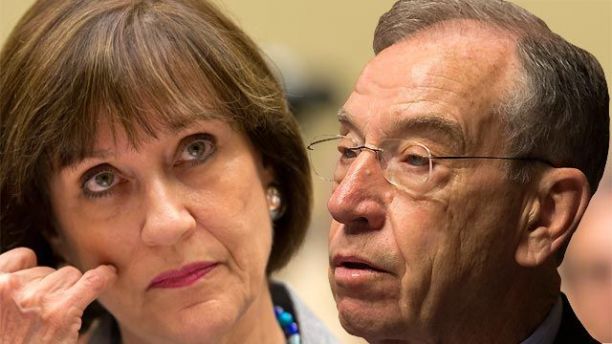
New emails show Lois Lerner, the former IRS official at the center of the IRS scandal, grossly abused her power by targeting Iowa Sen. Chuck Grassley. (Photo: FOX News)

House Republicans have released new emails showing Lois Lerner, the former IRS official at the center of the IRS scandal, targeted sitting Iowa Republican Senator Chuck Grassley, a revelation one lawmaker called “shocking.”

The emails — viewable below — were published late Wednesday by the House Ways and Means Committee, which is headed up by Chairman Dave Camp (R-MI), show Lerner referred Sen. Grassley for a completely unjustified internal audit. Lerner mistakenly received an invitation intended for Sen. Grassley back in 2012, in which Lerner believed the event organizer offered to pay for Grassley’s wife to attend the event.

Before bothering to learn the facts, Lerner emails an IRS colleague suggesting that the case be referred for an audit. Worth noting, Lois Lerner wasn’t even acting within her division when she made the referring, demonstrating an out-of-control pattern of corrupt practices.

“Looked like they were inappropriately offering to pay for his wife. Perhaps we should refer to Exam?” she wrote.

However, the colleague, who apparently wasn’t operating under a political agenda, pushed back on Lerner and the entire idea, arguing an offer to pay for his wife is “not prohibited on its face.”

The newly released emails represent another instance when Lerner, an Obama political appointee on a corrupt rampage to carry out a political agenda, used her authority at the IRS in the Exempt Organizations division to target conservatives.

“We have seen a lot of unbelievable things in this investigation, but the fact that Lois Lerner attempted to initiate an apparently baseless IRS examination against a sitting Republican United States Senator is shocking,” Ways and Means Committee Chairman Dave Camp said in a statement.

“At every turn, Lerner was using the IRS as a tool for political purposes in defiance of taxpayer rights.”

Sen. Grassley said in a statement that the emails show “political targeting” at the highest levels. “It’s very troubling that a simple clerical mix-up could get a taxpayer immediately referred for an IRS exam without any due diligence from agency officials,” he said.

The House held hearings this week on the latest revelation that the IRS supposedly lost the emails of Lois Lerner and six other employees due to hard drive crashes, which experts have said has a 1 in 1.5 million chance of occurring. The Americans people, however, aren’t buying the story. Roughly 80 percent of Americans in a recent poll said that the IRS is lying and that the emails were intentionally destroyed to cover up the scandal.

House Republicans have released new emails showing

boehner suing obama

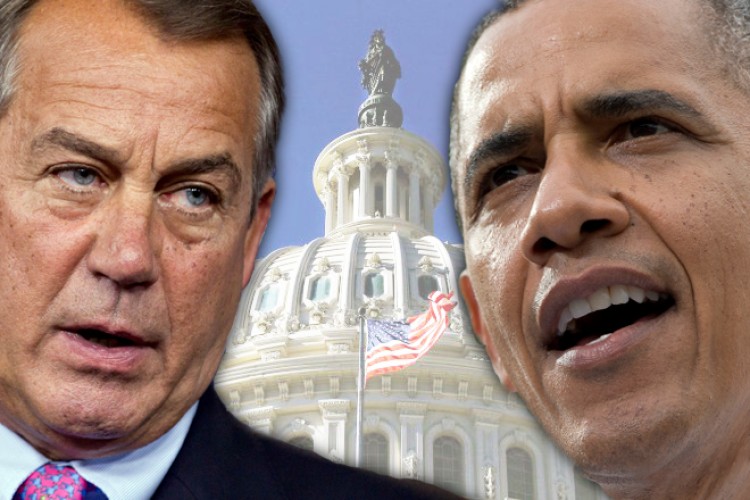
House Speaker John Boehner announced Wednesday he plans to file suit against President Obama over what even prominent liberals have said are repeated abuses of executive power.

“This is not about impeachment. It’s about him faithfully executing the laws of this country,” Boehner said.

The speaker alleged that the president not only has ignored the law but “brags about it,” decrying what he described as “arrogance and incompetence.”

Boehner had been deciding whether he would file a lawsuit in recent days, sharing the concerns of the majority of Americans who now feel that Obama exceeded his constitutional authority with various executive actions. Despite losing a recent Supreme Court decision, the Obama administration plans to go forward with their unilateral, unprecedented EPA rules to control sectors making up the U.S. energy grid.

The lawsuit has not yet been filed. But asked Wednesday whether he is planning to make good on his threat, Boehner made clear he would.

“I am,” he responded when asked by the media at his press conference.

“My view is the president has not faithfully executed the laws,” he said. “What we have seen clearly over the last five years is an effort to erode the power of the Legislative Branch.”

Then, in a memo to House Republicans sent later Wednesday, Speaker Boehner said he plans to bring legislation authorizing the suit to the House floor in July, noting that Obama’s executive actions could shift the “balance of power decisively and dangerously” in favor of the White House, resulting in an American government whose president has “king-like authority.”

During hearings conducted back in February, Jonathan Turley, a prominent liberal law professor, testified to President Obama’s many instances of executive overreach, warning that the president’s actions on immigration and various other issues have done more to destroy the balance of power than any other president before him. Following those hearings, South Carolina Rep. Tom Rice led a legislative counter-attack on the “lawlessness” of the Obama presidency, dubbed the Stop This Overreaching Presidency, or the S.T.O.P. resolution.


Boehner also cited Obama’s overreach on health care policy, energy, foreign policy and education.

“On one matter after another during his presidency, President Obama has circumvented the Congress through executive action, creating his own laws and excusing himself from executing statutes he is sworn to enforce — at times even boasting about his willingness to do it, as if daring the America people to stop him,” he wrote.

Republicans have also sounded the alarm on the many unilateral changes to the implementation of ObamaCare, which have been done with the sole purpose to postpone millions of cancellations and higher premiums until after both the 2014 and 2016 elections.

White House Press Secretary Josh Earnest attacked Republican leadership for what he characterized as a “taxpayer-funded lawsuit against the president of the United States for doing his job.” Since the president’s last ill-received State of the Union Address, the Obama administration has taken the blatant position that he planned to circumvent the law and lawmakers whenever possible, claiming he has “a pen and a phone” and he’s not afraid to use it without congressional approval.

“It seems that Republicans have shifted their opposition into a high gear,” he said. “Frankly, it’s a gear that I didn’t know previously existed.”

Prior to Boehner’s announcement, or in other words before she even knew what she was criticizing, House Minority Leader Nancy Pelosi scoffed at the idea of fighting for the separation of powers outlined in the Constitution.

“I make of it as subterfuge,” she said. “They’re doing nothing here. So they have to give some aura of activity.”

The decision by Boehner to sue Obama isn’t only his to make, as the measure still would have to be approved by a group of House leaders, and then the entire House. The plaintiff in the lawsuit would be the House of Representatives, itself.

House Speaker John Boehner announced Wednesday he

Long-lasting manufacturing goods, or durable goods are being made at Boeing plant. (Photo: Boeing/REUTERS)

The Commerce Department said orders for long-lasting goods dropped 1 percent in May, missing Wall Street’s expectations that orders would remain unchanged from the month prior. Excluding the transportation component, orders fell by 0.1 percent.

Durable goods are classified as products meant to last three years or more. The measurement was way off from the 0.4 percent gain economists forecast, and added to another piece of disappointing economic data that sent shockwaves through Wall Street.

The Commerce Department reported Wednesday that the U.S. economy contracted at an annual rate of 2.9 percent in the first quarter, clocking in at the largest drop since the first quarter of 2009. The latest report reflected an increase from the previous estimate of a contraction of 1 percent.

Wall Street expected the world’s biggest economy — soon to be the second-largest if conditions don’t turn around — to shrink by an annual rate of 1.7 percent.

Growth has now been revised down by a total of 3.0 percentage points since the government’s first estimate was released back in April, and the measurement represents the worst performance ever during a period that was supposedly not an economic recession.

The Commerce Department said orders for long-lasting

economic news

The U.S. economy contracted at an annual rate of 2.9 percent in the first quarter, which is the biggest drop since the first quarter of 2009 and far worse than the government previously reported. Wall Street expected the world’s biggest economy — soon to be second-largest — to shrink by an annual rate of 1.7 percent, up 7 percent from the previously reported contraction of 1 percent.

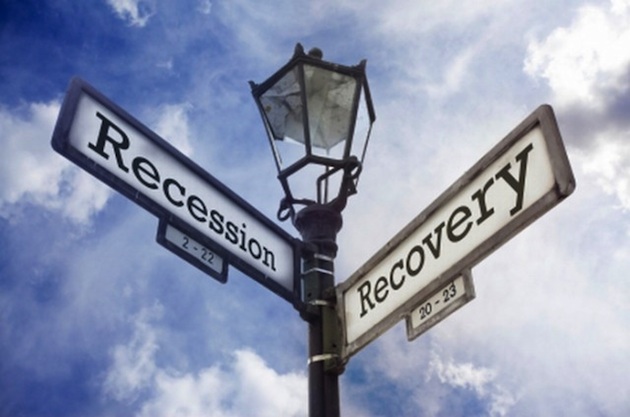
The Commerce Department said Wednesday that gross domestic product clocked in at its worst performance in five years, and the worst performance ever during a period that was supposedly not an economic recession. Surveys have consistently found that Americans believe the economy is in a recession, and until now, government data just didn’t reflect those views.

The largely negative economic news and data from the housing market and labor market have been blamed repeatedly on an unusually cold winter in media, even by outlets like FOX Business. However, as we’ve previously reported, the degree to which negative, long-term trends and data influenced the revisions demonstrate deeper and more fundamental weaknesses than can be explained by the weather. While many economists estimate colder-than-expected weather could have slashed as much as 1.5 percentage points from GDP growth in the first quarter, the government offered no details on the impact of weather.

Growth has now been revised down by a total of 3.0 percentage points since the government’s first estimate was released back in April, which had the economy expanding at an abysmal 0.1 percent rate. It isn’t at all unheard of for the government to revise estimates, or even that they have ill-intent to make those revisions, but the disparity between the second and third estimates was the largest ever on record. Dating back to 1976, the government has never missed the mark by more, the Commerce Department said.

The latest revisions show a weaker pace for consumer spending on health care than the government assumed, which not only reflects the increasing costs under ObamaCare pushing individuals to opt instead for the fine, but also resulted in a downward revision to the consumer spending estimate. Trade deficits, again, were responsible for a bigger slice off of GDP than previously thought.

Exports declined by 8.9 percent, not the previously estimated 6.0 percent pace, which helped to build a trade deficit that sliced off an estimated 1.53 percentage points from GDP growth.

The government’s measurement of domestic demand that excludes exports and inventories expanded by just 0.3 percent rate, rather than a 1.6 percent rate. Inventories sliced off 1.70 percentage points from first-quarter growth estimates, as well.

So, while businesses accumulated $45.9 billion worth of inventories, which is less than the $49.0 billion estimated last month, inventories still slashed 1.70 percentage points from first-quarter growth.

The latest economic data on the labor market, manufacturing and services sectors are giving many hope for an acceleration in growth early in the second quarter. Macroeconomic Advisers recently forecast the U.S. economy will grow at a 3.6 percent annual rate in the April to June period. However, many economists are now not viewing that figure as viable.

For instance, consumer spending, which accounts for more than two-thirds of U.S. economic activity, increased by just 1.0 percent. Yet, it was previously reported to have increased by a 3.1 percent pace. Further, as previously reported, weak housing market data may point to danger on the horizon, with the government again abandoning sound lending practices with an aim to rebound a fragile and volatile recovery that never was.

The U.S. economy contracted at an annual

lois lerner lost irs emails

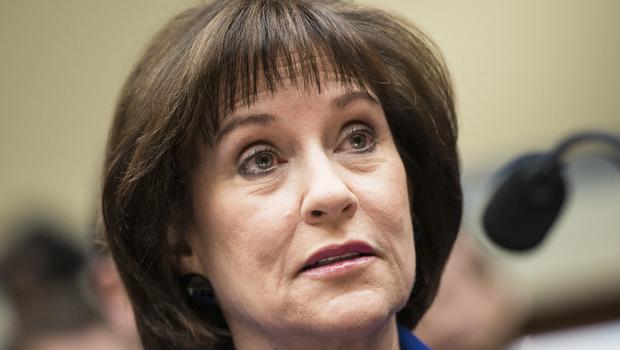
The former IRS official Lois Lerner, the figure at the center of the IRS scandal.

The vast majority of the American people aren’t buying the government’s story about the lost IRS emails, as just 12 percent of voters believe the emails were destroyed accidentally. Now, 76 percent believe the emails missing from the account of Lois Lerner, the ex-IRS official at the center of the scandal over targeting of conservative groups, were deliberately destroyed.

Though party loyalty is still hanging on, even 63 percent of Democrats now believe the emails were destroyed, while 90 percent of Republicans and 74 percent of independents, agree.

Tuesday morning, with Chairman Darrell Issa (R-CA) at the helm, the House Committee on Oversight and Government Reform held part two of its scheduled series of hearings entitled, “IRS Obstruction: Lois Lerner’s Missing Emails.” While Democrats are arguing there’s no there, there, interest, outrage and suspicion are all growing among the public.

A whopping 74 percent of registered voters say Congress should investigate the IRS “until someone is held accountable,” which is an increase from 67 percent measured in April. Adding to the bad news for the president and Democrats, is that the increase is fueled in part by 66 percent of Democrats who now also agree with Republican lawmakers. The hearings came complete with fireworks and headlines, including a National Archive employee who testified to the fact the IRS broke the law.

The Federal Records Act requires any and all government agencies to notify the National Archive in the event that the agency has either — through incompetence or intentional destruction due to corruption — misplaced or cannot account for emails and other records. When asked by Rep. Tim Walberg (R-MI) during this week’s hearing about whether the IRS broke the law, David Ferriero of the National Archives, said yes.

“Is it fair to say the IRS broke the Federal Records Act?” Rep. Walberg asked. “If they didn’t do that, can we safely assume they did not follow the law?”

“That’s right,” Ferriero responded. “They did not follow the law.”

The Fox News poll is based on landline and cell phone interviews with 1,018 randomly chosen registered voters nationwide and was conducted under the joint direction of Anderson Robbins Research (D) and Shaw & Company Research (R) from June 21-23, 2014. The full poll has a margin of sampling error of plus or minus three percentage points.

The vast majority of the American people

oklahoma senate primary

The national media have been inaccurately attempting to frame the Oklahoma Senate primary on Tuesday in the same light as the bare-knuckle battle in Mississippi. Not only is that not the case, at all, but the story actually shows a deeper divide than the typical establishment versus insurgent narrative.

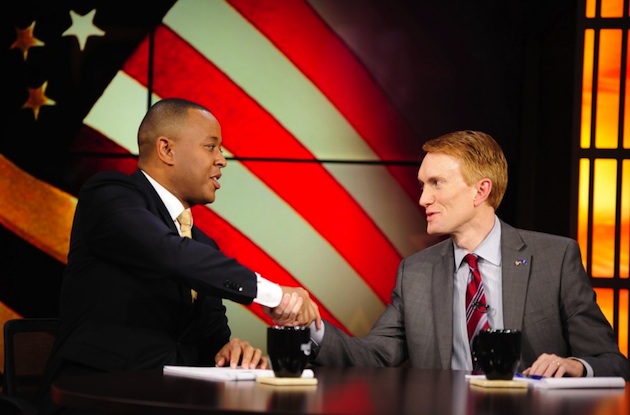
First, in the Oklahoma primary, national Tea Party groups got behind state Rep. T.W. Shannon. The former speaker of the Oklahoma House of Representatives stepped down to focus on his Senate campaign, and quickly attempted to cast himself as the contest conservative. However, local Tea Party activists have always preferred Rep. James Lankford, the 46 year-old House Republican Policy Committee chairman. Lankford might be a member of the House leadership, but he’s no establishment candidate, and won his seat just four years ago.

In fact, while Chris McDaniel enjoys widespread support among activists in Mississippi and on the national scene, the local Tea Party groups are a little more than angry in Oklahoma.

“Conservative grassroots leaders and activists from across the state of Oklahoma, felt it was important that we reinforce our opposition to the outside endorsements of T.W. Shannon for U.S. Senate in Oklahoma,” three-dozen conservative activists wrote in a June 19 open letter to the “D.C. Tea Party Establishment.”

“We continue to stand firm that T.W. is not the conservative in this race. Outside endorsements from the Senate Conservatives Fund, Governor Palin, Senators Cruz and Lee as well as others are at odds with many of the Tea Party and Grassroots Liberty organizations in Oklahoma. Boots on the ground, Oklahoma grassroots leaders and activists were not consulted regarding who the true conservative was prior to the endorsements.”

It’s because of these boots on the ground that we favor Lankford to earn more than Shannon in Tuesday’s primary in Oklahoma, despite Shannon, 36, enjoying the backing of the American Conservative Union, Citizens United, GOPAC, FreedomWorks, conservative talk radio host Mark Levin and RedState’s Erick Erickson. A candidate must receive more than 50 percent of the vote in order to avoid a runoff, which may change the dynamic of the race. However, even though primary polling isn’t at all reliable to begin with, and it’s even worse when the pollsters have an agenda, Shannon has only led in one poll since the head-to-head matchup has been tested.

Poll Date Sample Lankford Shannon Brogdon Spread
Sooner Poll/News 9/News on 6 6/19 – 6/21 840 LV 43 35 4 Lankford +8
Sooner Poll/Tulsa World 6/14 – 6/18 415 LV 41 38 3 Lankford +3
Sooner Poll/News 9/News on 6 5/5 – 5/10 580 LV 34 32 5 Lankford +2
NSON Opinion Strategy 4/23 – 4/29 400 LV 31 32 4 Shannon +1
Harper (R) 1/30 – 2/1 627 LV 54 18 Lankford +36

The Oklahoma Senate primary is rated “Leans Lankford” on PPD’s 2014 Senate Map Predictions, and will start as the strong favorite in November. The Oklahoma primary will determine who will replace outgoing Sen. Tom Colburn, who announced his retirement early.

mississippi senate race

Incumbent Republican Senator Thad Cochran (left) and conservative challenger Chris Daniels (right) will face off in Tuesday’s Republican Senate primary. The Mississippi Senate race is rated “Safe Republican” regardless.

Meanwhile, in the Mississippi Senate primary (part 2), Sen. Thad Cochran, a roughly 4-decade-long incumbent who lost to insurgent challenger Chris McDaniel three weeks ago by 1,386 votes (out of 313,483 ballots cast), is pulling out all of the stops to avoid retirement. The race had been a truly nasty establishment versus insurgent battle from the beginning, but got even worse after the first contest.

PPD first reported on Election Day that Cochran was collaborating with Democrats to stop the will of his own party and keep his lobbyist friends’ pockets deep, but now he isn’t even trying to hide it. In a last-minute cash infusion, the National Republican Senatorial Committee gave $175,000 to help Cochran get the job done.

The Senate Conservative Fund, Freedom Works and the Tea Party Patriots have all sent observers to areas where Mr. Cochran is recruiting Democrats, which is in and around his hometown of Jackson, indluing Hinds, Madison and Rankin counties. The more populous and moderate coastal counties, such as Harrison County, will also be regions to watch when the returns come in.

The new President of Senate Conservatives Fund, Ken Cuccinelli, and J. Christian Adams, a former Justice Department official turn-conservative commentator, described the watchers as “election observers.” They will mostly be made up of Mississippi residents trained to “observe whether the law is being followed.”

Areas rich with McDaniel’s supporters reside in the northern, more rural counties and his Pine Belt state Senate district. Jones County, which includes Ellisville and Laurel, saw record turnout June 3, and their heavy support propelled McDaniel to the lead.

Poll Date Sample McDaniel Cochran Spread
PPD Average 6/12 – 6/20 49.3 43.0 McDaniel +6.3
Chism Strategies (D) 6/20 – 6/20 697 LV 52 44 McDaniel +8
NSON Opinion Strategy 6/13 – 6/17 400 LV 44 45 Cochran +1
The Polling Company (R) 6/12 – 6/13 501 LV 52 40 McDaniel +12

Speaking of leads: McDaniel is currently in the lead in the polls, but polling in this race has been widely inaccurate and each of the pollsters have a different take on the electorate. However, regarding Cochran’s attempt to lure Democratic voters, I am skeptical. We witnesses and reported on his attempt in the first race, and while it is likely he will see much of his vote total represented by Democrats today, he is likely to lose a good deal of his moderate base pulling such a dirty stunt. In light of his entire justification for reelection, which is his ability to spend taxpayer money in his own state, the Hail Mary strategy shows just how desperate Team Cochran truly is.

The challenger, Chris McDaniel, is now favored to win the Mississippi Senate primary run-off election.

[scribd id=230525806 key=key-vjq458uL0o1S2WyUBuBh mode=scroll]

The national media have been inaccurately attempting

john kerry

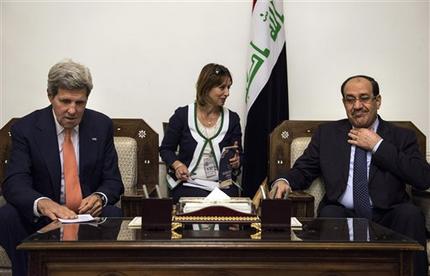
Iraqi Prime Minister Nouri al-Maliki, right, meets with U.S. Secretary of State John Kerry, left, at the Prime Minister’s office in Baghdad, Iraq, Monday, June 23, 2014. Kerry is visiting Iraqi leaders to discuss the increasing violence and instability in country caused by insurgents including the al-Qaida-inspired Islamic State of Iraq and the Levant (Syria). (AP Photo/Brendan Smialowski, Pool)

Secretary of State John Kerry said Monday that the leaders of Iraq’s various political factions assured him they would seat a new government next week, before a Sunni insurgency facilitates the end of a potential peace.

“This is a critical moment for Iraq’s future,” Kerry said at a press conference in Baghdad. “It is a moment of decision for Iraq’s leaders and it’s a moment of great urgency.”

Kerry said the U.S. pledged support for Iraq’s Security Force even as Sunnis remain frustrated by what has been an effort by Prime Minister Nouri al-Maliki to cut them out of power. They reportedly continue to enlist in the ISIS, an extremist group that has enjoyed a series of successes in neighboring Syria civil war prior to scoring gains in Iraq over the past two weeks.

However, despite the increasing rhetoric from Kerry and lawmakers on both sides of the aisle, al-Maliki gave no indication that he would consider stepping down. Still, the Obama administration says they will move forward with unspecified support for the Iraqi government, though a large military presence is unlikely.

“The support will be intense, sustained, and if Iraq’s leaders take the necessary steps to bring the country together, it will be effective,” Kerry said.

Last week, President Obama announced that he would send roughly 300 “military advisors,” which is code for Green Berets and other U.S. Special Forces soldiers, in a mission to assist and “advise” the Iraqi Security Force.

However, Kerry arrived in Baghdad just one day after the Sunni militants captured two key border posts, one along the frontier with Jordan and the other with Syria. Now, because they control the porous border with Syria, a free flow of weapons and hardened fighters from Syria are entering the country virtually unopposed. As far as Jordan, King Abdullah, an ally of the U.S., has been considerably concerned about the stability of his nation.

Meanwhile, these latest victories have vastly expanded territory now under the militants’ control in Iraq. In northern Iraq, they have all but total control of the region, despite the fact the Iraqi army are superior in numbers. According to the consensus in the intel community, the ISIS currently controls more than one-third of the territory in Iraq.

The control of the two border crossing points unequivocally brought the group closer to its goal, which is to establish an Islamic caliphate, a massive extremist-based state encompassing both Syria and Iraq.

Kerry conveyed to the prime minister and others that he and the U.S. believe only Iraqi leadership can save the government in Iraq, and they should start by granting more power to Iraq’s minorities.

“The very future of Iraq depends on choices that will be made in the next days and weeks, and the future of Iraq depends primarily on the ability of Iraq’s leaders to come together and take a stand united against ISIL (ISIS),” Kerry said, referring to the insurgency known as the Islamic State of Iraq and the Levant (Syria). “Not next week, not next month, but now.”

But ultimately, no country including the U.S., should be choosing leadership for Iraq. “That is up to the people of Iraq,” Kerry said.

Prime Minister al-Maliki is facing increasing pressure from within the U.S. and Iraq for his resignation. Sunnis say they do not believe he will give them a greater role or adequate representation in the government, and his past actions warrant little expectation for him to do so.

Still, Parliament Speaker Osama al-Nujaifi, for instance, one of Iraq’s top-ranking Sunnis, is prepared to work with the current leadership for the greater good of Iraq. He told Kerry that the ISIS pose “a threat to the entire world.” Al-Nujaifi, is from Mosul, which is Iraq’s second largest city that fell to the ISIS earlier this month by militants.

Of the insurgents, al-Nujaifi said “we have to confront it through direct military operations, political reforms so that we can inject a new hope into our own people so that they can support the political process and the unity of Iraq.”

Iraqi officials briefed on the meeting between Kerry and the Iraqi prime minister said al-Maliki urged the United States to target the militants’ positions in Iraq and neighboring Syria, citing training camps and convoys with airstrikes. The officials said Kerry responded by saying a great deal of care and caution must be taken before attacks are launched to avoid civilian casualties that could create the impression that Americans are attacking Sunnis.

The officials spoke on condition of anonymity because they were not authorized to speak to the media on the record.

President Barack Obama, in a round of television interviews that aired in the U.S., said al-Maliki and the Iraqi leadership face a test as to whether “they are able to set aside their suspicions, their sectarian preferences for the good of the whole.”

“And we don’t know,” Obama said. “The one thing I do know is that if they fail to do that then no amount of military action by the United States can hold that country together.”

While that is certainly debatable, the effectiveness of the ISIS versus the larger Iraqi force, isn’t. Sunday’s border crossing captures near Jordan and Syria came after the fall of the towns of Qaim, Rawah, Anah and Rutba. All of them are in the Sunni-dominated Anbar province, and many experts say they could not have been captured without local help. The region is also where militants have held up since January, when they took control of the city of Fallujah and other areas of the provincial capital, Ramadi.

On Monday, Islamic militants ambushed a police convoy that was transferring prisoners located approximately 85 miles (140 kilometers) south of Baghdad, killing nine policemen and 13 prisoners. The officials said some of the prisoners were convicted of terrorism-related charges, and were being relocated to a high-security prison in the southern city of Nasiriyah, which is 200 miles (320 kilometers) southwest of Baghdad.

Facing increasing pressure Prime Minister Nouri al-Maliki

supreme court obama

The Supreme Court justices ruled Monday to restrict and place limits on the unilateral Obama administration regulation already in place to limit power plant and factory emissions. The court ruled that the Obama administration exceeded its statutory authority when they increased regulations on stationary facilities that excude greenhouse gases, which the left blames for global warming, or now referred to as climate change.

While the decision is a huge setback for the Obama administration, executive power and to the Environmental Protection Agency, it does not affect the more-recent and highly controversial EPA rules that set the first-ever national standards for new and existing power plants. One recent proposal would mandate a 30 percent emissions reduction by 2030, which a report from the Chamber of Commerce found would will kill 224,000 jobs every year through the year 2030, and will impose $50 billion in annual costs.

The case ruling today refers to a requirement of companies who are already industrial facilities — or building new facilities that would increase overall pollution — to evaluate ways to reduce carbon emissions. The justices said that the EPA lacks authority in some cases to force companies to do so.

However, the ruling will most assuredly be used as precedent to challenge other, more radical power grabs from the EPA under Obama, who are making an effort to control the nation’s power grid in the name of climate change.

The rule in question applies when a company needs a permit to expand facilities or build new ones that would increase overall pollution. Yet, regarding the new rule, there is widespread agreement that the rule change will increase electricity prices, as there is no way to get around the fact the United States relies on coal for 40 percent of its electricity.

There is a growing concern among experts that the nation’s power grid is being unnecessarily stressed to the max. Utility officials are cautioning that the decrease of coal-fired power plants may have disastrous effects leaving the United States power system weak and vulnerable to blackouts in the future.

The Supreme Court ruled Monday to restrict

The latest existing home sales data report from the NAR showed U.S. home resales rose more than expected in May and the inventory of properties up for sale was the highest in more than 1-1/2 years, a welcomed piece of optimistic news in an otherwise weak housing market.

The National Association of Realtors said Monday that existing home sales increased by 4.9 percent to an annual rate of 4.89 million units, which is the largest gain since August 2011.

Meanwhile, April’s increase was revised slightly up to a 4.66 million units from the previously reported 4.65 million units.

Economists polled by Reuters had forecast sales rising by just 2.2 percent to a 4.73 million-unit pace last month, based upon a rash of bad economic data points.

The housing market and so-called recovery completely fell on its face in the second half of 2013. The housing market is still hanging by a thread, relying upon artificial and dangerous government regulations and rules to regain momentum after a small increase in mortgage rates and temporary modest price increases stifled demand.

Earlier this month, two policy statements made by Mel Watt, director of the Federal Housing Finance Agency (FHFA), and Shaun Donovan, secretary of HUD, backed-off tight restrictions that required sound lending practices, repeating the mistakes of the subprime mortgage crisis.

Even though there has been several consecutive months of increases, sales were still down 5.0 percent compared to May of last year and they are currently down 9 percent from a peak of 5.38 million units hit in July.

Further, the FHFA is the regulator of Fannie Mae and Freddie Mac, which along with the Federal Housing Administration (FHA) are responsible for guaranteeing about 75 percent of all mortgage credit in the United States. In an effort to boost a failing housing market, they’ve abandoned the rules against underwriting risky mortgages. While homebuilder confidence remains relatively dim, government regulators are less concerned about repeating the mistakes that led to the housing crisis and more concerned with political implications of a weak economy.

The latest existing home sales data report

People's Pundit Daily
You have %%pigeonMeterAvailable%% free %%pigeonCopyPage%% remaining this month. Get unlimited access and support reader-funded, independent data journalism.

Start a 14-day free trial now. Pay later!

Start Trial