Widget Image
Follow PPD Social Media
Friday, January 16, 2026
HomeStandard Blog Whole Post (Page 963)

georgia

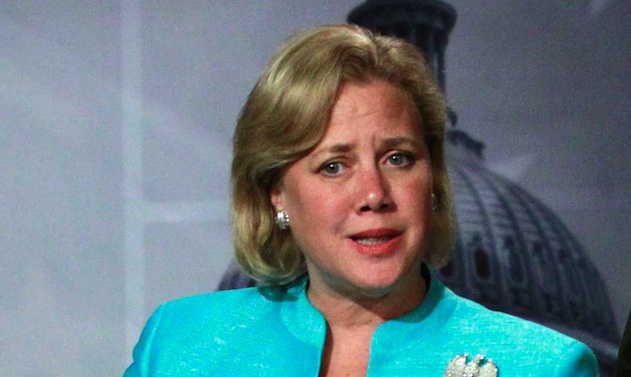
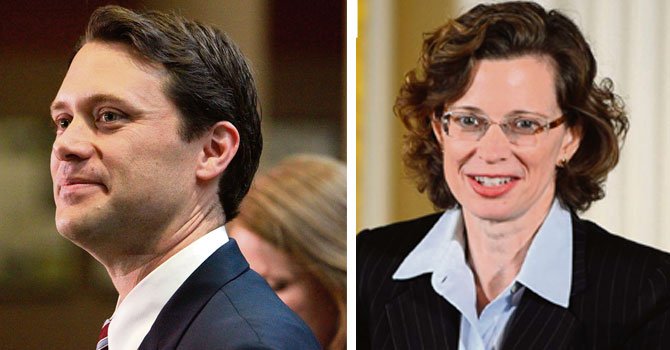
Gubernatorial candidate Jason Carter (left) and U.S. Senate candidate Michelle Nunn (right).

It’s no secret Democrats are hoping strong recruits in the Georgia Senate race and gubernatorial contest will help to offset Republican gains nationwide. Listening to some pollsters, pundits and party talking heads, it appears they have a more than decent shot at calling their efforts a success.

But in a cycle we now know has gone from just “leaning” toward a favorable political environment to a “likely” favorable one for Republicans, can Democrat candidates really pull off an upset in one or both of these two closely-watched contests?

We will first take a look at Peach State data overall, then take a closer look at the individual races and their ratings. As usual, we will touch on the many different variables used in our projection model, then discuss the probability of each projection. Because we have projected David Perdue the likely Republican nominee in the Georgia Senate race, for the purposes of this analysis we will focus on a head-to-head matchup between Perdue and Michelle Nunn. Democrats had hoped Republicans would nominate a less electable candidate, such as Broun or Gingrey, but that is highly unlikely now.

Let’s start with some historical voting patterns and demographic changes in the state of Georgia. Please note that polling data is averaged from the surveys included in the overall head-to-head match-ups.

Carter vocalized his hope that Georgia’s changing demographics can help him end the Republican Party’s 12-year domination of the state’s highest office. The proportion of white voters shrunk 9 points to 66 percent from 2002 to 2010, and the decrease was even more pronounced during presidential election cycles. Roughly 44 percent of Georgia residents are now minorities — which is up by 7 points over the past decade — and nonwhites could outnumber whites in Georgia by 2020. Yet, presidential election results have not historically mirrored these demographic changes.

Though Bush destroyed Kerry by roughly 17 points in 2004, Mitt Romney soundly defeated President Obama 53.30 to 45.48 percent, a slightly larger margin than the 52.10 to 46.90 percent margin McCain carried the state by in 2008. The not-yet purple state remains greater than 10 points more Republican than the national average.

It would appear Carter was premature in his reliance upon black voters to carry him to the Governor’s Mansion. Part of his problem is that he missed the fact that black voters in Georgia are more conservative than they are nationwide. In 2004, Bush won around 12 percent of the black vote, up from 7 percent in 2000, and Gov. Nathan Deal has outperformed Republican candidates, as well. If we are to believe the polling data, he still is. In the small sample of polling we have to examine, Gov. Deal has consistently enjoyed the support of a not-so insignificant number of black voters in Georgia, 15 percent. A smaller 12 percent support David Perdue.

It’s true that Republican candidates poll better in earlier surveys among black voters nationwide, but not in Georgia.

If either candidate hopes to upset their opponent, then they will have to win over a greater share of an increasingly Republican-voting, white electorate. Unfortunately for both Carter and Nunn, as we’ve seen in other southern states like Louisiana, Democratic support among white voters is on the decline. Support for Democratic candidates among white voters has fallen into the 20s, which theoretically means they have almost NO chance at putting together a majority on Election Day, despite the growth of the minority electorate.

Further compounding Democrats’ problems, among all subgroups to include white voters, Republican voters are far more likely to say they will “definitely be voting” come November. The gap among voters who say they are definitely voting is currently 11 points in favor of Republican candidates (67 – 56 percent), with independent voters almost as likely to say they will definitely vote in the upcoming general elections (64 percent). Independents favor deal by 10 points (47 – 37) and David Perdue by 8 points (46 – 38 percent). While the headline for the last Atlanta Journal-Constitution poll claimed Nunn was leading her Republican opponents, she is actually trailing among voters who can actually be projected to vote by 3 points. The same is true for Carter against Gov. Deal, which raises serious questions about the survey’s methodology considering the discrepancies in the various subgroups’ results.

When looking at the polling it is important to remember that — even though the headline results suggest close contests — Republican candidates have not even begun to unload on their Democratic opponents. Gov. Deal, who has a considerable war chest, has all but ignored Carter and his feel-good campaign, even as liberal-leaning Georgia-based media outlets hammer him over recent ethics investigations.

Republican Senate candidates are still beating up each other, with the well-financed David Perdue leading in the money race.

Nevertheless, when we factor in all the variables used on our model, which can be reviewed more on our 2014 Senate Map Predictions and our 2014 Governor Map Predictions, the results are not good news for either Carter or Nunn.

Because of Gov. Deal’s bad press problem, we have recently adjusted the ratings from “Safe Republican” to “Likely Republican” with a 74 percent chance that Deal will be reelected. The new rating now nearly mirrors the Georgia Senate race. With Broun and Gingrey out of the equation, Democrats’ hopes have faded, despite Michelle Nunn as their nominee. Perdue has a 71 percent chance of defeating Nunn in November.

Worth noting, many are assuming the two Democratic candidates — Michelle Nunn, daughter of ex-Senator Sam Nunn, and state Sen. Jason Carter, Jimmy Carter’s grandson — are, in fact, strong candidates. But do we even have strong evidence to support this assumption? We should be careful when pundits offer analysis that is predicated on such a superficial argument. Even though candidate recruitment is a very important variable in our election projection model, we must always avoid tipping the scales based on one variable alone, particularly when it contradicts the fundamentals of a state and an election cycle.

It's no secret Democrats are hoping strong
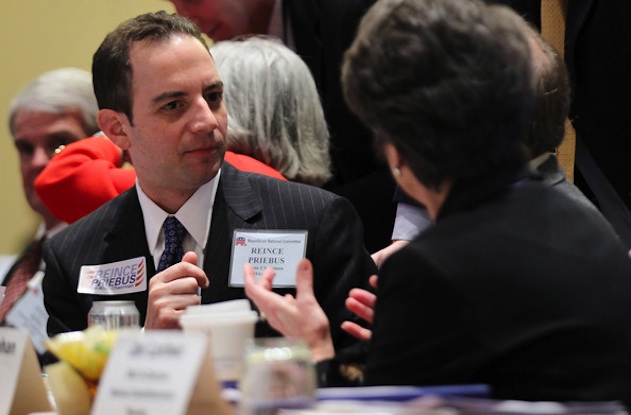
rnc chair reince priebus

RNC Chair Reince Priebus.

The Republican National Committee overwhelming voted Friday to limit presidential debates in the future, restricting the number of events that 2016 candidates can participate in. The vote was 152-to-7 in favor of granting the RNC sole discretion to decide which debates will be deemed “sanctioned debates.”

According to the language in the Republican National Committee rule, the decision will be made based upon the “timing, frequency and format, the media outlet and the best interests of the Republican Party.” If a future candidate decides to participate in a non-sanctioned debate, then they will not be eligible to participate in sanctioned debates, which will no doubt be much larger events.

“The liberal media doesn’t deserve to be in the driver’s seat,” RNC Chairman Reince Priebus told The New York Times.

The media bias during the 2012 president election, both in the general and the primary, was unprecedented. Candy Crowley, a CNN host and former moderator during the Town Hall-style presidential debate between Mitt Romney and President Obama, actually interjected in favor of the president on the question of whether the White House misled the American people on the Benghazi terrorist attack. Not only was the instance highly unprofessional and inappropriate, but we also know now that it was inaccurate. Crowley allowed her bias to creep into the moderation, which allowed Obama to creep out of the truth.

But that isn’t the only reason the RNC wanted to strengthen their grip on presidential debates. Establishment Republicans complained of Tea Party and conservative insurgents getting free press and a platform to drag out the primary, which left little time for Mitt Romney to rebut President Obama’s “Vampire Capitalist” narrative. By law, a primary candidate cannot respond to negative ads until he has sealed the general election nomination, which allowed Obama to attack Romney unfettered just as President George W. Bush had done to John Kerry in 2004.

Libertarian-leaning Kentucky Senator Rand Paul, a top 2016 contender, told The Times he agrees.

“I think maybe the last time we had too many. And so I think some of the rule changes, as long as they’re toward things that will enhance the party as a whole, are not a bad idea.”

The Republican National Committee overwhelming voted Friday

putin in crimea

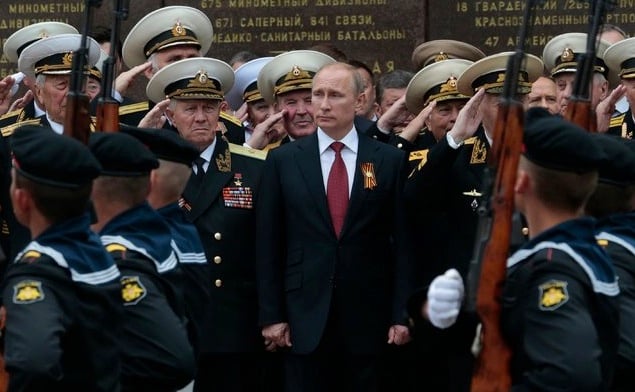
President Vladimir V. Putin of Russia attended a parade on Friday in Crimea, a territory which came under his control in March. (Photo: Ivan Sekretarev/Associated Press)

Earlier this week Russian President Vladimir Putin claimed he ordered the withdrawal of Russian troops from the eastern region of Ukraine, but U.S. intel refuted it from the beginning. Now, in a provocative visit to the recently annexed Black Sea region in Crimea, Putin appealed to hyper-nationalist sentiment, hailing recent developments as a great victory for the “Motherland.”

For those who resisted claims that Putin’s dream was reminiscent of a return to the former Soviet Union, he opened his speech to an eager crowd in front of 10 warships with “Hello, comrades!” Today wasn’t just any day, it was Victory Day, a nationwide rally meant to incite nationalistic fervor that doubles as a state of the Russian Federation speech.

“I think 2014 will also be an important year in the annals of Sevastopol and our whole country, as the year when people living here firmly decided to be together with Russia, and thus confirmed their faith in the historic truth and the memory of our forefathers,” Mr. Putin said in remarks broadcast nationwide.

“There is a lot of work ahead, but we will overcome all the difficulties because we are together, and that means we have become even stronger,” he added, with the finally consisting of a flyover that included 69 aircraft, representing the 69 years since the victory over Nazi Germany.

Meanwhile, the secretary general of NATO, Anders Fogh Rasmussen, aimlessly called the event “inappropriate.” Speaking in Tallinn, the capital of Estonia, Mr. Rasmussen also said that NATO still had “no visible evidence” that Russia was making good on Putin’s claim that he was withdrawing 40,000 Russia troops from the eastern border of Ukraine.

“This is the holiday when the invincible power of patriotism triumphs,” Mr. Putin said. “When all of us particularly feel what it means to be faithful to the Motherland and how important it is to defend its interests.”

The Ukrainian Ministry of Foreign Affairs immediately released a statement condemning the visit from President Putin. “This provocation once again confirms that Russia deliberately chooses to escalate tensions in Russian-Ukrainian relations,” said the statement. “We urge the Russian side to return to civilized methods of interstate relations.”

Putin has little reason not to take advantage of what is widely seen as a weak U.S. President and neutered European Union. Economic sanctions imposed on Russia from the U.S. and the European Union are doing no damage, whatsoever. According to the most recent government data, the world’s largest energy producer, Russia, shipped 2 percent more gas exports to Europe in the first three months of 2014 than it did during the same period last year.

Russian President Vladimir Putin praised the Russian

alaska senator mark begich

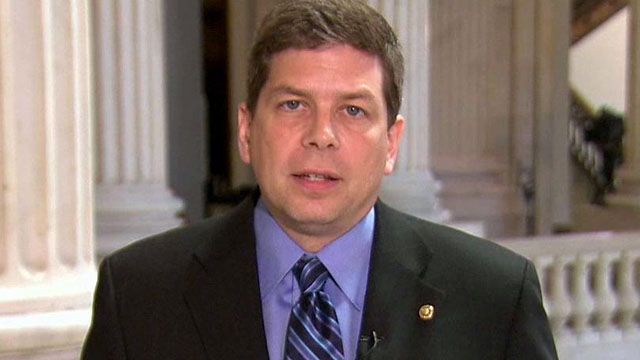
Vulnerable incumbent Democrat Senator Mark Begich of Alaska.

Alaska Libertarian Party Chair Michael Chambers and Republican Senate candidate Joe Miller pounced on vulnerable incumbent Democrat Senator Mark Begich after he made a series of remarks with the ridiculous aim of aligning himself with libertarianism.

Despite Begich’s big government record, to include ignoring his constituents when they screamed “NO” on the question of whether they wanted him to vote for ObamaCare, he pretended to appreciate and agree with the vast majority of Alaskans who identify with many of the core values of libertarianism.

“One thing that hasn’t changed is we’re very libertarian when it comes to some of these issues, and we don’t believe that government should be interfering in our personal and private lives,” Begich said.

Where was that sentiment when he voted to turn over the medical records of every Alaskan? Many on the left have heralded Begich as a brave progressive for standing firm on ObamaCare and Obama’s big government agenda, as we saw from the puff piece run by the Daily Kos. But as for proponents of liberty who actually have a record that suggests the same, there was only instant outrage.

Alaska Libertarian Party Chair Michael Chambers literally put out a liberty-for-dummies list to educate the left-wing senator who voted against the interest of every major libertarian issue.

“Senator Begich, allow me to define the vast majority of libertarians for your educational benefit, as you seem to be confused:

1. I know of no Alaskan libertarian who would remotely support the government takeover of our healthcare industry.

2. I know of no Alaskan libertarian who would vote to confirm:
• Eric Holder – anti-gun
• Elena Kagan – anti-gun
• Sonia Sotomayor – anti-gun

3. I know of no Alaskan libertarian who supports:
• Common Core
• Federal Department of Education
• suppression of parental rights in education

4. I know of no Alaskan libertarian who would vote to support and advocate:
• The IRS in any malignant manifestation
• NDAA and the suspension of habeas corpus
• NSA invasion of our personal effects
• The Patriot Act

5. No Alaskan libertarian I know would advocate globalist policies like:
• The United Nations Law of the Sea Treaty
• TPP – Trans Pacific Partnerships
• UN Treaties having any jurisdiction or precedence over the US Constitution.

Certainly, there are a few libertarians who may support the socialist policies you advocate, but to infer that you are ‘libertarian’ in any of your political representations is to vacate any measure of truth.”

Wow. And as if that wasn’t bad enough, 2010 Republican nominee Joe Miller, who has proven a particularly effective conservative at bridging the gap between conservatism and libertarianism, blasted Begich and left no room for doubt over which political group he is seeking more support from.

“I appreciate the fact that the Alaska Libertarian Party is speaking out on the important issues facing our state and nation,” Miller said in a statement. “What we don’t need more of is Mark Begich’s progressive ideology masquerading under the banner of liberty. True libertarianism is grounded in Constitutional liberty, and I am proud to share those values with the Alaska Libertarian Party.”

Miller has pushed the message that he is the real limited government candidate in what is shaping up to be a tough Republican primary. While former Natural Resources Commissioner Dan Sullivan enjoys the money advantage and the backing of the Club for Growth, Begich isn’t counting on having an easy Election Day regardless of who the Republican nominee turns out to be.

“People everywhere in this town write him off — I don’t,” Begich said of Miller in an interview with Scott Conroy for RCP. “Everyone’s a player right now in that race. The pundits will always say the guy with the cash is the winner. Alaska politics is always about knowing and meeting and greeting the voters.”

Senior Political Analyst for People’s Pundit Daily, Richard D. Baris, wholly agrees. In an article entitled, Why Joe Miller Could Pull Off An Upset Against The GOP Establishment, Again, Baris argues that anything can happen in the Republican primary. Laying out a series of data points, Baris writes, “while the media may not be giving Joe Miller a decent chance by citing fictions and notoriously inaccurate pollsters, the actual numbers suggest he does have a decent shot at an upset.”

With the backing of Libertarian Party voters and libertarian-leaning Alaskans Miller would certainly be tapping a large amount of support that is currently flying under the pundits’ radar. And he knows it.

“These are momentous times, and it is imperative that we transcend partisan frames of reference,” Miller added. “The only way we can push back federal tyranny is for all Alaskans of good will to unite under the banner of Constitutional Liberty.”

Regardless of who wins the Republican primary, Begich understands he is in the political fight of his life. According to Baris’ general election analysis and Gallup’s tracking of party-ID by state, Alaska has moved farther to the right since Begich barely won his seat in 2008 by just under 4000 votes. His opponent, former Senator Ted Stevens, was wrongfully convicted of a felony just prior to Election Day, which was later overturned after it was discovered it was a Democrat-led political witch hunt.

The 2014 Alaska Senate race is currently rated “Leans Republican” on our 2014 Senate Map Predictions.

Alaska Libertarian Party Chair Michael Chambers and

connecticut governor race

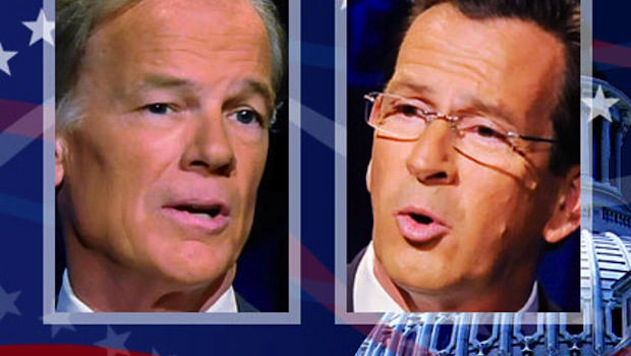
Former U.S. Ambassador to Ireland, businessman and Republican Tom Foley (left) and former Stamford Mayor and incumbent Democratic Governor Dannel Malloy (right).

The Connecticut Governor race is the eleventh article in what is a succession offering expanded analysis of our ratings on the 2014 Governor Map Predictions. Former Stamford Mayor and incumbent Governor Dannel P. Malloy will face the former U.S. Ambassador to Ireland and his 2010 Republican opponent, Tom Foley. Considering new developments in the race and the release of the latest Connecticut Governor poll, now is as good of a time as ever to revisit this gubernatorial contest.

Gov. Dan Malloy’s approval rating actually took a turn for the better last year after, under his direction, the state rammed through stricter gun laws following the Sandy Hook tragedy. Now, it looks as if the liberal honeymoon is over. The first Quinnipiac Univsersity poll found Malloy trailing Tom Foley, 43 percent to 40 percent. Malloy was on top of Republican Mark Boughton 43 percent – 36 percent, but the survey found that only 44 percent of voters thought Gov. Malloy deserved to be reelected.

We only have polling data from one pollster, Quinnipiac University, which often gives me reason for pause. However, Quinnipiac has a considerably accurate track record, particularly in their home state of Connecticut. The model used at People’s Pundit Daily researches pollsters’ track records, then weighs them based on the ratings they are on assigned, with 1 being the most accurate and 5 being the least accurate (we formerly rated pollsters on a scale from 1 to 4). Quinnipiac has an overall rating of 2.25 and, even though they were slightly outside of our 3-point threshold in 2010, we can still ascertain voter sentiment and trends by comparing variables in 2010 to 2014.

We will come back to polling data more in a bit, but let’s first discuss a little bit about the state’s political background.

We tend to think of Connecticut as a Democratic stronghold — mainly, because of Republican candidates’ pathetic performance on the presidential level — but Republican governors resided in the Governor’s Mansion for 16 years in a row prior to Malloy winning against the odds in 2010. Voters in the Nutmeg State, historically, have been more than willing to turn to the Republican Party on a gubernatorial basis.

The Republican primary had a ton of influence on this election prediction, and Foley didn’t have the road paved for him early on. Mayor Mark Boughton and State Senate Minority Leader John McKinney are also vying for the nomination alongside Foley and others. But, with a week to go before the Republican convention, we now confidently project Tom Foley will be the Republican nominee for governor. The first two Quinnipiac polls did find Foley with a slight edge over his GOP challengers, which was most likely due to name recognition, but I always felt his politics fit the state better and was basically waiting for the polling to confirm my suspicions.

Foley now enjoys a dominating lead over the Republican field in terms of both money and voter support, with 39 percent of Connecticut Republicans choosing him as opposed to Boughton, who earns just 9 percent and McKinney at 8 percent. No other Republican in the crowded field even tops 5 percent, with 28 percent remaining undecided. With Foley as the Republican nominee, the Republicans’ chances of flipping control of the Governor’s Mansion have increased significantly.

Getting back to general election polling, “It’s deja-vu all over again,” said Douglas Schwartz, director of the Quinnipiac University poll. Admittedly, Schwartz was referring to the two candidates being “locked in a dead heat.” But, is it really?

Not quite.

Unlike 2010, there has been a clear and consistent pattern of voter’s remorse. In the very first survey conducted in June, 2013, only 44 percent of voters thought Gov. Malloy deserved to be reelected. Now, in the latest survey, by a 48 – 44 percent margin voters say he does not deserve to be reelected, an uptick of 4 points against the incumbent. The particular issues that are hurting Malloy are unique to the state in some ways, but are typical fundamentals that sway gubernatorial elections. Unlike national races, “All politics really is local,” and the issues that impact the lives of state residents and voters are working against Malloy.

“Economic issues are dragging Gov. Malloy down,” Schwartz correctly noted. “A bright spot for Malloy is that voters think he has strong leadership qualities and is honest and trustworthy.”

While voters personally like Malloy, they approve only of his handling of education by a 45 – 39 percent margin. However, on every other major issue he is underwater. Voters say by a 35 – 53 percent that they disapprove of his handling the budget, and by a 32 – 61 percent margin of his handling of taxes. A large majority — a 60 – 29 percent margin — now say his failed promise to offer $55 tax refunds was a “campaign gimmick.” And, by a 38 – 55 percent margin voters disapprove of his handling of the economy and jobs, with only 21 percent of voters say they are personally better off than they were four years ago.

Taken together, the levels of disapproval on these ever-important issues are one career-ending, three-fold combination. When we factor in all of our variables, including Partisan Voting Index, which will be an identical D+7 that we saw in 2010, we project Republican Tom Foley has a 54 percent chance of victory. However, 45 – 55 percent qualifies as a “Toss-Up” on our model.

Considering Malloy trailed Foley in most polls conducted during the final month of the race in 2010, that is likely the safer assessment even though my gut is telling me Foley has the upper hand. Unlike 2010, when Malloy enjoyed a lead until the final month of the campaign, Foley has consistently polled ahead or even with the incumbent. Nevertheless, Gov. Malloy is in some serious trouble. I’m just not ready to count him out yet.

If you would like to read more about the election prediction/election projection model used at People’s Pundit Daily, view our 2014 Governor Map Predictions.

Poll Date Sample Malloy (D) Foley (R) Spread
PPD Average 6/12 – 5/6 —- 41.75 42.75 Foley +1
Quinnipiac 5/1 – 5/6 1668 RV 43 43 Tie
Quinnipiac 2/26 – 3/2 1878 RV 42 42 Tie
Quinnipiac 6/12 – 6/17 1154 RV 40 43 Foley +3

The Connecticut Governor race is the eleventh

Louisiana senate poll

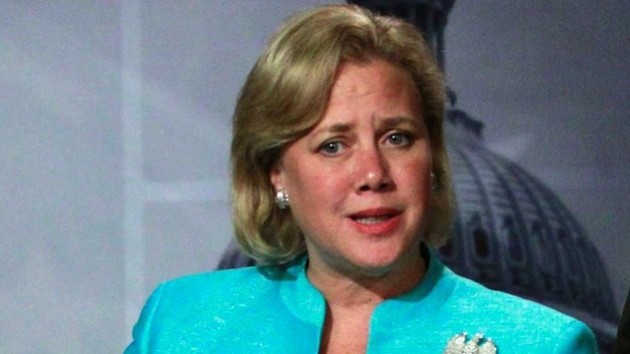
Vulnerable incumbent Democrat Senator Mary Landrieu is in serious danger of losing reelection, according to the latest Louisiana Senate poll.

The latest Louisiana Senate poll conducted by Southern Media and Research shows incumbent Democrat Senator Mary Landrieu’s chances of winning reelection are getting slim. Landrieu was always facing an uphill battle in a state Mitt Romney carried by over 7 points, but her support among key constituencies has fallen way beyond levels needed to run ahead of President Obama, who is deeply unpopular in the state.

Technically, Landrieu still holds a slight .6-percent lead in the upcoming “jungle primary,” with Rep. Bill Cassidy trailing her by just 36 – 35.4 percent. However, the incumbents favorables have now hit an all-time low of 39 percent, while her negatives have skyrocketing to 58 percent. Even though she has lost ground in every demographic since the last SMOR poll conducted back in November, a poll which I previously highlighted as a clear danger sign, her precipitous decline among white Democrats and female voters is particularly noteworthy.

Landrieu’s support among Democrats dropped 18 points, 17 percent among males and an even greater 19 percent among females. Clearly, in past polling and past elections, she had greater support among females, but the gender gap is now almost non-existent. Landrieu is bleeding white women like crazy, even white Democrat women. Since last fall, her favorables shed another 9 points among white male Democrats and 6 points among white female Democrats.

In past cycles, Landrieu has survived in a conservative state in some part due to her ability to appeal across the isle, but that’s all over now. Her positive ratings among Republicans fell by 17 points, from 30 percent down to 13 percent. Meanwhile, her favorables from Republican females fell from 38 percent to 17 percent. The vulnerable Democrat incumbent needs some female Republican support to win, and she’s not getting it in this poll. Overall, Landrieu only garners 4 percent of the Republican vote.

Collectively, the Republican candidates garner 46 percent of the vote, very close to the number (50 percent) needed to avoid a runoff if they consolidate their support for one candidate. Sarah Palin recently endorsed Rob Maness from Madisonville, a retired Air Force officer. But Cassidy is — by far — the most popular among Republicans statewide. At this point, Landrieu can hope a fractured party works to her benefit, but Cassidy still has enough wiggle room to reach 40 percent when undecideds and uncommitted voters make up their minds.

Only among black voters does she seem to be holding her ground, with 79 percent backing her and another 10 percent being undecided. Those voters, at least the overwhelming majority of them, will likely come home. But large support among black voters will not be enough considering her lack of support among white voters, which is now down to a devastating 20 percent, overall. Only 43 percent of white female Democrats say they will back her in the fall, while 36 percent say they will vote for one of the Republican candidates.

Despite the typical Democratic talking points, the drop in support among white voters — both male and female — is due to Landrieu’s unwavering support for ObamaCare, which her constituencies didn’t want when she voted for it and still do not want. ObamaCare is very unpopular in Louisiana, with only 31 percent of voters saying they were “for” the Affordable Care Act (ACA), while 63 percent said they were “against” it. ObamaCare typically polls a bit better when referred to as the Affordable Care Act, rather than ObamaCare, so it’s likely voter opposition is even higher. Eighty-one percent of white voters said they are against ObamaCare, while just 78 percent of black voters were for it.

Landrieu has little room to improve in the poll, because among those voters who responded they were undecided in the Louisiana Senate poll, a whopping 79 percent said they were against ObamaCare, and only 11 percent said they were for it.

As previously stated, Mitt Romney easily carried the state, and Landrieu would have to run far ahead of President Obama to win. But, in the September 2012 SMOR poll, she enjoyed a 24-point gap between her own negative ratings and Obama’s negatives. Now, Senator Landrieu’s negative ratings are at 58 percent, which are only 6 points behind those of President Obama, who also saw his negative ratings increase, now up to 64 percent.

If these numbers hold up, it is unlikely Senator Landrieu will have a chance to keep her seat. Of course, this is only one poll, and I typically am a stern believer in averaging polls. However, this cycle, trends are more reliable than averages in some states, with outliers like the NY Times/Kaiser poll throwing the average way off the mark. Landrieu was ahead by a ridiculous 24-point margin in their poll, but their sample consisted of an electorate that would have handed the state’s electoral voters to Obama. Bill Krystal of the Weekly Standard did a great job destroying their credibility if you’d like to read it.

Poll Date Sample Landrieu (D) Cassidy (R) Maness (R) Hollis (R) Spread
PPD Average 3/24 – 4/30 39.0 26.3 4.7 4.0 Landrieu +12.7
SMOR 4/28 – 4/30 600 LV 36 35 7 4 Landrieu +1
NY Times/Kaiser*(Flawed) 4/8 – 4/15 946 RV 42 18 4 5 Landrieu +24
Magellan Strategies (R)*(Partisan) 3/24 – 3/26 600 LV 39 26 3 3 Landrieu +13
PPP (D)(Partisan) 2/6 – 2/9 635 RV 43 25 3 5 Landrieu +18
SMOR 11/6 – 11/12 600 LV 41 34 10 Landrieu +7
PPP (D)(Partisan) 8/16 – 8/19 721 RV 48 24 5 Landrieu +24
Candidate needs to receive 50% of the vote to avoid a runoff.

Nevertheless, the trend in the state, as I previously examined and will likely do again very soon, shows an overall move to the Republican Party, despite Democrats’ hopes black voters would make the state more competitive.

In the past, Senator Mary Landrieu has managed to run ahead of national Democrats in the state and, in part, has survived due to the environment in the free-for-all “jungle primary.” But never have her numbers been so grim.

The latest Louisiana Senate poll conducted by

Benghazi

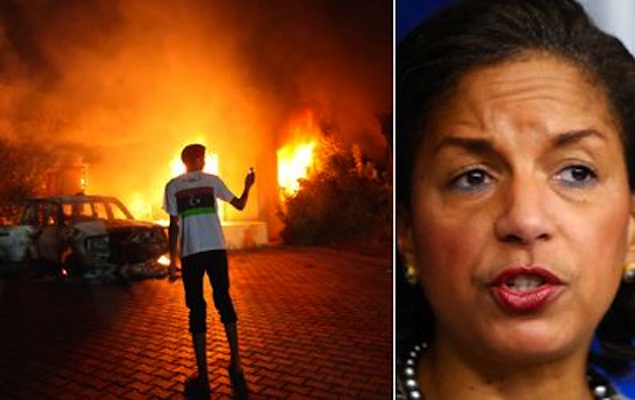
Newly released Benghazi emails tied White House through Ben Rhodes to Susan Rice talking points used on no less than five Sunday talk shows, which turned out to be lies. House voted to establish select committee on Benghazi on Thursday, May 8, 2014.(Photo: AP)

The Republican-controlled House voted Thursday to establish a select committee on Benghazi, marking the official launch of a serious investigation into the Benghazi scandal.

The committee Chair Rep. Trey Gowdy wrote in an op-ed Thursday in USA Today that “Benghazi matters because Americans deserve to know the truth from those entrusted to lead and govern.” The investigation is aimed at answering the many questions about what happened before, during and after the terror attack that killed four Americans.

The House voted 232-186 to approve the panel, with 7 Democrats joining the 225 Republicans voting in favor, while 186 Democrats voted against the committee.

Republicans are united in their support of the select committee, many of which have been pressuring House Speaker John Boehner for a year and a half until he finally called for it last week. Democrats, on the other hand, have been fractured on the investigation, with some even threatening to boycott the entire investigation.

Yesterday, former speaker Nancy Pelosi (D-CA) called on House Republicans to ensure an even split on the committee between parties. “If this review is to be fair, it must be truly bipartisan,” Pelosi said in a statement released by her office. “The panel should be equally divided between Democrats and Republicans as is done on the House Ethics Committee.

But Chairman Gowdy wasn’t biting on her request. “No, Ma’am, elections have consequences,” Gowdy said when asked if he would accommodate Pelosi’s request, flipping the script on both President Obama and Pelosi who used the same line during the health care debate.

It was only the day before that Pelosi seemed visibly annoyed by reporters who questioned her on the newly released Benghazi emails. “Diversion, subterfuge, Benghazi, Benghazi, Benghazi. …Why aren’t we talking about something else?” Pelosi said. Now, she is changing her tune. However, House Speaker John Boehner (R-OH) is sticking to his guns, as many suspected after the tapping South Carolinian Trey Gowdy, a former prosecutor to head-up the committee investigation.

“I had a conversation with [House Democratic Leader Nancy Pelosi] yesterday and made clear that this is a serious investigation, that we want to work together to get to the truth,” he said. “I think the seven-five split is eminently fair, frankly fairer than her Global Warming Committee that she set up.”

Then-Speaker Nancy Pelosi established a select committee on global warming, which had 9 Democrats and 6 Republicans. No one on the left complained at the time.

The legislation crafted by Boehner and now-passed in the House mandates that the select committee be re-established when a new Congress begins in January, but includes no specific financial limits.

Boehner was content with the already-established committees investigating Benghazi until newly released emails showed a senior White House advisor played a direct and pivotal role in prepping former U.N. ambassador Susan Rice for her despicable Sunday show appearances. The emails were only obtained after the conservative watchdog group, Judicial Watch, filed a lawsuit against the Department of State (Judicial Watch v. U.S. Department of State (No. 1:13-cv-00951)), and obtained more than 100 pages of documents. Many of the documents released by judges order contained information and emails that the White House either intentionally hid from Congress or excessively redacted in order to conceal the information we now know.

That was the final straw for Speaker Boehner.

In the email, Rhodes says the game plan was to stress the anti-Islam Internet video, but insinuates the strategy will be to obfuscate differences between the Benghazi attack and what were widespread protests across the Middle East directly related to foreign policy failures following negative developments on the botched Arab Spring.

The email specifically lists the following two goals, as well as several others:

“To underscore that these protests are rooted in an Internet video, and not a broader failure of policy.”

“To reinforce the President and Administration’s strength and steadiness in dealing with difficult challenges.”

What follows in the email is the line repeatedly returned to by administration officials when they knew that the attack had nothing to do with the video. “We find it disgusting and reprehensible. But there is absolutely no justification at all for responding to this movie with violence,” the email stated.

“The goal of the White House was to do one thing primarily, which was to make the president look good. Blame it on the video and not [the] president’s policies,” Judicial Watch President Tom Fitton said.

It remains unclear whether House Democrats and the Obama administration will cooperate with the select committee. Thus far, for the most part, the Democratic strategy seems to be along the lines of delegitimizing the investigation by depicting it as a political witch hunt. Congressman Jim Clyburn of South Carolinian, who serves as the assistant Democratic leader, said he was “dead set against” the committee unless Republicans agreed to an even split. Clyburn said he is ”not bringing the noose to any hanging.”

Refusing to participate or attempting to paint the investigation with a partisan brush may not be the best strategy for Democrats. According to the latest Fox News poll, 60 percent of registered voters think the White House is trying to cover-up what happened in Benghazi and want Congress to continue to investigate. Among a survey of likely voters, just over half — 51 percent — said the Benghazi scandal deserves further investigation, while just 32 percent disagreed.

What is certain is that the investigation by the select committee ensures that Benghazi will be an issue during the 2014 midterm elections, which will certainly serve to galvanize conservative voters. Gowdy, however, made headlines yesterday for criticizing fundraising efforts by Republican candidates “on the backs of four murdered Americans.”

FINAL VOTE RESULTS FOR ROLL CALL 209
(Republicans in roman; Democrats in italic; Independents underlined)

      H RES 567      YEA-AND-NAY      8-May-2014      6:29 PM
      QUESTION:  On Agreeing to the Resolution
      BILL TITLE: Providing for the Establishment of the Select Committee on the Events Surrounding the 2012 Terrorist Attack in Benghazi

YEAS NAYS PRES NV
REPUBLICAN 225 8
DEMOCRATIC 7 186 6
INDEPENDENT
TOTALS 232 186   14


—- YEAS    232 —
 

Aderholt
Amash
Amodei
Bachus
Barber
Barletta
Barr
Barrow (GA)
Barton
Benishek
Bentivolio
Bilirakis
Bishop (UT)
Black
Blackburn
Boehner
Boustany
Brady (TX)
Bridenstine
Brooks (AL)
Brooks (IN)
Broun (GA)
Buchanan
Bucshon
Burgess
Byrne
Calvert
Camp
Campbell
Cantor
Capito
Carter
Cassidy
Chabot
Chaffetz
Coffman
Cole
Collins (GA)
Collins (NY)
Conaway
Cook
Cotton
Cramer
Crenshaw
Culberson
Daines
Davis, Rodney
Denham
Dent
DeSantis
DesJarlais
Diaz-Balart
Duncan (SC)
Duncan (TN)
Ellmers
Farenthold
Fincher
Fitzpatrick
Fleischmann
Fleming
Flores
Forbes
Fortenberry
Foxx
Franks (AZ)
Frelinghuysen
Gardner
Garrett
Gerlach
Gibbs
Gibson
Gingrey (GA)
Gohmert
Goodlatte
Gosar
Gowdy
Granger
Graves (GA)
Graves (MO)
Griffin (AR)
Griffith (VA)
Grimm
Guthrie
Hall
Hanna
Harper
Harris
Hartzler
Hastings (WA)
Heck (NV)
Hensarling
Herrera Beutler
Holding
Hudson
Huelskamp
Huizenga (MI)
Hultgren
Hunter
Hurt
Issa
Jenkins
Johnson (OH)
Johnson, Sam
Jolly
Jones
Jordan
Joyce
Kelly (PA)
King (IA)
King (NY)
Kinzinger (IL)
Kline
Labrador
LaMalfa
Lamborn
Lance
Lankford
Latham
Latta
LoBiondo
Long
Lucas
Luetkemeyer
Lummis
Marchant
Marino
Massie
McCarthy (CA)
McCaul
McClintock
McHenry
McIntyre
McKeon
McKinley
McMorris Rodgers
Meadows
Meehan
Messer
Mica
Miller (FL)
Miller (MI)
Miller, Gary
Mullin
Mulvaney
Murphy (FL)
Murphy (PA)
Neugebauer
Noem
Nugent
Nunes
Olson
Palazzo
Paulsen
Pearce
Perry
Peterson
Petri
Pittenger
Pitts
Poe (TX)
Pompeo
Posey
Price (GA)
Rahall
Reichert
Renacci
Ribble
Rice (SC)
Rigell
Roby
Roe (TN)
Rogers (AL)
Rogers (KY)
Rogers (MI)
Rohrabacher
Rokita
Rooney
Ros-Lehtinen
Roskam
Ross
Rothfus
Royce
Runyan
Ryan (WI)
Salmon
Sanford
Scalise
Schock
Schweikert
Scott, Austin
Sensenbrenner
Sessions
Shimkus
Shuster
Simpson
Sinema
Smith (MO)
Smith (NE)
Smith (NJ)
Smith (TX)
Southerland
Stewart
Stivers
Stockman
Stutzman
Terry
Thompson (PA)
Thornberry
Tiberi
Tipton
Turner
Upton
Valadao
Wagner
Walberg
Walden
Walorski
Weber (TX)
Webster (FL)
Wenstrup
Westmoreland
Whitfield
Williams
Wilson (SC)
Wittman
Wolf
Womack
Woodall
Yoder
Yoho
Young (AK)
Young (IN)

—- NAYS    186 —
 

Bass
Beatty
Becerra
Bera (CA)
Bishop (NY)
Blumenauer
Bonamici
Brady (PA)
Braley (IA)
Brown (FL)
Brownley (CA)
Bustos
Butterfield
Capps
Capuano
Cárdenas
Carney
Carson (IN)
Cartwright
Castor (FL)
Castro (TX)
Chu
Cicilline
Clark (MA)
Clarke (NY)
Clay
Cleaver
Clyburn
Cohen
Connolly
Conyers
Cooper
Costa
Courtney
Crowley
Cuellar
Cummings
Davis (CA)
Davis, Danny
DeFazio
Delaney
DeLauro
DelBene
Deutch
Dingell
Doggett
Doyle
Duckworth
Edwards
Ellison
Engel
Enyart
Eshoo
Esty
Farr
Fattah
Foster
Frankel (FL)
Fudge
Gabbard
Gallego
Garamendi
Garcia
Grayson
Green, Al
Green, Gene
Grijalva
Gutiérrez
Hahn
Hanabusa
Hastings (FL)
Heck (WA)
Higgins
Himes
Hinojosa
Holt
Honda
Horsford
Hoyer
Huffman
Israel
Jackson Lee
Jeffries
Johnson (GA)
Johnson, E. B.
Kaptur
Keating
Kelly (IL)
Kennedy
Kildee
Kilmer
Kind
Kirkpatrick
Kuster
Langevin
Larsen (WA)
Larson (CT)
Lee (CA)
Levin
Lewis
Lipinski
Loebsack
Lofgren
Lowenthal
Lowey
Lujan Grisham (NM)
Luján, Ben Ray (NM)
Lynch
Maffei
Maloney, Carolyn
Maloney, Sean
Matheson
Matsui
McCarthy (NY)
McCollum
McDermott
McGovern
McNerney
Meeks
Meng
Michaud
Miller, George
Moore
Moran
Nadler
Napolitano
Neal
Negrete McLeod
Nolan
O’Rourke
Owens
Pallone
Pascrell
Pastor (AZ)
Payne
Perlmutter
Peters (CA)
Peters (MI)
Pingree (ME)
Pocan
Polis
Price (NC)
Quigley
Rangel
Richmond
Roybal-Allard
Ruiz
Ruppersberger
Ryan (OH)
Sánchez, Linda T.
Sanchez, Loretta
Sarbanes
Schakowsky
Schiff
Schneider
Schrader
Scott (VA)
Serrano
Sewell (AL)
Shea-Porter
Sherman
Sires
Slaughter
Smith (WA)
Speier
Swalwell (CA)
Takano
Thompson (CA)
Thompson (MS)
Tierney
Titus
Tonko
Tsongas
Van Hollen
Vargas
Veasey
Vela
Velázquez
Visclosky
Walz
Wasserman Schultz
Waters
Waxman
Welch
Wilson (FL)
Yarmuth

—- NOT VOTING    14 —
 

Bachmann
Bishop (GA)
Coble
Crawford
DeGette
Duffy
Kingston
McAllister
Nunnelee
Pelosi
Reed
Rush
Schwartz
Scott, David

The Republican-controlled House voted Thursday to establish

obama midterm woes

Polling data confirms Obama’s and the Democrats’ midterm woes.

In what is the latest in a vast amount of polling data showing Democrats headed for perilous defeat in November, Gallup found a near identical voter sentiment brewing in 2014 that was present in 2010.

According to Gallup, exactly 3 in 10 registered voters say when they vote for a candidate in the fall midterm elections, it will be to send a message that they oppose President Obama, identical to the number of voters who said the same before the Republicans handed Democrats a historic “shellacking” in November, 2010. Further, just 24 percent say they will be voting to support Obama, also nearly identical to data from 2010.

Midterm elections that occur in a president’s second term, historically, end badly for the president’ party, dubbed the “six-year itch.” Yet, even though the findings were similar to President Bush’s 2006 midterm election defeat, Obama is clearly more polarizing than either Bush or Clinton. A 54-percent majority of voters say they will vote to send a message of support (24 percent) or opposition (30 percent) to Obama, but less than a majority said the same in midterm polls before the two other former presidents’ parties faced the voters.

Put this all together, and Gallup is basically measuring intensity, which is clearly and overwhelmingly moving against Obama and the Democratic Party. As I have hammered over and over, there is a strong relationship between presidential approval rating and midterm election outcomes, particularly since the 1980s. In this area, too, it is all bad news. Obama’s late October approval rating according to Gallup was 45 percent, slightly higher than it is now in the PPD average of polls, yet his approval never hung in the low 40s – to high 30s for more than a few short days in 2010.

I recently and previously compared generic ballot results and presidential approval ratings from two other pollsters for 2010 and 2014 — CNN/Opinion Research and Pew Research — which both posted far better numbers for Obama in 2010.

In the USA Today/Pew poll, just 16 percent of voters said their vote for Congress will be a vote for Obama, but 26 percent said their vote will be against Obama. CNN asked the question slightly different, but found the same trend.

In September, 2010, 19 percent said their vote would be meant to send a message that they support Obama, while 26 percent said their vote was meant to send a message they oppose him. Now, the margin is a nearly identical 20 – 25 percent in opposition to the president’s policies.

Voter intensity, as we have consistently seen in prior polling, is dominated by the right this cycle. Now, Gallup has added even more confirmation to the conclusion I reached months ago: The trend, as of now, which I anticipate to continue along with the fundamentals, bodes bad for Democratic candidates and the party’s ability to hold the U.S. Senate. Soon I will be updating the generic ballot analysis and the 2014 Senate Map Predictions to further reflect the political reality.

In what is the latest in a

christian persecution

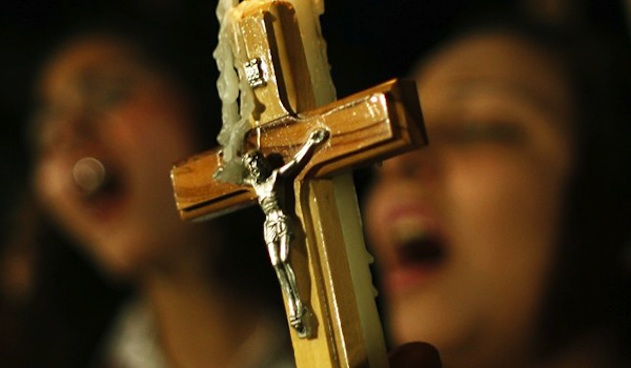
Coptic Christian in Egypt worship (above), but are becoming extinct at the hands of Muslim on Christian persecution.

According to a new report, Christian persecution in the Middle East and worldwide is on the rise, resembling more a genocidal extinction than persecution. An increasingly radicalized Middle East is more emboldened as a result of a weak-to-nil policy from the Obama administration, which is doing enough to stop Christian persecution by its allies.

The report, from the United States Commission on International Religious Freedom, named Iran, Saudi Arabia, Pakistan and North Korea as the top persecutors of those who practice Christianity. While a UN commission recommended back in February the U.N. General Assembly and the Human Rights Council should address crimes committed by North Korea, they cite general violations against the general public, not Christianity specifically.

Overall, nothing is being done by either the UN or the U.S. to address what is quickly becoming a mass extinction. In the Middle East, alone, the number of Christians plummeted to just 10 percent of the overall population, down from more than 25 percent as recent as in 2011.

“While the Obama administration should continue to shine a spotlight on abuses through public statements, it also should impose targeted sanctions to demonstrate that there are consequences, too,” Dwight Bashir, the commission’s deputy director of policy and research said. “By not utilizing an existing legislative tool, the United States risks sending the message that it prefers a nuclear deal to standing up for the rights of the Iranian people. The United States should not be confronting such a scenario in the first place.”

The report identified the 16 worst violators of religious freedom, which they have deemed “countries of particular concern.” Iran, despite liberal claims during the Iran nuclear negotiations, has gotten far worse since “purportedly moderate President Hassan Rouhani” came to power last year.

“As of February 2014, at least 40 Christians were either in prison, detained or awaiting trial because of their religious beliefs and activities,” the report found.

Hamid Babaei, spokesman for Iran’s mission to the UN, said he would review the commission’s report, but refused to answer our other questions or confirm the report’s statistics.

Saudi Arabia, a long-time U.S. ally in the Middle East, was slammed for its ban on all non-Islamic religious institutions, worships and general practices.

“Not a single church or other non-Muslim house of worship exists in the country,” the report found. Educational textbooks from 2013 – 2014, “justified violence against apostates and polytheists and labeled Jews and Christians ‘enemies.’”

The report rightfully focused on the grave situation for Christians in Egypt, which faulted former ousted President Mohammad Morsi and his Muslim Brotherhood. Though Morsi was ousted last year by the country’s military, the persecution continues.

“Despite some progress during a turbulent political transition, the Morsi-era government and the interim government failed or were slow to protect religious minorities, particularly Coptic Orthodox Christians, from violence,” the report stated, before implying that the Obama administration should use its leverage to protect the Christians who make up roughly 10 percent of Egypt’s population. “Egypt is one of America’s most important allies in the Middle East. Just last month, the Obama administration approved a shipment of attack Apache helicopters to the military-run government.”

PeoplesPunditDaily.com covered an April report by the non-profit advocacy group, International Christian Concern, which found young Christian women were at a greater risk of being kidnapped, tortured and forced to convert to Islam this year as opposed to the last.

Getting back to the secretive, leftist-communist dictatorship in North Korea, the report found their persecution of religious freedom is actually fundamental to their government system. Considering the historical track-record from the left, which has always persecuted people who believe in a higher power than the government, the report’s findings weren’t at all surprising.

“[The so-called hermit Kingdom] maintains a songbun system, which classifies families according to their loyalty to the Kim family; religious believers have the lowest songbun rating,” the report said. “Spreading Christianity is a political crime. Many religious believers are incarcerated in infamous penal labor camps.”

In 2013, North Korea sentenced Kenneth Bae, a U.S. citizen, to 15 years in prison for embarking on missions for his evangelical organization, Youth With A Mission. The Obama administration did nothing, and President Obama refused to comment on the event.

Pakistan, a supposed ally that harbored Osama Bin Laden, was named in the report, as well. The Pakistani government sits idly by as Christians are discriminated against by Hindus and other religious minorities. The report cited the Pakistan Taliban suicide bombers who attacked the All Saints Church back in 2013, which killed more than 100 people.

In the Sudan, a majority Muslim country, is among the worst due to its treatment of Christian converts.

“Conversion from Islam is a crime punishable by death, suspected converts to Christianity face societal pressure and government security personnel intimidate and sometimes torture those suspected of conversion,” the commission reported.

The additional sanctioned countries of particular concern were Burma, China, Eritrea, Iraq, Nigeria, Tajikistan, Turkmenistan, Uzbekistan and Vietnam.

“The defense of religious freedom is both a human rights imperative and a practical necessity and merits a seat at the table with economic, security and other key concerns of U.S. foreign policy,” Commission Chairman Robert George stated.

According to a new report, Christian persecution

college sexual assault

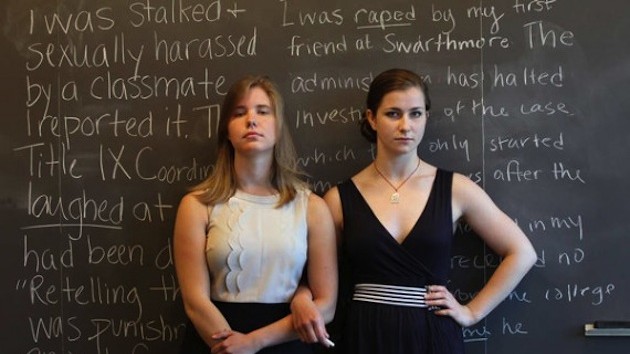
Hope Brinn (left) and Mia Ferguson (right) stand in front of a blackboard where they have written their complaints about sexual assaults at Swarthmore College (Credit: Michael Bryant/Philadelphia Inquirer)

The White House is kicking off an effort to combat sexual assault on colleges campuses, an admirable and noble goal without argument. Except, the repeat-offenders in the Obama administration behind the new website NotAlone.gov are driven by their usual motivation, which is political reward at the expense of facts, truth and wise policy-making decisions.

Sexual assaults on college campuses are a real problem, just not to the extent the White House claims. Last month, the White House sent out the following Tweet:

It was retweeted around 743 times, at last count, but unfortunately it was researched far less.

This figure comes from the 2005-2007 Campus Sexual Assault Study, which has been widely debunked by academics, government organizations and even Washington Post Fact Checker, Glenn Kessler. While Kessler highlighted that the so-called study was conducted at just two schools, which yielded a staggeringly low response rate for such a magnanimous claim, there are far more troubling irregularities. In fact, to an outside observer, there is a clear ill-intent to obfuscate the truth.

For starters, two-thirds of the college women cited in the study and counted as rape victims were drug or alcohol related instances, with the victims themselves saying they did not think they were raped. Further, only a handful out of these particular “victims” even reported suffering from some psychological harm.

“Drug- and/or alcohol-enabled sexual assault,” which represented roughly 70 percent of all the “rape” incidents in the study, consisted of instances of unconsciousness or incapacitation, but also flat-out cases of intoxication. Just to clarify, getting drunk and making a bad decision is not the same as passing out and being sexually assaulted by a predator, man or woman. Intoxication can cloud a woman’s or man’s judgment and blur the lines of consent, as well as result in someone giving it who might have otherwise declined to give it.

But putting aside garbage data from this study, and the numbers cited by the White House simply do not make sense.

The White House task force on campus sexual assault estimated that 12 percent of sexual assault cases go unreported, which if true, results in nowhere near 1 in 5 college women being assaulted throughout the course of attendance. In fact, using the administration’s numbers, University of Michigan economist Mark Perry did the number crunching and found it’s more like 1 in 20 or 1 in 30. But even that may be too high.

The Justice Department estimates that fewer than 5 percent of completed and attempted rapes of college women are reported to law enforcement officials. Worth noting — that is, if we want to actually pursue legitimate policy — that number is far below the rate for the country as a whole, where roughly 40 percent of all sexual assaults are reported.

Still, the phony White House numbers aren’t even as bad as other alarmist figures.

At least 1 in 4 college women will be the victim of a sexual assault during her academic career, claims one alarmist statistic found in a book written by Kathleen Hirsch in 1990, ”Fraternities of Fear: Gang Rape, Male Bonding, and the Silencing of Women.” This is a widely circulated — and, sadly false — statistic that is drummed over and over and proudly displayed on the website at Sarah Lawrence.

So, why would the White House — with an entire task force of researchers at their disposal — be pushing an otherwise noble agenda with disgracefully dishonest facts?

Politics, plain and simple.

College campuses are a rich, on-tap source of Democratic voters, who are by majority female. According to a recent poll conducted by Harvard’s Institute of Politics, turnout among young voters in the 2014 midterm elections will be very, very low. But it’s actually worse than it seems, because young conservative voters, who are by majority men, are far more likely to say they will “definitely be voting” in November.

“This is a no-brainer,” says senior political analyst, Richard D. Baris.

“We have seen this time and time again from the White House,” he added. “Whether it’s voter ID to scare black voters to the polls, income inequality to target single-working women or delaying the Keystone XL pipeline to satisfy the far left radical environmentalists, there’s always an aim to increase voter turnout in November among groups who are notorious for not participating in midterm elections.”

And sadly there’s always a legitimate problem that sacrifices it’s integrity. The problem of sexual assault on college campuses deserves a real response, not to be used as a political ploy or a tool to further degrade constitutional rights, which is exactly what is occurring now through the national, White House-backed initiative to combat the problem.

The Department of Education is recommending that college administrators resort to the lowest burden of proof, or the “preponderance of the evidence” standard. As Cathy Young of Time noted, this standard often “means a finding of guilt if one feels the evidence tips even slightly toward the complainant—in disciplinary proceedings on sexual assault.” Whereas students who have been accused of misconduct have traditionally enjoyed the higher standard of “clear and convincing evidence,” in line with our actual codified Constitution, the administration is now pushing a guilty until proven innocent standard.

“A far better solution would be to draw a clear line between forced sex (by violence, threats or incapacitation) and unwanted sex due to alcohol-impaired judgment, miscommunication or verbal pressure,” Young proposes. “For the former, victims should be encouraged to seek real justice: a rapist deserves prison, not expulsion from college. For the latter, the answer is to promote mutual responsible behavior, not female victimhood.”

But victimhood is exactly what the Obama administration has promoted for the past five years, reaching unprecedented levels in 2012 (except in the case of late Ambassador Chris Stevens) to ensure his reelection. The president’s party thrives and survives on victimhood, which they have aimed to take to a whole new level in 2014 to avoid loosing the Senate to the Republicans in November; even if that means abusing actual victims.

The White House is kicking off an

People's Pundit Daily
You have %%pigeonMeterAvailable%% free %%pigeonCopyPage%% remaining this month. Get unlimited access and support reader-funded, independent data journalism.

Start a 14-day free trial now. Pay later!

Start Trial