Widget Image
Follow PPD Social Media
Friday, January 16, 2026
HomeStandard Blog Whole Post (Page 964)

lois lerner contempt

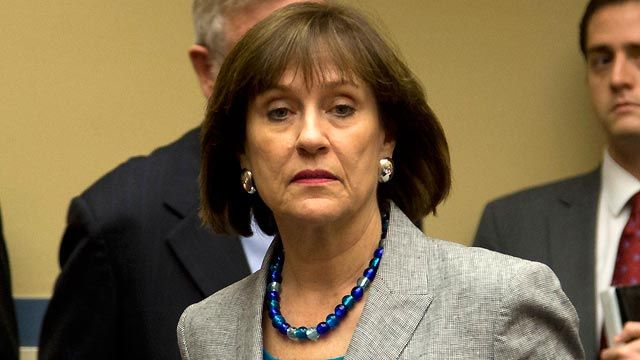
Former IRS official Lois Lerner, whom the House just voted to hold in contempt over her refusal to testify on the IRS scandal.

The Republican-controlled House of Representatives voted Wednesday to hold former IRS official Lois Lerner in contempt of Congress. Lerner refused to testify about the IRS scandal involving the targeting of conservative groups, only after she first offered a congressional committee a statement of innocence.

The House voted 231-187 for a resolution holding Lerner in contempt. All the Republicans voted yes, and they were joined by six Democrats, a significant development offering credibility to the House vote.

“Our system of government relies on the sacred trust the American people place in the transparency and accountability of its institutions, House Speaker John Boehner said in a statement following the vote. “Lois Lerner first violated that trust when she played a key role in the IRS’ targeting of certain groups based on their political beliefs, as our investigations have uncovered. She violated that trust again when she defied a congressional subpoena and refused to come clean about her participation in the scandal.”

Democratic Rep. Elijah Cummings (D-MD), the ranking member of the House Oversight Committee who was linked to the targeting of TruthTheVote.org last month, accused House Republicans of taking “a significant step backwards in their duty to uphold the U.S. Constitution by voting to strip an American citizen of her Fifth Amendment rights.”

But Republicans, as well the vast majority of the American people, aren’t buying the argument made by Cummings. “It’s time for Lois Lerner to account for her actions, and if she won’t then the full force of the law should be brought to bear,” the Speaker’s statement also read.

However, Lerner’s case will now be sent to the Justice Department, which is headed up by Attorney General Eric Holder, who was also held in contempt by the House. The Justice Department, in practice, must decide whether to prosecute Lerner in the case, but the language of the law states “shall prosecute” in instances of contempt of Congress.

In an effort to ensure Justice does their part, just minutes after the vote to hold Lerner in contempt, House lawmakers also passed a resolution requesting the Department of Justice appoint a special counsel to probe the IRS. It passed by an overwhelming 250-168 vote.

Last March, Lerner again refused to answer questions at a congressional hearing after Chairman Darrell Issa (R-CA) told reporters her lawyer had emailed his office indicating her willingness to testify. She received death threats and quickly did an about-face.

The House Oversight Committee voted to hold Lerner in contempt last month. All Republicans voted in favor and all Democrats voted against.

The contempt of Congress action now falls to Ronald Machen, the U.S. attorney for the District of Columbia. Federal law says Machen has a “duty” to prosecute the House’s case against Lerner before a grand jury. However, Machen was appointed to his job by President Barack Obama.

“We will carefully review the report from the Speaker of the House and take whatever action is appropriate,” Machen’s office said in a statement.

Lois Lerner headed-up the tax-exempt division at the IRS, but retired last fall. The IRS scandal ended her 34-year career in the federal government — with pay — which included time at the Justice Department and Federal Election Commission, which was directly tied to the scandal via leaked emails.

Considering the selection of Rep. Trey Gowdy for the select committee on Benghazi and the latest House vote to hold Lerner in contempt, it is safe to say Lerner may soon have company.

“The actions taken today also put the Obama administration on notice that the American people, and their representatives in the House, will not tolerate any more stonewalling,” Boeher’s statement read.

“Whether it’s the IRS scandal, Benghazi, Fast and Furious or any other area where the administration is hiding the facts, we will not stop until we get the full truth on behalf of the people we serve.”

The Republican-controlled House of Representatives voted Wednesday
trey gowdy

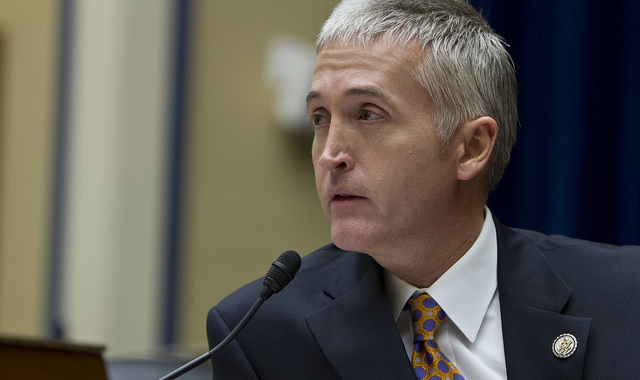
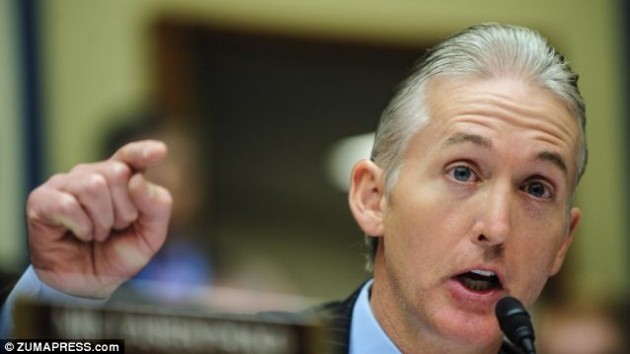
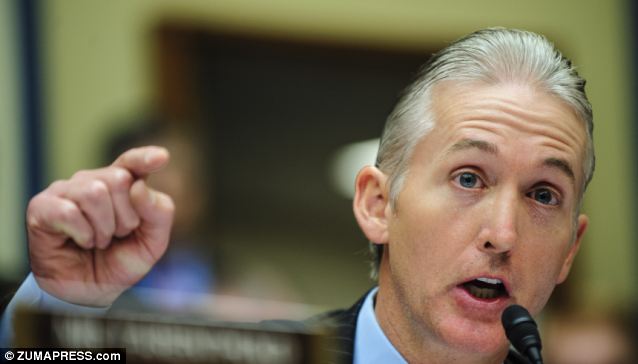
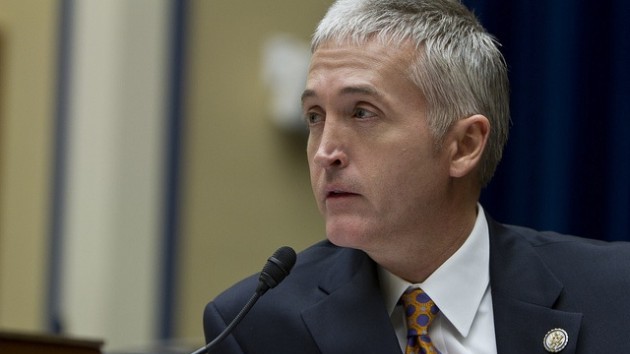
The Chairman of the Select Committee on Benghazi, South Carolina Rp. Trey Gowdy (R).

South Carolina Rep. Trey Gowdy gave the president and former House speaker Nancy Pelosi a dose of their own medicine Wednesday. “No, Ma’am, elections have consequences,” Gowdy said when asked if he would accommodate Pelosi’s request for an equal number of Democrats and Republicans on the new Select Committee on Benghazi.

In an interview with Megyn Kelly, host of “The Kelly File,” Gowdy addressed recent comments by Rep. Nancy Pelosi (D-CA), who just the other day was visibly annoyed at the journalists who questioned her on the newly released Benghazi emails. “Diversion, subterfuge, Benghazi, Benghazi, Benghazi. …Why aren’t we talking about something else?” Pelosi said. Now, however, she is changing her tune.

“If this review is to be fair, it must be truly bipartisan,” Pelosi said in a statement released earlier today by her office. “The panel should be equally divided between Democrats and Republicans as is done on the House Ethics Committee. It should require that witnesses are called and interviewed, subpoenas are issued, and information is shared on a bipartisan basis. Only then could it be fair.”

Pelosi, a veteran politician, knows a scandal when she sees it, and according to one congressional aide, changed her mind about the gravity of the Benghazi scandal and now believes Democrats should give the impression they are cooperating in an effort to get to the truth. But not all Democrats are falling in line with the minority leader this time around, despite her reputation for twisting arms and getting her members to walk lock-step. Quite the contrary, actually. Some members are being outright vocal about their willingness to circle the wagons around President Obama.

Still, some Democrats agree with Pelosi’s call for an equal number of party members on the committee, and the usual race-baiting emerged, insinuating that Republicans are driven by racism in their outrage over an administration that has been less-than truthful over Benghazi.

Congressman Jim Clyburn, an African American South Carolinian who serves as the assistant Democratic leader, said he is “dead set against” the committee unless Republicans agree to even split between. Clyburn, in a typical statement, said he is “”not bringing the noose to my hanging.” Then, it appears Clyburn will get to take his ball and go home, because Gowdy isn’t having it.

“In the words of the president,” he said before answering with a flat-out “no.” The Chairman said that the rules in select committees are that way for a reason. He also responded to the reported death threats, which we have confirmed are in fact being taken very seriously. When asked about the death threats, Gowdy was quick to bring up his time as a prosecutor and assured us that it wasn’t his first time receiving them, nor will it be the last.

And considering the lengths Democrats have proven themselves willing to go to cover for President Obama, who could blame him.

Worth noting, as Republicans have already, then-Speaker Nancy Pelosi established a select committee on global warming, which had nine Democrats and six Republicans.

"No, Ma'am, elections have consequences," select committee

putin and russian military

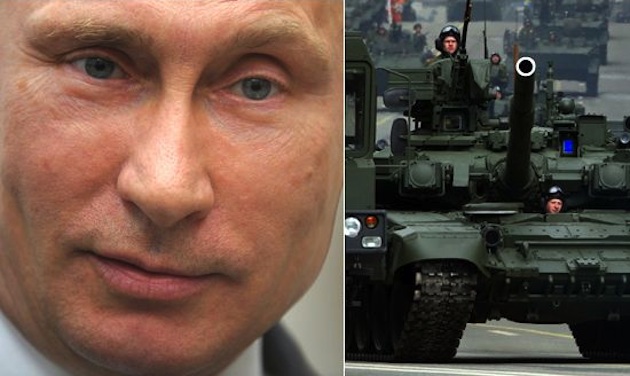
Russian President Vladimir Putin claimed Wednesday that the Russian military pulled back from the Ukrainian border, but Pentagon officials say US intelligence disagrees.

Russian President Vladimir Putin claimed Wednesday that the Russian military pulled back from the Ukrainian border, but Pentagon officials say US intelligence disagrees. “That’s bunk,” one official told People’s Pundit Daily, “we’ve not seen any movement from Russian forces.” Putin also urged pro-Russian agitators seeking Russian annexation of eastern Ukraine to delay Sunday’s referendum on secession, and claimed he is working behind-the-scenes to calm tensions, as well.

Putin made the comments during a Moscow meeting with Swiss president Didier Burkhalter. But upon further examination, his comments have discrepancies.

He said the Russian military pulled back to training grounds for “regular exercises,” but didn’t specify where those locations were in whether they were in or around areas near eastern Ukraine. Further, Pentagon spokesman Col. Steve Warren, told Fox News the US had “seen no change in Russian force posture along the Ukrainian border,” similar information PPD obtained.

That’s not stopping Putin from making the claims.

“We’re always being told that our forces on the Ukrainian border are a concern. We have withdrawn them. Today they are not on the Ukrainian border, they are in places where they conduct their regular tasks on training grounds,” Putin said at the meeting. He also pressed Ukraine to stop all military operations, which were launched May 4 in a counter-offensive after several government buildings were seized in at least a dozen cities and towns in Ukraine by pro-Russian separatists.

Sunday’s vote for more autonomy in another area of what was independent Ukraine would certainly spark further violence, just as the Russian annexation of Crimea in March. Residents in the Ukrainian Black Sea peninsula held a vote and overwhelmingly backed secession.

“We believe that the most important thing is to create direct, full-fledged dialogue between the Kiev authorities and representatives of southeast Ukraine,” Putin said. “Because of this, we ask that representatives of southeast Ukraine, supporters of federalization in the country. postpone the May 11 referendum in order to create the necessary conditions for such a dialogue.”

Russian President Vladimir Putin claimed Wednesday that

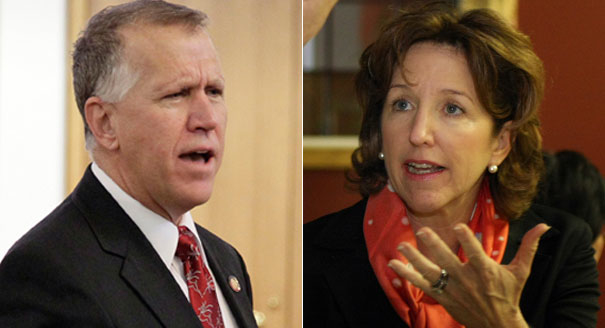
tillis vs hagan nc senatePrimary season really got started Tuesday when voters went to the polls to choose the Republican nominee in the closely-watched North Carolina Senate race, a state that’s rightfully a top target for the Republicans in their goal to retake control of the U.S. Senate. State House Speaker Thom Tillis was trying to avoid a runoff by beating back Greg Brannon, a tea party-libertarian favorite, and Charlotte pastor Mark Harris. Tillis was successful, and as the winner will take on Sen. Kay Hagan, one of the country’s most vulnerable Senate Democrats.

With 50 percent percent of the precincts reporting, Tillis took 45.16 percent of the vote (125,907 votes), with Greg Brannon running second at 27.80 percent (77,506 votes). Brannon was backed by libertarian-leaning Kentucky Senator Rand Paul, who made a last-minute push in the state running up to the primary. Paul spoke at a rally on Monday, which was a well-attended rally outside the NASCAR Hall of Fame in Charlotte, NC, slinging words like “Leviathan” to the crowd.

“The status quo has gotten too strong in Washington, D.C. The Leviathan has gotten too large. … Send us a dragon slayer,” Paul said.

Meanwhile, a robocall recorded by former Arkansas Gov. Mike Huckabee for the socially conservative candidate, Mark Harris, was reported to have reached nearly 300,000 registered Republicans between Saturday and Tuesday. But, in the end, robocalls are a technique of the past. Tillis, enjoying the backing of the Republican Establishment, was able to tap new technologies acquired by the party attempting to close the tech-gap with the Democrats.

Further, American Crossroads and the U.S. Chamber of Commerce combined spent more than $10 million on behalf of Tillis, which is on top of the more than $2 million his campaign spent in the cycle thus far. He was also been endorsed by former GOP presidential candidate Mitt Romney and likely 2016 Establishment contender, former Florida Gov. Jeb Bush. That may perhaps have something to do with how and why Tillis performed well in districts pundits didn’t expect him to fair so strong in.

Tillis will now go on to face vulnerable incumbent Democrat Senator Kay Hagan in November, which has already achieved the distinction of being the single-most expensive race this cycle. The North Carolina Senate race is currently rated a “Toss-UP” on our 2014 Senate Map Predictions.

Statement from National Republican Senatorial Committee Chairman Jerry Moran (R-KS) on Thom Tillis’ victory tonight in North Carolina:

“Tonight voters recognized that Thom Tillis is a strong leader with a history of getting things done for North Carolina, a strong contrast with Kay Hagan who, beyond ObamaCare and being a rubber stamp for Barack Obama, has little to show for her time in Washington,” the NRSC said in a statement via email.

“Kay Hagan promised to be an independent voice for North Carolina, but instead has voted with President Obama an astounding 96 percent of the time. It’s far from the only promise that Kay Hagan broke to voters in North Carolina. By November, this race will be a clear contrast between an effective candidate versus an ineffective Senator.”

The North Carolina Senate race is currently rated a “Toss-UP” on our 2014 Senate Map Predictions.

Thom Tillis staved off a crowded GOP

joni ernst ad shot

Republican Iowa Senate candidate, Joni Ernst, making headlines with another new ad, Shot.

Republican Iowa Senate candidate, Joni Ernst, making headlines with brazen and remarkably fresh tactics.[/caption]Iowa Republican Senate candidate Joni Ernst made headlines back in March with an ad called “Squeal” that talked about her experience “castrating hogs.” Now, a new ad from Ernst takes aim at ObamaCare in another remarkably fresh style.

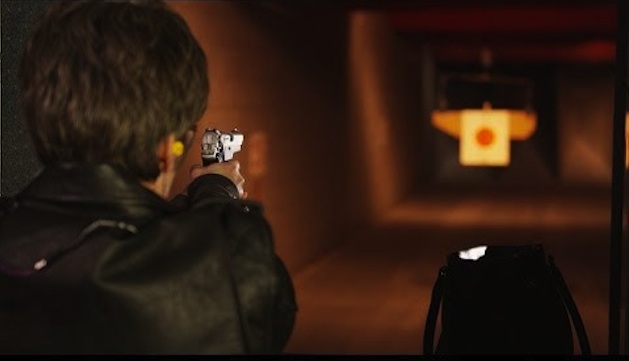
The new spot (watch below), called “Shot,” depicts Ernst, a veteran and former Lt. Colonel, with a firearm preparing “to take aim at wasteful spending” and promises to “set her sights on ObamaCare.”

The ad is sure to resonate among both GOP primary voters and general election voters in the upcoming 2014 midterm elections should she be the Republican nominee. While public polling still shows a slight advantage for Democrat Rep. Bruce Braley, we are keeping our rating for the Iowa Senate race a “Toss-Up” on our 2014 Senate Map Predictions for the same reasons Enrst’s new ad is a hit.

And here is why.

Aside from the fact Rep. Bruce Braley was recently caught on video trashing Iowa farmers, elevating lawyers above regular Iowans as a viable profession for the Senate, the political environment in Iowa has been favor to the Republican Party far longer than liberal pundits have admitted.

By a 2 to 1 margin, Quinnipiac University found Iowa voters say they want a senator who opposes ObamaCare and a path to citizenship for illegal immigrants, and a plurality want someone opposed to stricter gun control laws. Harper Polling, as well, found by a margin of 52 – 39 percent, Iowa voters say they want a senator who opposes ObamaCare. Similarly, Harper Polling found Iowa voters by a margin of 42 – 38 percent want a Republican senator.

Iowa voters approve 62 – 27 percent of the job Senator Chuck Grassley is doing, but only approve 55 – 31 percent of Senator Tom Harkin. When we compare trends, both of which show respectable improvements, we see a large disparity. The difference reflects the same political dynamic we discussed in the analysis of the last Iowa Senate poll conducted by Quinnipiac University: Iowa voters, ideologically and on the specific issues, have voter’s remorse over Barack Obama and largely agree with the Republican Party.

“President Barack Obama twice carried Iowa and it was the Iowa Caucuses which began his march to the presidency, but if he were on the ballot here today he would be toast,” said Peter A. Brown, assistant director of the Quinnipiac University Polling Institute.

But while Obama, himself, may not be on the ballot in Nov., his policies are. Yesterday we took a look at recent polling data that did not bode well for the president’s party, with excitement and enthusiasm on the side of the president’s opposition. Ernst is just the candidate the Democrats are worried about, because she is likely to fire up an already exited conservative base.

The Iowa candidate received key endorsements from top Republicans and conservative groups across the board. Sarah Palin, the the heavy-hitting Senate Conservatives Fund and, more recently, Florida Senator Marco Rubio have all endorsed Ernst in the Republican primary.

Iowa Republican Senate candidate Joni Ernst released

import-prices

U.S. trade deficit narrowed in March, but not as much as economists hoped and expected. CREDIT: Reuters

The U.S. trade deficit narrowed in the month of March as economists expected fueled by a rebound in exports, but nowhere near enough to boost first-quarter growth.

The Commerce Department reported Tuesday that the trade deficit fell 3.6 percent to $40.4 billion, while February’s deficit was revised to $41.9 billion from a previously reported $42.3 billion.

Economists polled by Reuters had forecast the trade deficit falling to $40.3 billion in March. When adjusted for inflation, the trade deficit dipped to $49.4 billion from $49.8 billion in February.

However, the amount the deficit narrowed off from the figure the government had assumed when it released advanced first-quarter gross domestic product estimates last week, which showed an abysmal .1 percent growth, meaning the economy likely contracted in the first three months of the year. Trade sliced off 0.83 percentage point from GDP growth in the first quarter.

The report is the latest piece of data suggesting the government will likely have to adjust downward its growth estimate to show a contraction when it released its revisions later this month. Last week, data showed spending on construction projects and factory inventories in March were also off the figures the government had assumed in its calculations. When factoring in the data, the economy contracted by roughly 0.4 percent rate in the first quarter.

The three-month moving average of the trade deficit, which is widely seen as a better indicator due to its avoidance of month-to-to month volatility, ticked up to $40.5 billion in the three months through the month of March from $40.0 billion in the prior three-month period.

Exports increased 2.1 percent to $193.9 billion, which is the the highest level since November.

Exports of capital goods, industrial supplies, materials and automobiles, all increased in the March. Exports of services hit a record high, while overall exports to Canada, South Korea and Germany were all at record highs.

Still, imports also increased by 1.1 percent to $234.3 billion in March, which is the highest level in two years and offset export gains. In March, considering the increases in food prices, it wasn’t a surprise food imports hit a record high, while other non-petroleum imports were measured at the highest on record.

Goods and services sold to China increased 9.6 percent, notable data after a report showed manufacturing in the world’s No. 2 economy slowed. Meanwhile, imports from China rose by only 1.6 percent.

The U.S. trade deficit with China was at $20.4 billion in March, slightly lower than the $20.9 billion measured in February.

The U.S. trade deficit narrowed in the

obama job approval and generic ballot polls

Polling data suggest Democrats may be headed for a worse Election Day than in both 1994 and 2010.

A new USA Today/Pew Research poll conducted from April 23 – 27 is bad news all around for the Democratic Party, with Republicans leading 47 – 43 percent on the generic ballot. That may not seem so terrible, but the latest polling data suggest the 2014 midterm elections may end up in a worse defeat for Democrats than either 1994 or 2010, two cycles resulting in historic Republican gains.

The current 4-point lead for the Republican Party compares with a 2-point deficit they faced in the Pew poll back in 1994 around this time, and the tie at 44 percent Pew found in March, 2010. Similarly, a CNN/Opinion Research poll found a 1-point lead for the Republicans on the generic ballot, compared with a 4-point Democratic lead in a CNN poll back in April, 2010. Sure, polls change. However, as I have been arguing since last year, which you can read on our 2014 Senate Map and Generic Ballot analysis, the fundamentals are moving strongly against the Democrats.

When asked which policies “would do more to strengthen the economy over the next few years,” 43 percent say the economic policies of Republican leaders in Congress, while just 39 percent say the economic policies of Barack Obama’s administration. Democrats are constantly pointing to the poor ratings of congressional Republicans, but much of those negatives have come from the right, and policy preferences matter when people think their economic condition needs improvement.

Voters in the USA Today/Pew poll disapprove of ObamaCare by a 55 – 41 percent margin, but intensity is working against the president and the Democrats. Within the numbers, 43 strongly disapprove of the president’s health care law, while just 26 strongly approve. Further, just 16 percent say their vote for Congress will be a vote for Obama, but 26 percent say their vote will be against Obama. CNN asked the question slightly different, but found the same trend.

In September, 2010, 19 percent said their vote would be meant to send a message that they support Obama, while 26 percent said their vote was meant to send a message they oppose him. Now, the margin is a nearly identical 20 – 25 percent in opposition to the president’s policies.

Voter intensity, as we have consistently seen in prior polling, is dominated by the right this cycle.

Despite early polling showing Clinton leading GOP hopefuls, American voters appear ready to move in a different direction than the direction President Obama has taken them and the country, which is very much in line with time-tested laws of political science. In modern American politics, only twice did a two-term president’s party succeed at winning what was essentially a third term in the White House (Truman after Roosevelt and H.W. Bush after Reagan).

When asked if voters would “like to see a president who offers policies and programs similar to those of the Obama administration, OR would you like to see a president who offers different policies and programs,” it’s bad news for Hillary or whomever may be the Democratic nominee.

The number of voters who chose the “policies and programs similar to the Obama administration” is ten points lower than when Clinton was in his second term — 30 percent. Meanwhile, a whopping 65 percent of Americans say they are ready to go in a different direction, which is almost the same as the 70 percent who said that in 2006 during the Bush administration. Now, whether the Republican Party and their nominee can convince voters they can lead them in that direction is a whole other story, altogether. But, still, the warning signs are clear.

Democrats appear to be in big, big trouble. With President Obama’s job approval stubbornly low, and even lower still than it was in the month of May before Election Day 2010, the fundamentals are beginning to shape the political landscape. As I have hammered over and over again, Democrats need a substantial lead on the generic ballot, and there is a strong relationship between presidential approval rating and congressional election outcomes. In May of 2010, Pew Research measured an above-water 47 – 42 percent approval for Obama, but found an upside-down 44 – 50 percent margin this week. CNN measured the president’s approval at 51 – 46 percent in May, 2010, but now he’s upside-down 43 – 55 percent.

The generic ballot, which according to the PPD average Democrats are currently trailing in by a .6-point margin, indicates the president’s party will get thumped in November — again.

A new USA Today/Pew Research poll conducted from

trey gowdy

Rep. Trey Gowdy, R-S.C., has been chosen to serve as chairman of a new House select committee tasked with investigating the 2012 Benghazi terror attacks.

Rep. Trey Gowdy (R-SC) has been chosen to serve as chairman of a new House select committee tasked with investigating the 2012 Benghazi terror attacks. House Speaker John Boehner (R-OH) made the announcement Monday afternoon.

“With four of our countrymen killed at the hands of terrorists, the American people want answers, accountability, and justice,” the Speaker said. “Trey Gowdy is as dogged, focused, and serious-minded as they come.”

Earlier, it appeared that — though other names were being tossed around — the Speaker had already made his decision. “It’s not done,” said a senior congressional source. “But it’s looking that way.”

Gowdy is a former prosecutor for the District Attorney in South Carolina, and is widely praised within Republican circles for his competence in prosecuting evidence and willingness to pursue investigations that are otherwise being ignored in the media. Benghazi was one such investigation before last week.

Newly released emails, which were only obtained and published by the conservative watchdog group Judicial Watch as a result of a June 21, 2013, Freedom of Information Act (FOIA) lawsuit filed against the Department of State (Judicial Watch v. U.S. Department of State (No. 1:13-cv-00951)), tied top White House officials to the fabrication of the infamous Benghazi talking points.

The announcement by Boehner that a select committee will be voted on in the House was the second of a one-two punch delivered to the White House last week. The House Oversight and Government Reform Committee announced Friday it has subpoenaed Secretary of State John Kerry to testify about the new bombshell Benghazi documents at a May 21 hearing.

“The State Department’s response to the congressional investigation of the Benghazi attack has shown a disturbing disregard for the Department’s legal obligations to Congress,” Chairman Darrell Issa (R-CA) wrote in a letter to Sec. John Kerry.

“Compliance with a subpoena for documents is not a game. Because your Department is failing to meet its legal obligations, I am issuing a new subpoena to compel you to appear before the Committee to answer questions about your agency’s response to the congressional investigation of the Benghazi attack,” he added.

While the special committee would still have to be approved by the House in a vote on the floor, the decision all but ensures its establishment and is widely expected to pass. The choice to name Trey Gowdy is already seen as a sign that House leadership is serious about pursuing an investigation in the Sept. 11, 2012, Benghazi attacks.

Rep. Trey Gowdy (R-SC) has been chosen

Political Correctness or PC is a term reserved for a way of putting a spin on things to offend as few people as you can, while still getting your point across. It’s also come to fit the Progressive Movement’s whole persona in recent years. An all-inclusive, “let’s play nice” mentality that really isn’t nice at all, and infringes on an individual’s right to free speech.

PC is an infringement on individualism and the First Amendment, make no bones about it. The First Amendment makes no exclusion for a person or persons to make racial or offensive comments. In America, you have a right to be a bigot. Or at least you did, until about 1985.

If you remember back then, several journalists in radio and broadcasting were under fire for what was considered racially charged remarks. One incident, however, came to be emblematic of PC — the Al Campanis incident. In 1986, Campanis, during an interview with “Nightline” said blacks “may not have some of the necessities to be, let’s say, a field manager, or, perhaps, a general manager” for these positions. Elsewhere in the interview he said that blacks are often poor swimmers “because they don’t have the buoyancy.”

Campanis for years had been a supporter of minorities in coaching jobs in MLB, and many rallied to his defense.

After he was fired and years later, of course, they spoke up.  No one dared speak up to defend him at the time of the incident, at least not anyone of note.

Whether or not the comments were racially insensitive or not, is not relevant; Campanis was terminated for exercising his right to free speech.  No one protested, no one complained. He was simply fired. There was no investigation as to whether he used racial differences in the promoting or the firing of minorities either — this was strictly a termination over his comments.

As years went by, PC became broader in its definition and its application. PC has become so widespread now, that blind people picket a Mr. Magoo movie claiming it perpetuates stereotypes.

In short, we have freedom of speech in this nation, as long as you don’t offend anyone. Of course, that means we no longer have freedom of speech.

Proponents of PC argue that the constitutional amendment protecting freedom of speech does not apply in these cases, because it was not government that passed laws to bar such behavior, only private industry exercising its right to hire fire or discipline anyone they want. Fair enough. But by setting the precedent and the definition of the protections of the First Amendment so low, you now have a situation where PC is being applied even in basic arguments of politics.

Our President says we need to be more “civil” in our discourse, the VP called Tea Party members terrorists, Hollywood empty heads claim conservatives are racists, and one Congresswoman the other day out and out called on conservative to “shut up.”

Like anything else, give them an inch and they will go a mile.

All of it, and the relationship between PC and discrimination are really the same issue — the application of law and rights equally among the members of society. Comments that are unacceptable by a white man are perfectly legitimate by a black man. Speech that is vile and directly violent, such as the speeches by Malcolm X, or the president’s own pastor are looked over, while Herman Cain suggesting that blacks are “brainwashed” by the left is a racially charged and motivated comment.

It is the cart before the horse, using the tools of speech and argument to shut down and muzzle those that dissent simply because of the content of the speech. This is the real danger, and why progressive political theory and its cousin PC speech ultimately can create more discrimination, hate and dissension than an open discourse of ideas.

In short, say the wrong thing and you will be punished. Say the right thing and you will be rewarded. This is the machinations of “plantation” behavior, making individuals subservient to a greater authority and the will of the mob, rather than by the rule of law. It is the first step in the breakdown of a free society.

Discrimination can come in many flavors and when you discriminate against anyone, for any reason, or neuter the protections of the Constitution, you make society less free for everyone and allow the power players of corruption to run roughshod over the people.

Thomas Purcell is host of the Liberty Never Sleeps podcast show and more of his work can be read at libertyneversleeps.com

In America, you have a right to

supreme court religious freedom.

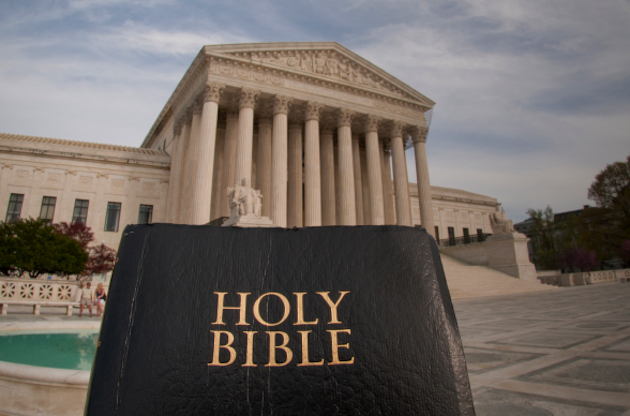
The Supreme Court ruled Monday that opening prayer at town council meetings do not violate the Constitution even if they routinely stress Christianity. The high court ruled in 5-4 decision Monday that the content of the prayers is not critical as long as officials make a good-faith effort at inclusion. The ruling was a victory for the town of Greece, N.Y., which is located just outside of Rochester.

“The prayer opportunity is evaluated against the backdrop of a historical practice showing that prayer has become part of the Nation’s heritage and tradition,” the majority wrote in the opinion. “It is presumed that the reasonable observer is acquainted with this tradition and understands that its purposes are to lend gravity to public proceedings and to acknowledge the place religion holds in the lives of many private citizens.”

The ruling is certainly not without precedent. For instance, in 1983, the court upheld opening prayer in the Nebraska legislature after it was challenged by secular progressives. The court went so far as to say that prayer is actually part of the nation’s fabric, and is not a violation of the First Amendment.

Monday’s ruling was consistent with and relied upon the earlier ruling.

Justice Anthony Kennedy, writing for the majority, said the prayers are ceremonial and part of out nation’s long-standing traditions.

“The inclusion of a brief, ceremonial prayer as part of a larger exercise in civic recognition suggests that its purpose and effect are to acknowledge religious leaders and the institutions they represent, rather than to exclude or coerce nonbelievers,” Kennedy wrote.

Justice Elena Kagan, an Obama appointee and liberal justice, in a dissent for the court’s four total liberal justices, said the case differs from the 1983 decision because “Greece’s town meetings involve participation by ordinary citizens, and the invocations given — directly to those citizens — were predominantly sectarian in content.”

A federal appeals court in New York ruled that Greece violated the Constitution by opening nearly every meeting over an 11-year span with prayers that stressed Christianity.

The majority justices, however, further ruled that the intended audience “is not the public, but the lawmakers themselves.”

The Supreme Court ruled Monday that opening

People's Pundit Daily
You have %%pigeonMeterAvailable%% free %%pigeonCopyPage%% remaining this month. Get unlimited access and support reader-funded, independent data journalism.

Start a 14-day free trial now. Pay later!

Start Trial