Widget Image
Follow PPD Social Media
Friday, January 16, 2026
HomeStandard Blog Whole Post (Page 971)

Alaska Senate candidate Joe Miller

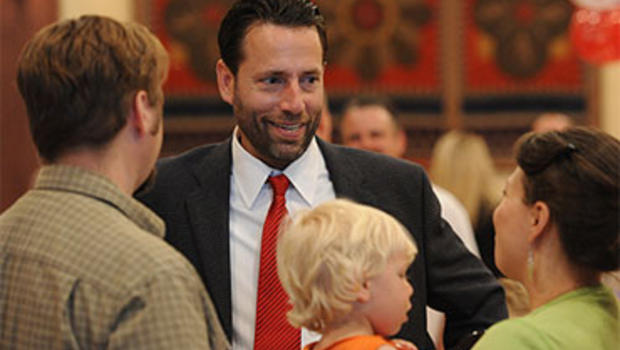
Alaska Senate candidate Joe Miller campaigns retail-style in his bid for U.S. Senate.

Alaska Republican Senate candidate Joe Miller picked up a key endorsement Thursday from the Alaska Right to Life PAC. The latest endorsement underscores Alaskan conservatives’ lack of excitement over the 2010 nominee’s two challengers, Lt. Gov. Mead Treadwell, and former Natural Resources Commissioner and Attorney General Dan Sullivan.

“The pro-life position Joe Miller takes isn’t merely a common political platitude, but is centered in the core of who he is. Joe will be a champion for the pro-life cause in Washington and is exactly the caliber of man we need representing Alaska in the US Senate. Alaska Right to Life’s Political Action Committee is proud to endorse him,” said Executive Director of Alaska Right to Life, Christopher Kurka.

While Dan Sullivan appears to have a consistent money edge in the Republican primary race, with a recent endorsement from The Club for Growth, Miller has been endorsed by PACs who support issues near and dear to the hearts of the conservative base in Alaska. The Combat Veterans for Congress PAC endorsed Miller in December, and he received the endorsement of the National Association for Gun Rights PAC (NAGR) in March. The NAGR endorsement added to a solid pro-Second Amendment standing — which has become a top priority for conservatives — including the endorsement of the Gun Owners of America. Miller also recieved an “A” rating from the National Rifle Association.

Now, with the endorsement of the key pro-life group, Joe Miller, who many see as an underdog in the Alaska Senate race, has defined himself as the true conservative in the race.

“I am honored to receive the endorsement of Alaska Right to Life. Government has been given a sacred trust to protect life, especially the lives of the innocent and most vulnerable among us. This trust is recognized in both the Declaration of Independence and the Constitution,” Joe Miller said in a statement.

After decades of finding an American majority identifying with the “pro-choice” designation, Gallup and other pollsters have consistently reported the new majority saying they are pro-life. With the proliferation of information, younger Americans have identified more and more with the pro-life position. And in a state such as Alaska, the pro-life position remains a top value to voters.

According to Gallup’s annual party ID measurement, Alaska is now a full 20 points more Republican than in the previous year, and even farther more Republican than when Mark Begich barely won his seat by just under 4,000 votes. The 2014 Alaska Senate race is currently rated “Leans Republican” on our 2014 Senate Map Predictions at PeoplesPunditDaily.com. The uncertainty of the GOP primary has kept us from moving it to “Likely Republican” on our map.

Though many pundits and Washington insiders view Joe Miller as the underdog in the race, Senior Political Analyst at PeoplesPunditDaily.com, Richard Baris, says he has a clear shot at winning.

“Aside from the fact pundits are referencing polling data far too much in a state that is notoriously difficult to poll, I took a look at this back in January,” Baris said. “And despite what the talking heads say, when you actually look at the data you can observe a very real, very clear path to victory for Mr. Miller.” In the January article he referenced, Baris wrote of the possibility that a “reverse vote-splitting phenomena” could sink the two Establishment candidates.

“That is, typically establishment Republican candidates win primaries because the conservative vote is split between 2 or more anti-establishment candidates,” he wrote. “In the Alaska Senate race the opposite is true, and it is conceivable to see how under the right conditions Joe Miller could upset the GOP establishment on primary night, again.”

Alaska Republican Senate candidate Joe Miller picked
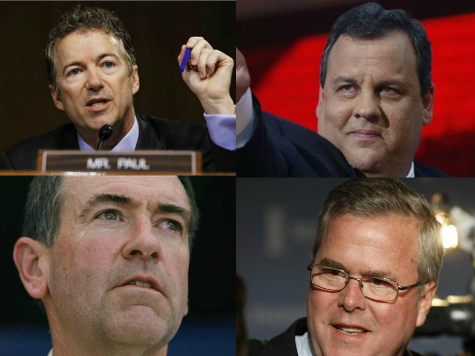
top 2016 gop candidates

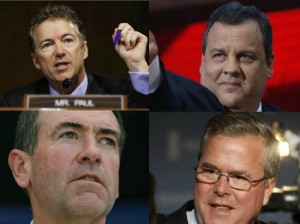
A new Fox News poll found NJ Gov. Chris Christie leading the top 2016 GOP candidates, with Kentucky Senator Rand Paul close behind. Former Florida Gov. Jeb Bush, who has been pushed by big donors to run and Republican Establishment, is nipping at their heels.

Interestingly, former Arkansas Gov. Mike Huckabee, who now hosts a show on Fox News, was excluded from the poll even though he has been leading the pack on the average of polls. Nevertheless, Christie fell 1 point to 15 percent from their December poll, while Paul and Bush both garnered 14 percent. Former vice presidential candidate and House Budget Committee Chair Paul Ryan (R-WI) received 9 percent and  Florida Senator Marco Rubio received 8 percent.

While it is certainly true that early polling has little to zero predictive value, a few trends are observable. With Huckabee left out of the list, Sen. Paul still takes second or is statistically tied for the lead, and the media and donor push for Jeb Bush is beginning to have some weight, though it is too early to tell if his momentum can last. As we previously examined, Bush has never led on any of the polling, save for one recent survey that found him tied with Huckabee, and will have a hard time in a general election given the anti-Bush sentiment that remains across the country.

Even in the new Fox News poll, voters are more likely to say a Bush-Clinton matchup would mean the political parties are controlled by two family dynasties (42 percent), while 36 percent say they feel the parties would be offering two strong alternatives. Democrats are five points more likely to say the parties were offering two strong alternatives.

Meanwhile, President Obama saw his approval rating tick up 2 points to 42 percent since their last poll, while Hillary Clinton’s favorability ratings fell to 49 percent from 56 percent measured in June of last year.

The Republican Party, however, enjoyed a 15-point bump in favorables to 45 percent, and now just 45 percent view the party unfavorable compared to the 63 percent measured in the prior survey. Similarly, the Democratic Party is viewed favorable by 44 percent of voters, while 45 percent now say they have unfavorable views of the party of big government. The Tea Party, as well, saw some improvement from the last survey, with favorables ticking up to 35 percent from 31 percent, and unfavorables falling from 53 percent to 45 percent.

<iframe src=”http://personal.crocodoc.com/Y7bzhBC?embedded=true” width=”100%” height=”600″ style=”border:1px solid #ddd;”></iframe>

A new Fox News poll found NJ

weekly jobless claims

The Labor Department reported Thursday that weekly jobless benefits rose less than expected and remained near pre-recession levels. First-time claims for state unemployment benefits increased by 2,000 to a seasonally adjusted 304,000 for the week ending on April 12.

That number stayed significantly close to a 6-1/2 year low touched the prior week. Meanwhile, claims for the week ending on April 5 were revised to show 2,000 more applications received than the Labor Department initially reported.

While the number did rise, overall, economists polled by Reuters had forecast315,000 first-time applications for jobless benefits.

In what is thought to be a far better indicator of the labor market, the four-week moving average for new claims fell 4,750 to 312,000, which is the lowest level since October of 2007.

An analyst at the Labor Department said there were no states estimated this time around, and that there were no special factors that could have influenced the state data for better or worse.

Data on job openings, the duration of unemployment and short-term unemployment, do suggest a degree of tightening in the labor market. But job growth averaged about 195,000 per month in February and March, and the headlien unemployment rate held steady at 6.7 percent, though the real, unadjusted unemployment rate is far higher.

The Labor report found that the number of people still receiving benefits after an initial week of aid fell by 11,000 to a still high 2.74 million in the week ending on April 5. Yet, this was the lowest level since December of 2007.

The Labor Department reported Thursday that weekly

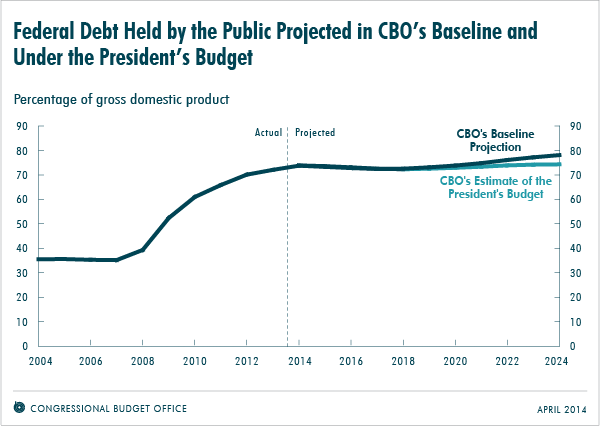
The Congressional Budget Office released two startling new reports showing crippling levels of national debt under the status quo and President Obama’s budget. The CBO projected total federal debt held by the public will hit 78 percent of GDP by 2024, which is up from 72 percent at the end of 2013 and roughly double historical levels.

Total federal debt has averaged 39 percent in the past four decades, and as recently as the end of 2007, the national debt equaled just 35 percent of total GDP. Yet, even under President Obama’s new proposed budget, the levels of spending are just not sustainable.

national debt

According to the CBO, deficits would total $6.6 trillion between 2015 and 2024 under President Obama’s budget, just $1.0 trillion less than the cumulative deficit in CBO’s baseline. The projected national debt would equal 74 percent of total U.S. GDP, or gross domestic product, meaning U.S. debt would be 74 percent of the entire American economy.

“Such high and rising debt would have serious negative consequences,” the CBO said. “Federal spending on interest payments would increase considerably when interest rates rose to more typical levels. Moreover, because federal borrowing would eventually raise the cost of investment by businesses and other entities, the capital stock would be smaller, and productivity and wages lower, than if federal borrowing was more limited.”

In other words, the U.S. economy will collapse and the social safety nets that Democrats consistently attack Republicans over, will become too expensive to fund. The only appropriations funded by an ever-shrinking stream of taxpayer revenue will need to be made to fund current debt obligations. The cost of doing business in the U.S. will be too high, causing even U.S.-based corporations to seek better-suited investment environments, i.e. other countries.

“In addition, high debt means that lawmakers would have less flexibility than they otherwise would to use tax and spending policies to respond to unexpected challenges,” the CB O added. “Finally, high debt increases the risk of a fiscal crisis in which investors would lose so much confidence in the government’s ability to manage its budget that the government would be unable to borrow at affordable rates.”

Because they refuse to deal with the spending problem in Washington now, rather than later, politicians will not have the time nor political will and capability to reverse the inevitable crisis. Future generations will be crippled economically and the very low-income citizens Democrats claim to be protecting will be hurt disproportionately, or the worst.

The Congressional Budget Office report relies upon conservative estimates, and admittedly cannot account for unpredictable costs associated with ObamaCare. As previously reported by PeoplesPunditDaily.com, total health care expenses are projected to hit $5.5 trillion by the year 2022, which were calculated by the Center for Medicare and Medicaid services. However, neither institution factored in likely bailouts mandated by the Affordable Care Act.

The Congressional Budget Office released two startling

consumer sentiment

Thanks to better-than-expected corporate earnings and strong data out of China, markets are continuing their rebound Wednesday after a week of losses.

As of 10:27 a.m. ET, the Dow Jones Industrial Average was up 103.15 points, or 0.63 percent to 16365.71, while the S&P 500 rose 13.2 points, or 0.73 percent to 1856. The Nasdaq Composite increased by 37.1 points, or 0.92 percent to 4071.

China, the world’s second-biggest economy, grew at an annual pace of 7.4 percent in the first quarter, barely beating out Wall Street’s estimates of 7.3 percent. Still, economists are cautious amid prior fears the country was slowing down to a disastrous level.

“We maintain our view that GDP growth is on a down-trend and we continue to expect it to slow to 7.1% in (the second quarter),” wrote analysts at Japan-based Nomura in an email to clients.

“We believe the government will not announce any new easing measures in April as it waits to see how the economy responds to the current fiscal easing measures.”

Meanwhile, in corporate news, Bank of America posted a first-quarter loss on a $6 billion litigation expense as both the nation’s No. 1 (JPMorgan) and No. 2 U.S. banks continue to battle with lawsuits from federal regulators. Yahoo (YHOO) and Intel shares were up after stronger-than-expected quarterly earnings.

Also, the Commerce Department reported Wednesday that — despite better weather — new housing starts in the U.S. rose less than expected in the prior month.

Thanks to better-than-expected corporate earnings and strong

new housing starts

(Photo: REUTERS)

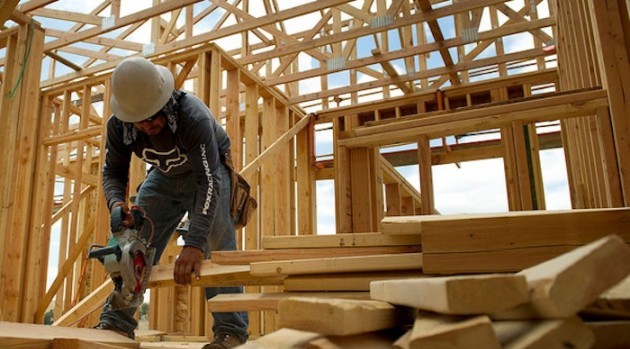
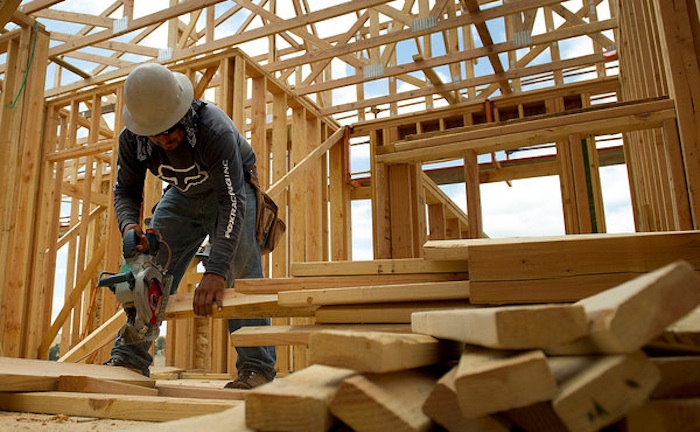
Despite better weather, new housing starts in the U.S. rose less than expected in the month of March, again, while building permits fell, suggesting fundamental issues in the housing market.

The Commerce Department said on Wednesday new housing starts increased by 2.8 percent to a seasonally adjusted annual rate of 946,000. However, in a bit of better news, February’s housing starts were revised upward to a 1.9 percent rise. They were previously reported at a 0.2 percent fall.

Still, this month missed expectation again, and economists can no longer blame or scapegoat old father winter. Economists polled by Reuters forecasted new housing starts would rise to a 973,000-unit rate last month.

The new housing market has been, in some degree, weighed down by shortages of building lots and skilled labor, even as material prices continue to rise for builders.

A report released on Tuesday found more builders view market conditions as poor than favorable. The NAHB/Wells Fargo Housing Market index increased to 47 this month, down from a revised 46 in March, the National Association of Home Builders said on Tuesday in a statement.

But higher mortgage rates and increased housing prices are keeping would-be buyers on the sidelines. “Headwinds that are holding up a more robust recovery include ongoing tight credit conditions for home buyers and the fact that builders in many markets are facing a limited availability of lots and labor,” said the NAHB’s Chief Economist, David Crowe, in an email.

Groundbreaking for single-family homes, which represents the largest segment of the market, did increase 6.0 percent to a 635,000-unit pace last month. The more volatile measurement os multi-family homes fell 3.1 percent to a 311,000-unit rate, which was the lowest level since last October.

Permits to build homes fell 2.4 percent in March to a 990,000-unit pace. Permits for single-family homes rose 0.5 percent but fell 6.4 percent for the multi-family sector.

Despite better weather, new housing starts in

When an incumbent spends money in the month of April, they’re in trouble. When an incumbent spends money on a fake ad complete with a fake Senate committee hearing, fake journalists and even a fake name tag, they’re in deep trouble. While many are simply poking fun at Democratic Senator Mary Landrieu, there is actually a serious component to the campaign’s decision to put on such a display in her new ad.

Mary Landrieu’s new ad depicts a fictitious reality because, despite her claims, she will never win with the truth. “For years, she’s forced Washington to respect Louisiana,” but her constituents have always opposed ObamaCare, yet she says she would vote for the law again.

To be sure, the ad attempts to focus on oil and gas production, which Landrieu was quick to underscore last month in an interview. However, JAZZ PAC, Landrieu’s political action committee, takes money from oil and gas supporters and gives them to liberal lawmakers who hate the industry her state depends upon.

The bottom line is this. Incumbents who are supposedly not worried about trailing their opponents as early as April, should not be spending money. Landrieu’s campaign has consistently brought up the point that she has yet to spend money, though she put aside air time. Yet, now she is, in an effort to literally fabricate an alternative reality.

“If the only way Sen. Landrieu can get votes is by manipulating the truth, it’s further proof we need change,” John Cummins, a spokesman for her top challenger, Bill Cassidy, said in an email. Of course, the campaign has a different perspective

“It is against Senate ethics rules to use footage that was shot using Senate cameras in campaign ads,” wrote Landrieu campaign manager Adam Sullivan in an email. Senate Resolution 431 does prohibit Senate floor footage from being used in campaign ads, but that’s not really the point, as her opposition is already underscoring.

The Republican opposition research super-PAC, America Rising, released this video in response to Landrieu’s new ad. Her re-enacted statement is juxtaposed with her actual statements from the hearing.

We currently rate the Louisiana Senate race a “Toss-Up” on our 2014 Senate Map Predictions. However, we first released our expanded analysis on the race back in Dec., and her actions may just mean we have to reexamine her chances.

While many are simply poking fun at

2014 michigan races

(Photo: Anne Savage Photography)

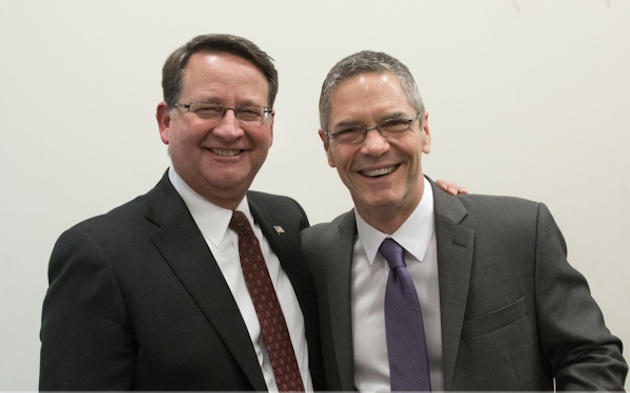
In two closely watched 2014 Michigan races, Democrats Mark Schauer and Rep. Gary Peters have consistently trailed their two Republican challengers. A new poll from Mitchell Research found Peters trailing former Secretary of State Terri Lynn Land by 6 points, while Schauer trails Gov. Rick Snyder by a wider 12-point margin.

Because Republicans recruited a formidable candidate in Land, who has a proven track record for winning statewide races, Democrats will be forced to spend money in blue-leaning Michigan to defend the open Senate seat vacated by Carl Levin. On our 2014 Senate Map Predictions, the Michigan Senate race is currently rated a “Toss-Up,” a rating that was justified before the failed ObamaCare rollout. The Mitchell research poll found Land edging out Peters 44 – 38 percent, which is in line with polling conducted prior to Democratic pollster PPP releasing a poll showing Peters with a 5-point lead, skewing the average results.

In the Michigan governor race, the lead for Gov. Rick Snyder has been larger and even more consistent, with Mitchell showing the incumbent ahead 49 – 37, just under the 50 percent threshold for safety. The race is rated “Likely Republican” on our 2014 Governor Map Predictions, largely for the same reasons we find Land ahead.

When we examined polling prior to and after both the Detroit bankruptcy and the ObamaCare rollout disaster, as well as other factors, including Partisan Voting Index and trends in party identification, the statewide move to the right was clear. In fact, the entire Midwest, including neighboring Wisconsin and Ohio, has been shifting toward the Republican Party. Whether or not the trend is momentary, or a temporarily benefit for the 2014 midterm elections as 2010 was prior to 2012, remains to be seen.

But Democrats, no doubt, will be forced to spend time, money and other resources in the state of Michigan, something no pundit (save us) believed to be necessary just six months ago.

In two closely watched 2014 Michigan races,

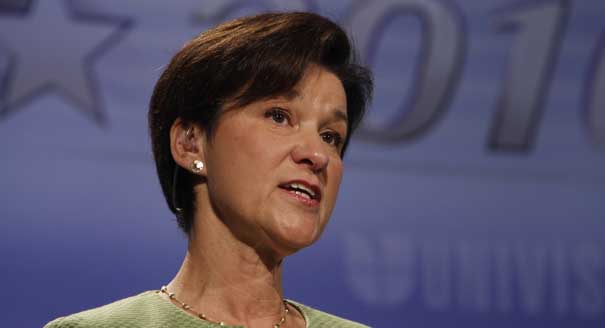
Democrat Alex Sink, who took on now-Rep. David Jolly and lost in the FL-13 special election, has decided to opt-out of a rematch in November. Members of the Democratic Party Establishment in Florida and in the DCCC had attempted to convince Sink that turnout in November would benefit her, but she wasn’t buying it.

In a message to supporters on her Facebook page, Sink vowed to remain relevant to the conversation and the party, quoting the late Republican Representative Bill Young who served and represented FL-13.

Friends, I have made a very personal decision not to run for the 13th Congressional District seat in the 2014 election. I want to thank every voter, volunteer and donor for standing beside me these past months – we can all be proud of the strong campaign we ran.

While I will not seek election in 2014, I will continue our dialogue here so that we can continue to work together to find new ways to continue to find common ground, to promote problem solving and find commonsense solutions to our most pressing problems.

In the words of Bill, I look forward to continuing to do good. I remain totally convinced that a Democrat can and will win this congressional seat in the fall, and I look forward to helping the Democratic nominee. Stay tuned!

However, in reality, Bill Young was far more aligned philosophically with David Jolly than he was with Alex Sink. Sink carried the district in her 2010 gubernatorial bid against now-Gov. Rick Scott, and the district was narrowly carried by President Obama in 2012 against Mitt Romney. And while the Democrats downplayed the loss in the special election, Sink’s defeat was a devastating sign that ObamaCare has hurt the Democratic Party, Republicans closed at least some of the tech gap with “Honeybadger,” and seniors have continued their move toward the Republican Party.

The late Bill Young, though an incumbent, was a popular Republican in a district that was moving toward the left. It has become a painful reality for Democrats to swallow, but FL-13 is a casualty of their lock-step pursuit of big government. Older, whiter seniors who were once reliable constituencies for the Democratic Party, have abandoned them in droves. In fact, they are the only bloc who identify consistently Republican, according to Gallup.

Alex Sink originally passed on both the gubernatorial rematch with Scott and her first bid for FL-13, citing the recent death of her husband.  Republicans point to Sink’s decision as a serious problem the Democrats have yet to acknowledge, and once which the media refuses to cover.

“These candidates who live outside the beltway understand what Obama and the DCCC [don’t] — their continued devotion to ObamaCare is not only costing them votes, it is costing them their star candidates,” National Republican Congressional Committee spokeswoman Andrea Bozek said in an email.

David Jolly, in what was no doubt a move to distance himself from the media narrative, actually voted against the Ryan budget that the House passed last week.

Democrat Alex Sink, who took on now-Rep.

Even though U.S. homebuilder sentiment did inch up in the month of April, sparse credit conditions for buyers and a lack of supply for building properties and labor continue to drag down industry fundamental.

(Photo: REUTERS)

Even though U.S. homebuilder sentiment did inch up in the month of April, sparse credit conditions for buyers and a lack of supply for building properties and labor continue to drag down industry fundamentals.

The NAHB/Wells Fargo Housing Market index increased to 47 this month, down from a revised 46 in March, the National Association of Home Builders said on Tuesday in a statement. The industry measurement again missed the mark, as economists polled by Reuters had forecast the index would show signs of recovery and increase to 50 in April, but the latest reading was the third in a row to come in below 50.

Index measurements that come in below 50 mean suggest more builders view market conditions as poor than favorable.

“Builder confidence has been in a holding pattern the past three months,” NAHB Chairman Kevin Kelly said in a statement. “Looking ahead, as the spring home buying season gets into full swing and demand increases, builders are expecting sales prospects to improve in the months ahead.”

However, only the index’s single-family home sales component remained unchanged at 51, though the the March measurement was revised downward, again, by 1 point.

“Headwinds that are holding up a more robust recovery include ongoing tight credit conditions for home buyers and the fact that builders in many markets are facing a limited availability of lots and labor,” said the NAHB’s Chief Economist, David Crowe.

Even though U.S. homebuilder sentiment did inch

People's Pundit Daily
You have %%pigeonMeterAvailable%% free %%pigeonCopyPage%% remaining this month. Get unlimited access and support reader-funded, independent data journalism.

Start a 14-day free trial now. Pay later!

Start Trial