Widget Image
Follow PPD Social Media
Friday, January 16, 2026
HomeStandard Blog Whole Post (Page 975)

The long-awaited Scott Brown New Hampshire run is at hand, as the former Massachusetts Senator plans to formally announce his campaign on Thursday. In an email to supporters on Monday, Brown wrote his weeks of canvassing the state convinced him that “you want a health care system that works for New Hampshire.”.

National Republican supporters have already begun to buy ads supporting Brown’s challenge to incumbent Democrat Jeanne Shaheen, correctly viewing the race as another opportunity to end Democrats’ 55-43 majority in the Senate in November.

Brown has focused on his opposition to ObamaCare for months, penning several opt-eds criticizing Shaheen for her unwavering support for the law.

“Together, we can do all this, but it starts by changing leadership in Washington,” said Brown, who stunned the state’s Democratic Party when he won the U.S. Senate seat previously held by Edward M. Kennedy in 2010. “This is the people’s seat,” Brown repeated during the campaign.

Polls show Shaheen with a lead in the race, but we currently rate the race “Leans Democrat” on our 2014 Senate Map Predictions due to Brown’s strength as a candidate, as well as a deteriorating national environment for Democrats. Shaheen has already conceded she sees Brown as a threat, citing him over and over in fundraising emails even before Brown last month confirmed he had formed a committee to explore a run.

Brown, who was born in New Hampshire and moved his residence there late last year, said he would kick off his campaign in the coastal city of Portsmouth, in the state’s south.

The long-awaited Scott Brown New Hampshire run

florida governor race

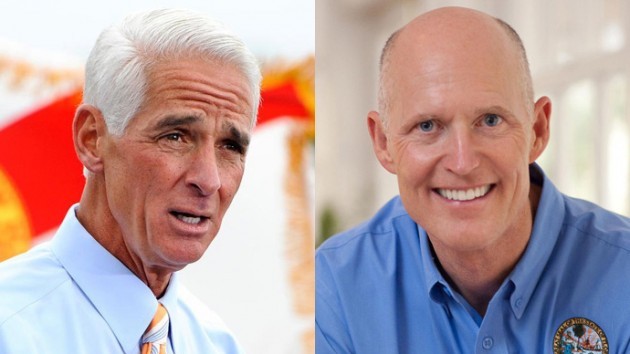
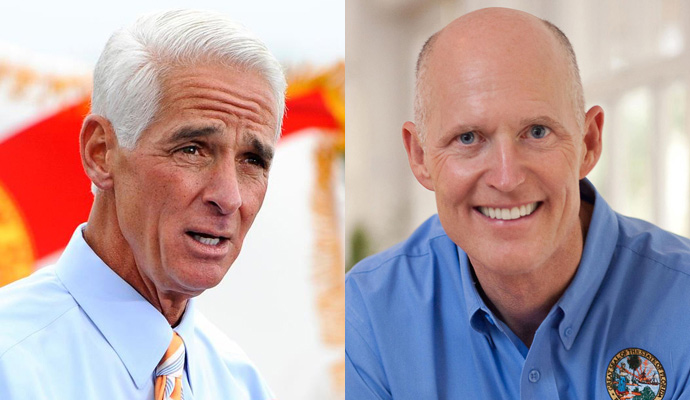
Former Florida Gov. Charlie Crist, a Republican-turned-Independent-turned-Republican again, is challenging incumbent Republican Gov. Rick Scott in the Florida governor race.

The Florida Governor race is the ninth article in what is a succession of articles offering expanded analysis on our 2014 Governor Map Predictions. Former governor and Republican-turned-Independent-turned-Democrat, Charlie Crist, will face incumbent Republican Governor Rick Scott in the 2014 midterm election.

Democrat strategists and pundits alike believed that Gov. Rick Scott was, perhaps, one of the most vulnerable Republican incumbents up for reelection this midterm cycle. To be sure, early in the cycle, I saw the race in much the same light, with a few caveats. Even though early polling found Scott trailing Crist, early polling in 2010 also showed Crist running far ahead of now-Senator Marco Rubio for months. That is, until the September before the election. Crist, of course, was blown out of the water against Marco Rubio, who defeated the thought-to-be popular former governor by over 19 points.

Further, it was rumored that Scott was willing, able and prepared to spend upwards of $100 million to get himself reelected, which we now know is no longer a rumor — it’s true. Nevertheless, despite early polling and pundit grumblings, several key data points have prompted us to reexamine the Florida governor race, which has given us reason to believe Scott has a far better chance at reelection than previously thought.

First, even though we can never be too sure where Crist stands on the issues these days, it is likely that the midterm electorate won’t be too happy with his recent flip-flops. He was keynoting Democratic events around the state and endorsing gay marriage before he even announced his bid. Also, his campaign ran into a few bumps early in the cycle when he hired a certain problematic campaign manager, that is, until he quit after being introduced to donors. The news will be bad enough in an ad and in debates, but it is who that manager was that will play even worse in Florida. Crist hired campaign manager Bill Hyers, who was fresh off his big New York City win for outright socialist Mayor Bill de Blasio.

That may play well in NYC, but not in Florida.

Prior to being fired, in a Washington Post write-up, Hyers, too, downplayed his new boss’s early lead in polls, claiming he would be “massively” outspent. In truth, quite a few Democrats are still worried about Crist’s chances of defeating Gov. Scott, for reasons other than being outspent, and the staff shake-up certainly did not help growing calls for Sen. Bill Nelson to jump into the race to rescue his party. To calm their fears, Crist now hired Steve Schale as a senior political consultant, who ran Barack Obama’s 2008 Florida campaign.

Gov. Scott, too, created major problems with his own party when he flip-flopped on Medicaid expansion under ObamaCare. Many pundits said that deciding to support the ObamaCare provision was a way of improving his general election chances. I, however, am not too sure about that. But what is certain is that Crist’s unwavering support for the law will hurt him, particularly in light of the failed rollout, the cuts to Medicare mandated by the law and its stubbornly deep unpopularity.

ObamaCare will be a central issue in the campaign, and its power to sink Alex Sink was badly underestimated by other pundits. Alex Sink, who was also Scott’s 2010 opponent, had vocalized her hesitation to commit to another run, because of the still-recent death of her husband. Yet, she decided to run for the late C.W. Bill Young’s seat in FL-13 and was defeated by David Jolly in an upset that shocked everyone but People’s Pundit Daily. We called the race a “Toss-Up,” while both Larry Sabato at Crystal Ball and Charlie Cook of Cook Political Report called it for Sink.

As a resident of the state who is familiar with its politics, I knew both Jolly and Scott could easily turn around their early disadvantages. However, the outcome of FL-13 confirmed a deeper and more fundamental trend that I have long been suspicious of, and it will favor credible Republican candidates in future Sunshine State elections. Let’s take a look at the polling data first, then examine this trend in more detail.

UNF poll found that Scott had already begun to cut Crist down to a 4-point lead back in September, which was prior to the ObamaCare debacle and Crist’s little-known campaign woe. Then, a January survey conducted by a Democratic pollster with a history of inaccurate and left-leaning survey results, PPP, found Crist leading by a statistically insignificant 2 percent. Last year, I argued that a good share of Scott’s support was understated in polling due to the fact Tea Party support was wavering, but I am now apt to think they will come home when it counts.

“Gov. Scott has shored up some Republican voters, but he’s also doing about as well among independents and members of the opposing party as Mr. Crist,” said Frank Orlando, a political science instructor at St. Leo University after releasing their March poll. Orlando found a 9-point swing in favor of Scott since their last survey in December. The poll also found only 29 percent of Florida voters are “more likely” to vote for a candidate who supports ObamaCare, while a 52 percent majority say they are less likely to vote for a candidate who backs Obama’s health-care law.

And in just over one week, voters’ support for Crist has deteriorated further. The latest Voter Survey Service poll conducted for Sunshine State News now shows Scott ahead by 1 point, 45 to 44 percent. But Scott leads 49 to 42 percent among those who say they have an “excellent” or “good chance” of voting in the November election, a finding not at all surprising considering midterm election data trends. Florida midterm elections are dominated by older voters, who have moved from reliably Democratic voters in 1992 to solidly Republican now, as was recently reported by Gallup.

“That, to me, is a very important piece of information, because it really does show the enthusiasm gap clearly favors the Republican Party in a non-presidential year,” said James Lee, president of Voter Survey Service. “It’s very easy for me to make the case that this could be a 3- or 4-point lead for Rick Scott right now, not a 1 point lead.”

I couldn’t agree more with Mr. Lee, who consequently is president of the single-most accurate pollster during the 2010 Florida Governor race. Yet I would stress the toxicity of ObamaCare among the senior voting bloc, as well as Floridians as a whole. The VSS poll also found 51 percent of Florida voters would be less likely to vote for a candidate that supports ObamaCare, while just 39 percent said they would vote for a candidate that supports the law.

The projected Partisan Voting Index in 2014 mirrors the R+2 advantage in 2010, but is likely understated if FL-13 offered us any lesson at all. In 2010, the Republican Party didn’t have the new Honeybadger database that performed so well in FL-13, helping to close the tech gap if not exceed the Democrats, altogether. Unlike Cuccinelli in Virginia, who saw a late surge when ObamaCare came front and center, Scott has the money to hit Crist where it is already hurting.

“The campaigning that’s happening on the ground … some of the TV wars have already kicked in,” Lee told Sunshine State News. “The impact of ObamaCare and the linkage of Crist to ObamaCare certainly is a very important reason why, in this poll, you see Crist losing ground.”

Because I see Crist continuing to lose even more ground as Scott bombards him with attack ads, which still carry considerable sway in Florida, as well as the Republicans’ tech improvements in the state, we are moving this race from “Toss-Up” to “Leans Republican,” even if we see it moving that way ever-so slightly. When we plug in the variables, Gov. Rick Scott is more likely than not to be victorious in November, and he will have what are now reliably Republican seniors and outraged Tea Partiers to thank for it.

Poll Date Sample Crist (D) Scott (R) Spread
PPD Average 03/16 – 04/03 43.5 42 Crist +1.5
Sunshine State News/VVS 03/31 – 04/03 800 RV 44 45 Scott +1
St. Leo University 03/16 – 03/19 401 LV 43 39 Crist +4
Quinnipiac 1/22 – 1/27 1565 RV 46 38 Crist +8
PPP (D) 1/16 – 1/21 591 RV 43 41 Crist +2
UNF 9/30 – 10/8 526 RV 44 40 Crist +4

The Florida Governor race is the ninth

same-sex marriage

The Supreme Court refused to hear an appeal from a commercial photography business in New Mexico that would not take pictures of same-sex wedding ceremonies.

The justices on Monday left in place a state Supreme Court ruling that said Elane Photography did, in fact, violate anti-discrimination law when they refused to work for a same-sex couple who wanted pictures of their commitment ceremony.

Elane Photography co-owner Elaine Huguenin said taking the photos would violate her religious beliefs, thus refuses to take the ceremony pictures. She said she also has a right of artistic expression under the First Amendment that protected her right to choose what pictures to take or not to take.

The Supreme Court refused to hear an

A new Gallup survey on the uninsured and ObamaCare found the number of uninsured Americans has fallen to its lowest level in years, which Democrats lay at the feet of the Affordable Care Act. The Gallup-Healthways Well-Being Index measured the number of adults without health insurance, which fell from 17.1 percent at the end of last year to 15.6 percent for the first three months of 2014.

While the number of uninsured Americans is at its lowest level since late 2008, before Obama took office, the numbers simply don’t jive with either the White House’s claims or admitted requirements for the law to remain sustainable. In fact, Gallup could only validate that the number of young and healthy sign-ups are lacking.

“While the Department of Health and Human Services’ April Enrollment Report has not yet been released, Gallup’s findings correspond with the government’s last report, showing only 25 percent of new enrollees as of Feb. 28 were in the 18-to-34 age range,” Gallup reported.

The Obama administration said 7.1 million have signed up for coverage through new insurance markets, while 3 million previously uninsured people gained coverage through the law’s Medicaid expansion. But a decline of 1.5 percentage points, which was reported by Gallup, would only translate into a bit more than 3.5 million people, total, gaining coverage.

So, why the disparity between reality and Obama’s claims?

First, HHS’s enrollment numbers include people who switched from their previous coverage or were cancelled due to the law. These are people who were already covered, but had their lives upended due to the Essential Health Benefit Standards mandated by ObamaCare. Second, the government’s numbers are include people who have not paid their first month’s premium, thus it is more than likely they are still uninsured.

“Regardless, the decline in the percentage of uninsured over the course of the first quarter almost certainly includes the effects of expanded Medicaid eligibility policies. It is also likely, in turn, that not all new enrollees will ultimately pay their insurance premiums, which would result in a subsequent change in status from insured to uninsured at some point later in 2014,” Gallup concludes.

We recently reported the number of Medicaid enrollments in states who opted to take federal money to expand Medicaid being over 8 percent higher than the previous year baseline, which will not be filled only with new enrollments. It is likely that the cost of ObamaCare has led many who previously paid for coverage to opt-instead for the free, lower quality Medicaid option.

Third, the White House touted in an email last week they are celebrating the coverage of minorities, but Hispanics remain more likely than any other racial or ethnic group to lack coverage. With a Spanish translated website still in fail mode, it is little wonder Hispanics, by far, are suffering to find access under the law, with a whopping 37 percent uninsured.

We, and others, have been reporting on the inflated numbers for months, and since a large amount is expected to miss payment within two months, success is premature. We likely will not have a good grip on the sustainability of the program until a year of data can be reviewed. Unfortunately, Democrats have promised millions of Americans Medicaid coverage with no way to pay for it. All the data, thus far, suggest the risk pool is a disaster. The headline in the Gallup survey may give superficial, skin-and-bones cause for Democrats to celebrate, but the meat in the data itself, is rotten.

The new Gallup data on uninsured and

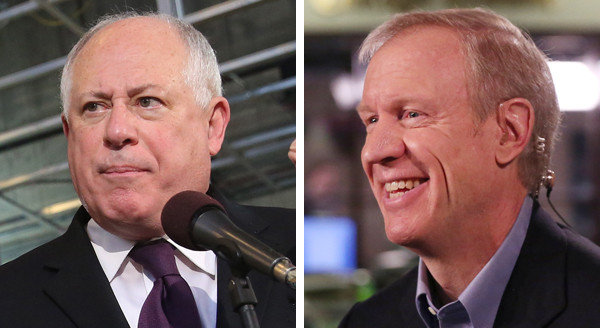
A new Illinois governor poll conducted for Human Events by Gravis Marketing found Republican challenger Bruce Rauner leading Gov. Pat Quinn 43 percent to 35 percent. In a hypothetical matchup between Michelle Obama and incumbent Republican Senator Mark Kirk, Kirk edges out the First Lady 47 percent to 42 percent.

The poll mirrors other pollsters on Quinn’s job performance, with just 31 percent approving of the job he is doing and 54 percent expressing disapproval. However, as far as President Obama, according to the survey only 47 percent approve of their hometown hero, which is fewer than the 53.7 percent measured by Gallup.

The Illinois governor poll reenforces our analysis of the governor’s race in the “Land of Lincoln,” as we currently rate the race “Leans Republican” on our 2014 Governor Map Predictions. However, though appears to be in serious trouble, Rauner is sailing to unseat a sitting Democratic governor in a traditionally Democratic state. Rauner must concern himself over his favorables, particularly with Democrats rushing to define him as a wealthy, uncaring businessman.

Approval of candidate Bruce Rauner was a less-than ideal 29.1 percent of all respondents from all parties, with just 49.3 percent of Republicans showing approval. “Rauner’s approval ratings carry considerable uncertainty with 25.2 percent of Independents and 34.3 percent of Republicans expressing uncertainty,” said Gravis President Doug Kaplan.

Still, it is hard to imagine a large majority of the 22 percent who say they are undecided breaking for Gov. Pat Quinn when his approval is so low. He only receives the approval of a small majority — 56.2 percent — among those in his own party.

A new Illinois governor poll conducted for

mickey rooney dead

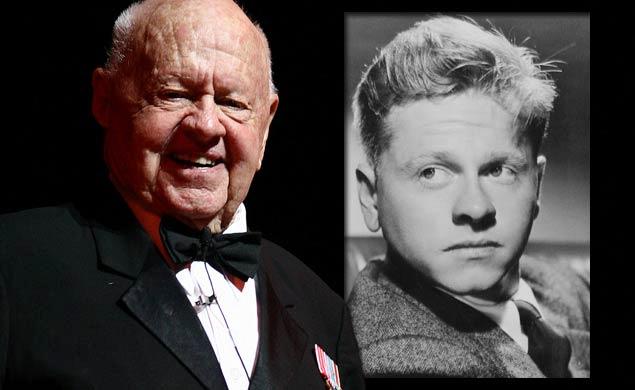
Actor Mickey Rooney dead at age 95. The entertainment legend appeared in over 100 films.

Legendary actor Mickey Rooney, who first saw a stage before the age of two and first won fame as the teenage Andy Hardy, died Sunday at the age of 93. The entertainment giant appeared in over 100 films, not counting his numerous stints on television and in the theater.

Los Angeles Police Commander Andrew Smith told the Associated Press that Rooney died at his home in North Hollywood, Calif. in the company of his family. Smith said police took a death report, but it was not a police case, suggesting the actor died of natural causes. Smith gave no additional details on the circumstances of Rooney’s death.

Rooney was the consummate performer. “I’ve always enjoyed the lights of the theater,” he wrote in his autobiography “Life is Too Short.” “No wonder that even now, when I open a refrigerator door, I feel like performing.”

Along the way, Rooney filled Hollywood headlines for marrying his eight wives, including the beautiful actress Ava Gardner. “Always get married early in the morning,” he once quipped. “That way, if it doesn’t work out, you haven’t wasted a whole day.”

Rooney had been married for 35 years to his last wife, Jan Chamberlin, who survives him. He also is survived by eight children after his ninth died in 2006.

Mickey Rooney was the last surviving big male star from the 1930s era. He was also one of the very few actors left who had gone from silent movies to 21st century films.

Born Joseph Yule Jr. on September 23, 1920 to vaudeville actors, Rooney literally crawled onstage at just 14 months-old, wearing a little harmonica around his neck, and his father scooped him up and introduced him to the audience as Sonny Yule. By 17 months-old, he was part of his parents’ routine in a specially tailored tux.

By 14, he had changed his name to Mickey Rooney and signed with MGM Studios; three years later he landed the role of Andy Hardy in the 14-film series that brought him fame and an abiding friendship with Judy Garland.

“Judy and I were so close we could’ve come from the same womb,” he once said. “…There was no love affair there, there was more than a love affair…It was a forever love.”

His big break came in the form of his breakthrough role as a dramatic actor came in 1938’s “Boys Town” alongside Spencer Tracy. In 1939, 1940 and 1941, he was the world’s biggest box-office draw.

Some of his other well-known films were “National Velvet,” “Breakfast at Tiffany’s,” “Requiem for a Heavyweight,” “The Black Stallion” and “Night at the Museum.”

Rooney won two Academy Awards (a 1939 juvenile award and a 1983 Honorary Award), an Emmy and two Golden Globes.

“I don’t regret anything I’ve ever done,” he once said. “I only wish I could have done more.”

Legendary actor Mickey Rooney, who first saw

medicaid enrollment

Nearly one-fifth of all Americans — 61 million nationwide — are on Medicaid, the already-financially insolvent government-run health care program. States who participated in the Medicaid expansion program under ObamaCare, will be in serious financial trouble after the initial three years are up, when Uncle Sam no longer bares any of the financial burden.

A new report from the Centers for Medicare and Medicaid Services found states who opted out of the Medicaid expansion see their states’ Medicaid enrollment rolls expanding their rolls at only a fraction of the rate as those who opted in, with some states even reporting a net decrease relative to the prior year baseline.

In total, for the 46 states (including the District of Columbia) who reported both February 2014 enrollment data and data from July — September of 2013, which is the pre-open enrollment baseline period, roughly 61.0 million individuals (nearly one-fifth of the total 312 million) were enrolled in Medicaid and CHIP in February, a gain of around 3 million additional individuals and a 5.2 percent increase over the average monthly enrollment for July — September of 2013.

In states who opted for the Medicaid expansion and whose expansions were in effect in February 2014, Medicaid enrollment rose by a whopping 8.3 percent compared to the July — September 2013 baseline period, while states that are not expanding Medicaid reported just a 1.6 percent increase over the same period.

Even before the passage of ObamaCare, the Medicaid actuaries warned of the program’s insolvency. According to a document obtained by People’s Pundit Daily in Nov. from the Center for Medicare and Medicaid Services, new ObamaCare costs are projected to push total health expenditures to over $5 trillion a year by 2022.

“In 2014, national health spending is projected to rise to 7.4 percent, or 2.1 percentage- points faster than in the absence of reform [or, passing ObamaCare], as the major coverage expansions from the Affordable Care Act (ACA) are expected to result in 22 million fewer uninsured people (compared to estimates that exclude the law’s impacts). Increases in Medicaid spending growth of 18.0 percent and private health insurance growth of 7.9 percent both contribute to this overall acceleration in national health spending in 2014.”

However, because of the bailout provision included in the ACA, considering the risk pool is now far more slanted than previously expected, these numbers are actually understating the true cost. Even the new CMS report admits these new figures will under-project costs if used to score.

“Note that the February 2014 enrollment numbers understate total Medicaid and CHIP enrollment because not all states are reporting, the data are preliminary, and the data do not include most individuals who will later be found eligible for Medicaid or CHIP effective in February through retroactive coverage,” the report reads.

And that doesn’t even include missed data from reporting delays. Below are the tables for states expanding Medicaid and states not expanding Medicaid, which clearly show some states who were already in financial dire straits expanding at an unsustainable rate.

I wonder what kind of care Medicaid will provide when cost controls inevitably are implemented? Maybe we could ask Paul Krugman — Mr. “Yes, death panels are built into the system” — for an answer?

States Expanding Medicaid

Marketplace Type

Enrollment

Total Medicaid and CHIP Enrollment, January 2014 (updated) (IX)

Total Medicaid and CHIP Enrollment, February 2014 (preliminary) (X)

Pre-ACA Monthly Average Medicaid and CHIP Enrollment (July-Sept 2013) (XI)

% Change From Pre-ACA to February 2014 (XII)

Arizona

1,207,102 1,234,401 1,201,770 2. 7%

Arkansas

751,576 763,356

680,920 12. 1%

California

9,816,000 9,999,000 9,157,000 9. 2%

Colorado

946,477 962,210 783,420

22. 8%

Connecticut

—-

Delaware

227,971 230,165 –

District of Columbia

235,041 238,000 235,786 0. 9%

Hawaii

307,112 313,669 288,357

8. 8%

Illinois

2,751,808 2,735,224 2,847,460 -3. 9%

Iowa

547,950 557,501 493,516

13. 0%

Kentucky

943,673 982,229 840,926 16. 8%

Maryland

1,023,129 1,034,084 856,297

20. 8%

Massachusetts

1,453,932 1,453,213 1,296,359 12. 1%

Michigan

1,849,657 1,879,568 1,912,009

-1. 7%

Minnesota

973,782 938,480 873,040 7. 5%

Nevada

381,137 404,825 332,560

21. 7%

New Hampshire

130,444 133,1 10 127,082 4. 7%

New Jersey

1,322,484 1,361,513 1,283,851

6. 0%

New Mexico

594,609 602,014 572,1 1 1 5. 2%

New York

5,775,826 5,823,995 5,678,417

2. 6%

North Dakota

– – 66,786 –

Ohio

2,339,557 2,361,103 2,341,481

0. 8%

Oregon

842,639 844,220 626,356 34. 8%

Rhode Island

217,110 224,583 190,833

17. 7%

Vermont

166,206 168,233 127,162 32. 3%

Washington

1,325,334 1,369,179 1,117,576

22. 5%

West Virginia

456,781 473,401 354,544 33. 5%

Subtotal for States Expanding Medicaid

36, 587, 337 37, 087, 276 34, 285, 617 7. 7%

Subtotal for States with Expansions in Effect in February

34, 607, 236 35, 074, 598 32, 246, 526 8. 3%

Subtotal for States Expanding Medicaid who reported in the reporting month and the baseline period

36, 359, 366 36, 857, 111 34, 218, 831

Difference, February to Baseline

2, 638, 280

States Not Expanding Medicaid reported only a 1.6 percent increase over the same period.

States Not Expanding Medicaid

Marketplace Type

Enrollment

Total Medicaid and CHIP Enrollment, January 2014 (updated) (IX)

Total Medicaid and CHIP Enrollment, February 2014 (preliminary) (X)

Pre-ACA Monthly Average Medicaid and CHIP Enrollment (July-Sept 2013) (XI)

% Change From Pre-ACA to February 2014 (XII)

Alaska

117,483 116,720 120,946 -3.5%

Alabama

774,136 769,235 799,176

-3.7%

Florida

3,121,517 3,233,195 2,987,843 8.2%

Georgia

1,742,401 1,726,597 1,702,650

1.4%

Idaho

267,079 268,606 251,926 6.6%

Indiana

1,140,416 1,120,847 1,120,674

0.0%

Kansas

410,878 415,284 397,989 4.3%

Louisiana

1,004,479 1,008,176 1,019,787

-1.1%

Maine

—-

Missouri

1,041,775 1,042,951 –

Mississippi

714,243 720,292 714,055 0.9%

Montana

144,772 149,245 139,604

6.9%

North Carolina

1,786,916 1,786,369 1,744,160 2.4%

Nebraska

237,047 227,049 244,600

-7.2%

Oklahoma

803,729 814,881 790,051 3.1%

Pennsylvania

2,395,464 2,398,718 2,386,046

0.5%

South Carolina

1,011,919 1,017,333 988,349 2.9%

South Dakota

114,779 115,013 115,501

-0.4%

Tennessee

1,269,860 1,279,336 1,268,459 0.9%

Texas

4,422,076 4,425,316 4,441,605

-0.4%

Utah

300,277 330,306 322,442 2.4%

Virginia

1,029,389 1,033,119 1,003,266

3.0%

Wisconsin

1,163,603 1,146,895 1,161,876 -1.3%

Wyoming

70,392 72,378 72,207

0.2%

Subtotal for States Not Expanding Medicaid

25, 084, 630 25, 217, 861 23, 793, 214 1. 6%

Subtotal for States Not Expanding Medicaid who reported in the reporting month and the baseline period

24, 042, 855 24, 174, 910 23, 793, 214

Difference, February to Baseline

381, 696

Total Across All States

61, 671, 967 62, 305, 137 58, 078, 831 5. 2%

Total for States who reported in the reporting month and the baseline period

60, 402, 221 61, 032, 021 58, 012, 045

Difference, February to Baseline

3, 019, 976

Nearly one-fifth of all Americans -- 61

Sarah Palin appeared on “Hannity” following her guest appearance on “The Tonight Show” with new host Jimmy Fallon, where she and Fallon mocked President Obama over his handling of Ukraine. Fallon plays Russian President Vladimir Putin, who calls Palin after he learns she predicted he would invade Ukraine in 2008.

In her interview with Sean Hannity, Palin slams the new budget put forward by Budget Committee Chairman Paul Ryan (R-WI), suggesting the underlaying philosophy outlined in the proposal represented a misplaced trust in politicians and government to carry out future promises. “No, no. Bless his heart, he has more faith in politicians than I do,” she said.

“I am have been in this political environment on the local, state and federal level for a long time now, and I don’t trust future legislative bodies to adhere to today’s legislative bodies,” referring to the law’s presupposition that future lawmakers wouldn’t change the law when able. History shows time and again that — as far as budgets go — lawmakers change reforms every chance and the first chance they get.

Ryan previously told Hannity on his radio show Wednesday that he would — if given the chance — be able to convince Sarah Palin his new budget would balance the budget in 10 years, reform Medicare and Medicaid, reform welfare, eliminate green energy slush funds and corporate welfare. But Palin isn’t buying it.

“Ultimately, what Paul Ryan’s budget does is increase spending over 10 years by $1.11 trillion. That’s trillion with a ‘T’ and that stands for trouble; trouble for our nation,” Palin said, again returning to the danger of wishing and hoping future politicians abide by past law.

Both Presidents Ronald Reagan and George H.W. Bush agreed to deals with Democratic lawmakers that including the promise of leaving in place future cuts to the budget. In the case of George H.W. Bush, who agreed to a tax increase in return for spending cuts that never materialized, it cost him a second term.

Palin supports and argued for a balance budget amendment, which Reagan also supported but was railroaded by the Establishment Republicans in his own party. “That’s common sense,” she said. “We do that on the state level, now let’s do that on the national level.”

VIDEO: In her interview with Sean Hannity,

epa testing

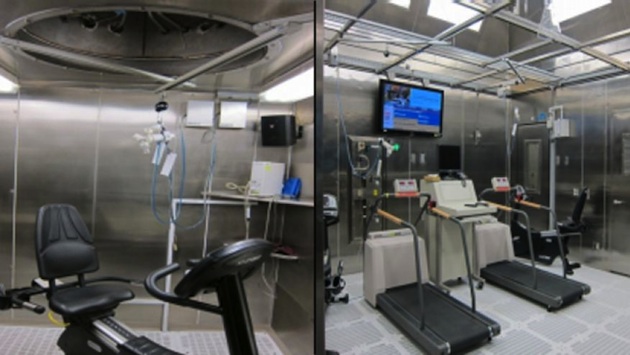
Shown here are the EPA testing labs used to expose humans to toxins in order to record the impact of pollutants on human subjects. EPA OIG

A recent IG report found the EPA tested human beings and exposed them to lethal toxins without fully disclosing health risks, all in order to justify more “clean air” regulations. Yet, scant media coverage has led to little outrage, thus Americans were offered only a minimal response from the government agency many now view to be totally out-of-control under the Obama administration.

In a written statement, the agency actually defended its work and twisted the IG report to imply it confirmed “all laws and regulations” concerning human testing were followed.

“EPA concurs with and is adopting the OIG’s recommendations to ensure its policies and procedures are strengthened even further. … All human exposure studies conducted by EPA scientists are independently evaluated for safety and ethics, and the results are peer-reviewed. EPA is committed to ensuring the protection of study participants,” the EPA statement read.

However, that’s a severely disconnected interpretation of what the IG report was attempting to shed light on. The response is referring to a sentence in the opening of the IG report, which leaves out the extent to which individuals, who were the weakest in society, including the elderly, children and the unhealthy were exposed to high levels of lethal pollutants without disclosing the risks of cancer and even death.

“While the consent forms met the requirements of 40 CFR Part 26, we found that exposure risks were not always consistently represented. Further, the EPA did not include information on long-term cancer risks in its diesel exhaust studies’ consent forms,” the IG report found.

These experiments exposed citizens, including those with asthma and heart problems, to dangerously high levels of toxic pollutants, such as fine particulate matter. Not only did the EPA fail to disclose the nature of the pollutants, but the levels and risks associated with them were omitted.  For instance, diesel fumes, were exposed to people with health issues at levels of up to 50 times greater than the agency, itself, says is safe for humans.

Even if the EPA heads had ethics enough to object to such a lack of respect for human life and rights, the IG report findings suggest the EPA testing likely still wouldn’t have proceeded.

“The EPA obtained required approvals for the five human research studies we reviewed. However, the EPA did not follow NHEERL guidance for its NHEERL reviews and approvals. According to NHEERL guidance, the branch chief must review and approve the protocol, informed consent form, and all other items to be sent to the IRB before the principal investigator sends these items to the IRB,” the report found.

This testing is based out of the University of North Carolina campus, at a facility that allows researchers to pump “gaseous pollutants at precise concentrations” into enclosed chambers. But other locations are also used. The agency report said the EPA was exposing children to pollution as part of an experiment at the University of Southern California, as well.

The EPA is authorized under federal law to perform human testing, as part of a radical effort by the Obama administration to regulate potentially harmful pollutants and seize control of land and industry. The agency, which has been well-funded under the Obama administration and an incompetent Congress, has spent millions of dollars on this research and court challenges in what many have called an unprecedented power grab. Clean air and clean water are just means to an end.

In late March, the Environmental Protection Agency proposed a rule change to the Clean Water Act, which would create granted authority over temporary wetlands and waterways, such as rain puddles and tiny creeks. The new proposal drew immediate criticism and raised concerns that the regulatory power will translate into new, dangerous EPA regulations that extend into seasonal ponds, streams and ditches, including those on private property.

However, without a national media willing to cover what is clearly a national scandal and outrage, the out-of-control agency will evidently continue to operate out of the boundaries of the Constitution, and basic human decency.

Table 1: Health impacts from exposure to fine particulate matter and diesel exhaust

Pollutant

Exposure

Respiratory impacts

Cardiovascular impacts

Other impacts

PM2.5

Short-term exposurea

Aggravated lung disease, causing asthma attacks and acute bronchitis, and may also increase susceptibility to respiratory infections.

In people with heart disease, exposure linked to heart attacks and arrhythmias.

Mortality

Long-term exposure

Respiratory-related disease and respiratory effects.

Cardiovascular-related mortality and cardiovascular effects.

Mortality and suggestive of lung and other cancers and reproductive and developmental effects.

Diesel exhaust/PM

Short-term exposurea

Respiratory effects including irritation to throat and lungs, a cough, nausea and exacerbated asthma.

Cardiovascular effects such as worsening heart disease.

Irritation to the eyes and nose and neurological effects such as lightheadedness.

Long-term exposure

Respiratory effects including lung inflammation.

Lung cancer and mortality.

Source: OIG analysis of the EPA’s Integrated Science Assessment for PM, EPA websites on particulate matter and diesel particulate matter, National Ambient Air Quality Standards for PM (December 2012) and the U.S. EPA. Health Assessment Document for Diesel Engine Exhaust (Final 2002). U.S. EPA Office of Research and Development, National Center for Environmental Assessment, Washington, D.C., EPA/600/8-90/057F, 2002.

a. According to the agency, short-term epidemiological studies generally involved exposures ranging from 1 to 5 days. The length of the exposure sessions for the five studies the OIG reviewed can be found in table 3.
b. Health impacts for diesel exhaust were combined because sources did not distinguish between short- and long-term effects.

A recent IG report found the EPA

The economy added 192,000 jobs in March, the Labor Department said Friday, slightly below economists’ forecast of 200,000 new jobs and under February’s revised total of 197,000. Employers added a combined 37,000 more jobs in January and February than previously estimated.

The March unemployment rate was unchanged at 6.7 percent, or 10.5 million, but at least a half-million Americans started looking for work last month, most of them finding relatively low paying positions. The number of people who are involuntary employed, part-time workers was little changed at 7.4 million in March, unable to work full time because their employers have scaled back on hours. Food services and drinking places logged in 30,000 jobs, making a whole 323,000 of the total for the year.

However, the increase in job-seekers is a sign that if Americans are optimistic about their prospects, then they will still seek a job in big numbers.

March’s job gain nearly matched last year’s average monthly total, suggesting that the economy will not likely average the 250,000 jobs monthly need to keep pace with current population growth.

Stock markets reacted favorably to the news. The broad S&P 500 index rose 0.36 percent to 1,895.59, while the Dow Jones Industrial average rose 0.23 percent to 16,610.96. The Nasdaq Composite rose 0.12 percent to 4242.98.

However, more than six years after the Great Recession, private employers have finally recovered all the jobs lost to the recession. The employers shed 8.8 million jobs in the downturn; they’ve since hired 8.9 million. Still, because the population has grown over that time, it is little cause for celebration. The lost economic growth in what is the recovery that never was has left the unemployment rate elevated, where it will likely remain without the BLS playing numbers games.

The proportion of Americans in the labor force — those either working or seeking work — has ticked up this year after steady declines since June of 2009. The labor force increased by 1.5 million in the January-March quarter after shrinking by 500,000 last year. The labor force for the majority of Barack Obama’s tenure has been at or even below that of Jimmy Carter’s tenure, over 30 years ago.

The labor force participation rate was 63.2 percent and the employment-population ratio was 58.9 percent, both numbers are nothing to get excited about and nearly the same as in February. The number of people employed part-time for economic reasons was also little changed at 7.4 million in March, according to the Labor Department.

The number of long-term unemployed (those jobless for 27 weeks or more) came in at 3.7 million, which changed little in March. Unfortunately, these individuals accounted for 35.8 percent of the unemployed.

Americans worked an average of 34.5 hours last month, up from 34.3 in February, but the increase, though small, means many Americans received larger weekly paychecks.

Yet, because of a variety of regulations holding down employers’ options, average hourly pay slipped a penny to $24.30 after a big 10-cent gain in February. The trend has been, in total, negative since the recession. These numbers were a big disappointment for many economists, who thought February’s larger-than-normal increase might signal the start of a trend.

Average hourly wages have risen 2.1 percent in the past year, but inflation has risen 1.1 percent in that time, eating much of Americans’ purchasing power.

Hiring averaged 178,000 in the first three months of this year, down from 198,000 a month in the final three months of 2013. But many economists forecast that hiring will average roughly 200,000 jobs a month for the rest of the year, which is still below the 250,000 needed to satisfy population increases and demand. Hiring at that pace may still lower the unemployment rate, however.

Many economists think growth slowed to a 1.5 percent to 2 percent annual rate in the January-March quarter, down from a 2.6 percent pace in last year’s fourth quarter. But most also forecast that steady hiring and less drag from government spending cuts should lift growth to nearly a 3 percent annual pace for the rest of the year.

The economy added 192,000 jobs in March,

People's Pundit Daily
You have %%pigeonMeterAvailable%% free %%pigeonCopyPage%% remaining this month. Get unlimited access and support reader-funded, independent data journalism.

Start a 14-day free trial now. Pay later!

Start Trial