Widget Image
Follow PPD Social Media
Saturday, January 17, 2026
HomeStandard Blog Whole Post (Page 992)

2013 club for growth scorecard

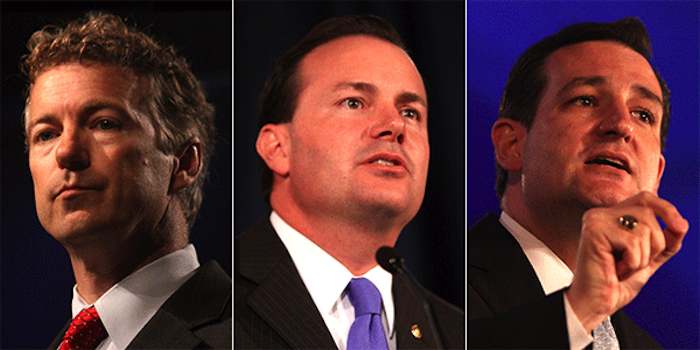
Ted Cruz (TX, right) and Mike Lee (UT, center) both received perfect scores in 2013, while Rand Paul (KY, left) had 2013 scores and LifeScores high enough to qualify for the Defender of Economic Freedom Award.

Looking at the new 2013 Club For Growth Scorecard there is little wonder why conservatives are putting up a large amount of primary challenges to leadership-backed establishment candidates. While the number of economically friendly lawmakers in Congress is currently at an all-time high, it is only do to the increased amount of true-red conservatives serving in Congress.

The mainstream media would have us believe that recent Congresses are the least-productive in modern times, but the legislative record examined in the 2013 Club For Growth Scorecard suggests that conservatives block legislation that will hurt, not help the economy.

“2013 saw the emergence of several new defenders of economic freedom as well as continued excellence among old allies,” said Club for Growth President Chris Chocola. 

“Some members have seen their voting records improve and will be honored this year with recognition of their efforts for the first time. While there are more champions of pro-economic growth policy serving in Congress than at any time before, it’s clear that our fight against the big spenders in both parties has a long way to go.”

In order to receive the Defender of Economic Freedom Award, which the group will give to 31 members of Congress this year, The Club for Growth required Representatives and Senators to not only score 90 or better on votes cast in a year, but to also have a “LifeScore” of at least 90.

Two United States Senators, Ted Cruz (TX) and Mike Lee (UT), received perfect scores in the 2013 Club For Growth Scorecard, both of whom also qualify for the Defender of Economic Freedom Award, while Sen. Rand Paul (KY) had 2013 scores and LifeScores high enough to qualify for the Defender of Economic Freedom Award.

Senator Paul was also joined by Senators Pat Toomey (PA), Marco Rubio (FL), Tom Coburn (OK), Jim Inhofe (OK), Tim Scott (SC) and Jim Risch (ID), all having 2013 scores and LifeScores high enough to qualify for the Defender of Economic Freedom Award.

Though the number of pro-growth lawmakers is at an all-time high, just 22 current House members received scores of 90 percent or better in 2013 who also had LifeScores of 90 or better, with only four members of Congress receiving 100 percent ratings in 2013.

Democrats have a shameful scorecard, generally hostile to pro-economic growth policies. Out of their 55 seat majority, a whopping 19 Senate Democrats actually scored zero in 2013, while every single Senate Democrat received a 20 percent or worse score, with only 3 Democrats scoring higher than 10 percent. The full Senate scorecard is below:

In the House, the situation for Democrats was slightly better. However, the 2013 Club For Growth Scorecard displays shameful GOP establishment scores.

Democratic leadership scores in 2013 were as follows: Pelosi 12%, Hoyer: 19%, Clyburn: 15%, Becerra: 12%, Van Hollen: 15%.

Republican Leadership scores in 2013 were as follows: Boehner: N/A, Cantor: 68%, McCarthy: 53%, McMorris Rodgers: 59%, Lankford: 70%, Ryan: 79%.

The highest scoring Democrat was a 40 percent tie between Congressman Jim Matheson (UT-04) and Congressman Mike McIntyre (NC-07), both of whom represent conservative districts and are facing difficult reelections. Nevertheless, the two Democrats actually scored higher than four Republicans.

Representatives Diaz-Balart (FL-25), Ros-Lehtinen (FL-27), Grimm (NY-11) and Gibson (NY-19). Ros-Lehtinen (FL-27), Grimm (NY-11), and Gibson (NY-19) tied for last among Republicans, each with a 37 percent score.

Click below for a complete list of House scores:

2013_Club_For_Growth_Scorecard_House

In the 2013 Club For Growth Scorecard,

Viktor Yanukovych

Ukraine’s acting government announced Monday that an arrest warrant has been issued for the country’s former president, Viktor Yanukovych.

Ukraine’s acting government announced Monday that an arrest warrant has been issued for the country’s former president, Viktor Yanukovych. There have been conflicting reports as to the whereabouts of the former president, as well as whether or not he has either been arrested or currently being protected by Russia.

In a statement on his official Facebook page, acting interior minister Arsen Avakhov wrote that Yanukovych and several other officials were wanted on charges of “mass killing of civilians” in violence that engulfed Ukraine’s capital city of Kiev.


At least 82 people, most of which were protesters, were killed in clashes with members of the police and security forces, including protestors who were shot by snipers overlooking the protestors’ camp in Independence Square.

Calls were mounting in and out of Ukraine to put former president Viktor Yanukovych on trial after a tenure that saw power grabs, paying off political allies and violent crack downs on protesters.

“We must find Yanukovych and put him on trial,” said protester Leonid Shovtak, 50, who is a farmer from the western Ivano-Frankivsk region. Shovtak came to Independence Square in Kiev to take part in the protests. “All the criminals with him should be in prison.”

Arsen Avakhov said Yanukovych arrived in the pro-Russian Black Sea peninsular region of Crimea on Sunday and relinquished his official security detail before driving off to an unknown location.

Early Monday, Ukrainian law enforcement agencies denied having information about the whereabouts of Viktor Yanukovych, who reportedly was seen in the port city of Sevastopol, home of Russia’s Black Sea Fleet. The Ukrainain news organization Liga.net reported that Sevastopol residents witnessed Yanukovych being escorted by Russian marines.

Ukraine’s border service said he tried to fly out of the country Saturday from Donetsk, however, he was turned away by their officials.

Opposition lawmaker Volodym Kurennoy said on his Facebook page that he had unconfirmed information that the president had been arrested in Crimea.

But neither of these claims could not be independently verified by PeoplesPunditDaily.com, and spokespersons for the regional and national Interior Ministry and Security Service said Monday they do not have information to corroborate either of them.

The Ukraine protests started at the end of November in response to President Yanukovych’s rejection of a landmark trade deal with the EU in favor of closer ties with Russia.

After signing an agreement with the opposition to end a bloody clash, Yanukovych was forced to flee the capital for eastern Ukraine. Hours after the release of Yulia Tymoshenko, the arch-rival of Viktor Yanukovych, protestors stormed the palace forcing the Russian-backed leader to flee Kiev.

Russia’s prime minister said the legitimacy of the new Ukrainian authorities is questionable.

Dmitry Medvedev said Monday, according to Russian news agencies, that the new authorities have come to power as a result of “armed mutiny,” so their legitimacy is causing “big doubts.”

He said that Russia doesn’t know with whom to communicate in Ukraine, and criticized the West for recognizing the new authorities following the ouster of Yanukovych.

Ukraine is facing serious financial challenges, and the recent developments have squashed previous arraignments to fulfill and meet financial deadlines.

On Monday, the acting finance minister said that the country needs $35 billion (25.5 billion euros) to finance the basic functions of government this year and the next. He said hope that Europe or the United States would help. Russia had pledge financial assistance when Viktor Yanukovych was still the legitimate president, but said now they will put those funds on hold.

Ukraine's acting government said an arrest warrant

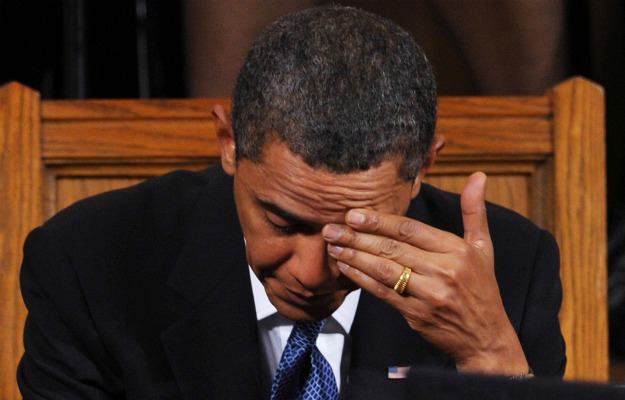
When President Obama began his tenure, part of the hope and change they were looking forward to restoring respect for the president around the world. Unfortunately, President Obama never understood that while nations didn’t respect President Bush, they feared him and worked with him. Now, Obama is neither feared nor respected, and Americans know it.

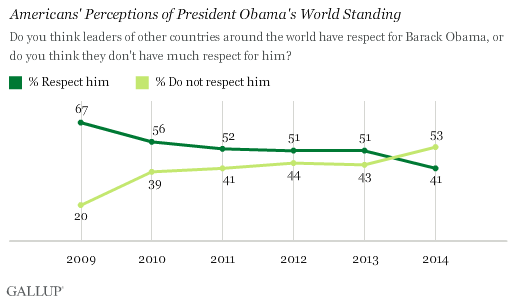
For the first time, according to Gallup’s annual World Affairs poll, a majority of Americans think President Obama is not respected by other world leaders. The dramatic shift was fueled by Democrats who shed 11 points down to 69 percent and, even more so, independents. Now, by a wide 57 to 34 percent margin, independents believe world leaders do not respect President Obama.

President Obama

After being relatively stable from 2010 to 2013, more American now believe President Obama is not respected by world leaders. (Gallup)

Republicans, unsurprisingly, have thought world leaders don’t respect the president for quite some time, but the number has crept up slightly to 77 percent from 74 percent.

In 2013, the president suffered a series of foreign policy defeats over Syria, which led into an Iran deal that was supported by Americans until it became clear that Obama was being played by the regime. These events are not taking a toll, and it has caused a dramatic shift in public opinion. We can tie the shift to specific policy failures because, Americans still thought world leaders respected Obama in 2010 and 2011, when his job approval rating was roughly the same it is now.

The lack of confidence in how Americans think the world leaders perceive Obama is a recent development, which suggests it may be more tied to specific foreign policy developments from 2013. In 2013, we learned the U.S. was listening in on foreign leaders’ phone calls, Obama failed to get a resolution for Syria after Putin ran circles around him, and tensions have been increasing with Russia.

However, at least a small number of Democrats and a large number of independents have been uncomfortable with the sour relationship between President Obama and Israeli Prime Minister Benjamin Netanyahu. It would be no surprise to see pro-Israel blocs in these groups begin to react to that relationship.

Overall, 61 percent of Americans are dissatisfied with the position of the United States in the world today, and 37 percent are satisfied. However, that level of dissatisfaction is not Obama-specific and has been fairly consistent since 2007. Though it is ticking up under President Obama, the last time a majority of Americans were satisfied with the position of the U.S. in the world was in 2003, just after the U.S. ousted Saddam Hussein’s regime in Iraq.

Under President Bush, U.S.-Russian relations were stable and far more favorable to the U.S. than they were for Putin and Co. For better or worse, whether or not you agree with a particular policy or not, it would appear that President Bush governed on the international stage through the Bush doctrine, which held the primacy of U.S. power in the world as the highest bargaining chip. He was not seen as respected by his own people among world leaders, but he was effective. Under Obama, it would seem Americans don’t believe either is true for President Obama anymore.

After being relatively stable from 2010 to

http://youtu.be/p89u-WlmO-E

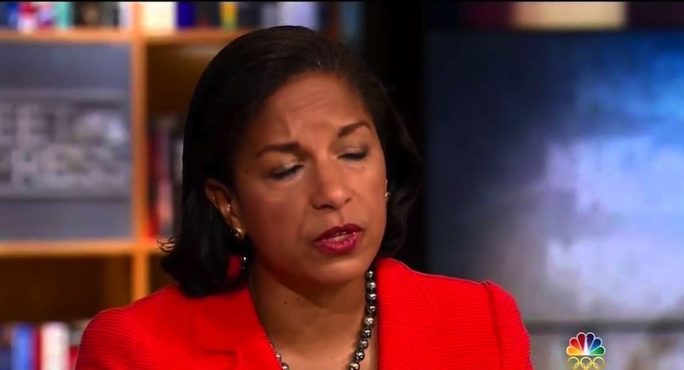
In an appearance on “Meet The Press,” on NBC News, National Security Adviser Susan Rice told David Gregory that she admits to giving inaccurate information on the Benghazi attack, but has no regrets.

Immediately following the Sept. 11 attack in Benghazi, Rice made full rounds of the Sunday TV talk shows, during which she gave blatantly false information that was later proven incorrect.

“What I said to you that morning, and what I did every day since, was to share the best information that we had at the time,” Rice told moderator David Gregory on “Meet the Press” Sunday. “The information I provided … was what we had at the moment.”

Rice said “No,” when Gregory asked whether she had any regrets about her statements. She also claimed nobody in the administration intended to mislead the public, despite the recently released testimony clearly suggesting otherwise, but acknowledged some of her information was inaccurate.

On the Sunday shows, Rice said the Benghazi attacks appeared to be a “spontaneous reaction” to an anti-Islamic video on the Internet.

However, recently declassified Benghazi documents reveal Obama was told only that the attack in Libya was a terror attack, not a reaction to a video. The former head of AFRICOM, General Carter Ham, told the House Armed Services Committee that the White House situation room was alerted immediately after the attack.

“That information turned out, in some respects, not to be 100 percent correct,” Rice said. “But the notion that somehow I or anybody else in the administration misled the American people is patently false. And I think that that’s been amply demonstrated.”

On “Face The Nation” Sunday, Arizona Senator John McCain literally busted into laughter in response to Rice’s statements during her latest interview. “I’m almost speechless because it’s patently obvious, first of all, that Susan Rice had no reason to be on the programs, she had no involvement in it,” McCain said.

“Second of all, she read talking points that we are now beginning to believe came from the White House, which were absolutely false.”

We now know that the CIA station chief on the ground sent a message immediately saying ‘not/not spontaneous demonstration,'” McCain said, referring to testimony given to congressional lawmakers. “And, of course, the information was totally misleading, totally false, and for Susan Rice to say such a thing, it’s a little embarrassing to tell you the truth.”

She was, at the time, the U.S. ambassador to the United Nations and a top candidate to become secretary of state. Following intense political pressure, Rice withdrew herself from consideration in the wake of the attacks on the U.S. outpost in Benghazi, Libya, after the firestorm of criticism she received for her response.

Rice said Sunday she didn’t know whether her responses killed her chances of getting the top U.S. diplomatic post.

“I don’t know,” she said. “What I do know is that I [now] have a great job.”

Four Americans were killed in the Sept. 11, 2012, attacks, including U.S. Ambassador Christopher Stevens. Former Navy SEALs Tyrone Woods and Glen Doherty, and State Department information management officer Sean Smith, also died in the attack.

The administration later said the attacks appeared pre-planned, and pretended to have said it along, but they continued to maintain that exactly who and what started them remained unclear. Despite several investigations, and multiple references to the video during Obama’s speech in front of the U.N. General Council, the administration continues to perpetuate the easily played back falsehood.

In an appearance on "Meet The Press,"

Kansas Senate race

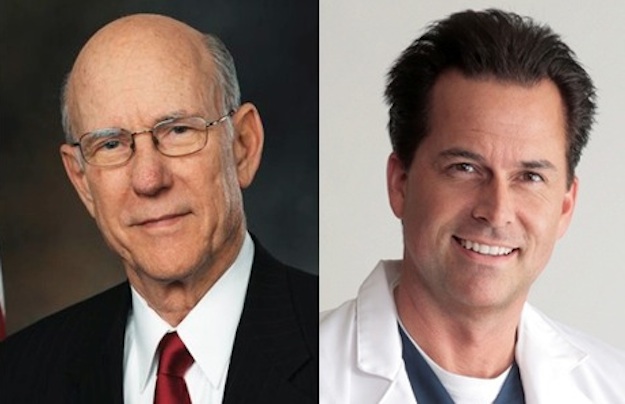
Incumbent Senator Pat Roberts (left), will be forced to defend against his primary challenger, Dr. Milton Wolf (right) in the Kansas Senate race.

The Kansas Senate race is the fifteenth article in a succession of articles offering expanded analysis on the ratings on the PeoplesPunditDaily.com 2014 Senate Map Predictions. Though the general election is rated “Safe Republican,” incumbent Senator Pat Roberts will have to attempt to fend off a challenge from Dr. Milton Wolf in the Republican primary.

Thus far, I have released expanded analysis for the following Senate races:

AlaskaArkansasIowaKentucky, Louisiana, MichiganMontana, North Carolina, Mississippi, West VirginiaVirginiaColorado and Oklahoma, with New Hampshire recently released earlier in February.

Senator Pat Roberts is ensuring any primary challenge from Dr. Milton Wolf will be difficult, as he’s planning to raise a bunch of money. Unfortunately, we have little polling at this point to go on in the Kansas Senate race. Roberts released internal polling from mid-January that found him leading Wolf by an overwhelming 54-point margin, fueled by a 78 percent favorable rating among Republican primary voters.

However, in the latest survey conducted by the Democratic polling firm PPP, Roberts is suffering from an abysmal 29 percent overall approval rating. Wolf trails Roberts 49 to 23 percent, but PPP is rated a 4 out of a possible 1 through 4 based on past accuracy in our model used at People’s Pundit Daily, which weighs pollsters’ past performance to determine how much justifiable influence a poll should have on a race’s rating or average.

However, if it is true, then it is largely due to name recognition, as PPP found only 24 percent of GOP primary voters know who he is. Considering Wolf is garnering an impressive 23 percent with only 24 percent name recognition, as well as leading the likely Democratic nominee, it is worth looking at who is helping to exploit what appears to be an opportunity.

The list of conservative powerhouses getting behind the doctor is enough to be of grave concern to Roberts. Wolf recently received a welcomed endorsement from conservative talk radio host, Mark Levin, which will no doubt help him increase name recognition among Republican primary voters. In addition, Wolf has the backing of the Senate Conservatives Fund, as well as the Madison Project, who launched a site called RetireRoberts.com.

Even a recent New York Times article covered the criticism by Wolf for how much time Sen. Pat Roberts actually spends at his supposed home in Dodge City, Kansas. “He didn’t bother to reestablish his Kansas Residency until October 7th of 2013, once I got into the race. Before then he owned rental property in Kansas, but he leased that house; someone else lived there,” Wolf said.

“People don’t know him. They haven’t seen him. Even in his backyard, people haven’t seen him because he’s been in Washington for 47 years.”

Senator Roberts, whose campaign clearly saw the potential threat from this line of attack during an anti-establishment cycle, attempted to explain away the lack of time spent in the state he supposedly represents. Though Roberts does own a home in Dodge City, he rents it out and hasn’t been seen living there in years until he came under fire.

“I live in Dodge. I pay taxes in Dodge. We own a home in Dodge. That’s where we just spent the last two or three days,” Roberts told KSHB Kansas City. It is unclear whether or not it will continue to resinate, but if PPP versus the internal polling results have anything to offer, it is that Wolf is gaining ground.

We are watching this race closely and moving our rating from “Safe Roberts” to “Likely Roberts” in the Republican primary, which could change on a dime. Unlike Sen. Roberts, Dr. Milton Wolf actually put forward a plan to replace ObamaCare, known as PatientCare, which is a 17-page proposal that “would create a patent-centered, market-driven health care system that offers Americans high quality, affordable care.”

In an election cycle that is likely to hinge largely on the president’s and Democrats’ health care law, this could be a big boon for Wolf as the campaign kicks into high gear and begins to draw more voter attention.

On the Democratic side, Chad Taylor emerged as the only challenger worth polling, though he is still undeclared. Roberts leads Chad Taylor by a healthy 48 to 32 margin, despite having a 29 to 38 percent disapproval rating spread. However, Democrat hasn’t represented Kansas in the Senate since 1939, the longest shutout for the Democratic Party in the entire country.

President Obama currently has an approval rating of 35 percent, which actually represents a small uptick in Gallup tracking for the month of February. Unlike the gubernatorial contest that is developing into a slightly less certain situation, there is a strong relationship between presidential approval rating and Senate election outcomes since 1980.

The Partisan Voting Index inched up from R+11 in 2010 to R+12 in 2014, which is also corroborated by the annual Gallup party ID by state measurement.

View Kansas Senate Race Polling Below Or 2014 Senate Map Predictions

General Election: Robert vs. Taylor

Poll Date Sample Roberts (R) Taylor (D) Spread
PPP (D) 2/18 – 2/20 693 RV 48 32 Roberts +16

General Election: Wolf vs. Taylor 

Poll Date Sample Wolf (R) Taylor (D) Spread
PPP (D) 2/18 – 2/20 693 RV 33 32 Wolf +1

Republican Primary: Roberts vs. Wolf

Poll Date Sample Roberts Wolf Spread
PPP (D) 2/18 – 2/20 375 RV 49 23 Roberts +26
The Terrance Group 1/13 – 1/15 375 RV 69 15 Roberts +54

The Kansas Senate race is the fifteenth

Ukraine President

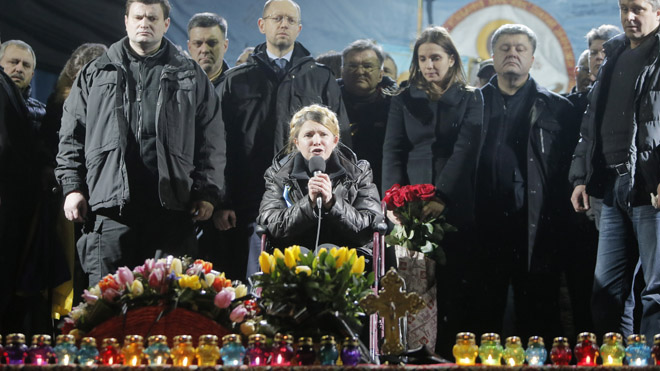
Former Ukrainian prime minister Yulia Tymoshenko addresses the crowd in central Kiev, Ukraine, Saturday, Feb. 22, 2014. Hours after being released from prison, former Ukrainian prime minister and opposition icon Yulia Tymoshenko praised the demonstrators killed in violence this week as heroes.(AP Photo/Efrem Lukatsky)

Hours after the release of Yulia Tymoshenko, the arch-rival of the now-ostracized Ukraine President Viktor Yanukovych, protestors stormed the palace forcing the Russian-backed leader to flee Kiev. He denounced what he and his Russian allies characterized as a “coup” carried out by “bandits” and “hooligans.”

Tymoshenko, who was released from prison after 2 1/2 years in captivity, spoke to a crowd of about 50,000 from a wheelchair she is remanded to due to the severe back problems she suffered in prison. Only one day earlier, President Yanukovych signed an agreement with opposition leaders that limited his powers and called for early elections.

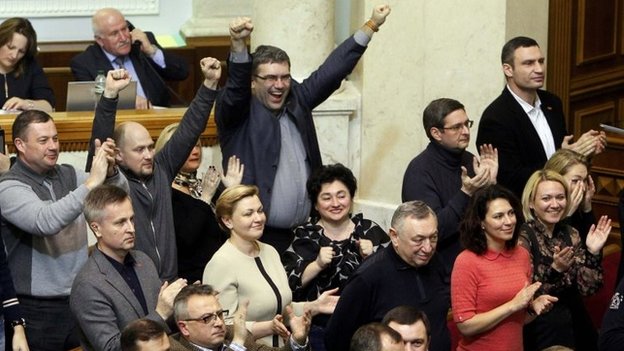
However, under the leadership of Oleksandr V. Turchynov, a former acting prime minister and close ally of Tymoshenko, a veto-proof majority of more than 300 of the 450 seats in the Ukrainian Parliament voted to declare the president unable to fulfill his constitutional duties and set a date for new elections.

In Kharkiv, Yanukovych was defiant in tone and words, declaring that he viewed the actions of the Ukrainian Parliament as invalid and likened the protestors to Nazis. “Everything that is happening today is, to a greater degree, vandalism and banditry and a coup d’etat,” he said. “I will do everything to protect my country from breakup, to stop bloodshed.”

But bloodshed there has been during the crisis in Ukraine. The Health Ministry on Saturday said the death toll from clashes between protesters and police, which included sniper attacks, had reached 82.

Ukraine President

In Kiev on Saturday, opposition members, including Vitaly Klitschko, top right, celebrated as Ukraine’s Parliament voted to remove President Viktor F. Yanukovych from office hours after he abandoned his office to protesters and denounced what he described as a coup. (Reuters)

Though visibly exhausted, Tymoshenko was at no loss for passionate words, a speech which the crowd eagerly listened to with seemingly unending chants of “Yulia! Yulia!”

“You are heroes, you are the best thing in Ukraine!” she said of those killed in the violence, vowing to run for president and promising “no drop of blood that was spilled will be forgotten.”

However, appearing on television from Kharkiv, Yanukovych made clear that he has no plans to leave his position, and though he had been abandoned by his guards, he isn’t exactly alone.

“I don’t plan to leave the country. I don’t plan to resign,” he said, notably speaking in Russian rather than Ukrainian, which is the country’s official language. “I am a legitimately elected president. What is happening today, mostly, it is vandalism, banditism and a coup d’état. This is my assessment and I am deeply convinced of this. I will remain on the territory of Ukraine.”

He characterized those who abandoned him as “traitors,” but he did not name them. Regional governors from eastern Ukraine apparently remain on Yanukovych’s side. They met in Kharkiv and adopted a resolution effectively denouncing the Parliament. They said that until the crisis is resolved, “we have decided to take responsibility for safeguarding the constitutional order, legality, citizens’ rights and their security on our territories.”

Russian Foreign Minister Sergey Lavrov on Saturday called the German, French and Polish foreign ministers and urged them to use their influence with the Ukrainian opposition to stop what is quickly becoming a forced transfer of power. But they did little other than call on them to be calm in their actions. Thursday the EU agreed in an emergency meeting to impose sanctions against the government.

“This commences a new life for Ukraine,” said protestor Roman Dakus. “This is only a start.” Another protester Viktor Fedoruk, 32, was among those who were placing flowers on the coffins of the dead.

“These are heroes of Ukraine who gave their lives so that we could live in a different country without Yanukovych,” he said. “Their names will be written in golden letters in the history of Ukraine.”

Hours after the release of Yulia Tymoshenko,

new china

Since the end of World War II, U.S. foreign policy has been predicated on liberal internationalism’s view that holds exporting economic opportunity will increase stability in the world. During the Clinton Administration, much of this internationalist view was put into practice, breaking from the traditional tie that connects liberalism with the policy of détente pursued during the Nixon Administration.

Both détente and engagement consist of open dialogue, but the liberal internationalist policy of engagement cedes economic power to state actors in the hope that economic interdependence will reduce the potential for conflict. Further, they view this process as a necessary means to push nation-states closer to democratization, which they view as inevitable as economic prosperity grows.

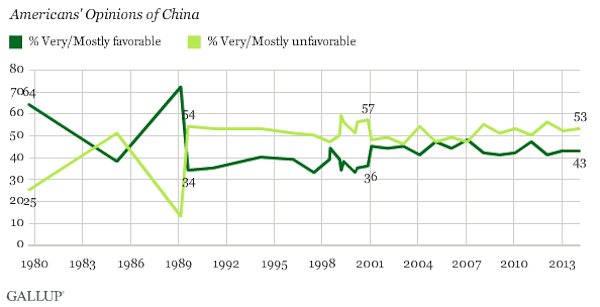
Clearly, and I contend, a simple observation of Americans’ views of China over time represents a rejection of liberal internationalist theory by American citizens. In fact, even though they view it beneficial in theory, in reality they become ever-skeptical and ever-concerned when economic growth threatens to surpass the economic power of the United States.

Though Gallup was not yet asking the question when headlines read “Nixon Goes To China,” most security experts agree Americans views of China turned positive after Nixon recruited them as a vital ally against their former-red ally, the Soviet Union. In 1979, when Gallup first asked, 64 percent of Americans saw China favorably, with just 25 percent having a “Very/Mostly unfavorable” view of the emerging Asian power.

new-China-perceptions

After Tiananmen Square, Americans’ favorable view of China bottomed out at 34 percent late. (Gallup)

Following the incident at Tiananmen Square in 1989, Americans’ view of China bottomed out dramatically to 34 percent. The Clinton foreign policy of engagement seemed to have an indifferent and immeasurable impact on public opinion. Even though China joined the World Trade Organization in 2001, the steps taken by both the U.S. and China to ensure they could join the international organization occurred under Clinton.

Ironically, the economic gains made from the policy of expanded free trade are precisely what are now fueling the negative perceptions toward the country.

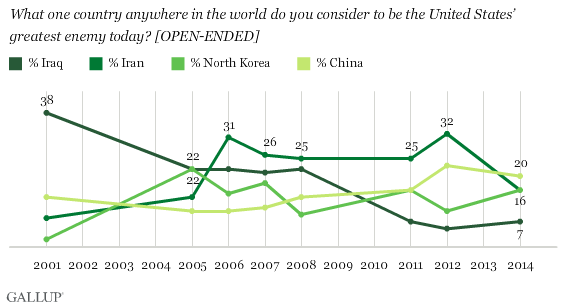
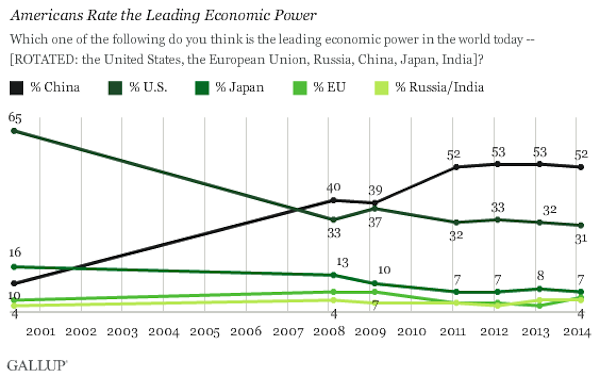
First, let’s look at the list of nations that Americans consider to be the top enemies of the U.S., then compare the trend to the question of who Americans believe to be the leading economic power. Seemingly unrelated, I know, but bare with me on this.

new china

Americans’ view on China has only slightly increased, following a similar pattern as their views on economic power. But Iran has plummeted, thrusting China to number one. (Gallup)

When we look at this time period, we must take into consideration that the “War on Terror” was in full force. As a native North-easterner, I cannot stress enough how much views were impacted by the current events. Nevertheless, we still see the usual suspects up above China until 2003, which suggests Americans base their view not on a nation’s intention, but whether or not they perceive that nation to have the power to project those intentions.

Strengthening my argument, we can clearly see China increase on the enemy list when the financial crisis hit.

new china

The U.S. still boasts a GDP almost twice that of China, but the majority of Americans (52 percent) believe China is the world’s leading economic power. (Gallup)

Americans have steadily and increasingly become aware of China’s economic power potential, recognizing economic power as a prevailing security threat. Despite headlines being filled with new China military technologies, Americans are more concerned with China’s economic power. Whether or not that is because Americans understand economic power is necessary in order to have military power, is doubtful. I would argue, however, that Americans generally understand that if you want nation-states to do what is in our interests, then you must be perceived as having a dominant economic position.

new China

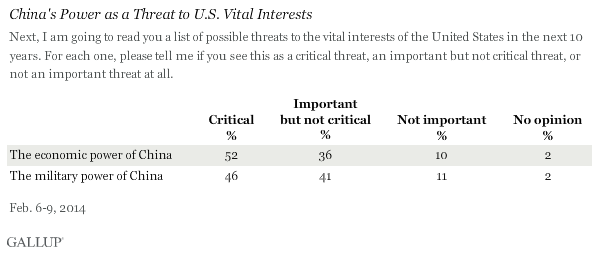
Americans are more likely to perceive China’s economy (52%) than its military (46%) as a “critical” threat to U.S. vital interests over the next 10 years. (Gallup)

When asked, Americans view China’s military strength and economic power as a threat to the vital interests of the U.S., but economic power is more concerning. While at first glance it may sound pretty straightforward, but this truly represents a complete rejection of liberal internationalist theory.

The entire purpose behind international organizations and exporting wealth is to stabilize the world politically, thus reduce the potential for war. But, in reality, economic threats are viewed more concerning than military threats by the American people. Public perceptions regarding security competition inevitably leads to nationalism, even hyper-nationalism, which then leads to a greater propensity for conflict.

With new China policy displaying an increasing dissatisfaction with the status quo in the Pacific, most recently in the form of establishing air defense zones, the potential for international crisis is growing. This past weekend, the first U.S. military boots hit central Thailand soil to kick off the official change in military and foreign policy, known as the Asia pivot.

Operation Cobra Gold, as it was dubbed, didn’t go over well in Beijing or the various state-run news agencies. Xinhua News, China’s People Daily and the China Perspective, all have been attempting to tap into Chinese nationalism for the obvious reasons I just stated above. Unfortunately, the new China looks a lot like the old China, with a large faction favoring regional hegemony. Though Gallup last year found that most Americans regarded China as more friend than foe, opinions will drastically change as U.S. economic power continues to wane and China continues to pursue regional hegemony.

The data above clearly suggest this unfortunate trend will continue. Abandoning the impractical liberal internationalist theory of foreign policy, altogether, would lead not only to a more coherent U.S. foreign policy, but the stabilization of U.S. views toward enemy and friend nations, whether for better or worse.

New China economic and military power is

Michigan governor race

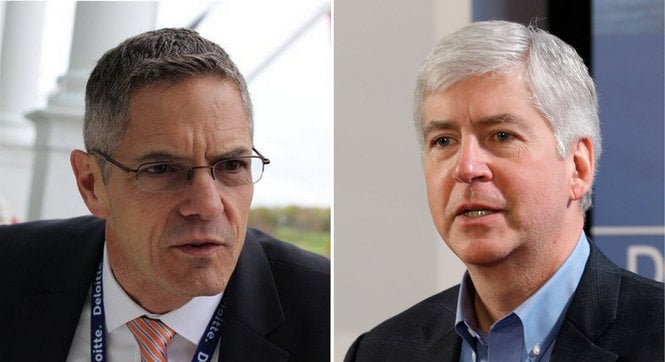
Former Democratic Rep. Mark Schauer (left), incumbent Republican Gov. Rick Snyder (right).

The Michigan Governor race is the fifth article in what will be a succession of articles offering expanded analysis released for the PPD 2014 Governor Map Predictions. With Rep. Gary Peters opting to run for retiring Sen. Carl Levin’s (D) seat and 2010 Democratic nominee Virg Bernero uninterested in another go at incumbent Republican Gov. Rick Snyder, ex-Rep. Mark Schauer (D) is the only viable Democratic nominee in Michigan.

Gov. Snyder, who officially launched his reelection earlier this month with a new 60-second TV ad, calling him “Michigan’s Comeback Kid,” raised $5.08 million in 2013. Synder has $4 million on hand and has the ability to self-fund as he did in 2010, when he spent nearly $6 million of his own money.

Ex-Representative Mark Schauer, on the other hand, raised just $1.6 million since he entered the Michigan Governor race back in June, 2013. He currently has roughly $1 million on hand, or a quarter of what Snyder boasts. Further, as an evident sign of struggle, Schauer has applied for public financing, which translates into smaller campaign expenditures. Though a Super PAC isn’t barred from topping expenses, the amount he spends between now and the August primary will likely be under $2 million.

Officially announcing at the end of May, at one time it appeared that Schauer was positioned strong to possibly unseat Gov. Rick Synder. Democrats did view Snyder as vulnerable, and publicly state that they still do, at least more vulnerable than other Midwest governors in blue or purple states, i.e. Governors Walker and Kasich.

However, the bankruptcy of Detroit turned that all around far more than other pundits seem to acknowledge. In surveys released during and after the Detroit disaster, voters widely approve of how Gov. Snyder handled the Democratic-induced financial crisis. We observe the same trend when we look at polling in the Michigan Senate race, which is rated a “Toss-Up” on the PeoplesPunditDaily.com 2014 Senate Map Predictions. Following a federal judge ruling on behalf of Snyder and the taxpayers of Michigan, there is little argument left for the Democrats to make.

In fact, Gallup party ID and PVI measurements both show Michigan moving somewhat to the right of the political spectrum. In the case of the Partisan Voting Index, in 2010 it measured at D+4 when Republicans made significant gains in the statehouse and legislature. In 2014, the PVI is predicted to again be D+4, which does represent a slight rightward movement due to population growth from minorities. We should have expected to tick up a bit in favor of Democrats if all other demographics remain stagnant.

Similarly, the annual Gallup party ID measurement of individual states found Michigan to be leaning Democrat in partisan identification. The year prior, it was solidly Democratic.

With what appears to be strong support from independents and conservative Michigan, the biggest problem the Democratic challenger will have in Michigan will be if urban strongholds remain fed up with the Democratic Party. We have seen Democrats’ inability to turn out their base in midterm elections time and time again. These numbers, and the predicted 2014 midterm electorate, could change at some point in the future. But, for now, this race is rated “Likely Republican.” And barring a change, this is another Midwest governorship that will likely stay under Republican control.

View Polling Below Or Return To 2014 Governor Map

Poll Date Sample Snyder (R) Schauer (D) Spread
PPD Average 2/5 – 4/9 47.6 38.6 Snyder +9.0
Mitchell Research 4/9 – 4/9 1460 LV 49 37 Snyder +12
PPP (D) 4/3 – 4/6 825 RV 43 39 Snyder +4
MRG (R) 3/24 – 3/28 600 LV 47 39 Snyder +8
LE&A/Denno Research (D) 3/9 – 3/10 600 LV 42 39 Snyder +3
EPIC-MRA 2/5 – 2/11 600 LV 47 39 Snyder +8
Harper (R) 1/7 – 1/8 1004 LV 47 35 Snyder +12
PPP (D) 12/5 – 12/8 1034 RV 44 40 Snyder +4
LE&A/Denno Research (D) 11/12 – 11/14 600 LV 45 31 Snyder +14
Inside Michigan Politics 10/29 – 10/29 794 LV 36 34 Snyder +2
EPIC-MRA 9/7 – 9/10 600 LV 44 36 Snyder +8
LE&A/Denno Research (D) 7/23 – 7/24 600 LV 43 37 Snyder +6
PPP (D) 5/30 – 6/2 697 RV 38 42 Schauer +4
EPIC-MRA 5/11 – 5/15 600 LV 39 39 Tie
EPIC-MRA 4/13 – 4/16 600 RV 38 39 Schauer +1
PPP (D) 3/2 – 3/4 702 RV 36 40 Schauer +4
PPP (D) 12/13 – 12/16 650 RV 39 44 Schauer +5


The Michigan Governor race is the fifth

Ukraine deal

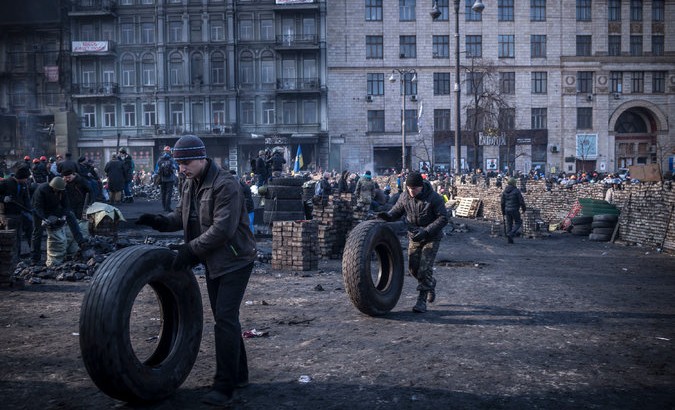
Protesters work to reinforce barricades in Kiev on Friday. (Photo: Sergey Ponomarev for The New York Times)

President Viktor Yanukovych on Friday announced early presidential elections and promised to bring opposition members into the government in an effort to defuse the country’s growing political crisis and tension.

In fact, tensions have been so high the Ukrainian deal was signed as police and anti-government protesters exchanged gunfire in and around Independence Square in Kiev.

However, President Yanukovych gave no time frame and it’s unclear whether his concessions will be enough to satisfy protesters who have occupied a piece of Kiev and government buildings around the country.

There was no immediate comment from opposition leaders, who were meeting among themselves after a marathon night of meetings with European diplomats. Thursday the EU agreed in an emergency meeting to impose sanctions against the government.

Before agreeing to impose sanctions, three European Union foreign ministers — France’s foreign minister Laurent Fabius, Poland’s foreign minister Radoslaw Sikorski, and Germany’s foreign minister Frank-Walter Steinmeier – had a five-hour meeting with President Viktor Yanukovych.

The foreign ministers, agreed on the scope of the sanctions that would be adjusted according to the developments in Ukraine. The restrictions are to be drafted into law in the coming days, Reuters reports.

Meanwhile, gunfire was exchanged near the main square in Kiev Friday morning. A police statement obtained by Reuters said Ukrainian police shot back when protesters opened fire on officers between the protest square and the parliament building.

The statement did not say whether there had been any casualties.

In a sign of the high tensions, armed law enforcement officers tried to enter parliament Friday morning during a debate over measures to end the crisis. Shouting lawmakers pushed them out.

The Ukrainian parliament on Thursday passed a measure that would prohibit an “anti-terrorist operation” threatened by Yanukovych to restore order, and called for all Interior Ministry troops to return to their bases.

But it was unclear how binding the move would be, as the mechanism for carrying it out would have to be developed by the president’s office and the Interior Ministry.

The preliminary deal struck overnight would see Ukraine’s president he would lose some of his powers, and a caretaker government created in 48 hours that would include representatives of the opposition, Slovakia’s Foreign Minister Miroslav Lajcak said.

“Of course, the participants of the talks, my colleagues, warned it is still premature to say the crisis is over.”

The head of Yanukovich’s party in parliament, Oleksander Yefremov, said the deal includes early presidential elections in December, and a constitutional vote in September.

Yanukovych also promised constitutional reforms reigning in presidential powers, which was a vital demand coming from protesters.

“As the president of Ukraine and the guarantor of the Constitution, today I am fulfilling my duty before the people, before Ukraine and before God in the name of saving the nation, in the name of preserving people’s lives, in the name of peace and calm of our land,” the president said in a statement on his website.

The Ukrainian deal came just after the worst instance of violence yet in the confrontation between security forces and protesters.

After a truce between President Yanukovych and the opposition fell apart Thursday, as fresh clashes between both sides have left at least 33 dead, bringing this week’s death toll in Kiev to 59. Dr. Oleh Musiy, the coordinator for the protesters’ medical team, claims that Thursday’s death toll alone is at least 70, but that has not been confirmed by People’s Pundit Daily or other media outlets.

Among the deceased were 10 police officers, a minimum of 21 protesters who reportedly were killed by security forces in Kiev, and a journalist working for the Russian-language newspaper,  Vesti. The journalist, Vyacheslav Veremyi, was pulled from a taxi by masked men and shot.

A statement on the website of the Health Ministry said 77 people had been killed between Tuesday morning and Friday morning, but again, there is no outlet prepared to verify any of these new death toll figures.

The US state department announced visa bans on 20 members of the Ukrainian government, however they did not provide any names. U.S. officials at the State Department reiterated Thursday that it would work with its European allies to resolve the crisis, and is now considering whether or not to join the EU sanctions. A freeze on assets and travel bans will hurt the oligarchs who back Ukrainian President Viktor Yanukovych.

Video footage emerged showing snipers firing on demonstrators who had been trying to retake their protest camp in Independence Square. Trying to protect themselves with shields, teams of protesters carried bodies away on sheets of plastic or on planks of wood.

One opposition lawmaker says police who were captured are being held in Kiev’s city hall, which is being occupied by protesters.

The Ukraine protests started at the end of November in response to President Yanukovych’s rejection of a landmark trade deal with the EU in favor of closer ties with Russia. After that move, Russia announced a $15 billion bailout for Ukraine, whose economy is in shambles.

Prime Minister Dmitry Medvedev said Russia will “try to do our best” to fulfill its financial obligations to Ukraine, but indicated Moscow would hold back on further bailout installments until the crisis is resolved.

“We need partners that are in good shape and a Ukrainian government that is legitimate and effective,” he said.

President Viktor Yanukovych on Friday announced early

(REUTERS)

Factory activity in the U.S. mid-Atlantic region contracted in February as new orders plunged, a survey showed on Thursday. The Philadelphia Federal Reserve Bank said its business activity index dove to a -6.3 reading, down from 9.4 in January.

That was far below Wall Street’s expectations of a reading of 8.0. Economists polled by Reuters expected a slight dip, but not a disturbing contraction.

A reading above zero indicates expansion, while a reading below zero indicated contraction, which now appears to be the case in the region. The regional survey covers factories in eastern Pennsylvania, southern New Jersey and Delaware.

New orders fell to a -5.2 reading down from 5.1 the month prior, a wild swing. Growth in the employment component decelerated, with the index down to 4.8 from 10.0.

The survey is seen as one of the first monthly indicators of the health of U.S. manufacturing leading up to the national report by the Institute for Supply Management. The latest economic news has not been good thus far for the month of February, validating economists’ concerns that the economy is once-again losing steam.

On Tuesday, the New York Fed manufacturing index fell to 4.48 in February, from 12.51 the month prior, widely missing Wall Street’s expectation of a reading of 9. U.S. homebuilder confidence suffered its largest one-month drop ever in the month of February, falling below the key 50 mark for the first time since May.

And Wednesday was no better.

U.S. housing starts recorded their biggest drop in almost 3 years in January, as the third consecutive month of declines in permits confirmed weakness in the housing market. The Commerce Department said Wednesday new permits plummeted 16 percent to a seasonally adjusted annual rate of 880,000 units, which is the lowest level since September.

The percentage drop, alone, was the largest since February 2011.

Yet, the Federal Reserve’s policy-setting board agreed unanimously that the central bank should continue cutting the pace of asset purchases in the Fed QE3 program in what was referred to as “measured steps.” As we discussed, the new measurement for PPI showed prices for finished goods rose 0.2 percent in January, while excluding the food and energy components, prices also rose 0.2 percent.


The Department of Labor, for the first time since 1978, is now using a revamped method for calculating prices, one in which economists say offers a broader and more accurate look at prices across the economy. However, markets rallied toward the end of the day on data showing a bit of hope for the manufacturing sector.

A report from Markit showed the factory sector revving up at a much faster pace in February than the month prior. The PMI gauge jumped to 56.7 — a nearly four-year high — from 53.7.

“The flash manufacturing PMI provides the first indications that production has rebounded from the weather-related slowdown seen in January,” Markit’s chief economist, Chris Williamson, said in the report. “While the strong PMI reading in part represents are rebound from the temporary weakness seen at the start of the year, further growth looks likely in coming months, suggesting the underlying health of the economy remains robust.”

Either way, economists are not all that convinced, but they seem adamant about blaming the cold weather for the latest economic news.


Though Markit survey conflicted, the Philadelphia Fed

People's Pundit Daily
You have %%pigeonMeterAvailable%% free %%pigeonCopyPage%% remaining this month. Get unlimited access and support reader-funded, independent data journalism.

Start a 14-day free trial now. Pay later!

Start Trial