Widget Image
Follow PPD Social Media
Saturday, January 17, 2026
HomeStandard Blog Whole Post (Page 998)

Obama-O'Reilly-Interview

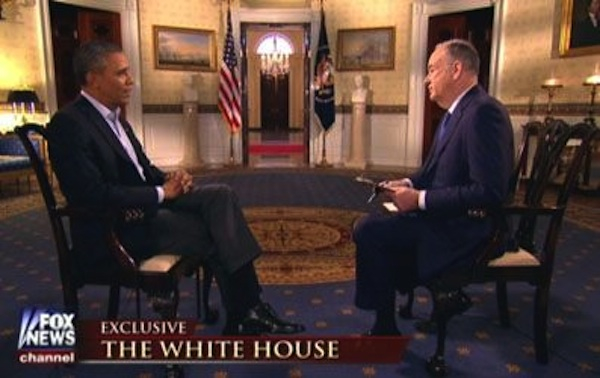
In an interview with Fox News’ Bill O’Reilly (view below), President Obama said he and his administration did not mislead the public on the Benghazi attack or the IRS scandal, claiming “not even a smidgen of corruption” was involved.

The president vehemently rejected the obvious political reasons that the IRS targeted Tea Party groups who were seeking tax exemption.

“That’s not what happened,” he told O’Reilly, claiming IRS officials were confused about how to implement the law governing those kinds of tax-exempt groups.

“There were some bone-headed decisions,” Obama said.

But as far as whether or not corruption, or mass corruption, was the case, he responded: “Not even mass corruption. Not even a smidgen of corruption.”

Obama conceded that then-IRS Commissioner Doug Shulman had visited the White House more than 100 times, including in the days before the decision to target the conservative groups was made, but Obama actually said he couldn’t recall speaking to him on any of those occasions.

Obama also downplayed the controversy over how the September 11, 2012, Benghazi attacks were characterized by the administration. Rather than offering an explanation for why Susan Rice and other administration officials would scapegoat a video several weeks after the attack, even going so far as to arrest the man who made an anti-Muslim video, he instead chose to focus on the security failure.

“All of the security precautions that needed to be taken didn’t happen,” the president said. “The key is that we’ve implemented the reforms that have been recommended.”

He said his administration was attempting to “hide the ball” regarding the Benghazi attack, or the cause for the attack, in which 4 Americans were killed including Ambassador Chris Stevens.

“We revealed to the American people exactly what we understood at the time,” the president said.

Obama also claimed that the attackers were made up of a mix of people, some affiliated with terror organizations and those he said were just “troublemakers.” A recent report from the Democratic-controlled Senate Intelligence Committee, however, definitively stated that individuals tied to Al Qaeda groups were involved in the attack, which did not occur because of a video.

He said he considers any such strike an act of terror and that he was told by then-Defense Secretary Leon Panetta at the time only that it was an “attack,” and that the more important issue is whether security lapses have now been fixed. Testimony from General Ham, however, confirmed that Panetta was told just before speaking with the president that night that the attack was a terrorist attack, and never was a video discussed as a potential cause.

In addition to Benghazi and the IRS scandal, the Super Bowl Sunday interview also hit on the failed launch of HealthCare.gov.

Obama said he did anticipate problems with the rollout of ObamaCare in October, particularly with the HealthCare.gov website because computer programs have “glitches.”

“But neither I nor anybody else anticipated the degree of problems with HealthCare.gov,” he said.

The president argued that total enrollment is now just about a month behind schedule and that young people, key to making ObamaCare work, are enrolling at a good rate.

However, he would not answer when asked repeatedly why he kept Health and Human Services Secretary Kathleen Sebelius on the job.

“I try to focus not on the fumbles but on the next play,” he said.

Watch the Obama O’Reilly interview below:

http://video.foxnews.com/v/3142612336001/bill-oreillys-super-bowl-interview-with-president-obama/

Watch Obama O'reilly interview from Super Bowl
Wisconsin governor race

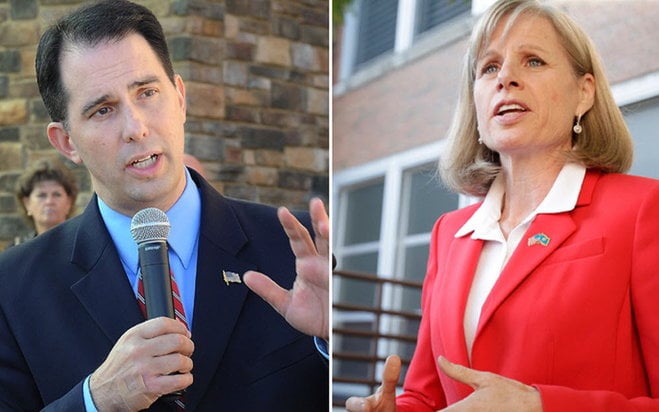
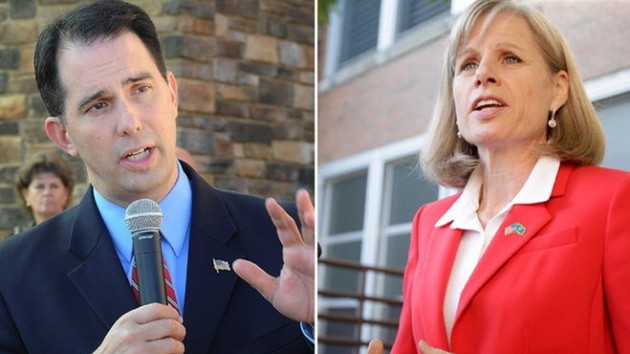
The Wisconsin Governor race is the first in what will be a succession of articles offering expanded analysis released for the PPD 2014 Governor Map Predictions. Incumbent Republican Gov. Scott Walker will face Democratic challenger Mary Burke, a former executive at Trek bicycles with a business background and personal fortune Democrats believe will make her a formidable challenger against Gov. Scott Walker.

Prior to Mary Burke entering the race, Gov. Scott Walker didn’t even have a credible opponent. In a purple-leaning state, one that is no doubt more Blue than not on the presidential level, the actions of the Democratic Party speak volumes. The failed recall effort, during which Walker won by an even larger margin than his first election, was a devastating defeat for the Wisconsin State Democratic Party.

The Republican incumbent has a big fundraising edge on his opponent, raising $5.1 million in the second half of 2013. Mary Burke, on the other hand, raised $1.4 million and has already put in $400,000 of her own money.

The first Marquette Law School Poll on the Wisconsin governor race in the 2014 election year found Gov. Scott Walker leading Democratic candidate Mary Burke 47 to 41 percent, representing a solid 5-point bump for Walker since they surveyed the race a month before.

Based on past accuracy, specifically regarding the state of Wisconsin, the Marquette Law School Poll has a stellar #1 rating for our model at PeoplesPunditDaily.com, which is the most pristine rating a pollster could be assigned by PeoplesPunditDaily.com and translates into more weighted influence when aggregating polls.

I actually believe there is a decent chance that Walker may be leading by a slightly larger margin, because all but 1/8 of the polling sample was interviewed prior to the State of the State address, which shined a media spotlight on the budget surplus following higher than expected state revenue projections. Though he has been making his rounds on national news outlets, state media didn’t cover his new tax reform plan until after the speech, which is reflected in the survey.

Still, 49 percent said that the state budget was in better shape now than it was a few years ago, 26 percent said that it is about the same, while 20 percent said that the budget is in worse shape now. Walker’s job approval ticked up in the January Marquette Law School Poll to 51/42. In October, his approval stood at 49 percent with 47 percent disapproving. Over the past two years, Walker’s job approval has averaged 49.9 percent with disapproval averaging 45.6 percent.

Overall, when asked about the direction of the state, 54 percent say that the state is headed in the right direction, while 40 percent say it is off on the wrong track and 6 percent say they don’t know or did not respond. This is a huge boon for Walker, because exactly 2 years ago, in Jan. 2012, 50 percent said the state was headed in the right direction and 46 percent it was on the wrong track. The last time the question was asked, two weeks before the June 2012 recall election, 52 percent said right direction and 44 percent said wrong track.

People feel like they are doing better with Walker, personally, and that cannot be understated.

According to Gallup, President Obama has an approval rating of 46 percent in the state, and in the Marquette Law School Poll only 44 percent approve of the president’s job performance, while 50 percent say they disapprove. The issue fueling this discontent, unsurprisingly, is ObamaCare. The fact he actually offered a plan to minimize the law’s damage, rather than simply oppose ObamaCare, is certainly helping the governor.

Walker proposed directing federal subsidies to Wisconsin’s poor and uninsured and allowing them to purchase coverage directly from the insurer, avoiding the online exchange. Walker’s idea is rapidly gaining support in the bitterly divided Wisconsin statehouse, with 6 Democrats having crossed party lines in support of Walker’s ObamaCare proposal in the assembly, sending it off to the Wisconsin Senate with large majority support.

The composition of the 2014 electorate will look more like the 2010 electorate than the one in 2012. However, interestingly enough, the 2012 electorate still would have reelected Gov. Walker. According to exit polling from the recall election and the 2012 presidential election, Walker-Obama voters — or, voters who supported Scott Walker in his recall victory and Barack Obama in the 2012 presidential election — represent at least 6 percent of the recent Wisconsin voting electorate. Worth noting, that is nearly identical to the margin Mitt Romney lost the state by in 2012.

The biggest problem Mary Burke has right now is Scott Walker’s crossover appeal. The governor seems to be keeping these ever-important Walker-Obama voters, who are otherwise predisposed to vote Democrat, in his corner. The demographics in the state have actually moved in a direction that generically benefits the Republican Party, and this has been validated by Gallup and measurements of the Partisan Voting Index.

In their annual party ID by state measurement, Gallup found a continuing slip in Democratic advantage nationwide, with Democratic states outnumbering Republican states by just 3. This is a slide from their 7-state advantage in 2012, and an evaporation of their once-30-state advantage in 2008. The Midwest states, particularly the northern region encompassing Wisconsin, Michigan, Minnesota and even Iowa, have been the driving forces behind the most dramatic rightward-shifts.

In 2014, the Partisan Voting Index is estimated by Cook to be D+2, a particularly noteworthy measurement. In 2010, Republican candidates in states where the PVI was more Republican than D+2 had an 83 percent success rate. Considering the proven strength of Gov. Scott Walker as a candidate, as well as all other variables considered, the Wisconsin Governor race will now be rated “Likely Republican” on our 2014 Governor Map Predictions.

I, like others, believe that Walker was emboldened by his 2012 recall victory, and if reelected as I believe he is more “likely” than not to be, Walker would be a strong potential dark horse in the 2016 presidential nomination.

View Polling (UPDATED) Below Or Return To 2014 Governor Map

Poll Date Sample Walker (R) Burke (D) Spread
PPD Average 1/20 – 3/11 46.0 43.0 Walker +4.5
Gravis Marketing 3/10 – 3/11 500 LV 49 44 Walker +5
Rasmussen Reports 3/10 – 3/11 500 LV 45 45 Tie
Marquette University 1/20 – 1/23 802 RV 47 41 Walker +6
Marquette University 10/21 – 10/24 800 RV 47 45 Walker +2
PPP (D) 9/13 – 9/16 1180 RV 48 42 Walker +6

The Wisconsin Governor race is the first

peyton-manning-mvp

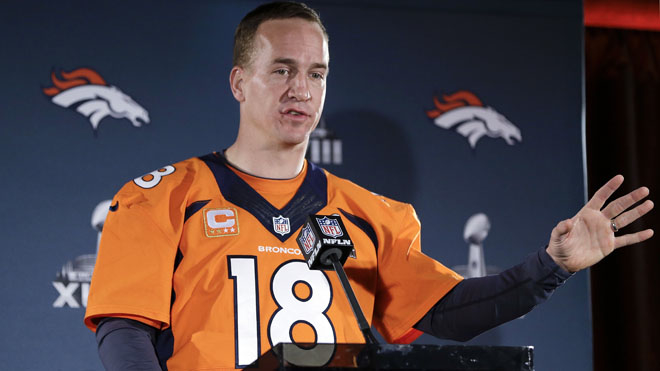
Denver Broncos quarterback Peyton Manning talks with reporters during a news conference Thursday, Jan. 30, 2014, in Jersey City, N.J. The Broncos are scheduled to play the Seattle Seahawks in the NFL Super Bowl XLVIII football game Sunday, Feb. 2, in East Rutherford, N.J. (AP Photo)

NEW YORK –  Peyton Manning’s record-setting season gave him his record-setting fifth Associated Press NFL MVP award Saturday night, and he won in a landslide.

No other player has won more than three MVP awards, and it was nearly a unanimous vote.

Denver’s record-setting quarterback, who threw for 55 touchdowns and 5,477 yards in leading the Broncos to the AFC’s best record, received 49 votes from a nationwide panel of 50 media members who regularly cover the league. New England quarterback Tom Brady got the one other vote.

Manning won his other MVPs with Indianapolis in 2003, `04, `08 and `09, coming in as the runner-up last season behind Adrian Peterson.

So how does the new NFL MVP award record fair next to other sports?

Manning still trails several Hall of Famers for total MVPs in their sport. Wayne Gretzky won 9 NHL MVPs, Barry Bonds won 7 in baseball, and Kareem Abdul-Jabbar won 6 in the NBA.

Peyton Manning also took the AP’s Offensive Player of the Year award for the second time. Carolina grabbed two major awards, with Ron Rivera winning AP NFL Coach of the Year and linebacker Luke Kuechly voted best defensive player.

Broncos executive John Elway accepted the Offensive Player award on Manning’s behalf.

“I can say I have never seen a better year played by a quarterback than Peyton Manning,” Elway said. “To see what he did this year, it was truly amazing.”

For the Associated Press Offensive Player of the Year Award, Manning received 33 total votes. He also was runner-up last year to Peterson for Offensive Player.

Running back LeSean McCoy of Philadelphia was runner-up with 10 votes, followed by Kansas City running back Jamaal Charles with 4.

Rivera engineered the Panthers’ turnaround from a 7-9 record to 12-4, the NFC South title and a first-round playoff bye. Kuechly keyed a defense that allowed 241 points, second only to the NFC champion Seattle.

Green Bay running back Eddie Lacy and Jets defensive tackle Sheldon Richardson were the top rookies for 2013, while San Diego quarterback Philip Rivers took the Comeback Player of the Year award at the NFL Honors show.

Rivera’s performance in his third season as head of Carolina earned him 21 1/2 votes, which beat out Kansas City’s Andy Reid, who received 13 1/2 votes, who took Kansas from 2-14 to 11-5 and an AFC wild-card berth.

“I do feel a lot of pride because it has been a long journey, but it also was a part of the process,” Rivera said. “Just like us getting to where we are winning 12 games was part of the process. We started, the team was 2-14 before I got there and we went to 6-10 and then 7-9, and this year we broke through at 12-4. It was part of the process of growing and developing.”

Rivera is the second Panthers coach to win the award. Dom Capers was AP Coach of the Year in 1996, Carolina’s second season in the NFL.

Kuechly also earned top defensive player in 2012, which sat up on the shelf with his defensive rookie award. Carolina’s All-Pro linebacker got 19 votes, beating out Indianapolis All-Pro linebacker Robert Mathis, who got 11 1/2. Kuechly had 96 tackles, 4 interceptions, 2 sacks and 8 passes defensed.

A second-round pick — 61st overall — from Alabama, Lacy rushed for 1,178 yards on 284 carries (4.1 average), with 11 touchdowns and 35 receptions. That record earned him 35 votes.

“I’m comfortable where I am, and my teammates believe in me, and they make me feel comfortable, so I’m able to play the way I’m capable of playing,” said Lacy, who came in ahead of San Diego wide receiver Keenan Allen, who got 12 votes.

Richardson was the 13th overall pick in April’s draft when New York traded star cornerback Darrelle Revis to Tampa Bay, and won a close race over Buffalo linebacker Kiko Alonso. Richardson received 23 votes, while Alonso, a second-round choice who was 46th overall, earned 19.

Richardson found himself being double-teamed around halfway through the season, but still made 42 tackles and had 3 1/2 sacks, and he closed the running lanes so effectively that the Jets ranked number 3 against the run this season.

“I’m surprised,” Richardson said of beating Alonso and Arizona safety Tyrann Mathieu, who got just 2 votes. “Kiko and Tyrann most definitely had outstanding rookie years and it was a toss-up to me. Kiko made a lot of tackles and Tyrann made a lot of plays down the field. Unfortunately he got hurt, but it was a tight race.”

Richardson did quip regarding the possibility of winning both awards, as he scored two touchdowns as a fullback in goal-line situations.

“Eddie Lacy beat me out there,” Richardson said. “He had a few more touchdowns than I did.”

Rivers led the Chargers to a wild-card playoff spot with 4 consecutive wins to end the schedule, leaving them off with a 9-7 record. He led the league with a 69.5 completion rate and threw for 32 TDs against 11 interceptions.

He received 13 votes in balloting so widespread that 12 players got votes. He was not at the awards show at Radio City Music Hall.

Chicago cornerback Charles Tillman won the Walter Payton Man of the Year award, and was visibly emotional when he accepted the award, with tears in his eyes.

“As a Chicago Bear, this award has a special meaning to me,” Tillman said.

NEW YORK – Peyton Manning's record-setting

new hampshire senate

The New Hampshire Senate race is the fourteenth article in a succession of articles offering expanded analysis on the ratings for the PeoplesPunditDaily.com 2014 Senate Map. Thus far, I have released expanded analysis for the following Senate races:

AlaskaArkansasIowaKentucky, Louisiana, MichiganMontana, North Carolina, Mississippi, West Virginia and Virginia, with Colorado and Oklahoma, recently released earlier in January.

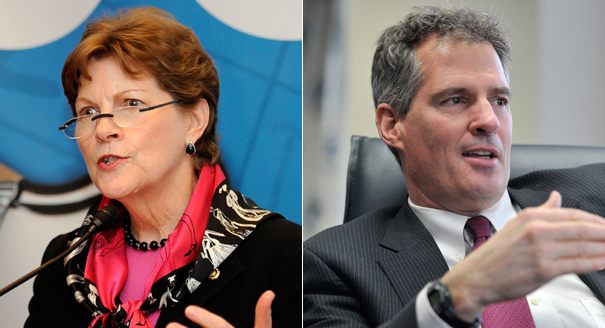
Former Senator Scott Brown’s (R-MA) has now formed an exploratory committee in a real sign he is running against Democratic Senator Jeanne Shaheen. Early in the cycle, it looked as if the chances of Brown running were better for Massachusetts governor. However, with the NRSC pleading for him to run and his chances of winning increasing with every cancelled health insurance policy, this is a serious problem for Senator Shaheen.

In a recent opt-ed on FoxNews.com, Brown singled-out New Hampshire in a scathing attack on Democrats over ObamaCare. Obviously, this shows he is far more serious about a run than some expected. We will return to Scott Brown in a bit after we move through the rest of the race’s dynamics.

The entrance of former Senator Bob Smith added a big name to the Republican field, but he had earlier stated that he would not run. In such antiestablishment environment, such as it will surely be in the 2014 environment, his ” I won’t run, but now I am running” reversal won’t play well with notoriously independent New Hampshire voters.

As previously reported by People’s Pundit Daily, Bob Smith has some serious challenges to contend with among those in his own party. Many feel he is both a turncoat and an opportunist, after he actually moved to win a seat that he thought would be more favorable to him in another state.

Shaheen seemed to be cruising to reelection before the failed ObamaCare rollout and her and Obama’s broken health care reform promises. However, now she is heading up an effort in the Senate to delay the individual mandate. But it appears that the voters of New Hampshire know she fell in line like a good soldier and opposed the delay during the government shutdown, simply because she was told to do so by Harry Reid and President Obama.

The Granite State is another state – like Minnesota – where Republicans really should be in better shape than they are. At this point, other conservative alternatives have not had the money to make the splash needed for a real run. So, that leaves the man who everyone wants to get in to the race.

New Hampshire, particularly, is a fascinating state to study in political science. It is a predominately white state that voted for Ronald Reagan (2x), Bill Clinton, but then for George W. Bush in 2000 and John Kerry (2004) and Obama (2x).

Yet, when we plug in the historical numbers, it is also one of the states most closely aligned with presidential job approval as it relates to their vote for the Senate. According to our model, which obviously factors in this historical pattern, Shaheen could win no more than 48 percent of the vote today versus a strong candidate such as Scott Brown.

Thus far, Obama’s job approval has not been able to climb up to 45 percent, which is above where it stood in 2010 when Republicans made big gains in the state. The Partisan Voting Index, which is backed up by the Gallup party ID by state survey, shows an even-more pronounced rightward-shift in the New Hampshire electorate.

For now, however, we will keep it where it was — Leans Democrat — and watch it very, very closely.

Ending Spending, a conservative outside group, has put out ads attacking Sen. Jeanne Shaheen over her support for the health care law, using Obama’s words against her. “If you like your senator, you can keep her,” the narrator intones. “If not, you know what to do.”

Ouch.

There will be thousands of ads just like that one before the election cycle is over. Nevertheless, until we see Scott Brown, or another well-funded alternative that has the resources to offer a viable challenge to Shaheen, we are rating the New Hampshire Senate race “Leans Democrat” on PeoplesPunditDaily.com.

However, if Scott Brown announces that he will seek the Republican nomination for her seat, then we likely need to prepare to move this race to “Toss-Up” as the campaign gets heated. The polling has moved back toward Shaheen, for now, but we will leave off on a note by Purple Strategies, who conducted a survey of the New Hampshire Senate race:

Additional trouble for the sitting Senator is apparent in the vote across party lines. Independents currently support Brown by 9 points (48% to 39%). Shaheen has consolidated Democrats (87% to 6%), yet Brown still has room to grow among Republicans (holding just 76% of the vote). If Brown can capture his potential base, Shaheen will need to reverse the trend among independents or will trail. This race is clearly competitive in 2014. 

View Polling Below Or Return To PPD 2014 Senate Map

Poll Date Sample Shaheen (D) Brown (R) Spread
PPD Average 1/9 – 3/16 47.8 40.2 Shaheen +7.6
ARG 3/13 – 3/16 533 RV 50 38 Shaheen +12
Suffolk/Boston Herald 2/27 – 3/5 800 LV 52 39 Shaheen +13
WMUR/UNH 1/21 – 1/26 454 LV 47 37 Shaheen +10
Purple Strategies 1/21 – 1/23 1052 LV 44 44 Tie
PPP (D) 1/9 – 1/12 1354 RV 46 43 Shaheen +3

The New Hampshire Senate race is the

keystone-xl-pipeline

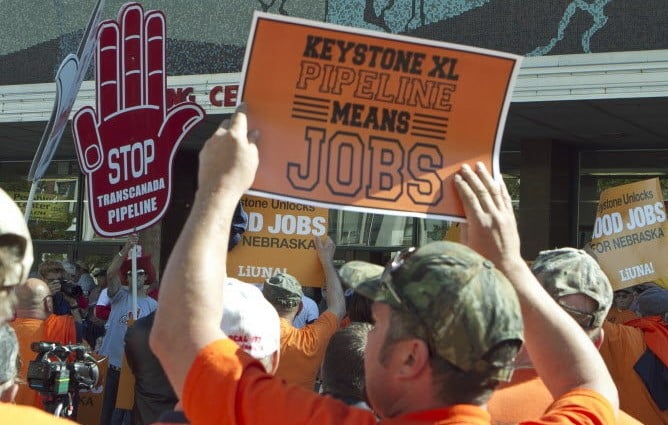
A new State Department review gave the Keystone XL pipeline the okay on Friday, finding no major potential environmental hazards. The report immediately turned up the pressure on the Obama administration to approve the long-awaited project, splintering the Democratic Party down union and environmental activist lines.

“This report from the Obama administration once again confirms that there is no reason for the White House to continue stalling construction of the Keystone XL Pipeline,” Senate Republican Leader Mitch McConnell said in a statement. “So, Mr. President, no more stalling — no more excuses.”

The minority leader also said in the statement that it was time for the president to use that pen he has been talking so much about lately.

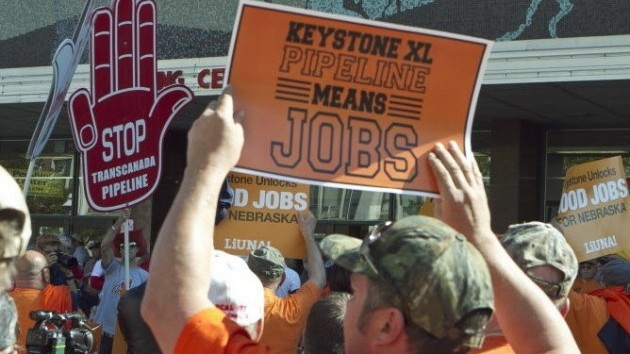
Though the review could give President Obama the political cover he needs if he chooses to order construction of the pipeline, the issue has divided liberal Democrats. The unions, concerned about jobs in a sputtering economy, have asked the administration to approve the project, but radical environmental activist groups have opposed it.

The 1,179-mile pipeline would travel through the heartland, carrying oil derived from tar sands in western Canada to a hub in Nebraska, where it would then connect with already existing pipelines to carry more than 800,000 barrels of crude oil a day to refineries in Texas.

There are several key problems with the environmentalists’ argument.

First, the State Department said Canadian tar sands are likely to be developed regardless of whether or not the U.S. will be the benefactor of the pipeline, noting other options to get the oil from Canada to Gulf Coast refineries. Without the pipeline, the product may get to refineries by other means, including railroads, trucks and barges, which they claim would be even worse for climate change.

Approval from the State Department is necessary for the construction of the Keystone XL pipeline, because the pipeline crosses a U.S. border. The Environmental Protection Agency, or the EPA, as well as other related departments will have 90 days to opine on the report before the State Department gives Obama a final recommendation on whether the project is in U.S. national interest.

A final decision, however, is not expected before the summer.

The new report comes only days after Obama’s fifth State of the Union address, during which he again publicly announced his support for an “all-of-the-above” energy strategy, drawing from oil and natural gas to renewables, including wind and solar power.

But it would appear from the Obama administration policy that some policies are being pushed far more than others, despite him taking credit for all-time high oil production that is occurring despite administration policy, not due to it.

In remarks written by his environmental allies, activists said that supporting a policy of expanded oil and gas production is hypocritical for a president who wants to reduce pollution linked to global warming.

“We believe that continued reliance on an `all-of-the-above’ energy strategy would be fundamentally at odds with your goal of cutting carbon pollution,” the environmentalists wrote in a letter to Obama.

Obama blocked the Keystone XL pipeline back in January of 2012, claiming he did not have enough time for a fair review before a deadline imposed by congressional Republicans. Of course, that conveniently delayed the choice for him until after his re-election.

When Obama first rejected the pipeline, it didn’t go over well with our neighbors in Canada, as our northern neighbor relies on the U.S. for 97 percent of its energy exports. The pipeline is critical to Canada, which needs infrastructure in place to export its growing oil sands production, and they will simply give the economic and security benefit associate with the pipeline to China if we do not come partner with them. The northern Alberta region has the world’s third largest oil reserves in the world, with 170 billion barrels of proven reserves.

Obama made a token gesture in hopes of repairing relations with Canada when he proposed development of an Oklahoma-to-Texas line to ease an oil bottleneck at a storage hub in Cushing, Oklahoma. Oil just began flowing in that segment of the pipeline last week.

However, the 485-mile southern section of the pipeline operated by Calgary-based TransCanada did not require presidential approval because it does not cross a U.S. border.

The new State Department review is the latest environmental review and the fifth such review on the project since 2010. It underscores that development of tar sands in Alberta would create greenhouse gases, a State Department official said. However, they argue that other methods of transporting the oil — including rail, trucks and barges — would release more greenhouse gases that contribute to global warming than the pipeline.

In fact, U.S. and Canadian accident investigators just last week warned about the dangers of oil trains that transport crude oil from North Dakota and other states to refineries in the U.S. and Canada. The officials urged new safety rules, warning that a “major loss of life” could result from an accident involving the increasing use of trains to transport large amounts of crude oil.

Several high-profile accidents involving crude oil shipments — including a fiery explosion in North Dakota and an explosion that killed 47 people in Canada last year — have raised alarms.

Keystone XL would travel through Montana and South Dakota before reaching Nebraska. An existing spur runs through Kansas and Oklahoma to Texas.

A new State Department review gave the

http://youtu.be/B-f6a9Nb8aw

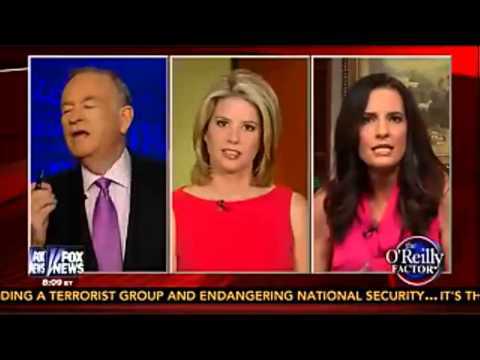
So, big shot Bill O’Reilly agrees with Democrats and says the “pinheads” in the Republican Party should stop opposing the minimum wage increase. As usual, Bill O’Reilly shot his mouth off without knowing what he was talking about.

Let’s look at his comments, and then explain why he — once again — made our “Daily Dunce” slot.

“The Republican Party should really wise up and stop opposing raising the minimum wage. It should be 10 bucks an hour,” O’Reilly proclaimed Wednesday during his opening “Talking Points Memo” segment.

O’Reilly said his proposed $10 an hour minimum wage would apply only to adults, and teenagers should be paid on a lower scale. For starters, Billy boy obviously does not know that the largest group in the U.S. labor force earning minimum wage is teenagers, most are younger than 25, and that most work less than 30 hours a week. With that in mind, the follow-up comment makes zero sense.

“The GOP needs to stop working against working people,” O’Reilly said.

Actually, big shot Bill O’Reilly would be the one — along with the Democrats — who are working against the working people with asinine proposals like this. A clear consensus among economic experts holds all data points show raising the minimum wage costs the economy more jobs, a fact echoed by the president’s Department of Labor.

study conducted by the Department of Labor concluded that the first minimum wage, 25 cents per hour in 1938, cost the jobs of 30,000 to 50,000 of the 300,000 workers who were covered and had previously earned below the minimum. And a 2007 review of 102 studies that were conducted beginning in the 1990s by David Neumark and William Wascher found, “Indeed, the preponderance of the evidence points to disemployment effects.”

It would seem, contrary to Billy boy’s statements, the Republican Party is working for the American worker, not against. As a former history teacher, it is a bit surprising that he would fail to understand doing the right thing sometimes requires doing it when it is hard, or may result in you becoming immensely unpopular.

But then again, who could argue with Billy boy’s intellectually superior argument?

“Come on, 10 bucks an hour? Babysitters get that,” he said. “This is a simple issue,” he said, “Even the people at MSNBC can understand this. That’s how simple it is.”

Actually, the people at MSNBC can’t understand this, which is why Bill Gates had to explain it to them. “You have to be a bit careful: If you raise the minimum wage, you’re encouraging labor substitution and you’re going to go buy machines and automate things,” Gates told MSNBC’s “Morning Joe” last week, which can be viewed below.

“And so within certain limits, you know, it does cause job destruction. If you really start pushing it, then you’re just making a huge trade-off,” he said much to the chagrin of his hosts.

Apparently big shot Bill O’Reilly believes he knows more about the effects of a minimum wage increase than Bill Gates, the U.S. Department of Labor, and economists David Neumark and William Wascher, who reviewed 102 studies on the subject.

I wonder how many Bill O’Reilly has reviewed?

Republican strategist Kate Obenshain fought the good fight in the face of O’Reilly’s bloviating ignorance , that is, when he would stop talking to take a much-needed breath of air, telling O’Reilly he’s taking on the “imperialistic position.”

O’Reilly countered he is taking the “working class position,” having worked for minimum wage himself as a teenager.

Obenshain tried to explain to him that the very people the policy claims to help will lose jobs, and that the free market should decide wages, but O’Reilly remained impervious to the facts.

He suggested all of the studies were propaganda. “It’s just baloney. They’re on the wrong side of it,” meaning Republicans, and apparently every other one of the aforementioned authorities on the subject.

“You’re totally on the wrong side. You’re the social engineer at this point,” Kate Obenshain said.

“If your guys keep doing this, the next election they’ll win will be 80 years from now,” O’Reilly responded. However, this claim that opposing minimum wage increases is detrimental to electoral prospects, is shaky.

Even though a new Fox poll found a 56-percent majority agreed with the president and Democrats the minimum wage should be raised, 1 in 4 registered voters wouldn’t raise it (25 percent) and 15 percent said the government shouldn’t ever be telling businesses what to pay their employees. Hardly conclusive evidence, Bill O’Reilly.

Regardless, that was one of O”Reilly’s comments that wasn’t particularly surprising, because like the issue of immigration, O’Reilly claims to be on the side of the working American, but has not the courage to take the harder, morally and subjectively correct position.

But then again, like his Catholic Church who also supports giving big business cheaper labor to exploit, he is a chameleon who changes his colors as his viewership and popularity require.

Bill O’Reilly was raised by a hard-working American father, was one himself, and worked his way up to the position he is in now. No one, no one, can take that away from him.

Yet it is obvious that on his way up he forgot much about working Americans, and certainly no longer remembers what it is like to be one. In the video below, watch this dunce suggest to Lou Dobbs that we could: 1) afford an increase in the cost of goods, which Dobbs tries to tell him will be the result of a minimum wage increase; and, 2) that, hey, “the folks wouldn’t mind paying it.”

Bill O'Reilly, despite Kate Obenshain trying to

(Credit: Reuters)

The Institute for Supply Management-Chicago’s PMI index shows Midwest manufacturing in the region slowed to 59.6 in January.

Even though the index for Midwest manufacturing sector came in slightly higher than Wall Street’s estimate of 59, it is down slightly from 60.8 in the month of December. The new orders sub-component surged to 64.6 from 43.9 the month prior.

Readings above 50 point to expansion, while those below indicate contraction.

Meanwhile, a reading on consumer sentiment from Thomson Reuters and the University of Michigan rose slightly in late January to 81.2 from a preliminary reading of 80.4 earlier in the month. Wall Street anticipated a reading of 81.

The Institute for Supply Management-Chicago’s PMI index

(Photo: REUTERS)

U.S. consumer spending rose more than expected in December, but weak income growth suggested the economy could miss first quarter expectations.

The Commerce Department said on Friday that consumer spending increased 0.4 percent after rising by a revised 0.6 percent in November. Consumer spending was previously reported to have increased 0.5 percent in November.

Economists polled by Reuters had forecast consumer spending, which represents more than two-thirds of U.S. economic activity, rising 0.2 percent in the month of December.

When adjusted for inflation, consumer spending rose 0.2 percent after advancing 0.6 percent in November.

The figures were included in the advance fourth-quarter gross domestic product report published on Thursday and confirmed the momentum in consumer spending at the end of 2013.

Even though consumer spending recorded its strongest gain in 3 years in the fourth quarter, helping to lift the economy to a 3.2 percent annual growth rate during that period, Americans’ income was unchanged last month after rising 0.2 percent in November. Already liberal economists are arguing the flat income is due to the end of jobless benefits for about 1.3 million long-term unemployed last month.

But we have no historical trend to back that up, nor would that account for the flat and dropping personal income levels over the last 5 years.

Income at the disposal of households after adjusting for inflation fell 0.2 percent, will be likely be reflected in consumer spending for the first quarter.

Weak income growth against the fairly strong spending backdrop translates into less savings for the American people. The saving rate, which is the percentage of disposable income households are putting away, dropped to an 11-month low of 3.9 percent in December.

It was at 4.3 percent in November.

Inflation ticked up a bit in the month December. A price index for consumer spending rose 0.2 percent after being unchanged for 2 consecutive months.

Over the past 12 months, prices rose 1.1 percent, compared to an advance of 0.9 percent in November. Even a modest increase can hurt Americans under felt or decreasing incomes.

Excluding food and energy, the price index for consumer spending rose 0.1 percent, rising by the same margin for a 6 straight month. Core prices were up 1.2 percent from 1 year ago, after rising 1.1 percent in the month of November.

Regardless of which inflation measurements are examined, they remain stuck below the Federal Reserve’s 2 percent target. That suggests that the Fed, which is gradually reducing the amount of money it is pumping into the economy through printing money in their quantitative easing bond-buying program, will hold interest rates near zero for the foreseeable future.

Meanwhile, a reading on consumer sentiment from Thomson Reuters and the University of Michigan rose slightly in late January to 81.2 from a preliminary reading of 80.4 earlier in the month. Wall Street anticipated a reading of 81.

U.S. consumer spending rose more than expected

WASHINGTON — What is it about women that causes leading Republicans to grow clumsy, if not stupid? When even savvy, fluent, attractively populist Mike Huckabee stumbles, you know you’ve got trouble. Having already thrown away eminently winnable Senate seats in Missouri and Indiana because of moronic talk about rape, the GOP might have learned. You’d think.

Huckabee wasn’t quite as egregious, just puzzling and a bit weird. Trying to make a point about ObamaCare mandating free contraceptives, he inexplicably began speculating that the reason behind the freebie was the Democrats’ belief that women need the federal government to protect them from their own libidos.

Bizarre. I can think of no Democrat who has ever said that, nor any liberal who even thinks that. Such a theory, when offered by a conservative, is quite unfortunately self-revealing.

In any case, why go wandering into the psychology of female sexuality in the first place? It’s ridiculous. This is politics. Stick to policy. And there’s a good policy question to be asked about the contraceptive mandate (even apart from its challenge to religious freedom). It’s about priorities. By what moral logic does the state provide one woman with co-pay-free contraceptives while denying the same subvention to another woman when she urgently needs antibiotics for her sick child?

The same principle of sticking to policy and forswearing amateur psychology should apply to every so-called women’s issue. Take abortion, which is the subtext of about 90 percent of the alleged “war on women,” the charge being that those terrible conservative men are denying women control of their reproductive health.

The charge has worked. Although the country is fairly evenly split on the abortion question, the Republicans’ inability to make their case in respectful tones has cost them dearly. In 2012, they lost unmarried women by 36 (!) points.

Yet there is a very simple, straightforward strategy for seizing the high ground on abortion in a way that transcends the normal divisions and commands wide popular support: Focus on the horror of late-term abortion — and get it banned.

Last year’s Kermit Gosnell trial was a seminal moment. The country was shown a baby butcher at work and national sentiment was nearly unanimous. Abortion-rights advocates ran away from Gosnell. But they can’t hide from the issue.

And the issue, as most succinctly defined by the late liberal Sen. Daniel Patrick Moynihan, is infanticide. Describing one form of late-term abortion known as partial-birth, Moynihan said: “I had once remarked that the procedure was too close to infanticide. And now we have testimony that it is not just too close to infanticide, it is infanticide.” How else to describe crushing the infant’s skull in mid-delivery before the head leaves the birth canal?

Conservatives need to accept that no such consensus exists regarding early abortions. Unlike late-term abortions where there are clearly two human beings involved, there is no such agreement regarding, say, a six-week-old embryo.

There remains profound disagreement as to whether at this early stage the fetus has acquired personhood or, to put it more theologically, ensoulment. The disagreement is understandable given that the question is a matter of faith.

This doesn’t mean that abortion opponents should give up. But regarding early abortions, the objective should be persuasion — creating some future majority — rather than legislative coercion in the absence of a current majority. These are the constraints of a democratic system.

Not so regarding a third- or late-second-trimester abortion. Here we are dealing with a child that could potentially live on its own — if not killed first. And killing it, for any reason other than to save the mother’s life, is an abomination. Outlawing that — state by state and nationally — should be the focus of any Republican’s position on abortion.

A test case for this kind of policy-oriented political strategy is the governor’s race in Texas: Wendy Davis, the Democratic candidate, has a complicated personal history. Stop talking about it. (Her capacity for veracity is a legitimate issue, but for God’s sake why go into her parenting choices? That’s a snare and a distraction.) Talk policy — specifically the issue that brought Davis to national prominence.

What was her 11-hour filibuster about? Blocking a state law whose major feature was outlawing abortions beyond 20 weeks. Make that the battlefield. Make Davis explain why she chose not just to support late-term abortion but to make it her great cause.

Stay away from the minefield of gender politics. Challenge the other side on substance. And watch them lose.

Charles Krauthammer’s email address is [email protected].

Opinion: Why go wandering into the psychology

An MSNBC Superbowl ad tweet is making a stir and showing just how much institutional corruption and bias exists in the network news agency. Now, MSNBC is in full-blown apology mode again, with the “lean forward” boss in full retreat following the threat of a Republican boycott of appearances on the MSNBC network news shows.

The original tweet stated:

Maybe the rightwing will hate it, but everyone else will go awwww: the adorable new #Cheerios ad w/ biracial family.

The tweet needed to be written — not embedded — because the network removed the tweet after announcing via tweet that they would do so.

But Republican National Committee Chairman Reince Priebus wrote a letter to MSNBC President Phil Griffin demanding MSNBC apologizes both “personally and publicly” for the tweet, saying that until he did all Republican National Committee spokesman and party personnel would be banned from appearing on the liberal network channel’s shows. Hours later, Griffin obliged.

“The tweet last night was outrageous and unacceptable,” Griffin said in a statement. “We immediately acknowledged that it was offensive and wrong, apologized, and deleted it. We have dismissed the person responsible for the tweet.

“I personally apologize to Mr. Priebus and to everyone offended,” he continued. “At MSNBC we believe in passionate, strong debate about the issues and we invite voices from all sides to participate. That will never change.”

However, Phil Griffin did not say who was fired for the Tweet, and that would really not even be sufficient or the point. The point is that, that is acceptable behavior for MSNBC employees and perfectly acceptable thinking for liberals. The MSNBC network is tantamount to a state-run media network, which everyone knows does the bidding of the liberal authority, not the journalistic job of challenging that authority.

Priebus, who this publication has not exactly been an ally to, correctly said in his letter to Griffin that the tweet is really part of a “pattern of behavior” that has “poisoned” the network.

Yet, rather than a tweet to undo another tweet, the network should instead make a public apology on primetime television. Fat chance, because here is the apology.

“Sadly, such petty and demeaning attacks have become a pattern at your network,” Priebus wrote in the Jan. 30 letter to Griffin. “With increasing frequency, many of your hosts have personally denigrated and demeaned Americans — especially conservative and Republican Americans — without even attempting to further meaningful political dialogue.”

Priebus would be referring to the Martin Bashir comments, which also earned him a spot in the People’s Pundit Daily Dunce spot, and described a vile act for slaves and suggested someone perform the act on Palin. Bashir was suspended more than two weeks later, and resigned on Dec. 4, 2013.

But just a few days before the Bashir incident, homophobic liberal actor Alec Baldwin, host of a  night-time talk show on MSNBC, was fired after being caught on camera using a gay slur.


Griffin said the two incidents that have forced him into these apologies don’t “define” the network.


“We quickly took responsibility for them and took action,” Griffin said. “They were unfortunate, but I’m not going to allow these specific moments of lack of judgment to define us.”

However, the actions and comments of these various MSNBC employees do “define” both the network and the raging liberal Phil Griffin, all of whom are clearly intellectually hopeless to defend their failing ideology.

The new MSNBC logo reads, “Meet me at the new MSNBC.com,” but it sounds more like the same old leftist vial network to me. And Peter Griffin is a perfect dunce to run it.

RNC Chairman Reince Priebus wrote a letter

People's Pundit Daily
You have %%pigeonMeterAvailable%% free %%pigeonCopyPage%% remaining this month. Get unlimited access and support reader-funded, independent data journalism.

Start a 14-day free trial now. Pay later!

Start Trial