Widget Image
Follow PPD Social Media
Friday, January 16, 2026
HomeStandard Blog Whole Post (Page 960)

Georgia Senate primary

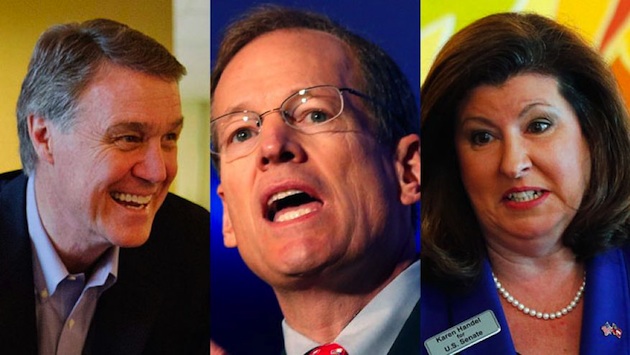
David Perdue (left), Jack Kingston (center), and Karen Handel (right) faced off in the Georgia Senate primary.

As expected, David Perdue and Jack Kingston will advance to the July 22 runoff after finishing in the top spots in the Georgia Senate Primary. With nearly 80 percent of the precincts reporting in, Perdue leads the pack with just over 30 percent, while Kingston trails in second with a little more than 26 percent. The race was surprisingly neck-and-neck until the larger counties began to report in, but Kingston still ran stronger-than-expected, in large part due to Karen Handel drawing votes in areas Perdue was expected to perform stronger.

Handel, who lost to Gov. Nathan Deal in the 2010 Republican primary for governor by less than 2,500 votes, was competing with Kingston for the top establishment slot. Unfortunately for Handel, that kind of competition comes complete with competition for donations. Since Jack Kingston was a political ally of Republican Gov. Nathan Deal, there simply wasn’t room enough for the both of them.

David Perdue had a lead going to into Election Day, but never enough to expect he or any other candidate would win the primary outright. In Georgia, a candidate must win 50 percent of the vote to avoid a runoff. While it is still early, the vote totals and regional performance data suggest Kingston will have a difficult time against Perdue in the runoff with Handel out of the running.

The real loser, regardless of who wins the runoff, has been the Democratic Party. They had hoped Republicans would elect a less-than-favorable candidate, but Republican primary voters opted again for the stronger candidates. The eventual Republican nominee will go on to face Democrat Michelle Nunn, daughter of longtime Senator Sam Nunn. Though Democrats have high hopes for the candidate, she has already begun to trip up on the campaign trial.

In an interview with the liberal network MSNBC, Nunn was ill-prepared to answer a question about the paramount issue of the cycle — ObamaCare. The Georgia Senate race is rated “Likely Republican” on PPD’s 2014 Senate Map Predictions.

As expected, David Perdue and Jack Kingston

kentucky senate race

Senate Mcconnell (left), Matt Bevin (center), Grimes (Right) — Photo AP

Minority Leader Mitch McConnell has defeated Matt Bevin easily in the Kentucky primary for U.S. Senate. He will now go on to face Alison Lundergan Grimes in November. Bevin, who enjoyed early excitement and the backing of several prominent conservative groups, had run a terrible campaign.

McConnell was successful at raising questions about Bevin’s seriousness as a candidate, and highlighted the claimed flip flop Bevin pulled on the TARP bailouts. People’s Pundit Daily called the race with just 7 percent of precincts reporting, when McConnell led by nearly a 30-point margin.

While McConnell has largely left Grimes alone in the state, the arial ad bombardment begins Wednesday. As previously reported by PeoplesPunditDaily.com, two independent expenditure groups that support Senator McConnell have bought a total of $5.2 million in ad time to hammer Grimes immediately after Tuesday’s primary election. Kentuckians for Strong Leadership — a PAC supporting McConnell, has reported raising more than $3.3 million already and will begin the effort to link Grimes to a deeply unpopular President Obama.

The We Are Kentucky PAC, the main PAC supporting Grimes, is lagging far behind on the fundraising race. They have yet to even run or reserve media advertising on behalf of Grimes, and recently reported raising just $32,500 in the first quarter of 2014. Since its inception last July, it has raised only $293,000. While the polls have shown a closer-than-expected contest, considering the state’s political leanings, they are likely to begin to move against Grimes.

Per election laws, McConnell is now able to tap his own massive — massive — campaign war chest. Since 2009, he has raised $21,686,624, with $10,145,566 cash on hand. The Kentucky Senate race is rated “Likely Republican” on our 2014 Senate Map Predictions.

Minority Leader Mitch McConnell has defeated Matt

natalie tennant | alison lundergan grimes | michelle nunn

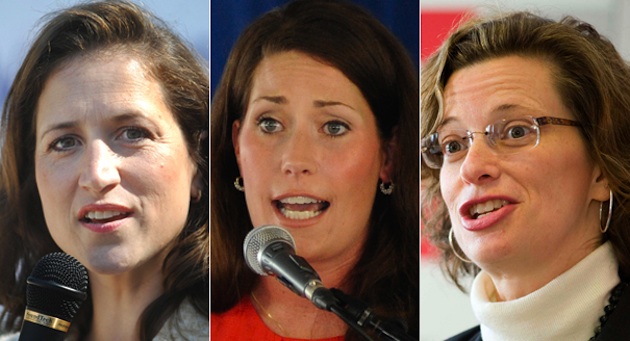
Democrats Natalie Tennant (left), Alison Lundergan Grimes (center) and Michelle Nunn.

With the help of a friendly media, Democrats have talked up the candidacies of Natalie Tennant in West Virginia, Alison Lundergan Grimes in Kentucky and Michelle Nunn in Georgia. But all three have begun to show the downside potential of strong party establishment politics, which favors discouragement of insurgent candidates and contentious primary debate.

The signs are already saying they can’t outrun red state reality.

Beginning with Alison Lundergan Grimes, whom polls show has been more competitive than the state’s political leanings would suggest, is about to find her lackluster campaign on defense. Up until now McConnell and his supporters have largely left the inexperienced Grimes alone. But that’s all about to change.

Not one but two independent expenditure groups that support Senator McConnell have bought a total of $5.2 million in ad time to bombard Grimes immediately after Tuesday’s primary election. KSL, a Super PAC that has begun the effort to link Grimes to a deeply unpopular President Obama, will again be tasked to start off the assault with a $575,000 ad buy scheduled to run this Wednesday through June 2.

And how effective can we expect Grimes to be at defending against the assault?

The We Are Kentucky PAC, the main PAC supporting Grimes, recently reported raising just $32,500 in the first quarter of 2014. Since its inception last July, it has raised only $293,000. We Are Kentucky has yet to even run or reserve media advertising on behalf of Grimes. However, it has already burned through most of the money it has raised. As of April 1, the PAC reports having just $108,336 cash on hand. Meanwhile, just one super PAC supporting McConnell — Kentuckians for Strong Leadership — has reported raising more than $3.3 million already.

None of this money takes into account McConnell’s own massive — massive — campaign war chest. Since 2009, he has raised $21,686,624, with $10,145,566 cash on hand.

Michelle Nunn, the daughter of former longtime Democratic Sen. Sam Nunn, has already shown signs of not being ready for primetime. During an interview on liberal MSNBC, Nunn was wholly unprepared to answer a question about the predominant issue of the election cycle — ObamaCare. Even a favorable editing job couldn’t mask the disastrous moment, which has now been made into a video by the opposition.

“So, at the time that the Affordable Health Care Act [sic] was passed, I was working for Points of Light,” Nunn says, right before the editor pulls a bit of magic by deleting the awkward rambling. “I wish that we had had more people who had tried to architect a bipartisan legislation,” she says before yet another edit job. “I think it’s impossible to look back retrospectively and say, ‘You know, what would you have done when you were there?’”

How she could be so unprepared for that question, is a question that only her should-be-replaced campaign head can answer (UPDATE: Grimes twice Wednesday [May, 21] also refused to answer whether she would have voted for ObamaCare).

Meanwhile, Natalie Tennat has run an under-the-radar campaign and is trailing Shelley Moore Capito by large margins in every poll conducted this cycle. Out of the four polls conducted since August of last year, Capito has averaged 48 percent, while Tennat has averaged just 37.5, only reaching a 40 percent ceiling of support once.

The media coverage and election projections have been widely overblown in favor of these Democratic candidates. The Republican candidates are all favored to win on PPD’s 2014 Senate Map Predictions, though you would never have guess it listening or reading the past media coverage. Despite tight polling, Grimes is likely at her ceiling of support in Kentucky, while McConnell’s unpopularity is largely due to his right flank being unsatisfied with his record. However, come November, those voters will come home.

The Kentucky Senate race is rated “Likely Republican” on our 2014 Senate Map Predictions.

The Georgia Senate race is being sold in a similar fashion as the Kentucky contest, a potential opportunity for Democrats to play offense in an otherwise favorable Republican environment. However, as we have previously examined in detail, this is unlikely.

The Georgia Senate race is rated “Likely Republican” on PPD’s 2014 Senate Map Predictions.

In West Virginia, the handwriting is on the wall. The Mountain State hasn’t been represented by a Republican in the U.S. Senate since 1959, which is the longest Republican Senate shutout in the country. But all things must come to an end, and the shutout will.

The West Virginia Senate race is rated “Safe Republican” on our 2014 Senate Map Predictions.

With the help of a friendly media,

jay carney

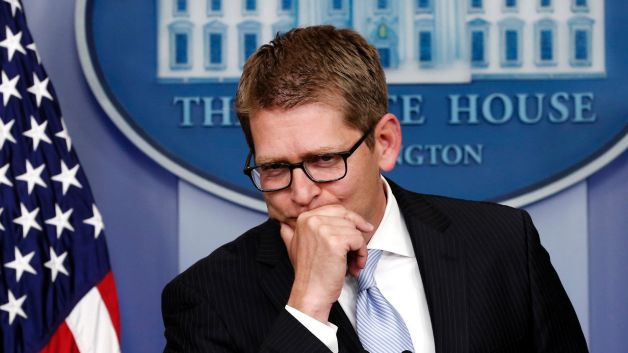
White House press secretary Jay Carney.

On Monday, White House press secretary Jay Carney continuously referred to the American Legion’s supposed praise of the administration over the resignation of a top VA health official, Under Secretary for Health Robert Petzel.

Petzel, which was first reported by PeoplesPunditDaily.com last week, had already announced back in September that he planned to retire in 2014. The American Legion, despite White House claims, said in a statement that the resignation as “business as usual.”

“The American Legion said that the group looks at Petzel’s resignation as a, quote, step towards addressing the leadership problem at the VA,” Carney said. “So I think that undercuts the assertion that that is not a meaningful development.”

However, the American Legion, which posted a statement at the top of the site, had a different take altogether. “Secretary [Eric] Shinseki and Under Secretary [Allison] Hickey remain on the job. They are both part of VA’s leadership problem, and we want them to resign as soon as possible.”

Now, with Carney’s words called into question, again, the White House is trying to explain the mischaracterization in their typical fashion — blame someone else.

Carney was just quoting newspaper accounts, the White House said, pointing to the Washington Times and USA Today. On, Friday the papers ran a quote from spokesman John Raughter characterizing the resignation as a “step towards addressing the leadership problem at the VA.”

When asked if he thought the White House fully understand and portrayed their position, there was a clear disconnect.

“Not at all,” he said. “We feel there is a cultural change that needs to be made.”

“We hope they read the commander’s full release on Dr. Petzel’s resignation,” American Legion spokesman, Peter Gayton, also told ABC News.

The American Legion called the resignation of

monica wehby expands 2014 senate map to oregon senate

Oregon Republican Senate candidate Monica Wehby at a candidate forum in Lake Oswego, Ore. March 19, 2014. AP

The scheduled May 20 primary elections consist of six states, the outcomes of which will influence the 2014 midterm elections in November. We are making our final predictions, though there will not be much of a change from our past analysis.

The elections for House and Senate candidates in Arkansas, Georgia, Idaho, Kentucky, Oregon and Pennsylvania will all be influenced by the Tea Party movement, but the question is not whether they will have the influence to help reshape the GOP, but how much influence.

In Arkansas, Democrat Mike Ross and Republican Asa Hutchinson face lesser-known, unfunded rivals Tuesday. Even though they have both said they weren’t taking anything for granted, they will both succeed and move on to a contested race in November.

We just provided in-depth analysis of the general election for Senate. Neither Senator Mark Pryor nor Rep. Tom Cotton will have primary challenges, but the Republican primary race for Cotton’s seat in Arkansas’s 4th Congressional District has been hotly contested. The outcome of tomorrow’s primary will tell us much about Pryor’s chance of survival.

Energy investor Tommy Moll, the conservative in the race, continued his attempt to link state Rep. Bruce Westerman to the state’s “private option” compromise on Medicaid expansion, hammering him on his sponsorship of the legislation and his introduction of an alternative proposal that would have included an overhaul to the state’s existing Medicaid program. Westerman backed down for political expediency, pulled his name from the private option legislation, then voted against it. He never did offer up his alternative proposal.

Our model, admittedly, is weak on this call. The numbers are spewing out that Moll has a small 53 percent chance of victory, but the margin of error is too large for certainty. There is simply not enough data to go on. However, with the backing of FreedomWorks and other conservatives, the activist GOTV may just put him over.

In Georgia, which we have covered in more detail for both the primary and general election, Republican businessman David Perdue (yes, he is the cousin of ex-Gov. Sonny Perdue) is the clear front-runner, but will likely not make the 50 percent threshold needed to avoid a runoff. Either Kingston or Handel will have the opportunity for a rematch with Perdue. Meanwhile, as is the typical case for Democrats, Michelle Nunn, daughter of former Democratic Sen. Sam Nunn, will face the Republican (who we believe to be Perdue) in November.

In Kentucky, as we have said over and over, it just never happened for Matt Bevin. Flip-flops, or perceived flip-flops, on the TARP bailout stopped any major momentum he may have had. Senate Minority Leader Mitch McConnell, or likely soon-to-be majority leader, will defeat Matt Bevin by a healthy margin. I will say, however, that the margin will not be as big as everyone believes. I have seen public and private polling that suggest Bevin is picking up last-minute steam. Despite Democrats’ hopes, he will also defeat Allison Grimes in November, just not by as large of a margin.

In Idaho, The Club for Growth and other conservatives endorsed GOP candidate Bryan Smith over incumbent Rep. Mike Simpson, who is by any and all measures a liberal Republican. Still, the message didn’t stick, and Simpson, who had no qualms about supporting TARP and other big government programs, will likely win his primary. If the night has a big upset, however, I’d bet it would be in Idaho.

Pennsylvania Democratic voters will decide who will take on vulnerable incumbent Gov. Tom Corbett, the single-most vulnerable Republican governor according to our model at PPD. However, there may be some light at the end of the primary tunnel for Corbett. Four Democrats have been beating each other up in a bitter nomination battle, and former state revenue secretary Tom Wolf is now the clear front-runner. Yet, his victory is good news for Corbett, despite polling. His three challengers accused him of attempting to buy the primary, which he did, and the governor’s camp has told me they will pick up on that line of attack.

Also in Pennsylvania, Rep. Bill Shuster faced Tea Party opposition from primary opponent Art Halvorson, a local businessman. Shuster will win.

In what may just be the most important race tomorrow, Monica Wehby and state Rep. Jason Conger of Bend will face off for the chance to take on Democrat incumbent Sen. Jeff Merkley. Merkley’s seat is by no means safe, but the nomination of a candidate like Wehby will wobble his security even more. The children’s brain surgeon turned-politician is one of the most talented candidates running in the Republican field this cycle (not to mention she had the single best ad all cycle). If she defeats Conger, which we believe she will, then this seat will be in play and the Republicans will have succeeded in expanding the map into blue states.

The scheduled May 20 primary elections consist

va scandal

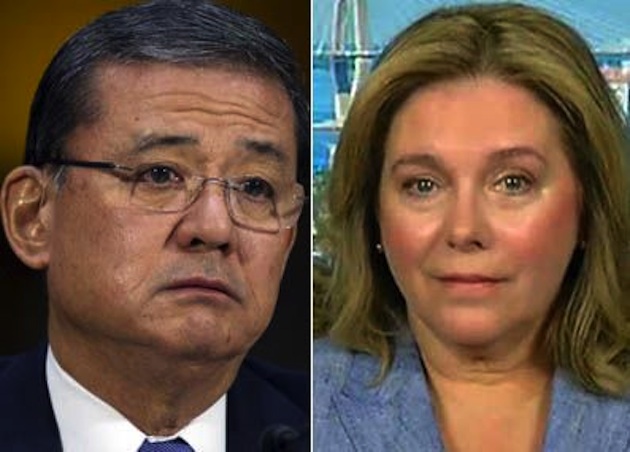
VA Secretary Eric Shinseki (left) and Dr. Margaret Moxness (right), a psychiatrist who was employed at the Huntington VA Medical Center in Charleston, West Virginia.

A former VA doctor made new allegations Monday against the Department of Veterans Affairs, telling hosts of a morning show that she was also ordered to delay the treatment of veterans for months and that at least two of them committed suicide.

The new allegations come amid a similar scandal involving administrators at the VA. Allegations in several states claim that workers were concealing information at the direction of VA administrators regarding the prolonged wait times for veterans to receive treatment. VA Secretary Eric Shinseki testified last week before Congress on the scandal, but so far has resisted calls for his resignation.

White House Press Secretary Jay Carney said Monday that both the president and his administration — including Shinseki — first learned about the story after seeing it on Fox News. The administration has sent out Carney with this position several times in the past, to include the IRS scandal, the wiretapping scandal and the gun-running scandal, Fast and Furious.

Dr. Margaret Moxness, a psychiatrist who was employed at the Huntington VA Medical Center in Charleston, West Virginia, from 2008 to 2010, appeared on “Fox & Friends” on Monday. She said she was told to put off treatment before and even after she alerted supervisors to veterans’ needs for immediate care. At least two of these patients ended up committing suicide while waiting to be treatmented.

“I was in a very tight-knit community,” Moxness said. “There was lots of extracurricular support: family, faith, vet centers. So we had help, but no thanks to the VA. …I mean, these men were eventually going to need more than a visit every 10 months.”

Moxness said that VA administrators have completely lost touch with the patients they are charged to care for, and said they’ve become compassionless toward veterans.

“They don’t really experience what the doctors and nurses are experiencing, which is the suffering and the pain and the death,” she said.

As of 1:45 P.M. ET, neither the Huntington VA Medical Center nor the Washington-based headquarters have even returned a call for comment made by People’s Pundit Daily.

“I was functionally silenced,” Dr. Moxness said, for attempting to argue for her medical opinion. When patients are forced to wait “months” in between visits, then that “means they’re partially treated, which means they’re worse off than no treatment at all.”

Several other whistle-blowers have made similar allegations of long delays and poor treatment at VA medical facilities, including in Texas and Missouri.

In response to the controversy, the Obama administration on Friday announced the resignation of a top VA health official, Under Secretary for Health Robert Petzel. Carney, under fire from reporters, said Monday that the resignation was an example of accountability, but they weren’t buying it. Petzel, which was first reported by PeoplesPunditDaily.com, hhe had announced back in September that he planned to retire in 2014.

His resignation simply came a few months earlier than was previously planned, and is not the resignation that others have called for. It is widely seen as a way to protect the man truly responsible, former general and Secretary Eric Shinseki. Carney said that the president has “complete confidence” in the abilities of Shinseki. But Shinseki ins’t the only official slipping past accountability.

Thus far, the VA has put three senior officials from the Phoenix facility on administrative leave following revelations other doctors said they were ordered to hold veterans’ names for months on a secret waiting list until a spot opened up on an official list that met the agency’s two-week waiting time goals.

Further, other allegations have been made about similar cover-up schemes at VA medical facilities in at least seven other cities. The Huntington VA Medical Center has 80 beds. In 2008, it provided care to 293,000 outpatients and 4,200 inpatients.

A former VA doctor made new allegations

eric holder china cyber estionage

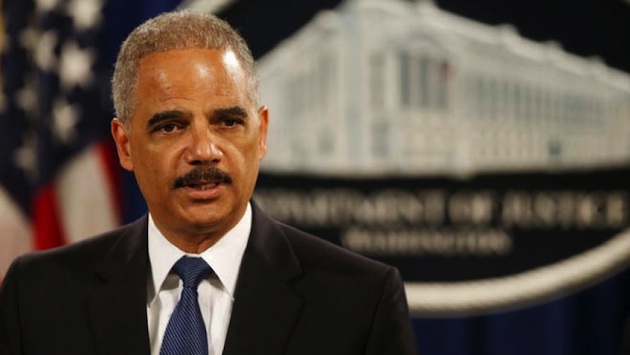
May 19, 2014: Attorney General Eric Holder speaks at a news conference at the Justice Department in Washington. (Photo: AP)

The Justice Department on Monday announced the first-ever criminal cyber-espionage case against Chinese military officials, accusing them of hacking major U.S. companies to steal intellectual property right and company secrets.

The Chinese Foreign Ministry immediately responded, reportedly warning that the action would further damage U.S.-China relations. Foreign Ministry spokesman Qin Gang urged “immediate rectification” for the charges, which he said were made up by the Obama administration.

U.S. officials accused five Shanghai-based Chinese officials of targeting companies in U.S. nuclear power, metals and solar sectors, including major U.S. firms like Alcoa World Alumina, Westinghouse Electric and U.S. Steel Corp. The other victims cited include Allegheny Technologies, United Steelworkers Union, and SolarWorld.

“This is a tactic that the United States government categorically denounces,” Holder said. “This case should serve as a wake-up call to the seriousness of the ongoing cyberthreat.”

John Carlin, who recently rose to head of the Justice’s National Security Division, said the prosecution of state-sponsored cyberthreats was a top goal for the Obama administration.

“For the first time, we are exposing the faces and names behind the keyboards in Shanghai used to steal from American businesses,” he said Monday, accusing the Chinese officials of “stealing the fruits of our labor.”

Last September, President Obama discussed cybersecurity issues on the sidelines of a summit in St. Petersburg, Russia, with Chinese President Xi Jinping. China has frequently been accused of hacking, but a report released last year by the Virginia-based security firm, Mandiant Corporation, contained some of the most extensive and detailed accusations to date linking its military to a wave of cyberspying against U.S. and other foreign companies and government agencies.

In late March, Defense Secretary Chuck Hagel revealed that the Pentagon planned to more than triple its cybersecurity staff in the next few years to defend against Internet attacks that threaten national security.

Hagel’s comments at the National Security Agency headquarters in suburban Washington came as he prepared to visit China.

“Our nation’s reliance on cyberspace outpaces our cybersecurity,” Hagel said at the time. “Our nation confronts the proliferation of destructive malware and a new reality of steady, ongoing and aggressive efforts to probe, access or disrupt public and private networks, and the industrial control systems that manage our water, and our energy and our food supplies.”

The Justice Department on Monday announced the


arkansas senate race

Incumbent Democratic Senator Mark Pryor (left) and Republican Rep. Tim Cotton (right) will face off in the Arkansas Senate race in November.

There can be little doubt that the 2014 Arkansas Senate race is proving to be far more competitive than the contest in 2010. The Republican path to retake control of the U.S. Senate in November, will almost certainly have to include the conservative state, with the defeat of incumbent Democratic Senator Mark Pryor coming at the hands of Rep. Tom Cotton. Since December, when we first analyzed the race, other pundit projections have swung back and forth, coming to rest now at a median predictions of a “Toss-Up.”

We disagree, falling in line alongside Five Thirty Eight and Rothenberg. But rather than offering up superficial, opinion-based analysis or simple knee-jerk reaction to volatile public polling as a justification for our rating, I instead would like to offer a detailed, transparent explanation for why the Arkansas Senate race is not a “Toss-Up.”

In 2010, when incumbent Democrat Blanche Lincoln was defeated by a 21-point margin by now-Senator John Boozman, the Partisan Voting Index was at R+9. As far as actual vote results, the state was 14 points more Republican than the country as a whole in 2010 and again in 2012. In 2014, the Partisan Voting Index is a mirrored R+14. While it is true that Lincoln made the top 10 for worst performances in Senate race history, Senator Mark Pryor is not Blanche Lincoln, so we would be correct to say a 2010 vs. 2014 comparison is somewhat the same as comparing apples and oranges. A better apples and apples comparison would be to focus on Pryor’s past performance.

In 2008, Pryor won every county when the state was also 14 points more Republican than the country as a whole, but he did so because he ran unopposed. Instead, let’s take a look at the 2002 Arkansas Senate race results by county, when Pryor defeated a severely damaged candidate, Tim Hutchinson, 53.90 to 46.10 percent.

There are several factors that are responsible for Pryor’s win. While we plug through these data points, it will become increasingly clear how much the “candidate strength” variable matters in election projection models, such as the one used at People’s Pundit Daily (or any credible model for that matter). However, by the time we get to the end of our data rundown, it will become apparent, as well, that Pryor has a serious two-fold problem he has never before had to contend with. Below is a map showing the 2002 election results.
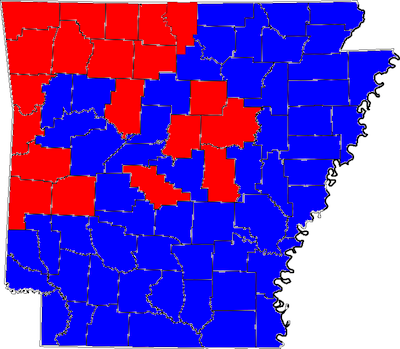
arkansas senate race

This was a particularly strong performance for Pryor considering 2002 was a fairly good Republican year. But if we look at the counties Pryor carried with 60 percent or more of the vote (dark blue) and 50 – 59 percent (light blue), then 1) the past performance is even more impressive, and 2) we will have a more in-depth understanding of Pryor’s current challenges. Forgive the rendition of the map, but you’ll get the point.
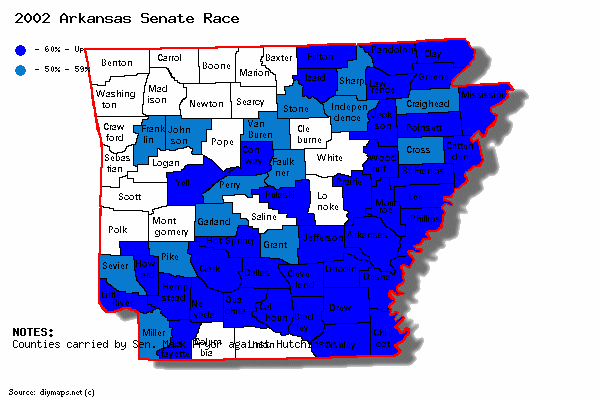
2002 Arkansas Senate race Pryor 60+ counties

Pryor was able to hold down Hutchinson’s margins in the reliably Republican regions, including in the Northwest, save for Benton. He won Pulaski County handily, which is where Little Rock is located, but also did well in its suburbs. Obviously, he carried the Delta counties by overwhelming margins, largely because it is one of the few regions of the state with a substantial black voter presence.

But, even with all of that aside, Pryor’s relatively narrow win came from his performance in southern Arkansas. This is where Pryor’s father comes into consideration. He represented the area in Congress, and Pryor carried almost all of these counties.

It is fair to call southern Arkansas a borderline swing region of the state. Prior Democrats who went down in defeat were very close to mirroring Pryor’s performance in the Delta and in Pulaski County. However, because they were not as strong in the southern region of the state, they lost. In 2000, Al Gore split these counties with George Bush, and lost the state by five points. In 2004, John Kerry lost nearly all of them. Demonstrating Pryor’s strength, Kerry and Gore didn’t come anywhere near the 70 percent level of support that Pryor enjoyed, even in the Democrat-friendly counties they won.

Still, the trend is clear and on par with the trends we observe in Partisan Voting Index and party identification. They all point to an ideological shift, which has moved on generation lines and strongly favors Republican candidates. Which brings us to Mr. Pryor’s two-fold problem, which unfortunately for him, directly affects his two strongest assets.

On the influence of his father’s legacy, it is grossly overstated. If you voted for Pryor’s father when he ran for Congress, governor and senator, then in 2014 you will be 89. While the Pryor name has been mentioned over and over as a significant factor in other pundit’s analysis, the reality is that very few of these voters will still be alive, and an even fewer number of them will be voting. He will not be able to rely upon name-related voter loyalty to the extent he has in the past.

Second, while Democrats perform well in the Delta, Little Rock and southern Arkansas, all of these counties combined cannot deliver a Democratic victory without duplicating or coming close to duplicating Pryor’s performance in the “southern swing” region in 2002. Why is this unlikely? Well, a large part of the region falls within Arkansas’s 4th Congressional District, which you may have guessed, is represented by a certain Rep. Tom Cotton, his Republican opponent. Take a look at the map below, and zoom in a few clicks if necessary.

We’ve spent all of this time talking about Pryor, but Cotton — though not without weakness — is likely to be a stronger-than-average candidate. His voting record is not one of an extremist, and he is no Todd Akin with diarrhea of the mouth. Cotton has an Ivy League Harvard education, which will appeal to suburban voters whom Pryor needs to hold on to in and around Little Rock, as well as other suburbanites from farther down south. His military background, which Pryor made the mistake of belittling, will appeal to rural voters that Hutchinson performed relatively poorly among in 2002.

President Obama, according to Gallup, has struggled to have an approval rating in the state above 35 percent. It has averaged around 33.5 percent in 2014, increasing only modestly to 34.5 even as his national approval rating seems to be recovering slightly. Arkansas is simply not the same state that it was when his father was elected, or even when Senator Mark Pryor was first elected for that matter. Pryor is a strong candidate, to be sure. But the trend in state’s political leanings are more likely than not to overcome him.

So, how do we explain the polling?

The average polling below shows Pryor ahead by 4.8 percent. However, The NYT/Kaiser poll’s sample is deeply flawed, with Pryor leading by 10 points among voters who voted for Mitt Romney by just 1 point, when nearly 61 percent of Arkansans voted for Mitt Romney in 2012. We see similar flaws — though not as prevalent — with the NBC/Marist poll. On our measurement of pollster accuracy, Marist scored a 4.2 out of 5 in 2012, with 5 being the least accurate. The last glimpse of internal polling from the Pryor camp showed him with just a 1-point lead in the low 40s. It would be safe to assume the majority of the large amount of undecideds disapprove of the president and his agenda.

My hunch is that the polling will catch up to reality by late summer.

When we run the numbers into the model, we find that there is a 63 percent chance that Rep. Tom Cotton will defeat incumbent Senator Mark Pryor. With these probabilities, the Arkansas Senate race is rated “Leans Republican” on PPD’s 2014 Senate Map Predictions.

It is certainly going to be a closer race in 2014 than in 2010, but it is no “Toss-Up” by any measure.

2014 Arkansas Senate Race Polling
Poll Date Sample Pryor (D) Cotton (R) Spread
Average Of Polls 4/8 – 5/4 45.8 41.0 Pryor +4.8
NBC News/Marist 4/30 – 5/4 876 RV 51 40 Pryor +11
PPP (D) 4/25 – 4/27 840 RV 43 42 Pryor +1
Magellan Strategies (R) 4/14 – 4/15 857 LV 43 46 Cotton +3
NY Times/Kaiser 4/8 – 4/15 857 RV 46 36 Pryor +10
Talk Business Poll* 4/3 – 4/4 1068 LV 46 43 Pryor +3
Opinion Research Associates 4/1 – 4/8 400 RV 48 38 Pryor +10
CEA/Hickman Analytics (D) 2/17 – 2/20 400 LV 46 46 Tie
Impact Management Group (R) 2/10 – 2/10 1202 RV 42 46 Cotton +4
Rasmussen Reports 2/4 – 2/5 500 LV 40 45 Cotton +5
The Arkansas Poll 10/10 – 10/17 LV 36 37 Cotton +1
Impact Management Group (R) 10/24 – 10/24 911 RV 41 42 Cotton +1
Talk Business Poll 10/8 – 10/8 603 LV 42 41 Pryor +1
WFB/The Polling Company (R) 8/6 – 8/7 600 RV 45 43 Pryor +2
Harper (R) 8/4 – 8/5 587 LV 41 43 Cotton +2

Though the 2014 Arkansas Senate race is

new york times NYT building

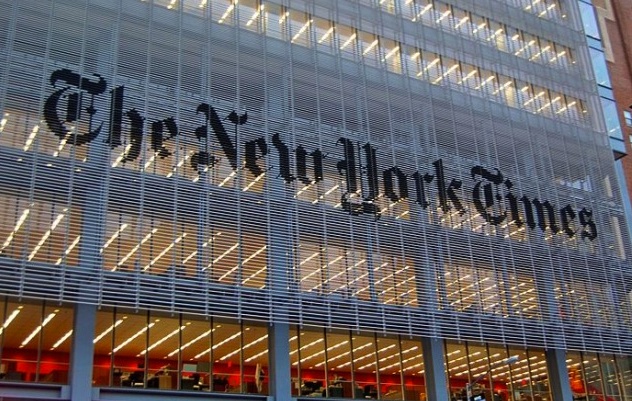
New York Times (NYT) building in NYC.

New York Times publisher Arthur Sulzberger, Jr. released a statement on Saturday attempting to clarify why former executive editor Jill Abramson was fired. Abramson, who made headlines herself in another way, drew fire for calling the Obama administration the least transparent administration she has ever covered. Naturally, specualtion arose over whether the liberal newspaper fired her for her comments.

Sulzberger says she was fired because “she had lost the support of her masthead colleagues and could not win it back.” He also what he characterized as “incorrect reports that Jill’s compensation package was not comparable with her predecessor’s,” and said her pursuit of a pay raise has no role in the decision to terminate her.

However, while he addressed the issue of equal pay for women, an issue that fits neatly in to the narrative the liberal New York Times pushes, the statement omitted any reference to her classification of the Obama administration, altogether.

“During her tenure, I heard repeatedly from her newsroom colleagues, women and men, about a series of issues, including arbitrary decision-making, a failure to consult and bring colleagues with her, inadequate communication and the public mistreatment of colleagues,” Sulzberger wrote in the statement.

“I discussed these issues with Jill herself several times and warned her that, unless they were addressed, she risked losing the trust of both masthead and newsroom,” he continued. “She acknowledged that there were issues and agreed to try to overcome them. We all wanted her to succeed. It became clear, however, that the gap was too big to bridge and ultimately I concluded that she had lost the support of her masthead colleagues and could not win it back.”

The paper has had a series of problems with their editors in recent years. Margaret Sullivan, another editor of the New York Times, admitted last year that the paper does have a liberal media bias. Daniel Okrent, the first public editor, wrote a column answering that very questions. He answered in the affirmative.

The full statement:

Perhaps the saddest outcome of my decision to replace Jill Abramson as executive editor of The New York Times is that it has been cast by many as an example of the unequal treatment of women in the workplace. Rather than accepting that this was a situation involving a specific individual who, as we all do, has strengths and weaknesses, a shallow and factually incorrect storyline has emerged.

Fueling this have been persistent but incorrect reports that Jill’s compensation package was not comparable with her predecessor’s. This is untrue. Jill’s pay package was comparable with Bill Keller’s; in fact, by her last full year as executive editor, it was more than 10% higher than his.

Equal pay for women is an important issue in our country – one that The New York Times often covers. But it doesn’t help to advance the goal of pay equality to cite the case of a female executive whose compensation was not in fact unequal.

I decided that Jill could no longer remain as executive editor for reasons having nothing to do with pay or gender. As publisher, my paramount duty is to ensure the continued quality and success of The New York Times. Jill is an outstanding journalist and editor, but with great regret, I concluded that her management of the newsroom was simply not working out.

During her tenure, I heard repeatedly from her newsroom colleagues, women and men, about a series of issues, including arbitrary decision-making, a failure to consult and bring colleagues with her, inadequate communication and the public mistreatment of colleagues. I discussed these issues with Jill herself several times and warned her that, unless they were addressed, she risked losing the trust of both masthead and newsroom. She acknowledged that there were issues and agreed to try to overcome them. We all wanted her to succeed. It became clear, however, that the gap was too big to bridge and ultimately I concluded that she had lost the support of her masthead colleagues and could not win it back.

Since my announcement on Wednesday I have had many opportunities to talk to and hear reactions from my colleagues in the newsroom. While surprised by the timing, they understood the decision and the reasons I had to make it.

We are very proud of our record of gender equality at The New York Times. Many of our key leaders – both in the newsroom and on the business side – are women. So too are many of our rising stars. They do not look for special treatment, but expect to be treated with the same respect as their male colleagues. For that reason they want to be judged fairly and objectively on their performance. That is what happened in the case of Jill.

Equality is at the core of our beliefs at The Times. It will always be.

New York Times publisher Arthur Sulzberger, Jr.

Hillary Clinton Boko Haram

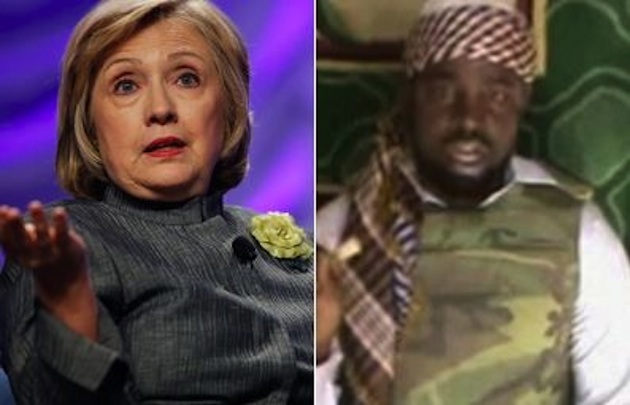
Hillary Clinton argued against designating Boko Harum a terrorist organization when serving as Secretary of State.

In 2012, Emmanuel Ogebe sent then-Secretary of State Hillary Clinton a 75-page brief advocating in favor of designating Boko Haram a terrorist organization. He received no response from Hillary Clinton or anyone at the State Department for that matter.

Ogebe, an international human rights lawyer and expert in bilateral U.S.-Nigerian relations, just returned from a three week fact-finding mission to Nigeria. While visiting refugee camps along the border with Cameroon, he interviewed countless victims who have been terrorized by Boko Haram. He recently reported his findings at an event hosted at the Hudson Institute, describing the failure of both U.S. and Nigerian governments to combat the violence and the rise of radical Islam in the region and around the world.

Boko Haram — a Hausa phrase meaning “Western education is a sin” — is an Islamic terrorist group whose stated goal is the forceful establishment of a strict, sharia-law theocracy in Nigeria. In April, Boko Haram abducted and enslaved some 276 schoolgirls while they were taking exams in a facility located in the northeastern Nigerian, Christian-populated enclave of Chibok. While the group has been threatening to sell the girls for roughly $12.00 each, their motivation for kidnapping the girls was Islamic extremism.

Yet, one might never know that if they walked the halls of the State Department, where at the highest levels a culture of denial exists regarding the grave threat of Islamic extremism. While First Lady Michelle Obama was the focus of criticism this past week for her use of “hashtag diplomacy,” tweeting out a picture holding a sign that read #BringOurGirlsHome, Clinton’s tweet warranted equal scrutiny, if not more.

Clinton’s tweet underscores a fundamental problem with the liberal world-view that is systemic at the liberally-dominated State Department. It’s not education that Boko Haram objects to per se, but Western education, hence the name. Clinton, at a campaign-style speech this week, also described the kidnapping as an “act of terrorism” that merits “the fullest response possible.” But, despite her too-late expression of outrage, when she had a chance to take meaningful action during her time as the head of the State Department, she didn’t. No amount pandering will change that reality.

“This is clearly a failure of the secretary of state,” Rep. Peter King said. “She refused to call Boko Haram a terrorist organization.”

It wasn’t as if the group just made their activities known after this most-recent kidnapping. Aside from the group’s long history of kidnapping and other acts of terror, Reps. Patrick Meehan (R-PA) and Jackie Speier (D-CA) first to wrote to Clinton asking her to label Boko Haram a terror group back in September 2011, just three weeks after the attack on a United Nations office in Abuja, Nigeria, which killed 23 people. As Ogebe noted, Hillary Clinton and the State Department refused the designation even though an American FBI agent was among the those murdered as a result of the attack.

However, persuaded by the then-furious FBI, the Justice Department joined the lawmakers in advocating for the terror designation, which allows the Treasury Department to freeze assets and the Justice Department to take further investigative action.

On March 30, 2012, a letter from Rep. Peter King, who was then the Chair of the House Homeland Security Committee, and Rep. Meehan again urged Hillary Clinton to “immediately designate” Boko Haram a terrorist group. It was followed just a few months later by another letter from Assistant Attorney General Lisa Monaco (viewable below), a high-level Justice Department official who also urged the State Department to place Boko Haram on the terror organization list. In Monaco’s letter, she lays out the case for the designation statute-by-statute, warning of the threat and arguing for the need to “make available a wide range of criminal and civil penalties” the Justice Department typically imposes to coerce cooperation and deterrence.

Still, Hillary Clinton refused all of the above requests. Within the once-feared and power politic-playing State Department, an evolution in to a leftwing bureaucracy hell-bent on reasoning with theologically-driven terrorists they don’t fully understand, occurred. But even though this evolution has accelerated throughout the Obama presidency, it doesn’t originate from Obama, it’s just thriving.

The State Department is known for being liberal,” Jonathan Gilliam, a former Navy SEAL and 8-year veteran of the FBI said in an interview Friday night on Fox News. According to Gilliam, who is now the founder and CEO of U.S. Continued Service, this evolution really began to grow roots during the Clinton years, when “the warrior” mentality became unacceptable to the foreign service officers at state.

State Department officials told People’s Pundit Daily that they were concerned about putting Boko Haram on the list of terror groups because they feared it would elevate the group’s profile and give it “greater credibility.” But Ogebe says they have received more credibility from First Lady Michelle Obama than they ever could have received from the terror designation.

“They’re up there with the big boys now,” Ogebe said in an interview Friday night. “For years they have been flapping their mouths.”

Their efforts had gone on without success until Michelle Obama and others helped to garner them the attention they desired, according to Ogebe. He noted that even after Boko Harum murder an American FBI agent during the attack at Abuja, Nigeria, the State Department opposed the Justice Department plan to take action. For Ogebe and many others, the lack of response and policy from the U.S. stems from ignorance of Islamic extremism.

“They are still saying the motive for the kidnapping was money,” he said. “At $12.00 a piece, $12 times 300 is $3600.00. That doesn’t make any sense.” Terror groups just don’t undertake missions of such magnitude to raise such a trivial amount of money.

Ogebe, returning from a previous trip to the region, brought back Deborah Peters, a teenage girl originally from the village of Chibok. In Chibok, hundreds of her neighbors and friends were recently taken captive by Boko Haram. Peters is the second known survivor and the first female survivor of Boko Haram to visit Washington. She survived and was released before the group changed their tactics. They killed her father and tortured her brother, but they used to have exceptions for women. Unfortunately, now they’ve changed that tactic and the new policy is now on full display.

Deborah is now a student in the United States. For Ms. Peters, Mr. Ogebe, Justice Department officials and others intimately familiar with the reality of Islamic terrorism, the State Department’s mindset is dumbfounding. For State Department officials, a misguided bureaucracy perpetuating a culture of denial, ignorance is their reality and it is bliss.

Watch Emmanuel Ogebe and Deborah Peters discuss the threat from Boko Haram. The panel was moderated by Nina Shea, the Senior Fellow and Director of the Center for Religious Freedom at the Hudson Institute.

Hillary Clinton's failure to designate Boko Haram

People's Pundit Daily
You have %%pigeonMeterAvailable%% free %%pigeonCopyPage%% remaining this month. Get unlimited access and support reader-funded, independent data journalism.

Start a 14-day free trial now. Pay later!

Start Trial