Widget Image
Follow PPD Social Media
Friday, January 16, 2026
HomeStandard Blog Whole Post (Page 961)

irs

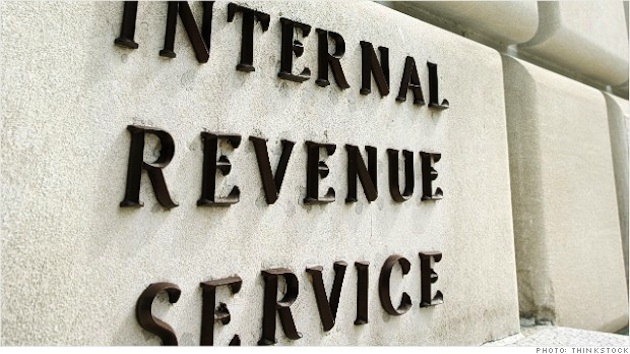
IRS building, Internal Revenue Service HQ, Washington, D.C.

It has been just over a year since the NRSC, the National Republican Senatorial Committee, sent the IRS a Freedom of Information Act request for “any and all documents or records, including but not limited to electronic documents, e-mails, paper documents, photographs (electronic or hard copy), or audio files,” pertaining to correspondences from January 1, 2009 and May 21, 2013 between thirteen different Democrat members of Congress and top IRS officials.

Yet, according to the NRSC, they have received no less than six letters — all regurgitating the same language and excuses from the last — requesting more time to fulfill the FOIA request. Each time, to include the most recent requested deadline of August 1, 2014, excuse letters have arrived from IRS Tax Law Specialists Robert Thomas or Denise Higley.

“I am responding to your Freedom of Information Act (FOIA) request dated May 21, 2013, and received in our office on May 30, 2013,” Higley wrote in a letter to NRSC Attorney Megan Sowards last year, in response to the original request. “I am unable to send the information requested by June 27, 2013, which is the 20 business day period allowed by law. I apologize for any inconvenience this delay may cause.”

It isn’t too difficult to speculate what the IRS may be hiding considering the newly released documents obtained by Judicial Watch. The emails prove that the story President Obama told Bill O’Reilly back in February, 2014, was completely false, and that the IRS targeting of conservative groups came from Washington, not Cincinnati.

In an interview with Fox News’ Bill O’Reilly (video included) viewed by millions of Americans on Super Bowl Sunday, President Obama said that neither he nor members of his administration lied about Benghazi or the IRS scandal, claiming the IRS targeting was simply the result of “bonehead decisions in local offices.” The president made headlines when he said that “not even a smidgen of corruption” was involved.

However, just as in the case with Benghazi, the emails show the president wasn’t telling the truth. Senator Carl Levin (D-MI), a fellow Democrat and Chairman of the Subcommittee on Investigations, corresponded with top Washington-based IRS officials throughout 2012, discussing how to target conservative groups who were working to fight the senator’s and President Obama’s reelection.

“Let me make it clear: These new documents show conclusively that officials in the Washington IRS headquarters were responsible for the illegal delays of Tea Party applications,” JW President Tom Fitton said. “And they also confirm the unprecedented pressure from congressional Democrats to go after President Obama’s political opponents.”

In a move that has little chance of turning out to be a coincidence, Senator Levin unexpectedly announced his retirement just weeks before the IRS scandal made headlines. However, involved parties, to include Lois Lerner, had known the story was bound to break several weeks ahead of time, ultimately opting to plant a question during a Q&A lunch in the hope they could get out in front of the story.

And Levin wasn’t the only Democrat directly communicating with the IRS.

Rep. Elijah Cummings (D-MD), the ranking member of the House Oversight Committee, also communicated back-and-forth with the IRS regarding the group True the Vote. The group focuses on voter fraud prevention, something Rep. Cummings has fought tooth and nail because, according to a claim he oft-repeats, voter fraud doesn’t even happen. Worth noting, prior to these revelations, Cummings had repeatedly denied that he or anyone in his office had any contact with the IRS.

But it wasn’t Levin or Cummings who were specifically named in the NRSC FOIA request, but rather embattled Democrats who still have to worry about answering to voters.

Several members of Congress were named in the request, including Sen. Schumer (D-NY), Sen. Reid (D-NV), DSCC Chair Sen. Bennet (D-CO), Sen. Landrieu (D-LA), Sen. Pryor (D-AR), Sen. Hagan (D-NC), Sen. Begich (D-AK), Sen. Shaheen (D-NH), Sen. Mark Udall (D-CO), Sen. Franken (D-MN), Sen. Warner (D-VA), Rep. Braley and Rep. Peters (D-MI).

Landrieu, Pryor, Hagan and Begich all have the political battle of their lives ahead of them. Shaheen, Udall, Franken, Warner, Braley and Peters are locked in tight or tighter-than-expected races, with several either tied or trailing in the polls against the Republican challengers.

But do we have information to even suggest Democrats took an interest in 501(c)4 groups and, more specifically, the targeting of Tea Party and other conservative groups? In truth, we not only have recent evidence, we have documented instances of Democrats pulling the levers of government to unfairly target political opponents going back decades, suggesting a systemic problem that would make it fairly easy to imagine several of the aforementioned names having something to hide.

In 2009, at the behest of Obama lawyer Bob Bauer, the husband of noted leftist Anita Dunn, the FEC illegally requested information from Lois Lerner at the IRS regarding the conservative 501(c)4 group, American Issues Project. In truth, as noted by Kimberly Strassel at The Wall Street Journal, widespread targeting of conservatives in this manner began in 2008, “when liberals began a coordinated campaign of siccing the federal government on political opponents.”

Fast-forward to May, 2013, roughly when the targeting revelations first surfaced, and it was already second nature for Lerner to use her office to aid those she agreed with ideologically. That’s why Bauer went to Lerner in the first place, he knew she would comply with his illegal request.

We previously reported on the following email back in September, 2013, which shows Lois Lerner and another IRS employee, Sharon P. Light, were monitoring the media headlines regarding Democrats’ interests in threats to the Senate majority from these groups.
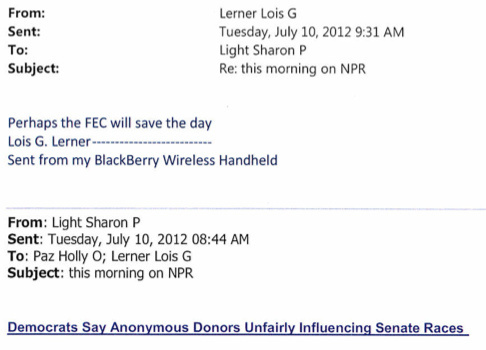
irs lois lerner email

Lerner’s response, “Perhaps the FEC will save the day,” is particularly noteworthy. Lerner’s nearly 34-year career in the federal government included time at the Justice Department and, you might have guessed, the Federal Election Commission. While at the FEC from 1986 to 2001, she was known for being overly aggressive during unwarranted investigations into conservative groups. And who would stop her? Lerner’s former boss at the FEC, former General Counsel Larry Noble, became the President of Americans for Campaign Reform, a leftist organization Lerner described as part of the “FEC world pushing for the prosecution of 501(c)4” groups.

In an email dated March 27, 2013, she says “one IRS prosecution would make an impact,” and that the “FEC world” felt that if they made an example, then conservatives “wouldn’t feel so comfortable” exercising their First Amendment rights. Describing a bureaucracy completely at the disposal of Democrats and their supportive groups like the ACR, she writes that this was “their latest push to shut these [conservative groups] down.”

From President Obama’s unprecedented State of the Union speech, during which he belittled the Supreme Court over Citizens United, to congressional Democrats who starred in the emails of IRS officials, the Democratic Party has made clear they loathe the high court’s decision and will use bureaucrats to help them do whatever they feel is in their power to undermine it. The high court’s decision may have begun the nationalization of this debate, but the IRS withholding emails from the NRSC, emails that are likely damning to their candidates and Senate majority, suggests this is a debate they would prefer to ignore — or silence.

Friday, Whitewater independent counsel Robert Ray agreed with Senator Ted Cruz that the time has come for the appointment of a special prosecutor to investigate the IRS scandal. As more prominent players come forward in support of more action, it will be more and more difficult for the left to silence the opposition, despite their past success.

The IRS may be intentionally withholding a
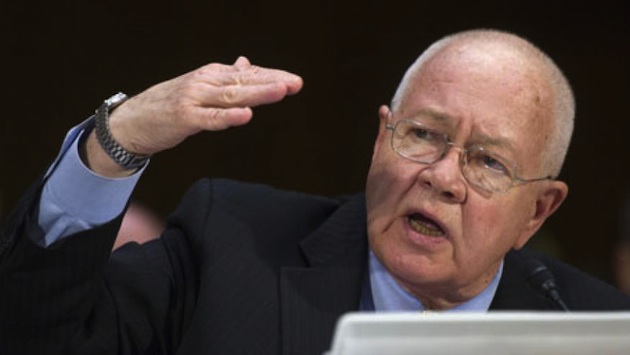
Robert Petzel VA scandal

Veterans Affairs Undersecretary Robert Petzel, MD, testifies on Capitol Hill in Washington, Thursday, May 15, 2014. (Photo: AP)

A top VA official supposedly in charge of veterans’ health care has resigned amid a VA scandal that produced a firestorm after it surfaced veterans died due to long appointment waits, treatment delays and falsified records at VA hospitals.

Veterans Secretary Eric Shinseki says he has accepted the resignation of Robert Petzel, the undersecretary for health care at the Veterans Administration. The news comes just one day after both men testified and were grilled by the Senate Committee on Veterans Affairs Thursday.

Whistleblowers told congressional investigators there was an attempt to cover up the deaths of up to 40 veterans while they were awaiting appointments at the medical center in Phoenix. Although it was the first instance, the Phoenix medical center wasn’t the last.

Shinseki says most vets are satisfied with the quality of care they get, but more must be done to “improve timely access to that care.” He has come under fire from lawmakers in Congress who said that he is clearly incompetent for not knowing what was occurring. He defenders say that he was left out of the loop by those in his inner circle, but critics say that makes the outrage even more justified, and calls into question his ability to run the Deparmtent of Veterans Affairs.

While many supporters of the administration are immediately pointing to Petzel’s resignation as an instance of accountability, he had announced back in September that he planned to retire in 2014. His resignation is simply a few months earlier than planned, and is not the resignation that others have called for. It is widely seen as a way to protect the man truly responsible, former general and Secretary Eric Shinseki.

Robert Petzel, the undersecretary for veterans' health

The number of Americans filing first-time jobless claims for unemployment benefits fell last week to 297,000 from an upwardly revised 321,000 the week prior. The number of claims is the lowest number seen since May 2007.

Wall Street was looking for claims to rise to 320,000 from an initially reported 319,000. However, some economists reacted negatively to the news, cautioning observers not to read the headlines too favorably. Rather than taking the number as a positive sign, they instead say that long-term high unemployment literally causing the workforce to run out of those elegible to file first-time jobless claims.

Last months jobs report said that — while the headline unemployment rate fell — it did so only due to the amount of people who simple quit from the workforce, altogether.

The number of Americans filing first-time jobless

(Photo: REUTERS)

According to duel reports released Thursday, both New York and Philly manufacturing data increased sharply in the month of May after April disappointed.

The New York Fed’s Empire State index rocketed to 19.01 in May, up significantly from 1.29 in April. April was a huge disappointment, showing growth slowed from 5.61 in the month of March.

The report said it was the highest reading since mid-2010, and was way above expectations. Economists polled by The Wall Street Journal had expected the latest index to increase to just 5.0. A reading above 0 indicates expansion, while below indicates contraction.

The New York Fed survey is the first monthly factory report released by regional Fed banks. The Philadelphia Fed’s gauge of manufacturing activity in the mid-Atlantic region, which was released shortly after, also rose to 15.4 in May from 16.6 the month prior. The May reading surpassed Wall Street’s expectations of 14. Economists expected the Philly survey would show expanding activity in May, but only at slightly slower rate than in April.

According to the New York Fed report, “business conditions improved significantly for New York manufacturers.”

The New York Fed said new demand is reviving. The new orders index rebounded to 10.44, after falling to -2.77 in April.

The shipments index shot up to 17.44 from 3.15 in April and 3.97 in March.

Demand for labor also increased, with the employment index increasing to 20.88 this month from 8.16 in April, and the workweek index edged up to 2.20 from 2.04 in April.

The prices-received index slowed to 6.59 after it increased to 10.20 in April from 2.35 in March. The prices paid index slowed to 19.78 from 22.45 in April and 21.28 in March.

The general business conditions expectations index for the next six months increased to 43.96 from 38.23 last month. The employee expectations index slowed to 17.58 from 22.45.

New York, Philly manufacturing data increased

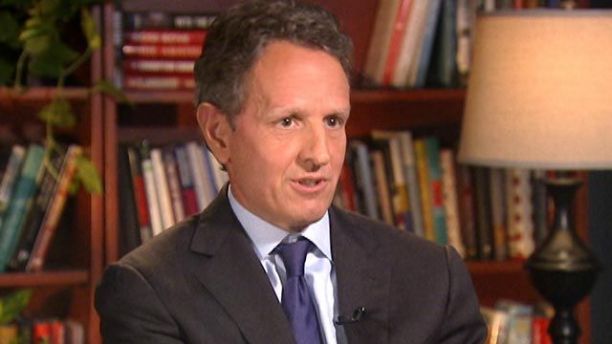
Treasury Secretary Timothy Geithner claimed in his new book that White House advisor Dan Pfeiffer tried to get him to mislead the American people on entitlements and the national debt, specifically Social Security. However, after a day of blowback, Geithner is now trying to change his entire story.

In an interview with Fox News’ Bret Baier Wednesday, the former Treasury Secretary denied that the White House attempted to get him to mislead the public, a revelation that surfaced just days after newly released emails showed a similar pattern of behavior in the aftermath of the Benghazi terror attack.

“I was never, ever in the position where anyone in the White House asked me to do that,” he told Baier. “And of course, I would never have done it. But Dan Pfeiffer never asked me to do that.”

Pfeiffer, who was also CC’ed on the now-infamous Ben Rhodes email along with others in the White House inner circle, played a pivotal role in attempting to prep Geithner before a Sunday talk show in 2011. In his memoir, “Stress Test: Reflections on Financial Crises,” Geithner wrote that he refused Pfeiffer when asked to say Social Security “didn’t contribute” to the growing and unsustainable federal debt.

“It wasn’t a main driver of our future deficits, but it did contribute,” Geithner wrote. “Pfeiffer said the line was a ‘dog whistle’ to the left, a phrase I had never heard before. He had to explain that the phrase was code to the Democratic base, signaling that we intended to protect Social Security.”

But that’s all changed now, apparently.

Now, Geithner said Pfeiffer was “helpful,” and simply noted “that we didn’t want to look like our proposals … were proposals that were going to appear to some as cutting Social Security benefits to cover the shortfalls.”

Though he now claims that the administration simply didn’t want to be “vulnerable to misperceptions,” mainly that they sought deficit reductions “on the backs of Social Security,” he doesn’t deny the severity of unfunded U.S. debt liabilities.

When asked whether Social Security contributes, he said: “To the long-term fiscal problem? Yeah, because, as is obvious, it’s just a math thing.”

“It’s not rocket science,” Geithner said of the debt, “it may be complicated, but it’s now rocket science.”

Yet, Press Secretary Jay Carney defended both Dan Pfeiffer and the Obama administration’s policy on Monday, again claiming that Social Security is not the “main driver” of the deficit, particularly and ironically compared to health care entitlements. “That, I’m sure, is the point that Dan was making,” Carney said.

Geithner also wrote about an incident in January 2009, when he was on the job as treasury secretary for less than a week. Another well-known Democratic strategist for the 2012 Obama reelection campaign — Stephanie Cutter — wanted him to put on an act of outrage.

“I was supposed to have my first one-on-one meeting with President Obama,” Geithner wrote. “As I was about to walk into the Oval Office, Stephanie Cutter, a veteran Democratic operative who was handling our communications strategy, told me we would have a ‘pool spray,’ a photo opportunity for the White House press.

“The president and I would make brief remarks about executive compensation, responding to a report that Wall Street firms had paid their executives big bonuses while piling up record losses in 2008. ‘Here’s what you’re going to say,’ Cutter said.”

Geithner wrote that Cutter handed him the text, which he said he then “skimmed the outrage I was expected to express.”

He wrote: “I’m not very convincing as an angry populist, and I thought the artifice would look ridiculous.”

He also told Cutter, like Pfeiffer, he wouldn’t do it.

“Instead, I sat uncomfortably next to the president while he expressed outrage. Americans were furious about bailouts for overpaid bankers, and the White House political team wanted us to show we were on the right side of the backlash,” he wrote. “The public outrage was appropriate … but I didn’t see how we could ever satisfy it. We had no legal authority to confiscate the bonuses that had been paid during the boom.”

Treasury Secretary Timothy Geithner claimed in his

polling on benghazi

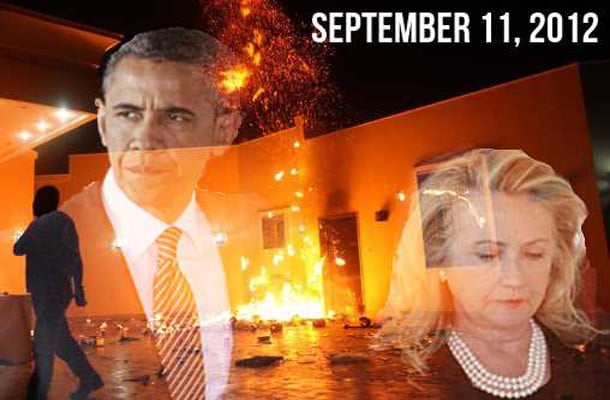
A majority of Americans believe President Obama and Hillary Clinton intentionally lied to the public about the Benghazi terror attacks on Sept. 11, 2012. However, while voters approve of the decision to establish a select committee by a whopping 67-28 percent margin, which includes a 55-percent majority of Democrats, Republicans have some challenges of their own to contend with.

The number of voters who say Republicans are investigating Benghazi for political gain is more than twice the number who say their intention is only to find the truth (63-30 percent). That includes 38 percent of Republicans who think their party is politicizing the Benghazi attack.

Still, by a 51-39 percent margin, voters say the White House knowingly lied about the attacks to help President Obama’s re-election campaign, including 25 percent of Democrats who say Obama has tried to deceive the American people on the issue and 23 percent who think the White House lied to help the campaign. While 54 percent of voters think the Obama administration has been “deceitful” about the events, 50 percent say the same was the case with former Sec. of State Hillary Clinton.

Both Obama and Clinton met with the victims’ families on the tarmac when airplanes brought the bodies of their murdered loved ones, including Ambassador Chris Stevens, but looked directly in their eyes and lied about what happened. The former Sec. of State promised the mother of Sean Smith, a State Department analyst who lost his life in the attack, and the Charles Woods, the father of Navy SEAL Tyrone Woods, that they would “arrest that guy who made the video.”

Of course, we now know what many suspected from the beginning, which is that the video and the man who made it were nothing but red herrings during a presidential campaign.

Newly released emails obtained by lawsuit from Judicial Watch showed senior White House advisor, Ben Rhodes, played a pivotal role in prepping former UN Ambassador Susan Rice for her appearances on the Sunday shows. The email was CC’ed to various members of the White House inner circle, including political communications advisors and even press secretary Jay Carney.

Overall, over a supermajority of voters — 78 percent — say they consider Benghazi a serious issue, including 52 percent who see the Obama administration’s handling of Benghazi as “very serious.” For comparison, 53 percent see government surveillance of everyday Americans as “very serious” and 44 percent feel that way about the IRS targeting of conservative groups.

The Fox News poll is based on landline and cell phone interviews with 1,025 randomly chosen registered voters nationwide and was conducted under the joint direction of Anderson Robbins Research (D) and Shaw & Company Research (R) from May 10, 12-13, 2014. The full poll has a margin of sampling error of plus or minus three percentage points.

A majority of Americans believe President Obama

Ohio Governor Race

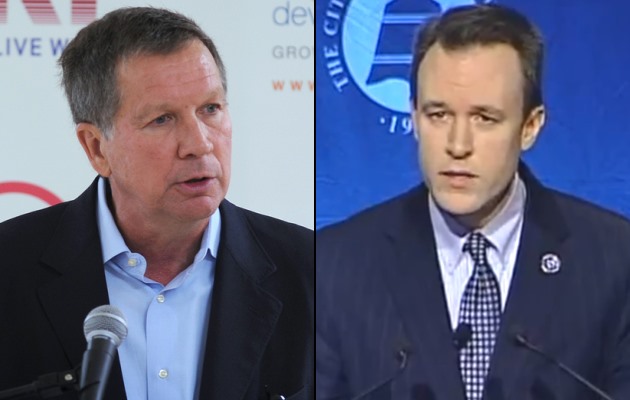
Incumbent Gov. John Kasich (left) and his likely Democratic opponent, Cuyahoga County (Cleveland) Executive Ed FitzGerald (right).

In our last look at the the Ohio Governor race, incumbent Gov. John Kasich was the “Likely” favorite to win reelection, but the data now show he is the “Safe” favorite come November. Kasich will face Cuyahoga County (Cleveland) Executive Ed FitzGerald, but according to new polling Kasich has now begun to break away from FitzGerald, hitting the crucial 50 percent threshold.

The PPD election projection model weighs several variables, i.e. polling, demographics and Partisan Voting Index, candidate recruitment and strength, campaign organization and fundraising, presidential approval ratings among other proven predictive measurements. If you want to read more about the model used at People’s Pundit Daily, then visit the map, but let’s begin with the polling conducted on the Ohio Governor race.

A year ago, this looked like it was going to be a close race, something similar to what we saw in 2010. Kasich was favored then, as well, but now to the extend we viewed him to be “safe” in November. Kasich defeated then-incumbent Gov. Ted Strickland 49.04 – 47.04 percent, just over 77,000 votes. However, it wasn’t until 4 months before the election in June that it became clear Kasich had built a lead over Strickland. The two candidates had largely been within the MoE.

That isn’t the case this time around.

FitzGerald has led in just one poll, which was conducted by the Democratic pollster PPP, a notoriously inaccurate pollster, and that was back in August of last year. Our model weights pollsters based upon past accuracy, and Public Policy Polling is rated a 4.25 out of 5, with 1 being stellar and 5 being widely inaccurate (to keep it simple). The latest poll from Quinnipiac University, a firm that has an overall rating of 2.25, and also came within 1.7 points of the actual 2010 vote result, found Kasich leading 50 – 35 percent. The trend — viewable below — is fairly clear, but inside the numbers is even greater cause for concern within the FitzGerald camp.

TREND: If the election for Governor were being held today, and the candidates were Ed FitzGerald the Democrat and John Kasich the Republican, for whom would you vote?
                     May 14  Feb 19  Nov 26  Jun 25  Apr 18  Feb 28
                     2014    2014    2013    2013    2013    2013
 
FitzGerald           35      38      37      33      37      35
Kasich               50      43      44      47      46      45
SMONE ELSE(VOL)       1       1       2       1       1       1
WLDN'T VOTE(VOL)      2       2       4       4       2       2
DK/NA                11      16      15      15      15      17

“Ohio Gov. John Kasich has opened up a 15-point lead in his re-election race as voters give him sterling grades for his job performance, especially on the economy,” said Peter A. Brown, assistant director of the Quinnipiac University Poll. “He gets plus-50 percent approval ratings from voters on his handling of the economy and the state budget. These numbers are crucial because the economy and jobs are the most important issues in the minds of voters.”

Brown nailed it. In governor races, “All politics really is local,” as people’s votes tend to reflect less on nationwide condition and more on personal situation. Under Kasich, they simply like the direction their state and their own lives are going, and they like their governor for it.

Voters in Ohio say by a 67 – 23 percent margin that he has strong leadership qualities; 54 – 31 percent say he is honest and trustworthy; 53 – 39 percent say he cares about their needs and problems, while 57 – 30 that he has good judgment.

“Voters think Gov. Kasich deserves another term and two-thirds consider him a strong leader. A small majority says he cares about their needs, a measure on which Republicans, even successful ones, often don’t do that well. And perhaps most important for Kasich’s re-election, 60 percent of voters are satisfied with the way things are going in the state,” Brown correctly added. Even if FitzGerald was more popular or even a more familiar name, those are tough numbers to contend with.

The polling is actually beginning to reflect what we have argued all along regarding the fundamentals of the Ohio Governor race. Ohio, by several measurements, has been moving slightly farther to the right in the political spectrum. According to the annual Gallup party ID-by-state metric, Republicans have erased nearly all of the Democrats’ identification advantage in the state since 2012, and Ohio was already a competitive battleground, as evident by the 2010 and 2012 outcomes.

Similarly, the Partisan Voting Index (PVI), was R+1 in 2010 and is now again R+1 in 2014. In 2010, Republican candidates running in states with a PVI of D+2 or more Republican, had a success rate of roughly 83 percent. While Partisan Voting Index provides us with a comparable electorate to estimate probabilities in overall election outcomes, it is only to be taken in concert with the other variables.

Kasich has always had the edge in candidate strength, as well as campaign fundraising and organization. Since July, 2013, when Kasich had the advantage of a $2.6 million war chest to just $600,000 for FitzGerald, the governor has consistently out-raised his Democratic opponent. Campaign finance reports back in Feb. showed Kasich raised nearly $3.9 million, receiving in-kind donations totaling more than $629,000. However, FitzGerald raised a little more than $1.6 million, but much of it came from his party.

What does any of this tell us about the status of the race?

For starters, Democrats aren’t excited about their candidate, nor do donors believe their resources are wisely spent backing their guy against a strong incumbent. I have had several conversations with Democratic Party operatives who say they have all but abandoned FitzGerald, opting instead to defeat Sec. of State John Husted. The move is more geared toward the 2016 election than it is November, 2014. Husted has vigorously pursued anti-voter fraud measures, and he has become a to target because of it.

Nevertheless, as far as the guberbnatorial contest in the state of Ohio, we are now rating the race “Safe Republican” on our 2014 Governor Map Predictions. While we believe it will be closer than the polling indicates at this early stage, the force is strong with Gov. Kasich.

Poll Date Sample Kasich (R) FitzGerald (D) Spread
PPD Average 4/14 – 5/12 47.0 37.5 Kasich +10.5
Quinnipiac 5/7 – 5/12 1174 RV 50 35 Kasich +15
Rasmussen Reports 5/7 – 5/8 750 LV 45 38 Kasich +7
SurveyUSA* 4/24 – 4/28 618 LV 46 36 Kasich +10
Magellan Strategies (R) 4/14 – 4/15 857 LV 47 41 Kasich +6
Quinnipiac 2/12 – 2/17 1370 RV 43 38 Kasich +5
Quinnipiac 11/19 – 11/24 1361 RV 44 37 Kasich +7
PPP (D) 8/16 – 8/19 551 RV 35 38 FitzGerald +3
Quinnipiac 6/18 – 6/23 941 RV 47 33 Kasich +14
Quinnipiac 4/10 – 4/15 1138 RV 46 37 Kasich +9
Quinnipiac 2/21 – 2/26 1011 RV 45 35 Kasich +10

In our last look at the the

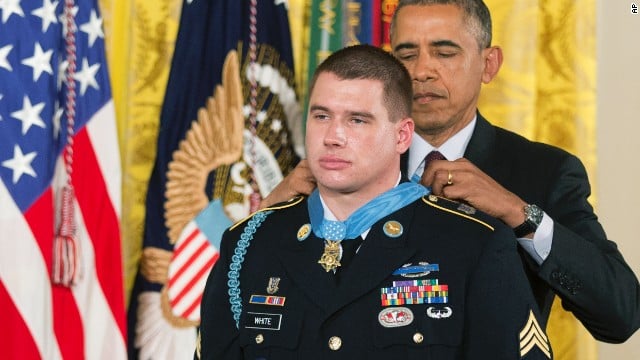
Army sergeant Kyle White

Army sergeant, Kyle White, received the Medal of Honor from President Obama.

What if there were no heroes anymore?

Yesterday we watched former Army sergeant, Kyle White, who withstood Afghan insurgent fire to save his fellow warriors’ lives, receive the Medal of Honor. During his acceptance speech, he talked about his fellow soldiers that had been killed, but he also mentions that his award was actually a medal for his team.

“Without the team,” he said, “there could be no Medal of Honor. That is why I wear this medal for my team.”

Unfortunately, the American fighting man is being slowly phased out. From the use of drones, to automated planes and robots, the very idea of heroism is under attack.

Now, I know what you saying — anything to save our boys from death and worse. In principle, I agree with that sentiment. No sense getting our sons and daughters killed when a well-placed missile can do the trick.

The problem with push button warfare though, is the death of heroism.

Heroism is important to a society. It gives people a symbol to look up to and people need symbols to understand what we are fighting about. Sports stars and astronauts are all well and good, but true heroism is often marred by sacrifice. Sacrifice of the mind, body and spirit are almost a perquisite for the advent of heroism. In this respect, a sports star cannot compete with the everyday fighting man in the field.

In order for a nation to understand the meaning of valor and to understand why a nation goes to war, it needs heroes. There is nothing heroic or anything to be admired about push button warfare, it is simply killing. War is much more than that — it is a contest of ideologies, backed up by the heroism of a nation’s people. Without heroism, warfare becomes little more than organized mass murder.

This was the criticism of wars like Vietnam, Iraq and Afghanistan. We did not go there to win; we went there to kill our enemies, which is an entirely different endeavor than war. As such, the American people did not understand the reasons for being there, and did not support our efforts there. Morale about those actions and support for our government evaporated. Our enemies (and some allies) perceived us as cowards.

What else could they take us for?

A nation that refuses to back up its ideology in blood and refuses to die for what it believes in does not last long. The horror of war is also removed with a push button ideology — it becomes easier to kill. It also places the awesome power of a superpower in too few hands. There can be no surrender and there can be no quarter when a nation can go to war with a few hundred people and kill thousands.

Even the military recognizes this; they have begun the process of awarding medals to drone pilots. They know full well the power of heroism and the spirit de corps.

A nation without heroes? No gallantry? No chivalry? Murdering our foes with a push of a button has been made practical and cost effective with the advent of the drone.

There are some things that are WORTH dying for. I would have thought the American people would have recognized this.

There are far worse things than death.

The American fighting man is being slowly

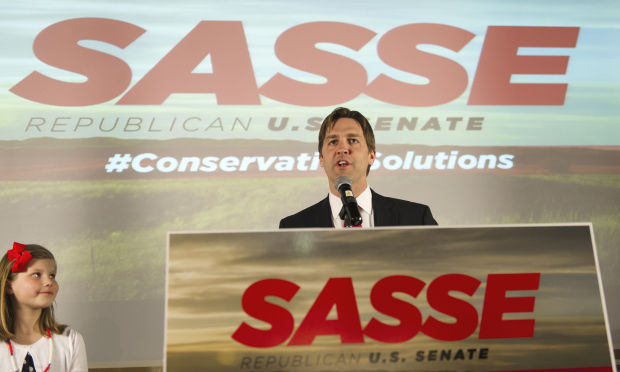
Nebraska Senate Ben Sasse

Nebraska Senate nominee Ben Sasse won roughly half of the vote in a five-way race.

The Nebraska Senate primary results are in and Ben Sasse will be the Republican nominee for U.S. Senate, taking nearly 50 percent of the vote in what was a five-way race. The last-minute surge from Sid Dinsdale, as we predicted, wasn’t enough to overcome the support Sasse had from both conservative and mainstream Republican voters. Republican candidates were vying for the chance to replace retiring GOP Sen. Mike Johanns.

“Congratulations to Ben Sasse on his victory tonight in Nebraska. Ben is a problem solver who will be a conservative voice in our effort to repeal ObamaCare and bring much needed fiscal sanity to the Senate,” Chairman Jerry Moran (R-KS) said in a statement to People’s Pundit Daily.

“Ben Sasse is a results-oriented leader whom I know will fight for Nebraska and be a great advocate for the Cornhusker State in the Senate. I look forward to working alongside of Ben in the Senate next year in a Republican majority.”

For most of the race, Sasse and former Republican State Treasurer Shane Osborn, the latter of the two once the front-runner in the eyes of many, had all but ignored Sid Dindale as they clobbered each other. Ben Sasse enjoyed the backing of several prominent conservative groups, including the Club for Growth, Senate Conservatives Fund, the Madison Project and FreedomWorks. FreedomWorks initially endorsed Shane Osborne, but retracted their endorsement back on March 30 and opted instead to back Sasse.

“Both Osborn and Sasse are great people, and this was not a decision taken lightly,” FreedomWorks president Matt Kibbe wrote in an email to PPD back in April.

“The question at the heart of this decision is, who would caucus with the Freedom Caucus, and who would fall in line with the establishment? At this point, it is clear that Shane Osborn formed allegiances with Mitch McConnell and the K Street lobbying class.”

In the end, we believe that it was the support from these groups that put Sasse over the top. The Madison Group responded to the late challenge with a 60-second radio ad condemning Dinsdale as a “counterfeit conservative.” The Club for Growth coughed up six-figures for a television ad campaign targeting Dinsdale, and in total The Club’s Super-PAC, Club for Growth Action, spent nearly $500,000 in support of Sasse’s candidacy.

“Congratulations to Ben Sasse, who won a hard-fought primary by building his campaign on the simple idea that ObamaCare is a disaster that needs to be repealed,” said Club for Growth President Chris Chocola in a statement via email to PPD.

“Ben clearly articulated a conservative vision to Nebraska voters who rewarded him with their votes. Club members strongly responded to our appeal for support for Sasse and we’re confident that he’ll be a champion of economic freedom when he is elected to the Senate in November.”

It worked, and it’s a testament to the problem conservatives have when it comes to getting behind a single insurgent candidate and a coherent unified message. Anti-establishment candidates have not performed well this election cycle, despite the anti-incumbent and anti-establishment sentiment. Yet in the Nebraska Senate race they really pulled it together. This allowed Sasse to effectively get his message across to the voters.

Meanwhile, Pete Ricketts and Jon Bruning were locked in a tight race from the time the polls closed. Ricketts had held a small lead as the early precinct reported, but the two have been neck-and-neck since 20 to 25 percent of the precincts were counted. With 100 percent of the precincts reporting, Ricketts held a 57,921 vote to 55,751 vote lead over Bruning, or 26.5 percent to 25.6 percent.

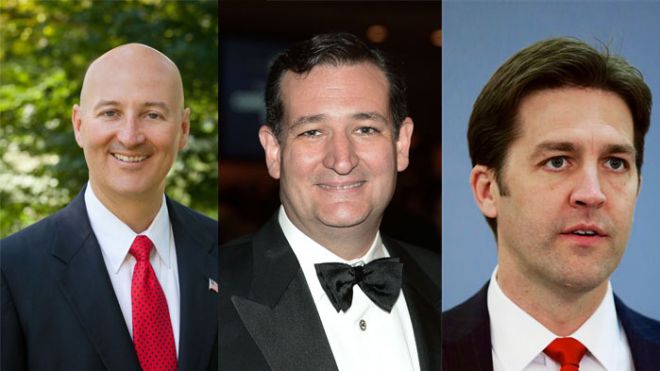
With both Sasse and Ricketts victorious, the real winner just may be Sen. Ted Cruz (R-TX), the conservative hero who had endorsed the two in the race. Media had portrayed the race beforehand as a test for the headline-making senator. Sarah Palin also endorsed the two same candidates in the race.

Sasse will go on to the general election, which all but ensures he will be the next senator from the state of Nebraska. Sasse will face Dave Domina, the Democrats’ nominee, but the Nebraska Senate race is rated “Safe Republican” on PPD’s 2014 Senate Map Predictions.

The Nebraska primary results are in and

Nebraska Primary

The Nebraska primary results show Ben Sasse leading his opponents by a healthy margin, while conservative candidate Pete Ricketts begins to pull away from Bruning. The two gubernatorial candidates are locked in a tight race in the Nebraska governor Republican primary. Both candidates were backed by Texas Senator Ted Cruz and former Alaska Gov. Sarah Palin.

NOTE: View Ben Sasse Victorious In Nebraska Senate Primary, Ricketts Leads Bruning For Latest Primary Results And Analysis

Nebraska U.S. Senate (R) (Precincts Reporting: 53%)
Candidates Votes Percent
Sasse 68,099 48.3
Dinsdale 32,445 23.0
Osborn 30,424 21.6
McLeay 7,810 5.5

The Nebraska primary results for Senate and

People's Pundit Daily
You have %%pigeonMeterAvailable%% free %%pigeonCopyPage%% remaining this month. Get unlimited access and support reader-funded, independent data journalism.

Start a 14-day free trial now. Pay later!

Start Trial