Widget Image
Follow PPD Social Media
Friday, January 16, 2026
HomeStandard Blog Whole Post (Page 968)

America

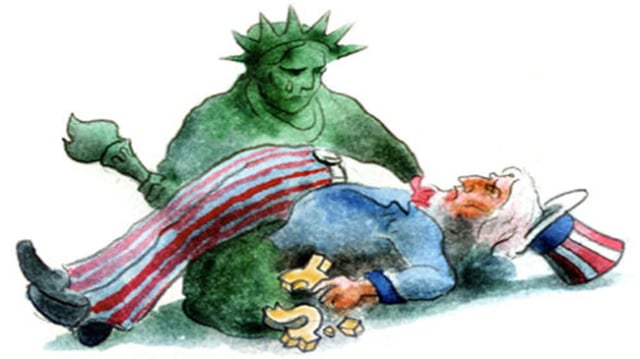
This is what the twilight of America looks like. “Put a pillow over Uncle Sam’s face please, it’s the only decent thing to do.”

Our nation has now slipped into the twilight of its years from the sunlight of its heyday. Many are asking themselves, “How did this happen?” while an even larger chunk of people are licking their Cheetos-stained fingers, turning on the Kardashians and asking, “Gee what will I get for Christmas?”

With the House still firmly in the hands of the GOP who have been labeled as woman-hating corporate thieves, and the Senate now weakened by 2 more years of internal strife and struggle within the right wing, the power of the Presidency is now stronger than ever, and firmly in the hands of a leftist who uses the Constitution as a guideline rather than as the rule of law.

The impotent Congress will now be in no position to argue when Obama issues executive order after executive order in the coming months, which will merely be a further consolidation of power masked under the guise of saving us from a do-nothing Congress.

People often use the expression “how could this happen?” when things go horribly wrong, or the old standby “why me?” and blame the world around them for all perceived injustices that are perpetrated on their persons. Yet, they never look to the answer that any rational adult observing from the outside would offer them — namely to suggest that they should look in the mirror and examine their own lives a bit more carefully, as well as their voting record. Assuming they vote, of course.

According to the math, the majority of Americans didn’t even vote in the last 2 elections. Even less will now vote as they grow disenfranchised and dissatisfied with the specter of a government that watches our every move and waiting for a mistake to cash in on.

So, pardon me if I don’t weep too much for the fate that is about to befall them and the predicament their children will eventually be placed in. As the role and power of the Presidency grows, liberty will shrink and Americans’ lives will continually become more directed by an unfeeling and arbitrary bureaucracy. Compartmentalized and like a horse with blinders on, people will continue to vote for more government to solve their own problems and fulfill their own shallow needs without regard to the subtle implications of a nation that is financially and morally bankrupt.

Many will blame Obama for this change to a statist government; others still, will blame the GOP or the minor political parties. Pseudo intellectuals will point out the finer details of campaign finance issues and cronyism. The wool scarf-wearing Occupy Wall Street crowd will blame corporate greed. In the end, all of it is merely a load of pasture patties wafting on the wind. Obama is merely the symptom to a much greater problem of rampant self-interest, fueled by a desire to be famous and pretty rather than free.

The blame falls squarely on the shoulders of everyone who wakes up in the morning and puts on a pair of pants and turns on the TV and is more concerned about their own petty little needs rather than the direction of society and the role of government in everyone’s lives.

People will line up for their free pills, their subsidized housing, education and automobiles, and their government-sponsored health care and wonder why they have no money in their pockets. The elderly of previous generations will pass into the night and turn over their enormous wealth to the next generation not realizing that it has already been spent, with government confiscating more and more in the name of “fairness.”

It is not the end of America despite what pundits are saying, it is a worse fate. Like a lame horse stumbling around the track while the audience gasps in horror, America will become a modern day Portugal, a nation of wandering sailors who drink lots of spirits and talk fondly of the “good old days” when they ran the world.

Put a pillow over Uncle Sam’s face please, it’s the only decent thing to do.

People will exclaim “we will become another Greece.” If only we were that lucky to have society collapse. At least then we would have a chance to rebuild, instead of living in a perpetual coma from a botched lobotomy, like Ken Kesey’s Randall McMurphy, a symbol to all that would cross the American government, which is now a modern day Nurse Ratched.

Put a pillow over Uncle Sam’s face please, it’s the only decent thing to do.

As for me, I will remain to the bitter end and circling the wagons to defend what is left as best I can to try and preserve what I can of that golden time when men walked free in the sunlight, instead of basking in the glow of a solar panel-powered utopia promise that is merely a roof over a tin shack run by our government slumlords.

Thomas Purcell is a nationally syndicated columnist,  host of the Liberty Never Sleeps podcast hour, and author of “Shotgun Republic.”

Opinion: This is what the twilight of

rand paul and hillary clinton

Kentucky Sen. Rand Paul (left) and Hillary Clinton (right). (Photo: Getty)

The state of Colorado has swung from a solidly Republican state over a decade ago to a Democratic-leaning state in recent elections. If Republicans want to take back the White House in 2016 they must appeal to nontraditional GOP voters in states like Colorado, and Rand Paul is the only candidate with potential to do so.

According to a new poll from Quinnipiac University, libertarian-leaning Sen. Rand Paul is the only potential 2016 Republican presidential candidate to lead Hillary Clinton in the battleground state of Colorado. Recently big GOP donors and other establishment forces have questioned Paul’s electability, opting instead to “draft” former Florida Gov. Jeb Bush. But, not only does Paul have a statistically significant lead, he is the only Republican candidate to have consistently held a lead over Clinton in the state.

TREND: If the election for President were being held today, and the candidates were Hillary Clinton the Democrat and Rand Paul the Republican, for whom would you vote?
                     Apr 24  Feb 06  Nov 20
                     2014    2014    2013
 
Clinton              43      43      44
Paul                 48      47      47
SMONE ELSE(VOL)       1       2       1
WLDN'T VOTE(VOL)      1       2       3
DK/NA                 7       7       5

Paul carries independents 48 to 37 percent, while leading Clinton in every demographic age group save the coveted 18 — 29 bloc, which is all tied up at 43 percent. Republican candidates have struggles with the youth vote in recent elections, which has been a large part of Paul’s message to the party over the last several years. Paul has made an effort to reach out to younger voters, including a speech at UC Berkeley, which was an event hosted by the Berkeley Forum student organization. Senator Paul fired up the crowd when he spoke about his class-action lawsuit against the Obama administration and the National Security Agency.

“The road to the White House has many twists and turns, but right now, U.S. Sen. Rand Paul is the man to beat in Colorado,” said Tim Malloy, assistant director of the Quinnipiac University poll.

While there is a large gender gap, with men backing Paul by a 55 – 35 percent margin, he holds the margin among women supporting Clinton to 50 – 40 percent.

Colorado voters also currently disapprove of the job President Obama is doing by a 59 – 38 percent margin, which will have huge implications on the Colorado Senate race. Incumbent Democrat Sen. Mark Udall is struggling with reelection, earning just 45 percent to 44 percent for Republican Rep. Cory Gardner. We moved the Colorado Senate race from “Leans Democrat” to “Toss-Up” on our 2014 Senate Map Predictions following the entrance of Cory Gardner, a talented conservative who is a proven, strong campaigner and fundraiser.

Even though Udall holds a 1-point lead, inside the numbers from Quinnipiac is painful and daunting for Udall. Voters who list the economy as their number one concern support Cory Gardner over Mark Udall by a large 53 – 40 percent margin, while voters who cite health care back Gardner by a larger 57 – 36 percent. Considering those two issues are the top concerns of Coloradans, Udall is in big trouble.

“In a race that is both too close to call and one of the prime targets for Republicans trying to take back the Senate, Colorado Sen. Mark Udall might best focus on one predominant concern – the economy,” said Malloy.

It is worth mentioning, as well, that Clinton leads former Florida Gov. Jeb Bush by 45 – 40 percent, or by the same margin Paul tops her. A major difference, however, is that Paul is closer to topping the ever-important 50 percent threshold.

According to a new poll from Quinnipiac

Long-lasting manufacturing goods, or durable goods are being made at Boeing plant. (Photo: Boeing/REUTERS)

The Commerce Department said Thursday durable goods orders increased by 2.6 percent in March, beating Wall Street’s expectations. while demand rose across all categories. Durable goods range from toasters to aircraft and are meant to last three years.

Orders for long-lasting manufacturing goods increased by 2.1 percent in February, not the previously reported 2.2 percent. Economists polled by Reuters had forecast orders rising 2.0 percent last month.

Growth in the first quarter of the year is expected to have slumped significantly, with an excessive inventory from last year carried over from businesses, who then placed fewer orders for goods.

First-quarter gross domestic product growth is estimated around a 1.5 percent annual rate. The economy grew at a 2.6 percent rate in the fourth quarter.

The new durable goods data also show non-defense capital goods orders — excluding aircraft — which is a closely watched indicator for future spending in individual business plans, increased by 2.2 percent in March following a decreased by a revised 1.1 percent the February.

Economists had expected orders for these core capital goods, as they are dubbed, to have increased by 1.5 percent last mont, following a previously reported 1.4 percent decline in February.

Core capital goods shipments rose 1.0 percent in the month of March. Shipments of core capital goods, which are including when calculating spending on equipment in the government’s GDP measurement, increased 0.7 percent in February.

Orders for motor vehicles increased by just 0.4 percent after increasing by a hefty 4.3 percent the prior month. Excluding transportation, order gained 2.0 percent, which was the largest increase since January of last year.

There were also increases in orders for machinery, fabricated metal products, electrical equipment, appliances and components. Meanwhile, orders for computers and electronic products increased by the largest margin since November of 2010.

The Commerce Department said Thursday durable goods

unemployment rate and jobs report

The number of Americans filing for first-time jobless claims rose more than expected last week, but experts insist the data does not suggest a negative in labor market conditions.

Initial claims for state unemployment benefits increased by 24,000 to a seasonally adjusted 329,000 for the week ending on April 19, the Labor Department reported Thursday.

Meanwhile, claims for first time jobless benefits during the week ending on April 12 were revised upward by 1,000 more applications than was previously reported last week.

Economists polled by Reuters had forecast first-time applications for jobless benefits jumping to 310,000.

There are difficulties when adjusting the data for seasonal factors, including a late Easter this year and the various timing of spring breaks.

The four-week moving average for new claims, which is considered a better measure of underlying labor market conditions as it irons out week-to-week volatility, increased by only 4,750 to 316,750. Last week, however, the four-week rolling average indicated a drop of 4,750 to 312,000.

Also, Labor Department analyst said told People’s Pundit Daily that no states were estimated and there were no special factors influencing the state level data.

The claims report showed the number of people still receiving benefits after an initial week of aid fell 61,000 to 2.68 million in the week ended April 12, which is the lowest level since December of 2007. However, that doesn’t necessarily reflect a positive trend, considering the amount of Americans receiving benefits must decrease during long-term unemployment because the benefits are no infinite.

Continuing claims fell between the March and April survey periods, which suggests a drop in the jobless rate, or at least that it hold steady. The unemployment rate was at 6.7 percent in March.

The number of Americans filing for first-time

export-import bank

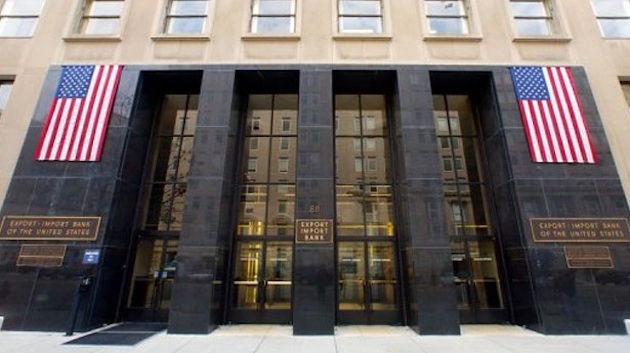
Conservatives almost won the Export-Import Bank fight last year, but now K Street and Wall Street aren’t taking any chances. (Photo: AFP)

A fight is brewing in the nation’s capitol over whether to reauthorize the Export-Import Bank, and K Street and Wall Street have decided to gang up on Main Street to ensure they win it. Last year, the revolving door that has become the Export-Import Bank was almost slammed shut by conservatives in Congress, but this year supporting politicians, lobbyists and their friends who benefit from the Ex-Im Bank plan to strike early.

The Export-Import Bank, which was established in 1934 by Franklin D. Roosevelt, is supposedly in existence to “facilitate exports and imports and the exchange of commodities between the United States and other Nations.” But five minutes of actual investigative journalism tells a very, very different story.

The bank fully supported and helped to advance funding for some not-so bipartisan or nationalistic ventures, including Solyndra, the now-infamous solar company headed-up by an Obama donor and bundler. The company filed for Chapter 11 bankruptcy after securing a speedy loan from the Department of Energy, costing taxpayers over $500 million. Solyndra received a hefty loan guarantee to the tune of $10.3 million from the Export-Import Bank.

Another blatantly partisan venture, which was brought to light by Katherine Rosario at Heritage Action, a grassroots group opposed to reauthorization, involves embattled North Carolina Democrat incumbent, Kay Hagan. Sen. Hagan helped to funnel money from the Ex-Im Bank in 2013 to supporter and small business owner, Jenny Fulton, of Miss Jenny’s Pickles. While Hagan stated in a press release in March 2014 that the original justification for funding the company was so Ms. Fulton could “start shipping [her] product label to countries overseas,” the timeline just doesn’t add up.

When introducing Vice President Joe Biden at the Bank’s annual conference, Fulton admitted her company had already been exporting pickles for over two years to countries abroad, including China and the United Kingdom. She went on to say her company was on pace to do $1,000,000 in gross sales by the end of 2013.

So, why exactly did she need taxpayer money from the Export-Import Bank?

As it turns out, Sen. Hagan met Fulton at an event she hosted, which was a campaign/fundraiser event disguised as a small business exporter forum.

But political and business relationships related to the bank are known to be far darker than what Sen. Hagan is involved in.

“The Export-Import Bank is nothing more than a slush fund for corporate welfare,” Club for Growth Spokesman Barney Keller told People’s Pundit Daily. And it gets even worse. The bank “has given subsidies to everything from Mexican drug cartels and Enron, and it should be eliminated,” he added.

In truth, if many of the Ex-Im Bank’s dealings were known, the American people would likely be disgusted by the lack of loyalty to country and the failure by politicians to be good stewards of their taxpayer money.

Gennady Timchenko, one of Russia’s richest billionaire oligarchs and long-time friend of President Vladimir Putin, sought a U.S. government-backed loan from the Ex-Im Bank to purchase 11 luxury Gulfstream jets for himself.

“To smooth the path for financial backing from the U.S. Export-Import Bank and allay possible U.S. government concerns about him, Timchenko hired lobbyists from powerhouse Washington law firm Patton Boggs, according to emails and documents viewed by Reuters,” the news agency reported back in July of 2013.

The Club for Growth will not be alone in their effort to oppose the reauthorization, with FreedomWorks and Heritage Action for America also committed to fighting the cronyism that has become so prevalent at the Ex-Im Bank. Yet the struggle to close the revolving door between lobbyists on K Street, many of whom serve at the behest of investors on Wall Street, underscores a deeply disturbing political reality.

Democrats might be gleefully able to point out that Americans’ views of the Tea Party have declined over the years, just as the Republican Party took a hit for daring to oppose a deeply unpopular health care law during the partial shutdown, Main Street America is more closely aligned with the views of the Tea Party than the modern Democratic Party. Though just 31 percent say they have a favorable opinion of the Tea Party movement, which is down from last year’s high of 44 percent just after the IRS scandal, more Americans than not say they are aligned with their values when specifically asked about those values.

A Rasmussen survey found that 42 percent think the president’s views are closest to their own when it comes to the major issues facing the country, but 42 percent also say their views come closest to those of the “average Tea Party member.” However, when asked about those issues specifically, such as the growth of government, spending and cronyism, it becomes apparent that the millions of dollars in lobbying and media bias are paying off. To be sure, favorables for the Tea Party movement are significantly down from the 2009 high of 51 percent, when widespread Tea Party and Main Street protests against President Obama’s big government spending policies first began.

Still, in reality, the Tea Party and other ideologically aligned conservatives are clearly the only ones willing to fight K Street and Wall Street for the protection of Main Street. Considering the amount of money behind the effort to smear opponents, all to protect their money train, it isn’t at all surprising it is having an effect.

And, the fight over the Export-Import Bank, is no different.

“This is an all-hands-on-deck effort,” Linda Dempsey told Bloomberg. Dempsey is the National Association of Manufacturers’ Vice President for international economic affairs and, in this fight, happens to be an ally of Christopher Wenk, the senior director for international policy at the U.S. Chamber of Commerce.

“We’re going to be doing our damnedest to focus some minds,” Wenk said of the intense lobbying effort underway.

For many conservatives, the fight is a staunch reminder of the Chamber’s reversal on immigration. The Chamber once opposed amnesty and unrestricted illegal immigration, unwilling to bear the tax burden needed in a welfare state with open borders, as was the case with Majority Leader Harry Reid (D-NV). Now, with the promise of a never-ending flow of cheap labor at an expense to human rights, the Chamber of Commerce has decided to spend million upon millions of dollars to lobby Republican leadership in the House to grant amnesty to tens of millions of illegal immigrants, despite the fact unemployment is still chronically high and Americans have strongly swung away from supporting a supposed “path to citizenship” to now widely opposing it.

Still, despite what is a seemingly insurmountable task, conservatives may just have a secret weapon this time around in the form of House Financial Services Committee Chairman Jeb Hensarling, the Texas Republican who has been a staunch Ex-Im critic. Rep. Hensarling heads-up the committee where legislation to reauthorize the Ex-Im Bank must pass through, and he could stall reauthorization if not squash it altogether.

Hensarling is on recess until April 28, as is the rest of Congress, thus wasn’t available for comment. But his office did tweet a link to a video on April 17. In the video Hensarling described the bank as the “face of cronyism.” His “RT,” or retweet, just so happened to be directed at former Sen. Jim DeMint, who is now president of the Heritage Foundation, the policy think-tank wing of Heritage Action.

A fight is brewing in the nation's

Justice Department

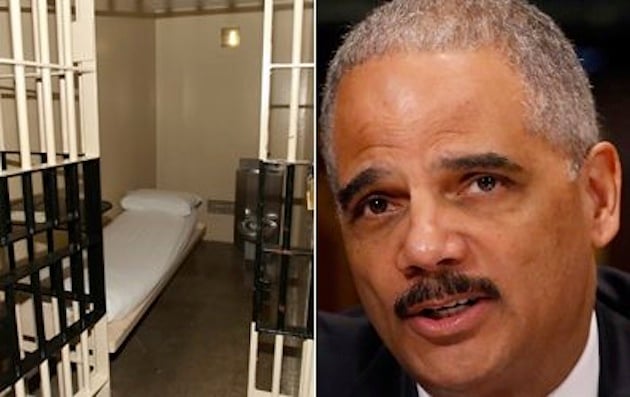
Eric Holder announced Justice Department plan to grant clemency for qualified prisoners.

A series of new proposals will expand the number of people eligible for clemency and, conveniently, just in time for upcoming elections. As the political winds continue to blow from left to right, Eric Holder has shown he is not only the attorney general, but a magician as well.

The regulatory rabbit magically appeared out of the hat when the administration announced the Justice Department will issue new guidelines for clemency targeted at a select group of prisoners.

The new guidelines for inmate eligibility consists of serving a minimum of 10 years and not have a “significant” criminal history. Crime(s) must be considered low-level, and committed by non-violent offenders who have maintained good behavior in prison, with no “significant” ties to gang activity.

The Bureau of Prisons will start issuing these new guidelines nationwide, and those who seem to “fit” the aforementioned criteria will fill out an electronic form, though hopefully the site was built by more competent people than those contracted to build healthcare.gov.

The National Association of Assistant U.S Attorneys wrote to Attorney General Eric Holder expressing that this would be a serious mistake, arguing that the current sentencing system is “worth preserving.” They argued the current guidelines secure cooperation from offenders, which plays a significant role in building “leverage to secure cooperation from defendants,”  who in turn give up more serious criminals who do, in fact, commit violent crimes.

Their argument against the new guidelines, however, fell upon deaf ears at the Department of Justice, who stated that the new standards are corrections applied only to those who were sentenced using the old guidelines. In other words, legislation crafted by elected officials who deliberated over the issues in the past are just not as wise as the policy the administration has single-handedly crafted. It is a familiar theme from the Obama administration, one which holds that they are simply smarter than those who have come before them.

Deputy Attorney General James Cole stated, “Older, stringent punishments that are out of line with sentences under todays laws erode people’s confidence in our criminal justice system.”

However, senior political analyst at People’s Pundit Daily, Richard Baris, believes there may be other considerations at play.

“Because any changes to these laws disporpotionately benefit more urban, black offenders statistically, this is no doubt part of a larger effort among Democrats to increase black voter turnout this November,” he stated.

“It is a smart play considering Sen. Rand Paul is basically the only Republican advocating a version of this policy,” he added. “But it is a play nonetheless.”

But I suppose the American people should feel safe since Obama’s political appointees will ensure lawyers at the DOJ are rigorously scrutinizing each criminal’s case. After all, the president’s political appointees were so competent implementing the president’s new health care, so I am sure there will be no reason to worry.

Opinion: A series of new proposals will

wall street stock markets

Barclays trading desk on Wall Street. (Photo: REUTERS)

Wall Street came off its bullish high Wednesday as U.S. equity markets fell when traders digested disappointing economic data and mixed corporate earnings reports.

As of 1:01 P.M ET, the Dow Jones Industrial Average dipped 4.7 points, or 0.02 percent to 16510, while the S&P 500 fell 1.4 points, or 0.08 percent to 1878. Meanwhile, the Nasdaq Composite was down 22.48 points to 4139.

The S&P 500 appears likely to miss making history, at least today, after adding a sixth-straight day to its winning streak on Tuesday. The broad-market index was just 0.6 percent shy from its all-time high.

In corporate earnings new, Boeing revealed adjusted first-quarter profits of $1.76 a share, easily beating Wall Street’s expectations of $1.56 a share. Sales of $20.5 billion also topped views of $20.2 billion. Shares of the aerospace giant increased by more than 2.3 percent in the pre-market.

Procter & Gamble, the blue-chip consumer products giant, revealed core fiscal third-quarter profits of $1.04 a share, topping estimates by three cents. However, sales of $20.56 billion were just shy of Wall Street’s expectations of $20.68 billion. Shares of the blue-chip consumer products giant were flat in pre-market trading.

AT&T reported after the bell Tuesday that its first-quarter earnings came in at 71 cents an adjusted share on revenue of $32.5 billion. Wall Street was expecting EPS of 70 cents on sales of $32.5 billion. The stock is up fractionally in after-hours trading.

Gilead, the biotech giant, which actually took a hit as momentum stocks dropped, did reprt much stronger-than-expected results.

Apple, the world’s biggest company by market capitalization, is set to post its results after the closing bell. Facebook is also set to report its results.

In commodities, U.S. crude oil futures fell $2.24, or 2.2 percent to $102.13 a barrel, while Wholesale New York Harbor gasoline rose 0.09 percent to $3.098 a gallon. Gold, again, advanced $6.60, or 0.52 percent to $1,288 a troy ounce. It has been the second straight day of increases on the troy ounce.

Meanwhile, in economic news, following a report by the National Association of Realtors yesterday, which found existing home sales in the U.S. fell to their lowest level in more than 1-1/2 years in March, NAR analysts told investors that better data was ahead. However, this latest housing report is a blow to the housing market recovery, anyway you slice it.

The Commerce Department said on Wednesday sales dropped 14.5 percent to a seasonally adjusted annual rate of 384,000 units, the second consecutive month of declines.

Wall Street came off its bullish high

New homes sales data reported by the Commerce Department. (Photo: REUTERS)

New home sales for single-family homes plummeted in the U.S. for the month of March, falling to their lowest level in eight months.

Following a report by the National Association of Realtors yesterday, which found existing home sales in the U.S. fell to their lowest level in more than 1-1/2 years in March, NAR analysts told investors that better data was ahead. However, this latest housing report is a blow to the housing market recovery, anyway you slice it.

The Commerce Department said on Wednesday sales dropped 14.5 percent to a seasonally adjusted annual rate of 384,000 units, the second consecutive month of declines.

February’s sales were revised up to a 449,000-unit pace from the previously reported 440,000-unit rate, but the month of March was widely off base. Economists polled by Reuters had forecast new home sales to be at 450,000-unit measurement last month, and when we compare these numbers to March of last year, sales were down 13.3 percent, the largest decline since April 2011.

While some experts continue to scapegoat the winter weather for the trend line in the housing market, higher mortgage interest rates and a shortage of properties are sidelining potential buyers. Increases in housing prices have outpaced wage increases.

New home sales are counted at the signing of contracts, and sales tanked in the Midwest and the South, while also falling in the West. In the Northeast, however, they rose, which debunks most of the winter weather excuses.

The inventory of new houses on the market increased 3.2 percent to 193,000 units in March, which is the highest since November of 2010. Yet, there are now too few buyers to grab them up. Even though the stock of new houses on the market has come off a record low hit in July 2012, it remains less than half of its pre-recession level, and means nothing economically if there aren’t enough viable buyers.

The lack of buyers is causing supply to become inflated, as March’s weak sales pace increased the supply of houses on the market to 6.0, or the highest level since October of 2011, and up a full point from 5.0 months in February.

The median price of a new home last month rose 12.6 percent to $290,000 from March last year.

New home sales for single-family homes plummeted

gosnell movie

A fundraising effort to make a film about abortionist Dr. Kermit Gosnell is posting big numbers ahead of its May 12, 2014, deadline. The production company, Ann and Phelim Media, has raised over $1,225,000 for the production of the Gosnell movie on the website Indiegogo since March 28. 

The group says that the Philadelphia house of horror’s is a story that needs to be told, because Gosnell was the “most prolific serial killer in American History, but almost no one knows who he is.”

As the group notes on the fundraising site, the trial of Dr. Kermit Gosnell, an abortionist doctor who got away with killing late-term babies for over 30 years using the most disturbing methods, was largely ignored by the mainstream media. Everyday, courtroom seating reserved for media were empty save for a few dedicated, impartial journalists who sat through horrific testimony, including the revelations that Gosnell snipped babies’ spines with scissors after often botched abortions.

The production company raising money for the Gosnell movie is best-known for their documentary, FrackNation, which premiered on Mark Cubans’ TV AXS TV in January 2013. Since then, it has been since broadcast also on PBS Colorado and Canadian Sun News Network. Now, according to their website, this crowd-funding effort was started because it is a “testament to the power of the media that very few people even know about Kermit Gosnell: America’s Most Prolific Serial Killer.

Crowd-funding allows production companies to bypass Hollywood bias, an imperative path to take while making a movie that depicts the horrors of leftist policy.

The most expensive crowd funded film of all-time is the Veronica Mars movie, which was a film about a teen detective. That effort set a goal of $2.1m but raised $5.7m. we think the Gosnell movie is more important, we think you do too.

Read more about the Gosnell movie here

A fundraising effort to make a film

markets

U.S. stock markets jumped higher on Tuesday following a major piece of M&A news in the pharmaceutical sector, strong data and corporate earnings.

As of 3:38 p.m. ET, the Dow Jones Industrial Average jumped 87.4 points, or 0.60 percent to 16553, the S&P 500 gained 10.9 points, or 0.60 percent to 1882, while the Nasdaq Composite increased 41.5 points, or 1 percent to 4163.

It was all about the biotech sector on Wall Street Tuesday, with as leading companies announcing merger deals.

Novartis announced a Tuesday it would buy the oncology products unit at GlaxoSmithKline  in a deal for $14.5 billion, while selling GSK its vaccines units — except for flu vaccines — for $7.1 billion. They will also be starting up a joint venture in consumer health space. The new venture will be managed and run by GlaxoSmithKline, which will own a 63.5 percent stake.

Novartis had a big Tuesday revamping its portfolio, also announcing it will be selling off its animal health division to Eli Lilly to the tune of roughly $5.4 billion. The move will allow Novartis to refocus on drugs and eye-care products, while keeping revenue roughly at current levels.

“The transactions mark a transformational moment for Novartis,” Novartis CEO Joseph Jimenez said in a statement. “Looking ahead, this positions Novartis well for future healthcare industry dynamics.”

Meanwhile, in corporate news, blue-chip giant United Technologies reported stronger-than-expected quarterly results, while Travelers, the insurance giant, also reported profits that beat Wall Street’s expectations. Netflix also posted better-than-expected results, following the announcement it will increase subscription costs to combat the perception it is overvalued. Netflix shares climbed higher in late-day trading. Earnings from McDonald’s, who has been plagued with union agitation, however, missed Wall Street’s expectations.

Also, the National Association of Realtors reported Tuesday that sales of existing single-family homes fell 0.2 percent in March from the month prior, now down to an annualized rate of 4.59 million units, which is the lowest level in more than 1-1/2 years. However, resales still beat Wall Street expectations for 4.55 million units.

“We expect that rising demand and limited inventory will continue to boost start and sale activity, as well as home prices, in 2014,” Cooper Howes, an economist at Barclays, wrote in an email to clients.

In commodities, U.S. crude oil futures fell 38 cents, or 0.36 percent to $103.99 a barrel, while Wholesale New York Harbor gasoline fell 0.46 percent to $3.073 a gallon. Gold, today, rose $3.40, or 0.25 percent to $1,292 a troy ounce.

U.S. stock markets jumped higher on Tuesday

People's Pundit Daily
You have %%pigeonMeterAvailable%% free %%pigeonCopyPage%% remaining this month. Get unlimited access and support reader-funded, independent data journalism.

Start a 14-day free trial now. Pay later!

Start Trial