Widget Image
Follow PPD Social Media
Wednesday, December 31, 2025
HomeStandard Blog Whole Post (Page 502)

Syrian-Refugees-Reuters

Migrants arrive at the main station in Munich, Germany September 5, 2015. (PHOTO: REUTERS/MICHAEL DALDER)

Like all good libertarians, I hate waiting in government-mandated lines. Heck, you don’t even have to be a curmudgeonly libertarian to have unpleasant thoughts about the Post Office or Department of Motor Vehicles (not to mention the virtual lines that exist for people stuck on hold after calling the IRS or some other inefficient bureaucracy).

And it must be doubly irritating to wait in line to get bureaucratic approval for things that shouldn’t require any sort of government permission in the first place.

Since I have to do a bit of travel, I’m especially resentful of the lines I face for customs and immigration when I cross borders. In some cases, these restrictions can even turn “Heaven into Hell.”
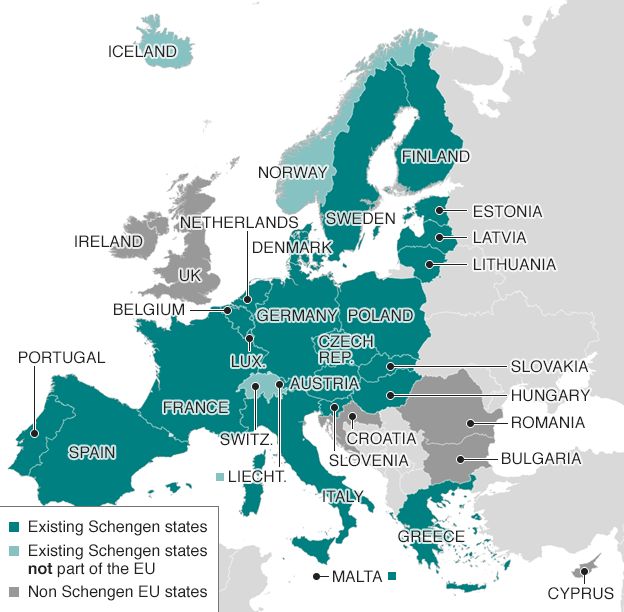
My aversion to government-mandated lines is so strong that I’m a big fan of the European Union’s “Schengen Zone” that has made crossing many European borders as simple as crossing from one American state to another (and regular readers know that I’m normally very reluctant to say anything nice about the policies concocted by the crowd in Brussels).

Given all this, I was very interested to see that the leading bureaucrat of the European Commission, Jean-Claude Juncker, has said that borders are “the worst invention ever.”

Was he making a libertarian argument about the value of making it easier for people to travel and/or move? Let’s investigate. Here’s some of what was reported about Juncker’s comments in the U.K.-based Daily Mail.

EU chief Jean-Claude Juncker risked widening divisions with European leaders today by saying borders were the ‘worst invention ever’. He called for all borders across Europe to be opened, despite the chaos caused over the last year from the flood in refugees fleeing Syria and the wave of terror attacks hitting various continent’s cities. …Mr Juncker also said a stronger EU was the best way of beating the rising trend of nationalism cross Europe. In another extraordinary remark, he appeared to warn of war on the continent if the EU disintegrates as he echoed the warning from the former French president Francois Mitterrand, who said nationalism added to nationalism would end in war.

Writing for the American Enterprise Institute, Michael Barone offered a different perspective.

He starts with the observation that Juncker’s home country of Luxembourg is rich because of borders.

Juncker comes from Luxembourg, a 998-square mile country… If you look up Luxembourg in lists of world economic statistics, you’ll find it rated No. 2 in gross domestic product per capita. That’s thanks to what Juncker called politicians’ worst invention ever, borders. Luxembourg is a financial haven and headquarters of the world’s largest steel company, Arcelor Mittal. Without their borders and national laws, the 576,000 Luxembourgers wouldn’t be as affluent as they are.

Barone is correct. Luxembourg is only a very successful tax haven because it has the right to have tax laws inside its borders that are attractive relative to the tax laws that exist in adjoining nations such as France and Germany.

For those who care about foreign policy, Barone also pushes back at the notion the European Union somehow has prevented World War III.

Juncker said, “We have to fight against nationalism, we have the duty not to follow populists but to block the avenue of populists.” Such is the faith of the Eurocrats: The EU exists to prevent another war between France and Germany. Never mind that the chance of such a war has been zero since 1945, 71 years ago. …Juncker was denouncing Austria and other nations for erecting border controls to keep out Muslim refugees. Evidently he believes that World War III will somehow break out if they are kept out.

This is surely right. The people in Western Europe no longer have any interest in fighting each other. And to the extent any international organization deserves credit for that, it would be NATO (even if it no longer serves a purpose).

Let’s now shift back to the role of borders and the size and power of government.

If you want a really good libertarian-oriented explanation of why borders are valuable, let’s go back in time to 2004. Professor Andy Morriss wrote an article forThe Freeman that explains borders are good for liberty because they limit the powers of governments.

Borders come from property rights and are essential to a free society…are wonderful things. Lorain and Cuyahoga counties in Ohio must compete for my family’s residence. Choosing to live where we do is related to the taxes charged by the communities where we might have lived.

The value of borders, Andy explains, is that they represent a territorial restriction on the power of government and people can cross those borders if they think governments are being too greedy and oppressive.

Investors make similar choices. …Choosing bad policies produces an exodus; choosing good policies leads to immigration of both capital and people. …the competition offered on local taxation policy and other regulatory issues is important in restraining governments from infringing liberty. …National borders are also important sources of liberty. …without borders we would not have the competition among jurisdictions that restricts attempts to abridge liberty. …Jurisdictions…compete to attract people and capital. This competition motivates governments to act to preserve liberty.

He cites the example of how Delaware became the leading jurisdiction for company formation (and also a very good tax haven for foreigners).

…states compete for corporations, with Delaware the current market leader. Delaware corporate law offers companies the combination of a mostly voluntary set of default rules and an expert decision-making body (the Court of Chancery). As a result, many corporations, large and small, choose to incorporate in Delaware, making it their legal residence. (Their actual headquarters need not be physically located there.) Corporations get a body of liberty-enhancing rules; Delaware gets tax revenue and employment in the corporate services and legal fields. That state’s position is no accident. At the beginning of the twentieth century, New Jersey was the market leader in corporate law. When New Jersey’s legislature made ill-advised changes to its corporations statute that reduced shareholder value, Delaware seized the opportunity and offered essentially the older version of New Jersey’s law.

Borders also are good, Andy explains, because they create natural experiments that allow us the compare the success of market-oriented jurisdictions with the failure of statist jurisdictions.

Statists are correct that competition among jurisdictions will make clear the costs of the policies they promote. …The former divide between East and West Berlin is a fine example of the impact of cross-border comparisons. East Germans could see the difference in outcomes between the two societies, and East Germany had to resort to increasingly costly and desperate measures to prevent its citizens from voting against communism with their feet. …Competition between the two Germanys exposed the cost of East German policies.

In an observation that could have been taken from today’s headlines, he also notes that uncompetitive governments try to prop up their inefficient welfare states by clamping down on pro-market policies in other nations.

To prevent cross-border competition from exposing the costs of their favorite policies, …special interests attempt to forestall it. …High-tax, heavy-regulatory jurisdictions in the European Union are waging just such a fight now, arguing, for example, that Ireland’s low taxes are “unfair” competition.

He’s exactly right. Which is precisely why it’s so important to block efforts to replace tax competition with tax harmonization.

Andy’s conclusion hits the nail on the head. We may not like having to wait in lines and fill out forms to cross borders, but the alternative would be worse.

Even though borders can be an excuse for reducing liberty, a world with lots of borders is nonetheless a far friendlier world for liberty than one with fewer borders. They promote competition for people and money, which tends to restrain the state from grabbing either. Borders offer chances to arbitrage regulatory restrictions, making them less effective. Without borders these constraints on the growth of the state would vanish.

Before closing, let’s look at an example of how governments are forced to dismantle bad policy because of the the jurisdictional competition that only exists because of borders. It’s from an academic study written by Jayme Lemke, a scholar from the Mercatus Center. Here are some excerpts from the abstract.

Married women in the early nineteenth century United States were not permitted to own property, enter into contracts without their husband’s permission, or stand in court as independent persons. This severely limited married women’s ability to engage in formal business ventures, collect rents, administer estates, and manage bequests through wills. By the dawn of the twentieth century, legal reform in nearly every state had removed these restrictions by extending formal legal and economic rights to married women.

Why did states grant economic liberty and property rights to women?

Was it because male legislators suddenly stopped being sexist?

Maybe that played a role, but it turns out that people moved to states that eliminated these statist restrictions and that pressured other states to also reform.

…what forces impelled legislators to undertake the costs of action? …interjurisdictional competition between states and territories in the nineteenth century was instrumental in motivating these reforms. Two conditions are necessary for interjurisdictional competition to function: (1) law-makers must hold a vested interest in attracting population to their jurisdictions, and (2) residents must be able to actively choose between the products of different jurisdictions. Using evidence from the passage of the Married Women’s Property Acts, I find that legal reforms were adopted first and in the greatest strength in those regions in which there was active interjurisdictional competition.

The moral of the story is that competition between states improved the lives of women by forcing governments to expand economic liberty.

And since even the New York Times has published columns showing that feminist-type government interventions actually hurt women, perhaps the real lesson (especially for our friends on the left) is that you help people by expanding freedom, not by expanding the burden of government.

P.S. There is a wealth of scholarly evidence that the western world became rich because of borders and jurisdictional competition.

[mybooktable book=”global-tax-revolution-the-rise-of-tax-competition-and-the-battle-to-defend-it” display=”summary” buybutton_shadowbox=”true”]

CATO economist Dan Mitchell: If you want

FBI Director James Comey, left, speaks during a press conference on July 5, 2016, while Hillary Clinton, right, followed by aide Huma Abedin, to her right, at Andrews Air Force Base on July 5, 2016. (Photos: AP)

FBI Director James Comey, left, speaks during a press conference on July 5, 2016, while Hillary Clinton, right, followed by aide Huma Abedin, to her right, at Andrews Air Force Base on July 5, 2016. (Photos: AP)

The Federal Bureau of Investigation (FBI) released several internal documents from their probe into Hillary Clinton and they show she claimed ignorance on classified material. The heavily redacted files released Friday, which also revealing large missing gaps of time and information, showed the FBI could not find some 13 Clinton mobile devices that were used to send emails from her personal email address.

That does not count an addition two iPads that were not obtained by the FBI during the criminal investigation, which the former secretary of state repeatedly referred to as a “security review” during interviews with the press. This runs contrary to the claims Mrs. Clinton made regarding her use of a private server for purposes of “convenience” at press conference at the United Nations in New York, NY, on March 10, 2015.

That was not true.

The FBI files showed the Bureau acknowledge her use of and their failure to find some 13 mobile devices that Mrs. Clinton used to send emails from her personal email address.

“The FBI’s summary of their interview with Hillary Clinton is a devastating indictment of her judgment, honesty and basic competency,” Republican National Committee (RNC) Chairman Reince Priebus said in a statement. “Clinton’s answers either show she is completely incompetent or blatantly lied to the FBI or the public. Either way it’s clear that, through her own actions, she has disqualified herself from the presidency.”

The documents show Mrs. Clinton also repeatedly claimed she could not recall numerous details of material concern to the investigation or whether she attended “any briefing or training by State related to the retention of federal records or handling of classified information.”

The FBI files also disprove her claim that she obtained permission for her use of a private email server, which was was allowed under the rules of the State Department.” In fact, it wasn’t and it wasn’t even her defense to the Bureau. Mrs. Clinton claimed to have not known what the rules were. The FBI’s investigation concluded Mrs. Clinton never sought or asked permission to use a private server or email address during her tenure as the nation’s top diplomat, which violated federal records keeping policies.

[brid video=”39291″ player=”2077″ title=”FLASHBACK Clinton Claimed Email Server Was Allowed Predecessors Did Same Thing”]

“It was allowed under the rules of the State Department,” Mrs. Clinton told Jake Tapper on CNN during an interview on October 16, 2015. No, it was allowed. You know, one of my predecessors did the same thing. Others in our government have done the same thing at very high levels because the rules did change after I left state department. But at the time and in prior years the rules allowed it.”

But the false statements made by Mrs. Clinton aren’t the only we uncovered in reviewing the report. In their interview, FBI investigators claims she denied attempting to use the server to avoid accountability and preserve secrecy, instead concluding “CLINTON [sic] assumed her communications were captured by State systems. However, while she might have been ignorant to proper practice of handling classified information, the FBI is not.

The State Department only began automatically preserving emails in February, 2015. That’s more than two years after Mrs. Clinton’s tenure, which a State Department spokesperson confirmed to People’s Pundit Daily in May immediately after the Office Of Inspector General (IG) released an audit finding Mrs. Clinton violated federal records keeping laws. Comparing the “Evaluation Of Email Records Management And Cybersecurity Requirements” with the former secretary of state’s past excuses and explanations could only conclude she was lying–pretty much at every turn.

[brid video=”56928″ player=”2077″ title=”Clinton Campaign Manager Blames State Department for Classified Information on Server”]

“Investigation identified hundreds of e-mails sent sent by [Huma] Abedin and other State staff to [redacted]presidentclinton.com e-mail address requesting him to print documents for Clinton,” the FBI investigation found. “Some of these e-mails were determined to contain information classified at the CONFIDENTIAL level.”

Perhaps the most concerning revelation in the FBI internal file is an unidentified witness admitting they had an “oh shit” moment after a March 2, 2015 report by the New York Times first brought to light Mrs. Clinton’s use of a private email server to conduct official State Department business. “Sometime between March 25-31, 2015” they “deleted the Clinton archive mailbox from the PRN server and used BleachBit to delete exported .PST files he had created on the server system containing Clinton’s e-mails.”

“Investigation found evidence of these deletions.”

At this point, the House Select Committee on Benghazi had been stonewalled on their May, 2014 request for some of these documents for nearly a year.

HRC 1

HRC 2

The Federal Bureau of Investigation (FBI) released

Unpopular and Without Solid Base Support, Trump and Clinton Threaten to Reshape Electoral Map

Donald-Trump-Hillary-Clinton-New-Jersey

Donald Trump, left, greets supporters as he arrives to appear with New Jersey Governor Chris Christie in Lawrenceville, N.J. on May 19, 2016. Hillary Clinton, right, speaks at a campaign rally in Blackwood, New Jersey, U.S., May 11, 2016. (Photos: Reuters)

Republican Donald Trump leads Democratic Hillary Clinton in Iowa and the two candidates are statistically tied in Virginia, with Mrs. Clinton up by 1 point. A new [content_tooltip id=”38226″ title=”Emerson College Polling University”] of the two battleground states confirm weaknesses for both candidates in an election that threatens to reshape the electoral map.

Iowa

In Iowa, Mr. Trump leads Mrs. Clinton 44% to 39%, with Libertarian Party candidate and former New Mexico Gov. Gary Johnson getting 8% and Green Party candidate Dr. Jill Stein at 1%. In a flip of the mainstream media narrative, Mrs. Clinton is the one having the trouble ensuring her base, with 78% of Democrats backing her juxtaposed to Mr. Trump taking 86% of the Republican vote. Independents in the Hawkeye State, who traditionally buck the national trend on the presidential level, break for Mrs. Clinton 34% to 33% with 16% voting for Gov. Johnson.

However, 34% of voters who supported Vermont Sen. Bernie Sanders are supporting another candidate other than Clinton, largely Mr. Trump.

In the race for U.S. Senate, Republican incumbent Chuck Grassley leads Democratic challenger Patty Judge 51% to 40% with 6% undecided. Sen. Grassley enjoys a 48% to 39% favorability rating but Ms. Judge finds herself underwater, 34% favorable to 36% unfavorable.

Read Full Results: ECPS Top lines Iowa Virginia Sept 2

Virginia

In the Old Dominion, which votes more like the New Dominion, Mrs. Clinton is just one point ahead of Mr. Trump, 44% to 43%, with Gov. Johnson taking 11% and the Dr. Stein at 3%. Despite choosing Virginia Sen. Tim Kaine as her running mate, Mrs. Clinton has yet to consolidate her own party’s base and is getting crushed by Mr. Trump among independents, 47% to 28%, with 19% voting for Gov. Johnson.

Still, the bitter primary is still taking its toll on both candidates, with former rivals on the Republican side still refusing to endorse Mr. Trump. Even though Sen. Sanders did endorse Mrs. Clinton, his followers are not ready to get behind his decision.

Only 36% of voters who supported Ohio Gov. John Kasich during the primary are voting for Mr. Trump. The same is true for (56%) Sen. Marco Rubio, the second place finisher in Virginia, and (73%) Sen. Ted Cruz. Only 63% of those who voted for Sen. Sanders say they will vote for Mrs. Clinton, while 16% go for Mr. Trump, 15% for Gov. Johnson and 6% for Dr. Stein.

“Although Clinton’s running mate is Virginia Senator Tim Kaine, he does not seem to be aiding her favorability numbers,” said Professor Spencer Kimball, Emerson College Polling Advisor. “Among Democrats, 85% plan to vote for Clinton while 9% are crossing over to Trump and 5% to Johnson. The crossover pattern is similar among Republicans, with Trump receiving 81% of the vote, Clinton 7% and Johnson 10%.”

The results of the Emerson College Polling Society Virginia poll is inline with a recent Hampton University poll that found Mrs. Clinton leading by just 2 points in a head-to-head matchup. Meanwhile, the New York businessman now holds a slight lead over Mrs. Clinton in the People’s Pundit Daily U.S. Presidential Election Daily Tracking Poll.

Bottom Line

Worth noting, Emerson College, which was awarded a lifetime grade of an A on the PPD Pollster Scorecard, was one of the most accurate polling outfits in the country during the 2016 primary season. Emerson College released 16 surveys in 8 states and was correct 94% of the time (92% lifetime), with an average error of 7.2%.

Read Full Results: ECPS Top lines Iowa Virginia Sept 2

The Emerson College Polling Society Virginia poll was conducted August 30-September 1. The sample consisted of 800 likely general election voters with a margin of error of +/- 3.4%. Data was weighted by 2012 election results, party affiliation, age and gender. The Emerson College Polling Society Iowa poll was conducted August 31-September 1. The sample consisted of 600 likely general election voters with a margin of error of +/- 3.9%. Data was weighted by 2012 election results, party affiliation, age and gender. It is important to remember that subsets based on gender, age and party breakdowns carry with them higher margins of error, as the sample size is reduced. Data was collected using an Interactive Voice Response (IVR) system of landlines only. The full methodology and results can be found here.

Unpopular and Without Solid Base Support, Trump

Job seekers navigate through a better labor market but still teetering economy. (Photo: REUTERS)

Job seekers navigate through a better labor market but still teetering economy. (Photo: REUTERS)

The Labor Department released the August jobs report on Friday showing the U.S. economy added 151,000 jobs, below the forecast for 180,000. The unemployment rate, which was expected to tick lower to 4.8%, also remained flat at 4.9%. and the labor force participation rate was unchanged at 62.8%.

The less-cited but arguably more important employment-population ratio, at 59.7%, showed no improvement last month. As a result, the number of long-term unemployed–or, people who are jobless for 27 weeks or more–was unchanged at 2.0 million. These would-be American workers represented 26.1% of the total unemployed.

In August, the lack of wage growth was particularly concerning. Average hourly earnings for all employees on private non-farm payrolls increased by only 3 cents to $25.73. Over the year, average hourly earnings have risen by just 2.4%, which is still better than the previous month. Average hourly earnings of private-sector production and nonsupervisory employees increased by 4 cents to $21.64 in August.

The Federal Reserve policy-making committee, known as the Federal Open Markets Committee, will almost certainly postpone a proposed and expected interest rate hike. Citing the strength in the current jobs market, Fed Chair Janet Yellen had signaled it was time to move the benchmark interest rate higher.

“The most important part is the weakness in hours and wages. That slammed the door on September [as the time for rate increases],” Dan North, Euler Hermes North America’s chief economist, said. “The economy is still on fairly shaky ground. We were hoping manufacturing would have a blip up because there were signs it was recovering from a big slump, but this shows it’s not. There was positive growth in payrolls, but there’s just no wage pressure…the economy is in slow-growth mode.”

As has also been the case in the ADP National Employment Report, which gauges only the private-sector, wages and hours have reflected what has been a shift to part-time, service-based economy. The higher-paying employment sectors, such as manufacturing, lag behind the part-time, low-skill and pay opportunities.

The average workweek for all employees on private non-farm payrolls decreased by 0.1 hour to 34.3 hours in August. In manufacturing, the workweek declined by 0.2 hour to 40.6 hours, while overtime was unchanged at 3.3 hours. The average workweek for production and nonsupervisory employees on private nonfarm payrolls decreased by 0.1 hour to 33.6 hours.

While employment in food services and drinking places continued to trend up over the month (+34,000), adding 312,000 jobs over the year, employment in mining continued to trend down in August (-4,000). Since reaching a peak in September 2014, employment in mining has fallen by 223,000, with losses concentrated in support activities for mining. Employment in several other industries–including construction, manufacturing, wholesale trade, retail trade, transportation and warehousing, temporary help services, and government–all either remained flat or declined.

The Manufacturing Report on Business, the Institute for Supply-Management gauge of U.S. factory activity, fell into contraction last month.

The Labor Department released the August jobs

trade-cargo-reuters

A Ferrari cargo crane moves shipping containing on a U.S. trade port. (Photo: Reuters)

The U.S. trade deficit in July declined 11.6% to $39.47 billion after three straight months of increases, missing the median forecast for a decline to $42.7 billion. June’s deficit was revised higher to $44.66 billion and exports hit a 10-month high.

Overall, U.S. exports increased to $186.3 billion in July from $182.9 billion in June. Goods were $124.1 billion in July, up from $120.6 billion, while services were $62.3 billion in July, down less than $0.1 billion from June. Imports fell to $225.8 billion in July from $227.6 billion in June. Goods were $184.4 billion in July, down from $186.2 billion in June, while services were $41.4 billion in July, up from $41.3 billion in June.

Even though exports to China expanded by 3.8%, the politically sensitive U.S.-China trade deficit still increased by 1.9% to $30.3 billion in July. That’s largely due to imports from China also rising 2.4%. Meanwhile, U.S. exports to the European Union (EU) fell 9.5%, with goods shipped to the United Kingdom declining 9.2%.

The U.S. trade deficit in July declined

ISM-manufacturing-index

The Institute for Supply Management’s Manufacturing Report On Business Survey. (Photo: REUTERS)

The Manufacturing Report on Business, a gauge of U.S. factory activity by the Institute for Supply Management, fell to 49.4 in August from 52.6 in July. Economists expected a slight decline to 52.0 for the month. Readings above 50 point to expansion, while those below indicate contraction.

“Manufacturing contracted in August for the first time since February of this year, as only six of our 18 industries reported an increase in new orders in August, down from 12 in July),” Bradley J. Holcomb, chair of the Institute for Supply Management Manufacturing Business Survey Committee, said. “Only eight of our 18 industries reported an increase in production in August, down from nine in July.”

Of the 18 manufacturing industries only 6 are reporting growth in August, in the following order: Printing & Related Support Activities; Nonmetallic Mineral Products; Computer & Electronic Products; Miscellaneous Manufacturing; Food, Beverage & Tobacco Products; and Chemical Products.

The remaining 11 industries reporting contraction in August — listed in order — are: Electrical Equipment, Appliances & Components; Apparel, Leather & Allied Products; Plastics & Rubber Products; Furniture & Related Products; Transportation Equipment; Machinery; Textile Mills; Paper Products; Petroleum & Coal Products; Primary Metals; and Fabricated Metal Products.

MANUFACTURING AT A GLANCE
August 2016
Index Series
Index
Aug
Series
Index
Jul
Percentage
Point
Change
Direction Rate
of
Change
Trend*
(Months)
PMI® 49.4 52.6 -3.2 Contracting From Growing 1
New Orders 49.1 56.9 -7.8 Contracting From Growing 1
Production 49.6 55.4 -5.8 Contracting From Growing 1
Employment 48.3 49.4 -1.1 Contracting Faster 2
Supplier Deliveries 50.9 51.8 -0.9 Slowing Slower 4
Inventories 49.0 49.5 -0.5 Contracting Faster 14
Customers’ Inventories 49.5 51.0 -1.5 Too Low From Too High 1
Prices 53.0 55.0 -2.0 Increasing Slower 6
Backlog of Orders 45.5 48.0 -2.5 Contracting Faster 2
New Export Orders 52.5 52.5 0.0 Growing Same 6
Imports 47.0 52.0 -5.0 Contracting From Growing 1
OVERALL ECONOMY Growing Slower 87
Manufacturing Sector Contracting From Growing 1

Manufacturing ISM® Report On Business® data is seasonally adjusted for New Orders, Production, Employment and Supplier Deliveries indexes.

*Number of months moving in current direction.

The Manufacturing Report on Business, a gauge

unemployment-benefits

Weekly jobless claims, or first-time claims for unemployment benefits reported by the Labor Department.

The Labor Department reported Thursday first-time jobless claims applications rose by 2,000 to 263,000 for the week ending August 27, lower than the median forecast. Economist polled by Reuters had estimated a rise to 265,000, while the prior week was unchanged at 261,000.

The four-week moving average–which is widely considered a better gauge, as it irons out volatility–came in at 263,000, a decline of 1,000 from the previous week’s unrevised average of 264,000.

A Labor Department analyst said there were no special factors impacting this week’s initial claims and no state was triggered “on” the Extended Benefits program during the week ending August 13.

The report marks 78 consecutive weeks of initial claims below 300,000, which is the longest streak since 1970. However, due to long-term unemployment, the pool of eligible applicants is simply too low, at itself a 30-plus year historic level.

The highest insured unemployment rates in the week ending August 13 were in Puerto Rico (3.0), New Jersey (2.8), Connecticut (2.7), Alaska (2.6), Pennsylvania (2.5), California (2.2), Rhode Island (2.1), West Virginia (2.1), Massachusetts (2.0), Illinois (1.9), and Wyoming (1.9).

The largest increases in initial claims for the week ending August 20 were in Michigan (+2,652), Louisiana (+2,280), North Dakota (+493), Puerto Rico (+352), and Pennsylvania (+325), while the largest decreases were in California (-2,962), Virginia (-1,168), Oregon (-985), Maryland (-675), and Oklahoma (-544).

The Labor Department reported first-time jobless claims

Hillary Clinton and Bill Clinton speak at an event for the Clinton Foundation, or Clinton Global Initiative. (PHOTO: Greg Allen/Invision/AP)

Hillary Clinton and Bill Clinton speak at an event for the Clinton Foundation, or Clinton Global Initiative. (PHOTO: Greg Allen/Invision/AP)

A supermajority of American voters say Hillary Clinton was “selling influence” to “foreign contributors who made donations to the Clinton Foundation,” a new survey finds. A [content_tooltip id=”37989″ title=”FOX Poll”] of 1,011 registered voters conducted from August 28-30 finds a whopping 66% don’t believe Mrs. Clinton when she says “there’s smoke, not no fire” when it comes to the quid pro quo during her tenure as secretary of state.

Overall, 42% say it is “very likely” and 24% say it is at least “somewhat likely” that Mrs. Clinton was “selling influence” at the State Department, including 13% and 30% of Democrats, respectively. Fifty-three (53%) of independents say it is “very likely” and 20% say it is at least “somewhat likely” she was, while Republicans agree by 67% 21%, respectively.

The percentage is up from 61% who said so in a previous Fox Poll conducted at the end of May. That survey was conducted before several bombshell reports that reviewed emails, schedules and phone calls revealed Mrs. Clinton clearly gave special access to Clinton Foundation donors, using her top aide as a go-between at the State Department and the foundation.

The Fox Poll also finds Republican presidential candidate Donald Trump has erased Mrs. Clinton’s 10-point lead over him during the prior month. The poll found him trailing Mrs. Clinton by just 2 points, 41% to 39%, with Libertarian candidate Gary Johnson at 9% and Green Party candidate Dr. Jill Stein at 4%. That’s within the poll’s 3-point +/- margin of error and slightly more favorable to Mrs. Clinton than the People’s Pundit Daily U.S. Presidential Election Daily Tracking Poll.

“What we’ve found over the last few days is that the damage done by the Clinton Foundation to Hillary Clinton is resulting in movement to Donald Trump,” says PPD’s senior political analyst Richard D. Baris. “Even about one-fifth (21%) of African-American voters have an unfavorable view of the former secretary of state and many black male voters are willing to give the Republican candidate serious consideration.”

PPD, as of Wednesday, August 31, finds Mr. Trump leading Mrs. Clinton by 1 point, 42% to 41%.

A supermajority of American voters (66%) say

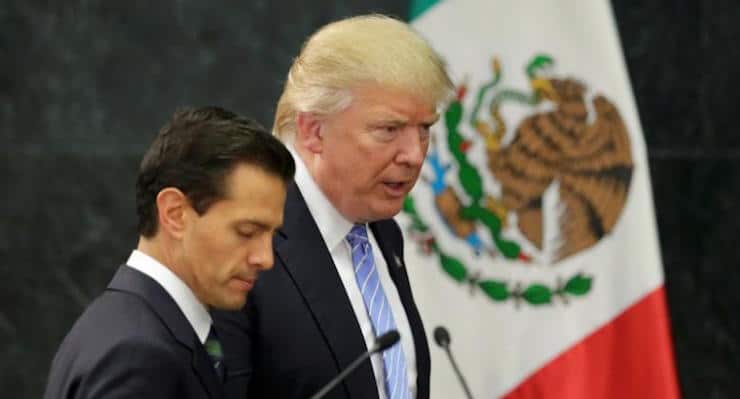
U.S. Republican presidential nominee Donald Trump and Mexico's President Enrique Pena Nieto arrive for a press conference at the Los Pinos residence in Mexico City, Mexico, August 31, 2016. REUTERS/Henry Romero

U.S. Republican presidential nominee Donald Trump and Mexico’s President Enrique Pena Nieto arrive for a press conference at the Los Pinos residence in Mexico City, Mexico, August 31, 2016. REUTERS/Henry Romero

Donald Trump on Wednesday met personally with Mexican President Enrique Peña Nieto and expressed concerns over trade and illegal immigration. According to sources, Mr. Trump, the Republican presidential candidate, told President Nieto that America has a “right” to build a wall on the U.S. southern border, focused on building the foundation of a relationship in the event he is elected in November.

“We had a very substantive, direct and constructive exchange of ideas,” Mr. Trump said. “We did discuss the wall. We didn’t discuss payment of the wall.”

He added that he sees immigration as a “humanitarian disaster” that must be addressed and solved. The Mexican president, who has falling approval rating numbers at home, tried to push back on the issue of the wall a bit following the meeting.

“What the president said is that Mexico, as he has said on several occasions … will not pay for that wall,” presidential spokesman Eduardo Sanchez told Reuters by telephone.

The comments came during a visit to Mexico just hours before he is set to deliver an immigration policy speech in Phoenix, Arizona. Mr. Trump delivered a 10-point plan on immigration.

“While many people want to make this campaign about style, Donald J. Trump once again makes it about substance. He has displayed presidential leadership when it comes to dealing with our regional allies. When we talk about behavior that is in this campaign, Mr. Trump’s decision to meet with President Peña Nieto should be at the top of the list,” Dr. Ralph Alvarado, a member of Trump’s Hispanic Advisory Council, said in a statement. “Mr. Trump proceeded to follow up this meeting with his most substantial speech to date on how to best handle the illegal immigration crisis impacting our country. Mr. Trump has shown once again why he is the most qualified candidate to become the next president of the United States.”

President Nieto, who even told reporters during a joint press conference with President Barack Obama that he was “looking forward” to working with Mr. Trump, once compared him to Benito Mussolini and Adolf Hitler, allies and World War II-era fascist leaders. Now, he’s singing a different tune, stating they had an “open” talk about the issues the countries face in their “joint challenge” on a shared border.

“We might disagree on several issues, but your presence here,” he told Mr. Trump, “shows that we do have fundamental common ground.”

Donald Trump on Wednesday met personally with

Trump-Rally-Charleston-WV-Coal-Miners

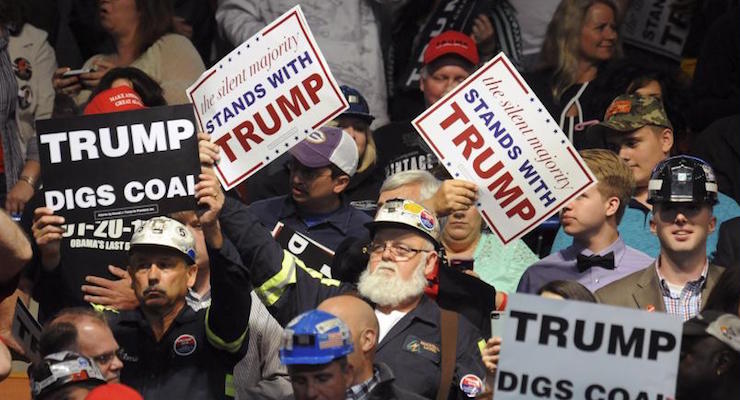
People show their support as Donald Trump speaks in Charleston, West Virginia, on May 5, 2016. (Photo: Chris Tilley/Reuters)

Some harsh truths: Years ago, blue-collar America suffered mightily in the loss of manufacturing jobs. Everyone knows that. Many new, high-paying factory jobs are today going unfilled because workers aren’t being trained for them. Some know that. Donald Trump has done about zero to offer these Americans a better tomorrow. Not nearly enough working white men seem to know that.

Or perhaps they’d rather see their anger applauded than their hard times ended. How else could anyone following Hillary Clinton’s proposals for improving ordinary Americans’ economic security prefer Trump? (We’re making the dangerous assumption that much of the general electorate has even bothered looking at the real-world fixes she’s prescribing.)

Let’s start with the struggling white folk of the Appalachian coal country. Polls indicate that the white men there especially prefer Trump. Because? Because? You tell me why. Politicos explain that they are an ornery population — proud, courageous and patriotic — but also susceptible to the sort of racist appeals that Trump uses to get them on the cheap.

Trump’s vow to “bring back coal” would be one of his easiest promises to break. The problem for coal isn’t just that it’s dirty energy. It’s that natural gas is cheaper. Trashing every environmental law on the books would not change the fact of free market life that consumers are going to buy the less expensive product.

Clinton, by contrast, has a plan to create a new economy for Appalachia. She would spend $30 billion upgrading the region’s roads and sewer lines, installing broadband and improving other communications. That’s good employment for local workers. Money would go toward education to prepare people for the high-paying jobs that don’t require a college degree. And she’d offer tax incentives for the companies that need such skills to move there. Her running mate, Tim Kaine of Virginia, has close family ties to Appalachia. He would, in all likelihood, be heading the project.

Trump’s plan is to favor himself and other 1 percenters with steep tax cuts that would drain the Treasury of money needed to make a Clinton-type plan a reality. (That might not matter much because he doesn’t have such a plan, or any plan.) The tax cuts would also put pressure on social programs — food stamps, Medicaid — that keep struggling workers above water.

Contrary to Trump’s hollering that American manufacturing is dead, U.S. factories are making more stuff than ever. They’re just doing it with robots and computers and fewer people than before.

The so-called Rust Belt state of Indiana is doing rather well in this new manufacturing economy. This is the state with the highest proportion of factory jobs, yet its unemployment is now only 4.4 percent. Meanwhile, personal income rose nearly 4 percent last year.

Most of the people who work in these modern plants don’t need a college education. They just need extra training to fix and operate the machines.

Some years back, European companies building ultramodern factories in South Carolina, Tennessee and elsewhere in the South complained that they couldn’t find people with the proper skills. Some set up their own apprenticeship programs to provide employees the education they need — the kind of vocational training that has nurtured Germany’s famously prosperous blue-collar workforce.

It’s good that some companies take it upon themselves to offer even low levels of training. But it’s our educational system’s duty to impart these basic skills before the workers submit their job applications. Neither Trump’s heart nor his brain is into setting up such a nuts-and-bolts program.

Blue-collar Americans have every right to vote their emotions over their economic self-interest. But let’s just not pretend they’re doing otherwise.

Blue-collar Americans have every right to vote

People's Pundit Daily
You have %%pigeonMeterAvailable%% free %%pigeonCopyPage%% remaining this month. Get unlimited access and support reader-funded, independent data journalism.

Start a 14-day free trial now. Pay later!

Start Trial