Widget Image
Follow PPD Social Media
Friday, January 16, 2026
HomeStandard Blog Whole Post (Page 973)

(Photo: AP)

(Photo: AP)

Ukraine’s acting president has called an emergency meeting after armed, Russian-backed agitators seized control of government buildings in eastern Ukraine. On Saturday, armed men took control of police headquarters in Donetsk, an eastern Ukraine city that has been ground zero for pro-Russia “protests.”

“At 9 p.m. a meeting will take place of the Ukrainian council of security and defense because of the situation in the east of Ukraine,” a spokeswoman for Acting President Oleksander Turchinov said.

The area of eastern Ukraine was center of the support base for Viktor Yanukovych, the former Ukrainian president who was ousted in February following months-long protests in the capital city of Kiev. Now, ethnic Russians in the area reportedly fear that the authorities who took over after Yanukovych’s ouster will oppress them, a fear Russian President Vladimir Putin has stoked in his efforts to annex Crimea and beyond.

Russian intelligence and special forces have been operating in Ukraine, particularly eastern Ukraine, since before the Crimea referendum, which saw over 95 percent support for Russian annexation. However, those operations have ramped up in recent weeks, as Putin senses a weak western opponent.

In Slovyansk, the mayor said the men who seized the police station were demanding a referendum on autonomy and possible annexation by Russia. Protesters in other eastern cities have made similar demands after a referendum in Crimea last month in which voters opted to split off from Ukraine, leading to annexation by Russia.

Approximately 20 men in balaclavas were armed with automatic rifles and pistols. They were guarding the entrance to the police station with another 20 men who were reportedly inside. They wore St. George’s ribbons, a new symbol of being pro-Russian in eastern Ukraine, but were originally associated with the Soviet Union’s victory in World War II.

“We don’t want to be slaves of America and the West,” one of the men reportedly said. “We want to live with Russia.”

Meanwhile, Ukraine Interior Ministry Arsen Avakov said in a statement that the attack was aimed at seizing the arms stored in the police station, where about 40 automatic rifles and 400 pistols and ammunition are held.

A video from the scene saw one man carrying a sniper rifle, while an AP reporter saw another man loading the magazine of a pistol at the police station.

“The response here will be very tough because there is a huge difference between the protesters and terrorists,” Avakov said.

Yet, reports are conflicting. Mayor Nelya Shtepa told the AP that she had spoken with the “protesters” and that they were local residents, not Russians. However, they are still widely believed to be influenced by Russian operations. Even though Kiev has offered amnesty to protesters if they surrender their weapons and leave the buildings, the result of the emergency meeting may just reverse that policy.

Ukraine's acting president has called an emergency

Nevada Ranch

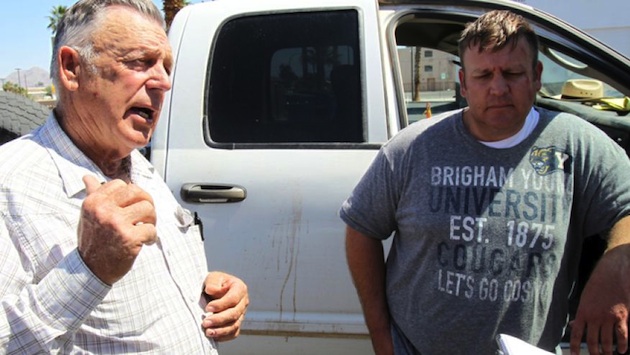
APRIL 7: Embattled Bunkerville rancher Cliven Bundy, left, and his son Dave Bundy talk to a reporter on the corner of North Las Vegas Boulevard and East Stewart Avenue in downtown Las Vegas.AP/LAS VEGAS REVIEW-JOURNAL

The Bureau of Land Management announced Saturday that it has ended its effort to remove “tresspasse cattle” from a Nevada ranch after a tense week-long standoff with Cliven Bundy and militia supporters.

“Based on information about conditions on the ground, and in consultation with law enforcement, we have made a decision to conclude the cattle gather because of our serious concern about the safety of employees and members of the public,” the statement read.

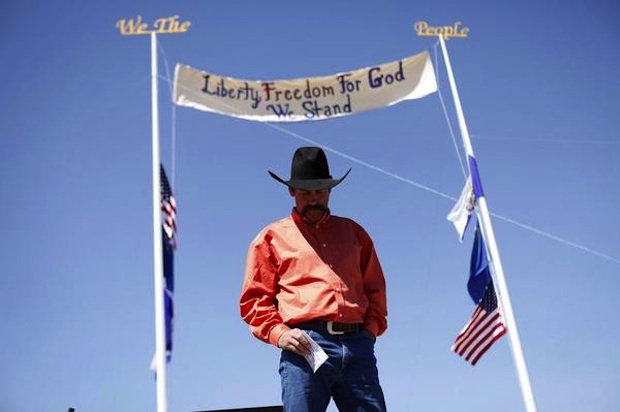
A group of about 1,000 supporting Bundy cheered, singing “The Star Spangled Banner” following the BLM announcement.

The federal government said Nevada rancher Cliven Bundy owes them more than $1.1 million in unpaid grazing fees for allowing his cattle to graze on property his Mormon family settled in the 19th century. Supporters began to assemble at the Bundy ranch near Bunkerville, Nevada, which quickly escalated into a confrontation between civilians and armed federal agents.

Millions of Americans nationwide were astonished and angry that police from the Bureau of Land Management used stun guns on Dave Bundy, who is Cliven Bundy’s adult son, during a Wednesday confrontation on a state highway near the Bundy melon farm in the Gold Butte area. The video — viewable below — went viral and mobilized an untold and unknown number of militia men throughout the West.

Senator Dean Heller and Gov. Brian Sandoval, both elected Republicans, also expressed their disapproval over with the way the BLM was conducting the roundup. After the areas were removed Thursday, Sandoval issued a new statement.

“Although tensions remain high, escalation of current events could have negative, long lasting consequences that can be avoided,” it said.

The dispute began in 1993, when citing a federally protected tortoise, the Bureau of Land Management began requiring Bundy to pay for grazing rights. It was only after Mr. Bundy declined to continue to pay for future grazing right that the federal government revoked his license.

Read Outrage Over Standoff With Nevada Rancher Spreads Amid Debate Over Excessively Armed Fed Or View Video Below From CBS News:

The Bureau of Land Management announced Saturday

nevada rancher

Rancher Derrel Spencer speaks during a rally in support of Nevada rancher Cliven Bundy, near Bunkerville, Nevada, on Monday, April 7, 2014. (AP Photo/Las Vegas Review-Journal, John Locher)

UPDATE: The Bureau of Land Management announced Saturday that it has ended its effort to remove “tresspasse cattle” from a Nevada ranch after a tense week-long standoff with Cliven Bundy and militia supporters.

Nationwide outrage over the ongoing standoff between the Bureau of Land Management and a Nevada rancher is not only escalating, but spreading. Now, a recent report from a government watchdog group showing an extraordinary amount of federal agencies arming up is receiving new attention.

The federal government says Nevada rancher Cliven Bundy owes them more than $1.1 million in unpaid grazing fees for allowing his cattle to graze on property his Mormon family settled in the 19th century. Supporters began to assemble at the Bundy ranch near Bunkerville, Nevada, which quickly escalated into a confrontation between civilians and armed federal agents.

Millions of Americans nationwide were astonished and angry that police from the Bureau of Land Management used stun guns on Dave Bundy, who is Cliven Bundy’s adult son, during a Wednesday confrontation on a state highway near the Bundy melon farm in the Gold Butte area. The video — viewable below — went viral and mobilized an untold and unknown number of militia men throughout the West.

The dispute began in 1993, when citing a federally protected tortoise, the Bureau of Land Management began requiring Bundy to pay for grazing rights. It was only after Mr. Bundy declined to continue to pay for future grazing right that the federal government revoked his license. Consequently, the desert tortoise was targeted by the very same agency in 1991, citing over population. With enough money, contractors are still able to obtain a license to hunt the desert tortoise, thus any media report that cites a “save the tortoise” narrative is patently false.

The roundup started Saturday, after the BLM and National Park Service shut down an area half the size of Delaware so that contractors in helicopters and vehicles could round up about 900 so-called “trespass cattle,” as officials call them.

Amy Lueders, BLM state director in Nevada, said 380 cows were collected by Thursday, though she would not give us a taxpayer cost for herding the animals. At nearly $1,000.00 per cattle, the financial cost to Cliven Bundy has been high.

The standoff has sparked a debate about states’ rights and federal land-use policy, but has also reopened debate about the massive arming of federal agencies that seemingly have zero need for armed agents. A recent report from Watchdog.org listed the names of federal agencies who possess special agents and other armed personnel, and it is shocking.

NOAA, for instance, the agency that forecast the weather, monitor the atmosphere and study the oceans and waterways has a budget of $65 million and employs 191 people, to include 96 special agents and 28 enforcement officers who carry weapons. The EPA, the agency now in the process of what many call a power grab, as well as exposing citizens to harmful substances in testing facilities without disclosing health risks, currently has over 200 special agents and swat teams.

The Environment Protection Agency recently raided an Alaskan village with a population of seven people without giving a specific cause. Among the federal agencies arming up is the Department of Education, who recently raided a California home over alleged student grant violations. They were forced to defend a gun and ammunition purchase back in 2010, but said only that the weaponry was needed to stop “waste, fraud, abuse, and other criminal activity involving Federal education funds, programs and operations.”

“There’s no question there’s been a proliferation of police units at the federal level,” says Tim Lynch, the director of the Project On Criminal Justice for the Cato Institute. “To me, it’s been a never-ending expansion, a natural progression, if you will, of these administrative agencies always asking for bigger budgets and a little bit more power.”

For many, the situation with Nevada rancher Cliven Bundy is a direct result of politicians carelessly allowing “bigger budgets and a little bit more power” over the decades. As Bundy takes a stand for property and privacy rights, the standoff stands as a sobering reminder that government grows at the expense to individual and, inevitably, our collective freedom.

Nationwide outrage over the ongoing standoff between

socialist bernie sandersThe Democratic Socialist Bernie Sanders said he wants to pull the party to the left even further than it already is by exploring a 2016 presidential bid. The Vermont senator, who has referred to himself as a Democratic Socialist in the past, says he will make a decision on whether or not he will run by January, the Boston Globe reported.

“It would be a serious campaign,” the radical Vermont lawmaker said. Sanders was first elected to the House of Representatives in 1990 and then in the U.S. Senate in 2006. “What I am proposing is a political revolution in this country.”

Sanders concedes that he has little chance of winning the nomination, but that’s not even his goal. Unlike half of America, socialist Bernie Sanders believes the Democratic Party isn’t far enough to the left on the issues, even though another Democratic Socialist, Massachusetts Senator Elizabeth Warren, would be his biggest obstacle when vying for leftist votes.

Warren, however, has insisted that she is not thinking about running in 2016, but Sanders said that wouldn’t even effect his decision.

“Nothing to do with Elizabeth. Nothing to do with Hillary,” he told The Globe.

Bernie Sanders, who caucuses with the Democrats in the Senate, and many other Democrats, are tired of pretending they aren’t what they are — socialists. The fact he is gearing up for a bid this early tells experts that Hillary Clinton may not represent the party as much as everyone claims in the media. It matters little that she really is far more to the left than portrayed.

“The Clinton era saw the rise of the corporate Democrat. You saw a lot of people in big business, all the sudden, getting in on the Democratic side,” Jim Dean said in an interview. Dean is the chairman of Democracy for America, which is the political action committee founded by his brother, Howard Dean.

Howard Dean was a serious Democratic presidential hopeful who is another Democrat Socialist in public. But he blew his chances after an outrageous campaign speech, during which he appeared to come completely unhinged.

Though Sanders wouldn’t rule out an independent run if unsuccessful, he did say he didn’t want to elect a “right-winger” as president by becoming a spoiler, such as Ralph Nader in 2000.

The Democratic Socialist Bernie Sanders said he

epa coal regulationsThere is a growing concern among experts that the nation’s power grid is being unnecessarily stressed to the max. Utility officials are cautioning that the decrease of coal-fired power plants may have disastrous effects leaving the United States power system weak and vulnerable to blackouts in the future.

American Electric Power’s Nick Akins stated, “I worry about the potential of brownouts and blackouts if we’re actually depending on this generation that’s going to be retired.”

They are concerned that extreme summer heat or frosty winters could cause the power system to fail.

In 2008 President Barack Obama stated, “If someone wants to build a new coal-fired power plant they can, but it will bankrupt them because they will be charged a huge sum for all the greenhouse gas that’s being emitted.”

President Obama has accelerated EPA coal regulations to the point that — all of the rules handed down from 5 years ago — has led to approximately 20 percent of the coal plants being closed. And if the new regulations that are being considered pass, another 20 percent will be closed.

American Coalition for Clean Coal Electricity Mike Duncan is concerned if more power plants are closed, “that creates huge stresses – we’re just not ready for anything like that in this country.”

Pro-coal supporters believe the White House’s focus on climate change has been too swift and too radical, placing the dependability of the nation’s power grid at risk. It has happened before in America, most notably in California when Governor Gray Davis led a green agenda that led to grid-failures.

But EPA Administrator Gina McCarthy stated, “Nothing we do can threaten reliability. We have to recognize that in a changing climate like the one we have recently been experiencing, it is an increasing challenge to maintain a reliable energy supply.” The EPA says government studies indicate there will be more than enough electricity-generating capacity to meet the nation’s needs. 

When asked about future regulations, EPA Administrator Gina McCarthy suggested the agency is trying to be careful. However, it is clear that the EPA believes this is “settled” debate over climate change, when Americans and American lawmakers are nowhere near conceding that.

Even nongovernmental (NGO) and intergovernmental (IGO) climate change panels are at odds with one another regarding the existence and impact of climate change. The NIPCC, a nongovernmental panel who are serious climate skeptics, released a report last week with hard data points rebutting the latest IPCC report. And Americans, as we recently reported, are largely unconcerned about climate change and do not attribute recent weather patterns to manmade events.

Considering this past winter’s severe cold and the fabrication of the term, “Polar Vortex,” Alaska Republican Sen. Lisa Murkowski is skeptical. She noted at a Senate hearing this week that the system was already at its limits.

“Eight-nine percent of the coal electricity capacity that is due to go offline was utilized as that backup to meet the demand this winter,” Murkowski said. Her concern is also echoed by Democratic Sen. Joe Manchin, from the coal-country states of West Virginia.

“Add the fact that EPA is proposing new source performance standard, what this is going to do will effectively ban the construction of any new coal plants,” Manchin said. “How do we keep the lights on so people’s lives will not be in danger?”

Even former comedian turned-Minnesota Democratic Senator, Al Franken, told Fox News that this is no laughing matter.

“We need state flexibility in addressing those kind of issues, especially on the new rules that the EPA will make on existing coal fire plants,” he said. “We’re talking about grid security — it’s a serious issue.”

There is a growing concern among experts

hud neighborhood diversity

(Photo: Trunews.com)

The Obama administration’s HUD neighborhood diversity scheme is forcing many veterans to leave suburban areas for downtrodden, Section 8 neighborhoods. Last year, Obama announced plans to use the federal government to undertake forced racial integration, and now we are beginning to see what that means.

The stated purpose of mapping every neighborhood in American by race was to use the data to force local officials to loosen zoning laws, build more public housing and allow poor inner-city minorities to access better opportunities for housing and education. But that isn’t what is happening, at all.

It is “one despicable back-door kind of policy,” one housing authority official told People’s Pundit Daily.

And here is how it works.

Because the government cannot lift up those less fortunate, they have decided to tear others down. In this case, unfortunately, that means forcing veterans who are receiving HUD-VASH assistance to move into Section 8 neighborhoods, rather than allowing them to find more suitable arrangements in suburbs with better-performing schools in safer neighborhoods.

Veterans who are determined low-income or at-risk of homelessness, many of which have families and are attending higher education or training schools, are eligible for Veterans Affairs Supportive Housing (HUD-VASH), a program that “combines Housing Choice Voucher (HCV) rental assistance” with case management and clinical services through the Department of Veterans Affairs, according to the Housing Department site. Services for those eligible are provided at VA medical centers (VAMCs) and community-based outreach clinics.

While HUD-VASH was originally geared toward older veterans with physical or mental illness, the program has transformed into a reentry program for many younger veterans who work with their case managers and others to find gainful employment or retraining programs. The program works very much in the same manner that Section 8 does, with veterans completing necessary paperwork at local housing authorities around the country. But landlords in better neighborhoods are far more willing to rent to tenants who receive HUD-VASH than Section 8, allowing veterans to find decent homes in decent neighborhoods.

However, because of new administration rules being funneled down through the Department of Housing and Urban Development, the agency in charge of racially diversifying neighborhoods, that is all about to change.

The amount of assistance, or the monthly amount the program allows for rent, has been substantially decreased for veterans with families, as well. In some cases, landlords are either forced to accept a several hundred dollar decline in monthly rent, or the veteran tenant must find cheaper housing, in Section 8 neighborhoods. Further, for veterans who have two children of the opposite sex — i.e. one boy and one girl — they are no longer allowed separate bedrooms up to ages that in many cases violate state law.

An official who works as a HUD-VASH case manager at the Department of Veteran Affairs told People’s Pundit Daily that these and other seemingly subtle changes that took hold in October, 2013, are now starting to have a negative impact on the veterans.

“Many of them are beginning to find out about these changes now, but most will not get hit with this until they attempt to renew their lease,” they said. “The housing authority officials are telling them on an as-needed basis, so really… they can’t really plan for this.”

In Florida, for example, families with children of the opposite sex over the age of two were allowed separate accommodations, which would be needed to comply with standards the Florida Department of Children and Families expects from other households. But the federal government is forcing local housing authorities to change that age requirement to ten years-old.

“First they told me my children had to share a room, something any sane parent knows is inappropriate, then they tell me they have to share it in a crappy neighborhood,” one veteran said. The veteran was afraid to give his name, fearing they would retaliate by pulling his voucher.

“We had our rent reduced from $1150.00 to $900.00 a month,” he said. “One, maybe two neighborhoods are that cheap around here, and they are both drug neighborhoods. Thank God my landlord is Christian,” he said.

He was forced to tell the landlord that he and his wife had been reduced, but will be allowed to stay in his present home because the landlord didn’t want him and his family to have to take his kids out of the better-performing school system and move across town.

Still, though the federal government is imposing much of these new rules in their effort to racially diversify neighborhoods, local housing authorities are relied upon to actually carry them out. And not everyone is willing to do it.

“I want no part of this social engineering garbage,” the veteran’s housing authority official told us. Speaking on the condition of anonymity, the official told us that other housing authority officials still have some options. “A lot of this stuff is income based, and guess who verifies the income,” they said. “If they need another hundred or two-hundred dollars in income to get them to the requested landlord amount or an amount they are willing to work with, then guess what, we’ll just have to put that down.”

Even though the program is largely based on Section 8, many landlords and officials don’t see the program in the same light. But if Section 8 isn’t welcomed in many suburban neighborhoods, thus recipients’ children cannot access better-performing schools, then why does the administration believe sending veterans’ children to poorer neighborhoods will help the poor?

“Look, are some of these veterans older veterans who have substance abuse problems and can’t seem to get their life together? Sure, lots of them,” the housing official said. “But many of them are not; they have families and are young people who need a safety net while they get their lives together.”

“Besides, regardless, they are veterans,” the VA case manager interjected. “And unlike Section 8 recipients, they’ve earned a hand up, not a hand out,” they said, as the housing official nodded in approval.

Find out how the Obama administration's HUD

Officials seem to be conflicting each other on whether or not the latest ‘ping’ detected can be attributed to Malaysia Airlines Flight 370. Angus Houston, the leading official in the search for the jetliner off Australia’s west coast, said Friday that the signal likely was not the missing plane, just as Australia’s prime minister suggested the ping would help them narrow down the search.

“On the information I have available to me, there has been no major breakthrough in the search for MH370,” Houston said. She also said that officials had determined Thursday that the ping was not stemming from the black box on Malaysia Airlines Flight 370.

However, Australian Prime Minister Tony Abbott told reporters in Shanghai that search crews located a more targeted area as the source of the sounds, which were first heard on Saturday.

“We have very much narrowed down the search area and we are very confident that the signals that we are detecting are from the black box on MH370,” Abbott said.

“Nevertheless, we’re getting into the stage where the signal from what we are very confident is the black box is starting to fade,” he said. “We are hoping to get as much information as we can before the signal finally expires.”

Since last Saturday, officials and experts had begun to suggest that a breakthrough was imminent, yet no real developments have been revealed. Concerns were mounting that time was running out for the search party to locate the box before the batteries expire, which are widely believed to be around the 30-day mark. Yet, in many past cases, the black box battery source continues to transmit signals for up to 10 days pr more after the expected termination date.

The Australian P-3 Orion aircraft has been scouring the Indian Ocean in the area Ocean Field picked up a transmissions originating around 15,000 feet below the ocean surface. They have been dropping sonar buoys along the way, but to no avail.

Malaysia Airlines FLight 370 disappeared on March 8, 2014, some time after the first hour of the flight when the last communication was made. Malaysian government officials said Thursday that they have definitely decided the pilot was the one who spoke the last words to air traffic control, “Good night, Malaysian three-seven-zero,” and that his voice by all measures was normal. It was initially thought to be the co-pilot who spoke the last words before the system was manually shutdown.

Officials seem to be conflicting each other

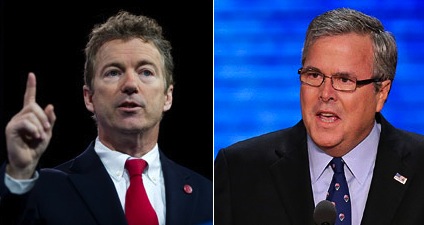
rand paul and jeb bushThe Washington Establishment and various others in the elite political class are overtly pushing and covertly nudging Republicans toward nominating Jeb Bush in 2016. It is obvious that there is an unprecedented early effort to discourage the conservative, activist base of the party and create an “air of inevitability,” or “electability” around Jeb Bush. In this article, I will address the claims made by the Establishment and destroy their arguments.

We recently reported that the GOP donor class was beginning a behind-the-scenes effort to “draft” the former Florida governor, which prompted Larry Sabato, whom I respect and was utterly shocked by, to rank Bush at the top of the Crystal Ball’s GOP contender list late last month. Then, on April 2, the “mainstream” Republican publication, Cook Political Report, another election projection site, released an article by Amy Walter entitled, “Don’t Call Rand Paul The Frontrunner.”

Well, if we can’t call Rand Paul the frontrunner, then we definitely cannot call Jeb Bush the frontrunner, either. It is important to note that–unlike other pundits–I feel it is important to disclose the fact that I am a conservative. Let’s cut the garbage. Cook is an Establishment Republican pundit, while Larry Sabato is a Kennedy-Era Democrat. There is nothing wrong with any of this, but it is dishonest not to disclose this to readers. We all know Nate Silver is a liberal, but that doesn’t mean we can’t look at his model and recognize his efforts to be objective. Sometimes, however, I get a faint whiff of something else.

The prevailing argument for Jeb Bush is an utterly ridiculous, one-tracked argument that generally holds that Jeb Bush is backed by the Establishment’s money, and presidential hopefuls need money. Admittedly, the data are pretty clear. History shows that those who receive the most Establishment endorsements have gone on to win the nomination, in both parties. Where these arguments have gone awry, however, is their assessment of how and when a candidate earns the support of the Establishment, as well as their lack of recognition that sometimes they are forced by the voters to get “comfortable” with a nominee they otherwise would not have wanted.

In 1980, by far, Ronald Reagan had the most Establishment endorsements, but that’s only because they were forced to abandon George H.W. Bush and back the conservative insurgent-turned-Republican standard-bearer. In 2008, Hillary Clinton was the choice of the Democrat Establishment who had the loyalty of the vast majority of Super Delegates, yet she was overtaken by the radical leftist, insurgent wing of the Democratic Party backing Barack Obama. To a lesser extent, in the same year, a somewhat fractured Establishment believed Rudy Giuliani was the only viable choice to run against Hillary, but settled on John McCain because of early state dynamics and flawed campaign strategy.

In 2012, by the way, Romney was able to straddle the fence as the previous cycle’s “conservative alternative” to John McCain, while at the same time remaining the Establishment. And even still, had Matt Strawn not flubbed the Election Day results showing Romney edging out the truly-victorious Rick Santorum, perhaps the former Pennsylvania senator would not have had to wait until Colorado to gain viability. The existence of Super PACs is not yet fully understood by respected pundits, but we know they have turned an unknown amount of past prevailing wisdom on its head.

Which brings me to my next point: Exactly, which early state does Jeb Bush think he will make his stand in, gaining that much-needed early momentum to sling-shot him through the nomination? Sure, it’s true that early polling holds little predictive value in presidential nominations, but actual dynamics and fundamentals are against him. Not one time has Jeb Bush led on the PPD average of 2016 Republican presidential nomination polls, nor is he a favorite in either New Hampshire or Iowa.

The very same positions Rand Paul holds on the NSA, drones and greater foreign policy have helped and will help him in the early state of New Hampshire, though I think concern over his positions are overblown. His foreign policy positions, which he has explained several times, resemble more Ronald Reagan than George H.W. Bush. “The Gipper was no neocon,” as Pat Buchanan recently pointed out. Paul has consistently led in New Hampshire surveys, while  former Arkansas governor turned-Fox New host, Mike Huckabee, is still holding on to a slight lead in Iowa, where Paul is nipping at his heels. Outreach to nontraditional GOP primary voters in Iowa may just pay off, as I have personally spoken with several Hispanic and black Protestant church leaders who say they will back Paul in 2016 if he decides to run.

The Washington Establishment, to include the Republican Establishment, media pundits and power-brokers, all are petrified over this next presidential election cycle. It is only natural, considering Rand Paul — or another actual conservative — would do their best to neuter them and return power to We the People if elected. But they have yet to come to understand a simple sentiment in the party, as well as America in general.

People, not just activist conservatives, don’t want Jeb Bush or any other Bush for that matter. A recent Washington Post-ABC News poll found that almost half of all Americans say they “definitely would not” vote for Jeb Bush in the 2016 presidential election. Another even more recent survey by Rasmussen Reports found 50 percent of likely voters “definitely would not” vote for another Bush. This is a sentiment that transcends party or the conventional rule that early polling lacks predictive power.

It is far more likely that a Scott Walker or John Kasich will be the benefactor of the Establishment’s inevitable abandonment of Jeb Bush, than it is Jeb Bush will be the Republican nominee. We cannot know this for certain at this point, but we can know that Jeb Bush is not the frontrunner, as the Establishment and pundits contend.

But, I suppose, if I were them, then I would be worried, too. Though I am just not sure that I would allow that to influence my election predictions. Call me cynically conservative, but I smell a little bit of that good ole’ fashion desire for self-preservation in the air at “Grand Ole’ Party” headquarters. And it smells a lot different from “inevitability” or “electability.”

The Establishment political class says they aren't

A reading on consumer sentiment from Thomson Reuters and the University of Michigan rose in April to 82.6, which is the highest level since July and up from 80 in the prior month. The index beat economists’ expectations, as Wall Street was looking for a reading of 81.

However, new data from the Labor Department suggest the gains are likely to be short-lived.

Labor reported Friday wholesale prices rose 0.5 percent in March, which was the biggest increase since June, and higher than expectations for a 0.1 percent increase. When Labor excludes the food and energy components, prices rose 0.6 percent, and again wider than the 0.2 percent increase Wall Street expected.

The increase in Labor’s seasonally adjusted producer price index for final demand was the largest in nine months, since March of 2011.

Food prices, alone, sharply increased by 1.1 percent, which is also the largest increase since May. In Feb., prices on food rose 0.6 percent.

The food price increase was fueled by a significant increase in the cost of pork, which rose by the largest margin since August of 2008. In fact, sausage, deli meat and boxed meat prices rose by the most since August 1980.

Food prices have now risen for a third straight month, an unmistakable trend whether short-term or not.

Meanwhile, energy prices dropped by 1.2 percent, the largest decline in nearly a year and hopefully enough to offset some consumer price pressure. Services for final demand spiked 0.7 percent, the largest gain since January 2010, after falling 0.3 percent in February.

In the 12 months through March, producer prices advanced 1.4 percent after rising 0.9 percent in February.

When excluding volatile food and energy costs, producer prices increased by 0.6 percent, which, too, was the biggest gain since March of 2011. The so-called core PPI for final demand fell 0.2 percent in the prior month of February.

In the 12 months through March, core PPI for final demand rose 1.4 percent after increasing 1.1 percent in February.

A reading on consumer sentiment from Thomson

WATCH VIDEO: Woman throws shoe at Hillary Clinton at fundraising event in Las Vegas, Nevada, and then was taken into federal custody.

It wasn’t long after Clinton took the stage before an Institute of Scrap Recycling Industries meeting at the Mandalay Bay resort as part of a week-long speaking circuit at $250,000 a pop, when a woman decided to throw a shoe at her.

Clinton ducked after the fact — despite the superwoman move the AP fabricated — and she was not hit by the object.

“Is that somebody throwing something at me? Is that part of Cirque de Soleil?” Clinton joked.

“My goodness, I didn’t know that solid waste management was so controversial,” Clinton said, as if she isn’t a known liar over Benghazi and many, many other events. “Thank goodness she didn’t play softball like I did.”

Brian Spellacy, who is a U.S. Secret Service supervisory special agent in Las Vegas, told the AP the woman was being questioned and would face criminal charges, though it isn’t clear why people are arrested when they throw shoes at aristocracy but not their neighbors. Spellacy wasn’t even clear what the charges would be.

It may ring a bell that President George W. Bush dodged two shoes thrown by an Iraqi journalist during a news conference in Baghdad in December of 2008. Obviously, shoe-throwing is considered an insult in Arab cultures, but the woman’s attire certainly wasn’t suggestive of such a motive. That may turn out to be the case, but she was a middle-aged blonde woman wearing a blue dress and thong sandals.

Unlikely radical “Islamo-shoeism” is the motive.

WATCH VIDEO: Women throws shoe at Hillary

People's Pundit Daily
You have %%pigeonMeterAvailable%% free %%pigeonCopyPage%% remaining this month. Get unlimited access and support reader-funded, independent data journalism.

Start a 14-day free trial now. Pay later!

Start Trial