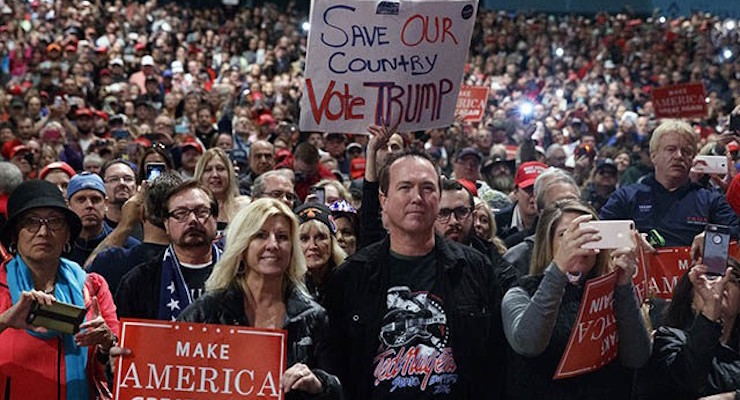
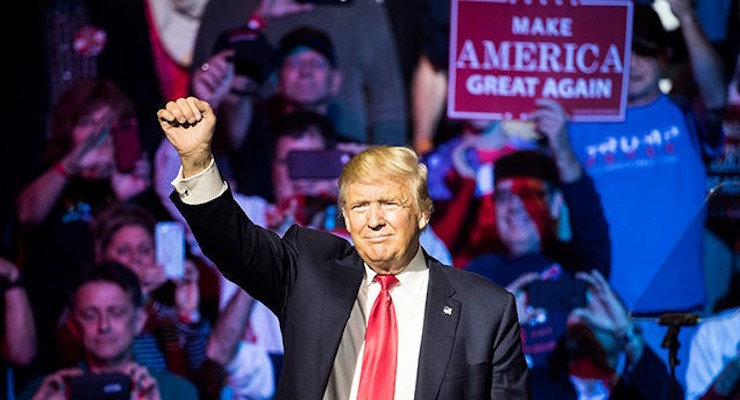
Supporters of Republican presidential candidate Donald Trump speaks during a campaign rally, Sunday, Nov. 6, 2016, in Sterling Heights, Mich. (Photo: AP)
Michigan Attorney General Bill Schuette filed an emergency motion with the state Supreme Court “to stop Jill Stein’s frivolous, expensive recount.” The motion is an attempt bypass the Court of Appeals and ensure the state does not forfeit its electoral votes in the Electoral College. Stein is attempting to use hand recounts to miss state deadlines, which could result in forfeits in Michigan, Wisconsin and Pennsylvania.
Mich voters rejected @DrJillStein's candidacy and her refusal to accept verified results poses an expensive &a risky threat to MI taxpayers.
On Thursday, a Wisconsin judge rejected a legal request to conduct a hand recount by Stein, citing no evidence or reason for why there should even be one. Dane County Circuit Judge Valerie Bailey-Rihn said the request, which was backed by Hillary Clinton and her campaign, failed to meet the state’s legal standard for prohibiting the use of machines in the recount.
Most suspect the Clinton campaign is using Stein as a pawn, though there is not direct evidence they are funding the operation. However, Clinton sent out an email fundraiser claiming they need “all hands on deck” for a recount in Michigan.
The Republican Party of Wisconsin filed an FEC complaint Wednesday alleging Stein is allowing her campaign to be used as a front for Hillary Clinton’s campaign in the recount effort. Stein denied the allegations, but even her own party is distancing themselves from her and her efforts.
“It is concerning that the Stein campaign would position itself to front and fund a recount attempt that only serves the interest of a desperate and defeated Clinton campaign,” the complaint states. “Further, it is incredibly disturbing that given these asymmetrical interests, the Clinton campaign would readily begin organizing around the effort in order to capitalize on the chaos created by this attempt to undermine the integrity of Wisconsin’s elections process.”
The Wisconsin Republican Party also argued Stein’s actions amount to a coordinated $3.5 million expenditure on behalf of the Clinton campaign, in excess of the $2,000 amount allowed by federal campaign donations laws. Stein, who has raised nearly $7 million (more than her entire campaign), also claims voting machines are illegal, something that has been laughed out of courtrooms.
Debbie Greenberger, the Stein campaign attorney, said she was not sure whether Stein would appeal.
Meanwhile, Clinton and her campaign initially stated they would not pursue a recount anywhere because “we had not uncovered any actionable evidence of hacking or outside attempts to alter the voting technology.” That is still the case, as even the Obama administration has said that there was no evident of hacking and that the president believes the results reflect the will of the American people.
While stating that they support electoral reforms, the Green Party released a statement essentially calling the effort a waste of time and drew a line between them and Stein. In a statement on their website, they noted Stein’s effort gives the appearance she is shilling for Clinton, particularly since the states that she chose to request a recount in are all states that Clinton lost to President-elect Donald J. Trump.
“There are significant electoral reforms needed to make elections more democratic and more representative of the people. While we support electoral reforms, including how the vote is counted, we do not support the current recount being undertaken by Jill Stein,” the statement said. “However, we urge the GPUS to distance itself from any appearance of support for either Democrats or Republicans. We are well aware of the undemocratic actions taken during the primaries by the DNC and the Clinton campaign. Greens cannot be perceived to be allied with such a party.”
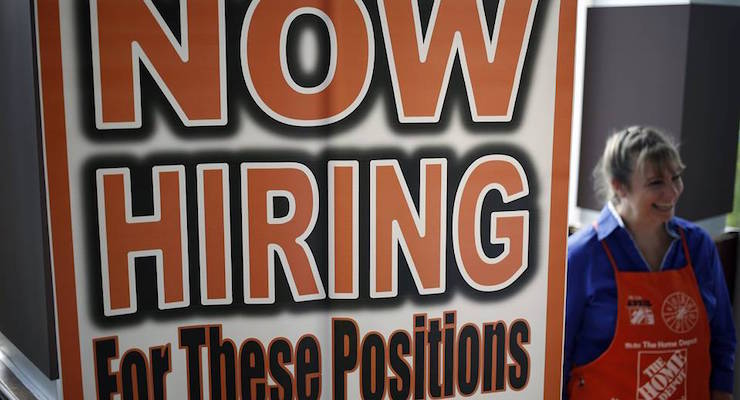
An employee at Home Depot (NYSE:HD) beyond a now hiring sign at a satellite location. (Photo: Reuters)
The Labor Department said Friday nonfarm payrolls increased by 178,000 jobs and the unemployment rate fell to a more than nine-year low of 4.6%. However, in September and October, the previous jobs reports were revised to show 2,000 fewer jobs created than previously reported.
In November, economists polled by Reuters had forecast payrolls would increase by 175,000 jobs and the unemployment rate unchanged at 4.9%.
Wages pulled back after two months of gains, as average hourly earnings fell three cents, or 0.1%, after gaining 0.4% in October. The economy has largely created part-time and lower-wage service-sector jobs. Manufacturing fell by 4,000 jobs in November, marking the fourth straight month of declines. Construction employment increased by 19,000 jobs last month after rising by 14,000 in October.
Retail sector payrolls fell 8,300, falling for a second straight month.
Further, while the Bureau of Labor Statistics (BLS) claims the labor market is nearing full employment, job gains have slowed from an average of 229,000 per month in 2015 to an average of 180,000 this year.
The U.S. economy needs to create an average of 250,000 jobs each month simply to keep pace with population growth.
The labor force participation rate, or the share of working-age Americans who are employed or at least looking for a job, ,fell 0.1% to 62.7% last month. That’s just off a 4-decade low and only in part reflects an aging and retiring workforce.
Statue of Liberty in front of the New York City skyline.
Libertarians are sometimes described as people who don’t want the government to interfere in either the bedroom or boardroom, which is a shorthand way of saying that there should be both personal freedom and economic freedom.
Based on this preference for liberty and a desire to avoid government coercion, what’s the most libertarian nation in the world? Is it Australia, which I recommended as the best option for escaping Americans if the U.S. becomes a failed welfare state?
Not quite. According to the new Human Freedom Index, Australia gets a very good score, but the most libertarian-oriented place in the world isn’t even a country. It’s Hong Kong, a “special administrative region” of China.
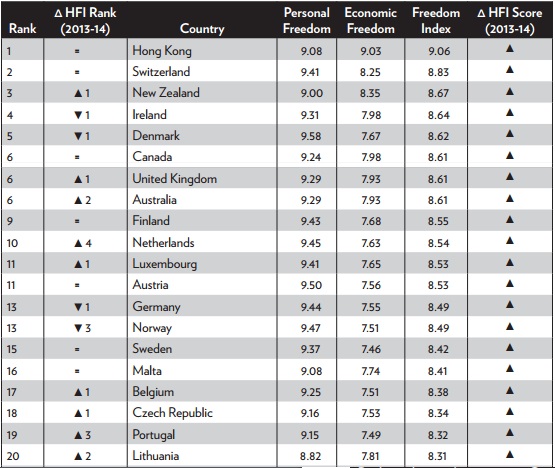
For what it’s worth, European nations dominate the rankings. Other than top-rated Hong Kong, New Zealand (#3), Canada (tied for #6), and Australia (tied for #6), every single nation in the top 20 is from the other side of the Atlantic.
So kudos to our friends from across the ocean. Most of them have big welfare states, but at least they compensate with free market policy in other areas, along with lots of personal freedom.
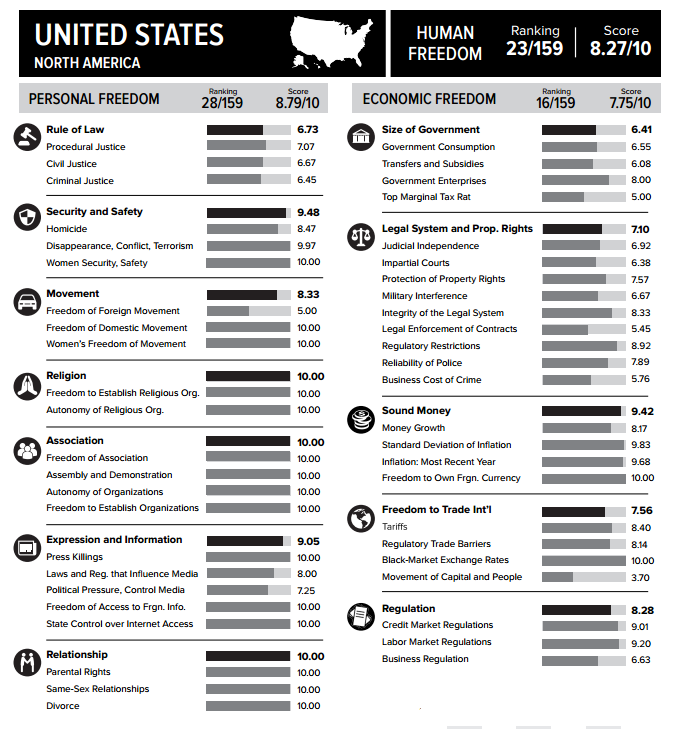
And what about the United States? We’re ranked #23, which certainly is decent considering that there are 159 countries that are scored, but obviously not worthy of superlatives.
The infographic below contains the specific scores for the United States. As you can see, our economic freedom score (7.75 out of 10) is worse – in absolute terms – than our personal freedom score (8.79 out of 10). But since more nations (especially in Europe) get high scores for personal freedom, our relative ranking for economic freedom (16 our of 159) is better than our relative ranking for personal freedom (28 our of 159).
And if we look at the sub-categories for personal freedom on the left side, you’ll notice that America’s main problem is a very mediocre score for rule of law. Thanks, Obama!
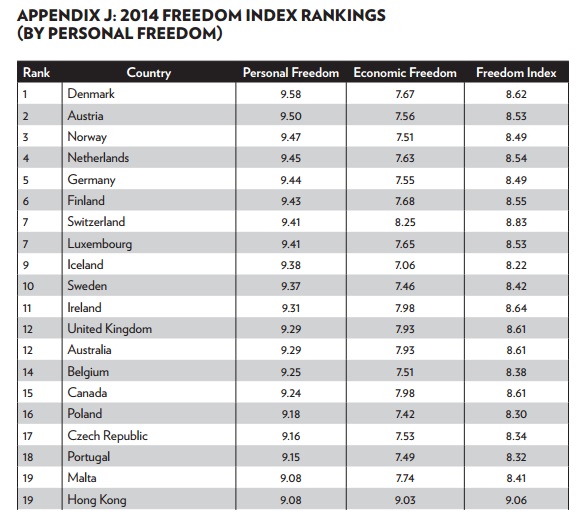
Let’s now look at the nations that have the most personal freedom.
I already mentioned that the United States is in 28th place, so we obviously don’t show up on this top-20 list. But you will find 17 European nations, along with Australia (tied for #12), Canada (#15), and Hong Kong (tied for #19).
By the way, Switzerland is the only nation to be in the top 10 for both personal and economic freedom. So maybe that country’s improbable success isn’t so improbable after all. You do the right thing and you get good results.
And honorable mention to Ireland, Australia, and the United Kingdom for just missing being in the top 10 in both categories.
In case you’re wondering why Hong Kong had the highest overall score even though it was “only” #19 for personal freedom, the answer is that the jurisdiction scores so much higher for economic liberty than the European nations.
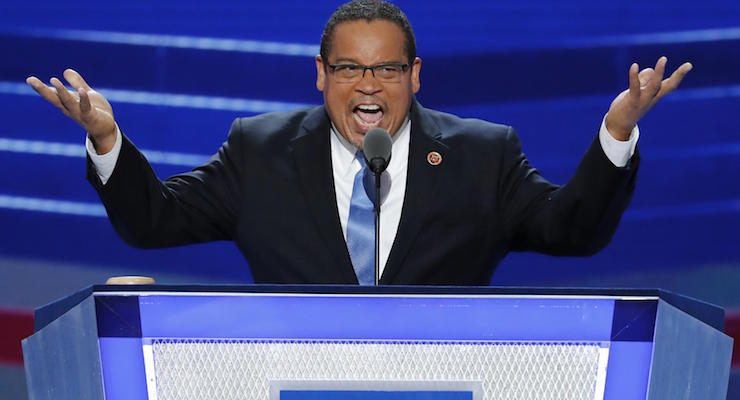
In this July 25, 2016, file photo, Rep. Keith Ellison, D-Minn., speaks during the first day of the Democratic National Convention in Philadelphia. Ellison, a prominent progressive and the first Muslim elected to Congress, has emerged as an early contender to become chair of the Democratic National Committee, backed by much of the party’s liberal wing. (Photo: AP, File)
The Anti-Defamation League (ADL) has bailed on Rep. Keith Ellison, D-Minn., in his bid to be the new chair the Democratic National Committee (DNC). The leftwing group, which bills itself as an anti-bigotry organization, released a statement after new audio surfaced in which he made questionnable comments about the state of Israel.
The United States foreign policy in the Middle East is governed by what is good or bad through a country of 7 million people. A region of 350 million all turns on a country of 7 million. Does that make sense? Is that logic? Right? When the Americans who trace their roots back to those 350 million get involved, everything changes. Can I say that again?
Rep. Ellison went on to say “the Zionists joined with the Nazis in murdering Jews, so they would flee to Palestine” and the ADL called the statements “deeply disturbing and disqualifying.”
“New information recently has come to light that raises serious concerns about whether Rep. Ellison faithfully could represent the Democratic Party’s traditional support for a strong and secure Israel,” ADL CEO Jonathan A. Greenblatt said in a statement. “His words imply that U.S. foreign policy is based on religiously or national origin-based special interests rather than simply on America’s best interests. Additionally, whether intentional or not, his words raise the specter of age-old stereotypes about Jewish control of our government, a poisonous myth that may persist in parts of the world where intolerance thrives, but that has no place in open societies like the U.S.”
In addition to his ties to the radical Nation of Islam and his defense of anti-Semitic leader Louis Farrakhan, Rep. Ellison once called Farrakhan a “role model” and Adolf Hitler a “great man.”
“Minister Farrakhan is a role model for black youth,” wrote Rep. Ellison in an Insight News op-ed in 1995. “He is not an anti-Semite.”
It wasn’t only time he took the position, either. Joanne Jackson, the then-executive director of The Minneapolis Initiative Against Racism, came under fire in 1997 for saying Jews are the most racist white people and that Farrakhan was a racist, Ellison defended her.
“She is correct about Minister Farrakhan,” Ellison, who was known then as Keith Ellison-Muhammad. “He is not a racist. He is also not an anti-Semite.”
Running to be the first Muslim elected to a position in the U.S. Congress, who was eventually sworn in on a Quran, he publicly renounced his association with the Nation of Islam in 2006. But it was only after it became a public campaign issue thanks only to local Republican bloggers who began publishing his old law school columns and photos connecting him to the organization.
“I have long since distanced myself from and rejected the Nation of Islam due to its propagation of bigoted and anti-Semitic ideas and statements, as well as other issues,” Rep. Ellison wrote in 2006.
However, in a 1990 column uncovered by CNN, he defended Kwame Ture, also known as Stokely Carmichael, who had once claimed publicly that Zionists collaborated with the Nazis in World War II.
“Zionism must be destroyed,” Ture said.
Rep. Ellison accused the university’s president of chilling the free expression of black students by openly criticizing a controversial speaker invited to speak on campus by the Africana Student Cultural Center. He also once advocated for a separate nation for black Americans.
Incoming Minority Leader Chuck Schumer said he will continue to support Rep. Ellison for DNC chair. But after looking at the “totality of his record on key issues on our agenda,” the ADL said they now have “serious doubts” about his ability to faithfully represent the party’s traditional support for Israel.
[brid video=”82098″ player=”2077″ title=”Full Event PresidentElect Donald Trump Rally in Cincinnati OH 12116″]
President-elect Donald J. Trump kicked off his “Thank You” tour in Cincinnati, Ohio striking an optimistic tone and confirmed a big cabinet appointment.
“This campaign proved that the old ways of doing things are over and anything is possible,” President-elect Trump said, “Now is not the time to downsize our dreams.”
President-elect Trump told a jubilant crowd that he will nominate retired Marine General James “Mad Dog” Mattis as secretary of defense, with a formal announcement to be made Monday. The next president met with the general two weeks ago and offered nothing but praise for him the next day.
“He’s the closest thing to General George Patton we got,” he said.
In typical Trump fashion, he took a stab at the media to intentionally underscore a narrative. He revisited how the pollsters and pundits said he was a long-shot candidate and that he could not win, let alone in the region of the country that inevitably put him over the top.
“Remember when they said we can’t break the blue wall?” President-elect Trump asked the crowd. “We didn’t break it. We shattered that sucker!”
“We are going to seek an inclusive society where people love each other, where they love each other, where they dream big and where they think anything was possible,” he said.”
The tour comes as Carrier and the president-elect formally announced a deal to keep roughly 1,000 jobs in the United States, marking the fulfillment of a major campaign promise. Carrier, which is owned by United Technologies Corporation (NYSE:UTX), manufactures products offering high-tech heating, air-conditioning & refrigeration solutions for residential, commercial, retail, transport & foodservice.
They had announced in February that they planned to move a plant and more than a thousand jobs to Mexico, but became the second political and economic win for Mr. Trump. Ford Motor Company (NYSE:F) also announced they would not move forward on plans to ship a manufacturing plant and those jobs to Mexico.
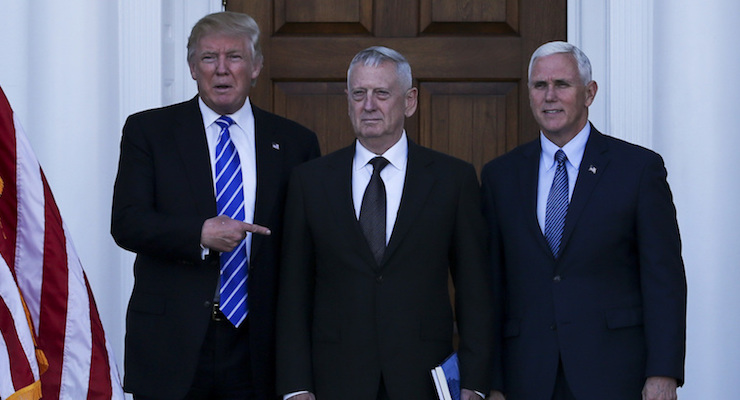
President-elect Donald Trump (L) and Vice President-elect Mike Pence (R) pose with General James Mattis (C) at the clubhouse of Trump International Golf Club, November 19, 2016 in Bedminster Township, New Jersey. (Photo: AP)
President-elect Donald J. Trump intends to nominate Gen. James Mattis, one of the most respected military figures for secretary of defense. “General James ‘Mad Dog’ Mattis, as he is known, is a modern day George Patton and a perfect attitudinal fit for the non-politically correct businessman from New York.
UPDATE: President-elect Donald J. Trump told the crowd at his first “victory tour” rally in Cincinnati, Ohio that he will nominate retired Marine Gen. James “Mad Dog” Mattis as secretary of defense, with a formal announcement to be made Monday.
Citing people familiar with the decision, the Washington Post said the announcement from the president-elect is expected to come next week. Gen. Mattis, 66, would need a waiver because Pentagon rules prevent those serving on active duty within the last seven years from serving in civilian.
Congress will also have to pass a law making an exception, which they have done just once when Gen. George C. Marshall was appointed to the post in 1950.
Gen. Mattis, born in Washington State, served in combat in Iraq and Afghanistan before he left the Marines in 2013. He has since been a think-tank scholar at Stanford’s prestigious Hoover Institution and serves on the board of several private companies. He was and still remains a critic of President Barack Obama on Iran, which undoubtedly cost him his position as commander of U.S. Central Command.
Trump met with the general two weeks ago and offered nothing but praise for him the next day. He has another, lesser-known nickname–“warrior monk.” Marines even have a Twitter hashtag for his well-known quotes–#Mattisisms.
The Trump campaign did not respond to a request for comment.
#Mattisisms for Your Reading Pleasure
“Be polite, be professional, but have a plan to kill everybody you meet.” — Iraq, 2003
“No war is over until the enemy says it’s over. We may think it over, we may declare it over, but in fact, the enemy gets a vote.” — Defense News
“I’m going to plead with you, do not cross us. Because if you do, the survivors will write about what we do here for 10,000 years.” — San Diego Union-Tribune
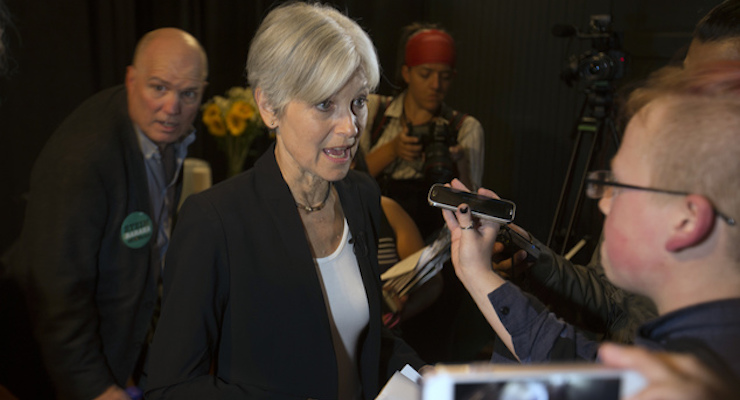
Green party presidential candidate Jill Stein, center, takes questions from reporters during a campaign stop at Humanist Hall in Oakland, Calif. on Thursday, Oct. 6, 2016. (Photo: AP)
A Wisconsin judge rejected a request for a hand recount by Dr. Jill Stein citing no evidence or reason for why there should even be one. Dane County Circuit Judge Valerie Bailey-Rihn said the request, which was backed by Hillary Clinton and her campaign, failed to meet the state’s legal standard for prohibiting the use of machines in the recount.
Judge Bailey-Rihn, while admitting a hand recount was likely more thorough, said the two campaigns did not show why it was necessary because there is no “clear and convincing evidence” of fraud or other problems.
“I follow the law. That’s who I am despite my personal opinions,” said Judge Bailey-Rihn, who was just elected to the bench last spring. “It’s (the counties’) decision. It’s their discretion. I may disagree with it … but I must follow the law.”
Stein, who has raised nearly $7 million (more than her entire campaign), is pushing for recounts in The Badger State, Michigan and Pennsylvania. She also said the voting machines are illegal, a claim that has been laughed out of the courtroom. Debbie Greenberger, the Stein campaign attorney, said she was not sure whether Stein would appeal.
Meanwhile, Clinton and her campaign initially stated they would not pursue a recount anywhere because “we had not uncovered any actionable evidence of hacking or outside attempts to alter the voting technology.”
They still haven’t.
Last weekend, the Obama administration said that there was no unusual cyber activity or evidence to indicate hacking occurred on election night. The White House added that the president believes the results reflect the will of the American people.
Most suspect the Clinton campaign is using Stein as a pawn, though there is not direct evidence they are funding the operation. However, Clinton sent out an email fundraiser claiming they need “all hands on deck” for a recount in Michigan.
The Republican Party of Wisconsin filed an FEC complaint Wednesday alleging Jill Stein is allowing her campaign to be used as a front for Hillary Clinton’s campaign in the recount effort. Stein denied the allegations, but even her own party is distancing themselves from her and her efforts.
“It is concerning that the Stein campaign would position itself to front and fund a recount attempt that only serves the interest of a desperate and defeated Clinton campaign,” the complaint states. “Further, it is incredibly disturbing that given these asymmetrical interests, the Clinton campaign would readily begin organizing around the effort in order to capitalize on the chaos created by this attempt to undermine the integrity of Wisconsin’s elections process.”
The Wisconsin Republican Party also argued Stein’s actions amount to a coordinated $3.5 million expenditure on behalf of the Clinton campaign, in excess of the $2,000 amount allowed by federal campaign donations laws.
While stating that they support electoral reforms, the Green Party released a statement essentially calling the effort a waste of time and drew a line between them and Stein.
“There are significant electoral reforms needed to make elections more democratic and more representative of the people. While we support electoral reforms, including how the vote is counted, we do not support the current recount being undertaken by Jill Stein,” the statement on their website said. “The decision to pursue a recount was not made in a democratic or a strategic way, nor did it respect the established decision making processes and structures of the Green Party of the United States (GPUS).”
The Green Party noted how Stein’s effort give the appearance she is shilling for Clinton, particularly since the states that she chose to request a recount in are all states that Clinton lost to President-elect Donald J. Trump.
“As a candidate, Dr. Stein has the right to call for a recount. However, we urge the GPUS to distance itself from any appearance of support for either Democrats or Republicans,” the statement added. “We are well aware of the undemocratic actions taken during the primaries by the DNC and the Clinton campaign. Greens cannot be perceived to be allied with such a party.”
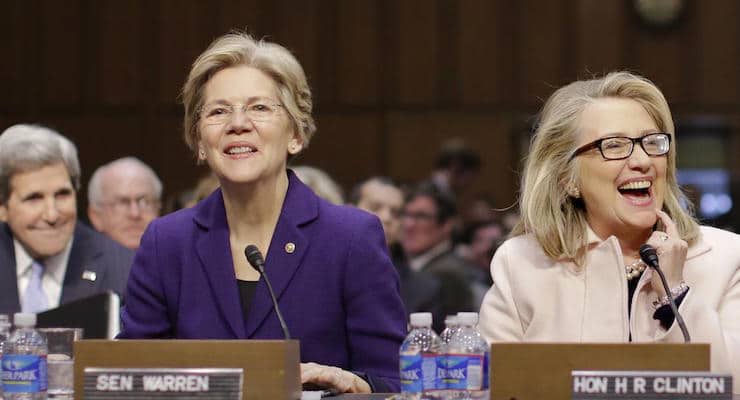
Sen. Elizabeth Warren, D-Mass., left, and Sec. of State Hillary Clinton, right. (Photo: AP/Associated Press)
The Consumer Financial Protection Bureau (CFPB), the brainchild of Sen. Elizabeth Warren, D-Mass., could end up on the chopping block in the new Trump administration. Multiple sources have confirmed that the transition’s economic “Landing Team” discussed how the agency is oversized and how it will be unnecessary after President-elect Donald J. Trump repeals onerous, burdensome regulations imposed by Dodd-Frank.
The Consumer Financial Protection Bureau was first proposed by Sen. Elizabeth Warren in 2007, then a Harvard Law School professor. It was established by the Dodd–Frank Wall Street Reform and Consumer Protection Act in 2010 in response to the Great Recession.
However, most analysts agree nothing in Dodd-Frank would’ve prevented the 2007-2008 financial crisis and CFPB Director Richard Cordray said the Bureau’s priorities are mortgages, credit cards and student loans, the latter being dangerously close to becoming the forefront of the next potential financial crisis.
Further, while big banks are burdened by additional regulations, the community banks lacking the same resources have suffered greatly trying to achieve compliance.
Sen. Warren, who was initially the favorite to be the first director to head up the CFPB, was removed from consideration for nomination after the Obama administration came to the realization she “could not overcome strong Republican opposition.” She was a vocal critic of the New York businessman during the primary and general election, and she would frequently take to social media to go on Twitter tirades.
In response, he mocked her with the nickname “Pocahontas” before apologizing for insulting the great historical figure by comparing her to the leftwing senator. It was a dig at Sen. Warren’s now-debunked claim to be of Native American heritage, a status that earned her a place in Ivy League hallways.
The controversy over Sen. Warren’s heritage began when the Boston Herald challenged the claim during the 2012 campaign. The Herald’s report cited the Harvard Crimson in 1998, which lamented how she was the university’s only tenured minority as a “Native American.” In response to the report, Sen. Warren claimed she didn’t know why she would be listed as Native American.
She would later admit that it was “folklore” passed down in her family, specifically how “Aunt Bea” talked about her “pappaw”‘s “high cheekbones.” Hence, Mr. Trump, known for assigning political rivals insulting nicknames, came up with Pocahontas.
Nevertheless, liberals will undoubtedly argue the Bureau serves a purpose and, such is the nature of Big Government, would be just too difficult to rollback.
Would they have a point?
While the intention was for the CFPB to run as an independent agency–meaning unelected and unaccountable to duly-elected representatives in Congress or the White House–it became subject to the jurisdiction of the chief executive after the U.S. Court of Appeals for the District of Columbia found that the president’s power to remove the CFPB Director had been unconstitutionally limited.
The court ruling said the president’s ability to remove the director moves beyond cases of simple “inefficiency, neglect of duty or malfeasance.” The case is still technically pending, but the implication is that it is now no different than any other agency in the executive branch. If the president finds no reason for it to exist, it doesn’t.
“This authority follows logically from the principle that the executive branch may assess the constitutionality of a statute, and then act on its assessment without preexisting judicial imprimatur,” wrote Aditya Bamzai, an associate law professor at the University of Virginia Law School.
Bamzai, who argued in the past for the Obama administration, wrote about the topic in a posting on the Notice and Comment blog managed by the Yale Journal on Regulation and the American Bar Association’s section of administrative law and regulatory practice.
Others disagree, and it would appear we will soon find out who is right.
Weekly Jobless Claims Graphic. Number of Americans applying for first-time jobless benefits.
The Labor Department said weekly jobless claims rose by 17,000 to 268,000 for the week ending November 26, higher than the estimate for 253,000. The prior week was unchanged at 251,000.
The four-week moving average came in at 2,037,500, an gain of 12,750 from the previous week’s unrevised average of 2,024,750. While the report marks 91 consecutive weeks of initial claims below 300,000–which is the the longest streak since 1970–long-term unemployment and decreased participation have shrunk the eligible applicant pool.
Put simply, there are fewer Americans even eligible to apply for first-time unemployment benefits in their respective state.
A Labor Department analyst said there were no special factors impacting this week’s initial claims and no state was triggered “on” the Extended Benefits program during the week ending November 12.
The highest insured unemployment rates in the week ending November 12 were in Alaska (3.9), Puerto Rico (2.6), the Virgin Islands (2.6), New Jersey (2.4), California (2.2), Connecticut (2.1), Pennsylvania (2.0), Wyoming (1.9), and Nevada (1.8).
The largest increases in initial claims for the week ending November 19 were in California (+14,214), Illinois (+5,581), Pennsylvania (+3,612), Missouri (+3,178), and Texas (+2,736), while the largest decreases were in Tennessee (-122), and Rhode Island (-64).
A shopper organizes his cash before paying for merchandise at a Best Buy Co. store in Peoria, Illinois, U.S., on Friday, Nov. 23, 2012. (Photo: Daniel Acker/Bloomberg/Getty)
The War against Cash is a battle that shouldn’t even exist. But politicians don’t like cash because it’s hard to control something that people can freely trade back and forth. So folks on the left are arguing that governments should ban or restrict paper money.
In Part I, we looked at the argument that cash should be banned or restricted so governments could more easily collect additional tax revenue.
In Part II, we reviewed the argument that cash should be curtailed so that governments could more easily impose Keynesian-style monetary policy.
In Part III, written back in March, we examined additional arguments by people on both sides of the issue and considered the risks of expanded government power.
In Part IV, a few months ago, there was additional discussion of the dangers that would be unleashed if politicians banned cash.
Now let’s add a fifth installment in this series, and we’ll focus on the destructive turmoil resulting from India’s decision earlier this month to ban “large” notes.
India unexpectedly scrapped all larger-denomination banknotes overnight… Prime Minister Narendra Modi said 500 and 1,000 rupee notes — worth around $7.50 and $15, respectively — would cease to be legal tender from midnight on Tuesday. The announcement stunned Indians, who were given four hours’ notice that much of their cash would be “mere paper”. RBI data suggests that the Rs500 and Rs1,000 notes account for 86 per cent of the value of all cash in circulation in India at present. …The shock move is the latest step by Mr Modi’s administration to crack down on the vast shadow economy, which remains beyond the reach of India’s tax authorities.
Before delving into why this is an unfortunate development, I can’t resist pointing out that banknotes worth $7.50 and $15 are neither large nor inappropriate for an economy at India’s level of development.
When the United States had a similar level of per-capita GDP (back in the late 1800s), there were $500 and $1000 notes. Yet America didn’t have serious problems with corruption and tax evasion. So why should the existence of far smaller bills be a problem in India today?
I’ll return to that question in the conclusion, but let’s first look at the impact of Prime Minister Modi’s unilateral attack on currency. A column in the New York Times explains why the policy does more harm than good.
On Nov. 8, the Indian government announced an immediate ban on two major bills that account for the vast majority of all currency in circulation. …In the two weeks after the measure was announced, millions of Indians stricken with small panic rushed out to banks; A.T.M.s and tellers soon ran dry. Some 98 percent of all transactions in India, measured by volume, are conducted in cash. …So far its effects have been disastrous for the middle- and lower-middle classes, as well as the poor. And the worst may be yet to come.
The ripple effect of the policy is large and unpleasant.
…demonetization is a ham-fisted move that will put only a temporary dent in corruption, if even that, and is likely to rock the entire economy. …Anyone seeking to convert more than 250,000 rupees (about $3,650) must explain why they hold so much cash, or failing that, must pay a penalty. The requirement has already spawned a new black market to service people wishing to offload: Large amounts of illicit cash are broken into smaller blocks and deposited by teams of illegal couriers. Demonetization is mostly hurting people who aren’t its intended targets. Because sellers of certain durables, such as jewelry and property, often insist on cash payments, many individuals who have no illegal money build up cash reserves over time. Relatively poor women stash away cash beyond their husbands’ reach.
As is so often the case, the bogeyman of terrorism is being used as a rationale for bad policy, even though everyone realizes that terrorists won’t be affected.
When the government announced demonetization, it also justified the measure as a way to curb terrorism financing that relies on counterfeit rupee notes… Catching fake notes already in circulation neither helps trap the terrorists who minted them nor prevents more such money from being injected into the economy. It simply inconveniences the people who use it as legal tender, the vast majority of whom had no hand in its creation.
I’m sympathetic, by the way, to the notion that the government should fight counterfeiting. Crooks printing up fake notes is even worse than central banks printing up too many real notes.
In any event, this indirect attack on the shadow economy imposes considerable costs on regular Indians.
In a country like India, where the illegal economy is so intimately intertwined with the mainstream economy, one inept government intervention against shadow activities can do a lot of harm to the vast majority, who are just trying to make a legitimate living.
India is conducting a big test of the idea that getting rid of cash can help address crime and corruption. Unfortunately, it might achieve nothing more than a lot of inconvenience. Criminals and corrupt officials often conduct business in cash, because it’s hard to trace. So in a sense it’s logical to assume that abolishing cash will help reduce criminal activity. …This rationale has led Indian Prime Minister Narendra Modi to declare a surprise cancellation of the nation’s two highest-denomination notes, effectively invalidating 86 percent of total currency in circulation. Anyone with outstanding notes must either deposit them in a bank — potentially incurring a tax — or exchange them for replacements in strictly limited sums.
Ms. Ou explains that the policy will be traumatic for the hundreds of millions of Indians who don’t have bank accounts.
In a country where most transactions are conducted in cash, many people have been unable to pay for necessities like food or medical services. Banks have had to work overtime to handle the exchange, bringing other financial services to a halt. It’s certainly likely that the sheer trauma will leave people less keen to hoard rupees, creating a big incentive to move economic activity out of cash and into banks. Except that a huge number of Indians don’t have a bank account.
In any event, she points out, banning cash won’t have much impact on corruption since politicians and public officials have plenty of ways to extort wealth from the productive sector.
…the prevalence of cash is far from a foolproof indicator of criminality and corruption. Consider Nigeria, which is perceived as one the world’s most corrupt countries and has a currency-to-GDP ratio even lower than Sweden’s… Nigerians have abandoned cash because they have so little trust in government-issued currency. Instead of using banks, they tend to transact in mobile airtime minutes. …Those with more substantial wealth put it in foreign currency. By undermining faith in its cash notes, India may go the way of Nigeria. Villagers are already resorting to barter. …corrupt public officials were believed to have their wealth in real estate and gold.
A news report highlights the real-world impact of the Indian government’s bad policy. Starting with the impact on a poor single mother.
With demonetisation, Sayyed’s family has been forced to cut costs across the board to make sure their limited cash resources don’t get exhausted faster than the banks can exchange money. “Last week it took me four hours of waiting in line to get my old notes exchanged,” said Sayyed. “And because no one had change for a Rs 2,000 note, I had to buy ration on credit for six whole days.” Vegetables and foodgrains, says Sayyed, have grown more expensive in the past 10 days, because of the impact of demonetisation on wholesalers and retailers.
And the impact on a small-business owner.
His salon, which charges Rs 40 for a haircut, used to make anywhere between Rs 1,000 to Rs 1,200 on the weekend. But now, he said, that has fallen to Rs 500. …How is he coping with this liquidity crunch? Not by going cashless. In part because he doesn’t have a bank account. “I tried to open one but they wanted too many proofs of identity,” Sharma said.
By the way, Sharma is a victim of pointless anti-money laundering laws, something even the World Bank recognizes as being particularly harmful for the poor.
A farmer also has been hit hard.
It has been three weeks since Vedagiri’s single acre of land had been tilled and paddy seedlings had been sown. …“The cooperative bank cannot lend us money now, so for the whole of last week, our crop has been standing without pesticides,” said Vedagiri. Several times last week, Vedagiri and the other farmers of Royalpattu were turned away by bank employees. New currency notes have been slow to reach most rural cooperative banks across India. While sowing the crop, Vedagiri had employed 20 labourers. But he has been unable to pay any of them since he had not still received the rest of the money…Vedagiri does not know how he will get through this cropping season without incurring a loss.
Bloombergreports on some of the bizarre unintended consequences of this bad policy.
Indian ingenuity is being stretched by Prime Minister Narendra Modi’s cash ban to crackdown on unaccounted money. India’s cash economy has been thrown into turmoil since Modi announced last week that 500 and 1,000 rupee notes would cease to be legal tender and would have to be deposited at banks by year-end, leaving about one-seventh of currency in circulation. …Here are some unintended consequences. Indian defense jets are on standby to airlift cash from mints across India to remote corners of the country. …wealthy Indians rushed to make costly purchases with unaccounted cash. One luxury watch outlet in north-west Mumbai saw 45 units of Rolex watches sold on a single day, according to a representative of a watchmaker, who was present when the sales took place. Demand matched what the shop would usually sell in a month and the store had to turn away customers… A new gold rush also emerged soon after Modi’s announcement. “Jewelers who had shut shop for the day on Nov. 8 had to reopen their stores within a couple of hours and were selling gold up to 4 a.m.,” Chirag Thakkar, a director at gold wholesaler Amrapali Group, said by phone… Customers paid as much as 52,000 rupees per 10 grams, almost double the current prices, he said. …About half of an estimated 9.3 million trucks under the All India Motor Transport Congress were off the road eight days after the announcement as drivers abandoned vehicles mid-way into their trips after running out of cash, according to Naveen Gupta, secretary general of the group. India’s roads carry about 65 percent of the country’s freight. Drivers don’t have enough money for food, truck maintenance and to make payments at border check posts. …Compounding the problem of pumping new money into the system is the need to reconfigure the country’s 220,000 cash machines so that they can dispense the new 500 and 2,000 rupee notes, which do not fit into existing ATM cash trays.
To be fair, some of these costs are transitory in nature, so it’s important to distinguish between those consequences and others that might linger.
Though the part of this story that doesn’t make sense is that the government plans on issuing new high-value banknotes. So the Prime Minister is not actually banning large banknotes (or even all non-digital currency), which is the usual goal of the war-on-cash crowd.
So why did the Modi cause so much turmoil with an overnight ban rather than allow for an orderly transition? I’m assuming that the answer has something to do with inconveniencing those with large cash holdings, some of whom will be crooks or counterfeiters or corrupt public officials.
As already noted, the battle against counterfeit currency surely is worthwhile.
But I have considerable doubts about whether this currency swap will have much impact on the shadow economy or public corruption.
And that brings me back to the rhetorical question I posed early in this column about why the United States didn’t have massive problems with crime and public corruption back in the late 1800s (when our per-capita GDP was akin to India’s today according to the Maddison data), even though we had banknotes that were far more valuable ($500 and $1000 compared to $7.50 and $15).
The answer, at least in part, is that the United States had a very tiny government. Government spending consumed at most 10 percent of economic output, with most of that spending at the state and local level. And there was no income tax.
And since people weren’t penalized for earning money and creating wealth, there was no incentive to be part of the shadow economy. And since government was small, there weren’t that many favors to distribute, so there wasn’t much need to bribe politicians or bureaucrats.
If Prime Minister Modi wants a vibrant, above-ground economy with minimal corruption, maybe that’s the path he should follow.
Let’s close with a very sage warning from Richard Fernandez’s column in PJ Media.
Money in its various forms has become the new battleground between a State that needs to reward its constituencies with and the actual economy which produces most of the real goods and services required to do it. The sad experience of command economies suggests in end the Real always wins over the Official. As Ramesh Thakur said of India’s demonitization policy: “a better solution would have been to shift the balance of economic decision-making away from the state to firms and consumers; simplify, rationalize and reduce taxes; cut regulations and curtail officials’ discretionary powers; eliminate loopholes; and widen the tax net.”
And my favorite Russian-Irish-Californian economist also has a very apt summary of this issue.
Governments killing off cash transactions is a catchy trend. Liberty & privacy being killed off for the sake of State control. https://t.co/VCY9lCQtk6
You have %%pigeonMeterAvailable%% free %%pigeonCopyPage%% remaining this month. Get unlimited access and support reader-funded, independent data journalism.