The Institute for Supply Management’s Manufacturing Report On Business Survey. (Photo: REUTERS)
The Institute for Supply Management’s gauge of factory activity fell to 48.6 in November from 50.1 in October, well below economists’ expectations for a reading of 505. The Manufacturing Business Survey reading was the lowest since June 2009, easily falling below 50 where it hasn’t been since November of 2012.
“Ten out of 18 manufacturing industries reported contraction in November, with lower new orders, production and raw materials inventories accounting for the overall softness in November,” said Bradley J. Holcomb, chair of the Institute for Supply Management Manufacturing Business Survey Committee.
Readings above 50 point to expansion, while those below indicate contraction.
MANUFACTURING AT A GLANCE
NOVEMBER 2015
Index
Series
Index
Nov
Series
Index
Oct
Percentage
Point
Change
Direction
Rate
of
Change
Trend*
(Months)
PMI®
48.6
50.1
-1.5
Contracting
From Growing
1
New Orders
48.9
52.9
-4.0
Contracting
From Growing
1
Production
49.2
52.9
-3.7
Contracting
From Growing
1
Employment
51.3
47.6
+3.7
Growing
From Contracting
1
Supplier Deliveries
50.6
50.4
+0.2
Slowing
Faster
4
Inventories
43.0
46.5
-3.5
Contracting
Faster
5
Customers’ Inventories
50.5
51.0
-0.5
Too High
Slower
4
Prices
35.5
39.0
-3.5
Decreasing
Faster
13
Backlog of Orders
43.0
42.5
+0.5
Contracting
Slower
6
Exports
47.5
47.5
0.0
Contracting
Same
6
Imports
49.0
47.0
+2.0
Contracting
Slower
2
OVERALL ECONOMY
Growing
Slower
78
Manufacturing Sector
Contracting
From Growing
1
Manufacturing ISM® Report On Business® data is seasonally adjusted for New Orders, Production, Employment and Supplier Deliveries indexes.
On NBC’s “Meet the Press” Sunday, Andrea Mitchell accused Republican presidential candidate Donald Trump of divisiveness. Trump’s alleged divisiveness aside, this is rich from an acolyte of the most divisive president in history, Barack Obama.
Mitchell was referring to Trump’s disputed claim that thousands of American Muslims celebrated the terrorist attacks on our soil on 9/11. Mitchell said: “It’s not only that the facts are wrong. It’s that what he is saying is so emotionally and politically powerful. He is lighting fires. He is turning people against people…. The kinds of facts that he is misstating are so … incendiary.”
Divisiveness and incendiary rhetoric don’t seem to bother Mitchell much when coming from Obama. She is so blinded by her adoration that she described his gauche selfie with two foreign heads of state during Nelson Mandela’s memorial service in South Africa as “great” and a “human moment.” She was visibly stunned when former New Hampshire Gov. John Sununu called Obama “lazy” and “disengaged,” and she asked him whether he wanted to apologize for his remarks.
This double standard from Mitchell and most of the rest of the liberal media is palpable. Obama’s penchant for partisanship and polarization was apparent from the beginning, yet Mitchell and her cohorts not only ignored it but also actively protected him.
After Obama had been in office for only a few months, the Pew Research Center reported that “for all of his hopes about bipartisanship, Barack Obama has the most polarized early job approval ratings of any president in the past four decades.”
Nor was this a misleading, isolated snapshot, as Gallup reported Jan. 25, 2010, that Obama had been the most polarizing first-year president in its poll’s history.
Obama has been the opposite of post-racial, repeatedly denouncing America’s blemished history and exuding resentment toward America’s record on race. He also decries America’s income inequality and what he wrongly perceives as its colonialism and imperialism. He has relentlessly trafficked in identity politics.
He has shown little patience for opposing viewpoints, routinely mischaracterized Republican positions, demeaned Republicans as liars and insisted that they shut up, get out of the way and let him handle the mess he “inherited.” He told one radio host that he needed people in Congress who wanted to cooperate. “And that’s not Republicans,” he said. “Their whole agenda is to spend the next two years trying to defeat me, as opposed to trying to move the country forward.”
He said he didn’t want Republicans to do a lot of talking but preferred they sit in back of the car. He called congressional Republicans “hostage takers” for opposing his tax policies. He told Latinos that people who believe in protecting America’s borders “aren’t the kinds of folks who represent our core American values.” He tried to energize Latino voters by saying on Univision that Latinos must not sit out the 2010 congressional elections but must tell themselves, “We’re going to punish our enemies, and we’re going to reward our friends who stand with us on issues that are important to us.”
During an interview with the Rev. Al Sharpton, Obama fully agreed with Sharpton’s suggestion that blacks needed to vote in 2010 as if Obama were on the ballot, because the midterm election was about his agenda. Obama likewise told a Philadelphia audience that Republicans were “counting on young people … and union members … and black folks staying home.” He didn’t forget to play the gender card, as well, sending Vice President Joe Biden to a fundraiser in Philadelphia, where Biden compared Republicans to those who excuse rapists by blaming their victims.
Obama even showed his partisanship at a high-school back-to-school speech in Washington, D.C. He also derided Republicans as lazy Slurpee sippers who stand around doing nothing while Democrats struggle valiantly to improve the economy. He said Republicans had driven the car into the ditch but wanted the keys back. “You can’t have the keys back,” he said. “You don’t know how to drive.” At a campaign stop in Ohio, he portrayed those in the GOP as villains from “Star Wars.” “They’re fighting back,” he said. “The empire is striking back.”
Obama has been the first president in recent history to make it obvious that he cares about representing only certain coalitions and not all the American people. And this has not escaped the people’s attention. For example, in 2011, a Washington Post-ABC News poll showed that only 35 percent believed that Obama had helped race relations.
In recent years, Obama has gotten even worse, blaming every mass shooting on gun rights advocates and stoking the flames of racial division in his rants against law enforcement. He routinely impugns Republicans as slaves of special interests and donors with no allegiance to principle. Of congressional Republicans, he said, “Folks are more interested in scoring political points than getting things done.” He shows more contempt for Republicans than he does the Islamic State group. I could go on — for a long time.
But has Andrea Mitchell ever pointed out, much less complained about, Obama’s intentional divisiveness? Of course not, because divisiveness is just fine with liberals if it advances their shared leftist agenda.
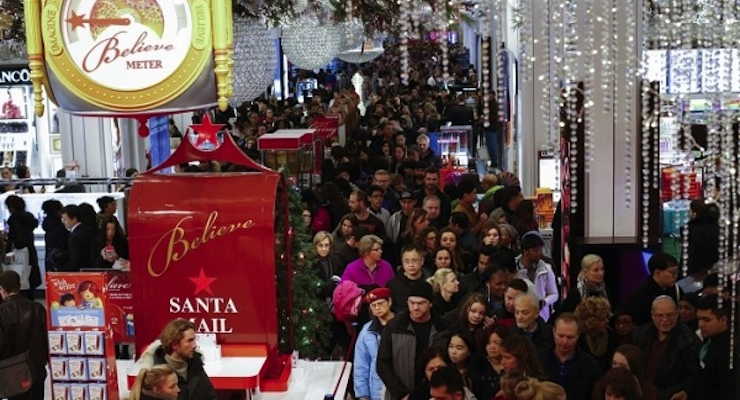
Black Friday shoppers at Macy’s in Herald Square (Photo : Getty Images/Kena Betancur )
First there was “Black Friday.” Then there was “Cyber Monday.” The holiday shopping markers plod through the calendar like a procession of Groundhog Days. The big difference is that Punxsutawney Phil the groundhog sometimes offers surprise. Will he see his shadow this year or bite his handler?
The latest retailing news predictably relates the change in consumers’ shopping habits — the move from bricks-and-mortar stores to online merchants. The convenience of online buying and an aversion to crowds are the usual explanations, and they no doubt play a part.
But there’s another reason for the change in shopping habits. It’s the change in selling habits. The mall-ification of America has made shopping a bore.
From 1970 to 2009, retail space in America grew by 54 percent. Almost all that new square footage went into malls populated by chain stores featuring the same layout, the same signage, the same merchandise made in the same low-wage countries. Once inside a chain outlet, shoppers can’t easily tell whether they’re in Columbus, Ohio, or Birmingham, Alabama.
Of course, many of us still go to malls. It’s not always easy to find socks or running shoes elsewhere. However, one no longer has to patronize Circuit City for electronics, which is why Circuit City is gone.
This is not a bah-humbug to shopping. I love shopping. This is a bah-humbug to sameness.
And though the convenience of online shopping is undeniable, the inconveniences can be understated. Will you be home when the package arrives? If the item turns out to be defective, whom do you call? Even if the cyber-merchant offers a liberal return policy, it’s still a pain to rewrap and lug the box to the post office or parcel service.
The item in the delivered box may turn out to be quite inferior to the consumer fantasy represented in pixels. And though this may be nobody’s fault, the red seen on the screen is often very different from the red reality.
My closets and shelves contain some items with which I would never have left a physical store. These were borderline disappointments — products I didn’t entirely adore but that were not so off base that they merited the hassle of a return.
Conventional malls do try to impart the holiday cheer of our lost Main Streets, still portrayed in Christmas movies as American dreamscapes. But installing some lonely chairs and cafe tables, overhead twinkles and the occasional restaurant where a human actually serves you usually isn’t enough to get the magic going.
So commercial real estate developers are trying to “reimagine” the mall experience. As The Wall Street Journal reports, a developer in York, Pennsylvania, has taken down a mall’s roof and made a plaza. Another in Fort Worth, Texas, is leaving some old oak trees at the center of a project, linking the grove to a walking trail along the Trinity River. Yet another in Cedar Rapids, Iowa, has taken down a mall building, built “streets” and incorporated a hotel and offices.
Many downtowns once given up for dead, meanwhile, are attracting small retailers selling more unusual and curated goods. And they’re hosting one of the most ancient and popular retailing phenomena ever — farmers markets.
As malls try to make themselves more resemble these downtowns, a common-sense question arises. Why don’t the stores just move back downtown? Well, those who frequent revived downtowns often complain that the chains already have.
But that’s what we call a high-class problem. Let the Banana Republic move next door to the quirky little shop selling hand-knit sweaters from Tibet. Together they’ll attract the shopping and reveling public — and better resist the online onslaught.
Customers at Walmart’s Black Friday shopping event on Thursday, Nov. 26, 2015 in Rogers, Ark. (Photo by Gunnar Rathbun/Invision for Walmart/AP Images)
People who want to buy Christmas gifts, without having to confront the crowds at the local shopping mall (or shopping maul) can take a load off their feet by buying books or movies on the Internet, while sitting in the comfort of their own homes.
In addition to old standbys like gorgeous coffee table books of Ansel Adams’ scenic photographs or the collected works of Shakespeare — or of “Calvin and Hobbes” comics — there are also many thought-provoking books on current events or on history.
People who already seem to have everything may not have DVDs of the latest movies or perhaps of some old movie classics like “Citizen Kane” or “The Hunt For Red October.”
Among the rare movies that children and adults can watch and enjoy together is the perennial favorite, “The Wizard of Oz.” Other good choices, however, would include “The Great Muppet Caper,” which I have watched a number of times and enjoyed each time.
For Sherlock Holmes fans, there is not only a large book titled “The Complete Sherlock Holmes” but also a boxed set of DVDs of many of the best Sherlock Holmes stories, starring Jeremy Brett as the best of a number of actors who have played the Holmes role over the years.
Among books on serious issues, some are great for people who are interested in a particular subject but have never read a good introduction to the issues involved. For young people, they may need to read something to counter the politically correct nonsense they have heard in their schools and colleges.
The recently published book “American Contempt for Liberty” by Walter E. Williams is an especially wide-ranging examination of current issues. This 417-page compilation of Professor Williams’ newspaper columns devastates innumerable politically correct beliefs, often providing not only new information but also some much-needed examples of rational thinking in general.
An older book that has been recommended here before, but will be recommended again because there is nothing else like it, is “Life at the Bottom,” by Theodore Dalrymple.
This is an insightful account of the dire consequences that the welfare state has led to among low-income whites in England. Many will recognize striking similarities to problems among low-income blacks in America — problems often blamed on “a legacy of slavery,” but which have followed in the wake of the welfare state in England, among whites with no legacy of slavery.
For those who would like a serious but very readable introduction to current issues among black Americans, there is none better than “Please Stop Helping Us” by Jason Riley.
Among my own books, “Basic Economics” remains the one read by the most people and translated into the most foreign languages. It presents economics without the graphs and equations, or the jargon, that make economics seem needlessly difficult to many people. “Basic Economics” was written with the idea that economics can be both informative and enjoyable.
My most recent book, published this past September, is “Wealth, Poverty and Politics.” It has received the kind of praise from reviewers that an author wants but seldom gets. Part of this may be due to the interest aroused by the subject matter itself and part to the book’s clarification of things that are too often presented in confused and misleading terms.
Much media hype about “the top ten percent” or “top one percent” of income earners collapses like a house of cards when you scrutinize the numbers and the words used to describe those numbers.
Over the course of a lifetime, for example, more than 60 percent of Americans are in households within the top ten percent of household incomes at one point or other. Politicians who want us to resent “the top ten percent” are encouraging most of us to resent ourselves.
Although that would not make sense, politicians are far less interested in making sense than in getting votes. Talk about the top ten percent or top one percent gets votes. And that is the politician’s bottom line.
For someone who likes to read about serious subjects but already has the kinds of books you might want to give as a gift, what no one has are future issues of outstanding publications on serious issues. A subscription to “City Journal” or “Hoover Digest” (or PPD) is a gift that would solve that problem.
[brid video=”21192″ player=”2077″ title=”Obama Paris Climate Change Conference An “Act Of Defiance” Against Terror”]
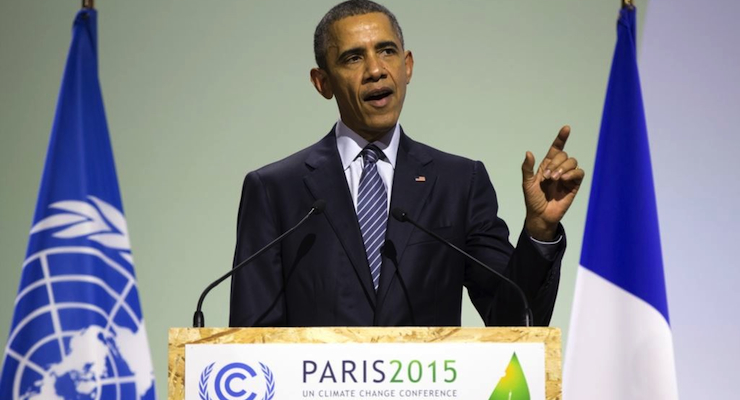
President Barack Obama said the Paris Climate Change Conference Monday in Paris was an “act of defiance” against terrorism carried out by the Islamic State in Europe and around the world.
Obama also echoed liberals of the past when he claimed the talks beginning on Monday at the Paris Climate Change Conference are the world’s last best chance to stop climate change.
“There is such a thing as being too late,” Obama said. “I come here personally as the leader of world’s biggest economy and second biggest emitter to say that America not only acknowledges its role in climate change but embraces doing something about it. One of the enemies we will be fighting at this conference is cynicism. The notion we can’t do anything about climate change.”
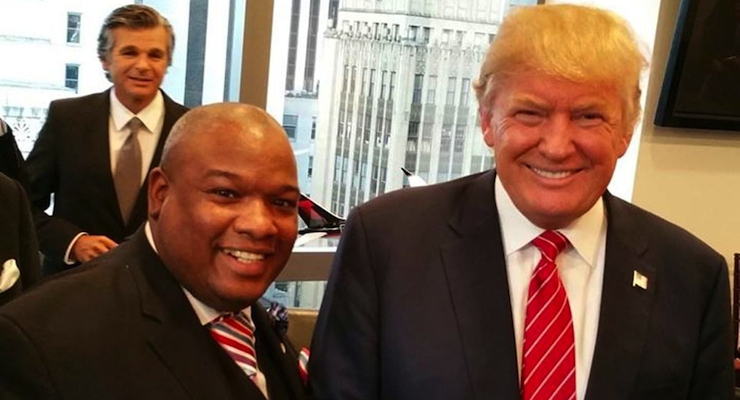
Pastor Mark Burns, co-founder of the NOW television network, left, with Republican presidential candidate Donald Trump, right, at Trump Tower. (Photo: Facebook via Pastor Mark Burns)
Pastor Mark Burns, co-founder of the NOW television network, said he was one of “many” black pastors to endorse Republican presidential candidate Donald Trump on Monday. The influential pastor made the announcement following a meeting with The Donald at Trump Tower in New York City, which was initially slated to be a big press event.
“This meeting was extremely successful,” the pastor said on MSNBC. “There was extremely strong support. He received many, many endorsements from the pastors that were there. It was a jam-packed room, standing support for Mr. Trump. Very good dialogue that we had back and forth and Donald Trump made it very clear that he’s willing to do whatever it takes to win the black vote.”
Trump has made a significant effort to reach out to minority voters that do not traditionally support GOP candidates, despite his highly controversial comments covered incessantly by mediates. In fact, Burns told MSNBC’s Kate Snow that another unnamed pastor interviewed by Thomas Roberts earlier made a claim about the meeting that was tantamount to a “fabrication.”
“I don’t know who you’re speaking about, but trust me, when I tell you, I’m not an Uncle Tom, no coon, nobody’s been paid. I have not been offered a position. This is me looking at the politics, and looking at an individual, a strong leader that i believe that’s going to bridge and bring a strength back to America,” Burns said.
“And in that room, there were pastors from all across the country, that were showing their support, many of them signed actual documents, endorsement cards, showing their support… this preposterous tone of offensive things that he said about Latinos in the meeting, it’s a fabrication.”
There are several reasons and none of them are good. But if you had to pick one cause for all the mess, it would be the fact that politicians have worked with interest groups and lobbyists to create myriad deductions, credits, exclusions, preferences, exemptions, and other loopholes.
This is a great deal for the lobbyists, who get big fees. It’s a great scam for politicians, who get lots of contributions. And it’s a great outcome for interest groups, who benefit from back-door industrial policy that distorts the economy.
But it’s not great for the American people or the American economy.
Writing for Reason, Veronique de Rugy of the Mercatus Center explains that the net result is a Byzantine tax code that imposes very harsh compliance costs on the productive sector.
According to a 2012 study from the Internal Revenue Service (IRS) and the Treasury Department, …corporations alone spent $104 billion complying with the tax code in 2012. …The cost to individuals may be even higher. According to a 2013 study by Jason Fichtner and Jacob Feldman of the Mercatus Center, Americans face nearly $1 trillion annually in hidden tax-compliance costs. …Why does tax compliance cost so much? The answer is largely that the Internal Revenue Code…is riddled with exclusions, exemptions, deductions, preferential rates, and credits.
And she also points to a solution.
Genuine reform would cut out loopholes that tilt the playing field in favor of those with political connections. It would also aim to provide lower tax rates, fewer tax brackets, and less double taxation of income that is saved and invested. Such measures would be good for growth, but they would also mean taking on the interest groups that benefit from swapping tax preferences for campaign cash.
Since I want to rip up the tax code and replace it with a simple and fair flat tax, this is music to my ears.
There’s the obvious political obstacle since all the groups that benefit from the current system (politicians, lobbyists, bureaucrats, cronyists, interest groups, and other insiders) will fiercely resist reform.
There’s also a policy obstacle because many people oppose loopholes in theory but they haven’t paid sufficient attention to the nuts-and-bolts details.
With that in mind, let’s set out a set of guiding principles for the elimination of tax loopholes and the creation of a neutral tax system.
1. A loophole exists when income isn’t taxed – In libertarian Nirvana, the central government is so small that there’s no need for an income tax. Until we get to that point, though, we’re stuck with the internal revenue code and the goal should be to collect revenue (hopefully a modest amount) in a way that minimizes the economic damage per dollar collected. And that means a tax code that doesn’t have loopholes, which are best defined as provisions that enable people to avoid any tax based on how they earn income or how they spend income. In a neutral system, all income is taxed one time.
2. The economy performs better without a loophole-riddled tax code– Most people understand that high tax rates are bad for growth because they penalize people for earning income. They also generally understand that double taxation of saving and investment is bad for growth because it creates a bias against capital formation. But there’s not nearly enough appreciation of the fact that loopholes in the code are bad for growth since they are a back-door form of industrial policy that exist for the purpose of incentivizing people to make decisions on the basis of tax rather than on the basis of what makes economic sense. A neutral tax system means less economic damage.
3. It’s not a loophole to protect income from double taxation or to require income to be measured correctly – The bad news is that the current system forces taxpayers to overstate their income and it also imposes multiple layers of tax on income that is saved and invested.The good news is that there are provisions in the tax code – such as IRAs, 401(k)s, deferral, bonus depreciation – that seek to mitigate these biases. These parts of the system oftentimes are needlessly complex and they frequently will alleviate penalties in a discriminatory manner, but they are not loopholes. In a neutral system, all income is taxed only one time.
4. Loopholes should be eliminated as part of a plan to lower tax rates, not in order to give politicians more money – If loopholes are a corrupt and distorting dark cloud, the silver lining to that cloud is that all the special favors in the tax code deprive the government of tax revenue. Even the most egregious of loopholes, such as ethanol, have this redeeming feature. This is why loopholes should only be eliminated as part of an overall tax reform plan that also lowers tax rates and reduces double taxation. A neutral tax system shouldn’t enable bigger government.
There are some important implications that follow from these four guiding principles.
As a practical matter, we can now identify provisions in the tax code that are clearly loopholes, such as thehealthcare exclusion, the municipal bond exemption, and thestate and local tax deduction (the mortgage interest deduction is misguided, but isn’t technically a loophole since one of the goals of tax reform is to give business investment the same tax-income-only-one-time treatment now reserved for residential real estate).
We also know that the capital gains tax rate isn’t a “preferential” loophole, but instead is the mitigation of a penalty that shouldn’t exist. Similarly, it’s not a loophole when companies deduct expenses when calculating income. And you’re not getting some sort of handout simply because Uncle Sam isn’t imposing double taxation on your retirement account. At the risk of repeating myself, all income should be taxed in a neutral system, but only one time.
Let’s close by looking at a few secondary – but still important – implications of a neutral tax code.
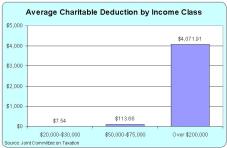
First, getting rid of loopholes won’t put a burden on poor and middle-income taxpayers for the simple reason that an overwhelming share of the benefits of these provisions go to high-income taxpayers.
The same is true for the state and local tax deduction and the healthcare exclusion.
And the Washington Post just editorialized that the home mortgage interest deduction is a boon for rich taxpayers as well.
The mortgage interest deduction is also a significant cause of after-tax income inequality: The top 20 percent of earners get 75 percent of the benefits; the top 1 percent get 15 percent, according tothe Congressional Budget Office. …Specifically, 10 metropolitan “hot spot” counties (among them Los Angeles in California and Fairfax in Virginia) with the greatest number of mortgages larger than $500,000 accounted for 45.1 percent of all such mortgages nationally. Just eight California urban and suburban counties accounted for 40 percent of the national total. Outside of such tony coastal precincts, the only big-mortgage hot spots were resort destinations such as Martha’s Vineyard, Mass., and Vail, Colo. — where many homes are vacation places, not primary residences.
To be sure, the Post is misguided in that it wants to restrict tax preferences in order to finance a larger burden of government spending.
So I’m not expecting the editors to join a coalition for pro-growth tax reform.
To cite one example, consider the oleaginous way that politicians deal with so-called tax extenders. Marc Short and Andy Koenig explain in a column they wrote for the New York Times.
Congress will soon take up the so-called tax extenders package, which has more than 50 tax breaks affecting a variety of industries and issues. …this bill mostly helps the wealthy and the well connected.
The fact that rich insiders benefit is no surprise, but what makes “tax extenders” so odious is that what began in 1988 as a supposedly one-time fix now has become a regular part of the process, a scam that gives lobbyists and politicians a way of generating fees and contributions.
The first tax-extender package…opened a door that lobbyists and lawmakers were all too willing to run through. …A 2014 analysis by Americans for Tax Fairness found that more than one out of every 10 lobbyists in Washington focused specifically on the extenders package. Given that this bill comes up about every year or two, special interests constantly have the opportunity to demand new handouts.
By the way, some of the extenders actually are good policy. They’re in the mitigation-of-penalties category I discussed above.
But those good provisions should be made permanent and the bad provisions should be jettisoned.
Unfortunately, that’s not in the interests of the politicians and lobbyists who benefit from an annual extender package, so the problem doubtlessly will fester.
Last but not least, let’s consider the moral component.
For those of us who believe in justice, it is ethically offensive that some rich and powerful taxpayer get better treatment simply because they know how to manipulate the political process.
This violates the important principle that the law should treat everyone alike. Yet another reason to have a simple and fair flat tax.
P.S. At the risk of being a nit-picker about my own writing, I should confess that a flat tax is not a purely neutral tax system. There will still be a penalty on earning income. But the penalty presumably will be modest if there is a low rate and that penalty won’t be exacerbated by penalties and loopholes that distort how people earn income and spend income.
P.P.S. Here, in one image, is all you really need to know about the economics of taxation.
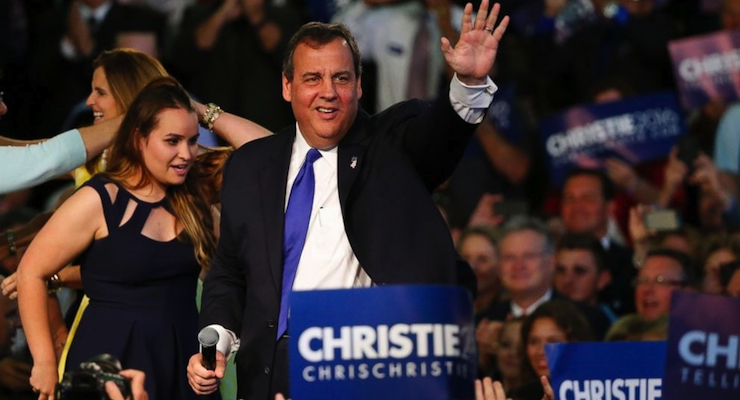
Chris Christie arrives to speak to supporters during an event announcing he will seek the Republican nomination for president, June 30, 2015, at Livingston High School in Livingston, New Jersey. (Photo: AP/Julio Cortez)
New Jersey Gov. Chris Christie just won the most important editorial thumbs-up in the Granite State, adding to an already impressive list of endorsements across-the-political spectrum.
“Thanksgiving is just past. Christmas is ahead. We doubt that too many people across New Hampshire have politics front and center right now,” The New Hampshire Union Leader wrote in an admission to the historically earliness of their endorsement. “But in just 10 weeks, New Hampshire will make a choice that will profoundly affect our country and the world. We better get it right.”
“Our choice is Gov. Chris Christie.”
No less than four of the Republican presidential hopefuls in 2016 have pegged their campaigns on the first in the nation primary state, including former Florida Gov. Jeb Bush, Ohio Gov. John Kasich, Florida Sen. Marco Rubio and Christie. But the paper made clear at least one of those is just too risky of a pick considering the seriousness of the times.
“We don’t need another fast-talking, well-meaning freshman U.S. senator trying to run the government,” the paper wrote in a not-so thinly veiled hit at Rubio. “We are still seeing the disastrous effects of the last such choice.”
Bush and others have tried to peg Rubio as the Republican version of Obama, all show and no experience. However, as Bush engaged in tit-for-tat back-and-forths with his former Floridian friend, Christie was beating the pavement in New Hampshire. The New Jersey governor has by far spent the most time in the state out of all the candidates, earning him endorsements from conservative activists and moderate business leaders alike.
“There is no doubt in my mind that Chris Christie is exactly the conservative leader that our nation needs in these dark and dangerous times,” said Chidester, a conservative activist, former Dover community police officer and a U.S. Army Veteran. “Governor Christie’s conservative record of reform in New Jersey, combined with his detailed plans to improve America’s financial and national security make him the best qualified candidate for President of the United States. After years of weakness in the Oval Office, it will take a strong, tough leader like Governor Christie to ensure that America is safe and secure from threats at home and abroad.”
Influential New Hampshire business leaders and moderate Republican activists Dan and Renee Plummer endorsed Christie this week after meeting nearly every Republican candidate. The Plummers called Christie the most tested and best prepared in these challenging times.
“Our country is at a tipping point: ISIS threatens America’s security, drug use tears apart our families, and our veterans do not receive the care they have been promised in return for their service. After personally meeting with nearly every Republican candidate for President, we firmly believe that Chris Christie is the best equipped to face these challenges, and we proudly endorse him for President.” The Plummers added, “Governor Christie has the strength to stand up for American interests and the compassion to believe in the potential of the American people. The times are too challenging to take a chance on inexperience – and no candidate is more tested and ready than Chris Christie.”
[brid video=”21151″ player=”2077″ title=”Putin “A Number of Countries” Are “Behaving As Accomplices” to Terrorists”]
Russian President Vladimir Putin lays the blame for the situation in Syria at those “directly behaving as accomplices to” ISIS, which he said were “a number of countries” whose “passive stance” led “to the emergence of this terrible phenomenon.”
“We believe that any attempts at white-washing terrorists, at condoning them have to be perceived as behaving like an accomplice to terrorism and an accomplice to criminality,” Putin said on Russian television Sunday.
TRANSCRIPT
Let us remind you that it is precisely the passive stance of a number of countries that often and directly behaving as accomplices to terrorists which led to the emergence of this terrible phenomenon, the so-called Islamic state… Terrorists with their illicit trade in oil, in human beings,drugs, cultural artifacts and arms have enjoyed such protection, and some even make money out of that and sometimes even hundreds of millions of dollars.
One would hope that after the terrorist attack against our plane in Egypt, after the tragic terrorist attack in France, the atrocious mass killing in Lebanon, Nigeria, Mali, the world community should finally come to the understanding of the need to pull together in the fight against terror.
[brid video=”21149″ player=”2077″ title=”Fiorina “Typical Leftwing Tactic” to Blame Me for Planned Parenthood Shooting”]
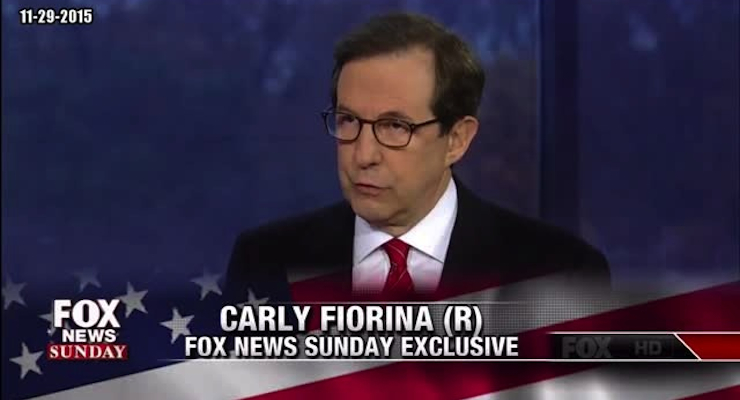
Carly Fiorina, the former Hewlitt-Packard CEO and presidential candidate, fired back at Planned Parenthood while speaking with Chris Wallace on Fox News Sunday regarding claims that language “like hers” has incited violence against the organization.
A man shot three people outside a Planned Parenthood clinic in Colorado Springs on Friday. The Colorado Springs Police Department confirmed Saturday the suspect is 57-year-old Robert L. Dear, but offered no motive to the crime. However, there are unconfirmed reports he said “no more baby body parts” during the attack, though friends and family say he never spoke about religion or against abortion prior.
You have %%pigeonMeterAvailable%% free %%pigeonCopyPage%% remaining this month. Get unlimited access and support reader-funded, independent data journalism.