Widget Image
Follow PPD Social Media
Friday, January 16, 2026
HomeStandard Blog Whole Post (Page 934)

robin williams dead

Academy Award-winning actor and comedian Robin Williams dead at age 63. Marin County Sheriff’s Office said Monday Williams died of a suspected suicide.

Academy Award-winning actor and comedian Robin Williams died Monday in a suspected suicide, the Marin County Sheriff’s Office said. He was 63.

“Robin Williams past away this morning. He had been battling severe depression as of late. This is a tragic loss, and the family respectfully asks for privacy as they grieve in this difficult time,” a Williams family statement read.

Robin Williams won an Academy Award for his role in “Good Will Hunting,” and starred in other blockbusters, such as “Good Morning, Vietnam” and “Bird Cage.”

UPDATE: Unfortunate details of actor Robin Williams death came to light at a press conference Tuesday afternoon.

Williams hung himself with a belt and apparently cut his left wrist with a pocket knife in his San Francisco area home before being discovered dead by his personal assistant on Monday, said assistant chief deputy coroner Lt. Keith Boyd.

“Mr. Williams’ personal assistant was able to gain access to Mr. Williams’ bedroom and entered the bedroom to find Mr. Williams clothed in a seated position, unresponsive, with a belt secured around his neck with the other end of the [belt] wedged between the… closet door and the door frame,” he said. “His right shoulder area was touching the door with his body perpendicular to the door and slightly suspended.”

Academy Award-winning actor and comedian Robin Williams

Israeli citizens overwhelmingly support Prime Minister Benjamin Netanyahu’s handling of the current Middle East crisis, as previously reported. He may not be Mr. popular with U.N. Secretary-General Ban Ki-moon & Co., but his people view Prime Minister Netanyahu as a rock star, and there is broad agreement over the actions taken by Israel against Hamas.

But, with the obvious rise of anti-Semitism on the American Left, and from within the Democratic Party, how have Americans’ views of their closest ally in the region changed over the past decade or more.

Similar to more than a decade ago, Americans still view Israel’s actions against Hamas as justified, says Gallup Editor-in-Chief Frank Newport. Religiosity, unsurprisingly, plays a significant role in determining Americans’ views for or against Israel over Palestine, or visa versa.

Religious Americans are significantly more likely than less religious Americans to be sympathetic to the Israelis. Throughout the past 14 years, an average of 66 percent of Americans who attend church weekly or almost every week are sympathetic to the Israelis, compared with 13 percent who are sympathetic to the Palestinians.

Though religious American clearly support Israel in greater numbers, even if American wasn’t a predominantly Christian nation sympathies for Palestine still wouldn’t be the majority position. Sympathy for Israel drops to 46 percent among those who never attend church, but are still twice as many as the 23 percent who are sympathetic to the Palestinians.

These results are from an aggregated sample of more than 14,000 adults interviewed each February from 2001 to 2014 as part of Gallup’s Foreign Affairs survey, and asked in survey: “In the Middle East situation, are your sympathies more with the Israelis or more with the Palestinians?”

Video: Similar to more than a decade

Abercrombie defeated by Ige

Incumbent Democrat Gov. Neil Abercrombie was handily defeated by state Sen. David Ige by over 35 points in Saturday’s Hawaii gubernatorial primary. Ige will go on to face former Lt. Gov. Duke Aiona, a Republican, who was leading both Democratic challengers in the race prior to the primary.

Abercrombie is the first Hawaii governor to lose to a primary challenger and only the second not to win re-election. Abercrombie’s decision to appoint U.S. Sen. Brian Schatz to the U.S. Senate seat after the death of beloved Hawaii political icon U.S. Sen. Daniel Inouye, who died in 2012, infuriated Hawaii voters. Before he died, Inouye told Abercrombie that he wanted him to appoint Hanabusa to his seat.

Polling in Hawaii, as is the case with another state outside of the continental U.S., is notoriously difficult to poll. However, Aiona has consistently polled strong since February of this year and, and whether the race would tighten hinge upon the outcome of the Democratic primary.

PPD rates the Hawaii governor race a “Toss-Up,” despite Aiona’s relatively comfortable lead. The state’s political leanings are overwhelmingly Democratic, and the party did themselves a favor nominating Ige.

“Now that Ige has defeated Abercrombie the Democrats have a far better chance at catching Aiona,” said PPD’s senior political analyst, Richard D. Baris. “However, Aiona is a well-liked politician in Hawaii and a strong candidate. Both sides admit he is ahead and Democrats have reason to worry that Abercrombie’s toxicity will linger.”

As of now, only one of President Obama’s endorsed candidates have only one remaining chance at victory.

The contest between incumbent Democratic incumbent U.S. Sen. Brian Schatz and U.S. Rep. Colleen Hanabusa remains too close to call. However, Schatz, who was endorsed by the president, is holding on to a small lead over Hanabusa, 49.7 to 48.2 percent.

Regardless, the Hawaii Senate race is rated “Safe Democrat” by PPD’s 2014 Senate Map Predictions model.

Incumbent Democratic Gov. Neil Abercrombie is the


In Obama’s weekly address, the president detailed why he authorized two operations in Iraq and attempted to prepare Americans for a long-term operation.  The president ordered targeted military strikes aimed at protecting Americans serving in Iraq, as well as humanitarian airdrops of food and water to help nearly 40,000 Iraqi civilians trapped on on Sinjar Mountain by ISIS terrorists.

Also, President Obama stressed that the United States will not be dragged into another war in Iraq and that American combat troops will not return, because he feels there is no American military solution to the larger crisis in Iraq.

Pentagon spokesman Rear Adm. John Kirby, said the U.S. launched the latest airstrikes to help defend the city of Irbil, where U.S. personnel are “assisting the government of Iraq,” and that U.S. military officials characterize the airstrikes as successful. However, PPD previously reported that — despite two U.S. airstrikes Friday aimed at mortar positions and a seven-vehicle convoy — the ISIS army in Iraq continues to advance on the Kurdish capital of Irbil.

The Islamic militant group’s goal is to establish control over the route that connects already-seized towns along the Kurdish-control territory, the most recent of which being Sheikhan.

Hundreds of women from the Yazidi religious minority have been kidnapped by the Sunni militants, who plan to sell them into the sex trade and forced marriage and conversion to Islam. Kamil Amin, the spokesman for Iraq’s Human Rights Ministry, said hundreds of Yazidi women below the age of 35 are being held in schools in Iraq’s second largest city, Mosul. He said the ministry learned of the captives from their families.

“We think that the terrorists by now consider them slaves and they have vicious plans for them,” Amin told The Associated Press. “We think that these women are going to be used in demeaning ways by those terrorists to satisfy their animalistic urges in a way that contradicts all the human and Islamic values.”

All airstrikes have been launched from the USS George HW Bush in the Persian Gulf, except a drone that took off from an undisclosed land base.

In Obama's Weekly Address, the president detailed

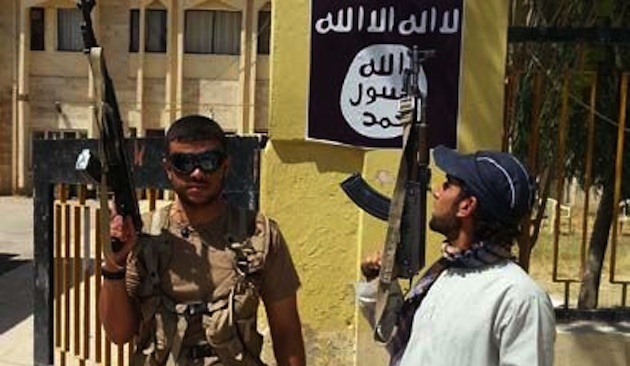
ISIS militants

In this image, ISIS militants pose for a propaganda video. (Photo: REUTERS)

Despite two U.S. airstrikes Friday aimed at mortar positions and a seven-vehicle convoy, the ISIS army in Iraq continues to advance on the Kurdish capital of Erbil. The Islamic militant group’s goal is to establish control over the route that connects already-seized towns along the Kurdish-control territory, the most recent of which being Sheikhan.

While President Obama authorized the use of force to protect U.S. personnel and Iraqi religious minorities facing a possible “genocide,” and to halt the advance into Erbil, the narrow operation that strikes at “targets of opportunity” isn’t effective enough.

In comments made Saturday from Martha’s Vineyard, President Obama told reporters and the American people that the Iraqi operation could go on for an extended period of time.

“I don’t think we’re going to solve this problem in weeks,” Mr. Obama said. “This is going to be a long-term project.”

Pentagon spokesman Rear Adm. John Kirby, said the U.S. launched the latest airstrikes to help defend the city of Erbil, where U.S. personnel are “assisting the government of Iraq,” and that U.S. military officials characterize the airstrikes as successful. All airstrikes have been launched from the USS George HW Bush in the Persian Gulf, except a drone that took off from an undisclosed land base.

A Defense Department official speaking in regards to the drone strike, which was carried out with hellfire missiles, told The New York Times, “you know that vehicle and the people in it don’t exist anymore.”

The airstrikes mark a small yet significant pivot in Obama’s foreign policy toward Iraq since what appears to have been a premature troop withdrawal back in late 2011.

Hundreds of women from the Yazidi religious minority have been kidnapped by the Sunni militants, who plan to sell them into the sex trade and forced marriage and conversion to Islam. Kamil Amin, the spokesman for Iraq’s Human Rights Ministry, said hundreds of Yazidi women below the age of 35 are being held in schools in Iraq’s second largest city, Mosul. He said the ministry learned of the captives from their families.

“We think that the terrorists by now consider them slaves and they have vicious plans for them,” Amin told The Associated Press. “We think that these women are going to be used in demeaning ways by those terrorists to satisfy their animalistic urges in a way that contradicts all the human and Islamic values.”

Obama announced that he was contemplating airstrikes to protect U.S. interests in the region and also after news that approximately 40,000 religious minorities were surrounded on Sinjar Mountain, stranded without food or water. If they descended down the mountain, they would be shot.

A model C-130 and a C-17 cargo dropped 72 bundles of supplies for the refugees, including more than 28,000 meals and more than 1,500 gallons of water. Humanitarian missions have been conducted jointely with the airstrikes, which were met with a response from the militant group.

A message by the leader of ISIS surfaced on Twitter, which recycled a YouTube video that was originally posted in June.

“You should know, you defender of the cross, that getting others to fight on your behalf will not do for you in Syria as it will not do for you in Iraq,” wrote the ISIS leader, Abu Bakr al-Baghdadi. “And soon enough, you will be in direct confrontation — forced to do so, God willing. And the sons of Islam have prepared themselves for this day. So wait, and we will be waiting, too.”

Despite two U.S. airstrikes Friday aimed at

Mideast - US airstrikes on Iraq

This image made from AP video shows smoke rising from airstrikes targeting Islamic State militants near the Khazer checkpoint outside of the city of Irbil in northern Iraq, Friday, Aug. 8, 2014. The Iraqi Air Force has been carrying out strikes against the militants, and for the first time on Friday, U.S. war planes have directly targeted the extremist Islamic State group, which controls large areas of Syria and Iraq.(AP Photo via AP video)

President Obama gave the order for U.S. fighter jets to launch a “targeted” airstrike Friday against Islamic militants in Iraq, and the second wave has just hit. The strikes came only hours after President Obama authorized military action “to protect U.S. personnel and Iraqi civilians.”

Further, hundreds of women from the Yazidi religious minority have been taken captive by the Islamic State (IS), the group formerly known as ISIS, as groups of Iraqi Christian and Yazidi minorities starve on a mountain side outside the city of Sinjar, which was surrounded by terrorists waiting to shoot them as they make their dissent.

The strikes also came after the U.S. conducted humanitarian drops to the Iraqi people on the mountain.

Pentagon press secretary Rear Adm. John Kirby said Friday that two F/A-18 jets dropped 500-pound bombs on a piece of artillery and the truck towing it. The Pentagon said the military conducted the strike at 6:45 a.m. ET.

“As the president made clear, the United States military will continue to take direct action against [IS] when they threaten our personnel and facilities,” Kirby said.

According to Pentagon officials, the strike took place near the city of Irbil, after the Islamic State used the artillery to shell Kurdish forces defending the city where U.S. personnel are stationed.

Though the president has been deeply opposed to combat operations in Iraq, including the use of U.S. air power, faced with a potential genocide he said America has an obligation to help. However, Obama stressed that combat troops will not be returning to Iraq.

“When we have the unique capabilities to help avert a massacre, then I believe the United States of America cannot turn a blind eye,” Obama said. “We can act, carefully and responsibly, to prevent a potential act of genocide.”

The airstrikes Friday originated from the USS George H.W. Bush conducting combat patrols in the Persian Gulf.

One senior military official said the latest strike and those that follow are “targets of opportunity,” and that more humanitarian aid drops are on the horizon. After militants were seen firing artillery indiscriminately toward Irbil, U.S. military operators made the decision to strike back.

Even though the military action earned bipartisan support from members of Congress, many continue to urge the administration to put together a more comprehensive strategy with clear goals. Critics say the president waited too long and has outlined too few goal oriented details.

“The president is right to provide humanitarian relief to the Iraqi civilians stranded on Mount Sinjar and to authorize military strikes against ISIS forces that are threatening them, our Kurdish allies, and our own personnel in northern Iraq,” Republican Sens. John McCain of Arizona and Lindsey Graham of South Carolina said in a statement. “However, these actions are far from sufficient to meet the growing threat that ISIS poses. We need a strategic approach, not just a humanitarian one.”

House Speaker John Boehner said the president needed to outline a “long-term strategy,” while Rep. Frank Wolf (R-VA), who has been among the most outspoken lawmakers regarding the plight of religious minorities in Iraq, called the developments a “positive first step,” but said they “can’t be the only steps.”

During Friday’s press conference, White House Press Secretary Josh Earnest said Friday there was no “specific end-date” to the airstrikes, but also stated “what is not contemplated here is the introduction of American troops in a combat role to alleviate this situation.”

For now, the president gave just two justifications for U.S. airstrikes. First, he has authorized strikes “if necessary” to aid the Iraqi operation to end the siege of the civilians on the mountain, and protect the people trapped there. Second, the president said he’s ordered the military to take “targeted strikes” against IS terrorists if their forces make movements toward the city of Irbil, where the U.S. has a consulate and U.S. military advisors are currently training Iraqi forces.

“We intend to stay vigilant and take action if these terrorist forces threaten our personnel or facilities anywhere in Iraq,” Obama said.

According to the U.N., between 35,000 and 50,000 fled to nearby Mount Sinjar and other areas, and for the last several days they have been without adequate food and water.

“They’re without food, they’re without water. People are starving, and children are dying of thirst,” Obama said. He said they face a “horrible choice”: descend the mountain face certain slaughter by IS militants, or stay and “slowly die of thirst and hunger.”

The humanitarian aid drop delivered Thursday involved C-130 and C-17 cargo aircraft, which were escorted by F-18 fighters. Pentagon officials said they dropped 72 bundles of supplies, including thousands of gallons of water.

The crisis in Iraq has escalated sharply in recent days, including the seizure Thursday of the country’s largest Christian city, Qaraqoush. The militants told its residents to leave, convert or die, which sent tens of thousands of civilians and Kurdish fighters fleeing from the area.

President Obama gave the order for U.S.

republican incumbent senators

Every single Republican incumbent senator seeking re-election in 2014 won their nomination. It’s the first time since 2008. (Photo: AP)

Incumbent Tennessee Sen. Lamar Alexander defeated state Rep. Joe Carr on Thursday, marking a Republican incumbent sweep in 2014 Senate primary races. In fact, it was the first time since 2008 that every single incumbent Republican senator seeking re-election won their nomination.

With the exception of Mississippi Sen. Thad Cochran, a race we initially rated a “Toss-Up” going into the first primary, PPD’s 2014 Senate Map Predictions model favored each and every one of them. Sen. Cochran still has woes in the form of conservative challenger Chris McDaniel, who narrowly defeated Cochran before losing the runoff election thanks to dubious, and likely fraudulent votes from liberal black voters.

So, how did this happen, particularly at a time when American voters consistently tell pollsters they want new blood in Washington?

Every second year political science student knows that incumbency wins. While Americans say they want to “throw the bums” out, the “bums” more often than not do not include their own representative or senator. Still, in 2014 there seemed to be a stronger-than-usual anti-incumbent sentiment, particularly among Republican and Republican-leaning independent voters. In fact, the historically low favorability numbers for the party are due in large part from the number of conservative voters who say they have an unfavorable opinion of the GOP.

From the beginning, the Republican Establishment knew their guys would have trouble on their right flanks, and they fought back.

“I think we are going to crush them everywhere,” the Minority Leader Mitch McConnell told The New York Times at the onset of the cycle. “I don’t think they are going to have a single nominee anywhere in the country.”

McConnell was both right and wrong.

While “they” don’t have a nominee this cycle, nowhere did a Republican incumbent senator “crush” their challenger, let alone “everywhere.” With the exception of McConnell’s own race, where challenger Matt Bevin imploded and was damaged by a cock-fighting story, Republican incumbents were very beatable.

Kansas Sen. Pat Roberts won by a less than impressive seven-point margin on Tuesday against physician Milton Wolfe. In Texas, Sen. John Cornyn couldn’t even break 60 percent in a deeply conservative state that once viewed him as the most conservative senator in the country. Neither could South Carolina Sen. Lindsey Graham, a powerful leader in the aggressive foreign policy wing of the party. And, last but not least, we have demonstrated it is a fact that Republican voters alone preferred McDaniel over Thad Cochran.

As unimpressive as all of this may seem, they will be heading back to Washington, while the conservative challengers are, well, losers.

And here’s why.

Nearly 40 percent of the state voted against Sen. John Cornyn, who faced seven other primary challengers. Graham had six challengers, who together garnered nearly 44 percent of the vote. Senator Roberts, who had the second worst showing, had more than half — 52 percent — vote against him, but the vote split between Wolfe and two other challengers. By raw vote totals, Roberts actually performed worse than Cochran, but considering Cochran’s tactics, it is fair to say he performed the worst.

It shouldn’t at all surprise observers that in the one race that the anti-incumbent forces coalesced around a single, viable candidate, they came the closest to defeated a sitting senator. “Tea Party” groups, for lack of a better term, have two challenges they have yet to address and, until they do, they will continue to lose primaries.

First, which is the point I am making above, is their inability to coalesce behind a single candidate. It is inherently fatal to the art of political messaging to have so many alternatives to the target you are attempting to draw a contrast with. It muddles the message that must be honed and delivered to voters with precision coherence.

Second, it is time for the Tea Party to somewhat disband and rebrand. I am going to make the argument no one has the courage to make, which is as follows:

The Tea Party, fair or unfair — and, just for the record I personally think it is unfair — has lost its usefulness because national Tea Party groups have lost their credibility with the American public. If you think the Republican Party is suffering from low favorability numbers, just look at the voters’ views of the Tea Party. There are more Republican and Republican-leaning voters who have an unfavorable view of the Tea Party, than there are conservative and Tea Party supporters who have an unfavorable view of the Republican Party.

Now, it’s unquestionably true that the media has demonized the Tea Party, characterizing them in a grossly unfair light that paints their views as extreme. It is also true that — when pollsters focus only on the issues — more voters will identify with the positions held by the Tea Party than with the truly extreme position held by members of the Democratic Party. But none of that matters, because the Tea Party “movement” has evolved into national Tea Party organizations and, as a consequence, the face of the movement has evolved from town hall-meeting activists to national organizations that now have their own establishment.

But, most importantly, because of their deep unpopularity, they are no longer effective at combating attacks from either the Democratic Party or the GOP Establishment, if in fact they ever were. It was the local, community-based Tea Party groups, which the national groups often ignore, that generated all of the excitement and support for the movement and its candidates. In Oklahoma, national Tea Party groups got behind state Rep. T.W. Shannon, while outraged local Tea Party groups supported Rep. James Lankford. It became an Establishment Tea Party versus local Tea Party battle.

The national Establishment Tea Party lost, badly.

Still think I am wrong.

The only noteworthy incumbent to go down in defeat this cycle came from the House, not from the Senate where national Tea Party groups chose to spend the bulk of their money this cycle. Eric Cantor’s stunning defeat at the hands of Dave Brat offered the consulting class many lessons, but activists missed the most significant lesson of all.

Even though Brat himself acknowledged his strong grassroots support, there wasn’t a single nationwide Tea Party group backing Dave Brat. Laura Ingraham, a conservative talk radio host who backed Brat early on in the contest, openly criticized Jenny Beth Martin, the co-founder and national coordinator for the Tea Party Patriots, for not even bothering to return Brat’s phone calls during the campaign. Judson Phillips, of Tea Party Nation, wrote an op-ed in the Washington Times back in March, in which she argued for widespread Tea Party support in the race.

Fortunately for Brat and the citizens living in the 7th Congressional District, it never came, which prevented the Republican Establishment and Debbie Wasserman-Shultz from being able to paint Brat as the typical “extremist Tea Party” candidate.

The data and the election results are clear. If the Tea Party, which is still a powerful force in Republican politics, wants to offer the party a positive contribution, then they will take both of my points of argument as mana from Heaven. They need to step back, rebrand, and take more of a back seat to the local Tea Party groups. They must support the people the local groups have chosen to represent their communities, or even broker the selection process, rather than fracturing the anti-incumbent vote with their own hand-picked candidates.

Or, they could be stubborn and stay the course, and they will continue to lose both at the primary ballot box and in the battle for public opinion.

For the first time since 2008, every

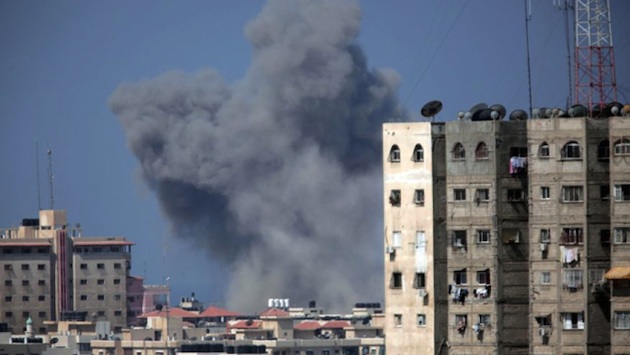
Israel attacks Hamas

Aug 8, 2014: Smoke rises over Gaza City after an Israeli strike as Israel and Gaza militants resumed cross-border attacks after a three-day truce expired and Egyptian-brokered talks on a new border deal for blockaded Gaza hit a deadlock. (Photo: AP)

Hamas militants in Gaza fired a barrage of rockets at southern Israel immediately after the three-day cease-fire between Israel and Hamas ended. Israeli military officials said it responded with strikes “across Gaza.”

At least one of the rockets fired from Gaza was successfully intercepted by the Iron Dome system over the southern Israeli city of Ashkelon while two rockets fell in open areas without causing casualties or damage. In under, 15 seconds, the computer determines whether the rocket will land in a populated area, or fall into an open area.

Israel and Hamas have been engaged in indirect negotiations in Cairo on new border arrangements for the blockaded coastal territory. Israel said it was willing to consider easing border restrictions, but demanded that Hamas disarmed. Israel offered to extend the cease-fire for another 72 hours while negotiations were taking place, but Hamas refused. The talks began during the three-day truce that ended at 8 a.m. local time on Friday.

Now, following the rocket attacks into, Israeli government spokesman Mark Regev would not say whether Israel is still interested in extending the cease-fire.

Regev blamed Gaza militants for breaking the cease-fire. “The cease-fire is over,” Regev said. “They did that.”

In fact, even before the end of the cease-fire, the Israeli military said that the militants had fired two rockets at Israel. Despite Hamas violating the cease-fire, the Israeli military did not respond. Hamas has violated every single cease-fire since the conflict began,

Meanwhile, in Cairo, Hamas has said it will not consider Israel’s demand that it disarm, and Israeli officials say they will not lift the blockade without a demilitarization of Gaza.

The blockade has been enforced by Israel and Egypt to varying degrees since Hamas seized Gaza by force in 2007. Egypt was forced to tighten the blockade due to Hamas ties to the Muslim Brotherhood, another terror organization that has attempted to subvert the military government that removed them from power last year.

The conflict was sparked after the kidnapping and subsequent killing of three Israeli teens, who were found in shallow graves in the West Bank in June. Israel began arresting hundreds of the group’s members in the West Bank, but Hamas and other militants began firing rockets from Gaza into Israel.

Hamas militants in Gaza fired a barrage

Montana John Walsh

Incumbent Democratic Senator John Walsh of Montana plagiarized his thesis to obtain his master’s degree from the United States Army War College. (Photo: NYT)

Democrat Sen. John Walsh threw in the towel after reports that he plagiarized several notable works in his thesis at the Army War College. Walsh initially blamed PTSD for his actions, and also scapegoated the suicidal death of a member of his unit.

“I am ending my campaign so that I can focus on fulfilling the responsibility entrusted to me as your U.S. senator,” Walsh said in a statement to supporters. “You deserve someone who will always fight for Montana, and I will.”

The Montana Democratic Party now will choose a replacement for Walsh at a nominating convention August 20, who will then go on to face Republican Rep. Steve Daines, who was always favored in the race, and Libertarian Roger Roots. Former Montana Gov. Brian Schweitzer, a popular Democrat who may have made the seat competitive, said Thursday that he would not make a bid for the U.S. Senate seat.

“I am proud that with your support, we held our opponent (Daines) accountable for his hurtful record to privatize Medicare, to deny women the freedom to make their own health decisions and to sell off our public lands,” Walsh said in the statement. “I know how important it is to continue the fight for these Montana values, and it is time for us all to return to the real issues of this election.”

Walsh, 53, was named as the state’s adjutant general by then-Gov. Brian Schweitzer in 2008, and the distinguished degree from the Army War College had been cited as a consideration that pushed the decision to choose Walsh over the edge.

The “strategic research paper,” which is what the Army War College calls the thesis required to earn a Master’s Degree, was passed off as his own when it was completed in 2007 and includes other academic papers, policy journal entries and well-known books. Walsh’s 14-page paper, titled “The Case for Democracy as a Long Term National Strategy,” argues for the basic tenets found in the democratic peace theory, except he plagiarized the work of other scholars at the Belfer Center for Science and International Affairs, a research institute at Harvard, as well as from a Carnegie Endowment for International Peace document.

In 2012, Steve Bullock chose Walsh as his running mate for lieutenant governor, and he resigned as adjutant general. The Bullock-Walsh ticket barely won the election. He was appointed by Gov. Steve Bullock in February to serve out the remainder of retiring Sen. Max Baucus’ term, which Democrats hoped would boost their chances of keeping the Red state’s Senate seat.

However, there is no historical evidence to support that claim or strategy, and the seat is now rated “Safe Republican” on PPD’s 2014 Senate Map Predictions.

“Even though historical election data show there is zero evidence to support the Democratic claim that appointed incumbency would give Walsh the edge, we viewed him a formidable candidate,” said PPD’s Senior Political Analyst, Richard D. Baris, after the story broke.

“However, we see this clear case of plagiarism as a campaign-ender.”

Apparently, Baris was right.

Democrat Sen. John Walsh threw in the

In his victory speech Tuesday night, libertarian-leaning Republican Rep. Justin Amash, slammed the Chamber of Commerce lobbyist who ran what was called “the nastiest in the country.”

“You are a disgrace,” Rep. Amash said to former congressman Pete Hoekstra. “And I’m glad we could hand you one more loss before you fade into total obscurity and irrelevance.”

Hoekstra, who backed Chamber of Commerce challenger Brian Ellis, is a career loser in Michigan’s statewide and national politics. He lost the state’s winnable 2012 Senate race against Democrat Sen. Debbie Stabenow after he ran a terrible ad depicting a Chinese girl saying, “thank you Debbie Spend-It-Now.” He also lost in the 2010 gubernatorial primary against now-Gov. Rick Snyder, who is favored to win reelection in Nov.

“You owe my family and this community an apology for your disgusting, despicable smear campaign,” he said addressing Ellis, his opponent. “You had the audacity to try and call me today after running a campaign that was called the nastiest in the country. I ran for office to stop people like you.”

In one ad, Ellis went as far as to quote Rep. Devin Nunes (R-CA), who labeled Amash “Al Qaeda’s best friend in Congress.”

Amash, who is Arab-American, addressed the despicable comment in a post-speech interview. “I’m an Arab-American, and he has the audacity to say I’m al-Qaeda’s best friend in Congress?” Amash said.

“That’s pretty disgusting.”

"You are a disgrace. And I'm glad

People's Pundit Daily
You have %%pigeonMeterAvailable%% free %%pigeonCopyPage%% remaining this month. Get unlimited access and support reader-funded, independent data journalism.

Start a 14-day free trial now. Pay later!

Start Trial