Widget Image
Follow PPD Social Media
Friday, January 16, 2026
HomeStandard Blog Whole Post (Page 952)

In the days following the stunning defeat of Eric Cantor, the first House majority leader in U.S. history to lose his primary, pundits were droning on and on about the impact the results would have on immigration reform. However, the defeat of Eric Cantor is potentially shaping up to be a big win for Main Street on another Capitol Hill battle.

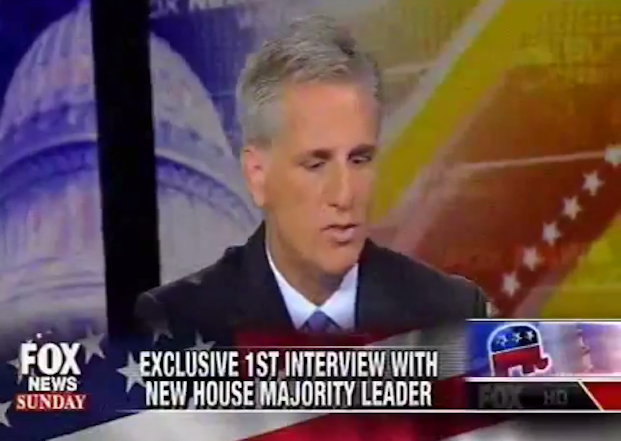
The “new” House Majority Leader Kevin McCarthy (R-CA), the former House whip and establishment candidate, needs an issue to help bridge the divide between the establishment and activist wings of the party. McCarthy did not go unchallenged and even though he defeated or scared off his more conservative challengers, has not silenced the criticism.

“Dave Brat’s historic victory over Eric Cantor (R-VA) was a clear sign of a grassroots conservative resurgence, but how did House Republicans respond? They doubled down on the status quo,” Senate Conservatives Fund executive director Matt Hoskins wrote in an email to PPD.

“House Republicans replaced House Majority Leader Eric Cantor with his lackluster 52% conservative rating with Kevin McCarthy (R-CA) who has an abominable 42% rating,” he added.

In an interview on “Fox News Sunday” with Chris Wallace, McCarthy gave a clear indication that he will be allied with conservatives on another issue of utmost importance — the Ex-Im Bank.

“Do you agree with conservatives who say that the Export-Import Bank is crony capitalism and it should be put out of business, allowed to expire?” host Chris Wallace asked McCarthy. Here was his first response:

One of the problems with government is they go and take hard earned money so others do things that the private sector can do. That’s what the Ex-Im Bank does. The last authorization with the Ex-Im bank directed the President and the Treasury secretary to wind down the Ex-Im bank, negotiate with other countries to wind them down so we have a level playing field. We’ve got hearings going on next week in financial services, which I sit on. I think Ex-Im bank is one that government does not have to be involved in. The private sector can do it.

“So, straightforward question, you can say it right here. You would allow the Ex-Im bank to expire in September?” Wallace followed-up. McCarthy’s second answer is cause for conservative optimism.

“Yes, because it’s something that the private sector can be able to do,” McCarthy added.

Last year, the revolving door that has become the Export-Import Bank was almost slammed shut by conservatives in Congress, but this year supporting politicians, lobbyists and their friends who benefit from the Ex-Im Bank planned to strike early.

Since April, the Main Street versus Wall Street and K Street battle over the Export-Import Bank has been heating up. Conservatives have once again found themselves in a political fight with the Chamber of Commerce, a group that has spent millions pushing immigration reform to obtain cheap labor to benefit corporate America.

“We’re going to be doing our damnedest to focus some minds,” Christopher Wenk, the senior director for international policy at the U.S. Chamber of Commerce said of the intense lobbying effort underway over the Ex-Im Bank.

Cantor was largely seen as a voice for both K Street and Wall Street, both of whom favor the institution that acts as a corporate slush fund for special interest, and worse.

The Export-Import Bank, which was established in 1934 by Franklin D. Roosevelt, supposedly exists to “facilitate exports and imports and the exchange of commodities between the United States and other Nations.” But five minutes of actual investigative journalism tells a very, very different story.

“The Export-Import Bank is nothing more than a slush fund for corporate welfare,” Club for Growth Spokesman Barney Keller told People’s Pundit Daily in April. And it gets even worse. The bank “has given subsidies to everything from Mexican drug cartels and Enron, and it should be eliminated,” he added.

While McCarthy’s comments on the Ex-Im Bank are cause for optimism within conservative circles, it is unlikely that the new majority leader will be an ally on immigration when it reappears in the national debate. However, With nothing short of a refugee crisis occurring on the southern border, the possibility public opinion will overrule special interest on immigration, as well, increases.

In the days following the stunning defeat

internet news and public trust in news

internet news is now more trusted by the public than television news.

The major network news stations, including NBC, ABC and CBS, are now less trusted by the American public than Internet news sites. The “don’t believe what you read on the Internet” adage still applies, however, as only 19 percent of American adults trust Internet news sites.

The results are from a Gallup poll conducted June 5-8.The three major sources of news ranked in the bottom third of 17 different U.S. institutions measured in the poll.

“Americans’ faith in each of three major news media platforms — television news, newspapers, and news on the Internet — is at or tied with record lows in Gallup’s long-standing confidence in institutions trend,” Andrew Dugan from Gallup said.

While trust in Internet news remains low, the trend from since the one prior measurement in 1999 has been roughly constant. On the other hand, the number of Americans saying they have “a great deal” or “quite a lot” of confidence in newspapers or TV news, is on a decades-long decline.

Confidence in newspapers has fallen by more than half since its all-time all of 51 percent measured in 1979. TV news has fallen from its high of 46 percent in 1993, which was the first year that Gallup posed the question.

Unsurprisingly, ideology strongly correlates with a respondent’s answer, as the number of conservatives expressing “a great deal” or “quite a lot” of confidence in newspapers has been cut nearly in half to 15 percent. Meanwhile, liberals are far more likely than conservatives — or the adult population as a whole for that matter — to be confident in what have become liberally-dominated newspapers. Still, despite the fact most project leftwing bias, just 34 percent of liberals express a high level of confidence. Nearly a quarter of moderates (24%), meanwhile, have confidence in newspapers.

Over the last decade, the emergence of alternative media and Internet news sites that relay data-driven stories, such as People’s Pundit Daily and others, has provided Americans with a choice they never before had. The once-dominant newspapers and network news stations are increasingly falling out of confidence with the American people, despite the fact that Internet news has yet to realize a boom in trust.

A Rasmussen Reports survey conducted back in March this year found that only 24 percent of Americans express trust in the media. The poll found that 59 percent of American adults say they get most of their news from TV, including 40 percent who get it from cable news networks. Also, just 19 percent still get it from the traditional news networks, while 28 percent now use the Internet as their main source of news, and only 7 percent say they still buy and read print newspapers. Only 4 percent get most of their news from radio.

“Amid this rapid change (news-specific websites), Americans hold all news media platforms in low confidence,” Dugan wrote. “How these platforms can restore confidence with the American public is not clear, especially as editorial standards change and most outlets lack the broad reach once available to major newspapers and broadcasters.”

The major network news stations, including NBC,

john kerry

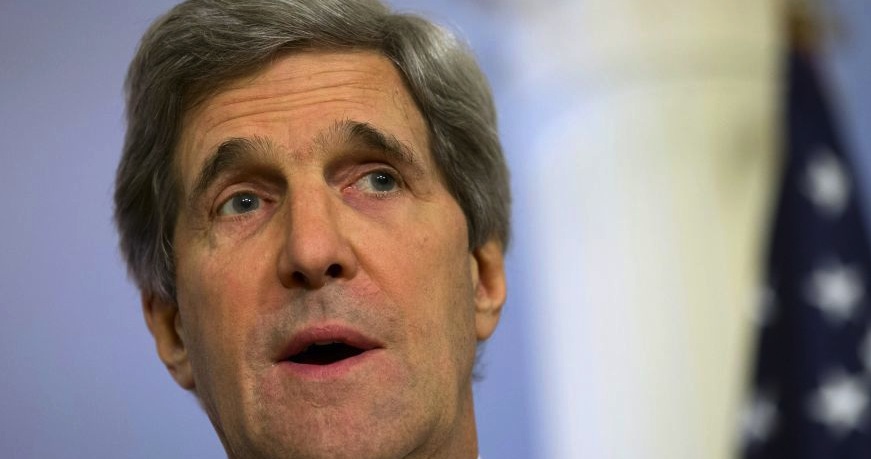
President Obama announced Thursday that he’s sending 300 “military advisers,” otherwise known as U.S. Special Forces, along with Secretary of State John Kerry to Iraq. Kerry will travel the Middle East and Europe this weekend to meet with leaders.

The special military advisers headed into Iraq will assist the Iraqi Security Forces in combating the threat from the ISIS, or the Islamic State of Iraq and Syria. After taking nearly one-third of the territory in Iraq, including the second-largest city of Mosul, the ISIS mocked President Obama and the U.S.

“Soon we will face you, and we are waiting for this day,” the group’s leader Abu Bakr al-Baghdadi said in a tweet over the weekend. The group also posted images of what they claimed to be mass executions in Tikrit and other cities. The images’ captions hurled threat after threat at the country’s Shiite population.

“The filthy Shiites are killed in the hundreds,” one read. “The liquidation of the Shiites who ran away from their military bases,” read another, and, “This is the destiny of Maliki’s Shiites,” referring to Prime Minister Nuri Kamal al-Maliki.

Meanwhile, in the U.S., a growing number of political leaders are starting to call for the removal of Iraqi Prime Minister Nouri al-Maliki, and have pushed President Obama to support a plan to facilitate his ouster. Apparently, either Obama has decided against such a plan, or John Kerry is tasked with assessing the situation and reporting back to his boss with an assessment of whether or not that option is valid.

Former Sec. of State Hillary Clinton said during an interview with Fox News that the removal of the prime minister would be necessary to achieve peace in the country, while Sen. John McCain (R-AZ) took to the Senate floor today to call for his removal. McCain also said when the crisis first developed that Obama’s entire national security team should be replaced.

Lawmakers on Capitol Hill, particularly in the Senate, were blasting the president’s policies.

“These recent events … are not intelligence failures. They are policy and leadership failures,” retiring Sen. Saxby Chambliss (R-GA) said on the floor, stating the president’s Middle East policy has “totally unraveled.”

Sen. Lindsey Graham (R-SC) blamed the premature withdraw entirely for the current situation in what was a relatively stable Iraq when Obama came into office.

“You’ve seen a collapse of the Iraqi Army that I think could have been prevented,” Graham said.

President Obama announced Thursday that he's sending

labor market jobs

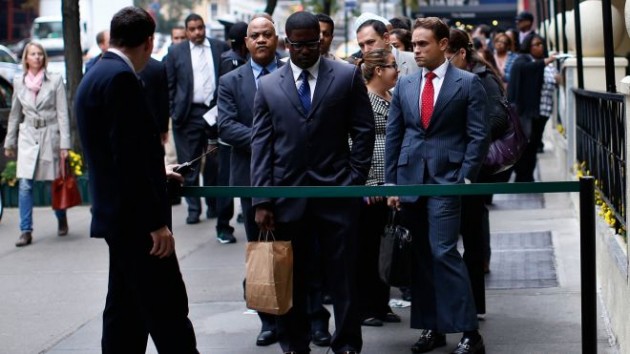
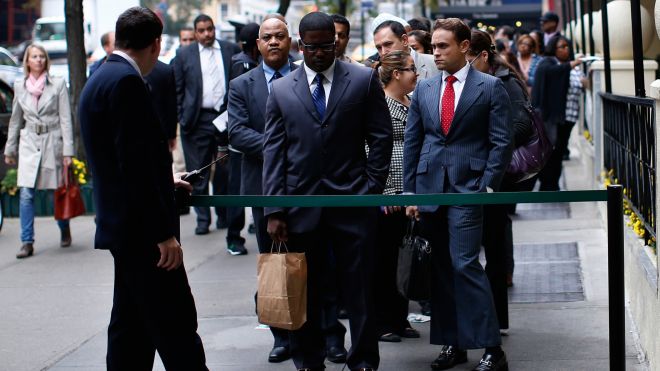
Job seekers navigate through a weak labor market and teetering economy. (Photo: REUTERS)

The latest labor market data may suggest the jobs situation is recovering, but the abysmal baseline in an economy that contracted last quarter misleads.

The number of Americans filing new claims for unemployment benefits fell more than economists had forecast last week, leading some to suggest the labor market conditions are improving. Meanwhile, the Philadelphia Fed’s gauge of mid-Atlantic manufacturing activity rose to 17.8 in June from 15.4 in May, beating Wall Street expectations for a fall to 14.

The reading was the highest since September, while first-time claims for state unemployment benefits fell by 6,000 to a seasonally adjusted 312,000 for the week ended June 14, the Labor Department reported on Thursday.

The prior week’s claims were revised to show 1,000 more applications received than previously reported. Economists polled by Reuters had forecast first-time applications for jobless aid falling to 314,000 last week. Still, the Federal Reserve said on Wednesday that they believe the labor market will improve gradually.

In an effort to prop up a historically weak U.S. economy and a recovery that never was, the U.S. central bank has kept overnight lending rates near zero since December 2008 and has printed money at a rate resulting in under-reported inflation. However, the Fed also announced yesterday it is planning on further cuts to its monthly bond buying program, known as quantitative easing.

A Labor Department analyst said there were no special factors influencing the state level data, but there is one data point no economist seems willing to address.

The four-week moving average for new claims, which is widely viewed to be a better measure of underlying labor market conditions, fell 3,750 to 311,750 last week. While the rolling average irons out week-to-week volatility, it doesn’t underscore how the employment-to-population ratio affects weekly jobless claims. Put simply, so many Americans have been long-term unemployed for so long, the number of eligible applicants have shrunk to a small enough pool that it impacts the data.

The claims report showed the number of people still receiving benefits after an initial week of aid dropped 54,000 to 2.56 million in the week ended June 7, which is the lowest level since October 2007. The number of so-called continuing claims has been on a downward trend, an indication that some long-term unemployed were finding work. The unemployment rate for people collecting unemployment benefits fell to 1.9 percent during the week ended June 7, the lowest since October 2007, from 2.0 percent the prior week.

The data covered the survey week for June’s nonfarm payrolls, but the four-week average for claims declined by 11,000 from the May to June survey periods. Even though that suggests payrolls will are likely to increase from last month’s reported 217,000, which was not enough to even keep pace with population increases, the discrepancy between weekly jobless claims and the closely-watched Bureau of Labor Statistics jobs report, is not negotiable.

The economy, which has recovered all the 8.7 million jobs lost during the recession, and for four straight months has added more than 200,000, is still not adding enough to cover the population increases during the periods of job-loss and so-called recovery.

The latest labor market data may suggest

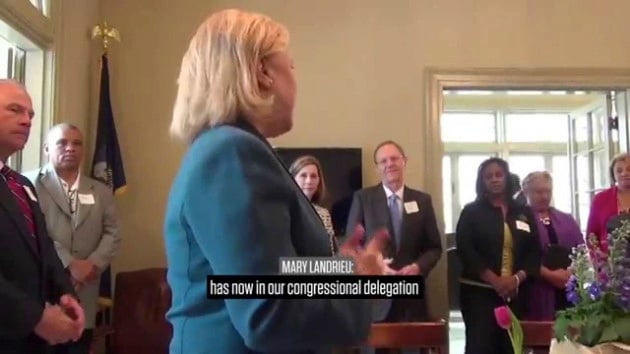
Louisiana Democratic Senator Mary Landrieu, who faces a tough reelection in November, has been on the receiving end of attacks from Republican for months. But the latest round over her effectiveness as the new chair of the Energy and Natural Resources Committee, is resonating with Louisiana voters.

Landrieu was a shoe-in for the role due to her seniority and the obvious political benefit of giving such a role to an embattled incumbent. The role has given her the ability to go home and tout her state’s new “clout” in Washington, which they would no longer enjoy if voters choose Republican Bill Cassidy in the fall. Landrieu even went so far as to tell the New Orleans-based Times-Picayune in April  “I’m indispensable,” because she can now “secure for Louisiana a significant and reliable string of revenue.”

However, there are two problems with Landrieu’s entire justification for reelection. Several polls conducted by SMOR and others, which we previously examined last month, show that Landrieu’s incumbency and seniority provide more of a reason to vote against her than they do to vote for her. Her approval rating hit an all-time low of 39 percent in the SMOR poll, and she trails Cassidy by 6 points in a survey conducted by the Republican polling firm, Magellan Strategies. Democratic polling firm CEA/Hickman Analytics also found her trailing Cassidy, but by a slightly smaller 4-point margin, 46 – 42 percent.

Despite the fact that her PAC has a documented track record of supporting opponents of the oil and gas industry, which constituents may find a bit dishonest, voters just don’t see her getting the job done.

“Last month, I said that the battle to build the Keystone Pipeline was not over,” Landrieu said Tuesday while discussing Wednesday’s largely meaningless committee vote on the Keystone pipeline. “Tomorrow is the next skirmish. Unlike some of my colleagues, I’m not going to give up until we get it built. The events in Iraq remind us how important it is to make our country energy secure. Keystone would bring twice as much oil to the United States than we import from Iraq. We need to build this pipeline now.”

The measure has zero chance to pass in the Senate, which Landrieu knows, because she has already had several conversations with Majority Leader Harry Reid (D-NV) over the pipeline. Reid ensured a plan to vote on a measure that would approve the pipeline absent Obama’s nod died last month, and according to aides, openly told Landrieu as much during a recent conversation about the upcoming confirmation hearings. Landrieu’s committee will approve Obama’s recent nominations of Norman Bay and Cheryl LaFleur to the Federal Energy Regulatory Commission, the agency that oversees America’s power grid.

While Landrieu makes an impossible attempt to appear moderate on the more controversial nomination of Bay, Louisiana’s other senator is concerned that he is just the next step in a climate change agenda that will hurt Louisiana’s economy.

“Norman Bay is a close ally of Majority Leader Harry Reid and President Obama – and I’m concerned he will serve as a rubber stamp for the President’s new unworkable cap-and-trade rule that will drive up electricity prices and hurt our economy,” Vitter said.

Louisiana voters by a whopping 79 – 15 percent margin say Washington should give precedent to job creation over climate change. By a 60 – 28 percent margin, the state’s voters say they are more likely to support someone who opposes the president’s climate change agenda.

The president’s job approval, which varies between 35 – 40 percent in recent polling, has become a real liability for Landrieu. Support among whites, women, and registered Democrats has cratered in recent weeks to the point it is becoming harder and harder to imagine how she can build a majority coalition in the fall, suggesting Republican attacks coupled with reality are taking a serious toll. Landrieu’s reelection team says her reelection strategy consists of maxing-out support among black voters and hoping to convince enough white Democrats that her seniority and independence from party leadership are reasons enough to stick with her over Cassidy in November.

Landrieu first won her seat in a competitive 1996 race and managed to increase her margins in 2002 and 2008, even as the state has become more solidly Republican. But the 2008 election cycle was a wave election for Democrats, and in a red state that voted for Mitt Romney by roughly 17 points, it is becoming increasingly clear that her incumbency and a few symbolic votes will not be enough to save the seat for the Democrats in November.

The Louisiana Senate race is currently rated a “Toss-Up” on PPD’s 2014 Senate Map Predictions, but that is likely to change in the next few weeks.

Poll Date Sample Cassidy (R) Landrieu (D) Spread
PPD Average 2/6 – 6/8 46.7 43.7 Cassidy +3.0
Magellan Strategies (R) 6/5 – 6/8 719 LV 50 44 Cassidy +6
Magellan Strategies (R) 4/14 – 4/15 775 LV 44 42 Cassidy +2
CEA/Hickman Analytics (D) 2/17 – 2/24 404 LV 46 42 Cassidy +4
PPP (D) 2/6 – 2/9 635 RV 44 45 Landrieu +1

Louisiana Democratic Senator Mary Landrieu a tough

iraq flag - iraq history

Photo: The flag of Iraq, a nation in strife due to a broken agreement made nearly a century ago.

The problems in Iraq are more complex than they seem and the United States had better act quickly if they plan on arriving at peace any time soon. The chaos in the Middle East is the direct result of the incompetence of U.S. intelligence and compounded by a president who is woefully short in his understanding of Arab history.

Let’s back up the clock to 1916. The world was heading into major war with the European powers and each of them sought new lands in the largely untamed Syria Plateau. Along with Russian expansion and the war with the then-Ottoman Empire, Britain and France sought help in the war there.

The British sent then-Corporal, T.E Lawrence to organize the scattered tribal leaders of the Arabs and Bedouin tribes and sought their help. Lawrence arrived and organized them into a fighting unit  of the finest light cavalry the world had ever seen up to this point, and he was hailed as a great hero of the tribes. They attacked with daring and impunity along the British flanks and were largely responsible for the British success in the Middle East.

In order to get the tribes to agree to work with the British, Lawrence promised them an Arab homeland, something the tribes had always desired. The terms of this deal were sketchy, but it consisted mainly of the lands between Syria and Bagdad — the area now claimed by the ISIS.

Unbeknownst to Lawrence, two little known bureaucrats named Sir Mark Sykes (British) and François Georges-Picot (France) drew a small agreement that said after the war was over, Britain and France would establish their own protectorate in that area and set up puppet governments to run it for them. The Sykes-Picot agreement, as it came to be known, made no allowances for an Arab homeland, and no mention of Lawrence’s agreement as described in his book “The Seven Pillars of Wisdom.”

The war ended, the Arabs wanted their land and their claim of Lawrence’s agreement went largely ignored. To quell the rising furor of the tribes, the European powers set up the Arab controlled countries now known as Syria, Iran, Iraq and Jordan, while providing a protectorate for the Jewish Zionists in the area now known as Israel.

Fast forward to 2008.

George Bush answered 9/11 with an invasion of Iraq and deposed the usurper Saddam Hussein who had stolen the Iraqi kingdom from the royal family installed by the colonial powers and the Sykes-Picot agreement. He brokered a tenuous peace and installed Nouri al-Maliki in a shared power agreement giving the native peoples a democratic vote. Shortly thereafter, the same Arab tribes and Bedouin of Lawrence’s time came to al-Maliki with their claims of Arab homeland and were rebuffed.  Maliki has governed Iraq using his Shia roots as a priority and moved Iraq toward a closer relationship with Iran.

Barack Obama becomes president in 2009 and assumed the problem had been solved and the agreements of the Bush era were allowed to go forward and American troops came home from Iraq. The Arab tribes see their opportunity to gain their homeland and seize lands in Syria per the original agreement under Lawrence of Arabia. They began carrying in a bastardized version of the same flag they fought under with Lawrence, and go into battle yelling “Sykes-Picot! Sykes Picot is no more!”

Maliki realized the danger and contacted Obama telling him the northern provinces bordering Syria are in rebellion and to send help in 2012. These reports and Maliki’s request went largely ignored.

After securing the lands in Syria, the rebels have now turned south to Bagdad and are reclaiming lands under the name ISIS and the black flag of Lawrence.

You know the rest.

An extensive narrative explaining the complexities of this situation was prepared for the western powers by Stratfor Global Intelligence and can be read here. It has been confirmed by the ISIS people themselves and you can read their comments under the hashtag #SykesPicotOver on Twitter.

This war is NOT about another 9/11, and is not the fault of George Bush invading Iraq. It’s about the illicit Sykes-Picot agreement of 1916, which 100 years later has now come back to haunt the Middle East. The ISIS group is the legacy of T.E Lawrence and his unfulfilled realization of an Arabian state. It’s no wonder Iran, Syria and Iraq want a U.S. alliance against “one of their own,” because they are trying to maintain the current status quo.

Without justifying the massive atrocities being committed, the U.S. would be wise to consider a brokered peace agreement with the ISIS that gives them their promised homeland and perhaps reconsider our position on the native Arab people of these lands.

It would be a huge mistake to do business with Maliki and Iran in order to preserve what may have been an extension of imperialist Europe.

Thomas Purcell is host of the Liberty Never Sleeps podcast show and more of his work can be read at libertyneversleeps.com

[caption id="attachment_13470" align="aligncenter" width="625"] Photo: The flag

Justina Pelletier

Justina Pelletier with her parents, Lou and Linda Pelletier, of West Hartford, Connecticut. (Photo: Fox News)

Justina Pelletier is finally coming home now that a Massachusetts judge okayed the 16-year-old Connecticut girl’s and her family’s request. The ruling says Pelletier, who was taken from her family by so-called child welfare advocates more than a year ago, is to be returned to her mother and father effective Wednesday.

The ruling ends a long-running medical custody dispute that first got way out of hand when two of Boston’s top children’s hospitals disagreed over the girl’s diagnosis. The case sparked national outrage across the nation, resulting in a legal and public opinion battle led by Lou and Linda Pelletier, of West Hartford, Connecticut.

“To hear the news is overwhelming,” Lou Pelletier said just moments after learning of the ruling. “Now we can certainly begin the healing process.”

The controversy and dispute began when the girl’s parents challenged a psychiatric diagnosis given by Boston Children’s Hospital and said they wanted their daughter returned to her original physician at another top Boston child hospital, Tufts Medical Center. Tufts had been treating Justina for mitochondrial disease, a group of rare genetic disorders that negatively affects cellular energy production.

Then, the Massachusetts Department of Children and Families got involved, and took the outrageous step to accuse Justina’s parents of “medical child abuse.” But sadly, as is typically the case with careless and arrogant state intervention, the parents knew what was the better course for their child. While in state custody, Justina’s condition deteriorated significantly, leading Mr. Pelletier to say during an interview that his “daughter’s life is literally at stake.”

In May, Justina was moved from Massachusetts to a facility in Thompson, Connecticut, which is allowed her parents to visit. In a 45-second, videotaped plea, first posted on a Facebook support page last week, a weakened Justina was seen sitting in a chair and pleading with the powers that be to go home.

“All I really want is to be with my family and friends,” the girl says, her voice faltering at times. “You can do it. You’re the one that’s judging this. Please let me go home.”

The judge obliged.

Former Arkansas Gov. Mike Huckabee and others have helped to give voice to this case of state and DCF overreach. After doing serious harm to the health and well-being of Ms. Pelletier, not to mention the anguish the family was put through, the Department of Children and Families simply decided to give up. They confirmed last week that they would simply reverse their position, without apology or policy changes.

“The People’s Republic of Massachusetts,” as Huckabee referred to the state, has made no effort to make amends save for agreeing with the family in court. For the Pelletier family, that is more than enough, for now.

“She’s coming home tomorrow,” Mr. Pelletier said. “I think she will want to get adjusted.

“Think of it like a prisoner of war who has been held captive for 16 months,” he added. “There will be an adjustment period.”

Justina Pelletier is finally coming home now

benghazi

DEVELOPING: Fox News has reportedly confirmed a suspected terrorist linked to the 2012 Benghazi terror attack has been captured inside Libya by U.S. forces. The operation, which was conducted on Sunday June 14 by U.S. Special Forces and one FBI agent, resulted in the arrest of Achmed Abu Khatallah before he knew what happened and without incident or casualty.

The Benghazi terror attacks killed four Americans, including Ambassador Chris Stevens. Khatallah is currently en route to the United States, Rear Admiral John Kirby confirms, on board a Navy ship.

“There were no civilian casualties related to this operation, and all U.S. personnel involved in the operation have safely departed Libya,” Kirby said in a statement.

Sources tell Fox News that the suspect will face prosecution in the United States.

The arrest convienantly comes shortly after the House voted to establish a select committee on Benghazi to investigate the events leading up to the attack and the subsequent coverup. Seven Democrats split with their party to vote alongside Republicans to set up the select committee, which is chaired by Rep. Trey Gowdy (R-SC), a former prosecutor in the Palmetto State.

While most Democrats claim the investigation is a political witch hunt, a majority of Americans believe President Obama and Hillary Clinton intentionally lied to the public about the Benghazi terror attacks on Sept. 11, 2012.

State Department official Sean Smith, and CIA contractors and former U.S. Navy SEALs Tyrone Woods and Glen Doherty were also killed during their heroic attempt to protect the ambassador during the attack.

DEVELOPING: Fox News has reportedly confirmed a

new housing starts

(Photo: REUTERS)

U.S. housing starts and building permits tanked far more than economist’s expected in May in what the latest sign the housing recovery is artificial. The number of starts for new homes fell by a whopping 6.5 percent to a seasonally adjusted annual pace of 1 million units, the Commerce Department said on Tuesday.

Last month’s report was revised down to a 12.7 percent increase rather than the previously reported 13.2 percent rise. Economists polled by Reuters had forecast starts to fall to a 1.03 million-unit rate last month.

The housing market is still hanging by a threat, relying upon artificial and dangerous government regulations and rules to regain small momentum after a small increase in mortgage rates temporary price increases stifled demand. Earlier this month, two policy statements made by Mel Watt, director of the Federal Housing Finance Agency (FHFA), and Shaun Donovan, secretary of HUD, backed-off tight restrictions that required sound lending practices, repeating the mistakes of the subprime mortgage crisis.

The FHFA is the regulator of Fannie Mae and Freddie Mac, which along with the Federal Housing Administration (FHA) are responsible for guaranteeing about 75 percent of all mortgage credit in the United States. In an effort to boost a failing housing market, they’ve abandoned the rules against underwriting risky mortgages.

A shortage of properties has also weighed down the sector, but homebuilder confidence remains relatively dim.

Groundbreaking for single-family homes, which represents the largest part of the market, fell 5.9 percent in May to a 625,000-unit pace, while starts for the volatile multi-family homes segment decreased 7.6 percent to a 376,000-unit rate.

Federal Reserve Chair Janet Yellen last month stated the obvious, which was that there was a risk a drawn out housing slowdown could undermine the economy.

Permits to build homes fell by 6.4 percent to a 991,000-unit pace in May, down from the 1.06 million units measured in April. Economists had forecase permits to fall to a 1.05-million unit pace.

Permits for single-family homes increased by 3.7 percent to a 619,000 unit-pace, though they continue to lag behind in groundbreaking numbers, indicating that single-family starts will fall further in the months ahead.

A survey on Monday showed confidence among single-family home builders increased in June, but missed the threshold considered favorable for building conditions.

Meanwhile, permits for multi-family housing plummeted by 19.5 percent to a 372,000-unit pace.

U.S. housing starts and building permits tanked

Photo: REUTERS

The American people now have more reason to believe the Fed’s money-printing policy is hitting them where it hurts, their pockets. U.S. consumer prices across-the-board posted their largest increase in more than a year in the month of May, as inflation pressures fueled by fiat money begin to manifest.

The Labor Department said on Tuesday its Consumer Price Index gained 0.4 percent last month, with food prices posting their largest increase since August 2011. The data continues a disturbing trend under the Obama administration, which presided over the largest increase in inflation since the Great Depression.

The Federal Reserve will no doubt claim that inflation was running too low, because the main inflation gauge outlined by the Fed continues to run below the U.S. central bank’s 2 percent target. However, the Fed’s policy disproportionately benefits the investor class over the average American, who continue to see their saving and purchasing power erode as the Fed prints more and more fiat money.

Fed officials start a two-day policy meeting on Tuesday, and they are expected to further trim the monthly bond buying program, marginally. Yet, they will put off raising interest rates until at least mid-2015, though they have pushed the date farther back several times.

Last month’s increase in consumer prices was the largest since February 2013 and above economists’ expectations for a 0.2 percent gain, up from a 0.3 percent gain in April.

Over the last 12 months through May, consumer prices gained 2.1 percent, which was the biggest increase since October 2012. Further, a 2.0 percent gain measured in April was above economists’ expectations for a year-on-year increase of 2.0 percent.

Excluding food and energy prices, two of the biggest expenses for everyday Americans, the so-called core CPI rose 0.3 percent, also the largest gain since August 2011. It had increased by 0.2 percent in April, and over the 12 months through May, the core CPI increased by 2.0 percent. That was also the largest increase since February, 2013, and came after a 1.8 percent rise in April.

Economists had forecast the core CPI would increase by 0.2 percent from April and 1.9 percent from 1 year-ago.

Meanwhile, food prices increased again by 0.5 percent in May, adding to an already expensive burden for American families for a fifth consecutive month. Prices for meat, dairy, fruit and vegetables rose at roughly the same pace, while poultry, fish and eggs all rose.

Gasoline prices, which are expected to shoot up due to the situation in Iraq, increased by 0.7 percent. Prices for electricity also rose after declining in the prior month.

There were also increases in medical care costs, clothing apparel, new cars prices and airline prices. The core CPI increase in large part due to a 0.3 percent rise in rent.

The American people now have more reason

People's Pundit Daily
You have %%pigeonMeterAvailable%% free %%pigeonCopyPage%% remaining this month. Get unlimited access and support reader-funded, independent data journalism.

Start a 14-day free trial now. Pay later!

Start Trial