Widget Image
Follow PPD Social Media
Friday, January 16, 2026
HomeStandard Blog Whole Post (Page 979)

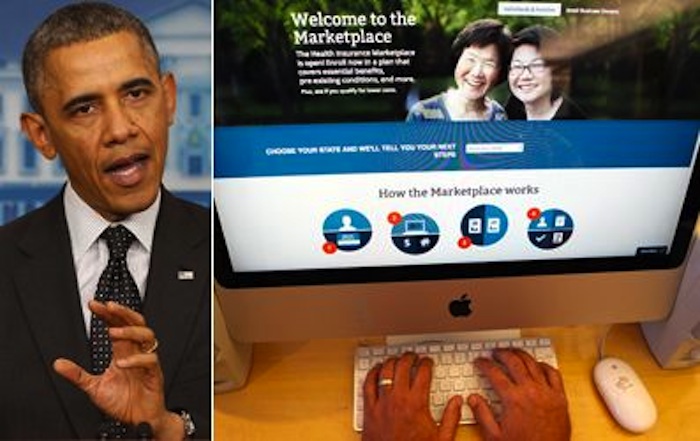
The administration will again delay a key element to Obama’s signature law, granting an ObamaCare deadline extension for those who “attempted” to enroll in the federal insurance marketplace. The president’s move is the latest unilateral action and desperate attempt to avoid responsibility for missing his administration’s set goals by his self-imposed deadline.

If consumers, which is what we call Americans who are forced to purchase a product these days, have begun the process of purchasing coverage on the ObamaCare website, but did not complete the registration by Monday, they will now have until mod-April to ask for an extension to do so.

Astonishingly, government website designers will create a button on the site for users to check, which will register them as a user who tried to enroll by the deadline, but the government says they will not verify whether or not they actually did attempt to enroll.

Though the original excuse for the program’s lack of performance was tied to glitch-prone tech problems, which actually turned out to be core architectural flaws in the website’s code, leading security experts to warn Americans of a real risk to identity theft for users, the fundamental problem is far more serious.

As previously reported by PeoplesPunditDaily.com, uninsured Americans simply are not signing up for insurance, though the argument for the law included a sense of desperation by those without. Yet, according to a survey by the consulting firm McKinsey & Co., which has been corroborated by data from Gallup and the Urban Institute, only 1 in 10 uninsured Americans who qualify for private plans through the new health insurance marketplaces actually enrolled as of last month.

Further, according to insurers, of those who have selected a plan either through the FFM or SBM online Marketplaces, roughly 20 percent have never paid the first month’s premiums and an additional 2 to 5 percent haven’t paid the second month’s premium. Now, health insurers “participating in ObamaCare are a very worried group right now,” according to health insurance industry consultant Robert Laszewski.

What is the cause for such underperformance? Cost. According to McKinsey & Co., Gallup, the Manhattan Institute and the Urban Institute, the number one reason uninsured Americans — and those who have had their policies cancelled due to ObamaCare’s Essential Health Benefit Standards — are not signing up for coverage, is cost.

Meanwhile, the administration is also trying to provide political and logistical cover for state exchanges who were equally inept in the rollout of ObamaCare. Overseers in Nevada Health Link, for instance, have characterized the state’s program as a “full failure” and a “catastrophe.”

Nevada Governor Brian Sandoval, a Republican who both accepted federal funds that will soon run out and opted to set up an exchange, now finds himself in a predictable sinking ship with President Obama.

“We can’t go through this again,” Sandoval said of the proposal to fire Xerox, the company awarded a $75 million contract to develop the system.

“We’re not going to wake up every morning seeing stories of Nevadans who can’t navigate through the system; that aren’t getting insurance cards; the gentleman who had a heart attack who is still sitting in limbo not knowing what his status is.”

Still, though boasting 5 million enrollments as of March, the administration refuses to release data on the risk pool, or whether or not they have an adequate amount of healthy, younger Americans to cover the cost of free insurance and coverage for the more expensive, sicker Americans. If they had positive information, which they claim they do not track, then they would have released it.

Earlier in March, Richard D. Baris, creator and editor of PeoplesPunditDaily.com, predicted people would begin to ask the question: What was the point of ObamaCare, again? As it stands now, the law has not achieved its stated goal to insure at least 30 million of the 45 million uninsured Americans, a figure which was false to begin with, and we have nothing to show for it but an out-of-control, lawless president who changes laws whenever he sees it political expedient.

The administration will again delay a key
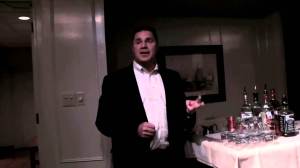
Well, it is a candidate’s worst nightmare to be caught on camera sounding like an elitist and trashing everyday Americans, particularly when you elevate the profession of lawyer over farmer — in Iowa! — and you imply farmers are stupid because they never finished law school. That’s the nightmare scenario facing Democrat Bruce Braley right now if, that is, the GOP can get the message out effectively.

Representative Bruce Braley will most-assuredly be the party’s nominee for the Iowa Senate race in 2014. He will run against whomever eventually prevails out of the very-crowded Republican primary field, which is not a certainty.

While many pundits have been citing the potential disastrous primary for Republicans as a reason for keeping the race Democrat-favored — though we at PeoplesPunditDaily.com rate the race a “Toss-Up” — they have had little to say about a potential disaster scenario occurring on the Democrat side. Because Democrats did what Democrats do and settled on a party Establishment-picked candidate early, there is simply no time to reverse course in the event a candidate makes a terrible campaign trail mistake.

Or, in the case of Bruce Braley, let is slip just how out-of-touch he really is with Iowans after spending time in Washington, D.C. Make no mistake, this is exactly what Americans — in Iowa and many other states — completely despise about Washington, and government. Now, more so than usual periods of anti-incumbent fervor, Iowans are willing to punish a politician whose values holds a lawyer more valuable than a farmer. Most Iowans, and Americans for that matter, will tell you they ally their political beliefs more with Main Street than K Street.

We have always viewed this race to be more favorable to Republicans than otherwise portrayed in the media and by other election pundits. And for good reason.

“As it stands on the issues now, Iowa voters are firmly on the side of the Republican Party,” I wrote back in December in my first data analysis of the Iowa Senate race, and not much has changed since then. Name recognition was Braley’s best asset in polling surveys, but as I identified in my second data analysis, Iowans were displaying a concerning pattern. The more they get to know Braley, the more disproportionately they decide they aren’t too keen on him. A widely viewed revelation such as this, particularly and necessarily accompanied by a smart messaging campaign defining him in a further negative light, is a game-changer.

The Democrats were already in peril of losing control of the Senate in the 2014 midterm elections, even without Iowa. However, this is one seat that is far from safe for Bruce Braley and the Democrats. Not that it ever was, as some pretended, but now this race is even more difficult for the Democrats to hold on to.

Here are Braley’s comments from the video above:

To put this in stark contrast, if you help me win this race, you may have someone with your background, your experience, your voice, someone’s who’s been literally fighting tort reform for 30 years in a visible and public way on the Senate Judiciary Committee or you might have a farmer from Iowa who never went to law school, never practiced law, serving as the next chair of the Senate Judiciary Committee. Because if Democrats lose the majority, Chuck Grassley will be the next chair of the Senate Judiciary Committee.

Democrat Bruce Braley is in a nightmare

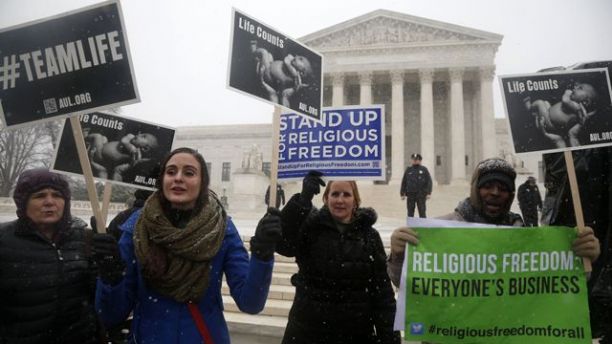
The Supreme Court on Tuesday heard arguments in the long-awaited Hobby Lobby contraception case, which is the highest-profile lawsuit over ObamaCare since the Supreme Court narrowly upheld the law in 2012.

As activists on both sides of the issue clashed outside the courtroom in Washington, inside the courtroom the justices appeared divided on the issue in question.

The Hobby Lobby contraception case involves family-owned companies that provide health insurance to their employees, but because certain methods of birth control work after conception, they object to being forced to violate their religious beliefs.

However, the Obama administration and the left say a Supreme Court ruling in favor of the businesses would also disrupt the laws ability to effectively govern immunizations, Social Security taxes and minimum wages.

Justice Kennedy, typically seen as the court’s swing vote, seemed concerned for both the rights of female employees and the business owners. Kennedy asked what rights would women have if their employers ordered them to wear burkas, a full-length robe commonly worn by conservative Islamic women.

Later in the 90-minute argument, he was clearly disturbed by the logic of the government’s argument, which would apply to abortions. “A profit corporation could be forced in principle to pay for abortions,” Kennedy said. “Your reasoning would permit it.”

Major advocacy groups attended the hearing and staged press conferences and demonstrations outside. On one side of the debate, Planned Parenthood and the American Civil Liberties Union, two organizations that profit immensely from the abortion industry, argued that the rights of women should not be trumped by CEOs.

On the other side, faith-based groups and lawmakers argued that businesses should be free to choose whether they want to comply with this part of the law or not, because of clear First Amendment rights to practice one’s own religion.

“This is about whether the federal government is forcing people to violate their own faith,” said Texas Senator Ted Cruz.

ObamaCare requires employers to offer health plans with a range of services at no extra charge, including all forms of birth control for women (and, oddly enough, men).

Nearly 50 businesses that have sued over covering contraceptives, but only a few object to paying for all forms of birth control. Hobby Lobby, and the other companies involved in the case, are willing to cover most methods of contraception. However, as long as they can exclude drugs or devices that the government says may work after an egg has been fertilized, they feel there is little conflict with their faith.

The largest company among them is Hobby Lobby Stores Inc., owned by the Green family. They say their “religious beliefs prohibit them from providing health coverage for contraceptive drugs and devices that end human life after conception.”

Oklahoma City-based Hobby Lobby has more than 15,000 full-time employees in more than 600 crafts stores in 41 states. The Greens are evangelical Christians who also own Mardel, which is a Christian bookstore chain.

In the Supreme Court brief submitted last month by the Becket Fund for Religious Freedom, which is the group representing Hobby Lobby, they called the mandate “one of the most straightforward violations … this Court is likely to see of a 1993 law preserving the free exercise of faith.”

The other company is Conestoga Wood Specialties Corp. of East Earl, Pa., owned by a Mennonite family and employing 950 people in making wood cabinets.

Even though most of the companies are willing to provide the majority forms of contraception, so-called women’s rights groups are not satisfied. “Women already have an income gap. If these companies prevail, they’ll have a health insurance gap, too,” said Marcia Greenberger, co-president of the National Women’s Law Center.

The only contraceptives at issue before the court are the emergency contraceptives Plan B and ella, and two IUDs.

The government, however, wisely argued that employers would also be able to invoke religious objections under the 1993 Religious Freedom Restoration Act to opt out of other laws, such as those governing immunizations, minimum wages and Social Security taxes. Because the Supreme Court previously has rejected some of these claims in cases decided before ObamaCare, the left saw this as their best argument.

However, the issue is only involving family-controlled businesses with a small number of shareholders. A survey by the Kaiser Family Foundation found 85 percent of large American employers already had offered such coverage before the health care law required it. There are also separate lawsuits challenging the contraception provision from religiously affiliated hospitals, colleges and charities.

The federal appeals court in Denver ruled in favor of Hobby Lobby. Conestoga Wood lost its case at the federal appeals court in Philadelphia. While the courts have been split on decision — though this is less true regarding Hobby Lobby — politicians have been firmly split down party lines. Republican support the First Amendment right to religious freedom, while Democrats have decidedly come down on the side of big government trumping personal liberty.

Last month, a group of Democratic senators filed an amicus brief supporting the Obama administration’s position in the case. A brief was subsequently filed on behalf of Hobby Lobby by Sens. David Vitter (R-LA), Ted Cruz (R-TX), John Cornyn (R-TX) and Mike Lee (R-UT).

However, on the key issue of whether profit-making corporations may assert religious beliefs under the 1993 religious freedom law or the First Amendment provision guaranteeing Americans the right to believe and worship as they choose, the justices could actually skirt that issue. If they find that the individuals who own the businesses have the right to object, then they could avoid addressing the larger issue.

The justices still would have to decide whether the contraception mandate infringes on Americans’ religious freedom and, if so, whether or not the government makes a persuasive case the policy is so vitally important and is put in place in the least objectionable way possible.

Hobby Lobby and Conestoga Wood say the financial burden they face is obvious and clearly objectionable, citing the $100-a-day fine they would have to pay for each employee for not complying with the contraception provision. On the other hand, businesses that choose not to offer health insurance at all can pay a tax of $2,000 a year for each employee.

Yet, Mark Rienzi, a Catholic University professor who is on the Hobby Lobby legal team, argued Hobby Lobby would clearly be at a competitive disadvantage with other employers who provide contraception in their health coverage plans. “Their view is and has always been that they want to take really good care of their employees and their families,” Rienzi said.

As activists on both sides of the

The Environmental Protection Agency proposed a rule change Tuesday to the Clean Water Act, which would create granted authority over temporary wetlands and waterways.

The new proposal drew immediate criticism and raised concerns that the regulatory power will translate in to new EPA regulations that extend into seasonal ponds, streams and ditches, including those on private property. The proposed rule change is the latest in what has been a string of new EPA regulations seen by many to be an agency power grab, overriding private constitutional property rights in favor of agency mission creep.

“The … rule may be one of the most significant private property grabs in U.S. history,” said Louisiana Republican Senator David Vitter, the top Republican on the Senate Environment and Public Works Committee.

The new EPA rule would expand pollution regulations to so-called “intermittent and ephemeral streams and wetlands” across the country, which are only created during wet seasons and are temporary.

The federal government, once again under the Obama administration, are arguing that temporary wetlands are, indeed, an actual part of the “waters of the United States.”

However, the Supreme Court already ruled on the issue in 2001 and 2006. The second decision restricted the federal government’s authority by ruling such waters must be “relatively” permanent or continuously flowing and sizeable, such as “oceans, rivers, streams and lakes.”

The EPA and the Army Corps of Engineers said Tuesday deciding Clean Water Act protection for streams and wetlands is now “confusing and complex,” something they supposedly claim occurred since the two Supreme Court decisions.

“For nearly a decade, members of Congress, state and local officials, industry, agriculture, environmental groups, and the public asked for a rulemaking to provide clarity,” the agencies said in a joint statement.

They added that these waters “form the foundation of the nation’s water resources,” but that the rule changes would not lead to a federal government overreach. In fact, they don’t acknowledge it even increases the reach of the government.

“To be clear, our proposal does not add to or expand the scope of the waters historically protected under the Clean Water Act,” EPA Administrator Gina McCarthy said in a video accompanying the announcement.

The EPA also said roughly 60 percent of “stream miles” in the country only flow seasonally or after rain but have a “considerable impact” on downstream waters — and that about 117 million Americans, or one in three, get their drinking water from public systems that rely in part on such streams.

The proposal is, however, subject to a 90-day comment period. Federal officials promised to conduct a “robust” public outreach effort that will include discussions across the country to gather the input needed “to shape a final rule.” Or, in other words, they will use public funds in an attempt to shape public opinion, otherwise known as propaganda.

The agencies said the proposed change is supported by the latest peer-reviewed science.

Yet Senator Vitter accused the EPA of “picking and choosing” its science, which they have been known to frequently do on other issues, while trying to “take another step toward outright permitting authority over virtually any wet area in the country.”

Vitter correctly warned the rule change, if and when approved, will inevitably lead to radical environmental groups suing private property owners to advance their agenda.

Republican Senator Lisa Murkowski of Alaska, said the change “could result in serious collateral damage to our economy.”

“[I]t appears that the EPA is seeking to dramatically expand its jurisdictional reach under the Clean Water Act,” Murkowski said in a statement. The senator also noted that the change has the potential to negatively impact Alaska.

“If EPA is not careful, this rule could effectively give the federal government control of nearly all of our state — and prove to be a showstopper for both traditional access and new development,” she said.

The Environmental Protection Agency proposed a rule

alaska senator mark begich

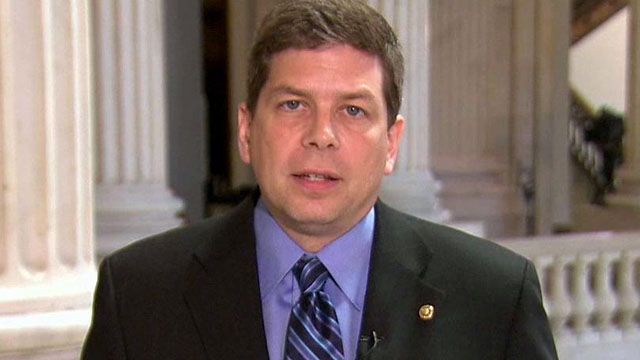
Vulnerable incumbent Democrat Senator Mark Begich of Alaska.

The latest round of Alaska Senate polls are beginning to reflect the grim political reality for Mark Begich, who is either tied or behind 2 out of 3 his Republican challengers. Interestingly, either Rasmussen Reports did not release or did not conduct a hypothetical matchup between Democrat Mark Begich and 2010 Republican nominee Joe Miller.

Nevertheless, according to a new survey by Rasmussen, Lieutenant Governor Mead Treadwell leads incumbent Democrat Senator Mark Begich 47 percent to 43 percent, while former Natural Resources Commissioner and Attorney General Dan Sullivan ties Begich at 44 percent of the vote.

Despite the Republican primary not yet being concluded, the Alaska Senate race is rated “Leans Republican” on our 2014 Senate Map Predictions, and according to our model, the 44 percent Begich earns against Sullivan is likely close to his ceiling of support. This is relatively confirmed when only 3 percent would choose some other candidate in the race, and only 6 percent are undecided so early in the race. Though we rate Rasmussen a 3.5 out of 4 for past accuracy, he is likely close to the mark.

The pollster did not return a request for a comment, as of yet, but it is unclear whether or not omitting Joe Miller was intentional or harmless. As I previously examined, Joe Miller has a path to the nomination, particularly if Treadwell and Sullivan cannot coalesce the Establishment vote. Miller has a dedicated group of followers who justifiably feel slighted by the Establishment and, as I have also noted prior, Alaska Senate polls are notoriously inaccurate.

Treadwell, who many believed to be the early favorite, may still be leading in the Rasmussen poll, but there is little doubt that some of the race dynamics have not gone his way. He benefits from name recognition and being well-liked, but recent endorsements have gone to his fellow-Republicans.

“Dan Sullivan is a fiscal conservative with a stellar track record in Alaska and we strongly endorse him for the United States Senate.” said Club for Growth President Chris Chocola in an email to supporters. Admittedly, it was a bit surprising to see the Club for Growth endorse Dan Sullivan, but it didn’t seem to surprise Joe Miller.

“It is unfortunate that Club for Growth would insert themselves into a contested primary to work against advocates of the free market,” Miller said. “But I never expected to be K Street’s candidate. We won the 2010 primary without their help, and we expect to do it again.”

Miller racked up the endorsement of the National Association for Gun Rights PAC (NAGR), adding to an already solid Pro-Second Amendment resume, including the endorsement of the Gun Owners of America. Miller also recieved an “A” rating from the National Rifle Association.

Still, Dan Sullivan is in the money lead, with the bulk of Super PAC attacks on behalf of Mark Begich targeting him. From March 13 to March 21, alone, the pro-Begich group, Put Alaska First PAC, has spent over $150,000 in attack ads, and nearly $380,000 as of March 24, according to OpenSecrets.org.

Begich has done much to distance himself from President Obama, who has an approval rating of around 30 percent in a state Gallup measured to have the sixth most conservative leanings in the country. Despite Begich cozying up to big oil, as well as other hypocritical connections, Alaska is a heavy lift even for an incumbent Democrat and continues to move to right in recent years. Begich boasts defeating scandal-laden Senator Ted Stevens in 2008 — a Democratic wave election no less — by under just 4,000 votes.

In a deeply red state with a PVI of R+12, which Mitt Romney easily won by 13 points, the latest Alaska Senate polls are just catching up to the reality of this race, which is that Mark Begich is in big, big trouble.

The survey of 750 Likely Voters in Alaska was conducted on March 19-20, 2014 by Rasmussen Reports. The margin of sampling error is +/- 4 percentage points with a 95% level of confidence.

The latest round of Alaska Senate polls

fitch ratings

Prior to President Obama arriving Monday at 1:30 PM to attend the G-7 meeting, Fitch Ratings downgraded Russia’s credit outlook to “negative” in anticipation of further sanctions.

Prior to President Obama arriving Monday at 1:30 PM to attend the G-7 meeting, Fitch Ratings downgraded Russia’s credit outlook to “negative” in anticipation of further sanctions. The move by Fitch Ratings follows Standard & Poor’s, who also downgraded their outlook of the Russian economy last week.

The ratings agency said the Russian economy was showing danger signs before the U.S. and EU implemented sanctions after Putin officially moved to annex Crimea, following a referendum that went some 95 percent for Russia.

“Growth slowed to 1.3 percent in 2013 and investment is contracting,” Fitch said. The firm lowered its forecast for Russian growth to less than 1 percent for this year, while Standard & Poor’s cut its growth estimate to just 1.2 percent.

The Russian exchange has taken more than a 10 percent hit since the Crimea crisis began, with the two rating agencies underscoring the economic ramifications of Putin’s decision. The Russian 10-year government ruble bond fell, forcing the yield to increase by 35 basis points, or 0.35 percentage point, up to 9.66 percent. The ruble declined 0.1 percent to 42.6165 against Bank Rossii’s dollar-euro basket by 1:07 p.m. in Moscow, extending this year’s decline to about 10 percent.

“If corporate financing needs cannot be met in the markets, the authorities could draw on ample foreign-currency reserves to provide foreign-currency liquidity, through the state-owned banks or from the Reserve Fund,” Fitch said.

President Obama will meet with European Union officials regarding a future coordinated action to increase even more pressure on Russia. EU leaders, met prior to the G-7, were expected to agree upon a unified position. Now, all economists’ eyes will be on Moody’s Investors Service, who currently rate Russia Baa1, or the third-lowest investment grade. However, thus far, they have allowed Russia to continue with a stable outlook.

For all intensive purposes, as Germany Prime Minister Angela Merkel noted, the G-8 doesn’t exist anymore. Russia has been kicked out and no conceivable future action will change that. Emboldened by international victories, Russia has, for the time being, resisted predictions of an economic downturn in Russia.

“I see no signs that Russia’s ability to service its debt is worsening,” Deputy Finance Minister Alexey Moiseev told Bloomberg by phone. He claimed the budget was being carried out without a deficit, and that Russia had a two-month budget surplus of 30.5 billion rubles, or 0.3 percent of gross domestic product.

Prior to President Obama arriving Monday at

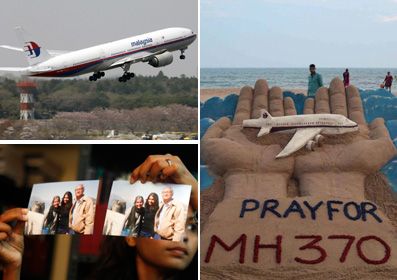
Malaysia Prime Minister Najib Razak said Monday new analysis of satellite data for Malaysia Airlines Flight 370 suggests the plane went down in the southern Indian Ocean.

Prime Minister Razak said during a news conference that he was briefed regarding the new data calculations by the U.K. Air Accidents Investigation Branch, which was conducted by Inmarsat, a British satellite company.

“Based on their new analysis … MH370 flew along the southern corridor, and that its last position was in the middle of the Indian Ocean west of Perth,” Razak said. “This is a remote location, far from any possible landing sites. It is therefore with deep sadness and regret that I must inform you that, according to this new data, that flight MH370 ended in the southern Indian Ocean.”

Razak’s announcement didn’t go over well with relatives of the passengers, many of whom were booked on charter flights to Australia. An emergency meeting between the victims’ families and officials at Malaysia Airlines took place in Beijing, Razak said.

“For them, the past few weeks have been heartbreaking. I know this news must be harder still,” Razak said. Sky News reporters said the victims’ relatives were screaming and in tears as they were told the news and one person was seen being rolled out in a stretcher.

“Malaysia Airlines deeply regrets that we have to assume beyond any reasonable doubt that MH370 has been lost and that none of those on board survived,” the airline said in a text message to the families. However, the Malaysian government, who owns a majority share of Malaysia Airlines, didn’t disclose if they were any closer to actually locating debris from the plane.

In a statement posted on Malaysia Airlines’ website, the company said it offers its “sincere thoughts, prayers and condolences to everyone affected by this tragedy.”

Prime Minister Razak said authorities plan to hold another press conference on Tuesday in order to discuss further details about the satellite data analysis.

Earlier Monday, Australian and Chinese search planes spotted more objects in the southern Indian Ocean that were identified as possible debris from the missing jet, which was carrying 227 passengers and 12 crew members and was due to fly from Kuala Lumpur, Malaysia, to Beijing on the morning of March 8.

Australian Prime Minister Tony Abbott said the crew of an Australian P3 Orion plane had located two objects, the first of which was either gray or green and circular in shape. The second orange and rectangular. The crew was able to photograph the objects, but it was unclear whether or not they were actual pieces of an aircraft.

“They could be flotsam,” Abbott said in Canberra. “Nevertheless, we are hopeful that we can recover these objects soon and that they will take us a step closer to resolving this tragic mystery.”

Regardless of these reports of possible sightings of debris, there still has not been one single confirmed sighting of debris from the missing plane.

The U.S. Pacific command, or said Monday that it was sending a black box locator in case a debris field is located. The Towed Pinger Locator, which is towed behind a naval vessel at relatively slow speeds, can hear the black box pinger down to a depth of about 20,000 feet.

“This movement is simply a prudent effort to pre-position equipment and trained personnel closer to the search area so that if debris is found we will be able to respond as quickly as possible since the battery life of the black box’s pinger is limited,” said Cmdr. Chris Budde, a U.S. 7th Fleet operations officer.

There was no sign the move was made because of any break in the mystery, but rather was done as a preparation.

Australian Maritime Safety Authority’s (AMSA) rescue coordination center said the search area was expanded from 22,800 to 26,400 square miles and that two Chinese Ilyushin IL-76 planes had joined the search from Perth, increasing the number of aircraft to 10 from eight a day earlier.

It said the weather in the search area, about 1,550 miles southwest of Perth, was expected to deteriorate with rain. On Tuesday, a cold front was expected to move through the search area from the west, bringing showers, more low clouds and less visibility. Tropical Cyclone Gillian, which is further to the north, will not impact the area.

The search was given added momentum when a French satellite detected potential debris on Sunday, after Australia and China earlier released satellite images identifying suspected objects.

Australian Transport Minister Warren Truss said the French radar data located the objects about 520 miles north of the current search area, and that “we need to check that out as well.”

However, the French satellite only uses radar technology, which makes identification nearly impossible and merely speculation.

Australian authorities Sunday also had sent planes and a ship to try to locate a wooden pallet that was spotted on Saturday from a search plane, but the spotters were unable to take photos of it. When Air France Flight 447 went down in the Atlantic Ocean during a flight from Brazil to Paris in 2009, a wooden palette, which is often in cargo storage, was the first piece of debris observed by the search party.

An official with Malaysia Airlines said Sunday night that the flight was, in fact, carrying wooden pallets. The official spoke on condition of anonymity in keeping with company policy, but we have confirmed that lithium batteries were also on board. Lithium batteries have the capacity to catch on fire, and are never permitted on passenger flights in the United States.

The southern Indian Ocean is thought to be a potential area to find the jet because Malaysian authorities have said pings sent by the Boeing 777-200 for several hours after it disappeared indicated that the plane ended up in one of two huge arcs: a northern corridor stretching from Malaysia to Central Asia, or a southern corridor that stretches toward Antarctica.

Malaysian authorities have not ruled out any possible explanation for what happened to the jet, but have said the evidence so far suggests it was deliberately turned back across Malaysia to the Strait of Malacca, with its communications systems disabled. They are unsure what happened next.

Authorities are considering the possibilities of hijacking, sabotage, terrorism or issues related to the mental health of the pilots.

Malaysia’s police chief, Inspector General Khalid Abu Bakar, again stated at a news conference Monday that all the passengers had been cleared of suspicion.

However, he did say the pilots and crew were still, in fact, being investigated. Yet he would not comment on whether or not investigators had recovered the files that were deleted a month earlier from the home flight simulator of the chief pilot. FBI investigators had taken possession of the simulator and were extracting deleted files over the weekend.

Malaysia Airlines chief executive Ahmad Jauhari Yahya said co-pilot Fariq Abdul Hamid had just graduated to the Boeing 777 from other commercial planes, and the missing Malaysia Airlines Flight 370 was only his sixth such flight.

“The first five flights, the co-pilot normally flies with what we call the check co-pilot. He actually passed the first five flights. We do not see any problem with him,” Yahya told the AFP.

It is important to note that — though the widely expected declaration by the Malaysian Prime Minister is a new development — no new information was shared. Further, the evidence, or at least the evidence given to the media thus far, is far from conclusive. While we will await the suppose new satellite data to be released tomorrow at the press conference, our sources tell us a much different story.

Malaysia Prime Minister Najib Razak said Monday

Newly released Nate Silver predictions are typically long-awaited and revered by liberals, that is, so long as he gives them what they want to hear. Yet if he gives the left the actual truth, and it happens to be bad news for the Democratic Party, then he is excommunicated by the likes of Paul Krugman.

Krugman, the hack liberal economist who apparently became an election forecast expert overnight, slammed Nate in a post entitled, “Tarnished Silver.” Krugman says Silver “seems to have taken the wrong lesson from his election-forecasting success.” In other words, he should remember that it was the left — Obama during 2008, actually — who got Silver started. And like the forever-for-sale Krugman, he should have learned that political loyalty trumps truth.

The truth is that Silver is just adjusting his predictions to reflect reality, no doubt because he wishes to maintain credibility. For months, I have been arguing that the Republican Party is slightly favored to win control of the U.S. Senate in the 2014 midterm elections, with a growing possibility that they can win big. But there are a few differences between the forecasting models at 538 and PPD, which surely explains the slight difference in percentages.

On our 2014 Senate Map Predictions, we believe that the Republican Party is “likely” (60 – 75 percent chance) to pick the net 6 six seats needed to retake control of the Senate. Because the model has a MoE, we peg the net pick up number from 6 to 9 seats. This is certainly playing out when we look at the individual races. Republicans have managed to find candidates that have closed the talent gap, such as Cory Gardner in Colorado challenging Udall for a seat that we long viewed a GOP opportunity, but a weak field threatened to blow the competitiveness of the race.

Further, we currently see it as a “Toss-Up” (45 – 55 percent chance) on the question of whether Republicans can win big in November, picking up a potential 9 to 13 seats, though again, it isn’t likely on the higher end.

Yet, other pundits have resisted reality, with Crystal Ball slowly moving some races toward the Republicans, although their map is still far too favorable to Democrats. We argued they, and others like Stu Rothenberg, who just under two weeks ago began reflecting reality, were wrong about FL-13. They didn’t listen, unsurprisingly, and frankly we are ecstatic they didn’t.

Newly released Nate Silver predictions are typically

obama doctrine

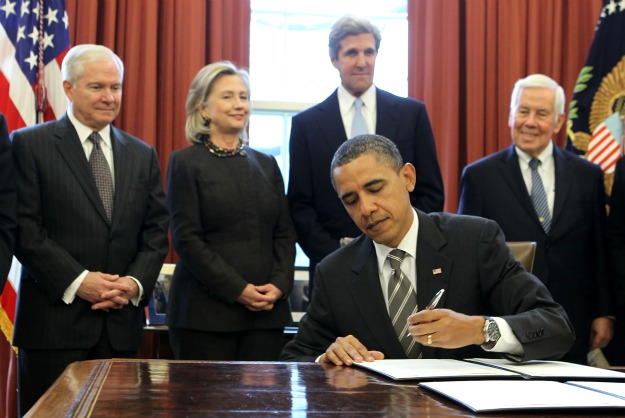
(From left to right) President Obama, Sec. of Defense Bill Gates, then-Sec. of State Hillary Clinton, now-Sec. of State John Kerry and Sen. Richard Lugar, all sit and watch the beginning of the end of the Obama doctrine.

(This is part two of a two-part addition analyzing the causes of the evident failure of the Obama doctrine.)

Given our inner dependence, any world order that elevates one nation or a group of people over another, will inevitably fail. — President Barack Obama speaking in Cairo, Egypt, on June 4, 2009.

In the first article in this series we discussed strategic response to crisis in foreign policy to explain how and why President Obama has found himself in a classic “credibility trap,” constantly and repeatedly tested by Putin and other world leaders. In this article, we will discuss the structure of the international system, and the false presumptions Obama and, progressives, in general, have made about this system.

But before we get started, there are two problems with the statement above, which President Obama made in Cairo, Egypt. Firstly, underscoring the ramifications of electing a little-known, know-it-all president who never sat for a single International Relations 101 or Western Civilization 101 class in the continental U.S., it’s “interdependence,” and not “inner dependence.”

Absolutely embarrassing, truly.

Second, while the progressive worldview regarding the international system has been around for quite some time, never before has it been implemented as a policy, until the presidency of Barack Obama. Now, those who naively believe in a community of nations operating within the boundaries of imaginary, binding international norms, where cooperation trumps security competition, are actually in charge of the one nation whose power has effectively prevented the outbreak of great power conflict.

Unfortunately, the real international system exists in a state of anarchy, not cooperation. Or put another way, there are no global policemen to call if a nation needs to pick up the global phone and call 911. And for reasons we will talk about soon, there will never be one, including the United Nations. Despite claims to the contrary, the U.N. has never been successful at stopping a war since its creation. But before we get into “why” a community of nations will never truly be effective, we must first understand “how” the international system has been structured in the past, and will always be in the future.

There are three “balance of power” scenarios studied in international relations and security studies scholarship, the first of which, progressives like Barack Obama and John Kerry, absolutely hate.

A unipolar system is one in which only one nation has achieved regional hegemony, or a nation that dominates all other states in the regional international system. In applicable history, or the period beginning in the early 19th century when the modern nation-state system emerged, only one power has achieved such a status — the United States of America. Though the 19th century United Kingdom is sometimes referred to as a hegemon, they were not a regional hegemon, because there were four other great powers at the time — Austria, France, Prussia and Russia — and the UK did not have the power to dominate.

A bipolar system, such as the one that existed during the Cold War, is one in which only two great powers have achieved regional hegemony. The two great powers — or, in this case, the U.S. and the Soviet Union (Russia) — dominate other powers in their respective regions and have a capacity to disrupt the global status quo. A bipolar international system was widely thought to be (and still is for many scholars) the most stable balance of power structure, or has the least tendency to lead to great war.

The final and, perhaps, most studied scenario is what we refer to as a multipolar system. While we could break this power structure down to a more specific tripolar or quadpolar system, for instance, the resulting empirical data would not vary. Sadly, this is the preferred system of the American left, and the so-called “progressive” worldview underscored in President Obama’s speech in Cairo, Egypt.

They believe not in U.S. primacy, but in a more social-democratic nation, resembling the former great and now-weak powers of Europe. They see the United States as a bully, and if only the U.S. would stop provoking other nations and be more cooperative, then a less powerful America could peacefully exist in a community of other social-democracies. Unfortunately, they make two problematic presumptions, neither of which are true and both are dangerous.

While it is correct that those who favor unipolar and bipolar systems have both made compelling arguments for why each is the most stable power structure — meaning, they are the least likely to lead to war — no serious scholar argues in favor of multipolarity. Sure, the only unipolar system the world has ever known began with the Gulf War, and the Cold War Era was riddled with small peripheral wars, i.e. Korea, Vietnam, and the Soviet invasion of Afghanistan. However, neither has the proven instability — or, propensity for great war as seen in a multipolar system — which led to catastrophic conflict during the Napoleonic Wars, World War I and World War II.

Multipolarity, as a means to peace through a community of nations, is impossible. When we examine the historical record, then we find that nationalism has always and will always trump ideology and cooperation. Kenneth Waltz, in his seminal book Man, the State, and War, explains how nationalism prevailed over ideology during the 20th century. The entire socialist theory holding that capitalism is the cause of great war, therefore eradicating capitalism will lead to peace, was completely demolished.

And the same logic is applicable to the democratic peace theory, or the claim that democracies do not go to war with each other. This is equally untrue, as John Mearsheimer unequivocally shows in The Tragedy of Great Power Politics, and in only one relatively short chapter, no less. This theory, most notably put forward by Bruce Russett in Grasping the Democratic Peace, must rely upon cherry-picking data and obfuscation over what constitutes a true democracy or an actual war.

Titans of international relations theory, such as John Mearsheimer (offensive realism) and Kenneth Waltz (defensive realism), debate why nations seek to increase their relative power, not whether or not they do. The naive and ignorant foreign policy of the Obama administration dangerously refuses to acknowledge this fact, and if history and empirical evidence tell us anything, the Obama doctrine has not only failed, but put the world at risk of another great war. In fact, there is a good deal of evidence to argue, as Dale C. Copeland argued in The Origins of Major War, that a declining U.S. is likely to lead to a challenge by another great power, such as Russia or China.

This is the simple nature of the international system of anarchy nation-states and state actors exists within. And in this natural state of anarchy, American primacy was the only truly stabilizing power, despite the feeble existence of the United Nations and the European Union.

In part two of a two-part addition

Gov. John Kasich (R-OH) appeared on Fox News Sunday with Chris Wallace to discuss the Ohio economic turnaround under his governorship. With a 6.5 percent unemployment rate, Ohio leads the Midwest in job creation and is number five in the nation.

When Gov. Kasich took over the helm in the Buckeye State, following his 2010 electoral victory over incumbent Democratic Gov. Ted Strickland, the unemployment rate in Ohio was over 10 percent. The state was drowning in an $8.5 billion deficit, but under the former congressional budget wonk that has turned into a $1.5 billion surplus.

Still, his Democratic opponent, Cuyahoga County (Cleveland) Executive Ed FitzGerald, has fallen back on the typical Democratic class warfare rhetoric, accusing Kasich of implementing economic policies that favor the wealthy.

“Look, you posted the numbers and the proof is in the pudding,” Kasich said, likening his economic philosophy that led to the dramatic turnaround in Ohio to the same policies under former President Ronald Reagan. He added that “like Ronald Reagan, we know that some taxes penalize economic growth and some encourage economic growth.” Kasich noted that his new proposed tax plan increases the earned income credit for lower income Ohioans, while cutting the state income tax to encourage investment.

Though he repeatedly compared his policies to the former president and Republican standard-bearer, the governor insisted he has no plans to run for president in 2016. He joked that when he ran for president in 2000, “no one wanted to talk to me. Now, that’s all anyone wants to talk about.”

Gov. Kasich said his focus is on Ohio, and while he refused to sign a pledge posted on FitzGerald’s website, which would bind all signers to serve a full term in office, he stated his first priority was getting reelected and finishing the job of “making the Buckeye State number one” in the country.

Kasich is favored to win reelection in 2014 and the Ohio Governor race is currently rated “Likely Republican” on our 2014 Governor Map Predictions.

The latest Quinnipiac University Poll has Kasich leading FitzGerald by five points, but other surveys have found a larger margin. He is supported by a healthy majority of independents, but has yet to coalesce the right completely, largely because of anger over his decision to take federal dollars for Medicaid expansion.

Answering the critics, who say refusing to set up a state-based exchange while taking the federal money, Kasich said that he could have left the money in Washington or brought it back to the state. He said, because he was up there for 18 years, he knows the money would be put to better use by the state of Ohio. He plans to use the money to help those suffering from drug addiction and mental health illnesses get back “into the mainstream and give them a chance to achieve their God-given potential.”

Kasich joins a growing list of Republicans who support policies that would reduce the criminalities of drug use. “Those people should not be sitting in our prisons, that’s just unconscionable,” he said.

Gov. John Kasich (R-OH) appeared on Fox

People's Pundit Daily
You have %%pigeonMeterAvailable%% free %%pigeonCopyPage%% remaining this month. Get unlimited access and support reader-funded, independent data journalism.

Start a 14-day free trial now. Pay later!

Start Trial