Widget Image
Follow PPD Social Media
Friday, January 16, 2026
HomeStandard Blog Whole Post (Page 980)

Wisconsin governor race

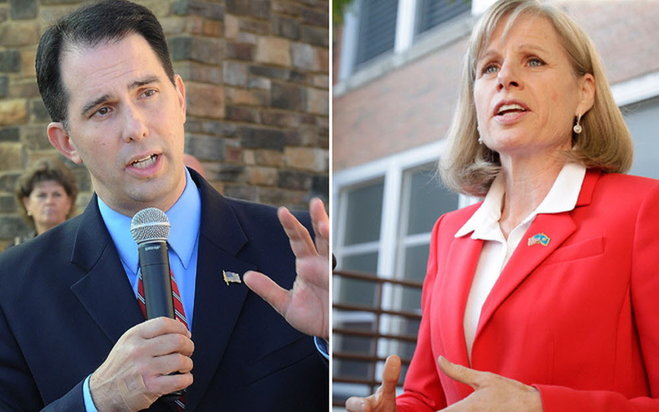
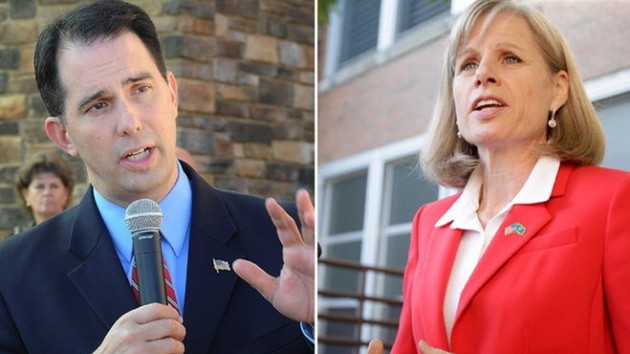
Incumbent Republican Gov. Scott Walker (left) is likely to defeat Democrat Mary Burke, according to the latest WI Gov polls and variables used to determine election predictions in model used at People’s Pundit Daily.com.

The latest WI governor polls show incumbent Republican Gov. Scott Walker with an advantage over Democrat Mary Burke. Because the polling surveys that have Walker ahead come from pollsters who have a particularly stellar track record of accuracy, we see no reason to adjust our “Likely Republican” rating on our 2014 Governor Map Predictions.
In the latest survey conducted for Human Events by Gravis Marketing, voters were asked “If the election for Governor were held today, would you vote for Republican Scott Walker, or Democrat Mary Burke?”

Among all respondent voters, 49 percent said they will vote for Scott Walker, while only 44 percent said they would vote for Mary Burke. While voters are generally split down party lines, independents break against Burke and go for Walker 37.7 percent to 47.4 percent, respectively.

As avid readers of People’s Pundit Daily know, we rate pollsters based on past performance for accuracy and assign them a rating of 1 through 4, with 1 being the top rating a pollster can be assigned. Because Gravis Marketing has a stellar rating (1.5) based upon past accuracy, and Rasmussen Reports has a negative-leaning rating (4), we are assured the race is going in Walker’s favor.

Admittedly, even the least-accurate pollster get things right from time to time, as even a stopped clock is right twice a day, and visa versa. But we simply cannot corroborate that the race is as close as Rasmussen Reports said it is. When it comes to the state of Wisconsin, specifically, Marquette University takes the top spot for accuracy, as they nailed the Walker 2010 election, the recall contest and the 2012 presidential election, each time. Marquette University currently has a stellar rating (1).

The latest Marquette University Poll, which was released after the initial publication of this article, has indeed corroborated our assessment of the status of race.

The new Marquette Law School Poll found Gov. Scott Walker leading Democrat Mary Burke 48 to 41 percent. Though voters are split on the job performance at 47 percent, by 54 to 42 percent they say the state is headed in the right direction, but also voters favor the Walker agenda. A majority, 55 percent, favor the $500 million tax cut enacted by the legislature and signed into law by Walker, while 34 percent oppose the tax reduction. This is the case even though 58 percent say those tax cuts do more to benefit the wealthy, while 25 percent see the middle class and 9 percent see the poor as benefiting more.

That’s a real testament to Walker’s ability to articulate the conservative agenda, without class warfare distracting from the overall result. While Burke has time and room to improve, she is seen unfavorably by a  margin of 19 to 22 percent, while Walker is above water 49 favorable to 47 unfavorable.

Until we see data from a reputable pollster or an immense surge in fundraising, then the race is “Likely” Walker’s to lose.

View Polling (UPDATED) Below, Expanded WI Governor Race Analysis Or Return To 2014 Governor Map

Poll Date Sample Walker (R) Burke (D) Spread
PPD Average 3/10 – 3/23 46.5 43.0 Walker +5
Marquette University 3/20 – 3/23 801 RV 48 41 Walker +7
Rasmussen Reports 3/10 – 3/11 500 LV 45 45 Tie
Marquette University 1/20 – 1/23 802 RV 47 41 Walker +6
Marquette University 10/21 – 10/24 800 RV 47 45 Walker +2
PPP (D) 9/13 – 9/16 1180 RV 48 42 Walker +6


The latest WI governor polls show incumbent
russian special forces

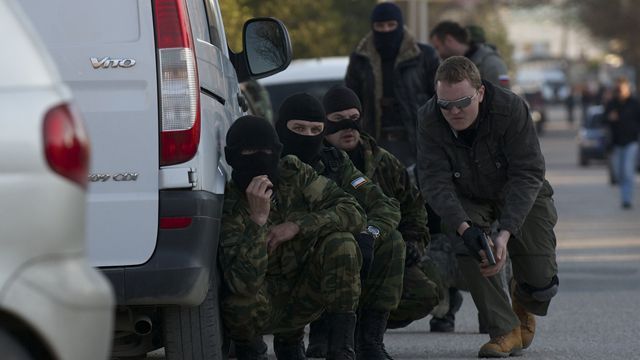
Russian special forces and an Armored Personnel Carrier smashed through the front gate of the Belbek base, which is located near the port city of Sevastopol.

Russian special forces attacked an important Ukrainian air force base in the Crimea region, smashing through concrete walls with four armored personnel carriers.

Two officers were was injured by gunshot wounds in the assault at Belbek Airbase, a Ukraine Defense ministry official confirmed, while the base commander is in the custody of Russian special forces.

Outrageously, even journalists, including foreign journalists, were beaten by the Russian forces.

An Armored Personnel Carrier smashed through the front gate of the Belbek base, which is located near the port city of Sevastopol. The aggression was captured by footage released by the Ukrainian Defense ministry.

The Ukrainian commander of the base, Yuliy Mamchur, reported there was at least one injury. While preparing for the Russian special forces assault, Mamchur assembled his men and they sang the Ukrainian national anthem, as they stood at ease. He reportedly said they were going to turn over their weapons, but also told CNN that they could expect his forces to be resisting Russian control of the base. Reuters also reported a similar statement.

Russian troops had surrounded the Ukrainian airbase and issued an ultimatum to forces inside to surrender, and now Mamchur is negotiating with the Russians.

Following the Crimea referendum, Russian forces have been seizing Ukrainian military facilities for several days in the Black Sea peninsula, which was formally legitimized according to Russia with the final proposal signed by Putin in Moscow. Belbek is just one of the few military bases controlled by Ukraine in the region, but it is a vital installation.

Not that Crimea is effectively under the control of Russia, which ring Ukrainian military bases on the strategic Black Sea peninsula, concern is rising that Ukraine’s eastern regions will also come under Russia assault.

Russia has brought large military forces to areas near the border with eastern Ukraine. Russian President Vladimir Putin has said there is no intention to move into eastern Ukraine, but the prospect appears high despite economic ramifications.

Eastern Ukraine is the heart and soul of Ukraine’s economic treasures, including vital heavy industry and mining, as well as the support base for Viktor Yanukovych, the Ukrainian president who fled to Russia last month after being ousted in the wake of three months of protests in the capital, Kiev.


The local parliament on Friday formed a working group to develop a referendum analogous to the one in Crimea. Activists on Saturday passed out mock ballots, although no referendum has been formally called.

A number of leading pro-Russian activists have already been detained by police on suspicion of fomenting secessionist activities. The country’s security services said Saturday that they have arrested Mikhail Chumachenko, leader of the self-styled Donbass People’s Militia, on suspicion of seeking to seize authority.

With developments in the region growing more tense, the Organization for Security and Cooperation in Europe is deploying an observer team aimed at easing the crisis, but it is unclear whether the team will even be allowed into Crimea.

Russian Foreign Ministry spokesman Alexander Lukashevich said in a statement on Friday that Moscow hopes that the 200-strong team “will help to overcome the internal Ukrainian crisis” and ensure the respect for human rights there.

Russian forces last week stopped OSCE military observers from entering Crimea. The organization on Friday did not specify whether the observers will go to Crimea.

Lukashevich said on Saturday that the OSCE’s mission “will reflect the new political and legal order and will not cover Crimea and Sevastopol which became part of Russia.”

Daniel Baer, the United States’ chief envoy to OSCE, said the observers should have access to the territory because Crimea remains Ukrainian to the rest of the world.

Russian special forces attacked the important Ukrainian

obama foreign policy doctrine

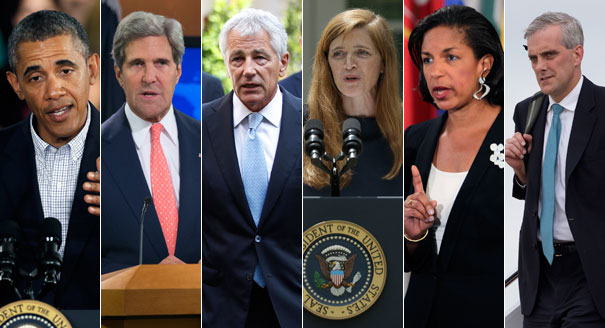
(From left to right) President Barack Obama, Sec. of State John Kerry, Sec. of Defense Chuck Hagel, UN Ambassador Samantha Power, National Security Advisor Susan Rice and WH Chief of Staff Denis McDonough, all will be judged harshly when scholars assess the Obama foreign policy doctrine.

(This is part one of a two-part addition analyzing the causes of the evident failure of the Obama doctrine.)

I have always found it ironic how liberal-progressives are hailed as intellectuals, yet with respect to foreign policy, progressives pursue careless, naive and even downright dangerous doctrines. If there was any confusion remaining in the security studies community, it has now become evident that the failure of the Obama foreign policy doctrine has put the U.S., our allies and the whole world in grave danger.

Admittedly, that sounds like an overblown assessment. But the disconnect between the reality of statecraft and the worldview responsible for the Obama foreign policy doctrine, really is that serious. While liberalism or internationalism is the dominant worldview in the halls of the elitist and disconnected State Department (and the halls of the New York Times and Washington Post for that matter), real events in history and actual empirical evidence used in advanced scholarship to study them, are dominated by realism.

Specifically, let’s look at two areas where the Obama foreign policy doctrine clearly made false presumptions: strategic response to crisis in foreign policy and the international system. In part 1, we will look at strategy, using history and international relations theory to explain the failures of this administration’s foreign policy.

Populated by a cabinet that an adoring media referred to as the “best and the brightest,” the Kennedy administration abandoned the “asymmetrical” approach to responding to crisis in foreign policy under Eisenhower. The approach practiced the policy of “massive retaliation,” a brainchild of Eisenhower’s Secretary of State John Foster Dulles, who believed the U.S. was forced into a conflict with North Korea and China because the communists weren’t convinced that President Truman, who was a the liberal internationalists, would massively retaliate against Moscow or Beijing in response.

He was right. Yet, throughout the Republican Eisenhower administration the U.S. managed to avoid starting another peripheral or great war, because the war-tested Eisenhower made enemies a believable promise that challengers to the U.S.-favored status quo would be bombed back to the stone age.

However, rather than continuing the promise of “massive retaliation” in response to unqualified threats to U.S. interests, the “best and the brightest” instead favored a “symmetrical,” or “proportional” response. In other words, how the U.S. responded in the face of challenges to the status quo was based on the severity of the threat and whether or not it was a vital or secondary U.S. interest. President Carter, though he based his foreign policy uniquely on a human rights platform, also took a symmetrical response, which Reagan reversed with his “peace through strength” doctrine.

Unfortunately, the Obama foreign policy doctrine subscribes to this approach, despite its historical failure, as made evident by Kerry’s use of the words “appropriate” and “proportional” when describing the U.S. response to Russia annexing Crimea.

On paper, in the Ivory Tower, this approach must have looked reasonable, and perhaps it still does to many Americans. But it’s a dangerous and foolish approach to foreign policy.

For starters, liberals who subscribe to “symmetrical” response are never clear — with the American people or themselves — on what defines a “vital” or “secondary” interest. Thus, neither are other nation-states, which makes for a dangerously unstable environment for decision-making actors to have to navigate within. But, because nations are constantly trying to increase their relative power, world leaders will constantly test the U.S. with crisis if they know “massive retaliation” against them is off the table.

For simplicity, we could accurately use the “give an inch and they’ll take a foot” metaphor, which is exactly what happened to Kennedy prior to the Cuban Missile Crisis and Vietnam. In the case of the Cuban Missile Crisis, Kennedy believed the prior plan crafted by Eisenhower was too strong, thus he reduced air support and force levels participating in the coup. The result was the Bay of Pigs. Further, considering Kennedy acquiesced to Nikita Khrushchev on the Berlin Wall, following what was widely viewed to be a weak performance by the young liberal during the June meeting in 1961, the Cuban Missile Crisis was inevitable.

Security scholars certainly differ on the question of U.S. involvement in Vietnam had President Kennedy not been assassinated, but there is a strong consensus that he would have faced the same crisis of credibility that faced President Johnson. Kennedy answered communist expansion into Asia with drips and drabs of troop deployments, an unconvincing strategy that said to enemies that the U.S. was not committed, and led to a massive buildup before and during the Johnson administration.

An ambitious power, if you let them, will take unless another great power or superpower stops them or they believe they have achieved their goal. Those who take a symmetrical approach have in the past — and will always in the future — fall in to the classic “credibility trap,” which is where Obama found himself after his “red line” debacle in Syria and finds himself now in the Ukraine crisis. What President Obama and liberals do not understand about foreign policy is that statecraft is interconnected, and no event in the international system of anarchy is trivial.

Removing the missile defense systems from Poland affected developments in Ukraine and Crimea. Failing to act on a self-imposed “red line” in Syria affected the decision-making of Vladimir Putin, and Obama’s weak response to Crimea will affect the decision-making process of Iranian leaders, who will now no longer be pressured by Russia and free to resume their nuclear program. And behind the scenes, China watches and plot how far they can push the envelope in the South China Sea, already initiating air defense zones that they knew Obama would not challenge.

Strategy is one area that explains the Obama administration’s foreign policy failures, but it is a symptom of a greater problem, which is ideological in nature. Obama and other progressives hold a dangerous worldview, which falsely believes the international system is filled with binding imaginary norms that promote the equality of nations. They naively believe in a community of nations that operate within the boundaries of imaginary, binding international norms, where cooperation trumps security competition.

It is at the heart of this ideology where we find the reason the Obama doctrine has failed, and this failure has truly put the U.S., our allies and the entire world in grave danger.

(Read Part 2: Obama Doctrine Not Only Failed, But Put World At Risk Of Another Great War)

Liberal-progressives are hailed as intellectuals, yet with

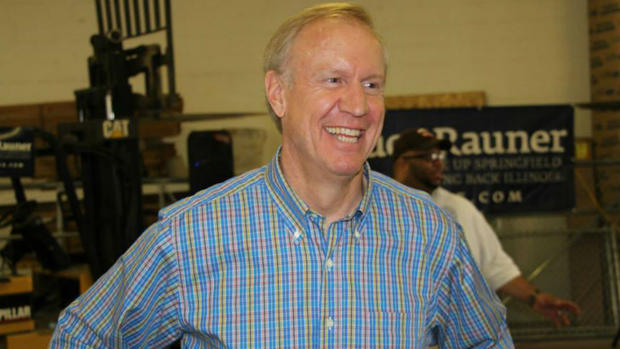
If Illinois Democrats endorse Bruce Rauner over Democrat Gov. Pat Quinn, then the incumbent would be in a lot more trouble than even we at PPD may have thought.

Former Kennedy administration official and Democratic activist Newton Minow, appeared on Thursday with roguhly a dozen other Illinois Democrats and independents to announce their endorsement of Republican Bruce Rauner in the Illinois Governor race, which we now rate “Leans Republican” on our 2014 Governor Map Predictions.

Minow, 88, an attorney and President John F. Kennedy’s chairman of the Federal Communications Commission, said Rauner would be the bipartisan leader for what is now a centrist Midwestern state that needs him.

“President Kennedy once said, ‘Sometimes party loyalty asks too much,'” said Minow. “I think this is one of those times. I’m a strong Democrat, but I’m taking a leave of absence from my party because Illinois is in desperate shape.”

Minow said the state can change course with Rauner before it is too late, as pension to debt ratios threaten to overwhelm the state tied with Nevada for the country’s second highest unemployment rate at 8.7 percent.

Rauner, a political newcomer, will face vulnerable incumbent Democratic Governor Pat Quinn, who took office in 2009 following the impeachment of Rod Blagojevich, another Democrat who is now in prison for corruption.

Rauner has avoided social issues in his campaign, and has opted instead to focus on the plethora of economic problems in Illinois, which is the adopted home-state of President Barack Obama.

Also appearing at the Chicago press conference was Manny Sanchez, an attorney who also served as a member of the Democratic National Finance Committee in the past, and Rauner’s wife, Diana Rauner, who just happens to also be a Democrat.

“Bruce and Diana have a bipartisan home life,” said Minow. “They’ll also have a bipartisan administration. There won’t be a big difference between Democrats and Republicans because the problems are too tough.”

When asked if he would cut the number of state employees to reduce public spending, Rauner said the state’s workers could be more productive and efficient through better use of technology, which he said is “woefully behind” other states and the public sector. And he is correct to make that assessment.

The contest between Gov. Pat Quinn and Bruce Rauner will be a tough and expensive contest, because Rauner has taken a strong stance against labor unions’ power in state government, which is fueling an inevitable Detroit-like bankruptcy. Unions say they back Quinn’s candidacy, however, they opposed a pension reform bill he supported.

A spokesman for Quinn’s campaign was not immediately available for comment, so it is unclear whether or not he would change course regarding his campaign strategy. The fact that Illinois Democrats endorse Bruce Rauner has shaken the Quinn campaign, likening the situation to New Jersey Democrats who endorsed Gov. Chris Christie in his big reelection win.

Gov. Pat Quinn recently told Lynne Sweet of Illinois’ preeminent political blog, Capitol Fax, that he “sees no need at this stage to put together a data-digital-social media-driven operation that is the hallmark of many campaigns because, he told me, he has an army of foot soldiers.”

If Illinois Democrats endorse Bruce Rauner over

While Australian authorities said Friday they have called off their second day of searching for Flight 370, a military source with close ties to Boeing officials working on the mystery of the missing plane found the Pakistan theory “credible.” Lt. General Tom McInerney, a retired Air Force commander and Fox News contributor, raised eyebrows this week when he introduced the possible scenario the plane had landed in western Pakistan.

“I think those passengers have the potential of still being alive, and I believe that airplane landed,” Lt. General McInerney told Sean Hannity.

But the source agreed with McInerney that there has been no evidence to suggest the plane continued South, citing what they characterized to be “sophisticated radar systems” in Indonesia and particularly Singapore. Radar would have picked up Flight 370 based upon altitude data transmitted by the two Rolls-Royce Trent 800 engines sending routine performance reports.

This person also confirmed that the SATCOM was still pinging throughout the estimated flight time, which raises the question — if in fact there was some form of a tragic accident — why neither the pilot nor co-pilot ever said a word about it.

Further, as stated by McInerney, the distance from Kuala Lumpur to Beijing is nearly the exact same distance from Kuala Lumpur to Lahore, Pakistan, located just South of Quetta International Airport in Pakistan. Malaysian government officials confirmed they did, in fact, suspiciously ask for cooperation or “assistance” from the Pakistani government Tuesday. When the missing plane was last picked up by a satellite at 8:11 PM, the flight was headed toward India on a Northwest trajectory, which would have put the plane on a clear path to Pakistan.

Both India and Pakistan have denied that the missing plane is anywhere in their territories or airspace, or that any of its citizens were somehow involved in its disappearance. “The idea that the plane flew through Indian airspace for several hours without anyone noticing is bizarre,” an Indian defense ministry official said. “These are wild reports, without any basis.”

There have been even more suspicious developments, or rather events that don’t corroborate with officials’ stories, which lend credence to the claim made by Lt. General McInerney. When asked whether or not it was possible that Flight 370 could fly in the shadow of Singapore Flight 68, which would at least explain the India blackout, the military official said “a Boeing 777-200ER could fly in the shadow of another flight with relative ease,” though there is no evidence to suggest that it did.

President Barack Obama said Wednesday that finding out what happened to the missing plane from Malaysia Airlines is a top U.S. priority. During what was his first public appearance since the disappearance, Obama said he wanted the families of the 239 missing people on the plane to know that the United States will keep working “to see if we can get to the bottom of this.”

However, a U.S. destroyer, which had covered 15,000 square miles of water in its effort, had left the search several days before. The fact that the destroyer and the majority of U.S. naval vessels taking part in the search had been called back, spoke volumes to what the U.S. may or may not have already known.

The source, who made clear they are not privy to the missing plane’s location, said they believe the search off the coast of Australia “is likely a decoy.” U.S. naval vessels only returned to the joint, multi-nation naval search after General McInerney made his claims Wednesday.

“Israel doesn’t increase air defense everytime a pilot aimlessly flies a plane until the fuel runs out and crashes in the South Indian Ocean.”

John Lucich, a former New Jersey State investigator also said, “in my opinion — based on the information that has come out — I believe this plane has landed somewhere; that they have hostages and an airplane now.”

The FBI has now taken into their possession the pilot’s computer and flight simulator data, which the Malaysian government had said was wiped clean and checked. Of course, they also said they originally cleared both the pilot and co-pilot.

As far as the reason terrorists may have settled on a Boeing 777-200ER, the military source with strong ties to the defense contractor company, said the plane is capable of far more than the media has been reporting. It is little-known that this particular plane can be remotely operated without any assistance from actual onboard pilots. And while this model was equipped with two Roll-Royce Trent 800 engines, others are also powered by engines made by General Electric and Pratt and Whitney.

However, “the Rolls-Royce Trent 800 engines are designed to power the flight of an airtank and not just an airbus,” the source said. “If hit with a variety of munitions, these two engines will not only not be disrupted, but the design is such they will literally spit them out.”

While Australian authorities said Friday they have

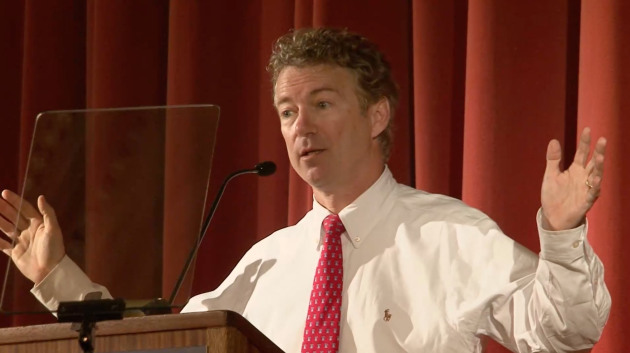
Two days ago, libertarian-leaning Republican Senator Rand Paul (R-KY) spoke at UC Berkeley, an event that was hosted by the Berkeley Forum student organization. Senator Paul fired up the crowd when he spoke about his class-action lawsuit against the Obama administration and the National Security Agency.

Up until now, the Democratic Party has been able to reconcile the oxymoron that logically becomes apparent when a party promoting big government also tries to claim they stand for civil liberty. This oil and vinegar mixture was exposed when the NSA spying program was blown wide open by Edward Snowden. Now, the likes of Senator Dianne Feinstein (D-CA), who voted in favor of John Brennan while Paul was filibustering his nomination over the drone program, has tried to come out against domestic spying.

Paul wasn’t buying it.

“I don’t know about you, but I’m worried. If the CIA is spying on Congress, who exactly can or will stop them? I look into the eyes of senators and I think I see real fear. Maybe it’s just my imagination, but I think I perceive fear of an intelligence community drunk with power, unrepentant, and uninclined to relinquish power,” Senator Paul said.

The UC Berkeley appearance is just the latest speech in what has been a concerted effort by Senator Rand Paul to introduce the liberty message to voters who typically do not support the Republican Party. Paul, unlike many other Republicans, has been working tirelessly to expand the reach and appeal of the party, hoping to move the party toward a more mainstreamed, liberty-based message.

Paul also reached out to inner-city minority voters in Detroit, Michigan, back in December, when he introduced an economic plan to bring prosperity and stability back to downtrodden neighborhoods who have been failed by progressivism.

What Rand Paul is doing is politically significant, and would have much more weight behind it if it was a mainstream Republican Party plan. While the party has been closing the tech and talent gaps, and also increasing appeal among minorities, Paul is setting the parameters of what could be a model template for the party. The groups targeted by Paul all have one thing in common.

All of these groups have been taken for granted by the Democratic Party. Alongside domestic spying, ObamaCare and the inevitable economic reckoning fueled by national debt, has thrown the younger generations under the bus. Big government policies have ensured future generations must pay for the decisions Obama and Democrats didn’t have the courage to make.

However, whether or not the Republican Party can be successful in getting younger Americans to understand this and who is to blame, remains very uncertain.

Two days ago, libertarian-leaning Republican Senator Rand

Russia annexes Crimea

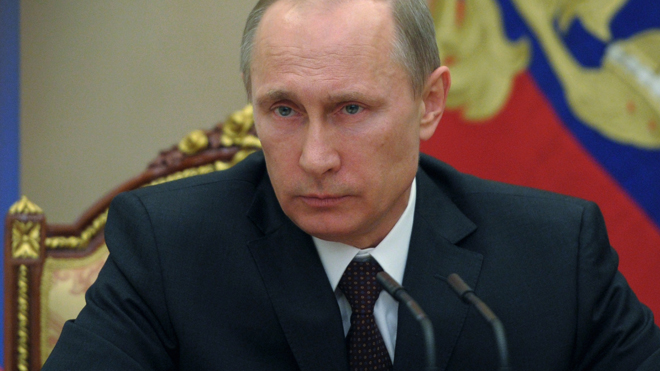
Russian President Vladimir Putin chairs a meeting with Security Council members in the Kremlin in Moscow, Russia, Friday, March 21, 2014. There is no need for Russia to further retaliate against U.S. sanctions, President Vladimir Putin said Friday as Russia annexes Crimea from Ukraine. (AP Photo/RIA-Novosti, Alexei Druzhinin, Presidential Press Service)

President Vladimir Putin signed bills at the Kremlin Friday completing the process that began with the parliamentary vote to take over the Crimea region. As Russia annexes Crimea officially from Ukraine, the U.S. and the European Union have responded by placing targeted economic sanctions on Russia.

Putin hailed the incorporation of Crimea into Russia as a “remarkable event” before he signed the bills into law. Ukraine and the West have rejected the earlier vote by Russian parliament held two weeks after Russian troops had taken over Crimea.

President Obama signed a second executive order Thursday targeting members of Putin’s inner circle and one major bank supporting them.

Russian stock plummeted Friday following the S&P downgrading Russia’s outlook to “negative,” specifically citing the potential for further sanctions and Russia’s lack of economic diversity.

Putin said in televised remarks at Friday’s session of the presidential Security Council that he sees no immediate need for further Russian retaliation. Mocking President Obama, Putin said he planned to open an account in the one targeted bank named in the president’s executive order.

Putin’s statement suggests the Russian president wants to continue relations with the West despite the tensions over Ukraine. He said that Russia will keep funding a program to service Afghan helicopters and train their crews that has been conducted jointly with NATO.

Whether or not the economic ramifications cited by the rating agency had any bearing on his decision, cannot be known for sure.

Meanwhile in Brussels, Ukrainian Prime Minister Arseniy Yatsenyuk and EU leaders signed an association agreement that was part of the pact that former President Viktor Yanukovych backed out of last November in favor of a $15 billion bailout from Russia.

That decision sparked the protests that ultimately led to his downfall and flight last month, setting off one of Europe’s worst political crises since the Cold War.

Meanwhile, Ukraine’s prime minister has pulled his nation closer into Europe’s orbit by signing a political association agreement with the EU at a summit of the bloc’s leaders.

Ironically, the agreement signed Friday between Prime Minister Arseniy Yatsenyuk and EU leaders was part of the pact that former President Viktor Yanukovych rejected last November in favor of a $15 billion bailout from Russia. It was that very decision that set off the Ukraine protests and ultimately led to Yanukovych fleeing the presidential palace last month, sparking one of Europe’s worst political crises since the Cold War.

President Vladimir Putin signed bills at the

Wednesday, the Federal Reserve released the 2014 bank stress test results conducted on the largest U.S. banks to show how they’d hold up in a hypothetical economic meltdown.

According to the Fed, the banks examined — which were 30 with assets of more than $50 billion —  could easily withstand a crisis of even worse proportions than the 2008 financial crisis. In fact, they are supposedly in a better position today to continue lending to businesses and consumers, while continuing to pay off their debts in the aftermath of a financial downturn than they were five years ago.

Among the banks the Fed says passed the tests with flying colors were JPMorgan Chase (JPM), Citigroup (C), Morgan Stanley (MS), Bank of America (BAC), Goldman Sachs (GS) and Wells Fargo (WFC).

The only bank that didn’t meet the Fed’s requirements was Zions Bancorp (ZION). However, officials at the Fed told reporters that Zions still has time to meet the requirements through a capital plan it is set to release next week at the same time the other banks release their plans.

“The annual stress test is one of the Federal Reserve’s most important tools to gauge the resiliency of the financial sector and to help ensure that the largest firms have strong capital positions,” Fed Governor Daniel Tarullo said in a statement.

Banks that fared the best were State Street (STT), Discover Financial (DSF) and Bank of New York Mellon (BNY).

In a statement, the Fed claimed that the biggest U.S. banks would lose at least $501 billion, and that their regulatory capital levels would be reduced by 41 percent. The hypothetical scenario crafted by the central bank would be equivalent to an economic crisis that would tower above the 2008 crisis.

The hypothetical scenarios used in the bank stress test includes a peak unemployment rate of 11.4 percent, a 50 percent drop in stock markets and a 25 percent fall in housing prices.

The banking stress test results are a product of the Dodd-Frank banking reform bill, which requires the Fed to determine how the banks — those in the too-big-to-fail category — would perform in the event of another financial crisis.

The Fed now requires banks to have a minimum tier 1 common capital ratio of 5 percent during a severe economic downturn.

Zions, the only bank to fail in the bank stress test results, had a tier 1 capital ratio that fell to 3.5 percent during the most severe stress scenario, naturally below the minimum.

“Capital is important to banking organizations, the financial system, and the economy broadly because it acts as a cushion to absorb losses and helps to ensure that losses are borne by shareholders, not taxpayers,” the Fed said in its statement.

The Fed will announce next week which banks’ plans to pay dividends or buy back shares were approved.

Wednesday, the Federal Reserve released the 2014

S&P downgrades Russia

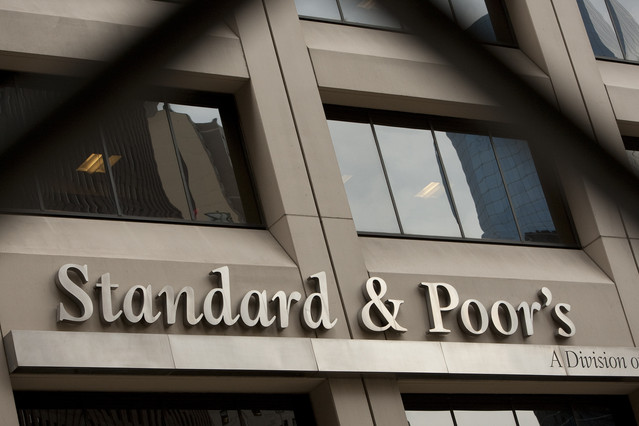
If S&P downgrades Russia, will the threat of economic blowback deter Vladimir Putin in the Ukraine or Crimea? Well, the global markets and world leaders are about to find out. A few hours after President Obama threatened future economic sanctions affecting key sectors of Russia’s economy, the rating agency Standard & Poor’s downgraded its outlook on Russia to “negative.”

The move comes amid fears over the economic fallout of the deteriorating geopolitical situation in the Ukraine, Russia and the Crimea.

Whether or not Putin weighs the ramifications of Moscow’s annexation of Crimea, which has slammed Russia’s equity and currency markets, is still an unknown.

“The outlook revision reflects our view of the material and unanticipated economic and financial consequences that EU and U.S. sanctions could have on Russia’s creditworthiness following Russia’s incorporation of Crimea,” S&P said in the report.

S&P specifically cited the prospect of U.S. and European Union economic sanctions in response to the developments in Crimea, a move that could reduce the flow of potential investment, fuel capital outflows and weaken Russia’s overall economy.

Earlier, Obama signed a new executive order expanding the U.S. government’s ability to hit Russia’s economic sectors, including banking, energy, metals and mining, engineering and defense companies.

“This is not our preferred outcome… However, Russia must know that further escalation will only isolate it further from the international community,” the president said.

S&P said there is at least a 1 in 3 chance that S&P could reassess risks to Russia’s overall creditworthiness, citing the country’s “deteriorating” external profile and limited monetary policy flexibility. S&P said it could downgrade Russia at anytime within the next 24 months.

The S&P report claimed they believe the geopolitical crisis has already hurt Russia’s economy, as evidenced by the need for the central bank to intervene in foreign-exchange markets and dramatically hike interest rates. The Russian economy is lacking in diversity, which makes it particularly susceptible to economic sanctions.

Further, S&P also downgraded its gross domestic product growth forecast for Russia for 2014 and 2015 to 1.2 percent and 2.2 percent, respectively. Growth had already slowed to just 1.3 percent in 2013, which is the lowest rate since 1999, excluding the global economic crisis in 2009.

S&P warned it foresees a real risk that the conflict between Russia and Ukraine could expand beyond Crimea.

On the other hand, S&P said it could upgrade its outlook on Russia to “stable” if the country’s economy were to “prove resilient to the current challenges.”

It was also learned Thursday that the Securities and Exchange Commission had recently contacted public funds who have exposure to at-risk Russian markets in order to confirm they are properly weighing risks and properly disclosing their investments.

If S&P downgrades Russia, will the threat

economic sanctions

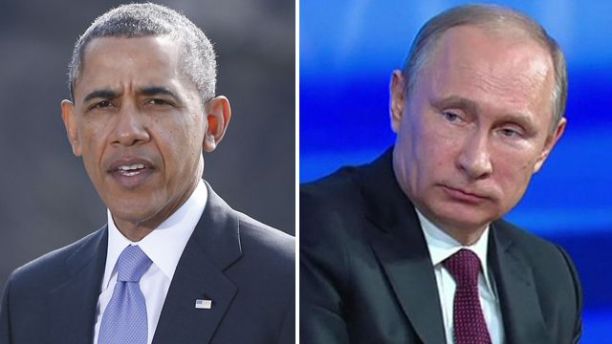
Obama and Putin are going tit-for-tat with each other imposing economic sanctions and banning top officials from traveling into the U.S. and Russia.

Just moments after President Obama signed an executive order authorizing future economic sanctions on Russia, including penalties on 20 Russians inside and outside the government, Putin banned nine American officials from entering Russia. At the top of the list you will find House Speaker John Boehner (R-OH), Senate Majority Leader Harry Reid (D-NV) and Senator John McCain (R-AZ).

Earlier this week, Vladimir Putin scoffed at U.S. sanctions on 7 Russian officials, and now it is the Americans’ turn to scoff at Moscow.

“I guess this means my spring break in Siberia is off, my Gazprom stock is lost, and my secret bank account in Moscow is frozen,” McCain said in a statement. “Nonetheless, I will never cease my efforts on behalf of the freedom, independence, and territorial integrity of Ukraine, including Crimea.”

A spokesman for Speaker Boehner, Michael Steel, said the speaker “is proud to be included on a list of those willing to stand against Putin’s aggression.”

Meanwhile, Obama signed an executive order that would allow the U.S. to place economic sanctions on key sectors of the Russian economy. Officials said Obama may act on that authority if Russian presence increases into other regions of Ukraine. 

The order freed up the U.S. government’s ability to hit Russia’s economic sectors, including banking, energy, metals and mining, engineering and defense companies. “This is not our preferred outcome… However, Russia must know that further escalation will only isolate it further from the international community,” the president said.

The president, speaking on the South Lawn of the White House, stated that the current locations of the Russian military suggests they could be contemplating “further incursions” into southern and eastern Ukraine.

The president cautioned that the threatened economic sanctions if implemented could hurt the global economy, as well as the Russian economy, but “Russia must know that further escalation will only isolate it further from the international community.”

Obama said the U.S. will impose sanctions on more “senior officials of the Russian government,” as well as “a number of individuals” who are known for supporting Russian leadership. And a bank — Bank Rossiya — which is also providing “material support,” will be targeted, as well. The list also includes Putin’s chief of staff and his banker.

The president, in an interview only a day earlier, ruled out the military option in response to Crimea. Yet the administration says they continue to assure NATO allies in the region that America’s support is “unwavering.”

Still, Obama stressed Thursday that “diplomacy between the United States and Russia continues.”

After President Obama signed an executive order

People's Pundit Daily
You have %%pigeonMeterAvailable%% free %%pigeonCopyPage%% remaining this month. Get unlimited access and support reader-funded, independent data journalism.

Start a 14-day free trial now. Pay later!

Start Trial