Widget Image
Follow PPD Social Media
Wednesday, January 14, 2026
HomeStandard Blog Whole Post (Page 867)

President-Obama-Meets-with-President-Nieto-of-Mexico

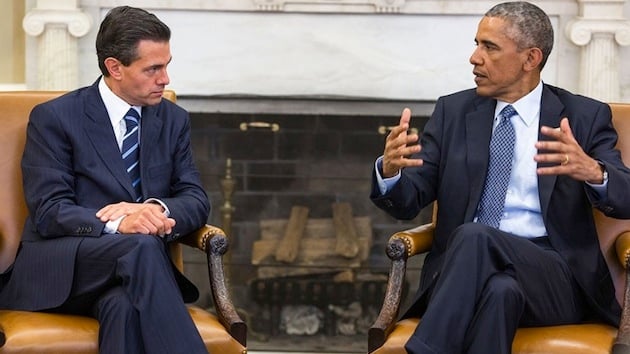
On January 6, 2015, President Obama delivers remarks after meeting with President Pena Nieto of Mexico. (Photo: YouTube/White House)

President Obama met with Mexico President Pena Nieto Tuesday, but a majority of American voters support pulling US aid to Mexico if illegal immigration continues.

Voters say the Mexican government doesn’t do enough to stop illegal immigration and drug trafficking, nor does it even want to stop either. According to a new survey from Rasmussen Reports, only 14 percent of likely voters think the Mexican government wants to stop its citizens from illegally entering the United States, while 55 percent say Mexico is not interested in stopping illegal immigration.

As a result, they favor stopping US aid to our southern neighbor until it does more to prevent illegal border crossings.

However, a significant number of likely voters (31 percent) say they are not sure.

Meanwhile, despite President Obama’s unilateral changes to immigration law, which deferred deportation for some four million immigrants, the new Republican-controlled Congress still plans to pass their own immigration proposal and send it over to the White House.

Republican lawmakers want to strengthen border security, particularly on the Southwest border where tens of thousands of illegal immigrants flooded across in search of permisos, or free passes, with the hope to prevent what the National Association of Former Border Patrol Officers called “a predictable, orchestrated and contrived assault on the compassionate side of Americans by her political leaders.”

But it is unclear whether the bill will include a provisional reversal to Obama’s action for illegal immigrants. A recent report found nearly all (96 percent) of the tens of thousands of illegal immigrants that poured across the border from Central America earlier this year were no-shows at their immigration hearings.

Currently, half of the country is united against the president’s order in a federal lawsuit headed up by for attorney general-now Texas Gov. Greg Abbott, including Alabama, Arizona, Arkansas, Florida, Georgia, Idaho, Indiana, Kansas, Louisiana, Maine, Michigan, Mississippi, Montana, Nebraska, North Carolina, South Carolina, North Dakota, Ohio, Oklahoma, South Dakota, Texas, Utah, West Virginia and Wisconsin.

A federal judge ruled earlier in December that large parts of President Obama’s executive immigration order are unconstitutional, in the first court opinion to address Obama’s controversial actions.

The national survey of 800 Likely U.S. Voters was conducted on January 5-6, 2015 by Rasmussen Reports. The margin of sampling error is +/- 3 percentage points with a 95% level of confidence. Field work for all Rasmussen Reports surveys is conducted by Pulse Opinion Research, LLC. See methodology or survey question wording, by clicking here.

President Obama met with Mexico President Pena

import-prices

U.S. trade deficit image depicting cargo ship at port. CREDIT: Reuters

The U.S. trade deficit narrowed in November to its lowest level in nearly a year as falling prices and weaker demand for foreign oil pushed down imports. Significantly weaker demand offset record imports of consumer goods.

“The U.S. Census Bureau and the U.S. Bureau of Economic Analysis, through the Department of Commerce, announced today that the goods and services deficit was $39.0 billion in November, down $3.2 billion from $42.2 billion in October (revised),” the Commerce Department report said. “November exports were $196.4 billion, $2.0 billion less than October exports. November imports were $235.4 billion, $5.2 billion less than October imports.”

The trade deficit fell by 7.7 percent, which is the smallest deficit since December 2013. However, as the report stated above, October’s deficit was revised from an initially reported $43.43 billion, leaving some economists cautious amid the news.

Economists surveyed by The Wall Street Journal had forecast a trade deficit of $42 billion in November.

Exports overall decreased by 1 percent from the $196.36 billion in October, while imports declined 2.2 percent to $235.36 billion. However, in the first 11 months of 2014 exports rose 2.9 percent on a year-over-year basis, while imports were up 3.3 percent.

Crude oil fueled the falling imports, as petroleum imports measured in dollars was the lowest since August 2009. Oil prices precipitously declined from a summer high of $100 per barrel during the fall, and fell below $50 a barrel this week. The Commerce Department said the average price of a barrel of crude oil fell to $82.95 in November, down from $88.47 in October and $94.69 a year earlier.

However, the lower prices did not fuel more demand as the administration claimed it would, as the volume of imported oil in November (189 million barrels) clocked in as the lowest monthly since 1994, according to the Commerce Department report. Despite myriad rules and regulations, as well as decreased permits on federal lands, an increased in U.S. oil production has limited domestic demand for foreign oil.

While non-petroleum imports were down in November on a seasonally adjusted basis, imports of consumer goods were the highest ever on record. Demand increased for cell phones, jewelry and apparel. The data suggest a strengthening U.S. dollar against a weakening euro has made foreign goods and services relatively more affordable. The euro hit a 9-year low on Monday amid fears of inflation and Greece exiting the euro zone without paying off bailout debts.

Through the first 11 months of the year, exports to the EU were up 5.5 percent from last year, while imports from the E.U. rose 7.5 percent. Meanwhile, exports to China were up 2.8 percent, while imports increased 5.8 percent.

However, the flip-side of this economic reality is that U.S. firms are clearly challenged with sales abroad. Firms shipped less civilian aircraft, which is typically volatile, but also computers, generators and other types of machinery in November. While trade was a net plus to U.S. economic growth during the 3Q, adding 0.78 percentage point to overall GDP growth, most economists agree it will not be in the final three months of 2014.

The U.S. trade deficit narrowed in November

federal reserve

Federal Reserve monetary policy known as quantitative easing, or printing money and buying bonds.

President Obama Tuesday nominated community banker Allan Landon for a seat on the U.S. Federal Reserve’s board amid growing concerns Main Street has little say on monetary policy. A growing number of lawmakers urged the president to appoint someone with community banking experience to one of the two open seats, hoping to reign-in the enormous influence that big Wall Street companies hold.

“ICBA is pleased that the President has announced his intent to nominate someone with community banking experience and supports Allan Landon for a seat on the Federal Reserve Board,” Independent Community Bankers of America President Camden Fine said in a statement. “Landon’s experience as the CEO of a community bank and his broader sector experience will bring a much-needed community bank perspective to the board’s deliberations.”

Landon, 66, a partner at private investment fund Community BanCapital, was chief executive of the Bank of Hawaii (NYSE: BOH) from 2004 until 2010. During his tenure, from 1999 to 2010, the company’s stock rose 152.6 percent, even as the S&P 500 was down 14.4 percent.

Prior to Bank of Hawaii, Landon was a partner with Ernst & Young, where he worked for 28 years in several Midwest and Eastern offices, before working as the CFO at First American in Tennessee.

Community BanCapital, which is based in Portland, Oregon, invests in the debt of community banks. The website says he is “responsible for sourcing , evaluating and monitoring investments.”

However, the appointment may be more about Landon’s ties to Washington and Obama’s family than it is about ties to small-bank, Main Street America.

The president’s grandmother Madelyn Dunham was one of the first female vice presidents at the Bank of Hawaii, where Landon was CEO. He even read aloud a letter from the newly elected Obama at a community service after her death in late-2008.

Further, Landon also serves on the boards of both the Smithsonian Institution, the Corporation for Public Broadcasting and MidFirst Bank in Oklahoma City.

Still, proponents say there is a reason to be optimistic with the nomination, which comes just as the Fed prepares for its first interest rate increase since 2006. Most expect the increase around mid-year, and say Landon’s common sense perspective is sorely needed during such a time.

“ICBA has been outspoken in calling upon the White House and Congress to ensure a community bank presence on the Fed board,” the ICBA adds. “ICBA hopes for a swift confirmation of Landon by the Senate, and, if confirmed, looks forward to working with him in the coming months to ensure an environment where community banks and the thousands of communities they serve can continue to succeed.”

Fed governors with community banking pedigrees are typically charged with supervision and regulatory issues. However, if confirmed by the new Republican Senate, Landon would have a regular vote on monetary policy.

Community banks have been suffering under the 2010 Dodd-Frank financial oversight law, which the Fed and other regulators are implementing. They say they need relief from the thousands of regulations demanding more resources for compliance small banks simply cannot afford. Fed officials have said they are open to loosening some rules to lessen the burden on smaller banks, but hope Landon’s seat on the policy-making board will serve as their voice.

President Obama Tuesday nominated community banker Allan

A discouraged worker sits and waits at a jobs fair. (Photo: REUTERS)

DEVELOPING: The latest ADP report says the U.S. private sector added 241,000 jobs in December, more than the 226,000 increase economists expected.

While job creation no doubt picked up in 2014, the latest labor market data find reason for concerns. Service sector growth cooled last month, with subindexes even showing contraction, while manufacturing nationwide took a beating.

The latest ADP report says the U.S.

France Newspaper Attack

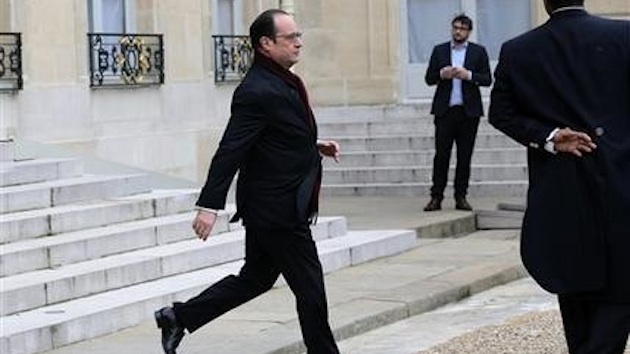
French President Francois Hollande leaves the Elysee Palace after a shooting at a French satirical newspaper, in Paris, France, Wednesday, Jan. 7, 2015. Police official says 12 dead in shooting at French satirical newspaper Charlie Hebdo. (AP Photo/Christophe Ena)

BREAKING: At least 12 people were killed Wednesday morning when three Islamic extremists carrying Kalashnikov rifles and pump-action shotguns opened fire inside the Paris offices of a satirical French newspaper, the satirical magazine Charlie Hebdo.

The editor of the French newspaper and lead cartoonist reportedly have been killed by the gunmen, who stormed the offices and requested their location and others’ locations by name. Witnesses say the gunmen yelled, “We’ve avenged the honor of the prophet!” before escaping. Police and several journalists reportedly are among the dead.

Officials told PPD that there is a surveillance tape with audio clearly showing the Islamic extremists firing and screaming, “Allahu Akbar!” during what officials say was a professionally, well-planned attack on unarmed civilians. But — H/T Martin Boudot — another civilian video surfaced showing the gunmen during the attack firing and screaming “Allahu Akbar!”

Charlie Hebdo had been threatened in the past for their satirical depiction of the Prophet Muhammad, and was already under extra police protection and surveillance. However, most local police in Paris choose not to carry firearms.

Their latest tweet — shown below — before the attack, was of a picture of Islamic State (ISIL or ISIL) leader Abu Bakr al-Baghdadi.

In remarks shortly after the shooting, French President Francois Hollande said the attack was an act of terrorism and claimed that several other potential terror attacks had been thwarted “in recent weeks.”

Police said that the gunmen fled in a stolen car driven by a fourth person and are still at large. At least one of the victims killed was a journalist, and police say three are considered “critical.”

Officials said the men walked into the ground floor of the newspaper’s offices and began shooting before making their way up to the first floor. As they fled the scene, they shot at arriving policemen.

Charlie Hebdo’s offices were firebombed in 2011 after a spoof issue featuring a caricature of the Prophet Muhammad on its cover. Nearly a year later, the magazine published crude Muhammad caricatures, drawing denunciations around the Muslim world.

At least 12 people were killed Wednesday

john-boehner

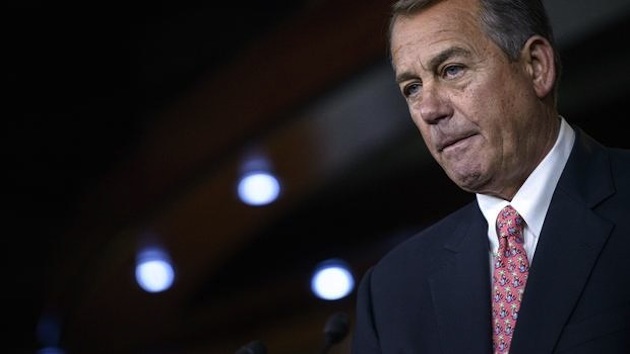
Speaker of the House John Boehner, R-Ohio, listens to a question during a press conference on Capitol Hill December 11, 2014 in Washington, D.C. (Photo: BRENDAN SMIALOWSKI/AFP/GETTY IMAGES)

The new 246-vote Republican House majority voted Tuesday to reelection Rep. John Boehner as speaker to the 114th Congress, giving him a third term with the gavel. However, it was far closer than most pols and pundits thought.

Boehner had two main challengers in Reps. Ted Yoho (R-FL) and Louie Gohmert (R-TX), each of whom voted for themselves. Out of a total 408, Boehner took 216 votes with Minority Leader Nancy Pelosi a distant second with 164.

But it was the late-declared candidate from Florida, Rep. Daniel Webster, who received the second-most votes out of any other Republican member — 12. Gohmert received 3, Yoho received 2, Jim Jordan of Ohio also received 2, and Jim Cooper of Tennessee received 1. Sens. Jeff Sessions (R-AL) and Rand Paul (R-KY) each received one vote, as it is a little known fact that an individual does not even have to be a member of the House in order to serve as speaker.

In fact, former Secretary of State Colin Powell earned himself a vote, as well. Overall, Boehner dodged the bullet by a meager 4 votes, as 25 members voted against him and he could only afford to lose 29 to avoid a second ballot.

Conservative members of the caucus were disappointed with the speaker over the passage of the $1.1 trillion CRomnibus spending bill because it didn’t cut anything, it didn’t chip away at ObamaCare, and it certainly didn’t fight “tooth and nail” against the president’s executive action on immigration. Even though Mr. Boehner had promised to do those three things, and more, he ended up working with President Obama and the Democrats to get the bill through.

This isn’t the first time the Ohio Republican congressman has been challenged for the gavel, and likely will not be the last.

In 2013, he was re-elected speaker with 220 votes, but 9 Republicans against him, one Republican voted “present,” and two Republicans abstained (in addition to Boehner, himself). However, in 2011, Boehner was elected by all 241 members of his conference.

Reps. Yoho and Bridenstine both voted for then-Majority Leader Eric Cantor, who received the second-most votes (3) for speaker in 2013. Massie voted for Rep. Justin Amash, R-Michigan, a libertarian-leaning Republican who survived a primary onslaught from the GOP establishment in 2014, while Gohmert voted for then-Florida Congressman Allen West, who had just lost his reelection bid.

Brat is the newest member to oppose Boehner and the establishment. That’s not particularly surprising considering he defeated Eric Cantor in an upset special election late last year. But despite the trend of opposition growing since 2011, it is sorely lagging behind public opinion.

A recent PPD Poll of 500 likely Republican voters found 65 percent wanted their representative to vote against Boehner for speaker, while just 26 percent said their representative should back him. While only 14 percent have a “very favorable” opinion of Boehner, 32 percent say they have a “very unfavorable” opinion of him.

“If actual Republican voters had their way, then his days as speaker would’ve been numbered,” said PPD’s senior political analyst, R. D. Baris. “But that’s just not how modern Washington works.”

When a serious member mounts a serious challenge to Mr. Boehner, he added, “they will know to begin the process earlier in order to mobilize grassroots pressure.”

The new 246-vote Republican House majority voted

bill-de-blasio-nypd

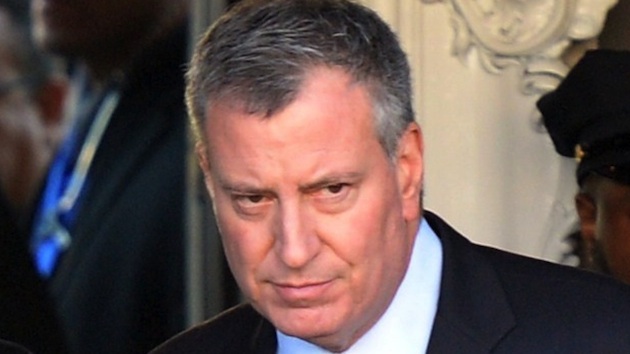
New York Mayor Bill de Blasio an his wife, Chirlane McCray, leave the Christ Tabernacle Church in New York on December 27, 2014, after attending the funeral for New York Police Officer Rafael Ramos. Thousands of people attended the funeral Saturday for Ramos, one of two New York officers shot dead in apparent revenge for recent police killings of unarmed black men. Ramos was shot alongside his partner Wenjian Liu on December 20 on the heels of nationwide protests accusing police of racism and using excessive force against black people. AFP PHOTO/DON EMMERT (Photo credit should read DON EMMERT/AFP/Getty Images)

According to the latest statistics, compared with the same period beginning Dec. 8, crime in New York City is up and arrests are down significantly juxtaposed to 2014. A new data set from the NYPD CompStat Unit reveals an across-the-board regression in policing and crime since leftist Mayor Bill de Blasio waged what many believe to be a war on the New York City Police Department.

Felony arrests are down 40 percent, drug arrests are down a whopping 83 percent and minor crimes arrests are down 93 percent.

There has been a shocking 35 percent increase in murders — or, 15 people — since Dec. 8, just a little over a week after a Staten Island grand jury decided not to indict Police Officer Daniel Pantaleo, a 29-year-old, eight-year veteran of the NYPD. Pantaleo faced charges ranging from murder to a lesser offense of reckless endangerment in the death of Eric Garner, a black man who resisted arrest after being caught selling untaxed cigarettes.

Following the grand jury verdict, NYPD union heads criticized de Blasio for siding with Al Sharpton and his increasingly violent protests, one of which was caught on video chanting the following: “What do we want? Dead cops! When do we want them? Now!”

In a press conference just before the protest, de Blasio claimed that he had told his own 17-year-old, mixed-race son, Dante, to be careful around New York City police officers when walking in the Bedford-Stuyvesant area of Brooklyn.

“[The Garner case] was profoundly personal for me,” de Blasio said, because of “the dangers Dante may face, we’ve had to literally train him in how to take special care in any encounter he has with the police officers who are there to protect him.”

Then, shortly after, de Blasio called a horrific assault by protestors on NYPD officers “alleged,” despite the fact it was also caught on camera. Not a week later, NYPD Officers Rafael Ramos and Wenjian Liu were tragically aassassinated execution style while sitting in their patrol car in Bedford-Stuyvesant as revenge for Eric Garner and Michael Brown.

The new data from the NYPD CompStat Unit follows the release of the annual report by the nonprofit National Law Enforcement Officers Memorial Fund, which underscored the concerning result of the anti-police sentiment that began brewing in the summer of 2014. The number of law enforcement officers killed by firearms in the U.S. jumped by 56 percent in 2014 to 50 officers, compared to 32 in 2013.

Further, the number of ambush assaults jumped to 15, up from just 5 in 2013. A string of ambush assaults, such as the one committed by 28-year-old Ismaaiyl Brinsley that killed Officers Ramos and Liu, law enforcement advocates contend, occurred amid heated rhetoric from self-serving politicians and race hustlers.

“There are some weak-minded individuals influenced by the anti-law enforcement, anti-police rhetoric,” said Craig Floyd, the chairman of the memorial fund. “And they’ve gone out and targeted police officers.”

Floyd said there is a real concern that the data could get much worse if tensions are not reduced.

“Enough is enough,” he said in a statement. “We need to tone down the rhetoric and rally in support of law enforcement and against lawlessness.”

According to the NYPD CompStat Unit, compared

service-sector

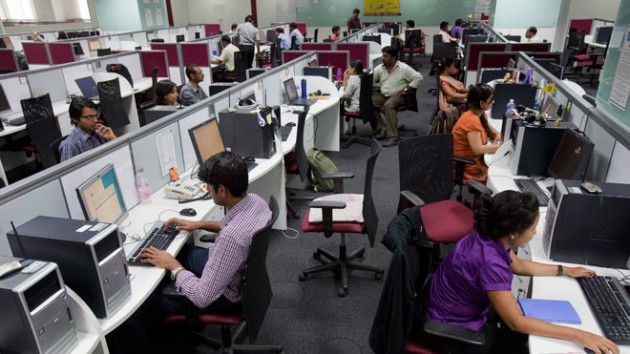
Service sector workers employed in a typical cubicle position. (Photo: Reuters)

A closely watched index of growth in the dominant U.S. services sector missed economists’ expectations for December, hitting a 6-month low across the board. Subindexes on employment, orders and business activity all declined.

The Institute for Supply Management said on Tuesday its services index fell to 56.2 for December, juxtaposed to 59.3 in November, a month that traditionally lags in performance compared to the height of the holiday season. The December figure fell short of expectations in a poll of economists conducted by Reuters, which forecast a 58 reading.

Worse still, two subindexes in the survey — prices and order backlogs — actually fell below 50, which indicates a contraction.

Readings above 50 suggest expansion, while below indicate contraction.

Indexes on both imports and exports saw significant declines, while the reading on new orders fell to 58.9, which is the lowest reading since April.

The service sector data is particularly concerning considering the terrible December manufacturing data, placing two significant sectors of the labor market either in or nearly in contraction territory.

A closely watched index of growth in

de-blasio-bratton-press-nypd-shot

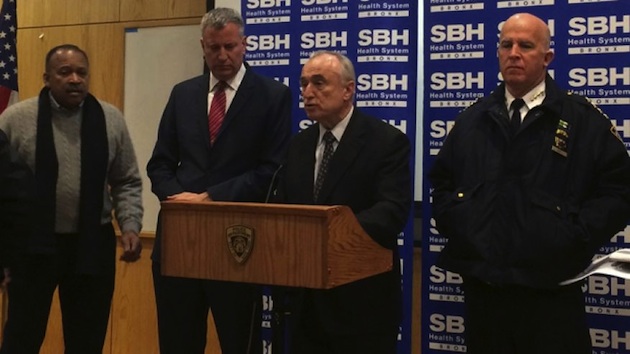
Jan 6, 2015: New York City Mayor Bill de Blasio, second left, stands by as Police Commissioner William Bratton, second right, speaks at a news conference at St. Barnabas Hospital in the Bronx after two police officers were shot. (AP Photo/Tom McElroy)

There’s a massive manhunt underway early Tuesday for the suspected armed robbers who shot and wounded two plainclothes NYPD officers in the Bronx. Both officers — who The New York Post identified as Andrew Dossi and Aliro Pellaranoare — are expected to survive.

The two officers just ended their regular shifts when they responded to a report of a robbery at a Chinese restaurant at approximately 10:30 P.M. ET. When they arrived, two suspects fired on the officers, hitting Pellarano in the arm and also grazing him in the chest, while Dossi was shot in the stomach and the arm. The gunmen exchanged fire with other officers responding to the call, but fled the scene on foot.

Officials at the NYPD confirmed that the suspects carjacked a white Chevrolet Camaro, but made it only a few blocks before crashing they crashed the vehicle. They then got out and fled on foot. A source told the Post that a weapon was recovered near where the car crashed, though PPD was not able to confirm that account.

Both officers were taken to St. Barnabas Hospital, where Dossi was reportedly undergoing surgery early Tuesday morning.

“Thanks God these officers are doing well,” New York City Mayor Bill de Blasio said in a news conference at the hospital early Tuesday. “These officers did something that was extraordinarily brave.They did it as part of their commitment. These officers had just come off their shift and upon hearing this call went back out in search of these criminals. The work they do is so profoundly important in this instance where they went above and beyond the call to protect their fellow New Yorkers.”

The Post reported that one possible suspect was apprehended at nearby New York-Presbyterian Hospital, where he had sought treatment for a gunshot wound. It was not clear how he was shot.

New York Police Commissioner William Bratton described the suspects as two Hispanic men in their mid-to-late 20s. The organization COP SHOT, Citizens Outraged at Police Being Shot, has offered a $10,000 reward leading to the arrest and conviction of the suspects.

There's a massive manhunt underway early Tuesday

obamacare-costs

Despite vehemently supporting increased health care costs via ObamaCare, Harvard professionals are now furious they are forced to pay. In November, the members of the Faculty of Arts and Sciences made a last-minute attempt to avoid changes to Harvard’s health care plan that would put them in the barrel with million of Main Street, working Americans.

Unfortunately, for them, the faculty vote came too late to have an impact.

Professor Richard Thomas, who teaches the Classics, called it “deplorable” and “deeply regressive.” Another one of his colleagues complained it was “the equivalent of a pay cut.”

Under the previous plan, Harvard employees paid only a portion of their premiums and had very low out-of-pocket costs. However, due to the changes forced by ObamaCare, which left-wing institutions argued was “progressive,” employees will have to pay 10 percent of health care costs until the $1,500 limit is reached for an individual, or $4,500 for a family.

The irony of it all, is that Harvard’s increased costs still remain far lower than most employers’ health care costs under ObamaCare.

According to a PPD study, which was conducted prior to the unilateral delays and exemptions, just 18.3 percent of working Americans are covered by health insurance plans that are not subject to the employer mandate out of the 170.9 million Americans with employer-sponsored health insurance.

The increases should’ve come as no surprise to the American intelligentsia, as a study conducted by healthcare analysts at Morgan Stanley in April of 2014 found health insurance premiums increased at the highest rate ever measured by the firm. The survey of 148 brokers concluded health insurance premiums increase under ObamaCare because of ObamaCare, blatantly stating “increases are largely due to changes under the ACA.”

Harvard elitists aren’t the only voices expression deep disappointment in law’s inability to control costs.

Healthcare advocate and policy analyst, Steven Brill, once a staunch supporter of ObamaCare, told CBS This Morning on Monday that everyone except the taxpayer benefited from the president’s signature health care law.

Brill, the author of America’s Bitter Pill: Money, Politics, Backroom Deals, and the Fight to Fix Our Broken Healthcare System, said “there’s nothing in the legislation that brings down the cost of healthcare.”

“We basically have created a system where the good news is that many more people get the kind of healthcare you and I get,” Brill added. “The bad news is that the taxpayers are paying for it and they’re paying the same exorbitant prices that make the system so unworkable.”

Brill went on to say that the bill was not designed to control the cost of healthcare, nor was it designed to help the working class Americans who arguably deserve the biggest break. The very poor and the corporate benefit the most from the law, while Main Street and other working, taxpaying Americans get the shaft.

“The best test of all this is the only way that a bill this big will pass in Washington is if the powers that be, you know, decide that it should pass. So the drug companies are making more money, the hospitals are making more money, the medical device makers are making more money and everybody is happy except the taxpayer,” Brill said Monday morning.

Despite vehemently supporting increased health care costs

People's Pundit Daily
You have %%pigeonMeterAvailable%% free %%pigeonCopyPage%% remaining this month. Get unlimited access and support reader-funded, independent data journalism.

Start a 14-day free trial now. Pay later!

Start Trial