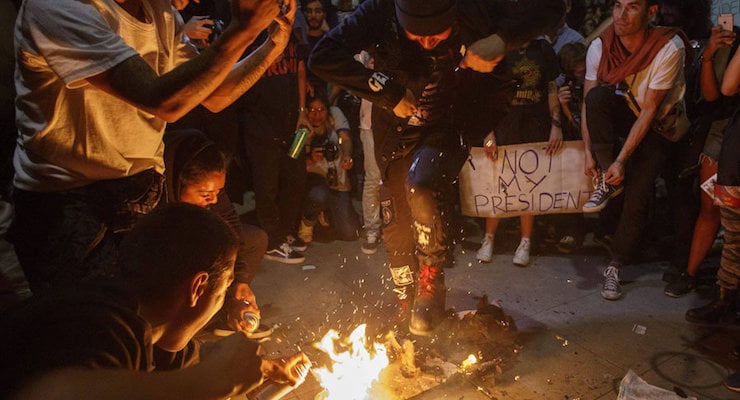
Supporters of Hillary Clinton, along with other groups of fringe radical leftists, burn American flags during protests against the election of President-Elect Donald J. Trump.
People who call themselves “progressives” claim to be forward-looking, but a remarkable amount of the things they say and do are based on looking backward.
One of the maddening aspects of the thinking, or non-thinking, on the political left is their failure to understand that there is nothing they can do about the past. Whether people on the left are talking about college admissions or criminal justice, or many other decisions, they go on and on about how some people were born with lesser chances in life than other people.
Whoever doubted it? But, once someone who has grown up is being judged by a college admissions committee or by a court of criminal justice, there is nothing that can be done about their childhood. Other institutions can deal with today’s children from disadvantaged backgrounds, and should, but the past is irrevocable. Even where there are no economic differences among various families in which children are raised, there are still major differences in the circumstances into which people are born, even within the same family, which affect their chances in later life as adults.
For example, among children of the same parents, raised under the same roof, the first born, as a group, have done better than their later siblings, whether measured by IQ tests or by becoming National Merit Scholarship finalists or by various other achievements.
The only child has also done better, on average, than children who have siblings. The advantage of the first born may well be due to the fact that he or she was an only child for some time, perhaps for several formative years.
By the time people have grown up and apply to college, all that is history. Nothing that a college admissions committee can do will change anything about their childhoods. The only things these committees’ decisions can affect are the present and the future. This is not rocket science.
Nevertheless, there are people who urge college admissions committees to let disadvantaged students be admitted with lower test scores or other academic indicators.
Those who say such things seldom even attempt to see what the actual consequences of such policies have been. The prevailing preconceptions — sometimes called what “everybody knows” — are sufficient for them.
Factual studies show that admitting students to institutions whose standards they do not meet often leads to needless academic failures, even among students with above average ability, who could have succeeded at other institutions whose standards they do meet.
The most comprehensive of these studies of Americans is the book “Mismatch” by Sander and Taylor. Similar results in other countries are cited in my own book, “Affirmative Action Around the World.”
When it comes to criminal justice, there is much the same kind of preoccupation on the left with the past that cannot be changed. Murderers may in some cases have had unhappy childhoods, but there is absolutely nothing that anybody can do to change their childhoods after they are adults.
The most that can be done is to keep murderers from committing more murders, and to deter others from committing murder. People on the left who want to give murderers “another chance” are gambling with the lives of innocent people. That is one of many other examples of the cruel consequences of seemingly compassionate decisions and policies.
Ironically, people on the left who are preoccupied with the presumably unhappy childhoods of murderers, which they can do nothing about, seldom show similar concern about the present and future unhappy childhoods of the orphans of people who have been murdered.
Such inconsistencies are not peculiar to our time, though they seem to be more pervasive today. But the left has been trying, for more than 200 years, to mitigate or eliminate punishments in general, and capital punishment in particular. What is peculiar to our time is the degree to which the views of the left have become laws and policies.
A long overdue backlash against those views has begun in some Western nations, of which the recent election results in the United States are just one symptom. How all this will end is by no means clear. Just as the past cannot be changed, so the future cannot be predicted with certainty.
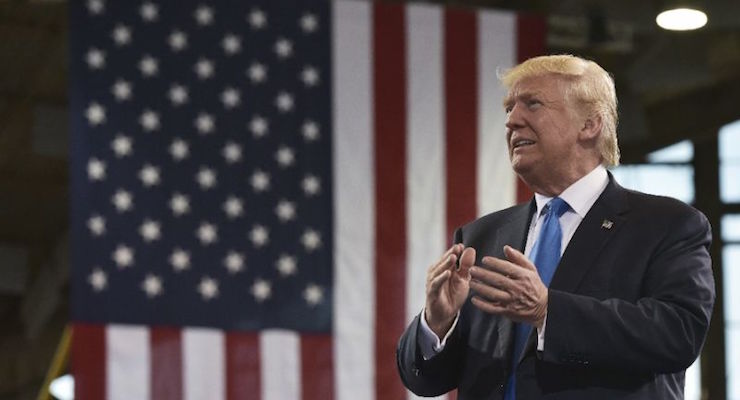
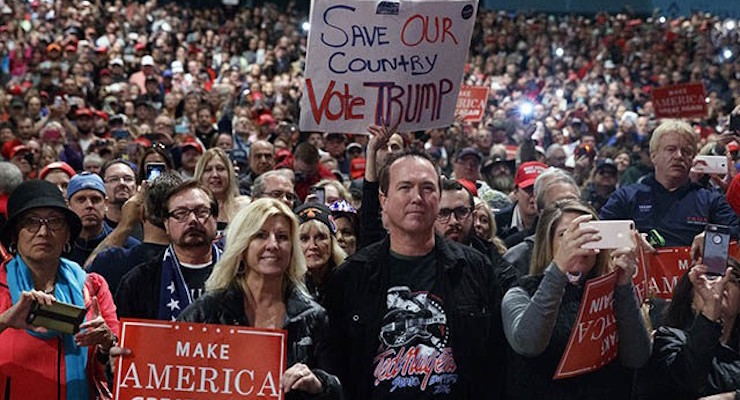
Republican presidential candidate Donald Trump delivers his speech on Election Eve in Manchester, New Hampshire, November 7, 2016.
After a week managing the transition, vice president-elect Mike Pence took his family out to the Broadway musical “Hamilton.”
As Pence entered the theater, a wave of boos swept over the audience. And at the play’s end, the Aaron Burr character, speaking for the cast and the producers, read a statement directed at Pence:
“(W)e are the diverse America who are alarmed and anxious that your new administration will not protect us, our planet, our children, our parents, or defend us and uphold our inalienable rights, sir. But we truly hope this show has inspired you to uphold our American values.”
In March, the casting call that went out for actors for roles in this musical celebration of “American values” read:
“Seeking NON-WHITE men and women.”
The arrogance, the assumed posture of moral superiority, the conceit of our cultural elite, on exhibit on that stage Friday night, is what Americans regurgitated when they voted for Donald Trump.
Yet the conduct of the “Hamilton” cast puts us on notice. The left neither accepts its defeat nor the legitimacy of Trump’s triumph.
His presidency promises to be embattled from Day One.
Already, two anti-Trump demonstrations are being ginned up in D.C., the first on Inauguration Day, Jan. 20, by ANSWER, Act Now to Stop War and End Racism. A second, scheduled for Jan. 21, is a pro-Hillary “Million Woman March.”
While the pope this weekend deplored a “virus of polarization,” even inside the church, on issues of nationality, race and religious beliefs, that, unfortunately, is America’s reality. In a new Gallup poll, 77 percent of Americans perceived their country as “Greatly Divided on the Most Important Values,” with 7 in 8 Democrats concurring.
On the campuses, anti-Trump protests have not ceased and the “crying rooms” remain open. Since Nov. 8, mobs have blocked streets and highways across America in a way that, had the Tea Party people done it, would have brought calls for the 82nd Airborne.
In liberal Portland, rioters trashed downtown and battled cops.
Mayors Rahm Emanuel of Chicago and Bill de Blasio of New York have declared their cities to be “sanctuary cities,” pledging noncooperation with U.S. authorities seeking to deport those who broke into our country and remain here illegally.
Says D.C. Mayor Muriel Bowser, “I have asserted firmly that we are a sanctuary city.” According to The Washington Post, after the meeting where this declaration had been extracted from Bowser, an activist blurted, “We’re facing a fascist maniac.”
Such declarations of defiance of law have a venerable history in America. In 1956, 19 Democratic Senators from the 11 states of the Old Confederacy, in a “Southern Manifesto,” rejected the Supreme Court’s Brown decision ordering desegregation of the public schools.
Arkansas Gov. Orval Faubus, Mississippi Gov. Ross Barnett and Alabama Gov. George Wallace all resisted court orders to integrate. U.S. marshals and troops, ordered in by Ike and JFK, insured the court orders were carried out.
To see Rahm and de Blasio in effect invoking John C. Calhoun’s doctrine of interposition and nullification is a beautiful thing to behold.
Among the reasons the hysteria over the Trump election has not abated is that the media continue to stoke it, to seek out and quote the reactions they produce, and then to demand the president-elect give assurances to pacify what the Post says are “the millions of … blacks and Latinos, gays and Lesbians, Muslims and Jews — fearful of what might become of their country.”
Sunday, The New York Times ran a long op-ed by Daniel Duane who said of his fellow Californians, “(N)early everyone I know would vote yes tomorrow if we could secede” from the United States.
The major op-ed in Monday’s Post, by editorial editor Fred Hiatt, was titled, “The Fight to Defend Democracy,” implying American democracy is imperiled by a Trump presidency.
The Post’s lead editorial, “An un-American Registry,” compares a suggestion of Trump aides to build a registry of Muslim immigrants to “Nazi Germany’s … singling out Jews” and FDR’s wartime internment of 110,000 Japanese, most of them U.S. citizens.
The Post did not mention that the Japanese internment was a project of the beatified FDR, pushed by that California fascist, Gov. Earl Warren, and upheld in the Supreme Court’s Korematsu decision, written by Roosevelt appointee and loyal Klansman, Justice Hugo Black.
A time for truth. Despite the post-election, bring-us-together talk of unity, this country is hopelessly divided on cultural, moral and political issues, and increasingly along racial and ethnic lines.
Many Trump voters believe Hillary Clinton belongs in a minimum-security facility, while Hillary Clinton told her LGBT supporters half of Trump’s voters were racists, sexists, homophobes, xenophobes and bigots.
Donald Trump’s presidency will be a besieged presidency, and he would do well to enlist, politically speaking, a war cabinet and White House staff that relishes a fight and does not run.
The battle of 2016 is over.
The long war of the Trump presidency has only just begun.
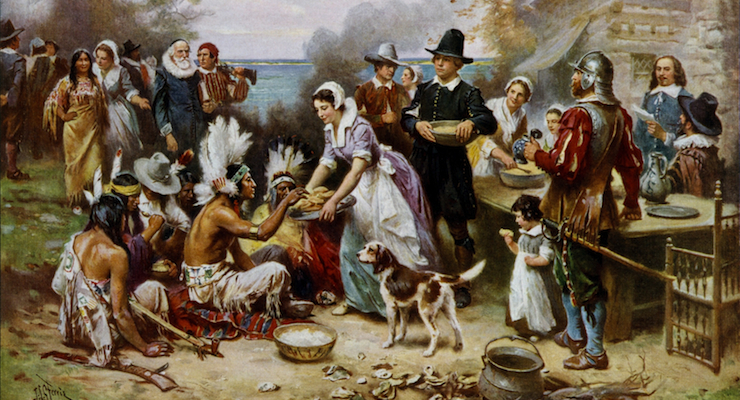
The First Thanksgiving 1621, oil on canvas by Jean Leon Gerome Ferris (1899).
Editor’s Note: The following is a revised version of a column first published in November 2002.
Thanksgiving is the most American of holidays. But there is something almost un-American about it. It is a day opposed to striving, to getting more. We stop adding up the numbers on the scorecard of life. We freeze in place and give thanks for whatever is there.
The Wall Street Journal once featured sob stories about failed dot-com entrepreneurs. People still in their 20s and 30s spoke painfully of their disappointments. They had planned to make many millions on internet startups, but the dot-com market crashed before they could pile up the first seven figures.
One 29-year-old had joined a new company that paid “only” $38,000 a year. His business school classmates were averaging $120,000 at traditional firms. Others talked of working outrageously long hours. When their dot-com closed its doors, they had little personal life to fall back on.
Our culture does not encourage contentment with what we have. This is the land of the upgrade. One can always do better, be it with house or spouse. When money is the measurement, the competitive struggle can never end without acknowledging some kind of defeat. Everyone other than Bill Gates has someone who is ahead.
Messages in the media continually tweak Americans’ innate sense of inadequacy. Our folk hero is the college dropout who sells his tech company for $2 billion by the age of 26. How is a middle-aged guy making $58,000 a year supposed to feel about that?
Some years back, an investment company ran an ad showing a young woman sitting pensively on a front porch. “Your grandfather did better than his father,” it read. “Your father did better than his father. Are you prepared to carry on the tradition?”
Note the use of the respectable word “tradition” on what’s really a call for intergenerational competition. It suggests that failure to amass more wealth than one’s parents is a threat to the family’s honor.
So what if the next generation isn’t so rich as the previous one? The way most of our younger people live would be the envy of 95 percent of the earth’s inhabitants.
Such thinking would have been wholly foreign to the Pilgrims celebrating the “first Thanksgiving.” The Pilgrims traded all the comforts of England to worship as they chose. Their ship, the Mayflower, landed at what is now Plymouth, Massachusetts, on Dec. 16, 1620. They held the “first Thanksgiving” the following autumn.
Mid-December is an awful time to set up shop in the New England wilderness. Disease immediately carried off more than half of the 102 colonists. They are buried on Coles Hill, right across the street from Plymouth Rock. Without the help of the Wampanoag Indians, the colony would have vanished altogether.
Things got better by 1625, prompting the colony’s governor, William Bradford, to write that the Pilgrims “never felt the sweetness of the country till this year.” But that hadn’t stopped them from giving thanks four years earlier. The purpose was not to celebrate the good life but to celebrate their staying alive. The natives shared in the feast.
By the 1830s, America was already a bustling land of fortune building and material lust. Intellectuals of the day looked back nostalgically at the Puritan concern with unworldly matters. Ralph Waldo Emerson spoke of the Pilgrims’ religious orientation as “an antidote to the spirit of commerce and of economy.”
Thanksgiving is a throwback to that misty past. It requires a Zen-like acceptance of the present and what is. Gratitude is the order of the day.
This is a full-glass holiday. To be healthy, educated and living in America is to have one’s cup running over. For that, let us give thanks.
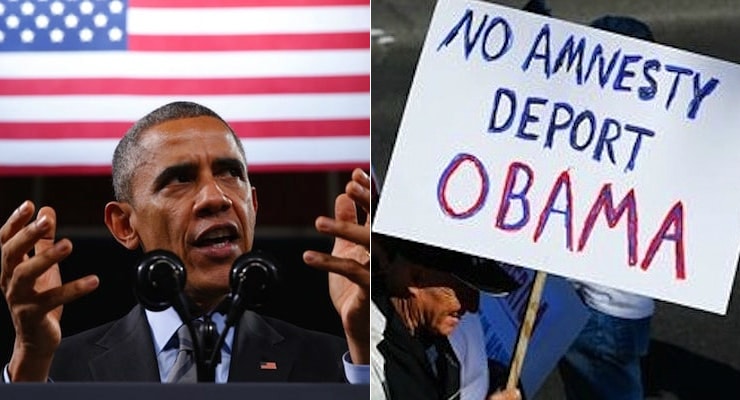
U.S. President Barack Obama, left speaks about immigration reform during a visit to Del Sol High School in Las Vegas, Nevada November 21, 2014. A man protests President Obama’s executive action granting amnesty to more than 4 million illegal immigrants. (Photos: AP/REUTERS)
A review by the Center for Immigration Studies (CIS) of new data from the U.S. Census Bureau shows that 1.5 million new immigrants are settling in the country each year. The American Community Survey (ACS) is largest survey conducted by the Bureau and it shows newly arrived immigrants are both legally and illegally migrating to the U.S.
They include new green card holders, who are permanent residents, long-term “temporary” visitors who often stay permanently, such as guest workers and foreign students, and new illegal immigrants. Immigrants as a share of the U.S. population now represent 13.5%, the highest percentage measured in 105 years. In 1970, according to CIS, less than 5% of the U.S. population were immigrants.
The study comes as PPD releases a multipart post-election 2016 series analyzing how the Democratic Party has been decimated under President Barack Obama. According to PPD polling and analysis, it is largely the result of the Democratic Party moving too far to the Left and their growing over-reliance on non-white voters. The party has cast the South, the Rust Belt and greater Appalachia aside with the belief immigration had reached an electoral tipping point.
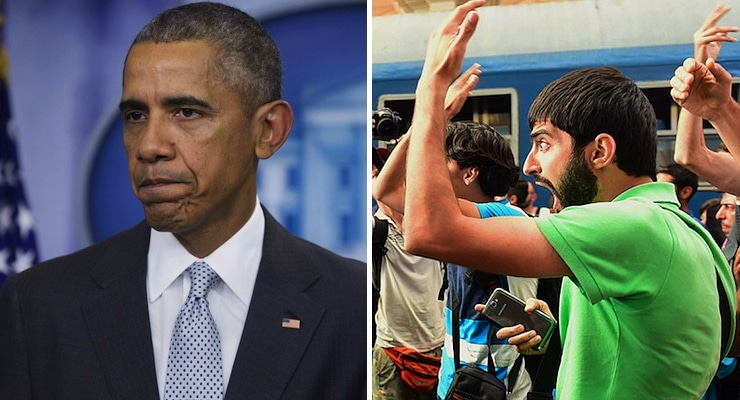
Barack Obama delivers a statement on the attacks in Paris from the press briefing room on Friday Nov. 13, 2015, left, and a Syrian refugee yells at a Hungarian border guard. (Photos: Pete Souza/WH/Reuters)
However, as the People’s Pundit laid out, they were wrong and now Mr. Obama appears to be allowing that trend to continue.
“I have repeatedly argued–in more columns than I can count–that political coalitions, like economic policy changes and impacts, do not occur in a vacuum and are ever-changing,” Rich Baris, the People’s Pundit wrote Sunday in part two. “Yes, it’s true that Democrats were poised to benefit from the demographic shifts in the country. But that was only if they could hold on to at least a substantial percentage of their traditional working-class white base in certain regions.”
The new Census Bureau data also confirmed research published by the Center in June of this year, which was based on a far smaller Bureau survey. It also showed a significant increase in new arrivals in 2014 and 2015. But CIS was criticized–now we know unfairly–by some on the Left. In fact, the data released thus far for the first 6 months of the year indicate that new arrivals could have reached an estimated 1.6 million in 2015.
While someone between three-fourths and two-thirds of the 1.5 million are legal immigrants, including permanent residents as well as long-term visitors such as guest workers and foreign students, the remainder are new illegal immigrants.
People’s Pundit Daily recently reported less than a week before the 2016 presidential election illegal immigrants from around the world were pouring across the U.S.-Mexican border. The review of the data backs up the U.S. Border Patrol agents testimony and apprehension figures.
“We are overwhelmed,” said a veteran agent in McAllen, Texas. “We are seeing 800 to 1,000 apprehensions every night.”
In fiscal 2016, the U.S. Border Patrol apprehended 117,200 immigrants from Central America, representing almost one-third of all apprehensions. This year, the agency said the number of apprehensions is 5,000 more than during the surge of 2014, the year that was considered an all out border crisis.
States with the largest increases in the number of immigrants from 2010 to 2015 were California (up 538,000), Texas (up 529,000), Florida (up 428,000), New York (up 232,000), New Jersey (up 133,000), Massachusetts (up 112,000), Maryland (up 108,000), Virginia (up 108,000), Pennsylvania (up 98,000), Washington (up 94,000), Georgia (up 81,000), Minnesota (up 79,000), and North Carolina (up 76,000).
Further, the increase in immigration from countries who do not share western values is larger than in any prior 5-year span. Preside-elect Donald Trump campaigned on implementing “extreme vetting” for immigrants coming from high-risk countries, a promise he first laid out during a speech at Youngstown, Ohio, in August. He said that immigrants would not only be vetted for possible connections to terrorism, but also for their believe in western, or First World values.
Growth of U.S. Foreign-Born Population Between 2010 and 2015, by Country of Birth
Country of Birth
U.S. Pop.
2010
U.S. Pop.
2015
Growth
Included in
World Values Survey?
1
Bangladesh
153,691
228,682
49%
no
2
Nigeria
219,309
323,635
48%
yes
3
Venezuela
184,039
255,520
39%
no
4
Egypt
137,799
185,872
35%
yes
5
Iraq
159,800
215,193
35%
yes
6
India
1,780,322
2,389,639
34%
yes
7
Ethiopia
173,592
228,745
32%
no
8
Pakistan
299,581
379,435
27%
yes
9
Ghana
124,696
155,532
25%
yes
10
Dominican Republic
879,187
1,063,239
21%
no
Source: American Community Survey.
Restricted to foreign-born populations of at least 100,000 people in 2010.
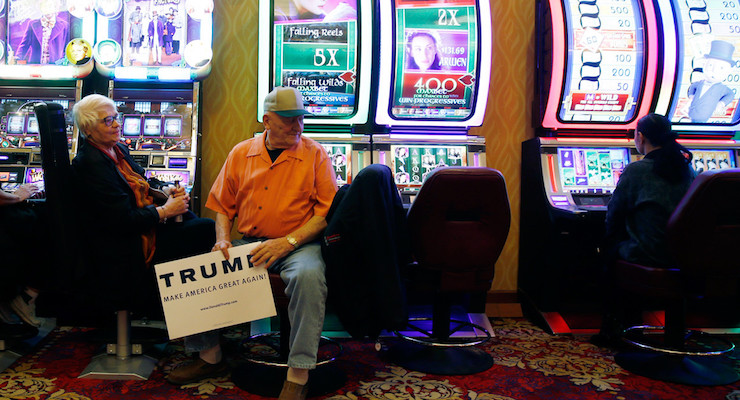
Frank Osysko waits at a slot machine before a rally for Republican presidential candidate Donald Trump on Thursday, Jan. 21, 2016, in Las Vegas. (Photo: AP)
Are the tyrannical online gambling laws in the United States set to become even worse, or has online gambling in the so-called “Land of the Free” just been dealt a Trump card?
Earlier this month, reality television star and business mogul Donald Trump shocked America and the world when he defeated Hillary Clinton in the 2016 Presidential Election. Despite receiving a million fewer votes than his opponent, Trump secured enough seats in the United States’ Electoral College system to become President-Elect.
Trump ran a campaign based on shock value, promising to deport all undocumented immigrants, build a border wall along the Mexican border, ban all Muslims from entering the country and prosecute Hillary Clinton.
In all this, he hasn’t really mentioned gambling. However, we’re concerned (as always with a new government) as to how this change will affect the industry. With the availability of online casino gaming like roulette being so free in Canada will American follow the same footsteps?
Gambling in the United States
Despite priding itself on being a land of opportunity and freedom, the laws concerning gambling – especially online gambling – in the US are extremely restrictive compared to the vast majority of western democracies.
Gambling in the US is technically legal at a federal level although the majority of states restrict or outright ban the practice. There are fewer than 500 commercial casinos in the US, and most of them are located within Las Vegas or Atlantic City.
For most people, the nearest casino outside of these locations is on a Native American reservation, which are much less restricted by the state in terms of gambling legislation thanks to the 1988 Indian Gaming Regulatory Act.
Online gambling is a similar story. Until 2006, online gambling in the US was as popular and freely available as any other country. However, the Unlawful Internet Gambling Enforcement Act caused many of the largest operators to withdraw from the market.
In 2011, the FBI shut down many of the largest online poker and casino operators in the US, effectively banning online gambling at a federal level. The practice is technically legal, but it is not legal for banks to facilitate transactions between customers and casinos.
As of November 2016, only three of the 50 states in the US offer regulated online casino and online poker.
Will Trump change American gambling laws?
Let’s begin this section with a short answer: probably not.
The simple reason for this is that a new President has far more concerns than a relatively minor piece of legislation. However, assuming that gambling laws do come up under Trump’s first four years in charge, let’s examine how likely it is that things change for better or worse.
Pro: Trump has been involved in the casino industry
The Trump Taj Mahal in Atlantic City has recently closed, but until 2016 Trump’s business empire included this large casino. Clearly, Trump is familiar with the potential revenue stream that federal online gambling legislation can bring in to the country.
(Editor’s Note: A previous version of this article did not state clearly Icahn Enterprises took over ownership of the Trump Taj Mahal. In February 2016, Trump Entertainment Resorts exited bankruptcy and became a subsidiary of Icahn Enterprises.)
Con: Sheldon Adelson is Trump’s largest donor
Sheldon Adelson, the billionaire owner of The Venetian casino, is anti-online gambling to a ridiculous extent. He is also the largest donator to the Republican party, and in the US political system, one can make gigantic donations to political parties in a bid to get laws passed. Trump now owes Adelson a favour, which is bad news for the online gambling industry.
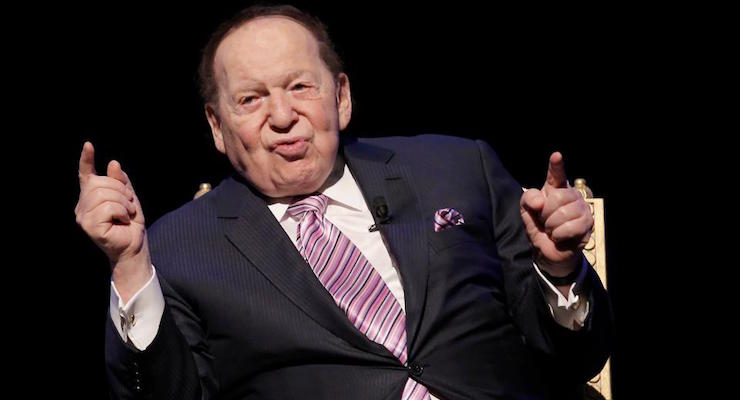
U.S. billionaire Sheldon Adelson speaks during a press conference for the opening of Parisian Macao in Macau, Tuesday, Sept. 13, 2016. Adelson was set to throw open the doors Tuesday to the French-themed Parisian Macao, the mogul’s fifth property in the former Portuguese colony. (Photo: AP)
Pro: Trump is pro-online gambling
Five years ago, Trump went on the record to state that he was in support of online gambling. However, we can’t count this as a major pro; already, Trump has gone back on much of what he said just weeks or months ago, let alone five years.
Con: the Republican party controls everything
Even if Trump was a massive proponent of online gambling, the President is not an all-powerful position. He must answer to the House of Representatives and the US Senate, both of which are now under the control of the Republican party.
It is the Republican party, namely some powerful Senators and Representatives, who have pushed for the restriction and outright banning of online gambling. It is extremely unlikely that any bid to de-restrict the industry would pass muster.
Conclusion: status quo likely to remain
If we had to bet on an outcome, it would be that the current situation would likely remain unchanged. Federalised online gambling is not going to be a top priority for President Trump, and even if it were then his party would almost certainly not support him in this position.
In fact, while the status quo is most likely, a negative impact is far more likely than a positive one. Sheldon Adelson’s multi-million-dollar influence on the Republican party cannot be overstated, and he will push to continue stopping online gambling at a federal level.
In short, it seems likely that there will continue to be an asterisk next to the word “freedom” when it comes to gambling in the US.
In a brutally graphic execution video released by Islamic State (ISIS), a young teenage boy was shot and run over with a tank allegedly by a Shiite militia group. The video was made by ISIS to show just how barbaric the Shiite El-Hashab el-Sharbi militia can be in combat and for fun, as well.
People’s Pundit Daily has not been able to independently verify the militia group carrying out this execution. However, an analysis of the video relating to uniforms and military gear does appear to be consistent with at least one soldier.
Regardless, whether they are Sunni or Shiite, it underscores why U.S. policy should take care before supplying what could very well be terrorist groups disguised as moderates or Iranian allies.
WARNING: This video contains extremely graphic images
[brid video=”79732″ player=”2077″ title=”ISIS Video Shows Teenager Executed Run Over With Tank”]
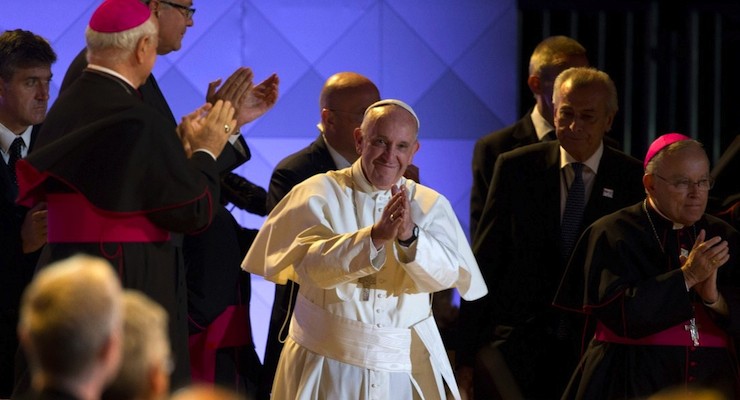
Pope Francis takes the stage at the Festival of Families in Philadelphia on Sept. 26, 2015. (Photo: AP)
The Jubilee of Mercy is over, but Pope Francis is allowing all priests to absolve the sin of abortion from here on out indefinitely. The Pope announced his decision in his new Apostolic Letter “Misericordia et Misera,” or “Mercy with Misery.”
“Given this need, lest any obstacle arise between the request for reconciliation and God’s forgiveness, I henceforth grant to all priests, in virtue of their ministry, the faculty to absolve those who have committed the sin of procured abortion,” the letter published Nov. 21 read.
The provision made for the duration of the Extraordinary Holy Year “is hereby extended, notwithstanding anything to the contrary,” adding “the Sacrament of Reconciliation must regain its central place in the Christian life.”
Pope Francis did maintain the position that “abortion is a grave sin, since it puts an end to an innocent life,” but said “there is no sin that God’s mercy cannot reach and wipe away when it finds a repentant heart seeking to be reconciled with the Father.”
“May every priest, therefore, be a guide, support and comfort to penitents on this journey of special reconciliation.”
When I give speeches on fiscal policy, I commonly get some variation of this question (and you can choose one of more of the options).
Isn’t our fiscal problem largely the result of the wars/intervention/Iraq/Afghanistan/Libya/Syria launched by Bush/Hillary/neocons/Blackwater/Pentagon?
I generally respond by first confessing my lack of expertise on military and foreign affairs, but then I point out that I’m not a fan of nation building (see George Will and Mark Steyn on this topic), so I tell people that I’m very sympathetic to the proposition that trillions of dollars that have been misspent on foreign adventurism this century. Not to mention the human cost of dead and wounded American soldiers.
But I then tell audiences that the Pentagon is not the reason why we’re in fiscal trouble.
Let’s look at two charts, both derived from the Office and Management and Budget’s historical data.
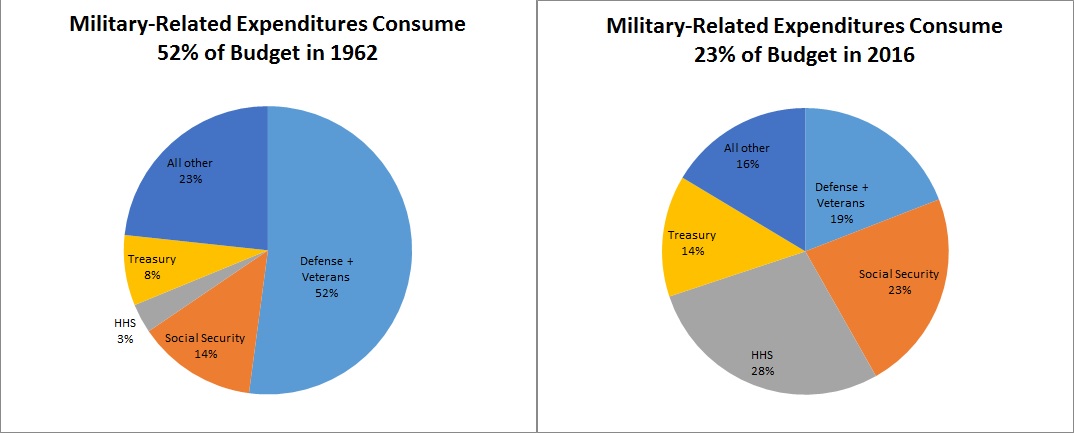
First, here are two pie charts based on the spreadsheet in Table 4.2, which looks at how much of the budget is consumed by different agencies and departments. For both 1962 and 2016, I added together outlays for the Department of Defense and Department of Veterans Affairs and compared that military-related spending to other major categories.
As you can see, military-related outlays used to account for more than one-half of the federal budget, but not they are less than one-fourth of total spending in Washington.
Notice, by the way, that Social Security spending now consumes a significantly larger share of the federal budget, as does spending by the Treasury Department (I assume much of that is EITC redistribution).
But the biggest change, by far, is that the Department of Health and Human Services used to account for 3 percent of federal outlays, but now eats up 28 percent of the budget. Why? Because of programs such as Medicare, Medicaid, and ObamaCare.
By the way, the above numbers do not mean that the military budget has been cut.
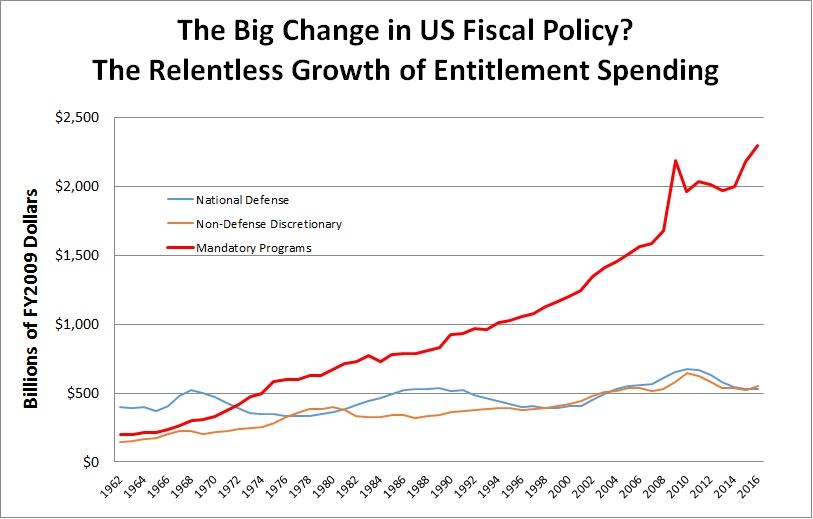
Here’s our second chart, which is based on the spreadsheet in Table 8.2, which has the numbers for inflation-adjusted outlays for major budget categories.
As you can see, the federal government is spending more today on defense than it was back in the 1960s, even after adjusting for inflation. And outlays for “domestic discretionary” programs also have increased.
But what’s obviously driving fiscal policy is the relentless expansion of entitlements (referred to as “mandatory spending” for purposes of the Budget Enforcement Act).
P.S. In addition to George Will and Mark Steyn, Barack Obama also expressed some support for a libertarian-oriented foreign policy. But only in theory, not in practice.
P.P.S. To put America’s military spending in global context, check out this pie chart.
People hold signs during a campaign rally for Republican presidential candidate Donald Trump Monday, Nov. 7, 2016, in Scranton, Pennsylvania. (Photo: AP)
In part one of what is a multipart series on the impact and significance of the 2016 presidential election cycle, we briefly looked at the Democratic Party’s losses under President Barack Obama. In subsequent articles, we will continue to examine the potential future impact these losses could have on the party, as well as the forces at play responsible for them.
In this second edition, we will look at the changing electoral map and why it favors the Republican Party under President-elect Donald J. Trump.
I have repeatedly argued–in more columns than I can count–that political coalitions, like economic policy changes and impacts, do not occur in a vacuum and are ever-changing. Yes, it’s true that Democrats were poised to benefit from the demographic shifts in the country. But that was only if they could hold on to at least a substantial percentage of their traditional working-class white base in certain regions.
This political shift has been underway for several cycles, as is evident by their slide among voters in the Appalachia region. But it obviously was exacerbated by the candidacy of a “working class billionaire” who added a substantial Rust Belt appeal to the mix. We’ll take a look at these two regions and draw the following conclusion.
If he delivers in his first-term, a President Trump could do severe longterm damage to the electoral viability of the Democratic Party. While none of this is set in stone and greatly depends on Mr. Trump himself, the following analysis could prove particularly true if the party continues to move far to the left of mainstream American voters.
Judging by their top pick for chairman of the Democratic National Committee (DNC), it would appear that part of the equation is already coming to fruition.
Rep. Keith Ellison, D-Minn.–a controversial Muslim lawmaker with extremist ties to the Nation of Islam, the Muslim American Society and the Council on American-Islamic Relations (CAIR)–has been backed by Sen. Bernie Sanders, the outgoing minority leader Harry Reid and the incoming minority leader Chuck Schumer.
The Big Picture
The large and increasingly suspicious majorities in high population states such as California, Illinois and New York are responsible for Mrs. Clinton’s popular vote lead. But they mask a devastating Electoral College vote defeat both beneath the surface and across the board. That is particularly true in the Rust Belt and the Midwest, as a whole.
During the primary, then-candidate Trump claimed he could compete in states other Republicans have not and could not. While only six states flipped from supporting the Democratic presidential candidate to the Republican, three of them were not traditional battlegrounds. Further, of the remaining three traditional battleground states that did flip–Florida, Ohio and Iowa–the latter was close and contested in only 1 of the prior 6 presidential elections.
Iowa
In 2004, heavy evangelical turnout literally gave George W. Bush a narrow 10,000-vote victory over John Kerry, 49.9% to 49.2%. In 2008, then-Sen. Obama hammered John McCain 54% to 44% and, in 2012, he easily carried the state against Mitt Romney 52% to 46%.
But in 2016, Mr. Trump demolished Mrs. Clinton in the Hawkeye State, 51.2% to 41.7%.
With the exception of Linn, Johnson and Scott, Mr. Trump flipped nearly all the eastern counties in the state. Counting Scott County, which went for Mr. Obama by roughly 14 points and Mrs. Clinton by only 1.5 points, a whopping 18 eastern counties flipped from backing Mr. Obama in 2012 to backing the next president.
In the southern part of the state, Union and Clarke counties, which backed Mr. Obama by roughly 4 and 1, respectively, backed Mr. Trump over Mrs. Clinton by a 2 to 1 margin.
That’s a monumental shift, one which nearly every pollster save for PPD (and Trafalger Group) didn’t seem to understand would be significant as it relates to other Rust Belt states in the Midwest, including Wisconsin, Michigan, Pennsylvania and even Minnesota.
Michigan
Most pundits, now largely discredited, are blaming low turnout for The Great Lakes State going Red for the first time since 1988. But dig a bit deeper and that explanation doesn’t really suffice.
In Michigan, Mr. Trump carried 12 counties that voted to reelect Mr. Obama in 2012, including Monroe, Bay, Eaton, Saginaw and Macomb. In Macomb County, voter turnout actually increased 4% juxtaposed to the 1.1% increase statewide from 4 years ago.
Supporters of Republican presidential candidate Donald Trump speaks during a campaign rally, Sunday, Nov. 6, 2016, in Sterling Heights, Mich. (Photo: AP)
Mrs. Clinton only won 8 counties, including Genesee, Ingham, Kalamazoo, Marquette, Muskegon, Oakland, Washtenaw and Wayne. However, in the Democratic stronghold of Wayne, the state’s largest population-wise, he was able to hold down the Democratic margin as he ran up record spreads in rural counties.
With a 289,000-vote lead in Wayne, Mrs. Clinton got 78,884 fewer votes than Mr. Obama and roughly 53,000 fewer votes than John Kerry in 2004. Mr. Trump got 14,449 more votes than Gov. Romney did in 2012.
At first glance it would appear the next Democratic candidate could overcome Mr. Trump’s margins in the rest of the state if they perform at historical levels in Wayne County, alone. Mr. Trump only carried the state by roughly 13,000 votes.
But that conclusion foolishly assumes the working class and suburban votes the winner left on the table do not vote in 2020 and, as I’ll state one more time, political coalitions do not evolve in a vacuum. We’ll have to watch new registrations and party preference changes closely over the next 4 years.
Pennsylvania
Like Michigan, The Keystone State had not gone for a Republican on the presidential level since 1988. Unlike Michigan, no one can blame low voter turnout in Democratic strongholds. Mr. Trump beat Mrs. Clinton, pure and simple.
In Philadelphia, she came out with a 457,000-vote lead, which was down slightly from Mr. Obama’s 479,000 and 492,000 in 2008 and 2012, respectively. But that wasn’t due to turnout, it was due to voter preference.
She outperformed Mr. Kerry in 2004, a year in which he nearly the lost the state to Mr. Bush and held on by a few thousands votes. Mr. Obama won 85.2% of the vote in 2012 and Mrs. Clinton won 82.4% in 2016. In Allegheny County, which includes Pittsburgh and it’s suburbs, she actually received a little less than 16,000 votes more than Mr. Obama.
But Mr. Trump basically flipped the rest of the state, which Mr. Obama only lost by about 270,000 votes. Excluding Philadelphia and Allegheny counties, he clobbered Mrs. Clinton by about 630,000 votes.
As was the case all over the Rust Belt, he flipped counties that previously voted for Mr. Obama in 2008 and 2012, including Erie County. The county voted for Mr. Obama by a 16-point margin but flipped narrowly to Mr. Trump by a 2-point margin.
Considering the demographics, it’s very likely that trend could continue. We will talk more about Appalachia in a future edition of this multipart series, but counties classified as belonging to the Appalachia region represent 52 of the 67 counties statewide, which cast 44% of the Keystone vote. They went big for Mr. Trump by just under a half million votes, up significantly from the roughly 176,000-vote lead Gov. Romney racked up over Mr. Obama.
Considering the slide of the Democratic Party in Appalachia, overall, it may become increasingly difficult for them to reclaim Pennsylvania and its 20 electorate votes.
Wisconsin
The Badger State went for a Republican for the first time since 1984, topping the two aforementioned fellow-Rust Belters by a full cycle. This time, it awarded Mr. Trump with its 10 electoral votes by a 1-point margin exactly, or 27,257 votes. That may not seem very significant until you consider it resisted the national trend in an election George H.W. Bush won with 426 electoral votes.
Further, Mr. Trump’s win in Wisconsin has more in common with Pennsylvania than it does with Michigan, meaning he changed minds and flipped voters who backed Mr. Obama in significant numbers. In Dane County, home to Madison, and Milwaukee County, she lost only a combined net 1,000 votes versus Mr. Obama in 2012. It was the rest of the state that did her in.
Outside the two vote-rich Democratic strongholds, Mr. Trump beat Mrs. Clinton by nearly 340,000 votes. That’s far more than the margin Gov. Romney enjoyed in 2012, which was just under 100,000.
Bottom Line
In part three, we’ll take a look at another state in the Rust Belt that was extremely close–Minnesota. The North Star State, or Land of 10,000 Lakes, voted heavily for Mr. Trump on Election Day and Mrs. Clinton’s small 1.5-point lead was only saved by early voting. It began on September 23, before the vice presidential debate, the second presidential debate and final debate.
In August, the PPD North Star Battleground State Poll found a close 3-point race, a show of strength for Mr. Trump that eroded until the third and final debate. Had he played in the state, which only PPD identified as a battleground, there is a very good case to make he would have won its 10 electoral votes, too.
We’ll also look at Appalachia, a region of the country that helped Mr. Trump carry The Keystone State and The Buckeye State, and one that also backed him overall by a 2 to 1 margin. For the record, we didn’t leave out bellwether Ohio, which the New York businessman carried by an astonishing 9 points.
We’re just saving it for the discussion on the collapse of the Democratic Party in Appalachia.
A man walks past the Department of Veterans Affairs headquarters building in Washington, D.C., on May 23, 2014. (Photo: Larry Downing/Reuters)
Editor’s Note: This ‘open-letter’ editorial by The People’s Pundit is a precursor to a study conducted by PPD in Florida, the state with the second largest population of veterans in the country. It’s one story, which I felt the need to share because the veterans in the study were too concerned about retaliation in the form of unfair Compensation and Pension claim decisions, among other concerns.
Open Letter to President-Elect Donald J. Trump,
The Department of Veterans Affairs (VA) desperately needs to be reformed. With a businessman heading to Washington D.C. who will enjoy party majorities in the U.S. House and Senate, I’m cautiously optimistic something can finally be done. We’ve all heard about veterans dying while they wait to receive care, a national disgrace that should be a top priority.
But another top complaint by veterans interviewed in central Florida surrounded claims examiners, who deny veterans deserved benefits because they do not have the resources to fight in the appeal process. Most believe, with some evidence, the bureaucrats are getting rewarded for finding ways to deny legitimate rewardable claims.
Those with experience and knowledge of the process agree that “something” has to be done. But we don’t all agree what that something is let alone what action we can and should take to fix it. The best way I can contribute to this–I believe–is to simply tell my own story and highlight where changes would’ve needed to be made to have prevented it.
When conducting the field study on veterans at the Orlando Veterans Affairs Medical Center and Malcom Randall Veterans Affairs Medical Center, the latter being located in Gainesville, Fla., it quickly became clear my situation was not unique. In fact, we believe the study uncovered a pattern. In 39% of the cases in which a veteran filed an appeal, we found the VA ignored law regarding something called “relative equipoise.”
In these cases, the veterans submitted evidence in support of their claim that included opinions from their own private doctors and/or doctors within the VA, which established a “Nexus” between their service and their claimed condition. In response, the VA simply ordered examinations by agency or contracted physicians that disputed that evidence and the claim examiner took that position.
That’s against the law.
When after consideration of all evidence and material of record in a case before the Departments with respect to benefits under laws administred by the Secretary, there is an approximate balance of positive and negative evidence regarding merits of an issue material to the determination of the matter, the benefit of the doubt in resolving each issue shall be given to the claimant. — 38 U.S.C.A § 5107(b) (West 1995).
Put simply, in the event of competing medical opinions by equally credentialed physicians, the veterans physician outweighs the VA doctor. In my own case, the VA physician did NOT have equal credentials and, in fact, wasn’t even board certified. Further, there was no explaination provided by the claims officer. That was also the case among roughly 60% of the other veterans interviewed, which is also a national disgrace.
And that’s also against the law.
When there is ‘significant evidence’ in support of the veteran’s claim, if the Board denies the claim, it must provide an adequate explaination as to why the evidence is not in ‘relative equipoise’ so as to warrant application of the benefit-of-the-doubt rule in 38 U.S.C.A § 5107(b).
In nearly a quarter (23%) of the cases in which the veteran appealed a claim for a secondary condition based on at least relative equipoise, including in my own case, the VA decided to attack the primary service-connected disability rather than answer for having reached a previous illegal decision. They figure if they can reduce or eliminate a veteran’s primary service-connected condition, then they can deny or reduce any future benefit to the veteran.
Here’s the kicker: In the case of myself and roughly a fifth of the appeal cases, the veteran’s primary condition is a degenerative condition, meaning it only gets worse as time goes on. We’re talking about conditions like chronic bursitus and traumatic brain injury (TBI), not trenchfoot or poison ivy. Only in the VA’s distorted and corrupt world do medical conditions like this improve over time.
On the contrary, the rest of the medical community agrees they get worse.
Yet, the decision review officers simply ignor the appeal rationale and veteran-provided medical opinions in the hope they either don’t know any better, don’t have the resources to see another private doctor to further overrule the hack they got to write up a competing opinion, or flat-out disappear without challenge.
Who knows? After what we’ve learned it wouldn’t at all surprise me that they are hoping veterans die before their claims are decided by a board.
Either way, they are just hoping the veteran goes away quietly so they can get a reward for saving the Department of Veterans Affairs money. In far too many cases, most of which involving veterans who are in far worse shape than me, they do just disappear. Or, they file a futile appeal incorrectly. In the event they do not, such as the case with myself, they will look for other ways to screw the veteran out of a legitimate claim and the medical care that comes with it.
President-elect Trump, by the time you take office it likely will be too late for me. But it won’t be too late to do something about this for veterans in the future. Who the hell will want to serve a country that places the bonuses and career advancements of bureaucrats above their sacrifice?
You have %%pigeonMeterAvailable%% free %%pigeonCopyPage%% remaining this month. Get unlimited access and support reader-funded, independent data journalism.