Widget Image
Follow PPD Social Media
Wednesday, December 31, 2025
HomeStandard Blog Whole Post (Page 507)

Republican presidential nominee Donald Trump speaks during a campaign rally in Austin, Texas, on Tuesday. (PHOTO: CARLO ALLEGRI/REUTERS)

Republican presidential nominee Donald Trump speaks during a campaign rally in Austin, Texas, on Tuesday. (PHOTO: CARLO ALLEGRI/REUTERS)

While the vast majority of Americans (72%) believe immigration is a “good thing for this country today,” more favor decreasing legal levels rather than increasing them. A new survey by Gallup finds the percentage of Americans favoring decreased immigration ticked up from 34% to 38%, while the those who favor increasing immigration ticked down slightly by the same margin, from 24% to 21%.

Now, the percentage saying they favor immigration levels to be “kept at present level” fell slightly from 40% to 38%, on par with those who say they favor decreasing immigration. Still, the latest survey data indicate a consistent mood post-2012, with Americans being roughly split between keeping the current pace and decreasing. Prior to 2012, and even more so in the years immediately after 9/11, Americans favored decreased immigration by larger margins.

Not surprisingly, Republicans and self-identified conservatives are most likely to favor decreased immigration levels, while Democrats and liberals are least likely to agree. What is surprising is that Whites are only slightly more likely than Hispanics to want immigration decreased, while blacks are the least likely.

Survey Methods

Results for this Gallup poll are based on telephone interviews conducted June 7-July 1, 2016, with a sample of 3,270 adults, aged 18 and older, living in all 50 U.S. states and the District of Columbia, who had previously been interviewed in the Gallup Daily tracking poll and agreed to be re-interviewed for a later study. The sample is weighted to be representative of U.S. adults.

Americans’ positive views about immigration dipped to a low point after 9/11 and have fluctuated since then, but the 72% and 73% “good thing” percentages measured in 2013, 2015 and this year are the highest in Gallup’s trend dating back to 2001.

For results based on the total sample of national adults, the margin of sampling error is ±3 percentage points at the 95% confidence level. For results based on the sample of 1,320 non-Hispanic whites, the margin of sampling error is ±4 percentage points at the 95% confidence level. For results based on the sample of 912 non-Hispanic blacks, the margin of sampling error is ±5 percentage points at the 95% confidence level. For results based on the sample of 906 Hispanics, the margin of sampling error is ±6 percentage points at the 95% confidence level.

While the vast majority of Americans believe

durable-goods-reuters

American workers at a manufacturing plant for long-lasting durable goods. (PHOTO: REUTERS)

The Commerce Department reported Thursday durable goods orders rose 4.4%x% in July from the prior month, higher than the median forecast calling for a gain of 3.3%. Excluding the volatile transportation component and durable goods orders rose 1.5%, higher than the estimate for an increase of 0.5%.

The data from the June report were revised to show a larger 4.2% decline, from an initial estimate of 3.9%. Through the first seven months of the year, durable goods orders were down 0.9%, compared to the same period in 2015 and are still down 4.3% in the first seven months of the year, compared with the same period in 2015.

The Commerce Department reported durable goods orders

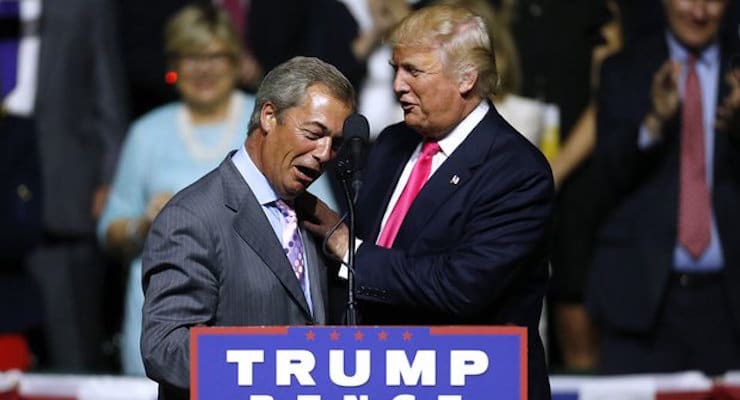
Donald Trump gives the stage over to former UKIP and Brexit leader Nigel Farage during a campaign rally in Mississippi. (Photo: Getty)

Donald Trump gives the stage over to former UKIP and Brexit leader Nigel Farage during a campaign rally in Mississippi. (Photo: Getty)

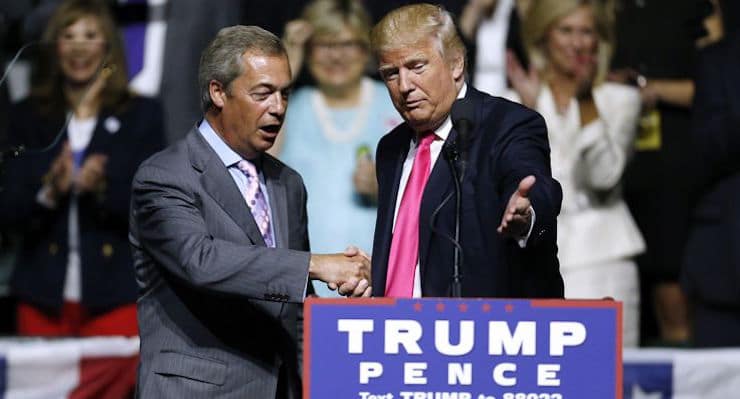
Donald Trump was joined by the former leader of the UK Independent Party Nigel Farage, “the man behind Brexit,” at a rally in Jackson, Mississippi on Wednesday night.

Mr. Farage left the UKIP after the United Kingdom voted to “Leave” the European Union despite proponents of the “Remain” campaign smearing him and Brexit supporters as racists, bigots, Islamophobes and worse. The fear campaign, which included political class pundits and economic analysts, attempted to shame and/or scare Brits into voting against the movement Mr. Farage worked for over his political career.

“I come to you from the United Kingdom with a message of home, with a message of optimism,” Mr. Farage said addressing the 10,000-strong crowd. It’s the message that says if the little people, if the real people, if the ordinary decent people are prepared to stand up and fight for what we believe in we can overcome the big banks. We can overcome the multinationals. And we did it.”

As People’s Pundit Daily reported, the Brexit polls were not even close, with many proponents accusing Reuters and other pollsters of openly fudging the data. We also recently drew a comparison to the social desirability bias that existed in the disparity between polling and voting results.

Saying “the parallels are there” between what was happening in the U.S. and what happened in Great Britain, Mr. Farage told the crowd voters habe a “fantastic opportunity” to “beat the pollsters … the commentators … Washington”.

Donald Trump greets Nigel Farage during a campaign rally in Mississippi. (Photo: Getty)

Donald Trump greets Nigel Farage during a campaign rally in Mississippi. (Photo: Getty)

“You can beat the pollsters, you can beat the commentators, you can beat Washington,” Mr. Farage said to a cheering crowd. “If you want change, you better get your walking boots on. Anything is possible if enough decent people want to fight the establishment.”

The comment was a clear suggestion to the U.S. presidential race, which Democratic pollster Pat Caddell has openly said was being unethically influenced by firms like Reuters. After a two-week period that saw Mr. Trump erase Hillary Clinton’s lead in their daily tracking poll and hold it for five more days, Reuters/Ipsos decided to change their methodology and back-date the results to scrub the horse race data for the period.

Mr. Farage also slammed President Barack Obama for campaigning against Brexit and having the audacity to tell voters in one of the “oldest functioning democracies in the world” how to vote.

“The big card the prime minister (David Cameron) decided to play in the referendum is he got a foreign visitor to come to London to talk to us. Yes, we were visited by one Barack Obama. And he talked down to us. He treated us as if we were nothing,” Mr. Farage said.

While he wouldn’t openly endorse Mr. Trump, as not to make the same condescending gesture as Mr. Obama, the Brexit leader jokingly told the crowd who he wouldn’t vote for if he was an American voter.

“I could not possibly tell you how to vote in this election,” he told the crowd. “But, you know, I get it. If I was an American citizen, I wouldn’t vote for Hillary Clinton if you paid me. In fact, I wouldn’t vote for Hillary Clinton if she paid me.”

[brid video=”60417″ player=”2077″ title=”Nigel Farage UKIP and Brexit leader Speaks at Trump Rally in Mississippi”]

The former leader of the UK Independence

jobs-search-station-reuters

Job Search Station (Photo: Reuters)

The Labor Department reported Thursday weekly jobless claims fell by 1,000 to 261,000 for the week ending August 20, lower than the estimate for 265,000. The prior week was unchanged at 262,000.

No state was triggered “on” the Extended Benefits program during the week ending August 6 and a Labor Department analyst said there were no special factors impacting this week’s initial claims. While the report marks 77 consecutive weeks of initial claims below 300,000, the longest streak since 1970, the eligible pool of applicants due to long-term unemployment is disproportionately low by comparison over the period.

The four-week moving average was 264,000, a decrease of 1,250 from the previous week’s unrevised average of 265,250.

The highest insured unemployment rates in the week ending August 6 were in Puerto Rico (3.3), Connecticut (2.7), New Jersey (2.7), Alaska (2.6), Pennsylvania (2.4), California (2.2), West Virginia (2.2), Rhode Island (2.1), Massachusetts (2.0), and Wyoming (2.0).

The largest increases in initial claims for the week ending August 13 were in Oregon (+1,321), Kentucky (+521), Virginia (+490), Oklahoma (+367), and Idaho (+104), while the largest decreases were in California (-1,677), Pennsylvania (-1,472), Ohio (-1,285), Puerto Rico (-800), and Wisconsin (-728).

The Labor Department reported Thursday weekly jobless

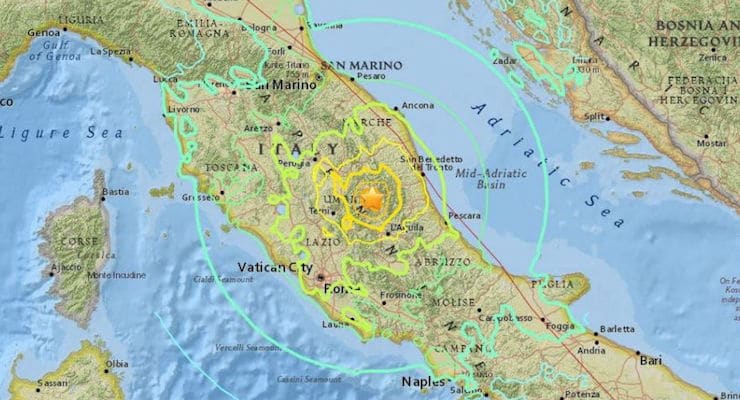
The U.S. Geological Survey measured the magnitude 6.2 earthquake in Italy and pegged the epicenter at Norcia, located roughly 105 miles northeast of Rome. The earthquake in Italy had a depth of about 6 miles.

The U.S. Geological Survey measured the magnitude 6.2 earthquake in Italy and pegged the epicenter at Norcia, located roughly 105 miles northeast of Rome. The earthquake in Italy had a depth of about 6 miles.

The death toll from the 6.2-magnitude earthquake in central Italy early Wednesday has risen to 247 people, the Italian Civil Protection Agency said on Thursday. The quake hit at 3:36 a.m. local time and was felt across most of central Italy, including in Rome and Florence, sending people running into the streets and cutting power.

The U.S. Geological Survey said the epicenter was located at Norcia, which is roughly 105 miles northeast of Rome, and it had a depth of about 6 miles.

Rescue workers, a group including Italian soldiers, police and other emergency crews continue to aid the injured and search for survivors in the hardest-hit towns of Amatrice, Pescara del Tronto and Accumoli, located close to the epicenter.

The number of victims had been rising steadily throughout the day on Wednesday as rescue crews searched the rubble for dozens of missing people.

“There’s nothing left, it’s unbelievable,” said Luisella Cruciani, 69 years old, who escaped her home in Amatrice by climbing out of her window.

Aerial photographs of the town showed it was almost completely leveled.

Meanwhile, Prime Minister Matteo Renzi is attempting to to respond more efficiently than Rome has in the past to natural disasters. In leftist Italy, rebuilding and providing for the victims at the same time has alluded the government, with efforts being overshadowed by corruption and scandal.

“Italy weeps for its fellow countrymen,” Prime Minister Renzi said in Amatrice Wednesday afternoon, vowing his government wouldn’t “leave anyone alone, no family, no town, no community.”

The death toll in the 6.2-magnitude earthquake

Republican presidential candidate Donald Trump speaks to supporters during a campaign rally in Fort Lauderdale, Florida, on August 10.

Republican presidential candidate Donald Trump speaks to supporters during a campaign rally in Fort Lauderdale, Florida, on August 10. (Photo: AP)

“You know, it really doesn’t matter what (the media) write as long as you’ve got a young and beautiful piece of ass,” Donald Trump philosophized during an interview with Esquire magazine.
The Republican presidential nominee has made many far less gentlemanly references to women’s anatomy, all easily found online. This one ranks in the middle of the pack as measured by the vulgarity meter — and quite low on the maturity scale.

Guess what. Women don’t appreciate that sort of commentary. That would include many white Republican women who, in presidential elections past, could be counted on to vote for the Republican.

The Democrat usually wins the female vote as a whole, but Republican women have prevented such deficits from turning into a rout. That is not a given this time. One more consideration: In the 2012 presidential election, some 10 million more women voted than men. That’s all women put together.

Trump’s recent “charm” offensive — which in his terms means talking about Latinos and blacks without racist smears attached — will not make many educated women think, “Well, maybe he’s not so appalling.” That’s in part because this group has been following the Trump trajectory and in part because the Clinton campaign will replay the tapes again and again.

More to the point, women will rehear the lava flow of Trump’s narration on women’s appearance and on genitals — his own and others’. They will hear over and over about his “adult” lifetime of salivating over models and beauty queens and, on at least one unpleasant occasion, his daughter. This memory lane is longer than the Pacific Crest Trail.

Here’s another sampling, provided by Tucker Carlson: After Carlson made fun of Trump’s hair on CNN, Trump left him a message. “But I get more pussy than you do.”

Trump’s problem with many Republican women is not political incorrectness. It’s not some largely harmless bit of ribaldry. It’s that any woman who’s been around the block once or twice can see the guy’s got a screw loose.

Note that in Trump world, women are not necessarily bad. They’re just not players. The women are there to be seduced and discarded as a way to score points against other wannabe alpha males.

As for the so-called security moms, one can’t see those women wanting Big Hands anywhere near the nuclear button. That’s in addition to his obvious ignorance of foreign and domestic issues, something that would disqualify even a totally nice fellow from the presidency.

Trumpsters, please spare us the comparisons to Bill Clinton. Clinton strayed from his marital vows in conventional ways. No one is pinning a medal on his chest for these liaisons, but they were intended to be private matters. Clinton did not publicly brag about his escapades.

Back to Trump’s demographic problem: Mitt Romney won 93 percent of Republican women’s votes four years ago — and lost. After the recent Republican convention, only 72 percent of Republican women polled said they’d vote for Trump. And since then, Trump’s lead over Hillary Clinton among Republican women has actually shrunk by 13 percentage points.

This is understandably of great concern to Trump’s new campaign manager. The new toxic-lite Trump is intended to settle the stomachs of more Republican and independent women, especially in places like the Philadelphia suburbs in the swing state of Pennsylvania.

Thing is, Clinton is all over places like Philadelphia ready to refresh women’s memories of the pre-charm-offensive Trump — assuming the erratic Trump does not do it for her.
In any case, Trump never did charm very well. The offense part is down pat. And as they say, the bell cannot be unrung.

Trump's "charm" offensive--which in his terms means

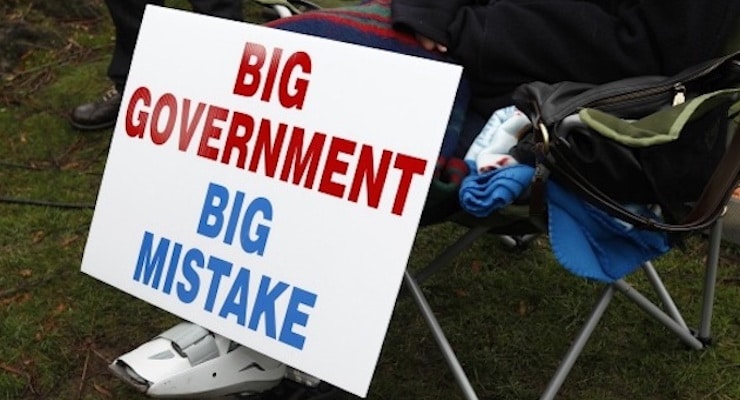
A protestor rests next to their big government big mistake sign. (Photo: Reuters)

A protestor rests next to their big government big mistake sign. (Photo: Reuters)

Which states in our union are the most tolerant of marijuana and guns? Which interfere the least with your life? Which are likelier to hand out special goodies to politically connected companies? Those are some of the questions answered by economists Will Ruger and Jason Sorens in the 2016 edition of their study “Freedom in the 50 States.”

Their ranking of the states in the U.S. in terms of freedom is based on three public policy dimensions affecting economic, social and personal freedoms. Sorens, a lecturer in the government department at Dartmouth College, and Ruger, vice president of research and policy at the Charles Koch Institute, scored more than 200 policies, including things such as gambling restriction, trans fat bans, the audio recording of police, occupational licensing restrictions, mandated family leave and the ability of couples to enter into private contracts.

According to their open-source methodology, in 2014 the freest states were New Hampshire, Alaska and Oklahoma, while New York, California and Hawaii ranked the least free. In terms of just one indicator, South Dakota, Idaho and Tennessee are the freest economically and New York, California and Hawaii the least. And personal freedoms are best served in New Mexico, Colorado and Nevada, with Kentucky, Texas and Alabama ranking the least free.

It’s valuable to know how free your state is. I, for instance, value freedom for its own sake, so I’m interested in knowing that Virginia, where I live with my two school-age daughters, ranks 21st in the overall index. I also enjoy knowing that the state isn’t too bad on fiscal issues, that its land use freedom is decent, that it has no minimum wage, that it’s one of the best states for gun laws, that it has too many government employees and that it’s in serious need of criminal justice reform because it has one of the highest incarceration rates in the country, even controlling for crime rates.

The rankings also deliver important lessons for lawmakers. In Virginia, Sorens and Ruger write, “victimless crime arrest rates are about average. Asset forfeiture is virtually unreformed, and local police frequently circumvent it anyway with equitable sharing. The state’s approach to cannabis producers and consumers is draconian.” They suggest that the state reform “sentencing for nonviolent offenses with an eye to reducing the incarceration rate to the national average in the long term.”

The report shows that when controlling for climate and other variables, all three dimensions of freedom are positively correlated to migration, but the results are exceptionally strong for economic (fiscal and regulatory) freedom. Edition after edition of the “Freedom in the 50 States” index confirms that people tend to move to economically freer states because economic freedom tends to be a fairly good indicator of prosperity. More economic growth usually means more jobs, and that attracts people.

The lesson for lawmakers is that if you want to attract productive people to your state or if you want to lose fewer productive taxpayers, you’d better implement policies that trigger economic growth and create jobs. In 2014, New York’s net migration was negative 11.2 percent. California was negative 4.9 percent, and Hawaii was negative 3.3 percent.

That raises the question of why so many people still live in the least free states. The fact is that when it comes to where people choose to live, intrinsic characteristics of a state weigh heavily in the decision. Among the factors that keep people in less-than-free places are jobs, family, friends and city amenities. There’s a certain stickiness to states that has nothing to do with how free these places are.

The federal tax and regulatory systems are incredibly burdensome and can weigh on us all more than most state policies, which can hinder interstate mobility. However, there are times when that stickiness isn’t so important — for example, when you are younger, are looking for a job and haven’t settled anywhere yet or when you’re about to retire. (Net migration in Florida was 10 percent in 2014.)

The bottom line is — whether you value freedom intrinsically or you’re a lawmaker who wants to improve your state’s economic outlook or slow down out-migration — you’re better off knowing where your state stands so you know what to do. “Freedom in the 50 States” will help you achieve this goal.

[caption id="attachment_41731" align="aligncenter" width="740"] A protestor rests

Donald-Trump-Marco-Rubio-Getty

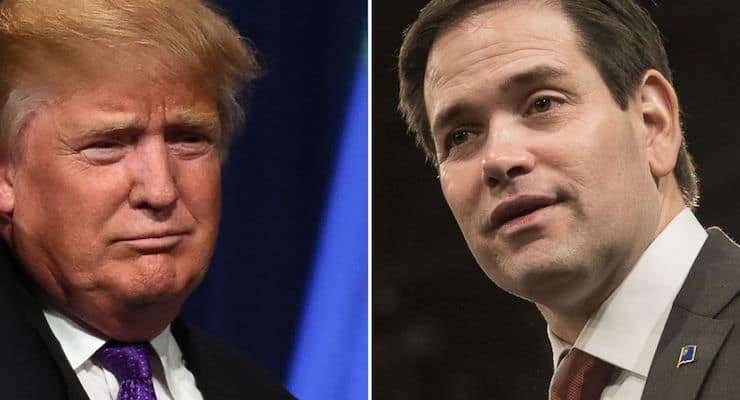
Donald J. Trump, left, waves to supporters on caucus night in Las Vegas, Nev., on Feb. 24, 2016, while Florida Sen. Marco Rubio speaks to supporters at a S.C. rally. (Photos: Getty Images)

Republicans Donald Trump and Sen. Marco Rubio lead their respective Democratic challengers in the key battleground state of Florida, a new Florida Atlantic University Poll finds. Mr. Trump leads Hillary Clinton 43% to 41%, with Libertarian Party candidate Gary Johnson taking 8% and 5% undecided. In the race for U.S. Senate, the incumbent Republican leads Democratic Rep. Patrick Murphy 44% to 39%, with both men overwhelmingly the favorites in their respective party primaries on Tuesday.

Over the last two weeks, specifically, the New York businessman has sought to soften his stance on immigration and reach out to African American voters, a strategy most mediates ridiculed and mocked. However, according to FAU and our own daily presidential tracking survey, those who laugh do so at their own peril.

“The race between Clinton and Trump among Hispanics in Florida is closer than it is nationally,” said Monica Escaleras, Ph.D., director of the BEPI. “Some of that is probably the Cuban vote. Trump’s support among Latinos in Florida is helping him stay competitive.”

Mr. Trump leads among white voters 49% to 33%, but trails among minorities by a smaller margin than his Republican predecessors. Among African Americans, Mrs. Clinton is only enjoying a 68% to 20% advantage, while she’s leading with Hispanics 50% to 40%.

Regionally, Mr. Trump is carrying every part of the state except for the South, with his strongest regional support coming from the western Panhandle where he leads 52% to 34%. In the North, the Republican tops the Democrat 47% to 32%. The central region of the state, which is home to the swing-vote I-4 corridor, he leads Mrs. Clinton 44% to 36%. Mrs. Clinton’s support is unsurprisingly the highest in South Florida, where she leads 57% to 30%.

The top issue for voters was dissatisfaction with government at 29%, which bodes well for the Republican nominee who is attempting to frame the election as a choice between outsider change and the corrupt status quo. The second most important issue to Floridians was jobs at 18%, followed by immigration (13%) and ISIS (12%). A better piece of news for Mrs. Clinton was the top quality for voters being experience (27%), followed by Commander-in-Chief (16%). However, they were followed closely by trustworthiness at 15%–a measure the Republican holds an advantage in–as well as focus on the economy (14%).

Wanting an outsider was the choice for 12% of respondents.

The survey no doubt will be welcome news to the Trump campaign after weeks of lagging behind Mrs. Clinton in the Sunshine State and other battlegrounds. After trailing in the People’s Pundit Daily U.S. Presidential Election Daily Tracking Poll for weeks, Mr. Trump has retaken a small statistically insignificant 1-point lead nationwide. The race in the battleground states as well as nationally remains volatile, in part because of both candidates’ favorability ratings.

Still, most other public polls do not show a race as close as the PPD tracking poll, with only Election Day left to be the decider on who is right or wrong. Kevin Wagner, Ph.D., associate professor of political science at FAU and a research fellow of the Initiative, said that despite the national numbers either way, the presidential race in Florida remains close and is within the survey’s margin of error.

“The fact that both Mr. Trump and Secretary Clinton are significantly upside down in their favorability ratings could make it difficult for either to move substantially ahead,” he said. “Clinton likely got a boost from the fact that Floridians chose experience as the top quality they are looking for in their presidential candidate. But, Floridians also chose dissatisfaction with government as their top issue, which likely favors Mr. Trump.”

While both candidates are underwater, as they’ve been throughout the election cycle, Mr. Trump had a 41%/56% favorable/unfavorable rating, while Mrs. Clinton has 40%/58% favorable/unfavorable rating.

Also inline with the PPD tracking poll, Trump voters (94%) are more loyal in Florida than Clinton voters (90%), and independents are breaking for the Republican big. Mrs. Clinton trails Mr. Trump among this key bloc by a wide margin, 47% to 26%. The gender gap is also present, but not aiding Mrs. Clinton as much as previous weekly surveys have shown. Mr. Trump leads among men 46% to 36%, but trails among women by a smaller 45% to 41% margin.

The Florida poll was conducted Aug. 19-22. The polling sample was a random selection of registered voters. The Democratic primary consisted of 364 registered Democrat likely primary voters with a margin of error of +/-5.1 percent at a 95 percent confidence level. The Republican primary consisted of 327 registered Republican likely primary voters with a margin of error of +/-5.4 percent at a 95 percent confidence level. The General election poll consisted of 1,200 registered likely voters with a margin of error of +/-2.7 percent at a 95 percent confidence level.

Republicans Donald Trump and Marco Rubio lead

pending-home-sales-reuters

Existing and pending home sales reported by the National Association of Realtors. Photo: Reuters)

The National Association of Realtors reported on Wednesday total existing home sales fell 3.2% in July to an annualized rate of 5.39 million units. That’s down from 5.57 million in June and lower than the median forecast calling for 5.51 million units. For only the second time in the last 21 months, sales are now below (1.6%) what they were a year ago (5.48 million).

“Severely restrained inventory and the tightening grip it’s putting on affordability is the primary culprit for the considerable sales slump throughout much of the country last month,” Lawrence Yun, NAR chief economist said. “Realtors are reporting diminished buyer traffic because of the scarce number of affordable homes on the market, and the lack of supply is stifling the efforts of many prospective buyers attempting to purchase while mortgage rates hover at historical lows.”

The median existing-home price 3 for all housing types and all regions in July was $244,100, a 5.3% gain from the $231,800 in July 2015. July’s price increase marks the 53rd consecutive month of year-over-year gains.

Regionally, only the West saw a monthly increase in closings in July and existing homes sales decreased year-over-year for the first time since November 2015. Existing-home sales in the West increased 2.5% to an annual rate of 1.23 million in July, but are still 0.8% below where they were a year ago. The median price in the West was $346,100, marking a 6.4% gain from July 2015.

“Furthermore, with new condo construction barely budging and currently making up only a small sliver of multi-family construction, sales suffered last month as condo buyers faced even stiffer supply constraints than those looking to purchase a single-family home,” Mr. Yun added.

Existing-home sales in the South fell 1.8% to an annual rate of 2.22 million and are 1.8% below July 2015. The median price in the South was $214,500, up 6.6% from a year ago. In the Midwest, existing-home sales declined 5.2% to an annual rate of 1.28 million in July, representing little to no changed from a year ago, with a median price of $194,000, up 5.0% on a year-over-year basis. The Northeast tanked 13.2% to an annual rate of 660,000 and are 5.7% below on the year (basis) with a median price iof $284,000. That’s 3.3% above July 2015.

Expect the housing lobby to hit K Street and Capitol Hill hard to influence lending standards and ease practices. Realtors® seems to indicate that appraisal complications are appearing more frequently as the reason why a contract signing experienced a delayed settlement, while NAR President Tom Salomone said in addition to affordability, another issue may be reemerging.

“Appraisal-related contract issues have notably risen over the past year and were the root cause of over a quarter of contract delays in the past three months 5,” Mr. Salomone, a broker-owner of Real Estate II Inc. in Coral Springs, Florida, said. “This is likely a combination of sharply growing home prices in some areas, the uptick in home sales this year and the strong refinance market overworking the already reduced number of practicing appraisers. Realtors® are carefully monitoring this trend, and some have already indicated they’re extending closing dates on contracts to allow extra time to accommodate the possibility of appraisal-related delays.”

Distressed sales, or foreclosures and short sales, at 5% of sales in July came in at the lowest since NAR began tracking in October 2008. That’s down from 6% in June and 7% on the yearly basis. Four percent (4%) of existing home sales in July were foreclosures and 1% were short sales, the former selling for an average discount of 18% below market value, up from the 11% in discounted rate the month prior. Short sales sold at a discounted 16%, down from the 18% in June.

Single-family and Condo/Co-op Sales

Single-family home sales alone fell 2.0% to a seasonally adjusted annual rate of 4.82 million in July from 4.92 million the month prior and are now 0.8% under the 4.86 million pace a year ago. The median existing single-family home price was $246,000 in July, increasing 5.4% from July 2015.

Existing condominium and co-op sales declined sharply by 12.3% to a seasonally adjusted annual rate of 570,000 units in July, down from 650,000. They  are now 8.1% below what they were in July 2015 (620,000 units). The median existing condo price was $228,400 in July, or 4.1% above a year ago.


The National Association of Realtors reported on

north-korea-missile-test

A South Korean man watches a TV news program showing an image published in North Korea’s Rodong Sinmun newspaper of North Korea’s ballistic missile believed to have been launched from underwater, at Seoul Railway station on May 9, 2015. (Photo: AP Photo/Ahn Young-oon)

Pentagon officials confirmed a North Korea ballistic missile launch from a submarine, but determined it did not pose a threat to North America. The development confirms the initial claim from South Korea on Tuesday.

U.S. Strategic Command said it was “likely a KN-11 ballistic missile” that was launched off the coast of Sinpo, flying about 300 miles into the Sea of Japan.

An official from the North American Aerospace Defense Command (NORAD), who spoke on the condition of anonymity, said the North Korea ballistic missile launch was expected.

“The men and women of USSTRATCOM, NORAD and U.S. Northern Command, and U.S. Pacific Command remain vigilant in the face of North Korean provocations and are fully committed to working closely with our Republic of Korea and Japanese allies to maintain security,” U.S. Strategic Command said in a statement.

The missile launch comes two days after the U.S. and South Korea began the allies’ annual joint military exercises.

Pentagon officials confirmed a North Korea ballistic

People's Pundit Daily
You have %%pigeonMeterAvailable%% free %%pigeonCopyPage%% remaining this month. Get unlimited access and support reader-funded, independent data journalism.

Start a 14-day free trial now. Pay later!

Start Trial